REAL TIME CRYING SIMULATION USING FLUID PARTICLES INTERACTION TECHNIQUE
SAADI MOHAMMED SAADI
REAL TIME CRYING SIMULATION USING FLUID PARTICLES INTERACTION TECHNIQUE
SAADI MOHAMMED SAADI
A dissertation submitted in partial fulfillment of the requirements for the award of the degree of
Master of Science (Computer Science)
Faculty of Computing Universiti Teknologi Malaysia
iii
iv
ACKNOWLEDGEMENT
“In the Name of Allah, Most Gracious, Most Merciful”
First and foremost, Alhamdulillah, it is with the assistance and grace of Allah Almighty that I was able to finish this dissertation.
I would like to express my sincere appreciation to my supervisor Dr.Ahmad Hoirul Basori for his great advice and generous help during the period of my study and also, who had the patience and wisdom to guide me in order to overcome all the academic obstacles that I faced during my study. My overwhelming gratitude to my evaluators, I am also grateful for their helpful suggestions.
A special thanks to my parents and my siblings for their unlimited moral support, to everyone in my extended family, and for their lessons on how to be patient and strong. I thank them very much for always being there for me and I ask Allah the almighty to grant them Paradise.
Last but not least, I would like sincerely to thank all the lectures, staff, friends and my fellow postgraduate students for their emotional support and cognitive, thanks for all the care and concern. I wish you more and brighter success
v
ABSTRACT
The enhancement of emotional expression of virtual human in extreme situation such as, crying or sweating required physics effect that involved fluid behavior. The aim of this research is to utilize Facial Action Coding System (FACS) and Smooth Particle Hydrodynamic (SPH) methods to effectively provide an efficient display in computer facial animation. This research presents two techniques for generating extreme expression in 3D facial animation, the facial action coding system is employed to describe and create facial expressions. It breaks down facial actions into minor units known as Action Units (AU’s). Emotion facial expressions generated are based on independent action unit’s combination. The SPH method technique is used to generate crying teardrops according to rules of physics. Each particle in tears drop is simulated and controlled by SPH rule. The created expressions include sadness and happiness by FACS then add the tears that followed the SPH method rules to provide an avatar tears displaying affectively as an extreme expression. The enforcement of the proposed system is able to fuse both FACS & SPH used in facial animation and fluid simulation, to create a system able to express, and implement the extreme expressions in facial animation. The results obtained in this research, were generated tears consist of 100 particles and achieved an average
vi
ABSTRAK
Penyerlahan ekspresi emosi manusia maya didalam keadaan ekstrem seperti menangis dan berpeluh memerlukan kesan khas fizik yang turut melibatkan sifat
cecair. Tujuan kajian ini adalah bagi menggunakan Sistem Pengekodan Aksi Muka (FACS) dan kaedah Kelancaran Partikel Hidrodinamik (SPH) dalam menyediakan kesan yang efektif dan cekap terutama pada paparan animasi muka di computer. Kajian ini membentangkan dua teknik dalam menghasilkan ekspresi ekstrem dalam 3D animasi muka, sistem pengkodan aksi muka yang dilakukan untuk menerangkan dan menghasilkan ekspresi muka. Ini mengecilkan aksi mimic muka kepada unit kecil yang dikenali sebagai Unit Aksi (AU’s). Emosi pada mimik muka yang
dihasilkan adalah berdasarkan kepda kombinasi uni-unit aksi yang bebas. Teknik kaedah SPH digunakan untuk menghasilkan titisan air mata yag menangis berdasarkan hukum fizik. Setiap partikel di dalam titisan air mata ini disimulasikan dan dikawal oleh peraturan SPH. Mimik muka yang dihasilkan oleh FACS termasuklah dalam keadaan sedih atau gembira yang kemudiannya telah ditambah dengan titisan air mengikut peraturan kaedah SPH bagi memaparkan air mata pada avatar lebih efektif. Penguatkuasaan dalam sistem yang dicadangkan dapat menggabungkan kedua-dua FACS dan SPH dalam animasi muka dan simulasi bendalir untuk menghasilkan sistem yang dapat mengekspresi dan mengimplimentasikan mimik muka animasi yang ekstrem. Hasil daripada kajian ini ialah titisan air yang dihasilkan terdiri daripada 100 partikel dan mencapai purata 55.5 bingkai per saat (FPS) yan kemudiannya dianggap sebagai keputusan akhir. Nilai yang digunakan didalan kajian ini ialah 0.0108 N./m2 untuk tekanan, 1 kg/(m.s) untuk kelikatan, 1 m/s2 untuk graviti sebagai parameter fizik yang mempengaruhi
vii
TABLE OF CONTENT
CHAPTER TITLE PAGE
DECLARATION Ii
DEDICATION Iii
ACKNOWLEDGEMENT Iv
ABSTRACT v
ABSTRAK Vi
TABLE OF CONTENTS Vii
LIST OF TABLES x
LIST OF FIGURES Xi
1 INTRODUCTION
1.1 Introduction 1
1.2 Problem Background 4
1.3 Problem Statement 7
1.4 Aim of the Study 8
1.5 Objectives of the Study 8
1.6 Scope of the Study 9
1.7 Significance of the Study 9
1.8 Thesis Organization 9
2 LITERATURE REVIEW
2.1 Introduction 11
2.2 Facial Expressions 11
2.2.1 Theory of Emotion
Expression 17
2.2.2 Facial Animation as Media
for Emotion Expression 21 2.2.2.1 Facial Action
Coding
viii
3 RESEARCH METHODOLOGY
3.1 Research Methodology 45
3.2 Development of Facial Animation and
Expression Method 47
3.2.1 FACS and Action Units 51 3.2.2 Rendering Facial Expression 52 3.3 Development of Extreme Expression
Method 53
3.3.1 Particle Generator 54 3.3.2 SPH Interaction for Particle
System 55
3.3.2.1 Viscosity, Density and
Velocity 55
3.3.2.2 Particle Size, Rotation
and Pressure 55 3.3.2.3 Gravity 56 3.3.3 Applying The Physics Parameters 56 3.3.4 Tears Rendering 57 3.4 Development of Simulation Model 57 3.5 Evaluation and Testing 58
3.6 Summary 58
4 IMPLEMENTATION
4.1 Introduction 59
2.3.1 Key Framing 26 2.3.2 Blend Shape Interpolation 28 2.3.3 Parameterization 30 2.3.4 Muscle Based 31
2.4 Extreme Expressions 32
2.4.1 Fluid Interaction Techniques 32 2.4.2 SPH Method / Techniques
for Fluid 34
2.4.3 Tears in Fluid 38 2.4.3.1 Viscosity, Density
and Velocity 38 2.4.3.2 Particle Size,
Rotation and
Pressure 40
2.4.3.3 Gravity 41
ix 4.2 BlendShape, Facial Action Coding
System (FACS) and Action Units
Methods 60
4.3 Extreme Expression Method 63 4.3.1 Particle Generation 64
4.3.2 SPH Method 65
4.3.3 Gravity 66
4.4 Tears Rendering in Extreme Expression 66 4.4.1 Creating Tears Using SPH
Method and Gravity 67 4.4.2 Rendering Tears Effect 67
4.5 The Simulation Model 69
4.6 Results 70
4.6.1 Neutral Mode 71
4.6.2 Creating Tears with Changing
the Particles Number 72 4.6.3 Creating Tears with Active the
Viscosity, Density and Set the
Velocity 76
4.6.4 Creating Tears with Active the particles Random Size,
Rotation and Pressure 77 4.6.5 Creating Tears with Changing
the Gravity 79
4.6.6 Creating Tears with set and active all the Parameters as
Final Result 81
4.7 Summary 83
5 CONCLUSION AND FUTURE WORK
5.1 Introduction 84
5.2 Conclusion 84
5.3 Contribution 85
5.4 Future Work 87
x
LIST OF TABLES
TABLE NO. TITLE PAGE
1.1 The Vulnerabilities of Some Related Works 6 2.1 The Single Facial Action Units of The Facial Action
Coding System 23
2.2 The Different Phenomena of Crying, Along with Their Contributing Factors, Importance and
Difficulty to Implement 42
3.1 Sample Single Facial Action Unites 52 3.2 The Sample of The Combining AUs for The Two
Expressions. 53
4.1 The Sample of the Combining AUs for The Two
Expressions. 62
4.2 The Proposed Values for This Study Parameters That
xi
LIST OF FIGURES
FIGURE NO. TITLE PAGE
1.1 Tony DePeltrie Avatar 2
2.1 Several of The Earliest Three-Dimensional Face Models Developed by Parke at The University of
Utah in 1971 13
2.2 Surface Based Model of Gollum 27
2.3 Expressions Interpolation 29
3.1 The Methodology for This Research 46 3.2 The Polygon Topology Used for The Simple
Parameterized Face Model 48
3.3 Basic Emotions: Neutral, Sadness, Happiness, 49 3.4 Anger, Fear, Disgust, and Surprise (from left to right)
Blend Shape of Anger and Disgust (left),
Happiness and Surprise (right) 50 4.1 The Blend Shape Interpolation for Sad and
Happy with The Neutral 60
4.2 Neutral Human Face Represented by Some Action Units That Controls the Changing
Appearance for Some Facial Muscles 62
4.3 Facial Expressions Implementation Depending
on FACS (happiness, sadness) 63 4.4 Generating 500 Random Fluids Particles 64 4.5 Generating Tears After Giving The Alpha
Transparency, Random Size and Rotation for
Some Particles 65
4.6 Tears Rendering Model in Extreme Expression 67 4.7 Four Selected Frames of Real-Time Crying
xii
FIGURE NO. TITLE PAGE
4.8 Real-Time Synthesis for The Third Type Tears Generators (sadness) Based on SPH and The
Tears Source Positions 69
4.9 The System Simulation Model 70
4.10 Virtual Avatar Neutral Mode Based on Facial
Action Coding System 71
4.11 FPS for Virtual Avatar Neutral Mode Based
on FACS 72
4.12 FPS for Creating Tears with 50 Particles 73 4.13 FPS for Creating Tears with 50 Particles 73 4.14 FPS Creating Tears with 100 Particles 74 4.15 Creating Tears with 100 Particles 75 4.16 FPS Creating Tears with 150 Particles 75 4.17 Creating Tears with 150 Particles 76 4.18 FPS for Creating Tears with Active The
Viscosity and Set The Velocity 77 4.19 FPS for Creating Tears without Rotation,
Pressure and Fixed Particle Size 78 4.20 Creating Tears with Random Rotation,
Different Particle Size, Applying Pressure 78 4.21 Creating Tears with 100 Particles and Set
Gravity: A -50, B -200 79
4.22 FPS Creating Tears with 100 Particles and
Set Gravity-50 80
4.23 FPS Creating Tears with 100 Particles and Set
Gravity-200 82
4.24 FPS for Creating Tears with Apply, Active and
Set All The Parameters as a Final Result 82 4.25 Creating Tears with Apply, Active and Set all
The Parameters as a final Result 85 5.1 The Sadness Expression Synthesis
(Khanam, 2008) 86
5.2 Expression of Sadness Using Tears
1
CHAPTER 1
INTRODUCTION
1.1 Introduction
In the recent years that has been observed evolution in the field of graphics computer, especially those relating to the drawing the computer characters model, including computer animation, such as, motion of objects, geometry, texture, lighting adjust, acceleration rendering, facial animation and so on, for example, how to move those characters (body , face or both) and the methods those used to express them and trying to reaching the graphics that more realistic which is similar to the human in terms of general appearance and facial expression (Wijnand and Egges, 2009). Facial expressions such as sadness, anger, joy, fear, disgust, and surprise, which are a basic human expressions, which is seeking researchers in computer graphics field to develop in order to be more realistic and more obvious to the user.
Facial animation now has more interest from the past 25 years. That can be defined as a one of the computer graphics fields to simulate the facial animation for human in computer graphically as realistic way in computer interactive games and applications.
K-2
dimensional data has been represented as a proposed by (Chernoff, 1971) to draw two-dimensional face in computer. In 1972 was establishment of the first
three-dimensional animated by Parke (Parke, 1972), one of the scientists his name Gillenson create an interactive system to assemble and edit line drawn facial images. Then, Parke developed in 1974 a parameterized three-dimensional facial model. The first physically based muscle-controlled face model developed by Platt in The early 1980.and techniques for facial caricatures was developed by Brennan.
Then a film ``Tony dePeltrie’’ in 1985 was a milestone in facial animation, Where it was the first animated short film of its kind in the world, so that the computer facial expression and speech animation was Intervention as essential elements of the tale of the events of the story.
Figure 1.1: Tony dePeltrie avatar
3
Throughout the last contracts, facial modeling and animation was achieved a measure of realistic asymptotic for photographs. Even though the sights instructors
will still be capable to discover minor defects in both animation and rendering of the modern feature films such as Final Fantasy the general quality and the particularly the modeling and the texturing are impressive extremely. However, several many-years gone to the modeling of every individual character from that film. Attempt to model a real person becomes more complicated than that: the replacement of artistic license to establishment of geometry and the textures to "look good" by the application to create models that "look real."
Emotions are close related to each other. Concern is the less severe form of fear, contempt is a lightweight version of disgust, and the rigor is a lightweight version of anger. Research in this area has shown that humans can identify the six emotions global (as maintained before). But there are more ambiguous expressions that human have. When any person combines more than one expression along, that will be the new work for research proposals. Further, physical states such as passion, sleepiness, pain, and physical exertion tend to be much more difficult to identify. So if any working to prove that the emotion that the people trying to describe is recognized, people must depend on the general position or animation of the character. Shyness, for example, is created with a slight smile and downcast eyes. But this could be misinterpreted as embarrassed or self-satisfied.
4
The extreme expression is the area that comes from combining to areas along like combining the facial animation methods with fluid method to generate the fluid
simulation like sweating or tears and so on. Some of the prevue works focusing on the facial expression to make it more realistic like using MPEG-4 for move the lips smoothly for speech. Another researchers focusing on the fluid simulation by applying the physics parameters like use the SPH to simulate the water running in real behavior. This research is use both of the facial animation method and fluid simulation method to creating the facial animation and expression extremely.
1.2 Problem Background
A significant issue that has remained unsolved in computer graphics is the construction and animation of realistic human facial models (Lee, Terzopoulos, and Waters, 1995). Facial animation is a research subject for nearly 4 decades. The pioneer work of different approaches happen to be suggested to enhance the different aspects involved with facial animation (Parke, 1972). Due to the complexness of human facial anatomy, and our natural sensitivity to countenance, this can be a tightly defined problem, but fixing it is not easy (Deng and Neumann, 2007).
Computer animation has lately acquired recognition in lots of programs, including web pages, video games, movies, as well as other human computer
interface designs. To be able to make these animated Figures lively and convincing, they might require sophisticated facial expressions and motions. Typically, these
5
One trouble with this method would be that the taken motion data cannot be edited easily. Recently, record techniques happen to be accustomed to address this
issue by understanding the mapping between audio speech and facial motion. New facial motion could be synthesized for novel audio data by re-using the motion capture data. However, since facial expressions are not patterned during these approaches, the resulting facial animation is realistic, yet expressionless.
A significant unsolved condition in computer graphics may be the construction and animation of realistic human facial models. Typically, facial designs include been built meticulously by manual digitization and animated by random parametrically controlled facial mesh deformations or kinematic approximation of muscle actions. Fortunately, artists can now digitize facial geometries by using checking range sensors and animate them with the dynamic simulation of facial tissue and muscles. However, they require considerable user input to create facial types of people appropriate for animation (Williams (1990), Hill et al. (1988), Pieper (1991), Weil (1982), Yuille et al. (1989)).
Exhibiting facial motions for example crying or laughing is tough to attain in simulations and games. Not just due to the complicated simulation from the physical qualities for example muscle motions or fluid simulations, but additionally because one should understand how to control these motions on the greater level (Wijnand and Egges, 2009).
One of the most challenging tasks is the achievement display facial motions with high accuracy and close to reality, such as laughing or crying in the simulations and games. The movement of the muscles and simulation of the fluid are not only the problem caused by complexity of simulation, but also there is knowing how to manage these motion in high levels (Wijnand and Egges, 2009).
6
preprogrammed, to increase immersion. Therefore, using a texture will not be sufficient to generate tears in an interactive environment. To simulate tears, this
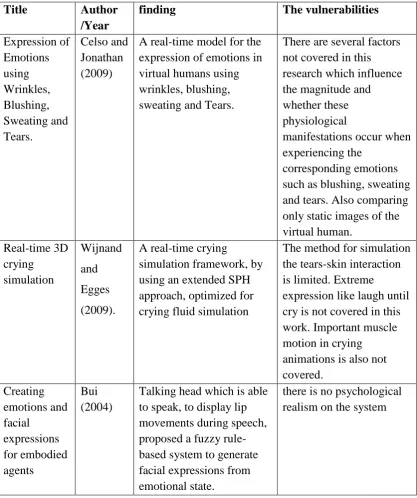
research needs to simulate fluids in a realistic way. One of the best ways to simulate the fluid particles is using the Smoothed Particle Hydrodynamics (SPH) method that will be talking about it and explain it in Chapter 2. Table 1.1 concludes the weakness of some related works with the tittles of the references.
Table 1.1: The vulnerabilities of some related works.
Title Author
/Year
finding The vulnerabilities
Expression of Emotions using Wrinkles, Blushing, Sweating and Tears. Celso and Jonathan (2009)
A real-time model for the expression of emotions in virtual humans using wrinkles, blushing, sweating and Tears.
There are several factors not covered in this research which influence the magnitude and whether these physiological
manifestations occur when experiencing the
corresponding emotions such as blushing, sweating and tears. Also comparing only static images of the virtual human. Real-time 3D crying simulation Wijnand and Egges (2009).
A real-time crying
simulation framework, by using an extended SPH approach, optimized for crying fluid simulation
The method for simulation the tears-skin interaction is limited. Extreme
expression like laugh until cry is not covered in this work. Important muscle motion in crying
animations is also not covered. Creating emotions and facial expressions for embodied agents Bui (2004)
Talking head which is able to speak, to display lip movements during speech, proposed a fuzzy rule-based system to generate facial expressions from emotional state.
7
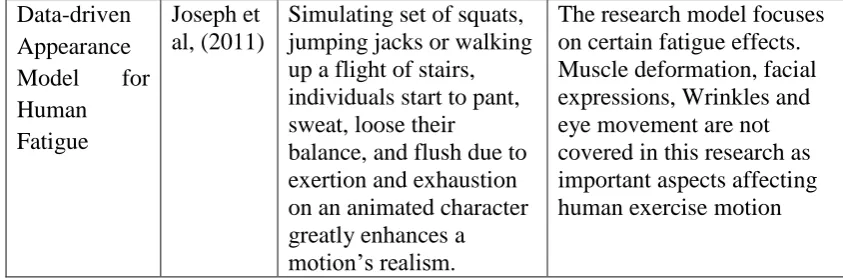
Table 1.1: Cont.
Data-driven Appearance Model for Human Fatigue
Joseph et al, (2011)
Simulating set of squats, jumping jacks or walking up a flight of stairs, individuals start to pant, sweat, loose their
balance, and flush due to exertion and exhaustion on an animated character greatly enhances a motion’s realism.
The research model focuses on certain fatigue effects. Muscle deformation, facial expressions, Wrinkles and eye movement are not covered in this research as important aspects affecting human exercise motion
1.3 Problem Statement
There are many extreme expressions that should be considered in facial animation such as, scared until sweating, sadness with cry, anger, shame, and pride in addition to combinations between some of expressions which happen together in some situations. According to previous studies that have been presented and through intensive observation this research reveals that the extreme expression is not researched well. Therefore it is required to generate some extreme expression to enhance the realism of virtual human.
The premise in this study can be considered as following:
How we can use the FACS and SPH method to provide an efficient display in computer facial animation effectively?
These are some research questions that can be derived from main research question:
Why the existing facial expression in virtual avatar still need for some
8
How to simulation tears during the extreme expression?
How to explain the tears properties?
What are the tears physics parameters?
What are the requirements to build this system?
1.4 Research Aim
The main aim for this study is how to emulate the human tears that is close to the reality by designed a proposed system to simulate the sadness until crying or laughing until crying which generate tears.
1.5 Research Objective
i. To study and analyze different models of computer facial animation techniques with its expressions and fluid simulation technique.
ii. To design and enforce proposed system that able to fuse the both Facial Action Coding System (FACS) and Smooth Particle Hydrodynamic (SPH) that used in facial animation and fluid simulation.
iii. To develop a simulation model of the FACS and SPH.
1.6 Scope
This study scopes are elucidate below:
i. Express the emotions in facial animation by used the FACS proposed
method.
9
iii. Five inputs (physics parameters) and one output (Frame per Second) Measure in real time performance.
iv. The FACS and SPH will be designed and applied using Microsoft visual C#
2008 as a programming language and the XNA library.
1.7 Research Significance
The significance of this study to propose system that closed to the reality. Because of the current avatar (current researches) focus on the facial animation only. The goal of this study is to add some of fluid to the facial animation to simulate the facial expression that closed to the reality.
1.8 Thesis Organization
Five Chapters are formation this dissertation. Which are, Chapter 1 includes introduction, problem background, problem statement, aim of this study, objectives, scope and significant of this research. Chapter 2 includes introduction, facial expression, theory of emotion expression, facial animation as media for emotion expression, facial animation techniques, extreme expression, fluid interaction techniques, tears in fluid .then followed by Chapter 3 which contained facial expression, emotion expression theory, facial action coding system and action unit, rendering facial expression, extreme expression, fluid generation, SPH interaction,
tears rendering and evaluation and testing. The end of this Chapter will be the thesis writing. Then the Chapter 4 shows the implementation and discuses the results and
84
REFERENCES
Arapakis, I., Konstas, I. and Jose, J. M, (2009). Using facial expressions and peripheral physiological signals as implicit indicators of topical relevance. In Proceedings of the seventeen ACM international conference on multimedia (pp. 461–470). USA: Springer.
Arapakis, I., Moshfeghi, Y., Joho, H., Ren, R., Hannah, D. and Jose, J. M., (2009). Enriching user profiling with affective features for the improvement of a multimodal recommender system.” In Proceeding of the ACM International
Conference on Image and Video Retrieval (pp. 1–8). New York, NY, USA: ACM.
Ax, A. F., (1952). The physiological differentiation between fear and anger in humans. Psychosomatic Medicine, 15(5), 433-442.
Bando, T. K., and Nishita, (2002). A simple method for modeling wrinkles on human skin. In Computer Graphics and Applications, 2002. Proceedings. 10th Pacific Conference on (pp. 166-175). IEEE.
Barr, R. G. (2006)., Crying behavior and its importance for psychosocial development in children. Encyclopedia on early childhood development. Montreal (QC): Centre of Excellence for Early Childhood Development, 1-10.
Barrett, L. F. and Russell, J. A., (1999). The Structure of Current Affect
Controversies and Emerging Consensus. Current Directions in Psychological Science, 8(1), 10-14.
Bergeron, P. and Lachapelle, P., (1985). Controlling Facial Expressions and Body Movements. In Advanced Computer Animation, SIGGRAPH ‘85 Tutorials,
pp. 61–79. New York: ACM.
85
experience. Information Processing and Management. An International
Journal, 43(1), 65–80.
Black, M. J. and Yacoob, Y., (1995). Tracking and Recognizing Rigid and Non-Rigid Facial Motions using Local Parametric Models of Image Motion.
In IEEE International Conference on Computer Vision, pp. 374– 381. Los Alamitos, CA: IEEE Computer.
Blake, A. and Isard, M., (1994). 3D Position, Attitude and Shape Input using Video Tracking of Hands and Lips. In Proceedings of SIGGRAPH 94, Computer Graphics Proceedings, Annual Conference Series, edited by Andrew Glassner, pp. 185–192, New York: ACM Press.
Blanz, V. and Vetter, T., (1999). A Morphable Model for the Synthesis of 3D Faces. In Proceedings of SIGGRAPH 99, Computer Graphics Proceedings, Annual Conference Series, edited by Alyn Rockwood, pp. 187– 194, Reading, MA: Addison Wesley Longman.
Blinn, J. F., (1978). Simulation of wrinkled surfaces. In ACM SIGGRAPH Computer Graphics (Vol. 12, No. 3, pp. 286-292). ACM.
Boissieux, G. K., Magnenat-Thalmann, and P. Kalra, (2000). Simulation of skin aging and wrinkles with cosmetics insight Proceedings Eurographics Workshop on Computer Animation and Simulation (pp. 15-27).
Bower, G. H., (1992). How might emotions affect learning ? The handbook of
cognition and emotion. Hillsdale, New Jersey: Lawrence Erlbaum Associates (pp. 3–31).
Brennan, S. E., (1982). Caricature Generator. Master’s thesis, Massachusetts Institute of Technology, Cambridge, MA.
Bui, T. D., (2004). Creating emotions and facial expressions for embodied agents. Celso M. de Melo and Jonathan Gratch, (2009). Expression of emotions using
wrinkles, blushing, sweating and tears. In Intelligent Virtual Agents (pp. 188-200). Springer Berlin Heidelberg.
Chernoff, H., (1971). The Use of Faces to Represent Points in NDimensional Space Graphically. Technical Report Project NR-042-993, Office of Naval Research.
86
Degraf, B., (1989). Notes on Facial Animation. In State of the Art in Facial Animation, SIGGRAPH ‘89 Tutorials, pp. 10–11. New York: ACM.
Deng, X. Q., (1988). A Finite Element Analysis of Surgery of the Human Facial Tissue. Ph.D. thesis, Columbia University, New York.
Deng, Z. and Noh, J., (2007). Computer facial animation: A survey. In Data-Driven 3D Facial Animation (pp. 1-28). Springer London.
Deng, Z., and Neumann, U., (2007). Data-driven 3D facial animation. Springer. Duy, B., Dirk, H., Mannes, P. and Anton N., (2001). Generation of facial expressions
from Emotion using a Fuzzy Rule Based System.
Ekman, P. and Friesen, W. V., (1975). Unmasking the face. A guide to recognizing emotions from facial clues. Englewood Cliffs, New Jersey: Prentice-Hall. Ekman, P., (1992). An argument for basic emotions. Cognition & Emotion, 6(3-4),
169-200.
Ekman, P., (1999). Basic emotions. The handbook of cognition and emotion. UK: John Wiley & Sons, Ltd. (pp. 45–60).
Ekmanand, P.W., Friesen, V. and released, (1978). Manual for the Facial Action Coding System. Consulting Psychologists Press, Inc.
Essa, I. and Pentland, A., (1994). A Vision System for Observing and Extracting Facial Action Parameters. Technical Report 247, Cambridge, MA: MIT Perceptual Computing Section.Expressions. SIGGRAPH ’87, Computer
Graphics 21:4, 17–24.
Folkman, S., Lazarus, R. S., Gruen, R. J. and DeLongis, A,, (1986). Appraisal,
coping, health status, and psychological symptoms. Journal of Personality and Social Psychology, 50(3), 571–579.
Frijda, N. H., (1986). The emotions. Paris, France, EU: Cambridge University Press. Gillenson, M. L., (1974) .The Interactive Generation of Facial Images on a CRT
Using a Heuristic Strategy. Ph.D. thesis, Ohio State University, Computer raphics Research Group, Columbus, Ohio.
Guente, B., (1992). A system for simulating human facial expression (pp. 191-202). Springer Japan.
87
Hill, D., Pearce, R. A. and Wyvill, B. (1988). Animating Speech: An Automated
Approach using Speech Synthesis by Rules. The Visual Computer 3 (277–289).
Irene, L. and Ioannis, A., (2010). Theories, methods and current research on
emotions in library and information science, information retrieval and human–computer interaction.
Izard, C.E., (1971). The face of emotion. New York: Appleton-Century-Crofts. Izard, C.E., (1997). Emotions and facial expressions. A perspective from Differential
Emotions” Theory, in J.A. Russell and J.M. Fernandez-Dols (Eds.), The Psychology of Facial Expression, Maison des Sciences de l’Homme and
Cambridge University Press.
Jian N. and Xifei W. (2011). Summary of Fluid Simulation Based on Physical Model. Advanced Materials Research, 268, 1326-1331.
Johnson, L. P. N.and Oatley, K. (1989). The language of emotions: An analysis of a semantic field. Cognition and Emotion. 3, 81–123.
Joseph T. Kider Jr., Kaitlin Pollock, and Alla Safonova, (2011). Data-driven Appearance Model for Human Fatigue.Eurographics/ ACM SIGGRAPH Symposium on Computer Animation.
Kleinginna, P., A, (2005). A categorized list of motivation definitions, with a suggestion for a consensual definition. Motivation and Emotion, 5(3),
263–291.
Kuhlthau, C. C., (1991). Inside the search process: Information seeking from the user’s perspective. Journal of the American Society for Information Science,
42(5), 361–371.
Lee, Y., Terzopoulos, D. and Waters, K., (1993). Constructing physics-based facial models of individuals. In Graphics Interface (pp. 1-1). Canadian Information Processing Society.
Lee,Y., Terzopoulos, D. and Waters, K. (1995). Realistic modeling for facial animation. Proc. ACM SIGGRAPH 95 Conf., pp. 55-62.
Lewis, J. P. and Parke, F. I. (1987). Automated lip-synch and speech synthesis for character animation. In ACM SIGCHI Bulletin (Vol. 17, No. SI, pp. 143-147). ACM.
88
computation on graphics hardware. The Visual Computer, 19(7-8), 444-456.
Lopatovska, I. and Mokros, H. B. (2008). Willingness to pay and experienced utility as measures of affective value of information objects: Users’
accounts.Information processing & management, 44(1), 92-104.
Magnenat-Thalmann, H. M., M. Angelis, and D. Thalmann. (1989). Design, transformation and animation of human faces. The Visual Computer,5(1-2), 32-39.
Magnenat-Thalmann, N., Primeau, N. E. and Thalmann, D. (1988). Abstract Muscle Actions Procedures for Human Face Animation. Visual Computer 3:5, 290–297.
Mooney, C., Scully, M., Jones, G. J. and Smeaton, A. F. (2006). Investigating biometric response for information retrieval applications. Lecture Notes in Computer Science, 570–574.
Nelson, J.K., (1998). The meaning of crying based on attachment theory.Clinical Social Work Journal, 26(1), 9-22.
Oat, C. (2007). Animated wrinkle maps. In ACM SIGGRAPH 2007 courses (pp. 33-37). ACM.
Ortony, A., Clore, G. L. and Collins, A., (1988). The cognitive structure of emotions. New York, NY, USA: Cambridge University Press (pp. 10011–4211).
Parke, F. I. (1972). Computer generated animation of faces. Paper presented at the Proc. ACM annual conf.
Parke, F. I. (1974). A Parametric Model for Human Faces. Ph.D. thesis, University of Utah, Salt Lake City, Utah,. UTEC-CSc-75-047.
Parke, F. I. (1989). Parameterized models for facial animation revisited ACM SIGGRAPH Facial Animation Tutorial Notes , 53-56.
Parke, F. I. (1991). Techniques for Facial Animation. In New Trends in Animation and Visualization, edited by N. Magnenat-Thalmann and D.” Thalmann, pp. 229–241. New York: John Wiley and Sons.
Parke, F. I., & Waters, K. (2008). Computer facial animation. AK Peters Ltd.
89
Parke, F.I. and Waters, K. (1996). ``Computer Facial Animation,’’ A K Peters.
Patel, V. (1993). Crying behavior and psychiatric disorder in adults. A review. Comprehensive Psychiatry, 34,(3):206{211, May/June.
Pieper, S. D. (1991). CAPS: Computer-Aided Plastic Surgery. Ph.D. thesis,
Massachusetts Institute of Technology, Media Arts and Sciences.
Platt, S. and Badler N.(1981). Animating facial expressions. InACM SIGGRAPH computer graphics (Vol. 15, No. 3, pp. 245-252). ACM.
Platt, S. M. (1980). A System for Computer Simulation of the Human Face. Master’s
thesis, The Moore School, University of Pennsylvania.
Platt, S. M. and Badler, N. I. (1981). Animating Facial Expressions. Proc. SIGGRAPH ’81, Computer Graphics 15:3, 245–252.
Plutchik, R. (1980). Emotions: A general psychoevolutionary theory.Approaches to emotion, 13, 38.
Prem Kalra, A. M., Nadia Magnenat Thalmann and Daniel Thalmann. (1992). Simulation of Facial Muscle Actions Based on Rational Free From Deformations Computer Graphics Forum (Vol. 11(3), pp. 59-69).
Ren, F. (2009). Affective information processing and recognizing human emotion. Electronic Notes in Theoretical Computer Science, 225, 39-50. Robert, B. and Matthias, M. (2007). Fluid simulation: SIGGRAPH 2007 course notes
Video files associated with this course are available from the citation
page (pp. 1-81). ACM.
Russell, J. A. (1994). Is there universal recognition of emotion from facial
expressions? A review of the cross-cultural studies. Psychological bulletin,115(1), 102.
Russell, J. A. and Mehrabian, A. (1977). Evidence for a three-factor theory of emotions. Journal of research in Personality, 11(3), 273-294.
Russell, J. A. and Steiger, J. H. (1982). The structure in persons' implicit taxonomy of emotions. Journal of Research in Personality, 16(4), 447-469.
Russell, J.A. and Fern´andez-Dols, J.M. (1997). The meaning of Faces, in J.A. Russell and J.M. Fernandez-Dols (Eds.), The Psychology of Facial Expression. Maison des Sciences de l’Homme and Cambridge University
Press.
90
R., (2005). Emotion and attention interactions in social cognition: Brain
regions involved in processing anger prosody. NeuroImage, 28 (4), 848–858 (special Section: Social Cognitive Neuroscience).
Schachter, S. and Singer, J, (1962). Cognitive, social and physiological determinants
of emotional state. Psychological Review, 69, 379–399.
Scherer, K. R. (2002). Emotion, the psychological structure of emotions. International encyclopedia of the social & behavioral sciences. Oxford: Harvard Libraries.
Sederberg, T. W. and Parry, S. R. (1986). Free-form deformation of solid geometric models. In ACM Siggraph Computer Graphics (Vol. 20, No. 4, pp. 151-160). ACM.
Serkis, A. (2003). The Lord of the Rings: Gollum, How We Made Movie Magic. Boston: Houghton Mifflin Company.
Sifakis, E., Neverov, I. and Fedkiw, R. (2005). Automatic determination of facial muscle activations from sparse motion capture marker data. In ACM Transactions on Graphics (TOG) (Vol. 24, No. 3, pp. 417-425). ACM. Smeaton, A. F. and Rothwell, S. (2009). Biometric responses to music-rich segments
in films. The cdvplex. In Seventh international workshop on content-based multimedia indexing (pp. 162–168).
Soleymani, M., Chanel, G., Kierkels, J. J. and Pun, T. (2008). Affective ranking of
movie scenes using physiological signals and content analysis. In Proceeding of the 2nd ACM workshop on multimedia semantics (pp. 32–39). New York,
NY, USA: ACM.
Vingerhoets, J. J. M. (2012). Adult crying: A biopsychosocial approach (Vol. 3). Routledge.
Waters K., (1987). A muscle model for animation three-dimensional facial expression. ACM SIGGRAPH Computer Graphics, 21(4), 17-24.
Weil, P. (1982). About Face. Master’s thesis, Massachusetts Institute of Technology,
Architecture Group.
Wijnand, V. T. and Egges, A. (2009). -time 3D crying simulation. Games and Virtual Worlds group Utrecht University, the Netherlands.
91
Williams, L., (1990). Performace Driven Facial Animation. SIGGRAPH ’90,
Computer Graphics 24:4, 235–242.
Yahi, M., (1992). Facial animation with wrinkles. EG Workshop on Animation and Simulation.
Yuencheng, L., Demetri, T. and Waters, K. (1995). Realistic modeling for facial animation. In Proceedings of the 22nd annual conference on Computer graphics and interactive techniques (pp. 55-62). ACM.
Yuille, A. L., Cohen, D. S. and Hallinan, P. W. (1989). Feature Extraction from Faces Using Deformable Templates. In IEEE Computer Society Conference on Computer Vision and Pattern Recognition (CVPR’89), pp. 104–109. San