Volume 2008, Article ID 765462,11pages doi:10.1155/2008/765462
Research Article
Blind Channel Equalization Using Constrained Generalized
Pattern Search Optimization and Reinitialization Strategy
Abdelouahib Zaouche,1Iyad Dayoub,2Jean Michel Rouvaen,2and Charles Tatkeu1
1INRETS LEOST, 20 rue Elisee Reclus, 59650 Villeneuve d’Ascq, France
2IEMN DOAE, University of Valenciennes and Hainaut-Cambresis, Le Mont Houy, 59313 Valenciennes, France
Correspondence should be addressed to Abdelouahib Zaouche,[email protected]
Received 5 November 2007; Revised 28 May 2008; Accepted 26 August 2008
Recommended by William Sandham
We propose a global convergence baud-spaced blind equalization method in this paper. This method is based on the application of both generalized pattern optimization and channel surfing reinitialization. The potentially used unimodal cost function relies on higher- order statistics, and its optimization is achieved using a pattern search algorithm. Since the convergence to the global minimum is not unconditionally warranted, we make use of channel surfing reinitialization (CSR) strategy to find the right global minimum. The proposed algorithm is analyzed, and simulation results using a severe frequency selective propagation channel are given. Detailed comparisons with constant modulus algorithm (CMA) are highlighted. The proposed algorithm performances are evaluated in terms of intersymbol interference, normalized received signal constellations, and root mean square error vector magnitude. In case of nonconstant modulus input signals, our algorithm outperforms significantly CMA algorithm with full channel surfing reinitialization strategy. However, comparable performances are obtained for constant modulus signals.
Copyright © 2008 Abdelouahib Zaouche et al. This is an open access article distributed under the Creative Commons Attribution License, which permits unrestricted use, distribution, and reproduction in any medium, provided the original work is properly cited.
1. INTRODUCTION
The major problem encountered in digital communications is intersymbol interference (ISI). The received signal is seriously distorted, due to the band limiting effect of the channel and the multipath propagation phenomenon. To overcome such problems, various channel equalization techniques have been proposed over the past few years. Most of these techniques take advantage of known training sequences to adaptively extract channel information. The main drawback with this approach is bandwidth consuming due to training. To overcome this resource wasting, blind equalization algorithms have been proposed. In this case, instead of using training sequences, only input signal and noise statistical properties are required. Thus, the original transmitted message is recovered from the received sequence that is corrupted by noise and ISI with no training sequence nor a priori channel knowledge [1]. In general, the blind equalization techniques can be classified according to their signals statistical properties exploitation, as those using maximum likelihood (ML) methods [2], or second-order statistics (SOS) [3] or higher-order statistics (HOS) [1,
+
sk ck
nk
yk
wk
zk
g
Channel Equalizer
Channel-equalizer
Figure1: Block diagram of the system.
problem using generalized pattern search algorithm that minimizesg4
2− g44over a search space, where gis the
joint channel-equalizer impulse response. This cost function is known to be potentially unimodal as discussed in [11,12]; however, this is not sufficient to warrant global convergence. To overcome this limitation and to ensure good global convergence behavior, we propose to use the channel surfing reinitialization strategy to estimate the optimal delay.
2. SYSTEM MODEL
The block diagram of the system under consideration is shown inFigure 1. It represents a single-input-single-output (SISO) channel equalizer. The source sequence {sk}, with finite real or complex alphabet, is assumed to be sub-Gaussian (kurtosis <3 if real or kurtosis < 2 if complex), circular (E{s2
k} =0 in the complex case), independent, and identically distributed (i.i.d) with variance E{|sk|2} = σs2. This sequence is transmitted through a complex linear time invariant baseband channel represented by a discrete finite impulse response (FIR) filtercof lengthPas
c=c0 c1 · · · cP−1
T
, (1)
theck’s being complex numbers.
The resulting signal is corrupted by a zero-mean random Gaussian noise {nk} with variance σn2, independent of the input source sequence {sk}, resulting in the regressor sequence{yk}. The latter is then processed by anL-taped FIR blind equalizer with complex coefficientsw, given by
w=w0 w1 · · · wL−1
T
. (2)
The goal of the blind equalizer is to provide an accurate estimate of the transmitted sequence, that we denote by
{zk}. This is achieved when the combined channel-equalizer impulse response g = c ⊗w (⊗ meaning convolution) behaves as a simple delay operator resulting in{zk} ≈ {sk−δ}. This is referred to as the zero forcing condition which can be measured using the intersymbol interference (ISI) formula defined in terms of the global channel-equalizer taps as
ISI=(
i|gi|2)− |g|2max
|g|2 max
, (3)
where |g|max stands for the maximum joint
channel-equalizer filter weight in absolute value.
Furthermore, it can be noticed that the zero forcing condition corresponds ideally to an ISI equal to zero. Thus, blind equalization can be viewed as the minimization of the above ISI.
3. PROBLEM FORMULATION
Most of blind equalization algorithms rely on the minimiza-tion of nonconvex cost funcminimiza-tions. Among these algorithms, constant modulus algorithm (CMA) is the most commonly used blind equalization scheme. It is mainly based on the use of stochastic gradient descent (SGD) strategy to minimize the nonconvex Godard’s cost function defined byJ=E{(γ− |zk|2)2}, where γ = E{|sk|4}/E{|sk|2} is the dispersion constant [13,14]. However, the use of such nonconvex cost functions may result in undesirable convergence problems due to the presence of several local minima and saddle points. To overcome this limitation, many zero forcing blind equalization cost functions have been proposed in the literature [12–15]. In this paper, we use one of them, which is simple in implementation and gives the best performances. This cost function is expressed in terms of joint channel equalizer impulse response as
g4
2− g44=
i gi2
2
−
i gi4
. (4)
It has been shown in [13,14] that by employing the gradient of the cost function with respect togiand setting it to zero, the corresponding extrema are the solutions of the following equation:
i gi2
−gi2
gi=0. (5)
Note that (5) has two different solutions, one of which cor-responds tog=0. This undesirable solution may be avoided by imposing a linear constraint on the equalizer weights. Among the linear constraints proposed in the literature, we can cite the normalization of the blind equalizer weights w =w/√wHwafter each iteration or, as suggested in [16], the assessment of a linear constraint of the form
uTw=e withu=/0,e /=0. (6)
However, in order to reduce the computation complexity and to avoid the division by zero, here we use a linear constraint. This latter consists in setting one tap of the blind equalizer (say at indexδ) to zero. This is formulated as
minimizef(w)= g4
2− g44 subject towδ=1, (7)
where 0≤δ≤L−1.
The current point
(a)
The current point
(b)
Figure2: Pattern vectors for the (a) GPS 2N =4 positive basis and (b) GPSN+ 1=3 positive basis.
of the joint channel-equalizer impulse responsegis allowed and the remaining taps are ideally forced to zeros. The use of a linear constraint on the equalizer tap directly rather than ongis due to two factors. The first one concerns the unavailability of g. The second factor is motivated by the direct relationship between maximizing one tap ofglocated at any positionδand maximizing the equalizer tap located at the same position.
As discussed in [12], in the case of baud-spaced equal-ization (BSE), the cost function g4
2 − g44 is sectionally
convex ingand unimodal both ingandwfor infinite length equalizers (L = ∞). Moreover, in most practical situations corresponding to BSE with finite N, the optimization problem of (7) is a unimodal one in g for a given delay
δ and potentially unimodal in w. Thus, unimodality in w, which ensures a global convergence, is not necessarily obtained. Unimodality inwfor finite length BSE remains still unproven.
Godard’s cost function has many local minima and saddle points for a given delay. Since the proposed cost function has a unique minimum ingfor a given delay, it is less likely to have many local minima inw, unlike Godard’s. However, the problem of global convergence still rises. Thus, in order to overcome this limitation, we propose to use the channel surfing reinitialization (CSR) strategy suggested in [17]. This has been originally proposed for CMA and we suggest to adapt here to the blind optimization problem of (7). CSR consists of varying the delay indexδsystematically and searching the optimum equalizer w for each delay value. Finally, the optimum index which minimizes the cost function f(w) is retained. In fact, unlike the CSR-CMA, where the algorithm parameters (step size and maximum number of iterations) must be adjusted for each value ofδ
to insure convergence, we propose to use CSR only to predict the global optimal delay indexδ†for the blind equalizer tap which is fixed to one. First, for the sake of simplicity, we introduce a notation for the shift operator applied on any given vectoruas
SHIFTK,n(u)=Δu(n−K), (8)
whereKis an integer delay.
Let us also define the covariance matrix estimate of the preequalized data sequence{yk}as
R=ΔEykyHk. (9)
As discussed in [17–19], if a Wiener equalizer for a particular delay has a reasonably good mean square error (MSE) per-formance in estimating{sk−δ}, there exists a blind equalizer in its immediate neighborhood. Using the converged blind equalizerwδ as an estimate of the MMSE equalizer results in the following estimate of the unknown channel impulse response [17,18]:
c=Rwδ. (10)
A performance measure of the blind equalizer after conver-gence is the following estimate of the Wiener cost function:
J=1−wHδc=1−wHδRwδ. (11)
The optimal delay is found using
δ†=arg min
⎧ ⎪ ⎨ ⎪ ⎩1− R
−1SHIFT
δ,k(c) H
SHIFTδ,k(c)
Jδ,k
⎫ ⎪ ⎬ ⎪ ⎭. (12)
Therefore, the local optimization problem of (7) is trans-formed into the global blind equalization problem stated as
minimizef(w)= g4
2− g44subject towδ† =1.
(13)
It can be noticed that the optimization problem shown above is formulated in terms of the unknown joint channel-equalizer impulse responseg. Consequently, its implemen-tation requires the formulation of the cost function only in terms of known quantities. These latter are the blind equalizer output sequence {zk} and the corresponding statistical measures related to the input source sequence{sk}. It has been previously shown in [11] that
f(w)=
E{|zk|2}
E{|sk|2} 2
−E{|zk|4} −3(E{|zk|2})2
E{|sk|4} −3(E{|sk|2})2
. (14)
Using the definitions for the variance σ2
s and the normalized kurtosisκsof the source sequence{sk}:
σs2Esk2
, κsE{|sk|
4}
σ4
s
, (15)
and those for the equalizer output statistics:
Ezk2
= 1
N
N
k=1
zk2
, Ezk4
= 1
N
N
k=1
zk4
, (16)
where N is the length of the sequence {zk}, (14) may be written as
f(w)=ξκs N2
N
k=1
zk2
2
− ξ
N
N
k=1
zk4
, (17)
1 0.8
0.6 0.4
0.2 0
Normalized frequency/π
−10
−5 0 5 10
M
ag
nitude
(dB)
1 0.8
0.6 0.4
0.2 0
Normalized frequency/π
−200
−100 0 100
Phase
(deg
rees)
(a)
1 0
−1
−2
−3
Real part
−1.5
−1
−0.5 0 0.5 1 1.5
Im
ag
inar
y
par
t
(b)
Figure3: Example channel characteristics: (a) (top) frequency response, (a) (bottom) phase response, (b) and zeroes locations.
25 20
15 10
5 0
Optimal delay
Delay index Wiener equalizers
CSR with||g||4 2− ||g||44 −1.5
−1
−0.5 0 0.5 1
MSE
(a)
25 20
15 10
5 0
Optimal delay
Delay index Wiener equalizers
10−2
10−1
100
MSE
(log
scale)
(b)
Figure4: MSE versus system delays for (a) Wiener equalizers and logarithmic view for (b) Wiener equalizers.
Considering the digital communication system of Figure 1, the equalizer outputzkcan be expressed in terms of the unknown blind equalizer vector and the known regressor vector as
zk=wHyk. (18)
Substituting (18) into (17) yields the desired formulation of the cost function in terms only of the unknown blind equalizer vector and known statistical quantities as depicted below:
f(w)= ξκs N2
N
k=1
wHyk2
2
− ξ
N
N
k=1
wHyk4
. (19)
The proposed cost function deals with both real and complex channels and equalizers. In fact, the unknown blind equalizer is given by
w=wreal+jwimg. (20)
The effect of using complex equalizers rather than real ones resides in doubling the number of the unknown variables to be found by the optimization process.
Finally, in order to solve the optimization problem, the expression for f(w) of (19) must now be substituted into (13).
40 35 30 25 20 15 10 5 0
SNR (dB) 100 samples
500 samples 1000 samples
1500 samples 2000 samples Wiener
−35
−30
−25
−20
−15
−10
−5 0 5
ISI
(dB)
Figure5: The proposed algorithm ISI performance for different sample sequence lengths and SNRs.
40 35 30 25 20 15 10 5 0
SNR (dB) CMA0
CMA1
CMA4 Wiener
−35
−30
−25
−20
−15
−10
−5 0
ISI
(dB)
Figure6: CMA ISI performance for different single spike initializa-tions and SNRs.
4. BACKGROUND ON GENERALIZED PATTERN SEARCH ALGORITHM
Generalized pattern search (GPS) algorithms that were first defined and analyzed by Torczon [20] for derivative-free unconstrained optimization belong to the family of direct search methods. In fact they rely on searching for a set of points around the current point, forming a mesh, in order to find one fitness value lower than that at the current point. The essence of defining a mesh is to find a set of positive spanning directionsDinRn. To better understand
the notion of positive spanning, we introduce the following definitions and terminology thanks to Davids [21].
Definition 1. A positive combination of the set of vectorsD= {di}r
i=1is a linear combination
r
i=1αidi, whereαi ≥ 0,i = 1, 2,. . .,r.
Definition 2. A finite set of vectors D = {di}r
i=1 forms
a positive spanning set for Rn, if every v ∈ Rn can be expressed as a positive combination of vectors inD. The set of vectorsDis said to positively spanRn. The setDis said to be a positive basis forRnif no proper subset ofDpositively spansRn.
Davids demonstrated a very important feature, which proves determinant in the choice of the set of positive direction in GPS algorithms, namely, the cardinal of any positive setDinRn, that we denote asm, lies betweenn+ 1 and 2n. This is mathematically formulated as
n+ 1≤m=card(D)≤2n, (21)
where the lower limit n+ 1 and upper limit 2n stand for the cardinals of the minimal and maximal positive bases, respectively.
It is common to choose the positive bases as the columns ofDmax=[In×n,−In×n] orDmin=[In×n,−en×1], whereIn×n is the n×nidentity matrix anden×1 is the n-dimensional
column vector of ones [22,23]. As an example to highlight this point, let us consider that the blind equalization problem formulated using (13) is a two-dimensional one. This means that the unknown equalizer vectorwhas two taps (n =2). According to (21), the cardinal of the positive basis to be used while applying GPS algorithm to the optimization problem lies between 3 and 4. Indeed, the corresponding minimal positive basis having a cardinal of 3 is constructed of the column vectors of the matrix:
Dmin=
I2×2,−e2×1
=
1 0 −1 0 1 −1
, (22)
yielding the following pattern search vectors:
d1=
1 0T, d2=
0 1T, d3=
−1 −1T.
(23)
Moreover, the corresponding maximal positive basisDmaxis
then constructed as
Dmax=
I2×2,−I2×2=
1 0 −1 0 0 1 0 −1
, (24)
yielding
d1=
1 0T,
d2=
0 1T,
d3=
−1 0T,
d4=
0 −1T.
3 2 1 0
−1
−2
−3
Real
−3
−2
−1 0 1 2 3
Im
ag
inar
y
(a)
1 0.5
0
−0.5
−1
Real
−1
−0.5 0 0.5 1
Im
ag
inar
y
(b)
1 0.5 0
−0.5
−1
Real
−1
−0.5 0 0.5 1
Im
ag
inar
y
(c)
1 0.5
0
−0.5
−1
Real
−1
−0.5 0 0.5 1
Im
ag
inar
y
(d)
Figure7: (a) QPSK constellations before equalization, (b) after equalization using GPS, (c) after equalization using CMA0, and (d) after equalization using CMA1.
These two minimal and maximal positive bases corre-sponding to the 2-dimensional optimization problem are illustrated inFigure 2. It is very important to point out the fact that the previous method of choosing the set of positive spanning directions is not unique.
In fact there is a great freedom in choosing these directions, but the set of positive directionsDcan be always expressed under the form [24,25]
[D]n×m=[G]n×n[Z]n×m, (26)
whereGis a nonsingular real generating matrix (most often taken as the identity matrix) and Z is a full rank integer matrix. Therefore, each direction vector dj ∈ D can be expressed asdj=Gzj, wherezjis an integer vector of length
n.
5. BLIND EQUALIZATION USING GPS ALGORITHM
1.5 1 0.5 0
−0.5
−1
−1.5
Real
−1.5
−1
−0.5 0 0.5 1 1.5
Im
ag
inar
y
(a)
1.5 1 0.5 0
−0.5
−1
−1.5
Real
−1.5
−1
−0.5 0 0.5 1 1.5
Im
ag
inar
y
(b)
Figure8: 4-PAM constellations after equalization using (a) GPS or (b) CMA2.
1.5 1
0.5 0
−0.5
−1
−1.5
Real
−1.5
−1
−0.5 0 0.5 1 1.5
Im
ag
inar
y
(a)
1 0.5 0
−0.5
−1
Real
−1
−0.5 0 0.5 1
Im
ag
inar
y
(b)
Figure9: 16-QAM constellations after equalization using (a) GPS or (b) CMA2.
fact, the search step relies on the exploration of a large number of mesh points around the current point which is computational and time consuming. This phase is therefore omitted in the present work. On the contrary, the local poll step only explores the neighborhood of the current iteration on the mesh. This set of pointsPkis called the poll set and is defined by [24–26]
Pk=
wk+Δkdk:dk∈Dk⊆D, (27)
whereΔk > 0 is the mesh size parameter that controls the fitness of the mesh,wkthe currentkth blind equalizer vector andDkis a positive spanning set of directionsdktaken from D.
At iterationk, in order to find some point belonging to
10 9 8 7 6 5 4 3 2 1
Index value QPSK
16-QAM 4-PAM 0.1
0.11 0.12 0.13 0.14 0.15 0.16 0.17
Ro
o
t
m
ea
n
sq
u
are
EV
M
Figure10: Averaged r.m.s. EVM values for CMA with various spike initializations.
(that decreases the fitness value) is found, then the iterationk
is called successful; otherwise it is considered unsuccessful. If the iteration is successful, the improved mesh point becomes the new iterate. This is achieved by settingwk+1=wk+Δkdk.
In this case, the mesh size parameterΔkis increased using the following updating rule:
Δk+1=min
τΔk,Δmax
, (28)
whereτ >1 is a step increase factor (often taken equal to 2),
Δ0is the initial step size, andΔmaxis the maximum step size.
The min(·) function is used to ensure an upper limit to step size expansion.
On the other side, if no improved mesh point is found in all the poll step aroundPk, the vectorwkis said to be a mesh local optimizer and is retained as the new iteratewk+1=wk.
Moreover, the mesh size parameter decreases following the equation:
Δk+1=max
Δk
τ ,Δmin , (29)
where the max(·) function ensures that the exploration step does not get lower than a minimum step sizeΔmin.
The process is repeated until a suitable stopping criterion is satisfied (maximum number of iterations exceeded or step size lower than the tolerance limit). The GPS algorithm is summarized inAlgorithm 1[27,28].
6. SIMULATION RESULTS
The validity of the proposed method has been studied using simulation. We consider the, assumed unknown, real baud spaced channel:
c=0.4, 1, −0.7, 0.6, 0.3, −0.4, 0.1T, (30)
which is the same channel used in [6].
Initialization
choose an initial guessw!forw
set minimal value of step for convergence testΔtol>0 set maximal value of stepΔmax>Δtol>0
set initial step valueΔ0(Δmax>Δ0>Δtol) set maximal iteration countk max init iteration countkto 0
define the set of positive directionsD Main loop
loop:
ifk≤kmaxthen
compute values of cost function on neighboring points
ifthere existsdl∈Dsuch that f(wk+Δkdl)< f(wk)then
setwk+1=wk+Δkdk
setΔk+1=min(τΔk,Δmax)
ifΔk+1<Δmax
incrementk
go to loop else
exit loop else
setwk+1=wk
setΔk+1=max(Δk/τ,Δmin)
ifΔk+1>Δmin
incrementk
go to loop else
exit loop else exit loop
Algorithm1: The algorithm for GPS optimization.
The corresponding magnitude and phase versus fre-quency characteristics, together with the z-plane zero pat-tern, are plotted in Figure 3. Note that the magnitude frequency response of this channel undergoes one severe fading (see Figure 3(a) top) and its corresponding phase is nonlinear (seeFigure 3(a) bottom). Moreover this channel is mixed phase with four zeros inside the unit circle and one outside as highlighted inFigure 3(b).
We start by applying the GPS algorithm to the con-strained blind equalization problem depicted in (7). The used input sequence is an i.i.d. unit power quadrature phase shift keying (QPSK) signal with a length of 2000 samples and the simulation parameters are as follows: the signal to noise ratio (SNR) is set to 20 dB, the blind equalizer is a FIR baud spaced equalizer of lengthL=20,Δ0=1 (initial step size), Δmin=10−7, Δmax=107, τ = 2. The value ofτ taken here
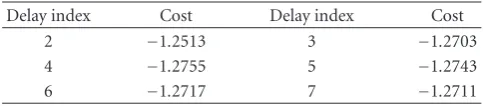
Table 1: Minimal cost using GPS for different delays around optimum.
Delay index Cost Delay index Cost
2 −1.2513 3 −1.2703
4 −1.2755 5 −1.2743
6 −1.2717 7 −1.2711
which has been sufficient for most tries we performed on a number of different channels.
Since the selection of the fixed tap location is strictly related to the optimal delay selection problem and, assuming no a priori channel knowledge, we choose a linear constraint that fixes some tap to one at each iteration.
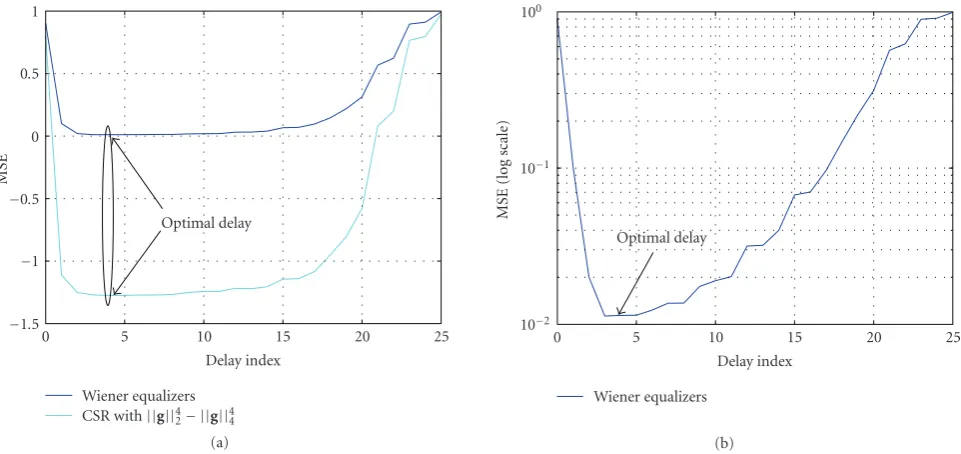
The probably suboptimal blind equalizer obtained after convergence is then used to estimate the desired optimal delay position using the CSR strategy as expressed in (12). Figure 4(a) shows the simulated estimates of the Wiener cost function for different delays from 0 to 25. Let us note that this exceeds the equalizer filter length (taken equal to 20), but enables us to verify that a sufficiently high value has been chosen for it.
InFigure 4(a), the theoretical Wiener equalizer based on minimum square error (MSE) is given for the same delay positions. Let us remember that the MSE is defined as
MSE=ΔEzk−sk−δ2
, (31)
and its corresponding optimal vector minimizer, namely, the Wiener equalizer is found as [13]
w†=
CHC+σn2
σ2
s CHgδ†
−1
CHgδ†, (32)
where C is the baud channel convolution matrix and δ†
represents the desired optimal delay index, which corre-sponds to the index of the minimum diagonal element of I−C(CHC+σ2
nI/σs2) −1
CH.
It can be easily noticed fromFigure 4(a) that both graphs have the same trend thus allowing the selection of the optimal delay which corresponds to an index δ† = 4. The value of the optimal delay is more clearly evidenced in Figure 4(b), which presents essentially the same data as Figure 4(a) for the MSE optimal equalizers, but in logarithmic scale. However, due to the occurrence of negative values for the simulated estimates of the Wiener cost function in Figure 4(a), full logarithmic representation is not truly feasible. Thus, the exact simulated values are given inTable 1 for index values around the optimumδ†.
The negative values found for the Wiener cost function estimates result from the imposed blind equalizer linear constraint that fixes one tap to one. In fact, the zero forcing joint channel-equalizer impulse response has its important tap situated exactly at that position where the coefficient is constrained to be one. This results inwδ c > 1 in (11). The negative values are not then to be considered as reflecting better performances in comparison to the theoretical Wiener MSE, but quite the contrary. It is actually more evident
fromTable 1that the estimated lowest cost value of−1.2755 corresponds to a delay index δ† = 4. This latter is in accordance with the theoretical Wiener optimal delayδ†. At present time, the constrained blind equalization problem can be reformulated more accurately as
minimizef(w)subject towδ†=w4=1. (33)
We apply GPS algorithm to this global optimization problem under the same simulation parameters (just stated above) but for different values of SNRs and different regressor sequence lengthsN. The measured performance will be the intersymbol interference ISI, redefined below in logarithmic scale (dB values) as
ISI(dB)=Δ10 log10
[i|gi|2]− |g|2max
|g|2 max
. (34)
Each simulation is run 30 times and the corresponding averaged results values are given inFigure 5. It can be noticed that the global blind equalization performs well for values ofN ≥1000 and is comparable to the Wiener equalizer for
N=2000.
For performance comparison with the constant modulus algorithm, we use the BERGulator software for CMA simulations which may be downloaded from http://bard.ece.cornell.edu/downloads/. Figure 6 shows the CMA simulated performances in terms of ISI for different SNR values and three single spike initialization strategies, that we denote by CMA0, CMA1, and CMA4 the numerical values 0, 1, and 4 standing for the index of the unique nonzero blind equalizer tap in the initialization vector. The simulation parameters, the modulation type, the unknown channel, and the blind equalizer length, are the same as before; the fixed step size isμ =5×10⁻⁴ and the iteration number is set to 2×10⁴to ensure final convergence.
It can be easily seen that, unlike the proposed algorithm which ensures global convergence behavior for sufficient samples sequence length, CMA is extremely vulnerable to the way of selecting the initial blind equalizer vector and local convergence is more likely to happen. This latter point is clearly highlighted in the case of CMA0 and CMA1. Moreover, the optimal Wiener delay index (which is in our case 4) corresponds exactly to the optimal position of the non-null element of CMA4 initial vector and also to the position of the equalizer tap constrained to one in the proposed algorithm. It may be noticed that CSR may equally well be applied to CMA, with the result of selecting the CMA4 case after initialization.
Furthermore, the proposed global blind optimization-based algorithm outperforms significantly CMA in terms of local convergence properties and gives slightly better global performance than CMA4 (that is also CMA with CSR), especially in low-noise environments (SNR≥30 dB).
Table2: Averaged r.m.s. EVM values using the proposed algorithm and CMA with optimum delay index δ†, for three modulation types.
Modulation type GPS Optimum CMA
QPSK 0.1090 0.1094
16-QAM 0.1243 0.1339
4-PAM 0.0997 0.1181
resolved before equalization and become distinguishable for CMA0 and more separated for CMA1. A constellation phase rotation effect may also be noticed for CMA0 and, to a lesser extent, CMA1. Very satisfactory results are obtained with our proposed algorithm using GPS, these for CMA4 being visually quite identical. In fact, one approaches the Wiener optimum solution in both cases.
Other modulation types have been investigated. Figures 8 and 9 show constellations (normalized such that the baseband signal power is equal to unity) obtained for, respectively, 4-level pulse amplitude modulation (4-PAM) and 16-level quadrature amplitude modulation (16-QAM).
Only results from our GPS-based algorithm (a little better than those obtained with CMA4) and with CMA2 are shown for comparison purposes (constellations before equalization and using a CMA1 equalizer are not shown here).
The good performance of our algorithm is again evi-denced. It may be noticed that, as may be logically expected, the same value is obtained for δ† independently of the modulation type.
Apart from constellation rotation, a measure of the equalizer efficiency is obtained using error vector magnitude (EVM) [29, 30]. The root mean square (r.m.s.) EVM is defined as
EVM= " # #
$Ni=1(ΔIi2+ΔQi2)
NNi=1(I0,2i+Q0,2i)
, (35)
whereNis the number of emitted symbols,I0,iandQ0,i, are the inphase and quadrature components, respectively, of the reference (noiseless) signal,ΔIi=Ii−I0,i,ΔQi=Qi−Q0,i, Ii andQibeing the inphase and quadrature components of the received (noisy) signals.
Our algorithm has been run 30 times on sequences of 2000 emitted QPSK, 16-QAM, or 4-PAM symbols and 2000 added noise samples with 20 dB SNR, to get the averaged r.m.s. EVM values given in Table 2 (the averaging process is taken over a sufficiently high number of samples as per Monte Carlo method).
The simulation has been repeated using CMA and variable spike initializations for comparison purposes. The EVM results are shown inFigure 10versus delay index value around optimum (from 1 to 10) for the three previously used modulation types.
The corresponding minimum cost function values (for delay indexδ†) are also given inTable 2.
Not surprisingly, one sees that the performance decreases for higher efficiency 16-QAM modulation. Moreover 4-PAM
and 16-QAM are not constant envelope modulations and thus CMA is not well-suited for them. As a consequence, our GPS-based algorithm outperforms noticeably CMA in these two cases. It has also been noticed during the simulation that our algorithm gives much lesser dispersion in EVM values when compared to CMA (lower variance).
7. DISCUSSION AND CONCLUSION
In this paper, a baud spaced blind equalization method based on GPS and CSR has been presented in detail and compared to the CMA algorithm. Successful simulation results have been obtained on a number of different, real, or complex channels. For example, real static channel presenting a single deep fading and mixed phase has been presented. We have shown the good performances of the proposed equalizer, even for nonconstant envelope modulations. For constant envelope modulations, the performances are nearly identical to that given by CMA, after selecting the optimum CMA spike delay value for its initialization vector and correctly choosing its step size. This has also been verified for QPSK as reported here and noted for 8-PSK and 16-PSK. Other static channels with more than one fading have also been tested, with essentially the same conclusions as above.
Our algorithm involves unavoidable steps of cost func-tion computafunc-tion (as any other equalizafunc-tion one) and simple algebraic equations for updating the equalizer weights (no gradient computation), testing, and loop instructions. It may be implemented in a FPGA-floating point DSP struc-ture, owing to its reasonable complexity. For performance evaluation, the main concern is the number of required cost function evaluations (which depends on the speed of convergence, and thus equalized channel and initial conditions). The comparison with CMA algorithm using CSR initialization, for a number of different channels, leads to the conclusion that the number of cost function evaluations is of the same order of magnitude as the CSR-CMA and our algorithm, with a little to significant advantage for the latter in the cases of channels with problems (like amplitude or frequency selectivity) or of nonconstant modulus modulations.
Our future work will be directed to extending our algorithm to fractionally spaced equalization, improving the CSR step, and using space diversity. Moreover, the case of slowly varying channels will be considered.
ACKNOWLEDGMENT
The authors thank Dr. Walaa Hamouda from the Depart-ment of Electrical and Computer Engineering of Concordia University for helpful comments and suggestions that have led to an improved paper.
REFERENCES
[2] F. Alberge, P. Duhamel, and M. Nikolova, “Adaptive solution for blind identification/equalization using deterministic max-imum likelihood,”IEEE Transactions on Signal Processing, vol. 50, no. 4, pp. 923–936, 2002.
[3] J.-P. Delmas, H. Gazzah, A. P. Liavas, and P. A. Regalia, “Statistical analysis of some second-order methods for blind channel identification/equalization with respect to channel undermodeling,”IEEE Transactions on Signal Processing, vol. 48, no. 7, pp. 1984–1998, 2000.
[4] C.-Y. Chi, C.-Y. Chen, C.-H. Chen, and C.-C. Feng, “Batch processing algorithms for blind equalization using higher-order statistics,”IEEE Signal Processing Magazine, vol. 20, no. 1, pp. 25–49, 2003.
[5] C.-H. Chen, C.-Y. Chi, and W.-T. Chen, “New cumulant-based inverse filler criteria for deconvolution of nonminimum phase systems,”IEEE Transactions on Signal Processing, vol. 44, no. 5, pp. 1292–1297, 1996.
[6] M. Kawamoto, M. Ohata, K. Kohno, Y. Inouye, and A. K. Nandi, “Robust super-exponential methods for blind equal-ization in the presence of Gaussian noise,”IEEE Transactions on Circuits and Systems II: Express Briefs, vol. 52, no. 10, pp. 651–655, 2005.
[7] A.G. Bessios and C. L. Nikias, “POTEA: the power cepstrum and tricoherence equalization algorithm,”IEEE Transactions on Communications, vol. 43, no. 11, pp. 2667–2671, 1995. [8] H. Mathis and S. C. Douglas, “Bussgang blind deconvolution
for impulsive signals,”IEEE Transactions on Signal Processing, vol. 51, no. 7, pp. 1905–1915, 2003.
[9] B. Maricic, Z.-Q. Luo, and T. N. Davidson, “Blind constant modulus equalization via convex optimization,”IEEE Trans-actions on Signal Processing, vol. 51, no. 3, pp. 805–818, 2003. [10] R. Pandey, “Complex-valued neural networks for blind
equal-ization of time varying channels,” International Journal of Signal Processing, vol. 1, no. 1, pp. 1–8, 2005.
[11] V. Shtrom and H. Fan, “A refined class of cost functions in blind equalization,” in Proceedings of the IEEE International Conference on Acoustics, Speech, and Signal Processing (ICASSP ’97), vol. 3, pp. 2273–2276, Munich, Germany, April 1997. [12] V. Shtrom and H. Fan, “New class of zero-forcing cost
functions in blind equalization,”IEEE Transactions on Signal Processing, vol. 46, no. 10, pp. 2674–2683, 1998.
[13] C. R. Johnson Jr., P. Schniter, T. J. Endres, J. D. Behm, D. R. Brown, and R. A. Casas, “Blind equalization using the constant modulus criterion: a review,”Proceedings of the IEEE, vol. 86, no. 10, pp. 1927–1950, 1998.
[14] S. Chen, T. B. Cook, and L. C. Anderson, “A comparative study of two blind FIR equalizers,”Digital Signal Processing, vol. 14, no. 1, pp. 18–36, 2004.
[15] S. Vembu, S. Verdu, R. A. Kennedy, and W. Sethares, “Convex cost functions in blind equalization,”IEEE Transactions on Signal Processing, vol. 42, no. 8, pp. 1952–1960, 1994. [16] A. T. Erdogan and C. Kizilkale, “Fast and low complexity blind
equalization via subgradient projections,”IEEE Transactions on Signal Processing, vol. 53, no. 7, pp. 2513–2524, 2005. [17] L. Tong and H. H. Zeng, “Channel surfing reinitialization
for the constant modulus algorithm,”IEEE Signal Processing Letters, vol. 4, no. 3, pp. 85–87, 1997.
[18] S. Evans and L. Tong, “Online adaptive reinitialization of the constant modulus algorithm,”IEEE Transactions on Signal Processing, vol. 48, no. 4, pp. 537–539, 2000.
[19] H. H. Zeng, L. Tong, and C. R. Johnson Jr., “Relationships between the constant modulus and wiener receivers,” IEEE Transactions on Information Theory, vol. 44, no. 4, pp. 1523– 1538, 1998.
[20] V. Torczon, “On the convergence of pattern search algo-rithms,”SIAM Journal on Optimization, vol. 7, no. 1, pp. 1–25, 1997.
[21] C. Davids, “Theory of positive linear dependence,”American Journal of Mathematics, vol. 76, no. 4, pp. 733–746, 1954. [22] E. Polak and M. Wetter, “Generalized pattern search
algo-rithms with adaptive precision function evaluations,” Tech. Rep. LBNL-52629, Lawrence Berkeley National Laboratory, Berkeley Calif, USA, May 2003.
[23] E. D. Dolan, R. M. Lewis, and V. Torczon, “On the local convergence of pattern search,”SIAM Journal on Optimization, vol. 14, no. 2, pp. 567–583, 2003.
[24] M. A. Abramson, “Second-order behavior of pattern search,”
SIAM Journal on Optimization, vol. 16, no. 2, pp. 515–530, 2006.
[25] C. Audet and J. E. Dennis Jr., “A pattern search filter method for nonlinear programming without derivatives,”
SIAM Journal on Optimization, vol. 14, no. 4, pp. 980–1010, 2004.
[26] M. A. Abramson, C. Audet, and J. E. Dennis Jr., “Generalized pattern searches with derivative information,”Mathematical Programming, vol. 100, no. 1, pp. 3–25, 2004.
[27] A. Zaouche, I. Dayoub, and J. M. Rouvaen, “Blind constant modulus equalization using hybrid genetic algorithm and pattern search optimization,” inProceedings of the 7th World Wireless Congress (WWC ’06), pp. 37–42, San Francisco, Calif, USA, May 2006.
[28] A. Zaouche, I. Dayoub, and J. M. Rouvaen, “Blind equalization via the use of generalized pattern search optimization and zero forcing sectionnally convex cost function,” inProceedings of the 2nd IEEE International Conference on Information and Communication Technologies (ICTTA ’06), vol. 2, pp. 2303– 2308, Damaskus, Syria, April 2006.
[29] K. M. Voelker, “Apply error vector measurements in commu-nications design,”Microwaves & RF, pp. 143–152, December 1995.