Search for New Physics Using
QUAERO: A General Interface to D0 Event Data
V. M. Abazov,23 B. Abbott,58 A. Abdesselam,11 M. Abolins,51 V. Abramov,26 B. S. Acharya,17 D. L. Adams,60
M. Adams,38 S. N. Ahmed,21 G. D. Alexeev,23 G. A. Alves,2 N. Amos,50 E. W. Anderson,43 Y. Arnoud,9
M. M. Baarmand,55 V. V. Babintsev,26 L. Babukhadia,55 T. C. Bacon,28 A. Baden,47 B. Baldin,37 P. W. Balm,20
S. Banerjee,17E. Barberis,30 P. Baringer,44J. Barreto,2J. F. Bartlett,37 U. Bassler,12 D. Bauer,28A. Bean,44 M. Begel,54
A. Belyaev,35 S. B. Beri,15 G. Bernardi,12 I. Bertram,27A. Besson,9R. Beuselinck,28V. A. Bezzubov,26 P. C. Bhat,37
V. Bhatnagar,11 M. Bhattacharjee,55 G. Blazey,39 S. Blessing,35 A. Boehnlein,37 N. I. Bojko,26 F. Borcherding,37
K. Bos,20 A. Brandt,60 R. Breedon,31 G. Briskin,59 R. Brock,51 G. Brooijmans,37 A. Bross,37 D. Buchholz,40
M. Buehler,38 V. Buescher,14 V. S. Burtovoi,26 J. M. Butler,48 F. Canelli,54W. Carvalho,3D. Casey,51 Z. Casilum,55 H. Castilla-Valdez,19 D. Chakraborty,39 K. M. Chan,54 S. V. Chekulaev,26 D. K. Cho,54 S. Choi,34 S. Chopra,56
J. H. Christenson,37 M. Chung,38 D. Claes,52 A. R. Clark,30 J. Cochran,34 L. Coney,42 B. Connolly,35 W. E. Cooper,37
D. Coppage,44 S. Crépé-Renaudin,9 M. A. C. Cummings,39 D. Cutts,59 G. A. Davis,54 K. Davis,29 K. De,60 S. J. de Jong,21 K. Del Signore,50 M. Demarteau,37R. Demina,45P. Demine,9D. Denisov,37 S. P. Denisov,26 S. Desai,55
H. T. Diehl,37 M. Diesburg,37 G. Di Loreto,51 S. Doulas,49 P. Draper,60 Y. Ducros,13 L. V. Dudko,25 S. Duensing,21 L. Duflot,11 S. R. Dugad,17A. Duperrin,10A. Dyshkant,39 D. Edmunds,51 J. Ellison,34V. D. Elvira,37R. Engelmann,55
S. Eno,47 G. Eppley,62 P. Ermolov,25 O. V. Eroshin,26 J. Estrada,54 H. Evans,53 V. N. Evdokimov,26 T. Fahland,33 S. Feher,37 D. Fein,29 T. Ferbel,54 F. Filthaut,21 H. E. Fisk,37 Y. Fisyak,56 E. Flattum,37 F. Fleuret,30 M. Fortner,39
H. Fox,40 K. C. Frame,51 S. Fu,53 S. Fuess,37E. Gallas,37 A. N. Galyaev,26 M. Gao,53V. Gavrilov,24 R. J. Genik II,27 K. Genser,37 C. E. Gerber,38 Y. Gershtein,59R. Gilmartin,35G. Ginther,54B. Gómez,5G. Gómez,47 P. I. Goncharov,26
J. L. González Solís,19H. Gordon,56L. T. Goss,61K. Gounder,37A. Goussiou,28N. Graf,56G. Graham,47P. D. Grannis,55
J. A. Green,43 H. Greenlee,37S. Grinstein,1L. Groer,53 S. Grünendahl,37 A. Gupta,17S. N. Gurzhiev,26G. Gutierrez,37 P. Gutierrez,58 N. J. Hadley,47 H. Haggerty,37S. Hagopian,35 V. Hagopian,35 R. E. Hall,32 P. Hanlet,49 S. Hansen,37
J. M. Hauptman,43 C. Hays,53C. Hebert,44D. Hedin,39J. M. Heinmiller,38A. P. Heinson,34 U. Heintz,48 T. Heuring,35 M. D. Hildreth,42 R. Hirosky,63 J. D. Hobbs,55 B. Hoeneisen,8Y. Huang,50 R. Illingworth,28 A. S. Ito,37M. Jaffré,11
S. Jain,17 R. Jesik,28K. Johns,29 M. Johnson,37 A. Jonckheere,37 M. Jones,36 H. Jöstlein,37 A. Juste,37 W. Kahl,45 S. Kahn,56 E. Kajfasz,10 A. M. Kalinin,23 D. Karmanov,25 D. Karmgard,42 Z. Ke,4R. Kehoe,51 A. Khanov,45
A. Kharchilava,42 S. K. Kim,18 B. Klima,37 B. Knuteson,30 W. Ko,31 J. M. Kohli,15 A. V. Kostritskiy,26 J. Kotcher,56 B. Kothari,53 A. V. Kotwal,53 A. V. Kozelov,26 E. A. Kozlovsky,26 J. Krane,43 M. R. Krishnaswamy,17 P. Krivkova,6
S. Krzywdzinski,37 M. Kubantsev,45 S. Kuleshov,24 Y. Kulik,55 S. Kunori,47 A. Kupco,7 V. E. Kuznetsov,34
G. Landsberg,59 W. M. Lee,35 A. Leflat,25 C. Leggett,30 F. Lehner,37,* J. Li,60 Q. Z. Li,37 X. Li,4J. G. R. Lima,3 D. Lincoln,37 S. L. Linn,35 J. Linnemann,51 R. Lipton,37 A. Lucotte,9L. Lueking,37 C. Lundstedt,52 C. Luo,41
A. K. A. Maciel,39 R. J. Madaras,30 V. L. Malyshev,23 V. Manankov,25 H. S. Mao,4T. Marshall,41 M. I. Martin,39
R. D. Martin,38K. M. Mauritz,43 B. May,40 A. A. Mayorov,41 R. McCarthy,55 T. McMahon,57 H. L. Melanson,37
M. Merkin,25 K. W. Merritt,37 C. Miao,59 H. Miettinen,62 D. Mihalcea,39 C. S. Mishra,37 N. Mokhov,37
N. K. Mondal,17 H. E. Montgomery,37 R. W. Moore,51 M. Mostafa,1H. da Motta,2E. Nagy,10 F. Nang,29M. Narain,48
V. S. Narasimham,17 H. A. Neal,50 J. P. Negret,5S. Negroni,10T. Nunnemann,37 D. O’Neil,51 V. Oguri,3 B. Olivier,12
N. Oshima,37 P. Padley,62 L. J. Pan,40 K. Papageorgiou,38 A. Para,37 N. Parashar,49 R. Partridge,59 N. Parua,55 M. Paterno,54 A. Patwa,55B. Pawlik,22 J. Perkins,60 M. Peters,36 O. Peters,20 P. Pétroff,11 R. Piegaia,1B. G. Pope,51
E. Popkov,48 H. B. Prosper,35 S. Protopopescu,56 J. Qian,50 R. Raja,37 S. Rajagopalan,56 E. Ramberg,37 P. A. Rapidis,37
N. W. Reay,45S. Reucroft,49M. Ridel,11M. Rijssenbeek,55F. Rizatdinova,45T. Rockwell,51 M. Roco,37P. Rubinov,37 R. Ruchti,42 J. Rutherfoord,29 B. M. Sabirov,23 G. Sajot,9 A. Santoro,2 L. Sawyer,46 R. D. Schamberger,55
H. Schellman,40 A. Schwartzman,1 N. Sen,62 E. Shabalina,38 R. K. Shivpuri,16 D. Shpakov,49 M. Shupe,29 R. A. Sidwell,45V. Simak,7H. Singh,34J. B. Singh,15V. Sirotenko,37P. Slattery,54 E. Smith,58R. P. Smith,37R. Snihur,40
G. R. Snow,52 J. Snow,57 S. Snyder,56 J. Solomon,38 V. Sorín,1 M. Sosebee,60 N. Sotnikova,25 K. Soustruznik,6 M. Souza,2N. R. Stanton,45 G. Steinbrück,53 R. W. Stephens,60 F. Stichelbaut,56 D. Stoker,33 V. Stolin,24 A. Stone,46
D. A. Stoyanova,26M. Strauss,58M. Strovink,30L. Stutte,37A. Sznajder,3M. Talby,10W. Taylor,55S. Tentindo-Repond,35 S. M. Tripathi,31 T. G. Trippe,30 A. S. Turcot,56 P. M. Tuts,53 P. van Gemmeren,37 V. Vaniev,26 R. Van Kooten,41
N. Varelas,38 L. S. Vertogradov,23 F. Villeneuve-Seguier,10 A. A. Volkov,26 A. P. Vorobiev,26H. D. Wahl,35 H. Wang,40
P. Yamin,56 T. Yasuda,37Y. A. Yatsunenko,23 K. Yip,56 S. Youssef,35 J. Yu,37 Z. Yu,40 M. Zanabria,5H. Zheng,42
Z. Zhou,43 M. Zielinski,54 D. Zieminska,41A. Zieminski,41V. Zutshi,56 E. G. Zverev,25and A. Zylberstejn13 (D0 Collaboration)
1Universidad de Buenos Aires, Buenos Aires, Argentina 2LAFEX, Centro Brasileiro de Pesquisas Físicas, Rio de Janeiro, Brazil
3Universidade do Estado do Rio de Janeiro, Rio de Janeiro, Brazil 4Institute of High Energy Physics, Beijing, People’s Republic of China
5Universidad de los Andes, Bogotá, Colombia
6Charles University, Center for Particle Physics, Prague, Czech Republic
7Institute of Physics, Academy of Sciences, Center for Particle Physics, Prague, Czech Republic 8Universidad San Francisco de Quito, Quito, Ecuador
9Institut des Sciences Nucléaires, IN2P3-CNRS, Universite de Grenoble 1, Grenoble, France 10CPPM, IN2P3-CNRS, Université de la Méditerranée, Marseille, France
11Laboratoire de l’Accélérateur Linéaire, IN2P3-CNRS, Orsay, France 12LPNHE, Universités Paris VI and VII, IN2P3-CNRS, Paris, France
13DAPNIA/Service de Physique des Particules, CEA, Saclay, France 14Universität Mainz, Institut für Physik, Mainz, Germany
15Panjab University, Chandigarh, India 16Delhi University, Delhi, India
17Tata Institute of Fundamental Research, Mumbai, India 18Seoul National University, Seoul, Korea
19CINVESTAV, Mexico City, Mexico
20FOM-Institute NIKHEF and University of Amsterdam/NIKHEF, Amsterdam, The Netherlands 21University of Nijmegen/NIKHEF, Nijmegen, The Netherlands
22Institute of Nuclear Physics, Kraków, Poland 23Joint Institute for Nuclear Research, Dubna, Russia 24Institute for Theoretical and Experimental Physics, Moscow, Russia
25Moscow State University, Moscow, Russia 26Institute for High Energy Physics, Protvino, Russia
27Lancaster University, Lancaster, United Kingdom 28Imperial College, London, United Kingdom 29University of Arizona, Tucson, Arizona 85721
30Lawrence Berkeley National Laboratory and University of California, Berkeley, California 94720 31University of California, Davis, California 95616
32California State University, Fresno, California 93740 33University of California, Irvine, California 92697 34University of California, Riverside, California 92521 35Florida State University, Tallahassee, Florida 32306
36University of Hawaii, Honolulu, Hawaii 96822 37Fermi National Accelerator Laboratory, Batavia, Illinois 60510
38University of Illinois at Chicago, Chicago, Illinois 60607 39Northern Illinois University, DeKalb, Illinois 60115
40Northwestern University, Evanston, Illinois 60208 41Indiana University, Bloomington, Indiana 47405 42University of Notre Dame, Notre Dame, Indiana 46556
43Iowa State University, Ames, Iowa 50011 44University of Kansas, Lawrence, Kansas 66045 45Kansas State University, Manhattan, Kansas 66506 46Louisiana Tech University, Ruston, Louisiana 71272 47University of Maryland, College Park, Maryland 20742
48Boston University, Boston, Massachusetts 02215 49Northeastern University, Boston, Massachusetts 02115
50University of Michigan, Ann Arbor, Michigan 48109 51Michigan State University, East Lansing, Michigan 48824
52University of Nebraska, Lincoln, Nebraska 68588 53Columbia University, New York, New York 10027 54University of Rochester, Rochester, New York 14627 55State University of New York, Stony Brook, New York 11794
58University of Oklahoma, Norman, Oklahoma 73019 59Brown University, Providence, Rhode Island 02912
60University of Texas, Arlington, Texas 76019 61Texas A&M University, College Station, Texas 77843
62Rice University, Houston, Texas 77005 63University of Virginia, Charlottesville, Virginia 22901
64University of Washington, Seattle, Washington 98195
(Received 7 June 2001; published 14 November 2001)
We describeQUAERO, a method that (i) enables the automatic optimization of searches for physics beyond the standard model, and (ii) provides a mechanism for making high energy collider data generally available. We applyQUAEROto searches for standard modelWW,ZZ, andtt¯production, to searches for these objects produced through a new heavy resonance, and to the first direct search forW0 !WZ. Through this interface, we make three data sets collected by the D0 experiment atps 苷1.8TeV publicly available.
DOI: 10.1103/PhysRevLett.87.231801 PACS numbers: 13.85.Rm, 12.60. – i, 29.85. +c
It is generally recognized that the standard model, a suc-cessful description of the fundamental particles and their interactions, must be incomplete. Models that extend the standard model often predict rich phenomenology at the scale of a few hundred GeV, an energy regime accessible to the Fermilab Tevatron. In part because of the complex-ity of the apparatus required to test models at such large energies, experimental responses to these ideas have not kept pace. Any technique that reduces the time required to test a particular candidate theory would allow more such theories to be tested, reducing the possibility that the data contain overlooked evidence for new physics.
Once data are collected and the backgrounds have been understood, the testing of any specific model in principle follows a well-defined procedure. In practice, this process has been far from automatic. Even when the basic selection criteria and background estimates are taken from a previ-ous analysis, the reinterpretation of the data in the context of a new model often requires a substantial length of time. Ideally, the data should be “published” in such a way that others in the community can easily use those data to test a variety of models. The publishing of experimen-tal distributions in journals allows this to occur at some level, but an effective publishing of a multidimensional data set has, to our knowledge, not yet been accomplished by a large particle physics experiment. The problem ap-pears to be that such data are context specific, requiring detailed knowledge of the complexities of the apparatus. This knowledge must somehow be incorporated either into the data or into whatever tool the nonexpert would use to analyze those data.
Many data samples and backgrounds have been defined in the context of SLEUTH[1], a quasi-model-independent search strategy for new high pT physics that has been applied to a number of exclusive final states [2,3] in the data collected by the D0 detector [4] during 1992-1996 in Run I of the Fermilab Tevatron. In this Letter, we describe a tool (QUAERO) that automatically optimizes an analysis for a particular signature, using these samples and stan-dard model backgrounds. SLEUTHandQUAERO are
com-plementary approaches to searches for new phenomena, enabling analyses that are both general (SLEUTH) and fo-cused (QUAERO). We demonstrate the use of QUAERO in eleven separate searches: standard model WW and ZZ
production; standard model t¯t production with leptonic and semileptonic decays; resonant WW, ZZ, WZ, and
tt¯ production; associated Higgs boson production; and pair production of first generation scalar leptoquarks. The data described here are accessible through QUAERO on the World Wide Web [5], for general use by the particle physics community.
The signals predicted by most theories of physics be-yond the standard model involve an increased number of predicted events in some region of an appropriate variable space. In this case the optimization of the analysis can be understood as the selection of the region in this variable space that minimizess95%, the expected95%confidence
level (C.L.) upper limit on the cross section of the signal in question, assuming the data contain no signal. The op-timization algorithm consists of a few simple steps:
(i) Kernel density estimation [6] is used to estimate the probability distributions p共xjs兲 andp共xjb兲 for the sig-nal and background samples in a low-dimensiosig-nal variable spaceV, wherex [V. The signal sample is contained in a Monte Carlo file provided as input to QUAERO. The background sample is constructed from all known stan-dard model and instrumental sources.
(ii) A discriminant functionD共x兲is defined by [7]
D共x兲苷 p共xjs兲
p共xjs兲 1 p共xjb兲. (1)
The semi-positive-definiteness of p共xjs兲 andp共xjb兲 re-stricts D共x兲 to the interval关0, 1兴 for allx.
(iii) ThesensitivityS of a particular thresholdDcut on
the discriminant function is defined as the reciprocal of s95%. Dcut is chosen to maximizeS.
TABLE I. A summary of the data available within QUAERO, including the selection cuts applied and the efficiency of iden-tification requirements. The final states are inclusive, with many events containing one or more additional jets. Recon-structed jets satisfy pjT .15GeV and jh
j
detj,2.5, and
re-constructed electrons satisfy pTe .15GeV and (jhedetj,1.1
or1.5,jhdete j,2.5), where hdet is the pseudorapidity
mea-sured from the center of the detector.
Final state Selection criteria eID RLdt
em pTe,m .15GeV 0.30 10865pb21 jhdetm j,1.7
eE兾T2j p e,j1,2
T .20GeV 0.61 11566pb21
E兾T .30GeV
pTeE兾T .40GeV
ee2j pe1,2,j1,2
T .20GeV 0.70 12367pb21
When provided with a signal model and a choice of variables V, QUAERO uses this algorithm and D0 Run I data to compute an upper limit on the cross section of the signal. Instructions for use are available from theQUAERO web site.
Table I shows the data available within QUAERO, and Table II summarizes the backgrounds. These data and their backgrounds are described in more detail in Ref. [3]. The final states are inclusive, with many events containing one or more additional jets. Kolmogorov-Smirnov tests have been used to demonstrate agreement between data and the expected backgrounds in many distributions. The fraction of events with true final state objects satisfying the cuts shown that satisfy these cuts after reconstruction is given as an “identification” efficiency (eID). Because electrons are
more accurately measured and more efficiently identified than muons in the D0 detector, the corresponding muon channels mE兾T2j and mm2j have been excluded from these data.
To check standard model results, we remove WW and
ZZ production from the background estimate and search (i) for standard model WW production in the space de-fined by the transverse momentum of the electron (peT) and missing transverse energy (E兾T) in the final stateemE兾T, and (ii) for standard modelZZ production in the space defined
TABLE II. Standard model backgrounds (often produced with accompanying jets) to the final states considered. VV denotes
WW, WZ, and ZZ; “data” indicates backgrounds from jets misidentified as electrons estimated using data. Monte Carlo programs (ISAJET [9], PYTHIA [10], HERWIG [11], and VECBOS
[12]) are used to estimate several sources of background.
Standard model backgrounds Final state multijets W Z VV t¯t
em data data ISAJET PYTHIA HERWIG
eE兾T2j data VECBOS · · · PYTHIA HERWIG
ee2j data · · · PYTHIA PYTHIA · · ·
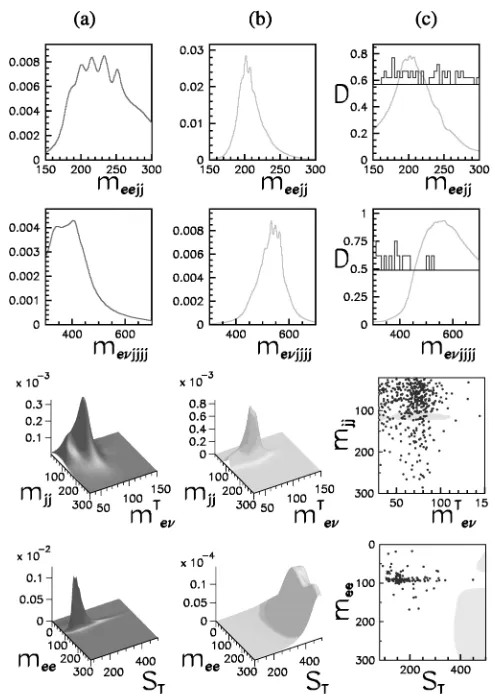
by the invariant mass of the two electrons (mee) and two jets (mjj) in the final stateee2j. Removing tt¯production from the background estimate, we search for this process (iii) in the final state eE兾T4jusing the two variables labo-ratory aplanarity (A) andPpTj, and (iv) in the final state
emE兾T2j, using the two variablespTe and P
pjT, assuming a top quark mass of 175 GeV.
Including all standard model processes in the back-ground estimate, we look for evidence of new heavy resonances. We search (v) for resonantWW production in the final stateeE兾T2j, using the single variablemenjj after constrainingmen andmjjtoMW, and (vi) for resonantZZ production in the final state ee2j, using the variablemeejj after constraining mjj to MZ. In both cases we remove events that cannot be so constrained. To obtain a specific signal prediction, we assume that the resonance behaves like a standard model Higgs boson in its couplings to the W and Z bosons. Constraining men to MW andmjj to MZ, we use the quality of the fit and menjj to search (vii) for a massiveW0 boson in the extended gauge model of Ref. [13]. Usingmen4j after constrainingmen to MW, we search (viii) for a massive narrow Z0 resonance with
Z-like couplings decaying tot¯t !W1bW2b¯ !en4j. Nonresonant new phenomena are also considered. The variablesmjj and eithermTen ormee are used to search for a light Higgs boson produced (ix) in association with a
W boson, and (x) in association with a Z boson. Finally,
TABLE III. Limits on cross section3branching fraction for the processes discussed in the text. All final states are inclusive in the number of additional jets. The fraction of the signal sample satisfyingQUAERO’s selection criteria is denotedesig;bˆ
is the number of expected background events satisfying these criteria; andNdatais the number of events in the data satisfying
these criteria. The subscripts on h, W0, Z0, and LQ denote assumed masses, in units of GeV.
Process esig bˆ Ndata s95%3B
WW !emE兾T 0.14 19.064.0 23 1.1 pb
ZZ!ee2j 0.12 19.764.1 19 0.8 pb
t¯t!eE兾T4j 0.13 3.160.9 8 0.8 pb
t¯t!emE兾T2j 0.14 0.660.2 2 0.4 pb
h175!WW !eE兾T2j 0.02 29.666.5 32 11.0 pb
h200!WW !eE兾T2j 0.07 66.0613.8 69 4.4 pb
h225!WW !eE兾T2j 0.06 43.169.2 44 3.6 pb
h200!ZZ!ee2j 0.15 17.963.7 15 0.6 pb
h225!ZZ!ee2j 0.15 18.863.8 12 0.4 pb
h250!ZZ!ee2j 0.17 18.163.7 18 0.6 pb
W2000 !WZ !eE兾T2j 0.05 27.766.3 29 3.4 pb
W3500 !WZ !eE兾T2j 0.23 22.765.2 27 0.7 pb
W5000 !WZ !eE兾T2j 0.26 2.160.8 2 0.2 pb
Z3500 !t¯t!eE兾T4j 0.11 18.764.0 20 1.1 pb
Z4500 !t¯t!eE兾T4j 0.14 18.764.0 20 0.9 pb
Z5500 !t¯t!eE兾T4j 0.14 3.861.0 2 0.3 pb
Wh115 !eE兾T2j 0.08 37.368.2 32 2.0 pb
Zh115!ee2j 0.20 19.564.1 25 0.8 pb
FIG. 1. The background density (a), signal density (b), and selected region (shaded) (c) determined byQUAEROfor the stan-dard model processes discussed in the text. From top to bottom the signals are WW !emE兾T, ZZ!ee2j, tt¯!eE兾T4j, and
t¯t!emE兾T2j. The dots in the plots in the rightmost column
represent events observed in the data.
we search (xi) for first generation scalar leptoquarks with mass 225 GeV in the final stateee2jusingmeeandST, the summed scalar transverse momentum of all electrons and jets in the event. The numerical results of these searches are listed in Table III. Figures 1 and 2 present plots of the signal density, background density, and selected region in the variables considered.
We note slight indications of excess in the searches for
t¯t !eE兾T4j and t¯t !emE兾T2j (corresponding to cross section 3 branching fractions ofs 3 B 苷 0.39120.210.19 pb
and0.14210.150.08pb) that are consistent with our measuredt¯t
production cross section of5.56 1.8pb [14] and known
W boson branching fractions. Observing no compelling excess in any of these processes, limits on s 3B are determined at the 95% C.L. As expected, we find these data insensitive to standard model ZZ production (with predicteds 3B 艐0.05 pb), and to associated Higgs bo-son production (with predicteds 3B &0.01pb). As a
FIG. 2. QUAERO’s analysis of signatures involving undis-covered particles. From top to bottom the hypothetical sig-nals are h200!ZZ !ee2j, Z5500 !tt¯!eE兾T4j, Wh115!
eE兾T2j, andLQ225LQ225!ee2j. Plots (c) of the first two rows
show the discriminant D (curve), the thresholdDcut
(horizon-tal line), and the data (histogram); the region with D.Dcut
is selected.
check of the method,QUAEROalmost exactly duplicates a previous search forLQLQ !ee2j [15].
QUAEROis a method both for automatically optimizing searches for new physics and for allowing D0 to make a subset of its data available for general use. In this Letter, we have outlined the algorithm used in QUAERO, and we have described the final states currently available for analysis using this method. QUAERO’s performance on several examples, including both standard model and reso-nantWW,ZZ, andt¯t production, has been demonstrated. The limits obtained are comparable to those from previous searches at hadron colliders. The searches forZZ !ee2j,
Z0 ! tt¯ !eE兾T4j, Wh !eE兾T2j, and Zh !ee2j are the first from D0, and the searches for W0 !WZ and resonant WW and ZZ production are the first of their kind. This tool should increase the facility with which new models may be tested in the future.
of Energy and National Science Foundation (U.S.A.), Commissariat á L’Energie Atomique and CNRS/Institut National de Physique Nucléaire et de Physique des Particules (France), Ministry for Science and Technology and Ministry for Atomic Energy (Russia), CAPES and CNPq (Brazil), Departments of Atomic Energy and Science and Education (India), Colciencias (Colombia), CONACyT (Mexico), Ministry of Education and KOSEF (Korea), CONICET and UBACyT (Argentina), The Foundation for Fundamental Research on Matter (The Netherlands), PPARC (United Kingdom), Ministry of Ed-ucation (Czech Republic), and the A. P. Sloan Foundation.
*Visitor from University of Zurich, Zurich, Switzerland. [1] D0 Collaboration, B. Abbott et al., Phys. Rev. D 62,
092004 (2000).
[2] D0 Collaboration, B. Abbott et al., Phys. Rev. Lett. 86,
3712 (2001).
[3] D0 Collaboration, B. Abbott et al., Phys. Rev. D 64,
012004 (2001).
[4] D0 Collaboration, S. Abachiet al.,Nucl. Instrum. Methods Phys. Res., Sect. A338,185 (1994).
[5] D0 Collaboration, B. Abbottet al.,http://quaero.fnal.gov/ [6] David Scott,Multivariate Density Estimation(John Wiley
& Sons, New York, 1992).
[7] L. Holmström, S. Sain, and H. Miettinen, Comput. Phys. Commun. 88,195 (1995).
[8] s95%is a Bayesian limit, computed assuming a flat prior. [9] H. Baer et al., BNL-HET-99-43; FSU-HEP-991218;
UH-511-952-00; hep-ph/0001086; we used v7.22. [10] T. Sjöstrand et al., Comput. Phys. Commun. 135, 238
(2001).
[11] G. Corcella et al., J. High Energy Phys. 1 10 (2001); hep-ph/0107071; we used v5.7.
[12] F. A. Berendset al.,Nucl. Phys.B357,32 (1991); we used v3.0.
[13] G. Altarelli, B. Mele, and M. Ruiz-Altaba, Z. Phys. C45,
109 (1989).
[14] D0 Collaboration, S. Abachi et al., Phys. Rev. Lett. 79,
1203 (1997).
[15] D0 Collaboration, B. Abbott et al., Phys. Rev. Lett. 79,