Rasta: A cipher with low ANDdepth and few
ANDs per bit
Christoph Dobraunig1, Maria Eichlseder1, Lorenzo Grassi1, Virginie Lallemand2, Gregor Leander2, Eik List3, Florian Mendel4, and Christian
Rechberger1 1
Graz University of Technology, Austria [email protected]
2
Horst G¨ortz Institute for IT Security, Ruhr-Universit¨at Bochum, Germany [email protected]
3
Bauhaus-Universit¨at Weimar, Germany [email protected]
4
Infineon Technologies AG, Germany [email protected]
Abstract. Recent developments in multi party computation (MPC) and fully homomorphic encryption (FHE) promoted the design and analysis of symmetric cryptographic schemes that minimize multiplications in one way or another. In this paper, we propose with Rasta a design strat-egy for symmetric encryption that has ANDdepth d and at the same time only needsdANDs per encrypted bit. Even for very low values of
d between 2 and 6 we can give strong evidence that attacks may not exist. This contributes to a better understanding of the limits of what concrete symmetric-key constructions can theoretically achieve with re-spect to AND-related metrics, and is to the best of our knowledge the first attempt that minimizes both metrics simultaneously. Furthermore, we can give evidence that for choices ofd between 4 and 6 the result-ing implementation properties may well be competitive by testresult-ing our construction in the use-case of removing the large ciphertext-expansion when using the BGV scheme.
Keywords: Symmetric encryption, ASASA, homomorphic encryption, multiplicative complexity, multiplicative depth
1
Introduction
applications of secure multiparty-computation protocols [4,38], verification time of SNARKs [2], the cost to avoid ciphertext-expansion in homomorphic encryp-tion schemes [4,20,49], or reducing the signature size of signature schemes based on Sigma-protocols [16,21,27,44,53].
In general, we may be interested in three different metrics. One metric refers to what is commonly called multiplicative complexity (MC), which is simply the number of multiplications (in our case AND gates) in a circuit, see e.g. [17]. A natural variant in the context of encryption schemes is the number of AND gates per encrypted bit (MC/bit). The third metric refers to the multiplicative depth of the circuit, which we will subsequently call ANDdepth.
1.1 Motivating applications
There are many examples where only the number of multiplications matters (perhaps together with the size of the ring in which they operate). SNARKs, protocols for secure multiparty communication based on Yao’s garbled circuits, or Sigma-protocol signature schemes come to mind. However, there are also a number of applications where both the ANDdepth and the number of multipli-cations matter simultaneously, such as the following two important examples.
Preventing ciphertext expansion in homomorphic encryption schemes. All known fully/somewhat homomorphic encryption schemes come with signif-icant, often prohibitive ciphertext expansion. To prevent the thousand-fold to million-fold ciphertext expansion in (F)HE schemes, a decryption circuit of a symmetric encryption scheme has to be homomorphically evaluated in addition to the actual computations on the ciphertext. The downside of this approach is that application-specific operations on the ciphertext become more costly, as the decryption circuit of the cipher always needs to be evaluated as well.
To prevent bootstrapping, we need to choose the FHE parameters gener-ously enough to accommodate all additional noise from the decryption circuit. This is linked to the homomorphic capacity of a concrete instantiation of an FHE scheme, i.e., the number of operations on the ciphertext before an expen-sive bootstrapping operation is needed. All known candidates for FHE schemes are using noise-based cryptography. Each operation on the homomorphically en-crypted ciphertext incurs an increase in the noise. In many schemes, the noise level grows fast with the multiplicative depth of the circuit [19,22]. Hence, sym-metric encryption scheme proposals aiming for these types of applications min-imize first of all the ANDdepth.
While the cost of the application-specific homomorphic operations only de-pends on the ANDdepth of the cipher, the cost of evaluating the additional decryption circuit itself primarily depends on the number of multiplications. Thus, the number of AND computations is also a relevant metric.
cheaper (no communication, less computation) than AND gates. There are also many MPC protocols where each AND gate of the evaluated circuit requires in-teraction and so the performance depends on both the multiplicative complexity (MC) and ANDdepth of the circuit. Examples are the semi-honest secure ver-sion of the GMW protocol [37], and tiny-OT [52] with security against malicious adversaries. Applications of symmetric encryption schemes in these protocols include privacy-preserving keyword search based on Oblivious Pseudorandom Functions (OPRFs) [33], set intersection [42] and secure database join [47]. More details to motivate the use of symmetric encryption in MPC are given in [3].
1.2 The design strategy Rasta and its background
In this paper, we propose a design strategy called Rasta5for symmetric encryp-tion that simultaneously achieves very low values in two of the three considered metrics: Symmetric encryption that has ANDdepthdand at the same time only needs d ANDs per encrypted bit. The main result is that even for very low
d= 2, . . . ,6, we can give some evidence that attacks may not exist.
We achieve this by putting so-called ASASA-like permutation constructions into a new setting. Generic substitution-permutation designs which interleave a key-dependent affine layer with key-dependent S-boxes have been studied since SASAS [14]. Follow-up work refined and extended this line of inquiry, and put it also into use for the purpose of white-box implementations of symmetric ciphers, and for instantiating schemes with public-key-like properties [12].
Ournew twist to ASASA-like constructions is to consider a setting where the substitution layer is suitably chosen, public and fixed, but the affine layers are derived from a public nonce and a counter such that no affine layer is likely to be ever re-used under a single key (see Fig. 1). This approach prevents the attacks [28,36,50] that broke the proposals of [12], as an adversary will never be able to query the same ASASA-like permutation more than once in Rasta. Since the setup of each instance via the extendable-output function (XOF) [51] depends only on public information (N,i), it does not contribute to the (homomorphic) circuit evaluation cost in applications like FHE. In addition to the number of rounds, we also consider key sizes (and so block sizes of the used permutation) that are bigger than the required security level as tunable security parameter to provide protection against certain attack vectors.
Variants. The practical downside of Rasta with a very low d is that for a fixed security level, the required key size and the number of additions needed for its evaluation grows very fast, see also the comparison in Table 1. Hence we consider such parameters as non-practical and at times use gray coloring in tables or figures for it. Throughout the paper we describe ways to bound 5 The name Rasta originates from the use of randomly looking affine layers A and the
repetition of affine and S-box layer (AS)* followed by a last affine layer A. In short R(AS)*A. A C++ reference implementation is available at: https://github.com/
public
key dependent
XOF
N, i
· · ·
K A0,N,i S A1,N,i S · · · S Ar,N,i ⊕ KN,i
Fig. 1. The r-round Rasta construction to generate the keystream KN,i for block i under nonceN with affine layersAj,N,i.
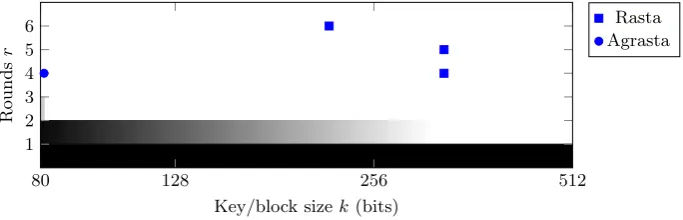
various classes of attacks and use them to derive key and block sizes for any depth d. However, we do not have attacks matching these bounds. As we can see in Sect. 3, the attacks we have are rather far away from these bounds. In order to also explore the limits of what this design approach might achieve and to further encurage more cryptanalysis we also propose a variant of Rasta called Agrasta where the key and block size equals the security level (plus one to get odd numbers) and basing the number of rounds on what we can attack plus a security margin. Fig. 2 brings the area where we know attacks in relation to the instances of Rasta and Agrasta having 80-bit security. Note that the area is mostly defined by cases, where the maximal number of different monomials becomes so low, that the equation system can be solved by a trivial linearization.
80 128 256 512
1 2 3 4 5 6
Key/block sizek(bits)
Rounds
r
Rasta Agrasta
Fig. 2.Security margin of Rasta and Agrasta instances having 80-bit security. White area cannot be attacked with a complexity less than 280. Black area can be attacked
with complexity below 250.
1.3 Related work and comparison
bits, LowMC and Kreyvium require an ANDdepth of 11 or more, whereas FLIP manages to have a much lower ANDdepth of 4. The total number of AND com-putations is however much larger in FLIP (1072 per bit, 112 from the quadratic function, and 960 from the triangular function) than in LowMC or Kreyvium (which can be as low as 3 to 4 ANDs per bit). We give a more detailed discussion and comparison of them in the following. MiMC [2] is a very different design that shows excellent properties in a broad range of use-cases incl. MPC and SNARKs. It’s main feature is that it can operate on elements in GF(p) natively and as such is very different to all the other designs we consider in our comparison.
High-level approach. What we do in this approach is to make a significant part of the computations independent of the key. This high-level approach was (perhaps for the first time) used in the FLIP design [49]. While in FLIP it is only the key bits that are permuted in a nonce-dependent way and the rest of the construction is fixed, in our design many essential parts of the construction are nonce-dependent: The derivation of a suitable affine layer, for every block, based on nonce and counter inputs using an extendable-output function (XOF) [51].
The advantage of this idea is that operations which do not depend on the key are in various settings of interest much less costly than operations that do depend on the key. In our experimental validation of the proposed approach, we include in the runtime the construction of each affine layer.
This results in a nice advantage of our approach as it allows for security ar-guments in the case of outputting many more than a single bit, hence drastically improving the number of ANDs per bit. Note that FLIP mitigates this property by focusing on a class of homomorphic encryption schemes where error growth is quasi-additive when considering a multiplicative chain and hence the large number of AND computations per encrypted bit are less of an issue.
New cryptanalytic insights. As a side-effect of these novel designs, new and interesting cryptanalytic insights continue to emerge. Attacks on earlier versions of LowMC [4] led to new insights on how higher-order properties can get extended because of non-full S-box layers [29,31] and novel optimization of interpolation attacks [29]. As a result, the LowMC v2 parameters are larger: For 80-bit security at least 12 instead of 11 rounds are needed, and for 128-bit security at least 14 instead of 12 rounds are needed. The 12-round version was shown to offer less than 128-bit of security. In this paper we consider both versions, because comparisons in the past have been done with v1. Another example are attacks on FLIP which showed that guess-and-determine attacks [32] force designers to choose more conservative parameters for their novel design.
these numbers might suggest. Whereas for LowMC the depth remains constant for the encryption of at least 256 bits, for Kreyvium the depth starts to grow after 67 bits already. The very low depth of FLIP comes at the cost of a much larger number of AND computations per encrypted bit: At a security level of 128 bits it is 1072 ANDs/bit for FLIP compared to values as low as 3 to 4 for Kreyvium and LowMC.
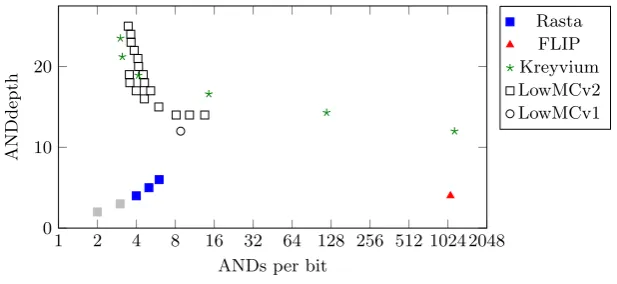
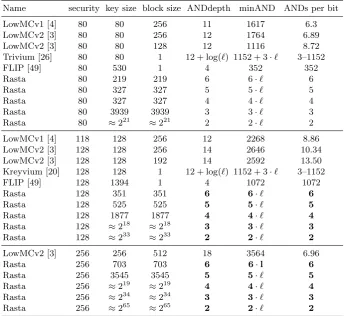
Table 1 and Fig. 3 illustrate a comparison of our design with these three earlier designs. They overlap partially in the content they convey, but also com-plement each other. For simplicity, in Fig. 3, we only show the figure for the security level of 128 bits, also because only for this particular security level, instantiation proposals are available for all design options.
1 2 4 8 16 32 64 128 256 512 1024 2048
0 10 20
ANDs per bit
ANDdepth
Rasta FLIP Kreyvium LowMCv2 LowMCv1
Fig. 3. Comparison with respect to the two most important metrics. All are for a security level of 128 bits. The different points for Kreyvium are derived from varying the number of output bits generated per initialization. For LowMCv2 the given round formula is used to explore various possible trade-offs in the design space.
Fig. 3 does not only give single data points for LowMC and Kreyvium, but explores a wider range of usable options. As the stream cipher Kreyvium needs an initialization phase, the number of ANDs/bit is very high if only a small number of keystream bits are generated. The more keystream bits are generated, the more this initialization phase is amortized and hence reduces the number of ANDs/bit, but on the other hand the ANDdepth is growing.
LowMC does not refer to a particular block cipher geometry, but allows to generate instantiations for a wide range of block sizes, security levels, and number of S-boxes per round. For Fig. 3, we fixed the security level to 128-bit, but tried a number of block sizes in the range between 256 and 1024 bits for two different choices of number of S-boxes per round (33 and 63), simply to get an impression of the trade-space between the two metrics.
Table 1.Comparison of Rasta with related designs.`is the number of encrypted bits. For Rasta and LowMC,`needs to be a multiple of the block size.
Name security key size block size ANDdepth minAND ANDs per bit
LowMCv1 [4] 80 80 256 11 1617 6.3
LowMCv2 [3] 80 80 256 12 1764 6.89
LowMCv2 [3] 80 80 128 12 1116 8.72
Trivium [26] 80 80 1 12 + log(`) 1152 + 3·` 3–1152
FLIP [49] 80 530 1 4 352 352
Rasta 80 219 219 6 6·` 6
Rasta 80 327 327 5 5·` 5
Rasta 80 327 327 4 4·` 4
Rasta 80 3939 3939 3 3·` 3
Rasta 80 ≈221 ≈221 2 2·` 2
LowMCv1 [4] 118 128 256 12 2268 8.86
LowMCv2 [3] 128 128 256 14 2646 10.34
LowMCv2 [3] 128 128 192 14 2592 13.50
Kreyvium [20] 128 128 1 12 + log(`) 1152 + 3·` 3–1152
FLIP [49] 128 1394 1 4 1072 1072
Rasta 128 351 351 6 6·` 6
Rasta 128 525 525 5 5·` 5
Rasta 128 1877 1877 4 4·` 4
Rasta 128 ≈218 ≈218 3 3·` 3
Rasta 128 ≈233 ≈233 2 2·` 2
LowMCv2 [3] 256 256 512 18 3564 6.96
Rasta 256 703 703 6 6·l 6
Rasta 256 3545 3545 5 5·` 5
Rasta 256 ≈219 ≈219 4 4·` 4
Rasta 256 ≈234 ≈234 3 3·` 3
Rasta 256 ≈265 ≈265 2 2·` 2
LowMC allow for keys as short as the security level in bits, both FLIP and Rasta require longer keys. Rasta, similarly to LowMC, requires a much larger number of XOR operations than FLIP or Kreyvium. Whereas traditionally the cost of linear operations is considered almost negligible compared to non-linear operations, the number of XOR operations is so extreme in the setting we are interested in that it is no longer negligible. Hence as we will see in the validation of the practical usefulness in Sect. 4, more moderate choices ofdbetween 4 and 6 seem more useful.
the required key size and especially the number of additions needed for its eval-uation grows very fast. Hence the question is: can variants of Rasta be useful in practice?
It turns out that implementations of our scheme with too low d are not possible. For some parameters this is already obvious from the huge required key and block size. As we will show in Sect. 4 also more moderate sizes can be prohibitive in the FHE setting we use as a test-case. Nevertheless, we also give some evidence that for more moderate choices ofdbetween 4 and 6, the resulting cost of homomorphically evaluating the circuit of our new construction may well be competitive.
1.4 External cryptanlysis
We are already aware of cryptanalysis attempts outside the design team. This includes work by Raddum on a dedicated attack [54] as well work by Bile, Perret and Faug`ere [11] on algebraic and Gr¨obner bases approaches.
1.5 Organization of the paper
In Sect. 2, we give the detailed specification of the new design approach to-gether with concrete parameters for instantiations of Rasta at various conjec-tured security levels. In Sect. 3, we thoroughly analyze the security of Rasta, considering both standard symmetric cryptanalysis techniques and some novel, design-specific attack angles. In Sect. 4, we discuss concrete implementations and provide a performance comparison with other designs. Finally, we conclude and discuss open problems in Sect. 5.
2
Specification
2.1 Encryption mode
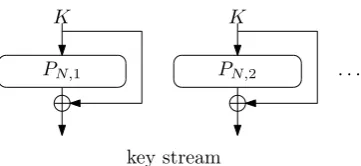
Rasta is a family of stream ciphers. To produce the keystream, it applies a per-mutation with feed-forward, as shown in Fig. 4. The input of the perper-mutation is the secret keyK, where the key sizekmatches the block size nof the underly-ing family of permutations PN,i. The keystream is generated by using different permutationsPN,iper encrypted block, which are parametrized by the nonceN and a block counter i. To ensure confidentiality, a new and unique nonce N is required for every encryption.
2.2 Permutation PN,i
Rasta’s family of permutations PN,i applies r rounds of different affine layers
Aj,N,i and non-linear layersS. Afterrrounds, a final affine layer is applied:
PN,i=Ar,N,i◦S◦Ar−1,N,i◦ · · · ◦S◦A1,N,i◦S◦A0,N,i
key stream
PN,1
K
PN,2
K
· · ·
Fig. 4.Encryption mode of Rasta.
Non-linear layer S. For the non-linear layer, we apply the χ -transforma-tion [25, Sec-transforma-tion 6.6.3], previously used inKeccak [8] and ASASA [12], to the entire block. This transformation is invertible for any odd number of bitsn[25]. For input bits xi and output bits yi, 0≤i < n, the non-linear layer is defined in (1), with all indices modulon:
y`=x`⊕x`+2⊕x`+1x`+2. (1)
Affine layers Aj,N,i. The affine layers are a simple binary multiplication of a binaryn×nmatrixMj,N,i to the input vectorx, followed by the addition of a round constant cj,N,i:
y=Mj,N,i·x⊕cj,N,i.
Generation of matrices Mj,N,i and round constants cj,N,i. We pro-pose to generate the different matrices and round constants with the help of an extendable-output function (XOF) [51] that is seeded with the number of rounds r, block size n, nonceN, andi. Hereby, the output of the XOF is first used to generate M0,N,i, a unstructured nonsingular Matrix. Several ways are possible to generate such matrices with the help of an XOF output. The first one is to add rows and check if the matrix is invertible. As pointed out by Ran-dall [55], on average it takes three tries before we end up with a nonsingular matrix. In the same paper, Randall [55] gives an algorithm to generate random nonsingularn×n matrices needing less thann2+ 3 random bits inserted in a clever way in twon×nmatrices, which are multiplied in the end. The choice of the algorithm to generate nonsingular matrices should not influence the security, just the execution time. However, communicating instances have to use the same algorithm.
2.3 Design rationale
The essential idea of Rasta is to reduce the ANDdepth as much as possible by creating a moving target, which is only evaluated once per key. Hence, we have decided to use a permutation with feed-forward, where the secret occupies the whole input and the keystream is generated by always evaluating a different permutation. Those permutations are obtained by choosing new matrices and round constants for each new permutation call, based on an XOF seeded with a public nonce and block counter. This technique allows us to treat matrices and round constants during our analysis as if they where randomly created for each different permutation (new nonce and counter pair), with the restriction that same nonce and counter pairs give us always the same permutation and hence, the same matrices and round constants. Since the XOF uses no secret, it can be publicly evaluated and thus, similar as for FLIP [49], the XOF does not influence the AND related metrics.
Choosing the matrices this way minimizes structural similarities between and within the permutation instances. The round constants remove obvious fixed-points, such as the fixed-point 0 that all instances would have in common other-wise. Furthermore, these round constants add an additional layer of protection against attacks between single instances of the permutation. The affine layer is required to be a permutation rather than a function to prevent reduction of the state space. Otherwise, if for example the final affine layer did not have full rank, then the final key feed-forward would allow an attacker to derive informa-tion about a linear subspace containing the key with each query.
Instead of smaller S-boxes for the non-linear layer, we use one large χ -transformation [25] across the entire state. Since we only need to evaluate it in forward direction, we benefit from the fact that it is very efficient to evaluate in forward direction with a degree of only 2, while its inverse has a very high degree of (t+ 1) for size (2t+ 1) [12].
2.4 Instances
Based on the security analysis done in Sect. 3, we propose block sizes for 4 to 6 rounds of Rasta aiming at 80, 128, or 256 bits of security in Table 2. These block sizes are derived from the results of our security analysis shown in Table 5 and Table 6 in Sect. 3. Since part of our analysis relies on good diffusion properties, we only recommend instances of Rasta with at least 4 rounds for use. However, from a theoretical perspective, smaller instances are also of interest and hence, we add parameters for 2 and 3 rounds (in gray) to Table 2 as well.
Table 2.Minimal block sizes for 4 to 6 rounds of Rasta aiming to provide 80, 128, or 256 bits of security (2 and 3 rounds in gray).
Security level Rounds
2 3 4 5 6
80-bit 2 320 961 3 939 327 327 219
128-bit 9 506 325 433 246 831 1 877 525 351
256-bit 40 829 356 287 426 864 861 16 167 762 975 445 939 3 545 703
Agrasta. As already mentioned, we have chosen the block sizes for Rasta in a conservative manner based on our security evaluation in Sect. 3. The block sizes of Rasta are mostly determined by the bounds we get on the maximal number of monomials and the bounds on the probability that good linear approximations exists. However, this does not mean that we have matching attacks for these bounds, in fact, as can be seen in Sect. 3, what we actually can attack is far away from these bounds. Hence, we propose Agrasta shown in Table 3.
Table 3.Instances of Agrasta.
Security level Rounds Blocksize
80-bit 4 81
128-bit 4 129
256-bit 5 257
Agrasta has a block size that matches the security level (or block size plus 1 for even security levels). For the number of rounds, we consider a minimal number of 4 rounds for the same reasons as for Rasta and add rounds until we cannot attack the construction anymore. As a consequence, Agrasta has a block size of 81-bit for 80-bit security having 4 rounds, 129-bit for 128-bit security having 4 rounds and 257-bits for 256-bit security having 5 rounds (in this case trivial linarization would work for 4 rounds).
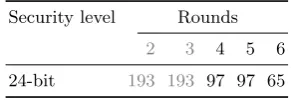
Toy version. To encourage cryptanalysis of Rasta, we specify toy versions of Rasta in Table 4. Those toy versions aim at achieving 24-bit security.
Table 4.Toy versions of Rasta.
Security level Rounds
2 3 4 5 6
3
Security analysis
In this section, we discuss various cryptanalytic approaches and argue the se-curity of the recommended parameter configurations of Rasta. We focus on key recovery attacks and assume that the attacker can obtain the keystream
K⊕PN,i(K) for arbitrary choices of (N, i). In particular, assume the attacker requires instances with a particular property of the affine layers that occurs with probabilityp. This chosen-nonce setting allows the attacker to obtain keystream for such an instance with aboutp−1 XOF queries (in key-independent precom-putation) and 1 Rasta query, instead ofp−1Rasta queries. We start out with al-gebraic attacks via linearization and Gr¨obner bases, then we describe a potential attack vector via linear approximations and argue why various classical attacks such as differential, integral, or higher order attacks are ruled out or unlikely. In Section 3.4 we then briefly describe a dedicated attack on variants that are very close to Agrasta but reduced to three rounds. Last but not least we describe various experiments on toy versions of Rasta, incl. SAT solver, Gr¨oberner-bases, and an analysis of linear properties and monomial counts. A discussion on the security of variants without the first or last affine layer can be found in our Appendix C.
3.1 Algebraic attacks
We first consider algebraic attacks that aim to recover the secret key K by solving a system of non-linear Boolean equations. These equations are collected by observing the keystream for different nonces, and setting up the algebraic normal form (ANF) for each observed instance of the permutation. All these ANF polynomials share the bits ofKas unknowns. In the following, we consider different approaches and trade-offs to solve these equations.
Trivial linearization. In this attack, the resulting non-linear system of equa-tions is solved by substituting the non-linear terms with new variables. Consider a cipher with algebraic degreeφand a key ofkbits. For such a cipher, the num-ber of unknowns in our equations is upper-bounded bykφ. Thus, after collecting at most kφ linearly independent equations, the system can definitely be solved and the key recovered. The maximum number of different monomials we can get is:
U = φ
X
i=0
k
i
. (2)
Key-guessing to reduce monomials. Guessing g out of k key bits reduces the numberU of possible monomials and hence the number of variables we need to introduce to linearize and solve the system to
U = φ
X
i=0
k −g
i
. (3)
Guessing g bits of the key reduces the data needed to perform a linearization attack. However, the linear system has to be solved 2gtimes for every key guess, giving a maximum number of bits corresponding to the security level of the scheme that can be guessed.
On the number of monomials. While the total number of monomials we can get gives us insight when the system of equations can definitely be solved, the number of monomials we get per output equation plays an important role in algebraic attacks. For instance, getting too many sparse equations might lead to a sub-system that can be solved or might enable other attacks similar to algebraic or fast algebraic attacks on stream ciphers [23,24]. Therefore, we study the average number of monomials after r rounds of Rasta, and we compare it with the worst-case number. We conclude that the number of monomials in the average case is well approximated by the worst case.
We first consider the worst case, which was already studied in the previous section. Since the S-layer has degree 2, the degree of the scheme afterr rounds is 2r, so the number of monomials is upper-bounded byP2r
i=0 k i
.
To analyze the average case, recall that the matricesA of the linear layers are uniformly distributed. Consider one round S ◦A(x) of Rasta with input
x= (x0, . . . , xk−1), and letA(x) =A·x+c:
S◦A(x)i= k−1
M
j=0 k−1
M
l=j+1
aij,l·xj·xl⊕ k−1
M
j=0
bij·xj⊕gi,
where remember that x2=xfor eachx∈
F2and where
ai
j,l=Ai+1,j·Ai+2,l⊕Ai+2,j·Ai+1,l,
bij =Ai,j⊕ci+2·Ai+1,j⊕(1⊕ci+1)·Ai+2,j,
gi=ci⊕ci+2⊕ci+1·ci+2.
First, we focus on the monomials of degree 2. The probability that a coefficient
aij,l is equal to 0 is 5/8:
P[aij,l= 0] =P[Ai+1,jAi+2,l=Ai+2,jAi+1,l= 0]+P[Ai+1,jAi+2,l=Ai+2,jAi+1,l= 1] =
3
4
2 +
1
4
2 = 5
Thus, the probability that all the coefficients of the variable xj·xl with l > j are equal to 0 is
P[aij,l= 0 ∀i= 0, . . . , k−1] =
5
8
k
,
or equivalently, at least one of these coefficients is different from 0 with proba-bility 1−(5/8)k. Since this is true for each i, we expect an average number of monomials of degree 2 equals to
k
2
·
1−
5
8
k
' k
2
,
where the approximation holds for k 1. In a similar way, we expect an av-erage number of monomials of degree 1 equal to k·(1−2−k)
' k. It follows that the average number of monomials is well approximated by the worst one6. Our experiments confirm this prediction: we observed that all the monomials of degree 1 and 2 are present in the system made by the equations of the output bits ofS◦A(x). Since the same argumentation holds for the following rounds, this justifies our claim.
Another consideration that strengthens our claim is the following. Suppose that the average number v of variables is much lower than the number w of variables in the worst case, that is, v w. Thus, given one encryption, the number of variables that one has to consider is only v. However, in order to find a solution for the given system of linear equations, one must consider other encryptions. Due to the previous hypothesis, for each one of these new encryp-tions, one expects an average number of v variables. On the other hand, since the linear layers change for each encryption, it is not possible to claim that the variables of these texts are always the same. In other words, the variables of a second encryption are in general different from the ones of the first encryption. This implies that if one uses a second encryption to find the solutions of the linear equations, the number of variables that one has to consider is on average notv, but greater thanv(and lower than 2·v). Due to the same argumentation, using rtexts, this number is on average (much) greater than v but lower than
r·v. Intuitively, if r is big enough, even if for each single text/encryption the number of variables v is lower than the total one (i.e. w), usingr texts to find the real values of these variables implies that this number is closer to w than to v. As a consequence, this provides another intuitive reason while one has to consider the worst number of variables in order to evaluate the security of this proposed encryption scheme.
Gr¨obner basis computation. Instead of linearization, one could also try to solve the non-linear system by computing a Gr¨obner basis for the system of 6 Note here that an attacker could rename the variables obtained after the linear layer,
equations. However, it is highly unlikely that this attack vector threatens our construction. The main point is that the number of unknowns is very large (starting from 219-bit blocks and keys) and the algebraic degree is not that small (starting from 24). This has to be compared with the best results to date, that to the best of our knowledge allow to solve a system with up to 148quadratic equations in 74 variables [43]. Actually, a recent technical report [11] provides further evidence that solving the corresponding system of equations for Rasta becomes quickly infeasible.
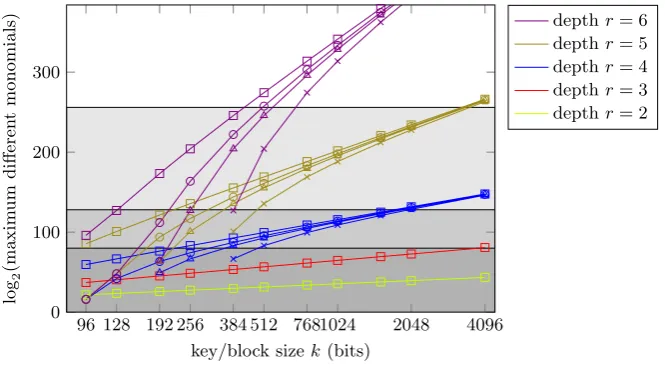
Discussion. As we have seen in this section, Rasta gives us a system of non-linear Boolean equations of a certain degreeφwith dense equations on average. This system of equations depends on the two parameters of Rasta, the block size and the ANDdepth. We have plotted the maximum number of different monomials under guessing 80-bit, 128-bit, 256-bit key information for various block sizes and ANDdepths in Fig. 5.
96 128 192 256 384 512 7681024 2048 4096 0
100 200 300
key/block sizek(bits)
log
2
(maxim
um
differen
t
monomials)
depthr= 6 depthr= 5 depthr= 4 depthr= 3 depthr= 2
Fig. 5.Trivial linearizion attack. / / / denote 0/80/128/256-bit key guess.
This is particularly interesting, since Fig. 5 gives us insight in the data an attacker has to acquire before the system can be definitely solved by using trivial linearization. At the moment, the costs of solving a linear system of U linear equations inU binary variables is aboutO(Uω) bit operations, whereωis bigger than 2. Nevertheless, the key can still be recovered with k equations in O(2k) using brute-force.
Estimating the required time complexity for solving a non-linear system with
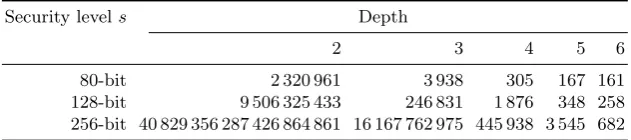
Table 5.Block sizes such that the number of monomials is greater than 2s.
Security levels Depth
2 3 4 5 6
80-bit 2 320 961 3 938 305 167 161
128-bit 9 506 325 433 246 831 1 876 348 258
256-bit 40 829 356 287 426 864 861 16 167 762 975 445 938 3 545 682
we set a limit on the number of equations acquirable by the attacker. Therefore, we apply the two following restrictions for a security level of sbits, which will influence the block and key size of Rasta:
– Choose key sizekand degreeφsuch thatPφi=0 k−ig>2s (Table 5). – Data complexity limit of√2s/kblocks.
3.2 Attacks based on linear approximations
In this section, we deal with classes of attacks that exploit linear approximations having a high biasδ.7 Although classical linear cryptanalysis [48] seems not to be applicable to Rasta in a straight forward manner, since it would require the repeated evaluation of the same Rasta permutation with different inputs, other attacks based on linear approximations can still be a threat. For instance, in the case of Rasta, an attacker can collect single evaluations of different linear approximations that are valid with a certain probability. Here, the attacker faces a problem similar to the LPN-problem and thus, algorithms similar to existing ones designed for solving the LPN-problem [15] might be applicable.
However, attacks utilizing linear approximations have in common that the data-complexity required to perform these attacks is bound to the biasδof the used linear approximations and usually lies in regions ofδ−2. Therefore, attacks exploiting linear approximations are not applicable if linear approximations that have a good bias do not exist. Hence, we want to bound the probability that a certain choice of the nonceN gives us matrices that allow linear approximations with a good biasδ.
Bounds for 2 S-layers (depth 2). First, we restrict our observations on two S-layers with one matrix M1 in between. If we restrict our observations just to the matrix M1, we can make the following statements about the quality for a certain linear characteristic, wherea0 bits are active at the input ofM1 anda1 bits are active at the output.
As already shown by Daemen [25], the correlation weight wc of a linear approximation for theχ-transformation only depends on the active bits of the 7 We do not extend this analysis to linear hulls as even for more suitable designs doing
output of the χ-transformation and its correlation is either zero or 2−wc. As noted in [7], the correlation weight is equal to half the number of active bits plus a positive number that depends on the position of the active bits. If all bits of the output are active, then the correlation weight is half the block length minus 1. Since in our case the block length is always at least the security level, we can ignore this special case and can upper-bound the bias just relying on half the number of active bits at the output of the S-layers.
However, as mentioned in the beginning of the section, we want to make statements on a linear characteristic just using the information thata0 bits are active at the output of the first S-layer and a1 bits are active on the input a second one. Thus, we have to make assumptions on the minimum number of active output bits, dependent on the number of active input bits. Let us assume that just one bit on the output of an S-layer is active. How many bits at the input can be active, so that we get a correlation, or bias different from zero? As we can see from (1), in order to determine the value of the active bit, just 3 bits of the input are needed. Hence, just these 3 bits can be used in a linear approximation of the output bit, while trying to include any other bit in a linear approximation definitely results in a bias of zero. So we know that if we have 3 active bits at the input of the S-layer, at least one output bit has to be active, while for 4 or more active input bits definitely 2, or more outputs have to be active. Considering two active output bits, at most 6 bits are used in their calculations, which in turn can be used in a linear approximation and so on. Therefore, a linear approximation using x active bits at the output might use less than 3x input bits, but never more.
Thus, we can upper-bound the correlation of a resulting linear approximation with 2−(a0+da1/3e+1)/2 and hence, the bias with 2−(a0+da1/3e)/2−1. So, our goal is to make statements about the probability that a randomly generated matrix
M1 allows linear characteristics with a0 active bits at the input and a1 active bits at the output, so that (a0+da1/3e) is smaller than a certain threshold. Consider that in Sect. 3.1, we already introduce a limit on the data complexity, we assume that linear approximations with a bias of 2−s/4 cannot be exploited in attacks, wheres is the security level in bits. As shown in the Appendix the number of invertible matrices that allow a certain fixed linear characteristic is
Qn−1
i=1(2n−2i). This number is independent of the concrete pattern. By counting the number of suitable linear characteristics, we get:
P2
h
−log2(δ)≤
s
2
i
≤ X
0<a0,a1 (a0+da1/3e)≤s/2
n
a0
n
a1
Qn−1
i=1(2n−2i)
Qn−1
i=0(2n−2i)
≤(2n−1)−1 X 0<a0,a1 (a0+da1/3e)≤s/2
n
a0
n
a1
≤(2n−1)−1 X 0≤a0,a1 (a0+a1)≤3s2
n a0 n a1
≤(2n−1)−1 X 0≤a≤3s
S0
M0 M1 S1 M2 S2 M3 S3 M4
| {z } | {z }
P1 P2
Fig. 6.Schematic of the Rasta permutations having 4 S-layers.
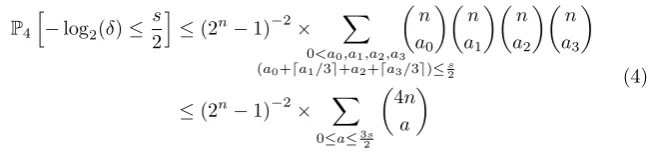
Bounds for 4 S-layers (depth 4). Fig. 6 shows the Rasta permutation having 4 S-layers. We will show bounds on the probability that randomly generated matrices allow linear characteristics having a bias higher than some threshold. As indicated in Fig. 6, we will calculate the probabilities that randomly generated matrices allowing a certain number of active bits independently for M1 and
M3, assuming that every randomly generated matrix M2 is able to connect the resulting linear characteristics.
As already mentioned, we do not want to have linear characteristics with a bias higher than 2−s/4. Hence, the probability that a matrix M
1 allows transi-tions with a0 and a1 active bits and that a matrix M3 allows transitions with
a2anda3active bits, where (a0+da1/3e+a2+da3/3e)≤s/2, should be small. We can calculate this probability by summing up the probabilities for fixeda0,
a1,a2, and a3up to this bound:
P4
h
−log2(δ)≤
s
2
i
≤(2n−1)−2× X 0<a0,a1,a2,a3 (a0+da1/3e+a2+da3/3e)≤s2
n a0 n a1 n a2 n a3
≤(2n−1)−2× X
0≤a≤3s 2
4n a
(4)
Bounds for r S-layers (depth r). Finally, we can extend the concept we have used for bounding the probability on 4 rounds to bounding the probability for an arbitrary even numberrof rounds of Rasta:
Pr
h
−log2(δ)≤
s
2
i
≤(2n−1)−r/2× X 0≤a≤3s
2 r ·n a (5)
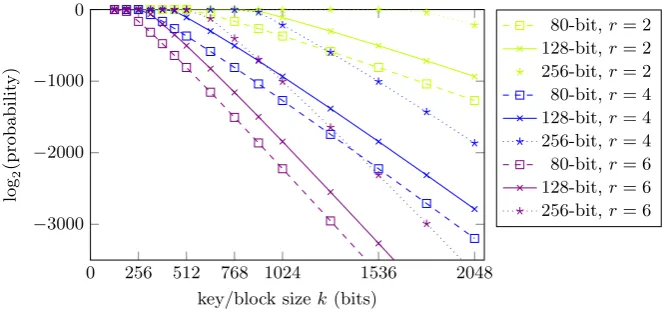
Discussion. We visualize the effects of different block sizes and depths on the probability that a linear approximation for such an instance of Rasta exists in Fig. 7. If we compare 80-bit security for 2 rounds of Rasta with 80-bit security for 4 rounds in Fig. 7, we see that we get similar probabilities for 4 rounds of Rasta, requiring just half the block size compared to two rounds. This gets already clear from equation (5), where we see that—at least for our bounds—doubling the depth has similar effects as doubling the block size.
0 256 512 768 1024 1536 2048
−3000
−2000
−1000 0
key/block sizek(bits)
log
2
(probabilit
y)
80-bit,r= 2 128-bit,r= 2 256-bit,r= 2 80-bit,r= 4 128-bit,r= 4 256-bit,r= 4 80-bit,r= 6 128-bit,r= 6 256-bit,r= 6
Fig. 7. Probability that a linear trail/approximation with bias above for a certain security level exists.
Table 6.Block sizes where−log2(P) matchess.
Security levels r= 2 r= 4 r= 6
80-bit 654 327 218
128-bit 1050 525 350
256-bit 2106 1053 702
where the squared biasδ2matches our data limit. Hence, the block sizes for this table have been chosen so that the probability that a linear approximation with a bias ≥2−s/4 exists (for one random choice of the linear layer) exceeds 2−s, wheresis the security level. Therefore, for block sizes exceeding the ones given in Table 6, the probability that one useable bias exists gets smaller and smaller.
3.3 Classical attacks exploiting the structure
In this section, we discuss some classical cryptographic attacks that exploit the “structure” of cryptographic primitives. This includes, among others, differential attacks [10], higher-order differential attacks [46], cube attacks [30] and integral attacks [45]. All these attacks have in common that they rely on the fact that an adversary is able to evaluate the cryptographic primitive (equation system) more than once with different inputs. Since Rasta uses different nonce-based matrices and constants for encryption/decryption, these attacks are thwarted.
Furthermore, even if we consider related-key attacks, where the attacker is able to use different keys under the same nonce and hence is able to evaluate the permutation of Rasta multiple times, it is unlikely that a good exploitable differential characteristic exists following similar arguments as used in Sect. 3.2.
Higher-order differential and cube attacks. Higher-order differential and cube attacks exploit the algebraic degree of the output functions of a crypto-graphic primitive. Considering the fact that Rasta aims to have a small AND-depth, the output functions of Rasta only have a low degree. For instance, Rasta with depth 4 has an algebraic degree of 16. Having such a low degree would be a major threat for classical permutation based designs, where a single permutation can be evaluated multiple times.
For instance, in a related-key scenario, an attacker could evaluate the same permutation of depth-4 Rasta 216times to mount a cube attack or exploit the re-sulting non-random properties in another way. Hence, Rasta is clearly not secure in such a related-key scenario. However, for single-key attacks, each individual output function can only be evaluated once. Therefore, higher-order differential attacks and cube attacks, which rely on evaluating these functions multiple times are effectively hindered.
Integral attacks. Integral attacks exploit the structure of the linear layer in combination with properties of the used S-boxes. In addition to the fact that the used linear layer of Rasta is highly unstructured, it changes for every application of the nonce. Moreover, we only get one evaluation per permutation instance. Both facts make the application of integral attacks on Rasta unlikely.
3.4 On the relative size of block and security parameter for depth 3
In this section we show a guess-and-determine attack to three-round (toy) vari-ants of Rasta where the block size matches the security parameter (n=k=s), or the block size slightly exceeds the security parameter. In particular, the at-tack is applicable to round-reduced variants of Agrasta. This atat-tack is based on a two-round analysis shown in Appendix A and also requires knowledge of only a single keystream blockKn. As an additional prerequisite, it needs a weakness in the matrixM2of the affine layerA2,N,j. The adversary can query the XOF in an off-line phase to identify a nonce-counter pair (N, i) that yields such a weak matrix. In the following, we briefly describe the details of the attack, including an estimation on the probability of a weak matrix to occur.
We enumerate byXi the states after the (i
−1)-th affine layer (e.g., X1 =
A0,N,j(K)) and by Yi = S(Xi) the states after the subsequent S-layer. The attack starts at X1. We guess g
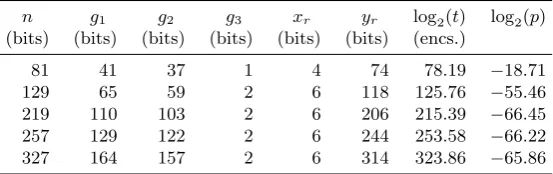
Table 7. Best found parameters for the guess-and-determine attack on three-round Agrasta. Encs. = encryptions;ps = Probability of a weak affine layer.
n g1 g2 g3 xr yr log2(t) log2(p)
(bits) (bits) (bits) (bits) (bits) (bits) (encs.)
81 41 37 1 4 74 78.19 −18.71
129 65 59 2 6 118 125.76 −55.46
219 110 103 2 6 206 215.39 −66.45
257 129 122 2 6 244 253.58 −66.22
327 164 157 2 6 314 323.86 −65.86
In backward direction, we can formulate K, and from it X4 = K
⊕KN, and
Y3=A−1
3,N,j(X4) also as a linear equation system in the unknowns fromX1. Next, from Y1, we can guess g
2 < n/2 bits of X2 at consecutive even bit indices. Therefore, we obtain g2 further equations for then−g1 remaining un-knowns. Moreover, we can formulate 2·g2 bits ofY2 as linear equations in the unknowns fromX1. We have to choose the 2g
2bits in a way such that we obtain a subset ofyr=g2−2 consecutive bits ofX3 to depend only on the 2g2 bits of
Y2 throughA
2,N,j, the “weak” linear layer.
LetMatndenote the set of all non-singular matrices fromFn2×n. Letx, y∈Fn2 be Boolean vectors withx=M·y. Letu, v∈Fn2 denote further Boolean vectors that represent masks; we call a bitxirelevant iffui= 1 andyirelevant iffvi= 1. We call a matrixM ∈Matn weak iff for alli, j∈ {0, . . . , n−1}withvi= 1 and
uj= 0, it holds thatMi,j= 0. So, ifM is weak, all relevant bits ofxdepend on only relevant bits of y.
Naturally, the probability for a linear layer to be weak depends on the num-bers of relevant bitsxrin x, relevant bitsyrin y, and the options to distribute them. In M, we need (n−yr)·xr zero entries and to have the relevant bits in both Y2 and X3 to be located at consecutive positions. Hence, there exist (n−yr+ 1) consecutive bit positions inY2 and (n−xr+ 1) positions in X3. So, we can approximate
P[M Matn :M is weak]≥
(n−xr+ 1)(n−yr+ 1) 2(n−yr)·xr .
We search for a region of xr consecutive relevant bits in X3 such they depend only on theyr relevant bits inY2. Since those bits are linear in unknowns from
X1, we can formulate also thexrbits ofX3as those. Since they are consecutive, we can guess g3 =b(xr−2)/2cbits at consecutive even indices among them. This yields againg3equations for the unknowns formX1. Moreover, the guessed bits allow to formulate 2g3 further linear equations for 2g3 consecutive bits of
Y3 through theS-layer since we already formulated Y3 as equations from the backward direction before.
We require that thexr consecutive bits in X3 depend only on the yr= 2g2 bits ofY2. We guessg =g
1+g2+g3=dn/2e+g2+b(xr−2)/2cbits atX1,
X2, andX3. We obtaing
X1. The equation system can be solved with computational complexity
t= 2g1+g2+g3
·(n− dn/2e)2.8 binary operations.
Rasta with rrounds consists of (r+ 1)(n2+n) XORs in the linear layers, 2rn XORs in theS-layers,nXORs in the feed-forward as well as (r+ 1)n2 multipli-cations by constants in the linear layers, plusrnmultiplications in theS-layers. Forr= 3, this sums to 8n2+ 14nbinary operations. We use this figure to com-pare the effort in terms of three-round Rasta encryptions and optimize the choice ofg2, g3, andxr with respect to lowest computational effort while remaining a practical probability that a weak matrix occurs of at least 2−80. The results of the optimal values for the interesting state sizes are provided in Table 7. We im-plemented a proof of concept of the attack for small state sizes of n∈ {11,21}, tested it with 100 random keys and weak affine layers each.
3.5 Experiments on small block size variants of Rasta
Number of Monomials. To confirm the analysis made in Section 3.1, we looked at a reduced version withn= 21 bits. We start with a state where each bit is a variable and compute one round, that isS◦A(x). As expected, we found out that all the monomials of degree less or equal to 2 are present in the resulting state. Similarly, we start with a formal statexand computeS−1◦A−1(x). Since
n = 21, the degree of S−1 is 11. On average on 20 instances (i.e. 20 different linear layers), we obtained that the resulting state contains 1394774 monomials out of the 1401292 monomials of degree less or equal to 11, that is 99.5%.
Practical Gr¨obner basis experiments. As mentioned above, [11] provided some experiments on computing a Gr¨obner basis using the algorithm F4 as implemented in Magma. Those experiments, limited to two and three rounds and a block size of at most 101 (for two rounds) and 49 (for three rounds) confirmed our intuition that the security of Rasta is not threatened by this attack vector.
Practical SAT solver experiments. To practically evaluate the performance of automatic solvers for Rasta, we solved small-scale key-recovery challenges with a state-of-the-art SAT solver. Each challenge consists of finding ak-bit key input that generates a randomly generated keystream, for a randomly sampled nonce. Such a challenge is expected to have a valid solution with a probability of roughly 63 %, which was confirmed by our experiments. We translated 8 chal-lenges per depth d ∈ {1,2,3} and block sizek ∈ {11,13, . . . ,41} (if d= 1) or
17 19 21 23 25 27 29 31 33 35 37 39 0
900 1,800 2,700 3,600 timeout
Block sizek
Seconds
depthd= 1 depthd= 2 depthd= 3
Fig. 8.SAT solver runtime for successful key-recovery on toy parameter sizes: Average, minimum, and maximum runtime for up to 8 challenges per block size.
on Intel Xeon E5-2630v3 CPUs (8 cores max. 3.2 GHz, 92 GB DDR4 RAM). Surprisingly, the solvers performed worse than exhaustive search for all depths
d >1. It appears the large, dense linear layers do not interact well with the SAT solver’s decision heuristics.
Linear properties. To test the linear properties of the cipher, we consider versions with small block sizes and we compute the linear approximation table of the full cipher. Recall thatLAT[a, b] = (1/2)×Wa,b whereWa,b is the Walsh coefficient. In our case, we have:Wa,b=PK∈Fn2(−1)
a·K⊕b·KN,i, whereK is the key andKN,iis the keystream for block iof nonceN.
As explained previously, to measure the resistance of these reduced versions we should not only look at the value of the higher coefficients of their LAT but also see if it is likely that the same linear approximation holds with high proba-bility for various instances. To apprehend these questions, we run the following experiments for variants on 9 and 11 bits and for different number of rounds:
– Pick 50 linear layers at random. For each of them, look for the maximum (in absolute value) of the LAT coefficients. Report the maximum and the minimum over the 50 maximums, together with their average (first three lines of Table 8).
– Pick 50 linear layers at random. Compute the average LAT (that is a LAT where each coefficient is the average of the corresponding (absolute) values of the 50 instances). Look for the maximum of this LAT (line 4 in Table 8). The obtained results in Table 8 show that the linear properties of variants of 4 and more rounds are close to the one of random permutations.
Table 8.Experiments on small scaled variants of Rasta. We look at 50 instances of each variant, and for each we note the maximum absolute coefficient of its LAT. We report below the maximum, the minimum and the average of these maximums. We also report the maximum of the average of the LAT.
n= 9 2 rounds 3 rounds 4 rounds 5 rounds random
max 128 64 60 60 60
min 60 50 46 48 50
average 72.72 53.88 53.40 52.96 52.92
max in av. LAT 13.68 13.76 14.00 14.12 14.36
n= 11 2 rounds 3 rounds 4 rounds 5 rounds random
max 384 160 132 130 126
min 184 112 112 110 112
average 256.64 121.92 119.44 117.64 118.40
max in av. LAT 29.44 30.72 29.32 28.96 29.20
Fig. 9.Pollock representation of the LAT for 1, 2 and 3-round versions of one instance of the cipher on 9 bits.
4
Validation of design approach through benchmarking
of FHE use-case
To test the feasibility of our proposed design approach for various choices for the ANDdepth, we implemented Rasta using Helib [40,41], which implements the BGV homomorphic encryption scheme [18] and which was also used to eval-uate AES-128 [35,34] and earlier custom designs that minimize the number of multiplications. Our implementation represents each plaintext, ciphertext and key bits as individual HE ciphertexts on which XOR and AND operations are performed. In the HE setting the number of AND gates is not the main deter-minant of complexity. Instead, the ANDdepth of the circuit largely determines the cost of XOR and AND, where AND is more expensive than XOR. However, due to the high number of XORs in Rasta, the cost of the linear layer is not negligible. In our implementation we use the “method of the four Russians” [1] to reduce the number of HE ciphertext additions from O(n2) toO(n2/log(n)).
Caveats. All earlier works of custom constructions use Helib for comparative timings. However things are vague in this part of the literature as security levels are not given (automatically determined by Helib from within a wide range of possibilities). Also the number of slots (i.e. blocks processed in parallel) is not under the direct control of the user (and as can be seen from the comparison tables in the literature). Hence we caution the reader to not interpret too much into the detailed timings. These timings should rather be seen as supporting evidence for the practical feasibility of a design approach. In contrast to earlier benchmarks we give the concrete (conjectured) security level of the instantiation of the underlying BGV scheme. We also try to get that BGV security level close to the security level of the cipher. Earlier comparisons were always done with at most 80-bit of security.
Discussion of timing results. A detailed overview of our benchmarks is given in Table 9 and 10. We use the publicly available Helib implementation of LowMC and compare it with our implementation of Rasta in various settings. We try parameters for 80-bit, 128-bit, and 256-bit security. In addition to the case of a pure cipher evaluation (Table 9), we also consider the case where the BGV parameters are chosen such that there is enough “room” for more noise coming from operations that constitute the actual reason (Table 10). For comparability with work in [20,49] we also chose to allow for 7 additional levels for this purpose. Note that we also include the time spent on parts that are not depending on the key, i.e., to generate all the affine layers. For simplicity, we re-use the approach that is used in LowMC to generate random invertible matrices. Only for larger block sizes this is not completely negligible, but it always amounts for less than 10 % of the overall time. This confirms our model to focus on AND-related metrics of those parts of the algorithm that depend on the key.
Table 9. Performance comparison of Rasta on Intel(R) Core(TM) i7-4650U CPU @ 1.70GHz CPU with 8GB of RAM. BVG parameters chosen to allow homomorphic evaluation of cipher only. n is the block size or the number of encrypted bits, d is the multiplicative depth, # slots is the number of slots used in HElib, ttotal is the
total running time of the decryption in seconds and includes the time to generate all nonce-dependant computations.Trivium and Kreyvium estimated based on [20], FLIP estimated based on [49], both using LowMCv1 numbers as a point of reference and linear extrapolation.
Cipher n d ttotal BGV slots BGV levels BGV security
80-bit cipher security
LowMC v1 128 11 884.7 600 13 64.24
LowMC v2 (low latency) 128 12 546.0 600 14 75.82
LowMC v2 (throughput) 256 12 733.6 600 14 62.83
Trivium 57 12 ∼500.0 504 – –
Trivium 136 13 ∼1500.0 682 – –
FLIP 1 4 ∼0.4 378 5 –
Rasta 327 4 110.5 378 5 50.72
Rasta 327 5 206.2 150 7 78.60
Rasta 219 6 159.0 150 7 78.60
Agrasta 81 4 20.0 378 5 50.72
128-bit cipher security
LowMC v1 256 12 2807.6 720 15 132.26
LowMC v1 256 12 2298.8 720 15 105.72
LowMC v2 256 14 2981.5 720 17 88.01
Kreyvium 46 12 ∼1090.0 504 – –
Kreyvium 125 13 ∼2530.0 682 – –
FLIP 1 4 ∼3.3 630 6 –
Rasta 525 5 464.5 330 7 103.97
Rasta 351 6 815.0 600 9 86.37
Agrasta 129 4 50.3 150 5 117.38
256-bit cipher security
LowMC v2 512 18 8142.7 1285 20 107.67
Kreyvium Not specified for this security level
FLIP Not specified for this security level
Rasta 703 6 1345.5 720 9 149.43
Agrasta 257 5 1141.1 720 9 212.90
are estimates based on [20], FLIP numbers are estimates based on [49], both using LowMCv1 numbers as a point of reference and linear extrapolation.
Table 10. Performance comparison of Rasta, like Table 9, but BGV parameters are chosen to allow homomorphic evaluation of 7 more levels on top of the cipher evaluation.
Cipher n d ttotal BGV slots BGV levels BGV security
80-bit cipher security
LowMC v1 128 11 2011.9 720 20 74.05
LowMC v2 (throughput) 256 12 1721.3 600 21 62.83
Trivium 57 12 ∼1560.0 504 – –
Trivium 136 13 ∼4050.0 682 – –
FLIP 1 4 ∼3.5 600 12 –
Rasta 327 4 397.8 224 12 89.57
Rasta 327 4 609.6 600 13 62.83
Rasta 327 5 766.7 600 14 62.83
Rasta 219 6 610.6 600 14 62.83
Agrasta 81 4 98.9 600 12 81.41
128-bit cipher security
LowMC v1 256 12 3785.2 480 21 106.31
Kreyvium 12 42 ∼1760.0 504 – –
Kreyvium 13 124 ∼4430.0 682 – –
FLIP 1 4 ∼39.0 720 13 –
Rasta 525 5 912.1 682 14 90.39
Rasta 351 6 2018.6 720 15 110.74
Agrasta 129 4 217.4 682 12 127.50
256-bit cipher security
LowMCv2 Too big to run
Kreyvium Not specified for this security level
FLIP Not specified for this security level
Rasta 703 6 5543.2 720 16 89.93
Agrasta 257 5 1763.8 1800 15 210.68
However, taking the number of encrypted bits into account the comparison with Rasta seems to be in favour of Rasta.
One interesting thing to note here is that in some cases we were not able to successfully complete the cipher evaluation, despite seemingly moderate parame-ter sizes. At the 256-bit security level LowMC instances could only be computed purely, but not when 7 additional levels of homomorphic operations are still al-lowable. With Rasta it was possible. Other designs do not offer parameter-sets for such high security levels.
algorithm of Randall [55] for the generation of the matrices on an Intel Core i5-4200U CPU. For Rasta, we measure a performance between 900 000 (6 rounds and 219-bit blocks) and 3 390 000 (6 rounds and 703-bit blocks) cycles per byte. In the case of Agrasta, the performance ranges from 235 000 to 915 000 cycles per byte. Clearly, we expect that the performance can be improved drastically for implementations that just consider fixed block sizes.
5
Conclusion and future work
Summary. We studied Rasta constructions where the substitution layer is chosen to be of low ANDdepth and public and fixed, but each affine layer is different, derived from a public nonce and various counters. Our conclusion is that they are interesting candidates for schemes that try to offersimultaneouslya very low ANDdepth and a very low number of AND computations per encrypted bit. This contributes to a better understanding of the limits of what concrete symmetric-key constructions can achieve.
Implementations and Applications. Applications for symmetric schemes that minimize metrics like those we consider in this paper are currently inves-tigated in various lines of work [2,4,20,38,49]. To test the applicability of our theoretical work, we chose the FHE setting (using HElib) and benchmarked actual implementations of Rasta, concluding that balanced choices of instanti-ations appear to be in the same ballpark as other specialized approaches. Our more aggressively parameterized variants termed ‘Agrasta’ result in our HElib experiments in an improvement of around one order of magnitude. It would be interesting to test applications of Rasta in various other settings, like secure multiparty communication protocols. Due to its low depth it will be especially beneficial for all those protocols where the round-complexity is linear in the ANDdepth of the evaluated circuit (e.g. GMW, tiny-OT).
Cryptanalysis. To better understand the security offered by Rasta, we ex-plored various attack vectors including algebraic attacks, linear approximations and statistical attacks and choose parameters for the instantiations of Rasta to rule them out in aconservative way. While we conclude that known attacks do not threaten our design, we encourage further cryptanalysis and also proposed concrete toy versions to that end.
Improving the affine layer. As we have shown, the huge amount of XORs influences performance in targeted applications, and even more so considerably slows down a “plain” implementation of Rasta. New ideas for linear-layer design are needed which impose structure in one way or another which on one hand allows for significantly more efficient implementations while at the same time still resist attacks and allows for arguments against such attacks.
Acknowledgments. This research was supported by H2020 project Pris-macloud, grant agreement n◦644962 and by the Austrian Science Fund (project
P26494-N15).
References
1. Albrecht, M.R., Bard, G.V., Hart, W.: Algorithm 898: Efficient multiplication of dense matrices over GF(2). ACM Trans. Math. Softw. 37(1) (2010)
2. Albrecht, M.R., Grassi, L., Rechberger, C., Roy, A., Tiessen, T.: Mimc: Efficient encryption and cryptographic hashing with minimal multiplicative complexity. In: ASIACRYPT. LNCS, vol. 10031, pp. 191–219 (2016)
3. Albrecht, M.R., Rechberger, C., Schneider, T., Tiessen, T., Zohner, M.: Ciphers for MPC and FHE. Cryptology ePrint Archive, Report 2016/687
4. Albrecht, M.R., Rechberger, C., Schneider, T., Tiessen, T., Zohner, M.: Ciphers for MPC and FHE. In: EUROCRYPT. LNCS, vol. 9056, pp. 430–454. Springer (2015)
5. Applebaum, B., Haramaty, N., Ishai, Y., Kushilevitz, E., Vaikuntanathan, V.: Low-complexity cryptographic hash functions. In: ITCS 2017. pp. 7:1–7:31 (2017), https://doi.org/10.4230/LIPIcs.ITCS.2017.7
6. Applebaum, B., Ishai, Y., Kushilevitz, E.: Cryptography in NC0. SIAM J. Comput. 36(4), 845–888 (2006)
7. Bertoni, G., Daemen, J., Peeters, M., Van Assche, G.: The Keccak reference (ver-sion 3.0) (2011),http://keccak.noekeon.org
8. Bertoni, G., Daemen, J., Peeters, M., Van Assche, G.: Keccak specifications. Sub-mission to NIST (Round 3) (2011),http://keccak.noekeon.org
9. Biere, A.: Lingeling, Plingeling and Treengeling entering the SAT Competition 2013. In: Balint, A., Belov, A., Heule, M., J¨arvisalo, M. (eds.) SAT Competition 2013. vol. B-2013-1, pp. 51–52 (2013),http://fmv.jku.at/lingeling/
10. Biham, E., Shamir, A.: Differential cryptanalysis of des-like cryptosystems. In: CRYPTO. LNCS, vol. 537, pp. 2–21. Springer (1990)
11. Bile, C., Perret, L., Faug`ere, J.C.: Algebraic cryptanalysis of RASTA. technical report (2017)
12. Biryukov, A., Bouillaguet, C., Khovratovich, D.: Cryptographic schemes based on the ASASA structure: Black-box, white-box, and public-key (extended abstract). In: ASIACRYPT. LNCS, vol. 8873, pp. 63–84. Springer (2014)
13. Biryukov, A., Perrin, L.: On reverse-engineering s-boxes with hidden design criteria or structure. In: CRYPTO. LNCS, vol. 9215, pp. 116–140. Springer (2015) 14. Biryukov, A., Shamir, A.: Structural cryptanalysis of SASAS. J. Cryptology 23(4),
505–518 (2010)
15. Blum, A., Kalai, A., Wasserman, H.: Noise-tolerant learning, the parity problem, and the statistical query model. J. ACM 50(4), 506–519 (2003)
16. Boneh, D., Eskandarian, S., Fisch, B.: Post-quantum EPID group signatures from symmetric primitives. Cryptology ePrint Archive, Report 2018/261 (2018),https: //eprint.iacr.org/2018/261
17. Boyar, J., Peralta, R., Pochuev, D.: On the multiplicative complexity of Boolean functions over the basis (cap, +, 1). Theor. Comput. Sci. 235(1), 43–57 (2000) 18. Brakerski, Z., Gentry, C., Vaikuntanathan, V.: Fully homomorphic encryption
19. Brakerski, Z., Gentry, C., Vaikuntanathan, V.: (leveled) fully homomorphic en-cryption without bootstrapping. In: ITCS. pp. 309–325. ACM (2012)
20. Canteaut, A., Carpov, S., Fontaine, C., Lepoint, T., Naya-Plasencia, M., Pail-lier, P., Sirdey, R.: Stream ciphers: A practical solution for efficient homomorphic-ciphertext compression. In: FSE. LNCS, vol. 9783, pp. 313–333. Springer (2016) 21. Chase, M., Derler, D., Goldfeder, S., Orlandi, C., Ramacher, S., Rechberger, C.,
Slamanig, D., Zaverucha, G.: Post-quantum zero-knowledge and signatures from symmetric-key primitives. In: CCS. pp. 1825–1842. ACM (2017)
22. Coron, J.S., Lepoint, T., Tibouchi, M.: Scale-invariant fully homomorphic encryp-tion over the integers. In: PKC. LNCS, vol. 8383, pp. 311–328. Springer (2014) 23. Courtois, N.: Fast algebraic attacks on stream ciphers with linear feedback. In:
CRYPTO. LNCS, vol. 2729, pp. 176–194. Springer (2003)
24. Courtois, N., Meier, W.: Algebraic attacks on stream ciphers with linear feedback. In: EUROCRYPT. LNCS, vol. 2656, pp. 345–359. Springer (2003)
25. Daemen, J.: Cipher and hash function design – Strategies based on linear and differential cryptanalysis. Ph.D. thesis, Katholieke Universiteit Leuven (1995) 26. De Canni`ere, C.: Trivium: A stream cipher construction inspired by block cipher
design principles. In: ISC. LNCS, vol. 4176, pp. 171–186. Springer (2006)
27. Derler, D., Ramacher, S., Slamanig, D.: Post-quantum zero-knowledge proofs for accumulators with applications to ring signatures from symmetric-key primitives. In: PQCrypto. pp. 419–440 (2018)
28. Dinur, I., Dunkelman, O., Kranz, T., Leander, G.: Decomposing the ASASA block cipher construction. Cryptology ePrint Archive, Report 2015/507
29. Dinur, I., Liu, Y., Meier, W., Wang, Q.: Optimized interpolation attacks on lowmc. In: ASIACRYPT. LNCS, vol. 9453, pp. 535–560. Springer (2015)
30. Dinur, I., Shamir, A.: Cube attacks on tweakable black box polynomials. In: EU-ROCRYPT. LNCS, vol. 5479, pp. 278–299. Springer (2009)
31. Dobraunig, C., Eichlseder, M., Mendel, F.: Higher-order cryptanalysis of lowmc. In: ICISC. LNCS, vol. 9558, pp. 87–101. Springer (2015)
32. Duval, S., Lallemand, V., Rotella, Y.: Cryptanalysis of the FLIP family of stream ciphers. In: CRYPTO. LNCS, vol. 9814, pp. 457–475. Springer (2016)
33. Freedman, M.J., Ishai, Y., Pinkas, B., Reingold, O.: Keyword search and oblivious pseudorandom functions. In: TCC. LNCS, vol. 3378, pp. 303–324. Springer (2005) 34. Gentry, C., Halevi, S., Smart, N.P.: Homomorphic evaluation of the AES circuit.
Cryptology ePrint Archive, Report 2012/099
35. Gentry, C., Halevi, S., Smart, N.P.: Homomorphic evaluation of the AES circuit. In: CRYPTO. LNCS, vol. 7417, pp. 850–867. Springer (2012)
36. Gilbert, H., Plˆut, J., Treger, J.: Key-recovery attack on the ASASA cryptosystem with expanding s-boxes. In: CRYPTO. LNCS, vol. 9215, pp. 475–490. Springer (2015)
37. Goldreich, O., Micali, S., Wigderson, A.: How to play any mental game or A completeness theorem for protocols with honest majority. In: STOC. pp. 218–229. ACM (1987)
38. Grassi, L., Rechberger, C., Rotaru, D., Scholl, P., Smart, N.P.: Mpc-friendly sym-metric key primitives. In: CCS. pp. 430–443. ACM (2016)
39. Grosso, V., Leurent, G., Standaert, F.X., Varici, K.: Ls-designs: Bitslice encryption for efficient masked software implementations. In: FSE. LNCS, vol. 8540, pp. 18–37. Springer (2014)
41. Halevi, S., Shoup, V.: Algorithms in helib. In: CRYPTO. LNCS, vol. 8616, pp. 554–571. Springer (2014)
42. Hazay, C., Lindell, Y.: Efficient protocols for set intersection and pattern matching with security against malicious and covert adversaries. In: TCC. LNCS, vol. 4948, pp. 155–175. Springer (2008)
43. Joux, A., Vitse, V.: A crossbred algorithm for solving boolean polynomial systems. Cryptology ePrint Archive, Report 2017/372
44. Katz, J., Kolesnikov, V., Wang, X.: Improved non-interactive zero knowledge with applications to post-quantum signatures. Cryptology ePrint Archive, Report 2018/475 (2018),https://eprint.iacr.org/2018/475
45. Knudsen, L.R., Wagner, D.A.: Integral cryptanalysis. In: FSE. LNCS, vol. 2365, pp. 112–127. Springer (2002)
46. Lai, X.: Higher order derivatives and differential cryptanalysis. In: Communications and Cryptography: Two Sides of One Tapestry. pp. 227–233. Kluwer Academic Publishers (1994)
47. Laur, S., Talviste, R., Willemson, J.: From oblivious AES to efficient and secure database join in the multiparty setting. In: ACNS. LNCS, vol. 7954, pp. 84–101. Springer (2013)
48. Matsui, M.: Linear cryptanalysis method for DES cipher. In: EUROCRYPT. LNCS, vol. 765, pp. 386–397. Springer (1993)
49. M´eaux, P., Journault, A., Standaert, F.X., Carlet, C.: Towards stream ciphers for efficient FHE with low-noise ciphertexts. In: EUROCRYPT. LNCS, vol. 9665, pp. 311–343. Springer (2016)
50. Minaud, B., Derbez, P., Fouque, P.A., Karpman, P.: Key-recovery attacks on ASASA. In: ASIACRYPT. LNCS, vol. 9453, pp. 3–27. Springer (2015)
51. National Institute of Standards and Technology: FIPS PUB 202: SHA-3 Standard: Permutation-Based Hash and Extendable-Output Functions. U.S. Department of Commerce (August 2015)
52. Nielsen, J.B., Nordholt, P.S., Orlandi, C., Burra, S.S.: A new approach to practical active-secure two-party computation. In: CRYPTO. LNCS, vol. 7417, pp. 681–700. Springer (2012)
53. Perrin, L., Promitzer, A., Ramacher, S., Rechberger, C.: Improvements to the linear layer of lowmc: A faster picnic. Cryptology ePrint Archive, Report 2017/1148 (2017),https://eprint.iacr.org/2017/1148
54. Raddum, H.: Personal communication (2017)