Conversions among Several Classes of Predicate Encryption and
Applications to ABE with Various Compactness Tradeoffs
Nuttapong Attrapadung∗1, Goichiro Hanaoka†1, and Shota Yamada‡1
1National Institute of Advanced Industrial Science and Technology (AIST).
July 13, 2015
Abstract
Predicate encryption is an advanced form of public-key encryption that yield high flexibility in terms of access control. In the literature, many predicate encryption schemes have been proposed such as fuzzy-IBE, KP-ABE, CP-ABE, (doubly) spatial encryption (DSE), and ABE for arithmetic span programs. In this paper, we study relations among them and show that some of them are in fact equivalent by giving conversions among them. More specifically, our main contributions are as follows:
− We show that monotonic, small universe KP-ABE (CP-ABE) with bounds on the size of attribute sets and span programs (or linear secret sharing matrix) can be converted into DSE. Furthermore, we show that DSE implies non-monotonic CP-ABE (and KP-ABE) with the same bounds on pa-rameters. This implies that monotonic/non-monotonic KP/CP-ABE (with the bounds) and DSE are all equivalent in the sense that one implies another.
− We also show that if we start from KP-ABE without bounds on the size of span programs (but bounds on the size of attribute sets), we can obtain ABE for arithmetic span programs. The other direction is also shown: ABE for arithmetic span programs can be converted into KP-ABE. These results imply, somewhat surprisingly, KP-ABE without bounds on span program sizes is in fact equivalent to ABE for arithmetic span programs, which was thought to be more expressive or at least incomparable.
By applying these conversions to existing schemes, we obtain many non-trivial consequences. We obtain the first non-monotonic, large universe CP-ABE (that supports span programs) with constant-size ciphertexts, the first KP-ABE with constant-constant-size private keys, the first (adaptively-secure, multi-use) ABE for arithmetic span programs with constant-size ciphertexts, and more. We also obtain the first attribute-based signature scheme that supports non-monotone span programs and achieves constant-size signatures via our techniques.
Keywords. Attribute-based encryption, doubly spatial encryption, generic conversion, constant-size ciphertexts, constant-size keys, arithmetic span programs
∗
†
‡
1
Introduction
Predicate encryption (PE) is an advanced form of public-key encryption that allows much flexibility. In-stead of encrypting data to a target recipient, a sender will specify in a more general way about who should
be able to view the message. In predicate encryption for a predicateR, a sender can associate a ciphertext
with a ciphertext attributeY while a private key is associated with a key attributeX. Such a ciphertext can
then be decrypted by such a key if the predicate evaluationR(X, Y)holds true.
There exist many classes of PE, each is defined by specifying a corresponding class of predicates. One
notable class is attribute-based encryption (ABE) [40,25] for span programs (or equivalently, linear secret
sharing schemes), of which predicate is defined over key attributes being a span program and ciphertext attributes being a set of attributes, and its evaluation holds true if the span program accepts the set. This is called key-policy ABE (KP-ABE). There is also ciphertext-policy ABE (CP-ABE), where the roles of key
and ciphertext attributes are exchanged. Another important class is doubly spatial encryption (DSE) [26],
of which predicate is defined over both key and ciphertext attributes being affine subspaces, and its eval-uation holds true if both subspaces intersect. Very recently, a new important class of PE, that is called
attribute encryption for arithmetic span programs is defined in [29]. They showed such a PE scheme is
useful by demonstrating that the scheme can be efficiently converted into ABE for arithmetic branching programs for both zero-type and non-zero type predicates. If the scheme satisfies a certain requirement for efficiency (namely, encryption cost is at most linear in ciphertext predicate size), it is also possible to ob-tain a publicly verifiable delegation scheme for arithmetic branching programs, by exploiting a conversion
shown in [38]. Furthermore, they gave a concrete construction of such scheme.
Compared to specific constructions of predicate encryption [31, 32, 34, 44, 22, 20] (to name just
a few) that focus on achieving more expressive predicates and/or stronger security guarantee, relations among predicate encryption schemes are much less investigated. The purpose of this paper is to improve our understanding of relations among them.
1.1 Our Results
Relations among PE.Towards the goal above, we study relations among PE and show that some of them are in fact equivalent by giving generic conversion among them. We first investigate the relation among ABE with some bounds on parameters (the size of attribute sets and the size of span programs) and DSE. We have the following results:
− First, we show a conversion from KP-ABE (or CP-ABE) with the bounds on parameters into DSE
(without key delegation, in Section 3). Such an implication is not straightforward in the first place.
Intuitively, one reason stems from the different nature between both predicates: while DSE can be considered as an algebraic object that involves affine spaces, ABE can be seen as a somewhat more combinatorial object that involves sets (of attributes). Our approach involves some new technique for “programming” a set associated to a ciphertext and a span program associated to a private key in the KP-ABE scheme so that they can emulate the relation for doubly spatial encryption.
− We then extend the result of [26], which showed that DSE implies CP/KP-ABE with large universes.
We provide a new conversion from DSE (without delegation) to non-monotonic CP/KP-ABE with
large universes (in Section4). We note that the resulting schemes obtained by the above conversions
have some bounds on parameters. In the conversion, we extensively use a special form of polynomial
introduced in [30] and carefully design a matrix so that DSE can capture a relation for ABE.
large-n-DSE mono,small(¯k,`,¯m, ϕ¯ )KP-ABE
mono,large(¯k,`,¯m, ϕ¯ )KP-ABE
non-mono,large(¯k,`,¯m, ϕ¯ )KP-ABE mono,small(¯k,−,−,−)KP-ABE non-mono,large(¯k,−,−,−)KP-ABE
KASP
mono,small(¯k,`,¯m, ϕ¯ )CP-ABE
mono,large(¯k,`,¯m, ϕ¯ )CP-ABE
non-mono,large(¯k,`,¯m, ϕ¯ )CP-ABE mono,small(¯k,−,−,−)CP-ABE non-mono,large(¯k,−,−,−)CP-ABE
CASP
Sect. 3
[26]
Sect. 4
trivial trivial trivial trivial
App. C
Sect. 5
Sect. 3
[26]
Sect. 4 trivial trivial trivial
trivial
Sect. 5 App. C
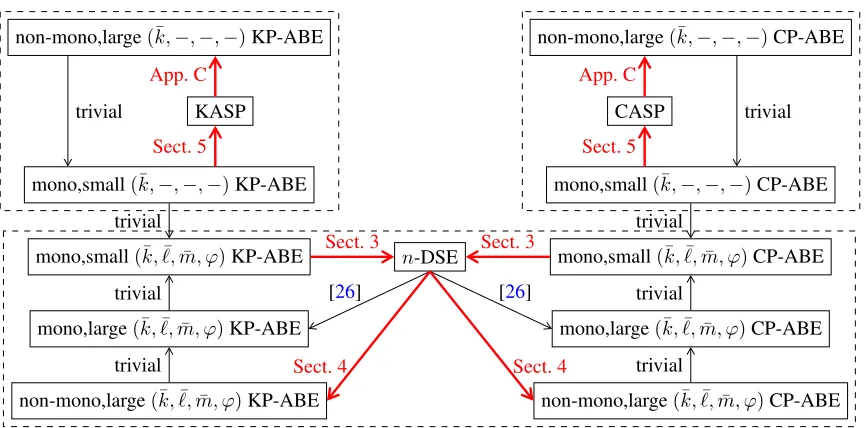
Figure 1: Relations among predicate encryption primitives. In this figure, arrows indicate conversions that
trans-form the primitive of the starting point to that of the end point. The red arrows indicate our results in this paper. For ABE, ‘mono’ and ‘non-mono’ indicates whether it is monotonic or non-monotonic, while ‘small’ and ‘large’ indicate whether the attribute universes are large (i.e., exponentially large) or small (i.e., polynomially bounded).
(¯k,`,¯m, ϕ¯ )specify bounds on size of sets of attributes and span programs. See Section2.1for details. As a result, primitives inside each dashed box are all equivalent in the sense there is a conversion between each pair.
universe; moreover, we also obtain conversions which transform ABE to its dual (key-policy to
ciphertext-policy, and vice versa). This implies that they are essentially equivalent in some sense. See Figure 1for
the details.
So far, we have considered ABE schemes with bounds on parameters, especially on the size of span programs. We then proceed to investigate relation among ABE schemes without bounds on the size of span programs (but with a bound on the size of attribute sets) and ABE for arithmetic span programs
recently introduced and studied by Ishai and Wee [29]. We call the latter key-policy ABE for arithmetic
span programs (KASP), since in the latter, a ciphertext is associated with a vector while a private key is associated with an arithmetic span program which specifies a policy. By exchanging key and ciphertext attribute, we can also define ciphertext-policy version of ABE for arithmetic span program (CASP). We have the following results:
− We show that monotonic KP-ABE with small universe (without bound on the size of span programs)
can be converted into KASP (in Section5). The idea for the conversion is similar to that in Section3.
− We then proceed to investigate the converse direction. In fact, we can show somewhat stronger result.
That is, we show that KASP can be converted into non-monotonic KP-ABE with large universe, which
trivially implies monotonic KP-ABE with small universe (in AppendixC). The idea for the conversion
is similar to that in Section4.
Given the above results, we have all of the following are equivalent: monotonic KP-ABE with small universe, non-monotonic KP-ABE with large universe, and KASP. Similar implications hold for the case of CP-ABE and CASP. However, we do not have a conversion from KP-ABE to CP-ABE in this case.
Direct Applications: New Instantiations. By applying our conversions to existing schemes, we obtain many new instantiations. Most of them have new properties that were not achieved before. These include
− the first DSE with constant-size public key,
− the first DSE with constant-size ciphertexts,
− the first DSE with constant-size private keys,
− the first non-monotonic, large-universe CP-ABE with constant-size ciphertexts,
− the first non-monotonic, large-universe KP-ABE with constant-size keys,
− the first KASP, CASP with constant-size public key,
− the first KASP, CASP with adaptive security and unbounded multi-use,
− the first KASP with constant-size ciphertexts,
− the first CASP with constant-size keys,
which together offer various compactness tradeoffs. Previously, all DSE schemes require linear (or more)
sizes in all parameters [26, 17, 14]. Previous CP-ABE with constant-size ciphertexts [19, 13, 21, 12]
can only deal with threshold or even more limited expressiveness. As for KP-ABE, to the best of our
knowledge, there were no constructions with constant-size keys.1 Previous KASP and CASP [29, 16]
require linear sizes in all parameters. Moreover, the adaptively secure schemes [16] support only attribute
one-use. See Section6and tables therein for our instantiations and comparisons. Note also that while our
conversion to DSE does not explicitly support key delegation algorithms, we provide them additionally in
AppendixB.
Application to Attribute-Based Signatures. Our technique is also useful in the settings of
attribute-based signatures (ABS) [35,36]. We first define a notion that we call predicate signature (PS) which is
a signature analogue of PE. Then, we construct a specific PS scheme with constant-size signatures such that a signature is associated with a set of attributes while a private key is associated with a policy (or monotone span programs). This is in some sense a dual notion of ordinary ABS in which a signature is associated with a policy and a private key with a set. By using the technique developed in the above, we can convert the PS scheme into an ABS scheme. As a result, we obtain the first ABS scheme with
constant-size signatures. Previous ABS schemes with constant-constant-size signatures [27, 12] only support threshold or
more limited policies.
Finally, we remark that although our conversions are feasible, they often introduce polynomial-size overheads to some parameters. Thus, in most cases, above schemes obtained by the conversions should be seen as feasibility results in the sense that they might not be totally efficient.
1.2 Related Works
There are several previous works investigating relations among PE primitives. In [24], a black box
sepa-ration between threshold predicate encryption (fuzzy IBE) and IBE was shown. They also rule out certain
natural constructions of PE for NC1 from PE for AC0. In [15], it was shown that hierarchical inner
product encryption is equivalent to spatial encryption, which is a special case of doubly spatial encryption.
[23] showed a generic conversion from KP-ABE supporting threshold formulae to CP-ABE supporting
threshold formulae. Their result and ours are incomparable. Our KP-ABE to CP-ABE conversion requires
the original KP-ABE to support monotone span programs, which is a stronger requirement than [23]. On
the other hand, the resulting scheme obtained by our conversion supports non-monotone span programs,
which is a wider class than threshold formulae 2. Thus, by applying our conversion, we can obtain new
1
KP-ABE with (asymptotically) short keys was also proposed in [9]. Compared to ours, their key size is not constant but they focus on more expressive ABE, namely ABE for circuits.
schemes (such as CP-ABE supporting non-monotone span programs with constant-size ciphertext) that is
not possible to obtain by the conversion by [23].
In recent works [2,5], it is shown that PE satisfying certain specific template can be converted into
PE for its dual predicate. In particular, it yields KP-ABE-to-CP-ABE conversion. Again, their result and ours are incomparable. On the one hand, schemes obtained from their conversion are typically more efficient than ours. On the other hand, their conversion only works for schemes with the template while our conversion is completely generic. Furthermore, since they essentially exchange key and ciphertext components in the conversion, the size of keys and ciphertexts are also exchanged. For example, if we
start from KP-ABE with constant-size ciphertexts, they obtain CP-ABE with constant-size private keys
while we obtain CP-ABE withconstant-size ciphertexts.
We also remark that in the settings where PE for general circuit is available, we can easily convert
any KP-ABE into CP-ABE by using universal circuits as discussed in [22,20]. However, in the settings
where only PE for span programs is available, this technique is not known to be applicable. We note that
all existing PE schemes for general circuits [20,22,9] are quite inefficient and based on strong
assump-tions (e.g., existence of secure multi-linear map or hardness of certain lattice problems for an exponential
approximation factor). In [7], in the context of quantum computation, Belovs studies a span program that
decides whether two spaces intersect or not. The problem and its solution considered there is very similar
to that in Section3of our paper. However, he does not consider application to cryptography and the result
is not applicable to our setting immediately since the syntax of span programs is slightly different.
Concurrent and Independent Work.Concurrently and independently to our work, Aggrawal and Chase
[1] show specific construction of ABE scheme with constant-size ciphertexts. Compared to our
CP-ABE scheme with constant-size ciphertexts, which is obtained by our conversion, their scheme only sup-ports monotone access structure over large universe, whereas our scheme supsup-ports non-monotonic access structure over large universe. Furthermore, we can obtain adaptively secure scheme whereas their scheme is only selectively secure. On the other hand, their construction seems to have shorter keys.
2
Preliminaries
Notation. Throughout the paper, pdenotes a prime number. We will treat a vector as a column vector,
unless stated otherwise. For a vectora ∈ Zn
p, a[i] ∈ Zp representsi-th element of the vector. Namely,
a= (a[1], . . . ,a[n])>. Fora,b∈Zn
p, we denote their inner product asha,bi=a>b=
Pn
i=1a[i]·b[i].
We denote byeithei-th unit vector: itsi-th component is one, all others are zero.Inand0n×mrepresent
an identity matrix inZnp×nand zero matrix inZpn×mrespectively. We also define1n = (1,1, . . . ,1)> ∈
Znp and 0n = 0n×1. We often omit the subscript if it is clear from the context. We denote by [a, b]
a set {a, a+ 1, . . . , b} for a, b ∈ Z such that a ≤ b and[b]denotes [1, b]. For a matrix X ∈ Zn×d
p ,
span(X)denotes a linear space{X·u|u∈Zd
p}spanned by columns ofX. For matricesA∈Znp1×mand
B∈Zn2×m
p ,[A;B]∈Z
(n1+n2)×m
p denotes[A>,B>]>i.e., the vertical concatenation of them.
2.1 Definition of Predicate Encryption
Here, we define the syntax of predicate encryption. We emphasize that we do not consider attribute hiding in this paper3.
Syntax.LetR={RN :AN×BN → {0,1} |N ∈Nc}be a relation family whereAN andBNdenote “ci-phertext attribute” and “key attribute” spaces andcis some fixed constant. The indexN = (n1, n2, . . . , nc)
3
ofRN denotes the numbers of bounds for corresponding parameters. A predicate encryption (PE) scheme
forRis defined by the following algorithms:
Setup(λ, N)→(mpk,msk): The setup algorithm takes as input a security parameterλand a indexN of
the relationRN and outputs a master public keympkand a master secret keymsk.
Encrypt(mpk,M, X)→C: The encryption algorithm takes as input a master public keympk, the
mes-sageM, and a ciphertext attributeX∈AN. It will output a ciphertextC.
KeyGen(msk,mpk, Y)→skY: The key generation algorithm takes as input the master secret keymsk,
the master public keympk, and a key attributeY ∈BN. It outputs a private keyskY.
Decrypt(mpk, C, X,skY, Y)→M or⊥: We assume that the decryption algorithm is deterministic. The
decryption algorithm takes as input the public parametersmpk, a ciphertextC, ciphertext attribute
X ∈ AN, a private key skY, and private key attributeY. It outputs the message M or⊥ which
represents that the ciphertext is not in a valid form.
We require the standard correctness of decryption: for allλ, N,(mpk,msk) ← Setup(λ, N),X ∈
AN, Y ∈ BN such that R(X, Y) = 1, and skY ← KeyGen(msk,mpk, Y), we have Decrypt(mpk,
Encrypt(mpk,M, X), X,skY, Y) =M.
Security. We now define the security for an PE schemeΠby the following game between a challenger
and an attackerA.
At first, the challenger runs the setup algorithm and givesmpk toA. ThenAmay adaptively make
key-extraction queries. We denote this phase PHASE1. In this phase, if A submits Y ∈ BN to the
challenger, the challenger returns skY ← KeyGen(msk,mpk, Y). At some point, Aoutputs two equal
length messagesM0andM1and challenge ciphertext attributeX? ∈AN.X?cannot satisfyR(X?, Y) =
1 for any attributeY such that Aalready queried private key forY. Then the challenger flips a random
coinβ ∈ {0,1}, runsEncrypt(mpk,Mβ, X?)→C?and gives challenge ciphertextC?toA. In PHASE2,
A may adaptively make queries as in PHASE1 with following added restriction: A cannot make a
key-extraction query for Y such that R(X?, Y) = 1. At last, A outputs a guess β0 forβ. We say that A
succeeds if β0 = β and denote the probability of this event byPrP EA,Π. The advantage of an attacker A
is defined asAdvAP E,Π = |PrP EA,Π−1
2|. We say thatΠis adaptively secure ifAdv
P E
A,Πis negligible for all
probabilistic polynomial time (PPT) adversaryA.
A weaker notion called selective security can be defined as in the above game with the exception that
the adversary Ahas to choose the challenge ciphertext indexX? before the setup phase but private key
queriesY1, . . . , YQand choice of(M0,M1)can still be adaptive.
2.2 (Arithmetic) Span Program, ABE, and Doubly Spatial Encryption
Definition of Span Program. LetU = {u1, . . . , ut}be a set of variables. For eachui, denote¬ui as a
new variable. Intuitively,uiand¬uicorrespond to positive and negative attributes, respectively. Also let
U0 ={¬u
1, . . . ,¬ut}. A span program overZp is specified by a pair(L, ρ)of a matrix and a labelling function where
L∈Z`p×m ρ: [`]→ U ∪ U
0
for some integer`, m. Intuitively, the mapρlabels rowiwith attributeρ(i).
A span program accepts or rejects an input by the following criterion. For an inputδ ∈ {0,1}t, we
consists of either rows labelled by someuisuch thatδi= 1or rows labelled by some¬uisuch thatδi = 0. We say that
(L, ρ)acceptsδiff(1,0, . . . ,0)is in the row span ofLδ.
We can write this also ase1 ∈ span(L>δ). A span program is calledmonotoneif the labels of the rows
consist of only the positive literals, inU.
Key-Policy and Ciphertext-Policy Attribute-Based Encryption.LetU be the universe of attributes. We
define a relationRKPon any span programs(L, ρ)overZp and any sets of attributesS ⊆ U as follows.
ForS⊆ U, we defineδ∈ {0,1}tas an indicator vector corresponding toS. Namely,δ
i = 1ifui ∈Sand
δi= 0ifui 6∈S. We define
RKP(S,(L, ρ)) = 1iff (L, ρ)acceptsδ.
Similarly,RCPis defined asRCP((L, ρ), S) = 1iff(L, ρ)acceptsδ.
A KP-ABE scheme may require some bounds on parameters: we denote
¯
k= the maximum size ofk(the size of attribute setS),
¯
`= the maximum size of`(the number of rows ofL),
¯
m= the maximum size ofm(the number of columns ofL),
ϕ= the maximum size of allowed repetition in{ρ(1), . . . , ρ(`)}.
These bounds define the indexN = (¯k,`,¯m, ϕ)¯ for the predicate family. When there is no restriction on
corresponding parameter, we represent it by “−” such as(k,−,−,−). We defineANandBN as the set of
all attribute sets and the set of all span programs whose sizes are restricted byN, respectively. KP-ABE is
a predicate encryption forRKPN :AN ×BN → {0,1}, whereRKPN is restricted onN in a natural manner.
CP-ABE is defined dually withAN andBN swapped.
Lett:= |U |. We say the scheme supports small universe iftis polynomially bounded and large
uni-verse iftis exponentially large. The scheme is monotonic if span programs are restricted to be monotone,
and non-monotonic otherwise.
Attribute-Based Encryption for Arithmetic Span Programs [29].In this predicate, the indexN for the
family is specified by an integer n. We call it the dimension of the scheme. We defineAN = Znp. An
arithmetic span program of dimensionnis specified by a tuple(Y,Z, ρ)of two matricesY,Z ∈ Zm×`
p
and a mapρ : [`] → [n], for some integers`, m. There is no restriction on`andm. Ifρis restricted to
injective, we say that the scheme supports only attribute one-use. Otherwise, if there is no restriction onρ,
we say that it is unbounded multi-use. We letBN be the set of all arithmetic span programs of dimension
n. We then define
RKASPN (x,(Y,Z, ρ)) = 1iffe1∈span{x[ρ(j)]·yj+zj}j∈[`],
where here e1 = (1,0, . . . ,0)> ∈ Zm
p andx[ρ(j)] is theρ(j)-th term of x, whileyj andzj are thej
-th column of Y andZrespectively. We call predicate encryption forRKASP key-policy attribute-based
encryption for arithmetic span program (KASP). Ciphertext-policy ASP (CASP) can be defined dually
withAN andBN swapped.
Doubly Spatial Encryption. In this predicate, the indexN for the family is specified by an integern(the
dimension of the scheme). We define the domains asAN =BN =Znp ×(∪0≤d≤nZnp×d). We define
RDSEN (x0,X),(y0,Y)
= 1iff x0+ span(X)
∩ y0+ span(Y)
6
Doubly spatial encryption is PE for relation RDSE
N equipped with additional key delegation algorithm
defined below.
KeyDel(mpk,sk(y0,Y),(y0,Y),(ˆy0,Y))ˆ →skYˆ: The key delegation algorithm takes as input the public
parameters mpk, a private key sk(y0,Y), (y0,Y), and (ˆy0,Y)ˆ such that yˆ0 + span( ˆY) ⊆ y0 + span(Y). It outputs a private keysk(ˆy
0,Yˆ).
We require that delegation is independent of the path taken. That is, for all λ, N, (mpk,msk) ←
Setup(λ, N),y0,Y,yˆ0,Yˆ such thatyˆ0+ span( ˆY)⊆y0+ span(Y), we have the following distributions
are identical:
KeyDel(mpk,sk(y0,Y),(y0,Y),(ˆy0,Y))ˆ ≈KeyGen(mpk,msk,(ˆy0,Y)).ˆ
wheresk(y0,Y)←KeyGen(msk,mpk,(y0,Y)).
2.3 Embedding Lemma for PE
The following useful lemma from [10] describes a sufficient criterion for implication from PE for a given
predicate to PE for another predicate. The lemma is applicable to any relation family. We prove the lemma
in AppendixAfor self-containment.
We consider two relation families:
RFN :AN ×BN → {0,1}, RF 0
N0 :A0N0×BN0 0 → {0,1},
which is parametrized by N ∈ Nc andN0 ∈
Nc
0
respectively. Suppose that there exists three efficient mappings
fp:Zc
0
→Zc fe:A0N0 →Afp(N0) fk :BN0 0 →Bfp(N0)
which maps parameters, ciphertext attributes, and key attributes, respectively, such that for all X0 ∈
A0N0, Y0 ∈BN0 0,
RFN00(X0, Y0) = 1⇔RFf
p(N0)(fe(X 0), f
k(Y0)) = 1. (1)
We can then construct a PE schemeΠ0 ={Setup0,Encrypt0,KeyGen0,Decrypt0}for predicateRFN00 from
a PE schemeΠ ={Setup,Encrypt,KeyGen,Decrypt}for predicateRFN as follows. LetSetup0(λ, N0) =
Setup(λ, fp(N0))and
Encrypt0(mpk,M, X0) =Encrypt(mpk,M, fe(X0)), KeyGen0(msk,mpk, Y0) =KeyGen(msk,mpk, fk(Y0)),
andDecrypt0(mpk, C, X0,skY0, Y0) =Decrypt(mpk, C, fe(X0),skY0, fk(Y0)).
Lemma 1 (Embedding lemma [10]). If Πis correct and secure, then so is Π0. This holds for selective security and adaptive security.
3
Conversion from ABE to DSE
In this section, we show how to construct DSE for dimensionnfrom monotonic KP-ABE (with bounds
on the size of attribute sets and span programs). We note that by simply swapping key and ciphertext attributes, we can also obtain CP-ABE-to-DSE conversion. We first describe the conversion, then explain the intuition behind the conversion later below.
3.1 The Conversion
Mapping Parameters.We mapfpDSE→KP:n7→(¯k,`,¯m, ψ)¯ where
¯
k=n(n+ 1)κ+ 1, `¯= 2(nκ+ 1)(n+ 1),
¯
m= (nκ+ 1)(n+ 1) + 1, ψ= 2(n+ 1),
where we defineκ:=dlog2pe. Moreover, we set the universeU as follows.
U =
n
Att[i][j][k][b]
(i, j, k, b)∈[0, n]×[1, n]×[1, κ]× {0,1} o
∪ {D},
whereDis a dummy attribute which will be assigned for all ciphertext. Hence, the universe size is|U |=
2n(n+1)κ+1. Intuitively,Att[i][j][k][b]represents an indicator for the condition“thek-th least significant bit of the binary representation of thej-th element of the vectorxi isb∈ {0,1}”.
Mapping Ciphertext Attributes. Forx0 ∈ Znp andX = [x1, . . . ,xd1]∈ Z n×d1
p such that d1 ≤n, we
mapfeDSE→KP: (x0,X)7→Swhere
S=
n
Att[i][j][k][b]
(i, j, k)∈[0, d1]×[1, n]×[1, κ], b=xi[j][k] o
∪ {D}.
Here, we definexi[j][k]∈ {0,1}so that they satisfy
xi[j] = κ
X
k=1
2k−1·xi[j][k].
That is,xi[j][k]is thek-th least significant bit of the binary representation ofxi[j]∈Zp.
Mapping Key Attributes. For y0 ∈ Zn
p andY = [y1, . . . ,yd2] ∈ Z n×d2
p such that d2 ≤ n, we map
fkDSE→KP: (y0,Y)7→(L, ρ)as follows. Let the numbers of rows and columns ofLbe
`= (2nκ+ 1)(n+ 1) +d2+ 1, m= (nκ+ 1)(n+ 1) + 1,
respectively. We then define
L=
e1 e1+ed2+2 y
> 0 Y>
E J
E J
..
. . ..
E J
∈Z`×m
of which each sub-matrixEandJboth appearsn+ 1times, where we define
E=
g g
. ..
g 0 0 . . . 0
∈Z(2p nκ+1)×n, J=
−1 −1
−1 −1
. ..
−1 −1 1 1 . . . 1
∈Z(2p nκ+1)×nκ (3)
whereg = (0,1,0,2, . . . ,0,2i, . . . ,0,2κ−1)>∈Z2κ p .
Next, we define the mapρ: [1, `]→ U as follows.
• Ifi≤d2+ 1, we setρ(i) :=D.
• Else, we havei∈[d2+ 2, `]. We then write
i= (d2+ 1) + (2nκ+ 1)i0+i00
with a uniquei0∈[0, n+ 1]and a uniquei00∈[0,2nκ].
− Ifi00= 0, we again setρ(i) =D.
− Else, we havei00∈[1,2nκ]. We then write
i00= 2κj0+ 2k0+b0+ 1
with uniquej0 ∈[0, n−1],k0 ∈[0, κ−1], andb0 ∈ {0,1}. We finally set
ρ(i) =Att[i0][j0+ 1][k0+ 1][b0].
Intuition. We explain the intuition behind the conversion.Scan be seen as a binary representation of the
information of (x0,X). In the span program(L, ρ), Eis used to reproduce the information of(x0,X)
in the matrix whileJis used to constrain the form of linear combination among rows to a certain form.4
In some sense, the roll of the lower part of the matrix L(the last (2nκ+ 1)(n+ 1)rows) is similar to
universal circuit while the upper part of the matrix contains the information of(y0,Y).
3.2 Correctness of the Conversion
We show the following theorem. The implication from KP-ABE to DSE would then follow from the
embedding lemma (Lemma1).
Theorem 1. Forn∈N, for anyx0 ∈Zpn,X∈Zpn×d1,y0 ∈Znp andY ∈Znp×d2, it holds that
RNKP(S,(L, ρ)) = 1⇔RDSEn (x0,X),(y0,Y) = 1
withN =fpDSE→KP(n),S =feDSE→KP(x0,X), and(L, ρ) =fkDSE→KP(y0,Y).
4A somewhat similar technique to ours that restricts the form of linear combination of vectors was used in [8] in a different
Proof. DefineI ⊂[`]asI :={i|ρ(i)∈S}and defineLIas the sub-matrix ofLformed by all the rows
of which index is inI. From the definition offeDSE→KP, we have thatLIis in the form of
LI =
e1 e1+ed2+2 y
> 0 Y>
E0 J0 E1 J0
..
. . ..
Ed1 J
0 1>nκ
. ..
1>nκ
∈Z`I×mI p
where`I := (nκ+ 1)(d1+ 1) +n−d1+d2+ 1andmI := (nκ+ 1)(n+ 1) + 1and
Ei =
gi,1 gi,2
. ..
gi,n
0 0 . . . 0
∈Z(pnκ+1)×n, J
0 = −1 −1 . .. −1 1 1 . . . 1
∈Z(pnκ+1)×nκ.
fori∈[0, d1], where
gi,j =
xi[j][1], 2xi[j][2], . . . ,2κ−1xi[j][κ]
>
∈Zκp.
We remark that it holds thath1κ,gi,ji = xi[j]by the definition ofxi[j][k]and thus E>i ·1nκ+1 = xi
holds. We also remark that ifv>J0 = 0holds for somev ∈ Znκ+1
p , then there existsv ∈ Zp such that
v=v1nκ+1. These properties will be used later.
To prove the theorem statement is now equivalent to prove that
e1∈span(L>I) ⇔ x0+ span(X)
∩ y0+ span(Y)
6
=∅.
Forward Direction (⇒). Supposee1 ∈ span(L>I). Then, there existsu ∈ Z
(nκ+1)(d1+1)+n−d1+d2+1
p such thatu>LI=e>1. We writeuas
u>= v
|{z}
1 , v>
|{z}
d2
, u>0
|{z}
nκ+1 , u>1
|{z}
nκ+1
, . . . , u>d1
|{z}
nκ+1 , ud1+1
| {z }
1
, . . . , un
|{z}
1
.
We then write
u>LI=
v,
v+hu0,e1i,
vy>0 +v>Y>+
d1
X
i=0 u>i Ei
,
u>0 ·J0
, . . . ,
u>d1·J0
,
ud1+11
>
nκ+1
, . . . ,
un1>nκ+1
the first and the second element of the vector, we obtainv= 1andv+hu0,e1i = 1 +u0h1>,enκ+1i=
1 +u0 = 0. Hence,u0=−1. Finally, we have thatPd1
i=0u >
i Ei+vy>0 +v>Y>=0and thus
−
d1
X
i=0
E>i ui =y0+Y·v.
The left hand side of the equation is
−
d1
X
i=0
E>i ui =−u0E>0 ·1nκ+1−
d1
X
i=1
uiE>i ·1nκ+1
=x0−
d1
X
i=1
ui·xi ∈ x0+ span(X)
.
while the right hand side isy0+Y·v∈ (y0+ span(Y)). This implies that x0+ span(X)∩ y0+
span(Y)6=∅.
Converse Direction (⇐). Suppose x0+ span(X)
∩ y0 + span(Y)
6
= ∅. Hence, there exist sets
{ui ∈Zp}i∈[1,d1]and{vi ∈Zp}i∈[1,d2]such thatx0+
Pd1
i=1uixi =y0+Pid=12 viyi.We set a vectoruas
u>= 1, v1, . . . , vd2
| {z }
d2
−1>nκ+1,−u11>nκ+1, . . . ,−ud11
>
nκ+1
| {z }
(nκ+1)(d1+1)
,0, . . . ,0
| {z }
n−d1
).
Therefore, we have
u>LI =
1, 1−1,
y0>+
d2
X
i=1
viy>i −1
>
nκ+1(E0+
d1
X
i=1 uiEi)
,
−1>nκ+1J0,−u11>nκ+1J
0, . . . ,−u
n1>nκ+1J
0,0. . . ,0
=
1,0,
y>0 +
d2
X
i=1 viy>i
−x>0 +
d1
X
i=1 uix>i
,0. . . ,0
=e>1
as desired. This concludes the proof of the theorem.
4
From DSE to Non-Monotonic ABE
In [26], it is shown that DSE can be converted into monotonic CP-ABE with large universe (and bounds
on the size of attribute sets and span programs). In this section, we extend their result to show that non-monotonic CP-ABE with large universe and the same bounds can be constructed from DSE. We note
that our transformation is very different from that of [26] even if we only consider monotonic CP-ABE
4.1 The Conversion
Mapping Parameters. We map fpCP→DSE : (¯k,`,¯m,¯ `)¯ 7→ n = 4¯`+ ¯m+ 2¯k`¯. We assume that the
universe of attributes isZp.This restriction can be easily removed by using collision resistant hash.
Mapping Ciphertext Attributes. For a span program(L, ρ), we mapfeCP→DSE : (L, ρ) 7→ (x0,X)as
follows. Let`×m¯ be the dimension ofL, where` ≤ `¯. (If the number of columns is smaller, we can
adjust the size by padding zeroes.) Let`0, `1be such that`=`0+`1, and without loss of generality, we
assume that the first`0rows ofLare associated with positive attributes and the last`1rows with negative
attributes by the mapρ. We denoteLasL= [L0;L1]using matricesL0 ∈Zp`0×m¯ andL1 ∈Z`p1×m¯. We
then definefeCP→DSE(L, ρ) = (x0,X)with
x0=−e1 ∈Znp, X
> = L0 ¯ `
z}|{ G0
L1 I`1
¯
`−`1
z}|{ G1
∈Z(p`0+2`1)×n,
whereGb ∈Z`b×
¯
`(¯k+1)
p for eachb∈ {0,1}is defined as
Gb =
p ρ(b`0+ 1)
> (¯`−`b)(¯k+1) z}|{
p ρ(b`0+ 2)>
. ..
p ρ(b`0+`b)
> (4)
wherep()is a function that takes an element ofZpor its negation ({¬x|x∈Zp}) as an input and outputs
a vectorp(x) = (1, x, x2, . . . , xk¯)> ∈Z¯kp+1.
Mapping Key Attributes.For a setS = (S1, . . . , Sk)such thatk≤k¯, we mapfkCP→DSE:S 7→(y0,Y)
where
y0=0n∈Znp, Y
> =
¯
m
z}|{ H I(¯k+1)¯`
H I(¯k+1)¯`
!
∈Z2(¯pk+1)¯`×n,
of whichHis defined as
H=I¯`⊗qS =
qS qS . .. qS
∈Z (¯k+1)¯`
×`¯
p ,
whereqS = (qS[1], . . . ,qS[¯k+ 1])>∈Z¯kp+1is defined as a coefficient vector from
QS[Z] = k+1
X
i=1
qS[i]·Zi−1= k
Y
i=1
(Z−Si).
Ifk <k¯, the coordinatesqS[k+ 2], . . . ,qS[¯k+ 1]are all set to0.
Intuition.The matricesXandYconstructed above can be divided into two parts. The first`0rows ofX>
negation of attributes. Here, we explain how we handle negated attributes. Positive attributes are handled by a similar mechanism. I(¯k+1)¯`inY>andG1inX>restricts the linear combination of the rows ofX>
andY>to a certain form in order to two affine spaces to have a intersection. As a result, we can argue
that the coefficient of thei-th row ofL1 in the linear combination should be multiple ofQS(ρ(`0+i))5.
Since we have that QS(x) = 0iffx ∈ S for anyx ∈Zp, this means that the coefficient of the vector in
the linear combination should be0ifρ(`0+i) =¬AttandAtt ∈S. This restriction is exactly what we
need to emulate predicate of non-monotonic CP-ABE.
4.2 Correctness of the Conversion
We show the following theorem. The implication from DSE to non-monotonic CP-ABE with large uni-verse would then follow from the embedding lemma.
Theorem 2. For any span program(L∈Z`×m
p , ρ)such that`≤`¯andm≤m¯ andSsuch that|S| ≤k¯,
letN = (¯k,`,¯m,¯ `)¯, we have that
RDSEn ((x0,X),(y0,Y)) = 1⇔RCPN (S,(L, ρ)) = 1
wheren=fpCP→DSE(N),(x0,X) =feCP→DSE(L, ρ), and(y0,Y) =fkCP→DSE(S).
Proof. LetI ⊂ [1, `]beI = {i|(ρ(i) =Att∧Att∈S)∨(ρ(i) =¬Att∧Att6∈S)}. We also letLI
be the sub-matrix ofLformed by rows whose index is inI.
To prove the theorem statement is equivalent to prove that
x0+ span(X)∩ y0+ span(Y)=6 ∅ ⇔ e1 ∈span(L>I).
Forward Direction (⇒).Suppose that there existu∈Zp`0+2`1 andv∈Z
2(¯k+1)¯`
p such thatx>0 +u>X>= y0>+v>Y>=v>Y>. We denote these vectors as
u>= (u>0
|{z}
`0
, u>1
|{z}
`1
, u>2
|{z}
`1
), v>= (v>1
|{z}
¯
k+1
, . . . , v>`¯
|{z}
¯
k+1 w>1
|{z}
¯
k+1
, . . . ,w>`¯
|{z}
¯
k+1 .)
Hence,x>0 +u>Xandv>Ycan be written as
x>0 +u>X =
−e>1 +u>0L0+u>1L1
| {z }
¯
m
,0>`¯,u0[1]·p(ρ(1))>, . . . ,u0[`0]·p(ρ(`0))>
| {z }
(¯k+1)`0
,
0>(¯`−`
0)(¯k+1), u
> 1
|{z}
`1
,0>`¯−`1,
u2[1]·p(ρ(`0+ 1))>, . . . ,u2[`1]·p(ρ(`0+`1))>
| {z }
(¯k+1)`1
,0>(¯`−`
1)(¯k+1)
(5)
and
v>Y= (0>m¯,hv1,qSi, . . . , ,hv¯`,qSi
| {z }
¯
`
,v>1, . . . ,v>`¯
| {z }
(¯k+1)¯`
,
hw1,qSi, . . . , ,hw¯`,qSi
| {z }
¯
`
,w>1, . . . ,w>`¯
| {z }
(¯k+1)¯`
). (6)
5 Here, We treat negated attributes ({¬
First, by comparing the m¯ + ¯`+ 1-th to m¯ + (¯k+ 2)¯`-th elements of the vector, we obtain that
vi =u0[i]·p(ρ(i))fori∈[1, `0]andvi =0¯k+1fori∈[`0+ 1,`]¯. Furthermore, by comparingm¯ + 1-th
tom¯ + ¯`-th elements of the vector, we have
hvi,qSi=u0[i]· hp(ρ(i)),qSi=u0[i]·QS ρ(i)
= 0
fori∈ [1, `0]. The second equation above follows from the definition ofp()andqS. SinceQS(ρ(i)) =
Q
ω∈S(ρ(i)−ω)6= 0ifρ(i)6∈S, we have thatu0[i] = 0ifρ(i)6∈S. That is,u0[i] = 0fori∈[1, `0]\I.
Next, by comparing the last(¯k+ 1)¯`elements in the vector, we obtain thatwi =u2[i]·p(ρ(`0+i))
fori∈[1, `1]andwi =0¯k+1fori∈[`1+ 1,`]¯. By comparing them¯ + (¯k+ 2)¯`+ 1-th tom¯ + (¯k+ 3)¯`-th
elements in the vector, we have that(u>1,0>`¯−`
1) = (hw1,qSi, . . . , ,hw¯`,qSi)and thus
u1[i] =hwi,qSi=u2[i]· hp(ρ(`0+i)),qSi=u2[i]·QS(ρ(`0+i))
holds fori∈[1, `1]. From the above, we have thatu1[i] = 0ifρ(`0+i) = ¬AttandAtt ∈Sfor some
Att. This implies thatu1[i] = 0if(`0+i)6∈Ifori∈[1, `1].
Finally, by comparing the firstm¯ elements in the vector, we obtain that−e>1 +u>0L0+u>1L1 =0>.
Letu0,I be a subvector ofu0 which is obtained by deleting all elements u0[i]fori 6∈ I. Similarly, we
define u1,I as a vector obtained by deleting all elements u1[i] for i such that (`0 +i) 6∈ I from u1.
Since u0[i] = 0 fori ∈ [1, `0]\I andu1[i] = 0for i ∈ [1, `1]such that (`0 +i) 6∈ I, it follows that (u>0,I,u>1,I)LI=u>0L0+u>1L1=e>1 and thuse1∈span(L>I)as desired.
Converse Direction (⇐). The converse direction can be shown by repeating the above discussion in reverse order. Assume thate1∈span(L>I). Then there existsu0 ∈Z
|I|
p such thatu0>LI =e>1. We extend u0to defineu00 ∈Z`0+`1
p so thatu00I =u
0andu00[i] = 0fori6∈I hold. Here,u00
I ∈Z
|I|
p is a subvector of
u00which is obtained by deleting all elementsu00[i]fori6∈I. These conditions completely determineu00.
We denote thisu00asu00>= (u>0,u>1)usingu0 ∈Z`0
p andu1 ∈Z`p1. We note thatu0>L0+u>1L1 =e>1
holds by the definition.
Next we definevi fori∈ [¯`]asvi =u0[i]·p(ρ(i))ifi∈[`0]andvi =0¯k+1 ifi∈ [`0+ 1,`]¯. We
claim thathvi,qSi = 0holds fori∈ [¯`]. Here, we prove this. The case fori∈[`0+ 1,`]¯ is trivial. For
the case ofi∈[1, `0], we have
hvi,qSi=u0[i]· hp(ρ(i)),qSi=u0[i]·QS(ρ(i)) = 0.
The last equation above holds because we haveQS(ρ(i)) = 0ifi ∈ I andu0[i] = 0otherwise, by the
definition ofu0[i].
We defineu2[i] ∈ Zp fori ∈ [1, `1]asu2[i] = u1[i]/QS(ρ(`0 +i))ifu1[i] 6= 0andu2[i] = 0if u1[i] = 0. We have to show thatu2[i]are well defined by showing thatQS(ρ(`0 +i))6= 0ifu1[i]6= 0
(i.e., division by0does not occur). Ifu1[i]6= 0, then(`0+i)∈I by the definition ofu1. It implies that
(ρ(`0+i) =¬Att)∧(Att6∈S)for someAtt∈Zpand thusQS(ρ(`0+i)) =Qω∈S(Att−ω)6= 0holds
as desired.
We also definewiaswi =u2[i]·p(ρ(`0+i))fori∈[1, `1]andwi=0¯k+1fori∈[`1+ 1,`]¯. Then,
we have
hwi,qSi=u2[i]· hp(ρ(`0+i)),qSi=u2[i]·QS(ρ(`0+i)) =u1[i]
fori∈[1, `1]andhwi,qSi= 0fori∈[`1+ 1,`]¯.
Finally, we define u and vas u> = (u>0,u>1,u>2) and v> = (v>1, . . . ,v>`¯,w>1, . . . ,w`>¯). Then,
Equation (5) and (6) hold. By the properties ofuandvwe investigated so far, it is straightforward to see
5
From KP(CP)-ABE to KASP(CASP)
In this section, we show that monotonic KP-ABE with small universe (without bounds on the size of span programs) can be converted into KASP. We note that we can also obtain CP-ABE-to-CASP conversion by simply swapping key and ciphertext attribute.
5.1 The Conversion
Mapping Parameters. We show how to construct KASP for dimensionnfrom monotonic KP-ABE for
parameterN = (nκ+ 1,−,−,−)and the size of attribute universe is|U |= 2nκ+ 1. Here,κ=dlog2pe.
That is, we definefpKASP→KP(n) =N. We set the universe of attributes as
U =
n
Att[i][j][b]
(i, j, b)∈[1, n]×[1, κ]× {0,1} o
∪ {D}.
Intuitively,Att[i][j][b]represents an indicator for the condition “thej-th least significant bit of the binary
representation ofi-th element of the vectorxisb∈ {0,1}”.Dis a dummy attribute which will be assigned
for all ciphertexts.
Mapping Ciphertext Attributes.Forx∈Znp, we mapfeKASP→KP:x7→S where
S=nAtt[i][j][b]
(i, j)∈[1, n]×[1, κ], b=x[i][j] o
∪ {D},
where we definex[i][j]∈ {0,1}in such a way thatx[i] =Pκ
j=12j−1·x[i][j]. In other words,x[i][j]is
thej-th least significant bit of the binary representation ofx[i]∈Zp.
Mapping Key Attributes.For an arithmetic span program(Y= (y1, . . . ,y`)∈Zpm×`,Z= (z1, . . . ,z`)∈
Zmp ×`, ρ)such thatY,Z∈Zpm×`, we define the mapfkKASP→KP : (Y,Z, ρ)7→ (L, ρ0)as follows. First, we define
L=
G1 J
G2 J
..
. . ..
G` J
∈Z (2κ+1)`
× κ`+m
p , (7)
where the matrixJ∈Z(2pκ+1)×κis defined as in Equation (3) (by settingn= 1) whileGiis defined as
Gi = [g·y>i ;z>i ] = (0m,yi,0m,2yi,· · ·,0m,2κ−1yi,zi)>∈Z(2p κ+1)×m
whereg = (0,1,0,2, . . . ,0,2i, . . . ,0,2κ−1)>∈Z2κ p .
Next, we define the mapρ0: [(2κ+ 1)`]→ U as follows.
• Ifi= 0 mod (2κ+ 1), we setρ(i) :=D.
• Else, we write
i= (2κ+ 1)i0+ 2j0+b0+ 1
with uniquei0 ∈[0, `−1],j0 ∈[0, κ−1], andb0 ∈ {0,1}. We finally set
ρ0(i) =Att[ρ(i0+ 1)][j0+ 1][b0].
Intuition. Scan be seen as a binary representation of the information ofx. In the span program(L, ρ0),
J is used to constrain the form of linear combination among rows to a certain form. Gi as well asρ0,
along with the above restriction, are designed so that linear combination of rows of Gi only can be a
5.2 Correctness of the Conversion
We show the following theorem. The implication from KP-ABE with parameterN = (nκ+ 1,−,−,−)
to KASP with dimensionnwould then follow from the embedding lemma.
Theorem 3. For anyx∈Zn
p,Y∈Zmp ×`,Z∈Zmp×`, andρ: [`]→[n], it holds that
RKPN (S,(L, ρ0)) = 1⇔RnKASP(x,(Y,Z, ρ)) = 1
whereN =fpKASP→KP(n),S =feKASP→KP(x), and(L, ρ0) =fkKASP→KP(Y,Z, ρ).
Proof. DefineI ⊂[1,(2κ+ 1)`]asI ={i|ρ0(i)∈S}. We defineLIas the sub-matrix ofLformed by
rows whose index is inI. From the definition offeKASP→KP, we have thatLIis in the form of
LI=
G01 J0 G02 J0
..
. . ..
G0` J0
∈Z
(κ+1)`× κ`+m
p ,
where
G0i = [gi·y>i ;z
>
i ]∈Z(κ
+1)×m
p , J
0 =
−1 −1
. ..
−1 1 1 . . . 1
∈Z(pκ+1)×κ,
and where
gi = (x[ρ(i)][1],2x[ρ(i)][2], . . . ,2κ−1x[ρ(i)][κ])>∈Zκp.
We note that we haveh1κ,gii=x[ρ(i)]by the definition ofx[ρ(i)][j]and thusG0>i ·1κ+1=x[ρ(i)]yi+zi
holds. We also remark that ifv>J0 = 0holds for somev ∈ Zκ+1
p , then there existsv ∈ Zp such that
v=v1κ+1. These properties will be used later below.
To prove the theorem statement is equivalent to prove that
e1∈span(L>I) ⇔ e1 ∈span({x[ρ(i)]yi+zi}i∈[`]).
Forward Direction (⇒).We assume thate1 ∈span(L>I). From this, there existsu ∈Z(pκ+1)` such that
u>LI =e>1. We write thisuas
u>= u>1
|{z}
κ+1 , u>2
|{z}
κ+1
, . . . , u>`
|{z}
κ+1
.
Therefore, we have that
e>1 =u>·LI =
X
i∈[`]
u>i G0i,u1>J0, . . . ,u>` J0
Sinceu>i ·J0 =0fori∈[`], there exist{ui ∈Zp}i∈[`]such thatui =ui1κ+1. Then, we have
e>1 =X
i∈[`]
u>i G0i =X
i∈[`]
ui1>κ+1G0i=
X
i∈[`]
ui(x[ρ(i)]·yi+zi)>.
This impliese1 ∈span({x[ρ(i)]yi+zi}i∈[`]), as desired.
Converse Direction (⇐). We assume that e1 ∈ span({x[ρ(i)]yi +zi}i∈[`]). Then, there exist {ui ∈
Zp}i∈[`]such that
P
i∈[`]ui(x[ρ(i)]·yi+zi) =e1. We set a vectoru∈Z(pκ+1)`as
u>= u11>κ+1, . . . , u`1>κ+1
Then, we have that
u>·LI =
X
i∈[`]
ui1>κ+1G 0
i, u11
>
κ+1J 0
, . . . ,u`1>κ+1J 0
=
X
i∈[`]
ui(x[ρ(i)]yi+zi)>,0>κ, . . . ,0>κ
=e
> 1.
This impliese1 ∈span(L>I), as desired. This concludes the proof of the theorem.
6
Implications of Our Result
In this section, we discuss consequences of our results.
Equivalence between (bounded) ABE and DSE.We have shown that monotonic KP/CP-ABE for(¯k,`,¯ ¯
m, ϕ)implies DSE (without delegation) in Section3and DSE implies non-monotonic KP/CP-ABE with
large universe for (¯k,`,¯m, ϕ)¯ in Section 4. Since non-monotonic KP/CP-ABE with large universe for
(¯k,`,¯m, ϕ)¯ trivially implies monotonic KP/CP-ABE with small universe for(¯k,`,¯m, ϕ)¯ , our results indi-cate that these PE schemes are essentially equivalent in the sense that they imply each other.
Equivalence between K(C)ASP and KP(CP)-ABE.Next, we consider the case where there is no
restric-tion on the size of span programs. In Secrestric-tion5, we showed that monotonic KP-ABE for((¯k+1)κ,−,−,−)
implies KASP for(¯k,−,−,−). In AppendixC, we also show the converse direction. That is, we show
that KASP for (¯k+ 1,−,−,−) implies non-monotonic KP-ABE for (¯k,−,−,−) with large universe.
Since non-monotonic KP-ABE for (¯k,−,−,−) trivially implies monotonic KP-ABE for (¯k,−,−,−),
our results indicate that these PE schemes are essentially equivalent similarly to the above case. Similar
implications hold for CP-ABE. See figure1for the overview.
By applying the conversions to existing schemes, we obtain various new schemes. The overviews of
properties of resulting schemes and comparison with existing schemes are provided in Table1,2,3, and
4. All schemes in the tables are constructed in pairing groups. In the tables, we count the number of group elements to measure the size of master public keys (|mpk|), ciphertexts (|C|), and private keys (|sk|). Note
that our conversions only can be applied to ABE schemes supporting span programs overZp. Therefore,
for ABE schemes constructed on composite order groups [31,2], our conversions are not applicable since
they support span programs over ZN whereN is a product of several large primes. Similar restrictions
are posed on DSE and K(C)ASP. Though it is quite plausible that our conversions work even in such cases
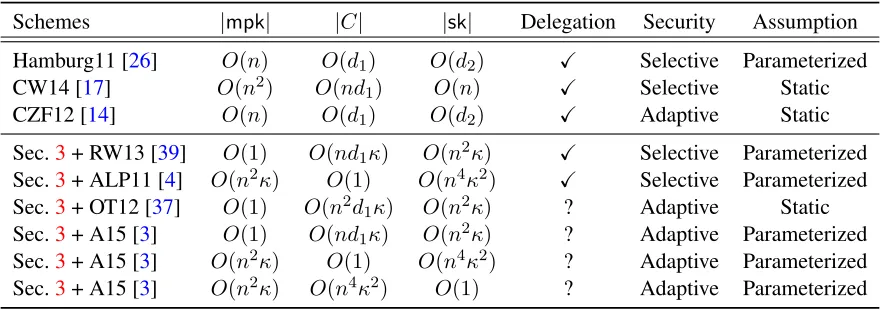
Table 1: Comparison among DSE Schemes
Schemes |mpk| |C| |sk| Delegation Security Assumption
Hamburg11 [26] O(n) O(d1) O(d2) X Selective Parameterized
CW14 [17] O(n2) O(nd1) O(n) X Selective Static
CZF12 [14] O(n) O(d1) O(d2) X Adaptive Static
Sec.3+ RW13 [39] O(1) O(nd1κ) O(n2κ) X Selective Parameterized
Sec.3+ ALP11 [4] O(n2κ) O(1) O(n4κ2) X Selective Parameterized
Sec.3+ OT12 [37] O(1) O(n2d1κ) O(n2κ) ? Adaptive Static
Sec.3+ A15 [3] O(1) O(nd1κ) O(n2κ) ? Adaptive Parameterized
Sec.3+ A15 [3] O(n2κ) O(1) O(n4κ2) ? Adaptive Parameterized
Sec.3+ A15 [3] O(n2κ) O(n4κ2) O(1) ? Adaptive Parameterized
†nis the dimension of the scheme; d1 andd2 denote the dimension of the space associated with
the ciphertext and private key, respectively;κ=dlog2pe.
‡“Delegation” shows if key delegation is supported. “?” means unknown.
New DSE Schemes.By applying our KP(CP)-ABE-to-DSE conversion to existing KP(CP)-ABE schemes,
we obtain many new DSE schemes. Table1shows overview of obtained schemes.6 Specifically,
− From the unbounded KP-ABE schemes [37,39,3], we obtain the first DSE scheme with constant-size
master public key (without delegation). Note that all previous schemes [26,14, 17] require at least
O(n)group elements in master public key wherenis the dimension of the scheme.
− From KP-ABE scheme with constant-size ciphertexts [4,28,41, 3], we obtain the first DSE scheme
with constant-size ciphertexts. All previous schemes [26,14,17] require at leastO(d1)group elements
in ciphertexts whered1 is the dimension of the affine space associated to a ciphertext.
− From CP-ABE scheme with constant-size keys [5], we obtain the first DSE scheme with constant-size
private keys. All previous schemes require at least O(d2) group elements in private keys whered2 is
the dimension of the affine space associated to a private key.
The schemes obtained from [37, 3] achieves adaptive security. Furthermore, for schemes obtained from
[39,4,28], we can define key delegation algorithm. The details of the key delegation algorithm will be
given in AppendixB.
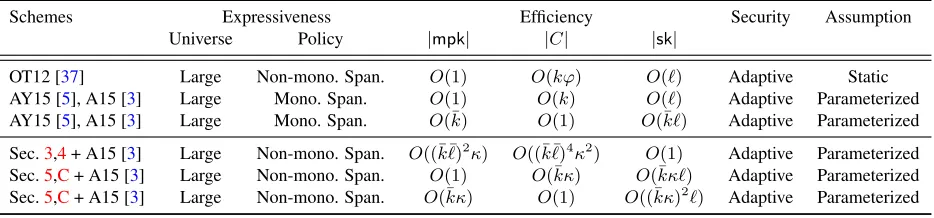
CP-ABE with Constant-Size Ciphertexts. By applying our DSE-to-non-monotonic-CP-ABE
conver-sion in Section 4 to the DSE scheme with constant-size ciphertexts obtained above, we obtain the first
non-monotonic CP-ABE with constant-size ciphertexts. Previous CP-ABE schemes with constant-size
ci-phertexts [19,13,12] only support threshold or more limited predicates7. See Table2for comparison (we
list only relevant schemes).
KP-ABE with Constant-Size Keys. By applying our DSE-to-non-monotonic-KP-ABE conversion in
Section4to the DSE scheme with constant-size keys obtained above, we obtain the first non-monotonic
KP-ABE with constant-size keys. See Table3for comparison (we list only relevant schemes).
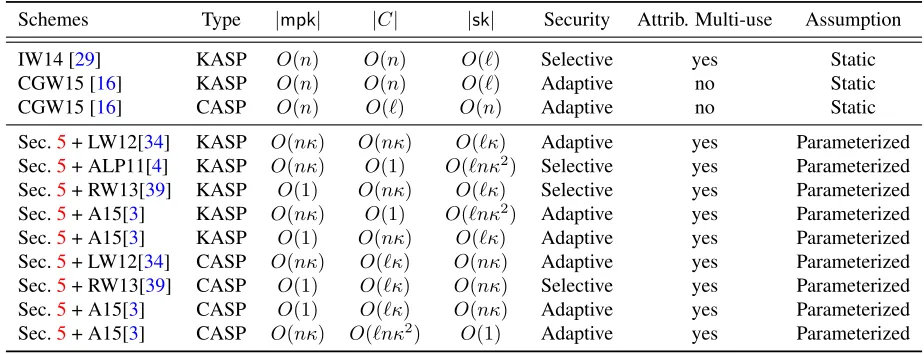
New KASP and CASP Schemes. By applying the KP(CP)-ABE-to-K(C)ASP conversion in Section5,
we obtain many new K(C)ASP schemes. See Table4for the overview. Specifically,
6
In the table, parameterized assumptions refer toq-type assumptions, which are non-interactive and falsifiable but parameter-ized by some parameters of the scheme such ask,k¯.
7
Table 2: Comparison among CP-ABE Schemes
Schemes Expressiveness Efficiency Security Assumption
Universe Policy |mpk| |C| |sk|
OT12 [37] Large Non-mono. Span. O(1) O(`) O(kϕ) Adaptive Static AY15 [5], A15 [3] Large Mono. Span. O(1) O(`) O(k) Adaptive Parametrized AY15 [5], A15 [3] Large Mono. Span. O(¯k) O(¯k`) O(1) Adaptive Parametrized EMN+09 [19] Small AND-only O(¯k) O(1) O(¯k) Selective Static CZF11 [13] Small AND-only O(¯k) O(1) O(¯k2) Selective Static CCL+13 [12] Small Threshold O(¯k) O(1) O(¯k2) Adaptive Static
Sec.3,4+ ALP11 [4] Large Non-mono. Span. O((¯k`)¯2κ) O(1) O((¯k`)¯4κ2)
Selective Parametrized Sec.3,4+ T14 [41] Large Non-mono. Span. O((¯k`)¯2κ) O(1) O((¯k`)¯4κ2) Semi-adapt Static Sec.3,4+ A15 [3] Large Non-mono. Span. O((¯k`)¯2κ) O(1) O((¯k`)¯4κ2) Adaptive Parametrized Sec.5,C+ A15 [3] Large Non-mono. Span. O(1) O(¯kκ`) O(¯kκ) Adaptive Parameterized Sec.5,C+ A15 [3] Large Non-mono. Span. O(¯kκ) O((¯kκ)2`) O(1) Adaptive Parameterized
†
kis the size of an attribute set associated with a key,`is the number of rows of a span program matrix associated with a ciphertext; ¯
k,`¯are the maximums ofk, `(if bounded);ϕis the maximum number of allowed attribute multi-use in one policy (if bounded); κ=dlog2pe.
Table 3: Comparison among KP-ABE Schemes
Schemes Expressiveness Efficiency Security Assumption
Universe Policy |mpk| |C| |sk|
OT12 [37] Large Non-mono. Span. O(1) O(kϕ) O(`) Adaptive Static AY15 [5], A15 [3] Large Mono. Span. O(1) O(k) O(`) Adaptive Parameterized AY15 [5], A15 [3] Large Mono. Span. O(¯k) O(1) O(¯k`) Adaptive Parameterized
Sec.3,4+ A15 [3] Large Non-mono. Span. O((¯k`)¯2κ) O((¯k`)¯4κ2) O(1) Adaptive Parameterized Sec.5,C+ A15 [3] Large Non-mono. Span. O(1) O(¯kκ) O(¯kκ`) Adaptive Parameterized Sec.5,C+ A15 [3] Large Non-mono. Span. O(¯kκ) O(1) O((¯kκ)2`) Adaptive Parameterized
†
kis the size of an attribute set associated with a ciphertext,`is the number of rows of a span program matrix associated with a key;k,¯ `¯are the maximums ofk, `(if bounded);ϕis the maximum number of allowed attribute multi-use in one policy (if bounded);κ=dlog2pe.
− From the unbounded KP-ABE, CP-ABE schemes of [39,3], we obtain the first KASP, CASP schemes
with constant-size master public key.
− From adaptively secure KP-ABE, CP-ABE schemes of [34,3], we obtain the first adaptively secure
KASP, CASP schemes with unbounded attribute multi-use.
− From KP-ABE schemes with constant-size ciphertexts [4,28,41,3], we obtain the first KASP schemes
with constant-size ciphertexts.
− From CP-ABE schemes with constant-size keys [3], we obtain the first CASP schemes with
constant-size keys.
Until recently, the only (K)ASP scheme in the literature was proposed by [29], which is selectively secure
and the master public key and ciphertext size are linear in the dimension of the scheme. Very recently,
adaptively secure KASP and CASP were given in [16], albeit with the restriction of one-time use (of the
same attribute in one policy).
We remark that the conversion is not applicable for schemes in [36,37] since these schemes are
KP-ABE for(∗,∗,∗, ϕ)whereϕis polynomially bounded, whereas our conversion requires the last parameter
Table 4: Comparison among KASP and CASP Schemes
Schemes Type |mpk| |C| |sk| Security Attrib. Multi-use Assumption
IW14 [29] KASP O(n) O(n) O(`) Selective yes Static
CGW15 [16] KASP O(n) O(n) O(`) Adaptive no Static
CGW15 [16] CASP O(n) O(`) O(n) Adaptive no Static
Sec.5+ LW12[34] KASP O(nκ) O(nκ) O(`κ) Adaptive yes Parameterized Sec.5+ ALP11[4] KASP O(nκ) O(1) O(`nκ2) Selective yes Parameterized Sec.5+ RW13[39] KASP O(1) O(nκ) O(`κ) Selective yes Parameterized Sec.5+ A15[3] KASP O(nκ) O(1) O(`nκ2) Adaptive yes Parameterized Sec.5+ A15[3] KASP O(1) O(nκ) O(`κ) Adaptive yes Parameterized Sec.5+ LW12[34] CASP O(nκ) O(`κ) O(nκ) Adaptive yes Parameterized Sec.5+ RW13[39] CASP O(1) O(`κ) O(nκ) Selective yes Parameterized Sec.5+ A15[3] CASP O(1) O(`κ) O(nκ) Adaptive yes Parameterized Sec.5+ A15[3] CASP O(nκ) O(`nκ2) O(1) Adaptive yes Parameterized
† nis the dimension of the scheme;`is the number of the columns of the matrices that define an arithmetic span program (`reflects the size of an arithmetic span program);κ=dlog2pe.
7
Application to Attribute-Based Signature
Here, we discuss that our techniques developed in previous sections are also applicable to construct
attribute-based signatures (ABS) [35, 36]. ABS is an advanced form of signature and can be
consid-ered as a signature analogue of ABE. In particular, it resembles CP-ABE in the sense that a private key is associated with a set of attributes while a signature is associated with a policy and a message. A user can sign on a message with a policy if and only if she has a private key associated with a set satisfying the policy. Roughly speaking, this property corresponds to the correctness and unforgeability. For ABS, we also require privacy. That is, we require that one cannot obtain any information about the attribute of the signer from a signature.
The construction of expressive ABS scheme with constant-size signatures has been open. All previous
ABS schemes with constant-size signatures [27,12] only supports threshold predicates. The difficulty
of constructing ABS with constant-size signatures seems to be related to the difficulty of construction of CP-ABE with constant-size ciphertexts. That is, it is hard to set constant number of group elements so that they include very complex information such as span programs.
To solve the problem, we first define the notion of predicate signature (PS) that is a signature analogue of PE. Then we construct a PS scheme that is dual of ABS: a private key is associated with a policy and a signature with a set. The scheme achieves constant-size signatures. This is not difficult to achieve because the signature is associated with a set which is a simpler object compared to a policy. The scheme is based
on PS scheme for threshold predicate with constant-size signatures by [27]. We change the scheme mainly
in two ways. At first, instead of using Shamir’s secret sharing scheme, we use linear secret sharing scheme so that they support more general predicate. We also add some modification so that the signature size be even shorter. The signatures of the resulting scheme only consist of two group elements.
Since signature analogue of Lemma 1holds (Lemma 2in AppendixD), we can apply
KP-ABE-to-non-monotonic-CP-ABE conversion (combination of the results in Section3and4) to obtain the first ABS
scheme with constant-size signatures supporting non-monotonic span program. See Appendix Dfor the
details.
References
[1] S. Agrawal and M. Chase. A study of pair encodings: predicate encryption in prime order groups. IACR Cryptology ePrint Archive, 2015:413, 2015.
[2] N. Attrapadung. Dual system encryption via doubly selective security: framework, fully secure functional encryption for regular languages, and More. InEUROCRYPT, pages 557–577, 2014.
[3] N. Attrapadung. Dual System Encryption Framework in Prime-Order Groups.IACR Cryptology ePrint Archive, 2015:390, 2015.
[4] N. Attrapadung, B. Libert, and E. Panafieu. Expressive key-policy attribute-based encryption with constant-size ciphertexts. InPublic Key Cryptography, pages 90–108, 2011.
[5] N. Attrapadung and S. Yamada. Duality in ABE: Converting Attribute Based Encryption for Dual Predicate and Dual Policy via Computational Encodings. InCT-RSA, pages 87–105, 2015.
[6] A. Beimel.Secure Schemes for Secret Sharing and Key Distribution. PhD thesis, Israel Institute of Technology, Technion, Haifa, Israel, 1986.
[7] A. Belovs. Span-program-based quantum algorithm for the rank problem. Technical Report arXiv:1103.0842, arXiv.org, 2011. Available fromhttp://arxiv.org/abs/1103.0842.
[8] A. Beimel, and Y. Ishai. On the Power of Nonlinear Secret-Sharing. IEEE Conference on Computational Complexity, pages 188–202, 2001.
[9] D. Boneh, C. Gentry, S. Gorbunov, S. Halevi, V. Nikolaenko,G. Segev, V. Vaikuntanathan, and D. Vinayaga-murthy. Fully key-homomorphic encryption, arithmetic circuit ABE and compact garbled circuits. In EURO-CRYPT, pages 533–556, 2014.
[10] D. Boneh and M. Hamburg. Generalized identity based and broadcast encryption schemes. InASIACRYPT, pages 455–470, 2008.
[11] D. Boneh, A. Sahai, and B. Waters. Functional encryption: Definitions and challenges. InTCC, pages 253–273, 2011.
[12] C. Chen, J. Chen, H. Lim, Z. Zhang, D. Feng, S. Ling, and H. Wang. Fully secure attribute-based systems with short ciphertexts/signatures and threshold access structures. InCT-RSA, pages 50–67, 2013.
[13] C. Chen, Z. Zhang, and D. Feng. Efficient ciphertext policy attribute-based encryption with constant-size ciphertext and constant computation-cost. InProvSec, pages 84–101, 2011.
[14] C. Chen, Z. Zhang, and D. Feng. Fully secure doubly-spatial encryption under simple assumptions. InProvSec, pages 253–263, 2012.
[15] J. Chen, H. Lim, S. Ling, and H. Wang. The relation and transformation between hierarchical inner product encryption and spatial encryption. Des. Codes Cryptography, 71(2):pages 347–364, 2014.
[16] J. Chen, R. Gay, and H. Wee. Improved Dual System ABE in Prime-Order Groups via Predicate Encodings. In Eurocrypt, 2015.
[17] J. Chen and H. Wee. Doubly spatial encryption from DBDH. Theor. Comput. Sci, 543:pages 79–89, 2014
[18] J. Chen and H. Wee. Semi-adaptive attribute-based encryption and improved delegation for Boolean formula. SCN, pages 277–297, 2014.
[19] K. Emura, A.o Miyaji, A. Nomura, K. Omote, and M. Soshi. A ciphertext-policy attribute-based encryption scheme with constant ciphertext length. InISPEC, pages 13–23, 2009.
[20] S. Garg, C. Gentry, S. Halevi, A. Sahai, and B. Waters. Attribute-based encryption for circuits from multilinear maps. InCRYPTO (2), pages 479–499, 2013.
[21] A. Ge, R. Zhang, C. Chen, C. Ma, and Z. Zhang. Threshold ciphertext policy attribute-based encryption with constant size ciphertexts. InACISP, pages 336–349, 2012.
[22] S. Gorbunov, V. Vaikuntanathan, and H. Wee. Attribute-based encryption for circuits. InSTOC, pages 545–554, 2013.
[24] V. Goyal, V. Kumar, S. V. Lokam, and M. Mahmoody. On Black-Box Reductions between Predicate Encryption Schemes. InTCC, pages 440–457, 2012.
[25] V. Goyal, O. Pandey, A. Sahai, and B. Waters. Attribute-based encryption for fine-grained access control of encrypted data. InACM Conference on Computer and Communications Security, pages 89–98, 2006.
[26] M. Hamburg. Spatial encryption. IACR Cryptology ePrint Archive, 2011:389, 2011.
[27] J. Herranz, F. Laguillaumie, B. Libert, and C. R`afols. Short attribute-based signatures for threshold predicates. InCT-RSA, pages 51–67, 2012.
[28] S. Hohenberger and B. Waters. Attribute-based encryption with fast decryption. InPublic Key Cryptography, pages 162–179, 2013.
[29] Y. Ishai and H. Wee. Partial Garbling and Their Applications. InICALP (1), pages 650–662, 2014.
[30] J. Katz, A. Sahai, and B. Waters. Predicate Encryption Supporting Disjunctions, Polynomial Equations, and Inner Products. InEUROCRYPT, pages 146–162, 2008.
[31] A. B. Lewko, T. Okamoto, A. Sahai, K. Takashima, and B. Waters. Fully secure functional encryption: Attribute-based encryption and (hierarchical) inner product encryption. InEUROCRYPT, pages 62–91, 2010.
[32] A. B. Lewko and B. Waters. Unbounded hibe and attribute-based encryption. InEUROCRYPT, pages 547–567, 2011.
[33] A. B. Lewko and B. Waters. Decentralizing Attribute-Based Encryption. InEUROCRYPT, pages 568–588, 2011.
[34] A. B. Lewko and B. Waters. New Proof Methods for Attribute-Based Encryption: Achieving Full Security through Selective Techniques. InCRYPTO, pages 180–198, 2012.
[35] H. K. Maji, M. Prabhakaran, and M. Rosulek. Attribute-Based Signatures. InCT-RSA, pages 376–392, 2011.
[36] Tatsuaki Okamoto and Katsuyuki Takashima. Efficient attribute-based signatures for non-monotone predicates in the standard model InPKC, pages 35–52, 2011.
[37] T. Okamoto and K. Takashima. Fully secure unbounded inner-product and attribute-based encryption. In ASIACRYPT, pages 349–366, 2012.
[38] B. Parno, M. Raykova, and V. Vaikuntanathan. How to Delegate and Verify in Public: Verifiable Computation from Attribute-Based Encryption. InTCC, pages 422–439, 2012.
[39] Y. Rouselakis and B. Waters. Practical constructions and new proof methods for large universe attribute-based encryption. InACM Conference on Computer and Communications Security, pages 463–474, 2013.
[40] Amit Sahai and Brent Waters. Fuzzy identity-based encryption. InEUROCRYPT, pages 457–473, 2005.
[41] K. Takashima. Expressive attribute-based encryption with constant-size ciphertexts from the decisional linear assumption. SCN, pages 298–317, 2014.
[42] B. Waters. Efficient identity-based encryption without random oracles. InEUROCRYPT, pages 114–127, 2005.
[43] B. Waters. Ciphertext-Policy Attribute-Based Encryption: An Expressive, Efficient, and Provably Secure Realization. InPKC, pages 53–70, 2011.
[44] B. Waters. Functional Encryption for Regular Languages. InCRYPTO, pages 218–235, 2012.
[45] S. Yamada, N. Attrapadung, G. Hanaoka, and N. Kunihiro. A framework and compact constructions for non-monotonic attribute-based encryption. InPublic Key Cryptography, pages 275–292, 2014.
A
Proof of Lemma
1
Proof. We prove the lemma for the case of adaptive security. The same proof works for other cases.
We construct an adversary Bagainst Π from an adversaryA against Π0 so thatBhas the same
advan-tage as A and the running time ofB is only polynomially larger thanA. At first,Setup(λ, fp(N0)) =
Setup0(λ, N0)→(mpk,msk)is run andmpkis given toB.BgivesmpktoA. In PHASE1, whenAmakes
key query forY0 ∈ BN0 0,BcomputesY = fk(Y0) and makes a key-extraction query for its challenger.