
Recent STAR Results from Heavy-Ion and Polarized Proton
Programs
GrigoryNigmatkulov1,∗for the STAR Collaboration
1National Research Nuclear University MEPhI
115409, Kashirskoe shosse 31, Moscow, Russia
Abstract. We present recent physics results from the STAR experiment at
Relativistic Heavy Ion Collider (RHIC). The proceedings cover studies of az-imuthal anisotropy in small and large systems, global and local hyperon polar-ization, correlation femtoscopy, antideuteron andJ/ψproduction from heavy-ion program as well as the measurements of longitudinal spin asymmetry from polarized proton program.
1 Introduction
The main goal of high-energy physics is to understand the properties of the strong interac-tion that can be described by the Quantum Chromodynamics (QCD). In order to measure the QCD matter, one can use ion-ion collisions. Variation of collision energy provides a unique opportunity to investigate the properties of the created medium on baryon chemical poten-tial (µB) and temperature (T). This medium is also known as Quark-Gluon Plasma (QGP). The Relativistic Heavy Ion Collider (RHIC) accelerates and collides nuclei from protons to uranium. Using different colliding species gives important information about the influence
of the initial conditions, dynamical evolution and transport properties. RHIC is also the only accelarator of polarized proton beams. Studying the high-energy polorized p+p collisions is
essential key in understanding of the spin structure of the proton in terms of gluon, quark and antiquark constitiuents. In these proceedings, we report recent results from heavy-ion and polorized proton-proton programs obtained in the Solenoidal Tracker At RHIC (STAR) experiment.
2 Azimuthal harmonics in small and large systems
The process of particle emission in the transverse plane is anisotropic. This anisotropy, known as anisotropic flow, can be measured via Fourier decomposition of the single-particle az-imuthal angle (φ) with respect to thenth-order event plane (Ψn) [1]. The first three extracted flow coefficientsv1,v2, andv3are called directed, elliptic, and triangular flow, respectively. The fluctuations-driven component ofv1, namedv1f lucis proportional to the dipole asymmetry of the collision system [2, 3]. Azimuthal anisotropy is one the key observables because it car-ries information about the viscous hydrodynamic response to the initial spatial distribution in energy density due to fluctuations and geometry.
∗e-mail: [email protected];[email protected]
Figure 1 shows the< Nch >dependence of the v1f luc (a), v3 (b), andv2 (c) flow coeffi -cients [4]. The measurements have been performed for p+Au, d+Au, Cu+Cu, Cu+Au, and
Au+Au collision at √sNN=200 GeV and U+U collisions atsqrtsNN=193 GeV. The inset in
Fig. 1(a) compares the extracted values ofK ≡1/(<Nch >< p2T >), that takes into account the long-range non-flow correlations induced by global momentum conservation, for each system.
For<Nch>≥170, thevnvalues show a decrease with increasing values of<Nch>. This is consistent with the expected decrease ofnfor more central collision as compared to the midcentral ones. The decrease ofv2for<Nch>≤170 shows the dominant role of size-driven viscous attenuation of the flow harmonics for the give multiplicities.
0.02 0.04 0.06 0.08
0 175 350 525 700 0.02 0.04 0.06 0.08 (c)
v2 0.2 < pT(GeV/c) < 4
〈Nch〉
U+U Au+Au Cu+Au Cu+Cu d+Au p+Au
0.01 0.02
0 175 350 525 700
〈Nch〉
(b)
v3 0.2 < p T(GeV/c) < 4 0.01
0.02
0 175 350 525 700 vn
(a)
|veven1 | 0.2 < pT(GeV/c) < 0.9
〈Nch〉
0 0.01
0 0.02 0.04
K
〈Nch〉-1
Figure 1. Thev1f luc(a),v3(b), andv2(c) dependence on<Nch >for p+Au, d+Au, Cu+Cu, Cu+Au,
Au+Au, and U+U collision systems. The dashed curve in (c) represents a hydrodynamic model
calcu-lation.
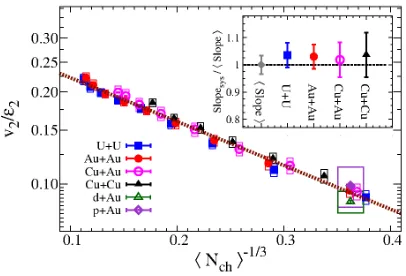
The system-dependent behaviour ofv2shown in Fig. 1(c) can be attributed to the depen-dence of2on system size for a given value of<Nch>. Figure 2 shows thev2/2as a function of<Nch>−1/3[4]. This confirms the system dependence of the2on system size.
Figure 2.Thev2/2as a function of<Nch>−1/3for p+Au, d+Au, Cu+Cu, Cu+Au, Au+Au, and U+U
collisions. (Inset) The respective ratios of the slopes extracted for each collision system separately relative to the slope extracted from a fit to the combined data sets.
Figure 1 shows the< Nch >dependence of thev1f luc (a), v3 (b), andv2 (c) flow coeffi -cients [4]. The measurements have been performed for p+Au, d+Au, Cu+Cu, Cu+Au, and
Au+Au collision at √sNN=200 GeV and U+U collisions atsqrtsNN=193 GeV. The inset in
Fig. 1(a) compares the extracted values ofK ≡1/(<Nch >< p2T >), that takes into account the long-range non-flow correlations induced by global momentum conservation, for each system.
For<Nch>≥170, thevnvalues show a decrease with increasing values of<Nch>. This is consistent with the expected decrease ofn for more central collision as compared to the midcentral ones. The decrease ofv2for<Nch>≤170 shows the dominant role of size-driven viscous attenuation of the flow harmonics for the give multiplicities.
0.02 0.04 0.06 0.08
0 175 350 525 700 0.02 0.04 0.06 0.08 (c)
v2 0.2 < pT(GeV/c) < 4
〈Nch〉
U+U Au+Au Cu+Au Cu+Cu d+Au p+Au
0.01 0.02
0 175 350 525 700
〈Nch〉
(b)
v3 0.2 < p T(GeV/c) < 4 0.01
0.02
0 175 350 525 700 vn
(a)
|veven1 | 0.2 < pT(GeV/c) < 0.9
〈Nch〉
0 0.01
0 0.02 0.04
K
〈Nch〉-1
Figure 1. Thev1f luc(a),v3(b), andv2 (c) dependence on<Nch >for p+Au, d+Au, Cu+Cu, Cu+Au,
Au+Au, and U+U collision systems. The dashed curve in (c) represents a hydrodynamic model
calcu-lation.
The system-dependent behaviour ofv2shown in Fig. 1(c) can be attributed to the depen-dence of2on system size for a given value of<Nch>. Figure 2 shows thev2/2as a function of<Nch>−1/3[4]. This confirms the system dependence of the2on system size.
Figure 2.Thev2/2as a function of<Nch>−1/3for p+Au, d+Au, Cu+Cu, Cu+Au, Au+Au, and U+U
collisions. (Inset) The respective ratios of the slopes extracted for each collision system separately relative to the slope extracted from a fit to the combined data sets.
The inset in Fig. 2 shows similarity between the slopes of the2-scaled v2 for Cu+Cu, Cu+Au, Au+Au, and U+U collisions over the indicated multiplicity range. The
eccentricity-scaled results for p+Au and d+Au collisions also follow the data trend for these heavier
collision species with larger systematic uncertainty.
3 Global hyperon polarization
The angular momentum carried by colliding nuclei can be transferred to the created system. Due to the spin-orbit coupling, this may lead to the global polarization of particle’ spin along the direction of angular momentum of the system [5, 6]. Experimentally, such a global polar-ization can be probed with hyperons via parity-violating weak decays, in which the daughter baryon is preferentially emitted in the direction of the hyperon’s spin. In case of antihyperon, the daughter baryon tends to be emitted in the opposite direction to the parent spin.
Since the angular momentum of the system is perpendicular to a plane defined by the impact parameter vector and the beam direction (so-called reaction plane), the hypeon polar-ization can be measured via the azimuthal distribution of daughter baryons with respect to the reaction plane (Ψ1) in the hyperon’s rest frame (φ∗p):
PH= 8
παH
<sin(Ψ1−φ∗p)>
Res(Ψ1) , (1)
whereαHis the hyperon decay constant,Res(Ψ1) is the experimental resolution of the
first-order event plane.
Figure 3 shows the global polarization ofΛand ¯Λhyperons as a function of collision
energy (√sNN) for 20–50% most central Au+Au collisions [7, 8]. The global polarization
results follow the same trend and seem to decrease with increasing collision energy.
[GeV]
NN
s
10 2
10
[%] H
P
0 1 2 3
STAR Au+Au 20%-50%
Nature548.62 (2017)
Λ Λ
PRC76.024915 (2007)
Λ Λ
this analysis
Λ Λ
Λ UrQMD+vHLLE,
primary primary+feed-down Λ
AMPT,
primary primary+feed-down
Figure 3.Global polarization ofΛand ¯Λas a function of collision energy (√sNN) for 20–50% central
Au+Au collisions. Thin lines show calculations from a (3+1)D cascade+viscous hydrodynamic model
(UrQMD+vHLLE) [9] and bold lines show the AMPT model calculations [10].
The (3+1)D viscous hydrodynamic model vHLLE with the UrQMD initial state [9] agrees
the current accuracy of the experimental measurements. Calculations from a Multi-Phase Transport (AMPT) model [10] predict slightly higher global polarization than those from the hydrodynamic model, but are also in good agreement with the data within uncertainties.
4 Polarization along the beam direction
Recently STAR has also reported the measurement of the hyperon polarization along the beam direction [11]:
Pz=
<cos(θ∗p)> αH<cos2(θ∗p)>
. (2)
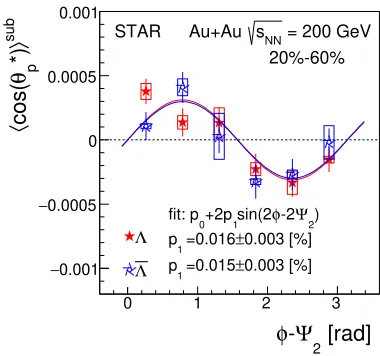
The beam direction component of the polarization, Pz, arises from vorticity due to elliptic flow. It is expected thatPzwill be more sensitive to the later stages of the system evolution after the anisotropic flow is developed [2] as compared to global hyperon polarization which originates mostly from the initial velocity fields. The<cos(θ∗p)>was measured as a function of azimuthal angle ofΛ( ¯Λ) relative toΨ2. The acceptance effects and inefficiencies were
taken into account. Figure 4 shows<cos(θ∗p) >subofΛand ¯Λ, obtained with event plane
method, as a function of azimuthal angle relative toΨ2for the 20%–60% centrality region.
0 1 2 3
[rad]
2Ψ
-φ
0.001
−
0.0005
−
0 0.0005 0.001
sub
〉
*)
pθ
cos(
〈
Λ
Λ
= 200 GeV
NN
s Au+Au
20%-60% STAR
)
2
Ψ
-2
φ
sin(2
1
+2p
0
fit: p
0.003 [%]
±
=0.016
1
p
0.003 [%]
±
=0.015
1
p
Figure 4.The<cos(θ∗p)>ofΛand ¯Λas a function of azimuthal angleφrelative to the second-order
event planeΨ2for 20%–60% centrality bin in Au+Au collisions at√sNN=200 GeV. Open boxes show
the systematic uncertainties. The lines show the fit with the sine function.
The lines in Fig. 4 represent the fit results usingp0+2p1sin(2φ−2Ψ2), wherep0andp1 are the fit parameters. The data are consistent with a sine structure for both ¯ΛandΛ. This is
expected due to the elliptic flow.
5 Antideuteron production
the current accuracy of the experimental measurements. Calculations from a Multi-Phase Transport (AMPT) model [10] predict slightly higher global polarization than those from the hydrodynamic model, but are also in good agreement with the data within uncertainties.
4 Polarization along the beam direction
Recently STAR has also reported the measurement of the hyperon polarization along the beam direction [11]:
Pz=
<cos(θ∗p)> αH<cos2(θ∗p)>
. (2)
The beam direction component of the polarization, Pz, arises from vorticity due to elliptic flow. It is expected thatPzwill be more sensitive to the later stages of the system evolution after the anisotropic flow is developed [2] as compared to global hyperon polarization which originates mostly from the initial velocity fields. The<cos(θ∗p)>was measured as a function of azimuthal angle ofΛ( ¯Λ) relative toΨ2. The acceptance effects and inefficiencies were
taken into account. Figure 4 shows<cos(θ∗p) >subofΛand ¯Λ, obtained with event plane
method, as a function of azimuthal angle relative toΨ2for the 20%–60% centrality region.
0 1 2 3
[rad]
2Ψ
-φ
0.001 − 0.0005 − 0 0.0005 0.001 sub〉
*)
pθ
cos(
〈
Λ Λ= 200 GeV
NN s Au+Au 20%-60% STAR ) 2 Ψ -2 φ sin(2 1 +2p 0 fit: p 0.003 [%] ± =0.016 1 p 0.003 [%] ± =0.015 1 p
Figure 4.The<cos(θ∗p)>ofΛand ¯Λas a function of azimuthal angleφrelative to the second-order
event planeΨ2for 20%–60% centrality bin in Au+Au collisions at√sNN=200 GeV. Open boxes show
the systematic uncertainties. The lines show the fit with the sine function.
The lines in Fig. 4 represent the fit results usingp0+2p1sin(2φ−2Ψ2), wherep0andp1 are the fit parameters. The data are consistent with a sine structure for both ¯ΛandΛ. This is
expected due to the elliptic flow.
5 Antideuteron production
The underlying mechanism for light (anti)nuclei production in relativistic heavy-ion col-lisions is not well understood. One of the possible approaches is through coalescence of (anti)nucleons. Since the binding energies of light nuclei are small (≈2.2 MeV for
(anti)deuteron and≈7.7 MeV for 3He), the light nuclei cannot survive when the tempera-ture is much higher than the binding energy. The typical kinetic freeze-out temperatempera-ture for light hadrons is around 100 MeV, hence they may be formed by final-state coalescence, after nucleons are decoupled from the hot and dense system. In case of the coalescence picture, the invariant yield of light nuclei is related to the invariant yiled of nucleons as:
Ead 3N
A dp3
A
≈BA
Epd
3N p dp3
p
A, (3)
wherepp,pn, andpAare momenta of proton, neutron, and nucleus, respectively. HerepA = App, assumingpp ≈pn. The A and Z are the mass and charge number of the nucleus. The BAis a coalescence parameter and it reflects probability of nucleon coalescence.
Figure 5 shows the excitation function of B2 at pT/A=0.65 GeV/c in 0%–10% most central Au+Au collisions [12].
4 5 6 7 8 10 20 30 40 100 200 300
(GeV) NN s 3 − 10 ) 3 /c 2 (GeV2 B E864(d) Au+Pb E866(d) Au+Au E877(d) Au+Au NA49(d) Pb+Pb PHENIX(d) Au+Au ) Au+Au d STAR( ) Au+Au d PHENIX(
/ A = 0.65 GeV/c
T
p
STAR 0-10%(d) Au+Au ) Au+Au d STAR 0-10%( Central Collision
Figure 5. Energy dependence of the coalescence parameter,B2, fordand ¯dat pT/A=0.65 GeV/c
from Au+Au collisions at RHIC. Results from AGS [13–15], SPS [16–18] (0%–7% and 0%–12%
collision centralities), RHIC [19, 20] (0%–18% and 0%–20% collision centrality for √sNN=130 GeV
and 200 GeV) are also presented.
The results are compared to those measured at AGS [13–15], SPS [16–18] and RHIC [19, 20]. At energies below √sNN=20 GeV, the coalescence parametersB2decrease as a function of increasing collision energy, This implies that the size of the emitting source of nucleons increases with the collision energy. When √sNN >20 GeV, the rate of decrease seems to change and saturate up to 62.4 GeV. It might imply a change of the equation of state of the medium in those collisions. TheB2from 200 GeV is found to be larger than the BES satura-tion values, which needs further studies. TheB2values for antideuterons are systematically lower than those for deuterons, which implies that the overall size of the antibaryon-emitting source is larger than that of baryons.
6 Correlation femtoscopy
In 2015 STAR conducted a fixed-target (FXT) test run using gold ion collisions at
√s
NN =4.5 GeV to show that STAR is capable to run in a fixed-target configuration. One
(4% interaction probability) gold foil target. The target was placed at the edge of the TPC, about 211 cm away from the center of the detector to make use of the full tracking volume of the TPC. Approximately 1.3 million events were collected with a top≈ 30% centrality trigger. Figure 6 (left) shows the measured femtoscopic radii as a function of transverse mass for 0-10% central Au+Au collisions in the fixed-target mode.
Figure 6. (Left) Transverse mass dependence ofRout,Rside, andRlongfor pions measured for 0-10%
Au+Au collisions in STAR (red stars), E895 (black triangles) [21], and E866 (green crosses) [22].
(Right) TheRsidevs. Rlong dependence for the E866, E895, STAR [23] and ALICE [24] experiments.
Only statistical uncertainties shown.
The STAR FXT results are compared with E895 [21] and E866 (E802) [22] and are consistent with the energy dependence trend of these other experiments within uncertainties. Figure 6 (right) shows the dependence ofRside, which reflects the transverse size of the source,
onRlong that reflects the size in the longitudinal direction for several collision energies. As the collision energy increases in the FXT regime, compression reduces the source size and increases the baryon density, whereas the BES collider regime shows increasing longitudinal expansion.
The correlation femtoscopy technique was also used to study identical pion correlations in d+Au collisions at √sNN=200 GeV. Figure 7 shows the extractedππfemtoscopic radii,
Rinv.
0.2 0.3 0.4 0.5 0.6
(GeV/c)
T
k
1 1.2 1.4 1.6 1.8 2 2.2
(fm)
inv
R
d+Au @ 200 GeV
STAR Preliminary
Figure 7.Charged pion femtoscopic as a function of pair transverse momentum,kT, measured in d+Au
(4% interaction probability) gold foil target. The target was placed at the edge of the TPC, about 211 cm away from the center of the detector to make use of the full tracking volume of the TPC. Approximately 1.3 million events were collected with a top≈ 30% centrality trigger. Figure 6 (left) shows the measured femtoscopic radii as a function of transverse mass for 0-10% central Au+Au collisions in the fixed-target mode.
Figure 6. (Left) Transverse mass dependence ofRout,Rside, andRlongfor pions measured for 0-10%
Au+Au collisions in STAR (red stars), E895 (black triangles) [21], and E866 (green crosses) [22].
(Right) TheRsidevs. Rlongdependence for the E866, E895, STAR [23] and ALICE [24] experiments.
Only statistical uncertainties shown.
The STAR FXT results are compared with E895 [21] and E866 (E802) [22] and are consistent with the energy dependence trend of these other experiments within uncertainties. Figure 6 (right) shows the dependence ofRside, which reflects the transverse size of the source,
onRlong that reflects the size in the longitudinal direction for several collision energies. As the collision energy increases in the FXT regime, compression reduces the source size and increases the baryon density, whereas the BES collider regime shows increasing longitudinal expansion.
The correlation femtoscopy technique was also used to study identical pion correlations in d+Au collisions at √sNN=200 GeV. Figure 7 shows the extractedππfemtoscopic radii,
Rinv.
0.2 0.3 0.4 0.5 0.6
(GeV/c)
T
k
1 1.2 1.4 1.6 1.8 2 2.2
(fm)
inv
R
d+Au @ 200 GeV
STAR Preliminary
Figure 7.Charged pion femtoscopic as a function of pair transverse momentum,kT, measured in d+Au
collisions at√sNN=200 GeV. Boxes represent systematic uncertainty.
TheRinvdecreases with pair tranverse momentum,kT =|pT,1+pT,2|, which is consistent
with previuos measurement in p+p collisions at the same energy [25].
7 J/
ψ
suppression in Au+Au collisions
Among the various probes of the QGP, quarkonia play a special role as they are expected to dissociate in the medium when the Debye radius, inversely proportional to the medium tem-perature, becomes smaller than their size. Strong suppression of the J/ψmeson with respect to its yield in p+p collisions scaled by the number of binary nucleon-nucleon collisions has been observed at high transverse momenta (pT) in central heavy-ion collisions at both RHIC
and LHC energies. Recently, STAR has presented new measurement of J/ψsuppression at midrapidity in Au+Au collisions at √sNN=200 GeV through the dimuon decay channel [26]
shown forpT >0.15 GeV/c in Fig. 8.
part
N 0 50 100 150 200 250 300 350
AA
R
ψ
J/
0 0.2 0.4 0.6 0.8 1 1.2 1.4 1.6 1.8 2
> 0 GeV/c T Au+Au @ 200 GeV, p TM I: Tsinghua TM II: TAMU
SHM
uncertainty coll N
Inclusive
> 0.15 GeV/c
T
STAR: Au+Au @ 200 GeV, |y| < 0.5, p
> 0 GeV/c
T
ALICE: Pb+Pb @ 2.76 TeV, |y| < 0.8, p
STAR
Figure 8.The J/ψRAAas a function ofNpartabove 0.15 GeV/c in Au+Au collisions at √sNN=200 GeV,
compared to those for Pb+Pb collisions at √sNN=2.76 TeV [27].
The J/ψRAAis seen to decrease from peripheral to central collisions, which is expected in
the presence of the QGP. The results are compared to those obtained at√sNN=2.76 TeV [27].
The low-pT J/ψ’s are more suppressed in central and midcentral collisions at RHIC than at
the LHC, likely due to the smaller charm quark production cross section and thus smaller regeneration contribution at RHIC. Transport model calculations are consistent with the data at low pT. The calculation from Statistical Hadronization Model (SHM) is shown as the
dashed line and also describes the data well in non-peripheral events [28].
8
W
±longitudinal spin asymmetry
The leptonicW+ → e+νandW− → e−νdecay channels provide sensitivity to the helicity
distributions of the quarks,∆uand∆d, and antiquarks,∆u¯and∆d¯, that is free of uncertainties associated with nonperturbative fragmentation. The primary observable is the longitudinal single-spin asymmetryAL =(σ+−σ−)=(σ++σ−), whereσ+(−) is the cross section when
the helicity of the polarized proton beam is positive (negative).
STAR reported new measurements of the single-spin asymmetries for decay positrons and electrons fromW±bosons produced in longitudinally polarized proton-proton collisions
at √s=510 GeV [29]. The recorded data correspond to an integrated luminosity of about 250 pb−1. The luminosity-weighted beam polarization was P=0.56, with a relative scale
uncertainty of 3.3% for the single-beam polarization and 6.4% for the product of the polar-izations from both beams. The newW±ALdata are shown in Fig. 9 and consistent with the
previously published results, but have statistical uncertainties that are 40%–50% smaller.
e η
1
− 0 1
1 − 0.5 −
0 0.5
-W
+
W
X
+ ±
e
→
X
+ ±
W
→
p
+
p = 510 GeV
s 25 < EeT < 50 GeV
L
A
Rel lumi syst
3.3% beam pol scale uncertainty not shown
STAR 2011-2013 BS15 CHE NLO DSSV14 CHE NLO DSSV14 RHICBOS NNPDFpol1.1 CHE NLO NNPDFpol1.1rw CHE NLO
Figure 9.Longitudinal single-spin asymmetries,AL, forW±production as a function of the positron or
electron pseudorapidity,ηe, for the combined STAR 2011+2012 and 2013 data (points) in comparison
to theory expectations (curves and bands).
The results are compared with expectations based on the DSSV14 [30], NNPDF-pol1.1 [30] and BS15 [31] PDFs. The NNPDFNNPDF-pol1.1 analysis, unlike DSSV14 and BS15, includes the STAR 2011+2012W±data [32], which reduces in particular the uncertainties
forW−expectations at negativeη. The data confirm the existence of a sizable, positive∆u¯in
the range 0.05<x<0.25 [32] and the existence of a flavor asymmetry in the polarized quark
sea.
9 Summary
The recent results from the STAR experiment at RHIC has been overviewed. A comprehen-sive set of flow measurements for different colliding nuclei has been presented. The detailed
comparisons of the measurements show the sensitivity ofvn to the magnitude of the initial-state eccentricity, system size, and final-initial-state interactions in the expanding matter. TheΛ
polarization along the beam directions with a quadrupole structure has been observed for the first time and needs futher theoretical input. The values of coalescence parameter, B2, for deuterons decrease as collision energy increases and seem to reach a minimum at about
√s
NN=20–40 GeV, indicating a change in the equation of state.B2values for antideuterons have been found to be less than those for deuterons at collision energies below 62.4 GeV. New STAR measurements of longitudinal single-spin asymmetry forW± produced in
po-larized proton-proton collisions at √s=510 GeV have been shown. TheAL data forW+ andW−, combined with previously published STAR results, show a significant preference
for ∆u¯(x,Q2) > ∆d¯(x,Q2) in the fractional momentum range 0.05< x <0.25 at a scale of Q2=10 (GeV/c)2.
uncertainty of 3.3% for the single-beam polarization and 6.4% for the product of the polar-izations from both beams. The newW±ALdata are shown in Fig. 9 and consistent with the
previously published results, but have statistical uncertainties that are 40%–50% smaller.
e η
1
− 0 1
1 − 0.5 −
0 0.5
-W
+
W
X
+ ±
e
→
X
+ ±
W
→
p
+
p = 510 GeV
s 25 < EeT < 50 GeV
L
A
Rel lumi syst
3.3% beam pol scale uncertainty not shown
STAR 2011-2013 BS15 CHE NLO DSSV14 CHE NLO DSSV14 RHICBOS NNPDFpol1.1 CHE NLO NNPDFpol1.1rw CHE NLO
Figure 9.Longitudinal single-spin asymmetries,AL, forW±production as a function of the positron or
electron pseudorapidity,ηe, for the combined STAR 2011+2012 and 2013 data (points) in comparison
to theory expectations (curves and bands).
The results are compared with expectations based on the DSSV14 [30], NNPDF-pol1.1 [30] and BS15 [31] PDFs. The NNPDFNNPDF-pol1.1 analysis, unlike DSSV14 and BS15, includes the STAR 2011+2012W± data [32], which reduces in particular the uncertainties
forW−expectations at negativeη. The data confirm the existence of a sizable, positive∆u¯in
the range 0.05<x<0.25 [32] and the existence of a flavor asymmetry in the polarized quark
sea.
9 Summary
The recent results from the STAR experiment at RHIC has been overviewed. A comprehen-sive set of flow measurements for different colliding nuclei has been presented. The detailed
comparisons of the measurements show the sensitivity ofvnto the magnitude of the initial-state eccentricity, system size, and final-initial-state interactions in the expanding matter. TheΛ
polarization along the beam directions with a quadrupole structure has been observed for the first time and needs futher theoretical input. The values of coalescence parameter, B2, for deuterons decrease as collision energy increases and seem to reach a minimum at about
√s
NN=20–40 GeV, indicating a change in the equation of state.B2values for antideuterons have been found to be less than those for deuterons at collision energies below 62.4 GeV. New STAR measurements of longitudinal single-spin asymmetry forW± produced in
po-larized proton-proton collisions at √s=510 GeV have been shown. TheAL data forW+ andW−, combined with previously published STAR results, show a significant preference
for ∆u¯(x,Q2) > ∆d¯(x,Q2) in the fractional momentum range 0.05< x <0.25 at a scale of Q2 =10 (GeV/c)2.
Acknowledgements
The reported study was partially supported the Ministry of Science and Higher Education of the Russian Federation, grant No 3.3380.2017/4.6, and by the National Research Nuclear
University MEPhI in the framework of the Russian Academic Excellence Project (contract No. 02.a03.21.0005, 27.08.2013). The part of the work was performed using resources of NRNU MEPhI high-perfomance computing center.
References
[1] S. Voloshin, Y. Zhang, Z. Phys. C70, 665 (1996) [2] D. Teaney, L. Yan, Phys. Rev. C83, 064904 (2011)
[3] M. Luzum, J.Y. Ollitrault, Phys. Rev. Lett.106, 102301 (2011) [4] J. Adam et al., Phys. Rev. Lett.122, 102301 (2019)
[5] Z.T. Liang, X.N. Wang, Phys. Rev. Lett.94, 102301 (2005) [6] S. Voloshin (2004),041008
[7] L. Adamczyk et al., Nature548, 62 (2017)
[8] L. Adamczyk et al., Phys. Rev. C98, 014910 (2018) [9] I. Karpenko, F. Becattini, Eur. Phys. J. C77, 213 (2017)
[10] H. Li, L.G. Pang, Q. Wang, X.L. Xia, Phys. Rev. C96, 054908 (2017) [11] J. Adam et al., Phys. Rev. Lett.123, 132301 (2019)
[12] J. Adam et al., Phys. Rev. C99, 064905 (2019) [13] M.J. Bennett et al., Phys. Rev. C58, 1155 (1998) [14] T.A. Armstrong et al., Phys. Rev. C61, 064908 (2000) [15] T.A. Armstrong et al., Phys. Rev. Lett.85, 2685 (2000) [16] G. Ambrosini et al., Phys. Lett. B417, 202 (1998) [17] I.G. Bearden et al., Eur. Phys. J. C23, 237 (2002) [18] I.G. Bearden et al., Phys. Rev. C94, 044906 (2016) [19] C. Adler et al., Phys. Rev. Lett.87, 262301 (2001) [20] S.S. Adler et al., Phys. Rev. Lett.94, 122302 (2005) [21] M. Lisa et al., Phys. Rev. Lett.84, 2798 (2000) [22] L. Ahle et al., Phys. Rev. C66, 054906 (2002) [23] L. Adamczyk et al., Phys. Rev. C92, 014904 (2015) [24] K. Aamodt et al., Phys. Lett. B696, 328 (2011) [25] M.M. Aggarwal et al., Phys. Rev. C83, 064905 (2011) [26] J. Adam et al., Phys. Lett. B797, 134917 (2019) [27] J. Adam et al., J. High Energy Phys.07, 051 (2015)
[28] A. Andronic, P. Braun-Munzinger, K. Redlich, J. Stachel, Nature561, 321 (2018) [29] J. Adam et al., Phys. Rev. D99, 051102(R) (2019)
[30] D. de Florian, R. Sassot, M. Stratmann, W. Vogelsang, Phys. Rev. Lett.113, 012001 (2014)
[31] C. Bourrely, J. Soffer, Nucl. Phys. A941, 307 (2015)
![Figure 3 shows the global polarization of √ Λenergy ( and Λ¯ hyperons as a function of collisionsNN) for 20–50% most central Au+Au collisions [7, 8]](https://thumb-us.123doks.com/thumbv2/123dok_us/7989864.1326066/3.482.168.320.393.571/figure-polarization-lenergy-hyperons-function-collisionsnn-central-collisions.webp)
![Figure 5 shows the excitation function of Bcentral Au2 at pT/A= 0.65 GeV/c in 0%–10% most+Au collisions [12].](https://thumb-us.123doks.com/thumbv2/123dok_us/7989864.1326066/5.482.125.361.246.397/figure-shows-excitation-function-bcentral-au-gev-collisions.webp)

![Figure 8. The J/ψ RAA as a function of Npart above 0.15 GeV/c in Au+Au collisions at √sNN= 200 GeV,compared to those for Pb+Pb collisions at √sNN= 2.76 TeV [27].](https://thumb-us.123doks.com/thumbv2/123dok_us/7989864.1326066/7.482.164.319.244.362/figure-function-npart-gev-collisions-gev-compared-collisions.webp)

