Constructing Safety Training: Foundations of Attitudes and Perceptions of the Construction Site Supervisor
Marilyn Hubner College of Education
Victoria University
Submitted in the fulfilment of the requirements for the degree of
Doctor of Philosophy at Victoria University
Abstract
Safety-training interventions are common across all Australian workplaces due to the legislative requirement to provide a safe working environment. As a safety practitioner, I often work with
workers who are forced to attend training programs and, as a
consequence, do not want to participate. In my ten years of delivering safety training, attitudes of ‘boring’, ‘irrelevant’, and ‘already know it all’ are common barriers to effective training.
My investigation into the construction industry sought to unearth the foundational principles that determine attitudes and perceptions of supervisors toward safety training, and trace the impact that these attitudes have on organisational values and safety practice. I sought to reveal how the attitudes and perceptions of construction site supervisors can be mediated to produce effective safety-training situations and, as such, move toward reducing the injuries and fatalities that plague the construction industry.
Using a social-constructivist framework of enquiry and an embedded case study approach, I crossed the boundaries of two disciplines: the theoretical tradition of applied sciences and the tradition of adult learning. My research was inductive and framed by the construction supervisors’ stories.
Declaration
I, Marilyn Hubner declare that the PhD thesis entitled Constructing
Safety Training: Foundations of Attitudes and Perceptions of the Construction Site Supervisoris no more than 100,000 words in length including quotes and exclusive of tables, figures, appendices, bibliography, references and endnotes. This thesis contains no material that has been submitted previously, in whole or in part, for the award of any other academic degree or diploma. Except where otherwise indicated, this thesis is my own work.
Signed:
Acknowledgements
This moment in time - the submission of a PhD thesis - has been on my bucket list since illness and my actions forced me to suspend my initial studies in early 2004. At that lowest point in my adult life, there were three people that may have lost faith in me, Dr. Annie Ross, Professor Helen Ross and Dr. Manada Page. These three academics offered their knowledge and experience to me, and at that stage in my life I was too immature to understand the importance. One of the drivers behind my passion and motivation for this thesis has been the memory of the disappointing look I saw in my supervisor’s faces.
Skip ahead eight years where two more academics Dr Mark Vicars and Dr Kerry Renwick offered to assist me in my journey to submission. The journey has been longer than expected with external factors often clouding my ability to write. Mark and Kerry challenged, pushed, forced, assisted but most of all supported my growth and their effort should not go unrecognised. Thank you Mark and Kerry for you unwavering support through difficult times.
However, I would not have had the opportunity to meet Mark and Kerry had it not been for my burning desire to beat my brothers at something. Growing up with four brothers has been difficult. The level of competition between us is worthy of an Australian Vs. New Zealand test match. Be it ten-pin bowling, cards, monopoly, cockroach races or qualifications our competition is fierce. No one in my immediate family has a PhD! So, I will be the first, and my brothers cannot take that away from me. I give thanks to my mother for my brothers and for providing me the opportunity to make mistakes (many of them) for from them I have learnt.
Table of Contents
Constructing Safety Training: Foundations of Attitudes and Perceptions of the
Construction Site Supervisor ... 1
Abstract ... 3
Declaration ... 4
Acknowledgements ... 5
Table of Contents ... 7
Phase One - Drawing for Research: Introducing the Research Plan ... 10
Introduction to the Research Space ... 10
Research Purpose ... 15
Research Questions ... 18
Research Significance ... 19
Construction Framework ... 20
Phase Summary ... 24
Phase Two - Clearing the Site: Understanding OHS and the Construction Industry... 25
Phase Introduction ... 25
Safety Research ... 26
What is Occupational Health and Safety? ... 30
Definition Debates ... 31
Dictionary Definition ... 31
Workplace Definition ... 32
Government Definition ... 33
Safety Professional Definition ... 34
Worldwide Definitions ... 35
Issues with Different Definitions ... 35
The Importance of OHS ... 37
The economic cost of OHS ... 39
Providing and Managing OHS in Workplaces ... 41
Competing Positions in Safety ... 48
Stakeholder Safety Positions... 50
Wrap Up on OHS ... 72
The Australian Construction Industry ... 73
Tier One Organisations ... 74
The Importance of the Industry... 75
Globalisation of the Industry ... 76
Competing Positions Within the Construction Industry... 80
Phase Summary ... 93
Phase Three - Laying the Foundations: Locating the Theory in Workplace Safety Training ... 94
Phase Introduction ... 94
Separating the Language ... 96
Understanding Workplace Learning ... 97
Behaviourism Theories ...101
Behaviour Approaches to Safety Management ... 103
Situated Learning Theories and Communities of Practice ... 116
Cultural-Historic Activity Theory ... 121
Expansive-restrictive Continuum ... 124
Theory of Expertise – Knowing in Practice ... 130
Sociocultural Approaches to Safety Management ... 134
Educational Learning Theories – Learning Through Experience ...139
Andragogy – Adult Learning Principles ... 140
The Adult Learning Principles ... 141
Application of Adult Learning Principles in Safety Training ... 149
Kolb’s Learning Cycle ... 154
Application of the Learning Cycle in Safety Training ...158
Phase Summary ...161
Phase Four - Raising the Crane: Research Methodology ... 163
Phase Introduction ...163
Methodological Understandings ...165
A Social Constructionist Methodology ...167
Positionality ...170
Insider/Outsider Approach...171
Research Design Framework ...175
Case Study Research and Methods ...177
An Embedded Case of the Construction Industry ... 179
Participants and Sampling ... 181
Scope and Research Limitations ... 186
Data Collection Methods ...188
Interviews ... 189
Official Documents ... 196
Analysis ...198
Analysis of Discourse ...202
Step One – Deconstruction of Text ... 204
Step Two – Patterns and Themes... 206
Step Three – Ways of Talking ... 208
Reflexivity ... 210
Ethical Considerations ...213
Trustworthiness ...217
Truth-value ... 218
Applicability ... 219
Consistency ... 220
Neutrality... 221
Phase Summary ...224
Phase Five - Bricks, Mortar, and Concrete: Safety Attitudes of Construction Supervisors ... 226
Phase Introduction ...226
Theme One - Capability Differences in Supervisors...228
Understanding the Supervisors’ World of Work ... 231
Influencing Safety Practice ...234
Soft Skills... 235
Industry Preference for Project Management Skills... 238
Organisational Needs ... 241
Competencies... 243
Safety Culture ... 252
Improving Safety Training ...254
Conflicting Values ... 257
Consistency in Safety-training Interventions ... 259
Phase Summary ...263
Construction Phase Six –Walls and Floors: Piecing the Narratives Together ... 265
Phase Introduction ...265
Theme Two - The Question of Safety Training ...266
The Relevance of Safety Training...268
Legislative-Mandated Safety Training ...275
Organisational Safety Training ...285
Capability of Trainer ...295
Theme Summary ... 300
Phase Summary ...302
Phase Seven - “Fitting Out” the Services: Influences on Safety-Training Interventions ... 303
Phase Introduction ...303
Theme Three - Organisational Factors ...304
Safety Systems and Management Commitment ...306
Internal Training Practices ... 314
Industry Factors ...319
Phase Summary – Organisational and Industry Influences ...327
Phase Eight - Applying the Finishing Touches: Recommendations and Closing Remarks ... 329
Phase Introduction ...329
Influencing Effectiveness of Safety Training...333
Foundations for Safety Attitudes and Perceptions ...336
Organisational Factors ...337
Implications for Practice ...342
Recommendations for Further Research ...349
Contribution of the Work ...351
The Final Handover ...353
Phase Nine - All Hail the Workers... 354
References ...354
Appendix A: Report for Host Organisation... 445
Phase One - Drawing for Research: Introducing the Research Plan
Construction planning and the associated
drawings are a fundamental and
challenging activity in the management
and execution of all construction projects.
Much like the introductory chapter of a PhD
thesis, which provides the reader with all the necessary information
on the research, construction drawings provide the builder with all
information for the construction of the project. A decent
construction plan, like a good introductory chapter of a thesis,
provides an overall view of the project, is divided into sections, and
gives detailed information on all distinct sections.
Introduction to the Research Space
This constructed work focuses on safety training in the commercial
construction industry within Australia. It seeks to reveal how the
attitudes and perceptions of construction site supervisors can be
mediated to produce effective safety-training situations and, as such,
essentially situates itself in workplace learning or adult education
fields of study.
Across Australia, between 2003 and 2013, the construction industry
was responsible for 402 work-related fatalities, which equates to one
worker killed on a construction site every eight days (SafeWork
Australia, 2014a). These fatalities, along with a high number of serious
injuries, mean that the construction industry accounts for 21% of $60
billion of workplace injury and fatality costs in the Australian economy
each year (SafeWork Australia, 2012b). Labourers and tradespersons
account for a high proportion of these numbers each year, yet it is
difficult to further distinguish workplace positions for within official
statistics and public perception, there is a lack of segregation and
segmentation between civil, domestic, and commercial construction. All
State Regulators and the National Authority, SafeWork Australia, report
on these statistics as a combined industry. This lack of segmentation
can cause concern within the individual components of the industry
that intentionally attempt to improve safety performance through
increased safety interventions, such as training programs. It is the
This constructed work is limited to the Australian commercial
construction industry, which is unique, standing apart from the civil
and domestic industries. The building components in the work
performed are considerably different in terms of size, project timelines,
location, craft skills, and production. As the civil component builds and
maintains roadways, railways, and bridges, the domestic component
develops and builds housing estates and subdivisions, as well as
provides maintenance services to the wider public. In comparison, the
commercial construction component builds large commercial buildings
such as office blocks, apartments, and hotels.
A fundamental component of the commercial construction industry is
its contractual nature; and, this is further intensified by an increasing
reliance on subcontracting. In addition, the commercial construction
industry is characterised by the pressure from developers and clients
to build, with the emphasis on certain attributes: time, budget, and
safety. The commercial construction industry’s continued success is
based upon the principal builder supervising subcontractors with
minimal formal skills or training, but yet are performing high-risk tasks
are lured by the high wages and increasing benefits, as opposed to a
desire to work in an industry that is building the nation.
The construction industry is commonly associated with a
disproportionately high number of injuries and fatalities as compared
to the number of workers (Raheem & Hinze, 2014). The industry is
dynamic, complex, and inherently dangerous (Carter & Smith, 2006);
but, many risks can be avoided through the proper implementation of
safe work practices (Raheem & Hinze, 2014). The poor safety
performance across the entire construction industry has connected the
commercial industry component to a poor safety culture (Stephan,
2001). Organisations, comprised of their workers and management,
have differing cultures. They integrate specific, but constantly
changing, attitudes and behaviours to safe working practices. The term
“safety culture” is used to refer to these comparative values and
practices, which are formed by, as well as a part of, each organisational
culture (Bahn, 2008). It is increasingly common practice for
organisations to focus on improving their safety culture by
implementing mandatory safety-training programs for management
and workers (Gale, 2011). However, whilst current research in the
(i.e., safety training and safety culture programs), evaluation is
required for the safety programs and managing practices currently in
place.
This work indicates that, in order to improve training programs and
increase the safety performance of the commercial construction
industry, the opinions of those involved in supervision and
management need to be heard, and opinions considered, when
developing and delivering safety interventions, such as training.
Identifying the workplace attitudes, perceptions, and values, which
permeate this industry, and ascertaining how they are determined, to
reinforce the safety culture and safety performance, underpins this
constructed work.
Strategies and partnerships could be developed to encourage increased
consultation between training coordinators, senior management, and
onsite staff when planning for safety performance interventions.
Investigating the gap between rhetoric and reality to ensure the
effectiveness of the safety intervention was a key idea behind this
research. Recognising the need for new approaches of development
work, and identifying appropriate best practice strategies in an effort
to provide a benchmark for construction organisations and
safety-training organisations is a major aim. This phase of construction details
the significance and purpose of these issues, and follows with
background information on OHS, as well as specific issues facing the
construction industry.
Research Purpose
The primary purpose of this research is to investigate the relationship
between construction site supervisors’ individual attitudes and
perceptions, as well as organisational values and management
practices, in terms of workplace-based, safety-training interventions in
an effort to identify areas where training interventions could be
improved.
The practical aim of this work is to identify methods, approaches, or
initiatives that may improve the effectiveness of safety-training
programs within the construction industry, as it is plagued with
ever-present incidents that result in serious injuries and fatalities. Despite
interest in workplace safety, construction managers, supervisors, and
workers still practice unsafe acts onsite; there is still a gap between
company objectives and practice. This pragmatic constructed work is
aimed at improving the effectiveness of workplace, safety-training
programs; but, it is positioned in a sea of perceptions and interactions
where values, behaviours, and practices compete to enable safe
working practices.
Theoretically, this constructed work challenges the current model of
safety-training development and delivery. On one level, it is
constructed around actual legislative and organisational safety-training
requirements and training practices in the workplace. On a different
level, it endeavours to explore the perceptions, attitudes, and practices
that challenge the effectiveness of these training programs as they
occur. Practically, this constructed work seeks to highlight
organisational actions or approaches, at both workplace level and
training development level, which can increase the effectiveness of
safety-training programs.
The aim of this work is to theoretically establish how the broad actions
behaviour on a construction site. As such explores the relations
between individual and organisational values, practices, and
expectations, or more simply, how safety attitudes and perceptions are
established and enacted in daily practice. The work identifies and
investigates the underlying power of regulators and organisations over
workplace managers and supervisors in establishing how safety
interventions (such as training) are practiced on construction sites.
Primarily, it is positioned within the field of workplace training,
investigating how attitudes and perceptions can influence the
effectiveness of training interventions.
This constructed work uses a social constructivist framework and a
qualitative approach to gather and explore construction site supervisor
narratives, in an effort to highlight and focus upon the relationship
between individual and organisational needs, and how this can affect
training interventions. This approach is used, as the objective of the
work is to focus upon individual attitudes and perceptions, and how
they intertwine with internal organisational and external regulatory
requirements to produce safety practice onsite. The narratives
gathered from site supervisors are used to identify areas of concern
what effect the range of different attitudes and perceptions have on
safety-training interventions and safety practice in workplaces. The
supervisors’ narratives explore how attitudes and perceptions are
generated and applied in practice within the construction industry.
The following section details the rationale behind the use of attitudes
and perceptions toward safety training in the construction industry.
This information sets the ground for the exploration and presentation
of the construction site supervisors’ attitudes and perceptions and
their relationship with safety-training interventions.
Research Questions
The main research question, which drives the central purpose1 of this
constructed work, is as follows:
• To what extent are the attitudes and perceptions toward
safety-training interventions influencing the effectiveness of such
training in the construction industry?
This research question is supported by the following sub-questions:
1“…to investigate the relationship between construction site supervisors’
1. What are the foundations for these current attitudes and
perceptions?
2. To what extent are these attitudes and perceptions
affecting the relationship between organisational values
and expectations and safety practice?
Research Significance
Theoretically, this constructed work will challenge the
conceptualisation of workplace safety as a disembodied, tangible, and
easily quantifiable phenomenon (Zanko & Dawson, 2012; Nichols,
1997). By providing an exploratory study that tackles the current
realities for an industry that is continually demonstrating poor safety
performance (AIG, 2014, Carter & Smith, 2006), this work will provide
current and relevant information, which can be utilised by regulatory
authorities to inform training requirements or standards, and by
organisations to direct safety-training development. Whilst there is
considerable quantitative literature on safety interventions and their
effectiveness within the construction industry, there appears to be
minimal qualitative literature that explores an individual’s attitudes
constructed work aims to produce knowledge that utilises socially
constructed perspectives on the nature of, as well as contests, the
practice of safety training.
Construction Framework
This dissertation represents my struggle as a pragmatic,
industry-focused practitioner, to conceptualise and structure a comprehensible
argument by way of a large piece of academic writing. In order to
facilitate this process, I found it more effective to present my academic
voice through the use of a metaphor, like many before me (Kelly, 2011).
Therefore, in an effort to tell the story (Richardson, 2000; Keller, 1992)
of construction supervisors, I use language typically heard onsite in the
construction industry. In addition, various elements of construction
industry language (i.e., project work, phases, and constructed work)
are used as metaphors in the formation of this PhD thesis.
As such, each chapter is presented as a construction phase, in an effort
to both model and situate the research within the construction
industry. To remain consistent with the metaphor of a constructed
dissertation, or research. I do this purposefully to highlight that, just as
buildings can be deconstructed, decommissioned, refurbished, or
renovated, this thesis argument, data, and analysis can also be
deconstructed to fit contexts and situations such as research papers,
industry guidelines, or codes of practice.
The second phase of construction, Clearing the Site, provides an
understanding of the difficulties within the practice of OHS in both the
workplace and the construction industry. During this phase, the
changing definition and context of OHS between different stakeholders
within a workplace situation will be reviewed, and these complexities
linked to a more specific situation of safety training.
Phase three, Laying the Foundations, will highlight the issue that the
sub-discipline of safety training is trailing behind other workplace
learning disciplines within the construction industry, primarily due to
the lack of consideration of the importance of incorporating learning
theory into training programs. This phase will also highlight that,
whilst there are repeated calls to explore different methods of engaging
continue to be strongly influenced by economic and organisational
considerations of training, thus failing to consider workers’ attitudes,
perceptions, and needs.
Phase four, Raising the Crane, will outline the overarching framework
of the research design. The rationale for an exploratory,
socially-constructed case study, which uses qualitative data collection methods,
will be argued. There will be a specific emphasis on the deep
ethnographic and narrative case study process that is at the core of the
study’s purpose and aims. My role as the practitioner and researcher,
as both “emic” and “etic,” will be addressed. This phase will also
highlight the critical analysis of the collected narratives and the
formulation of the presentation method of the site supervisors’ voices.
Last, in this this phase, the reader will be assured that a high level of
ethics is employed while gathering what, at times, is sensitive data.
Phases five, six, and seven will present and discuss the narratives of the
construction site supervisors as grouped into three major themes:
supervisors,
2. relevance of safety-training interventions, and
3. organisational and industry influences on safety, as well as
safety-training interventions.
Detailed discussion on the relationship between individual and
organisational attitudes, perceptions, expectations, behaviours, and
values will be presented through a critical lens across these three
phases of construction.
Construction phase eight Applying Finishing Touches will highlight the
narratives, link them to current practice, and provide
recommendations for practice and further research. This final phase of
construction, will review the entire work and suggest critical outcomes
in terms of its contribution to theory, recommendations for practice,
and future research targets. This stage provides responses to the
research question and supporting sub questions, and will provide an
appraisal of the issues that mediated the constructed work.
provide the links between the construction of a building and the
construction of a PhD thesis. These details, whilst simplistic in nature,
are not true reflections of the stages of the construction of a
commercial building. They are provided as a representation of the
practice and the struggles of undertaking research, and to keep the
context of the work located within the construction industry.
Phase Summary
This investigation provides qualitative data on perceptions
surrounding issues pertaining to safe work practices in the
construction industry, as such, it draws on first person accounts of
individuals who have responsibility for overseeing the implementation
of safety measures. As such it provides insight into the divergence of
policy and practice as told by practitioners’ experiential accounts. This
introductory phase presented the significance of the study in the field
of this constructed work. It explored and defined the research issues
and stated the broad aims and pragmatic orientation. It concluded with
an overview of the remainder of the work. The next phase introduces
the construction industry as a unique industry with its own specific
Phase Two - Clearing the Site: Understanding OHS and the Construction Industry
Excavation and clearing the site for
commencement of a building project is an
integral part of construction. The clearing
of the ground opens up the site to enable
the foundations and formwork to be built.
In the construction of a PhD thesis, the development of a literature
review is similar to the process of clearing of the site. A literature
review provides the stability and structure for the research, just as
the excavation and clearing provides a solid standing on which to
build.
Phase Introduction
Within this phase, the concept of OHS is introduced, initially at a
general holistic level, and then within the complexity of the
construction industry in Australia. Whilst OHS is often discussed as
being “common sense” (Young, 2010), OHS is actually a multifaceted,
forms, aims to bring people home from work each day safely. As this
constructed work primarily focuses on attitudes and perceptions
toward safety-training, there is a discussion on the difficulty of defining
OHS within this realm, followed by identification of how safety
interventions are managed through the use of management systems.
The Phase concludes with a discussion on the competing positions
within the Construction Industry to highlight the complexities of why
organisations implement safety training interventions.
Safety Research
OHS is a challenging field in which to undertake research due to the
complexities that exist between the legislative requirements,
organisational needs, and individual’s perceptions. What attracts me,
though, is the opportunity to provide outcomes that have the potential
to save people’s lives. But, to do this effectively, an understanding of
complex issues on a range of different levels is required. Part of the
complexity of the field is that it is difficult to place OHS in a specific
setting, or even define it. OHS is not really a discipline in its own right,
such as medicine or education. As it focuses on the health and safety of
to all industries. Therefore, as a service, OHS research provides
knowledge that enables decision-makers to implement safety
interventions.
Anecdotal evidence suggests that, when engaged in talking about
safety, workers and management will say that safety is of major
importance. Nobody wants to get hurt at work. Nobody goes to work on
any given day and says ‘I’m going to fall off the building today’. ‘Safety is
Number One’ or ‘Zero Harm’ are common catchphrases or aims.
However, individual and organisational behaviours do not reflect this
strongly expressed goal. Accident investigations often cite unsafe acts
(individual behaviour) or unsafe conditions (organisational systematic
failures) (see Reason, 1990, 1997) as the two major contributing
factors of workplace incidents and accidents. However, the focus of
safety research gravitates toward two main approaches: (a) the
systems (focusing on management commitment, resources, and
interventions), and (b) the processes (engineering solutions or dealing
with risk at the source), as opposed to the individual choice and
The first approach, based on an assumption that OHS performance in
the workplace is directly affected by the effectiveness of risk
management activities, ensures that a majority of safety research takes
a technical, rational approach, focusing on safety in design (Waddick,
2011). The increasing trend to focus on upstream interventions, such
as engineering out (or eliminating) safety risks prior to the use (of
equipment or resources) in the workplace is evident (see Bluff 2014;
Safe Work Australia, 2012b) with this approach.
The other main research approach stems from a social norm that OHS
improvement in the workplace requires significant commitment from
management. This ensures that research focuses on development and
implementation of safety interventions, such as management systems,
training programs, and safety culture communication (Yoon Kin Tong,
2015).
These two approaches use quantitative data (and methodology), such
as injury statistics or financial resource costs, to develop or present
results and recommendations. However, these approaches often fail to
supervisors or workers in the development or implementation of safety
interventions.
Increasingly, there are safety research projects such as case studies and
ethnographies being undertaken that focus on the missing subjective
element of previous research. Using mixed methods, with open-ended
surveys accounting for the majority of the qualitative methods used,
safety research (particularly within Australia) is moving toward
identifying and investigating the role of individual workers in safety
performance (see Waddick, 2011; SafeWork Australia 2011a; Bluff,
2010). However, the major research influence for government and
organisational policymakers remains that of quantitative scientific
enquiry, which continues to fail to recognise the individual and
personal factors of safety.
This resistance to recognise these factors of safety in both research and
practice is the core driver behind this constructed work. In order to
demonstrate the importance and usefulness, as well as the social and
cultural aspects of safety, this constructed work identifies and presents
An understanding of what OHS is to these supervisors is provided in
the following section.
What is Occupational Health and Safety?
OHS—as its name suggests—is concerned with the health and safety of
people conducting their occupations. However, this is not a simple
construct. OHS is a wicked problem (Wagner, 2010), which is made
complex by the seemingly competing positions, divisions of
responsibility and authority, and different perceptions demonstrated
by the major stakeholders.
The gamut of safety language, as well as the range of differing
environments that OHS occupies, further extends these complexities.
Language concerns, debate on the definition of OHS, and difficulty in
interpreting the legal jargon, is made more problematic by the
changing risk context of workplaces where OHS is perceived and
Definition Debates
There is no clear consensus on what constitutes OHS, and its current
scope seems too wide. Lowrance (1976) initially voiced the concern
that the concept of safety had, up until that point, been poorly defined,
widely misunderstood, and often misrepresented. The context in which
the term was used or situated was a major contributing factor to the
explanation. Thirty years later, Montante (2006, p. 36) supported
Lowrance’s concern by identifying that “a single vision of what safety is
and how to manage it is not a certainty among OHS professionals or
those that are served by them”. In a survey undertaken by SafeWork
Australia, Australian workers identified numerous meanings for the
term “occupational health and safety,” with six major categories and at
least 15 separate subcategories of meaning identified (SafeWork
Australia, 2011a).
Dictionary Definition
Some definitions used across the world are simply ambiguous, whilst
others appear to be too complex. The expression “occupational health
and safety” is referred to in the Oxford Dictionary as, the absence of
work,” where “health” refers to a “state of well-being in mind and
body,” and “safety” refers to the “freedom from danger or risk”
(Australian Oxford Dictionary 2004, pp. 969, 645, 1247). However, on
the surface, these simplistic definitions do not consider the practical
nature of the work activities, or the complexity of how OHS is
implemented in workplaces.
Workplace Definition
Within a workplace environment, OHS is generally considered to be a
set of obligations, standards, or minimum criteria listed within
legislation that duty holders must reach to prevent prosecution. Some
stakeholders define OHS as being a goal to protect and promote the
safety and health of workers by preventing and controlling
occupational diseases and accidents (Dunn, 2012). Still, others discuss
OHS as a right, using the World Health Organisation’s Declaration on
Occupational Health as a definition, as it states that there is a
“fundamental right of each worker to the highest attainable standard of
health” (WHO, 1994:2).
work, not getting hurt, wearing protective equipment, following rules,
and going home safely (SafeWork Australia, 2011b).
Government Definition
Australian government regulators, who have the responsibility to check
compliance of safety in workplaces, use a complex definition of OHS by
looking at either of the following: (a) the elements they are composed
of, such as “system of laws, regulations and compliance codes which set
out the responsibilities of employers and workers to ensure that safety
is maintained at work” (WorkSafe Victoria, 2013, title page), or (b) the
objectives they seek to achieve, such as a reduction in the number of
worker fatalities due to injury of at least 20% (SafeWork Australia,
2012a, p. 4). Governmental policymakers in Australia (and writers of
legislation) infer the definition of OHS through the objects of the Act,
such as “secure the health, safety and welfare of employees and other
persons at work” and “to eliminate, at the source, risks to the health,
safety and welfare of employees and other persons at work” (VIC Act S.
Safety Professional Definition
From a safety professional’s perspective, OHS is not defined as an
expression or an object. It is a multidisciplinary field that incorporates
a variety of opportunities to engage in the practice of providing advice,
conducting training, implementing interventions, auditing, or
consulting. The International Labour Organisation (ILO) describes OHS
as a discipline that primarily deals with the prevention of work-related
injuries and diseases, as well as the promotion of workers’ health (ILO,
2011). As a discipline, it involves a variety of specialised fields, such as
systems specialists, occupational hygienists, auditors, or trainers, who
collectively aim to promote and maintain the highest possible degree of
physical, mental, and social well-being of workers across all
occupations.
As no clear definition for the term OHS exists, practitioners are often
faced with using the term in the manner that the client understands it.
The practice and language of OHS is still understood primarily from the
positivist paradigm and viewed as a technical and medical
The terminology used in the OHS arena frequently supports particular ideological positions regarding the causation of injury and illness, that is the prevailing definitions of occupational injury and illness are value laden and frequently based on medical or managerial constructs. (p. 114)
Worldwide Definitions
Even the term “occupational health and safety” is becoming lost in
translation, as some states within Australia have adopted the
harmonised term of Work Health and Safety (WHS), whilst elsewhere
in the world, Occupational Safety and Health (North America and
Europe), Safety at Work (some areas of Asia), or Workplace Safety
(South Pacific) are used.
Issues with Different Definitions
This constructed work is situated within one large multinational
construction organisation that functions across various social
frameworks with different hierarchical structures, different values, and
different knowledge. Differences in language and differences within
definitions add to the multilayered structure of the organisations OHS
discourse. BuildUp Constructions along with other organisations within
the construction industry, work across Australian and international
can arise due to the lack of understanding of safety practice.
Gunnarsson (2004, 2009) and Kankaanranta (2005) both identified the
need to consider the interactions between all hierarchal levels and the
local environment, in order to understand and improve practice.
Differing perceptions of what OHS entails are partly due to the wide
array of working definitions used within practice (Gunnarsson 2004)
This constructed work focuses on one component of OHS—the training
within the workplace. Therefore, any definition or understanding of the
term should involve a learning or knowledge acquisition characteristic.
As such, I adopt Gherardi and Nicolini’s (2000) definition of OHS:
Safety is the result of a set of practices shaped by a system of symbols and meanings which orient action but which consist of something more. Safety can therefore be viewed as a situated practice, an emerging property of a socio-technical system, the final result of a collective process of construction,
a “doing” which involves people, technologies, textual
relations.” (P. 333)
This definition of OHS is not offered as a means of contributing to the
ongoing debate concerning the meaning of OHS, but as an
understanding of how implementing safety (including training) should
managers and workers. OHS should not be viewed as separate to
workplace practices; it should be viewed as an integrated part of
practice. The difficulty in coming to a shared and agreed upon
definition is often highlighted in training interventions where
questions about positions and language are encountered regularly
(Waddick, 2011).
The Importance of OHS
If safety is a result (Gherardi & Nicolini, 2000), then we (as a society)
could be failing the test. Concerns of OHS are one of the biggest
workplace challenges facing governments, regulators, organisations,
and workers, worldwide (Masi & Cagno, 2015). The ILO estimates that
more than two million people die from work-related diseases and
accidents annually. This equates to an average of more than 6,300
work-related deaths each day. This statistic is often combined with
work-related injury and illness numbers to emphasise how serious is
the problem of OHS. Estimates of annual workplace injuries and
illnesses are more difficult to obtain than fatality numbers, but the ILO
has, in the past, conservatively estimated that workers experience 270
The one difficulty with these numbers is that they are reported as
estimates, as there is no real system to record actual data on a
worldwide basis. This reporting issue is exacerbated in Australia where
reporting systems across the jurisdictional borders differ, thus
affecting the total number of injuries and incidents identified. SafeWork
Australia is the governmental body responsible for reporting the
annual workplace injury statistics; and, this is usually measured using
data collected from accepted workers’ compensation cases (Dunn,
2012). Official statistics take time to be collected and are generally
years behind. For example, at the time of this writing, the most recent
official Australian statistics available were dated 2014, and these
reported 188 fatalities (SafeWork Australia 2015b) and 106 565
serious injuries (SafeWork Australia, 2015c).
SafeWork Australia reported 205 as the preliminary number of
work-related fatalities for the year 2015 (SafeWork Australia, 2016). The
official record of fatalities for 2014 will not be released or published by
SafeWork Australia until the 2015 Compendium of Workplace Statistics
is released (generally around September each year). However, due to
of injuries through the workers’ compensation scheme, these numbers
could be incorrect.
Inherent problems with using accepted compensation cases as the
official measurement of workplace safety statistics could be classified
under four separate headings: (a) workplace diseases not reported
correctly to health or workplace officials due to the long latency period
of many diseases (Dunn, 2012), (b) workplace injuries and diseases not
reported through official channels by sole-traders and independent
contractors as there is no requirement to do so (Dunn & Chennell,
2012), (c) workplace injuries and fatalities incorrectly recorded under
other statistics (such as road accidents and public health issues), and
(d) workplace injuries unreported by workers due to perceived
consequences (Probst & Estrada, 2010). These issues provide
limitations for the use of workers’ compensation data as a sole means
of identifying the extent of injuries and fatalities within Australian
workplaces.
The economic cost of OHS
economic cost in Australia for the 2008–2009 financial year was
estimated to be $60.6 billion, representing 4.8% of gross domestic
product for the same period (SafeWork Australia, 2012b). Again, here
is evidence of the lag time in releasing statistical data, as this most
recent estimate of cost was based on the 2008-2009 financial year data.
Whilst recorded injury statistics have reflected a reduction over time,
the economic cost has been increasing, with $57.5 billion reported for
the financial year 2005-2006, which was an increase of 0.9% from the
previous report published in 2000-2001 (ASCC, 2009). This increase in
costs is mostly borne by the community (through increased use of
health facilities), with the economic burden reported as 3% of total
costs covered by employers, 49% by workers, and 47% by the
community (ASCC, 2009).
Linking the cost of workplace injury and disease back to Gherardi and
Nicolini’s (2000) definition of OHS (as being a result of a set of
practices), these practices within Australia seem to be in need of an
overhaul. The issues related to the reported, versus actual number and
cost of, workplace injuries, diseases, and fatalities are important to
consider. The design, development, and implementation of measures
of penalties) and organisations (i.e., management systems, training,
policy and procedures) are firmly situated within a positivist paradigm
that uses these statistics as evidence to make decisions regarding the
management of OHS issues within workplaces (Waddick, 2011).
Providing and Managing OHS in Workplaces
The statistics, and the dialogue on their importance, have caused an
increase in the adoption of ideas and tools from general business
administration and related disciplines that focus on traditional systems
and technological advances (Nunez & Villanueva, 2010). Through the
evolution of safety legislation and the increased use of management
systems to monitor safety performance, organisations have
implemented systematic processes to manage safety performance.
These processes—intrinsically connected to a technical-rational
approach—link safety directly back to the statistics when something
goes wrong such as an incident or injury in the workplace (Waddick,
2011). However, the technical-rational approach endeavours to
condense the complex field of workplace safety practices into clear,
From a legislative perspective, traditionally OHS has been viewed as a
state responsibility; however, during the past two decades, various
attempts to harmonise or standardise have been attempted. The
Australian Productivity Commission (2004) recommended “a single
uniform national OHS regime, which is focused on preventing
workplace injury and illness, should be the medium-term reform
objective for OHS” (p. 96). This recommendation was implemented
during 2011-2013, as seven of the nine jurisdictions within Australia
harmonised their legislation by enacting a local version of the Model
Work Health and Safety (WHS) Act.
However recent changes to the national OHS and WHS legislation
frameworks were not prompted by the number of injuries or illnesses
within workplaces, but by (a) the inconsistencies for duty holders, (b)
the changing nature of work, and, (c) the need to implement best
practice (Dunn & Chennell, 2012). Whilst the overall aim of the new
legislation was to prevent injury and illness, the day-to-day
implementation and management of OHS in the workplace focuses on
the elimination of risk at the source through the means of engineering
and the demonstration of compliance through systems implementation.
OHS assumes that a business owner or manager could access
legislation and then implement policies and procedures to ensure a
safe and healthy workplace” (p. 21). This concept of compliance
through systems implementation has evolved through different ages of
safety (Hale & Hovden, 1998).
Hale and Hovden (1998) argued that OHS evolved from an age of
reliance on technology, to an age of reliance on human factors, to an
age of reliance on systems. Their description of the ages of safety has
been extended more recently to include a fourth age—one of
integration (Glendon et al., 2006). This integration age identifies a
change from a systematic evolution to a more scaffolding approach, in
which each age uses the last, and then builds upon it. The integration
age scaffolds the use of systems with human interaction and behaviour.
However, whilst some organisations may identify and use evidence
relating to human factors to improve safety (see Cohen & Colligan,
1998, for a range of case studies), the reliance on systems, rules, policy,
and procedure remains the major focus of safety prevention for most
organisations. This is evident when looking at the management of
safety within construction organisations, as the necessity for safety
The aims of safety management systems include providing
documentation for compliance and eliminating any surprises in
unforeseen risk (by correct implementation and 100% operating
efficiency) (Dunn and Chennell, 2012). Management of safety is
practiced through frontline staff being able to act immediately to
whatever risk issue or problem arises. Organisations using safety
management systems can be confident that their workers and
managers are acting correctly as the components of the management
system provide proper procedures. These procedures are designed to
ensure that the response is appropriate to the situation, meeting
required standards.
The difficulty, however, is that no safety management system can
operate at 100% efficiency, as it is impossible to foresee (and,
therefore, develop responses for) all risks. This being the case, when
unforeseen risks occur in the workplace, workers and managers can be
caught unaware. When this happens and an incident does occur
(regardless of if an injury resulted), two typical responses have been
identified within the literature (see Human Engineering, 2005; Mullen,
downplaying (or hiding) it or just not reporting the circumstances. The
second common response is that the incident is reported to the
appropriate persons, and the circumstances are incorporated in the
next update of the management system (Probst & Estrada, 2010). This
second, and more common, approach often fails to answer questions
regarding the circumstances that caused the incident, as new
procedures are created to guide the workers and management through
the next occurrence without regard to individual components of
incident causation. Thus, unforeseen risks (often caused by a multitude
of causation factors) are treated as exceptions rather than the norm.
Workers’ and managers’ perceptions and attitudes become averse to
the nature of risks; and, a major consequence is that they no longer pay
attention to any risk. The systems of control are increased and
procedures improved rather than questioned, as if the complexities of
the safety risks can be accounted for by increasing the size of the safety
management system (Mullen, 2004). Workers and, in particular,
managers become complacent (Waddick, 2011) toward changes to
safety practice and any implementation of safety interventions.
This constructed work, whilst focusing on safety training, begins from a
The focus on injury statistics, costs, technological and engineering
control options, management systems and their associated policy and
procedures, to make decisions regarding workplace safety is
contributing negatively to the implementation of effective
safety-training interventions. Systems management includes a component of
safety training, and implementation of this training is often mandated
by organisations, thereby forcing workers and management into
training that may not be required or useful in improving safety
performance. The training becomes a tick in the box activity; and, the
opportunity for effective and engaging learning is lost, as no training
transfer can occur (See Phase Three for a more detailed discussion on
safety training and the opportunity for learning, and training transfer.)
However, whilst the focus of safety performance relies on systems
management, the attitudes and perceptions of workers and frontline
managers are left unnoticed. The general premise of a safety
management system (SMS) is that workers and managers will
undertake and implement the system-mandated activities. However,
these activities (including safety training) are often brought into
question by researchers. Yet the questions and statements seem to go
researchers were questioning the effectiveness of safety management
systems (Gallagher et al., 2001). The National Occupational Health and
Safety Commission (NOHSC) issued the report, which identified that
safety management systems would fail if the right circumstances
existed:
The likelihood is that SMS can deliver better OHS outcomes, although the volume and quality of direct research on this issue remains limited. The research and consultants strongly encourage, including the kind of
system used, senior management commitment,
integration into general management systems, and effective employee participation. OHSMS can succeed, but in the wrong circumstances, they will also fail. (Gallagher et al., 2001, p. vii)
Dekker (2003) identified that there is a “mismatch” (p. 234) between
system management (through rules and procedures) and actual
practice; and, there is “always tension between centralised guidance
and local practice” (p. 237). Bruns (2009) questioned if following
routines (rules and procedures) “actually leads to stability or change”
(p. 1400). Woods et al. (1994) and Snook (2000), using different case
studies and industries, discussed that not abiding by, or following,
systematic procedures and rules does not necessarily lead to accidents
to this argument by introducing other internal organisation factors
such as production, time issues, power relations, and sociocultural
issues such as attitudes, perceptions, and competing positions within a
workplace that can impede workers from following rules at all times.
These factors that Dekker (2003) identifies have cause to impact on the
safety training interventions as arranged training will often focus on
the rules that need to be followed.
Competing Positions in Safety
It is in the investigation of sociocultural issues that this constructed
work resides, and where the identification of competing positions
becomes an issue. The different perceptions of OHS taken by the
stakeholders within a workplace, often compete. The competing
positions between compliance and individual practice are major
contributing factors to ineffective training programs.
Safety in the workplace (and especially on a construction site) is
multidisciplinary, involving a variety of stakeholders including
unskilled workers; a variety of tradespersons, including plumbers,
representatives (HSRs); union officials; senior management; and
government regulators. Whilst general respect for each professional or
individual is given, the “positions” of each are commonly taken for
granted and are recognised by a range of different opinions, attitudes,
and motivations. The range of different motivations and opinions
causes competition for safety control (both individually and
organisationally) and places constraints on what can and cannot be
said or done (Cheek, 2000; Allender, Colquhoun, & Kelly, 2006).
With the increasing popularity of workplace training programs as
safety interventions, and the reliance on management systems to
provide the need or justification for these types of interventions, OHS
consultants and private providers of safety-training services look
toward the dominant positions to develop and deliver training
programs. Training providers often promote programs to organisations
based on compliance and commercial requirements, yet scant regard is
paid to the end-users of the training programs—the frontline
supervisors and workers. This position, taken by training providers,
adds further complications to the delivery of effective safety-training
A number of competing discourses, or positions, on OHS have
previously been identified and discussed through the literature in the
vein of organisational responses to OHS, although none of these
discussions have centred specifically on the implementation of safety
interventions, such as safety training. This constructed work expands
on the current literature by extending the discussion to focus on the
implementation of safety interventions.
Stakeholder Safety Positions
Whilst there are a number of stakeholders who practice safety in the
workplace, only two dominant positions, legislative compliance and
financial motivation, and a third (albeit weaker) position of personal
safety have been identified as being the major influences for
implementation of safety interventions (SafeWork Australia, 2011b;
Bluff, 2010; Parker, 2002; Haines, 1997; Hopkins, 1995). These
influences, held by a range of people within the workplace, often
provide decision-makers with the rationale for implementing safety
interventions or, conversely, provide the justification for limiting OHS
Legislative Compliance Motivation
All Australian industries, including the construction industry, face a
range of safety-related legislative requirements, from a general or
primary “duty of care” obligation under both statute and common law,
to more technical specifications and standards that regulate everyday
work practices. The cornerstone of these obligations is the assumption
that improved compliance results in lower injury rates (Purse, Dawson,
& Dorrian, 2010). OHS’ compliance intervention has traditionally been
seen as the role of the regulator, and intervention strategies have
drawn heavily upon the enforcement of legislation. The safety regulator
in each state or territory, armed with objectives to reduce statistics,
enforces these obligations and regulations through a regime of reports,
inspections, and prosecutions, which have become known as the
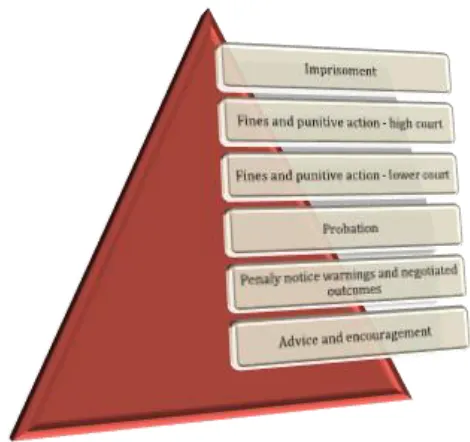
enforcement pyramid (SafeWork Australia, 2014a). Failure to comply
with legal obligations can result in a range of consequences, from
improvement notices, prosecutions, fines, and, in some cases,
Figure 1: The enforcement pyramid
This enforcement pyramid, shown in Figure 1, is frequently spoken or
thought of in terms of “responsive regulation” because the regulator
will generally take into account any past conduct or behaviour of the
organisation or individual when considering the level of regulatory
response for any breach of the legislation (Ayres & Braithwaite, 1992).
The pyramid provides regulators of all jurisdictions with a scaffolded
approach for the application of enforcement, allowing them to graduate
through levels of the pyramid if lower levels failed to provide the
necessary compliance with the legislation. This form of scaffolded
enforcement also provides organisations (possessing knowledge of this
regulators’ advice and encouragement, as the risk of higher-level
sanctions should motivate ongoing compliance.
Historically, the enforcement strategies of Australian and international
regulators have been criticised (see Johnstone, 2008; Matthews, 1993;
Prior, 1985). This criticism has been partly due to the lack of
deterrence motivation for organisations when in noncompliance of
OHS legislation. A lack of inspectors to enforce compliance and
insignificant fine amounts has often contributed to wide-ranging
noncompliance of OHS legislation (Purse, Dawson, & Dorrian, 2010).
However, changes to legislation, as well as increasing pressure from
stakeholders, have led to significant changes in the way that
organisations manage OHS in their workplaces.
Until the mid-1980s, maximum fines for OHS offences rarely exceeded
$1,000 and, in many cases, were much lower. As an example,
Braithwaite and Grabosky (1985) identified that within the
construction industry during the early 1980s, the average fine in New
South Wales (NSW) was $182; and, in South Australia (SA), the average
prosecutions were customarily confined to breaches of legislation that
resulted in a serious injury or death, thereby ignoring a significant
number of incidents and potential breaches of legislation (Purse,
Dawson, & Dorrian, 2010).
During the 1980s, reform-minded Labour governments largely
supported a strong push from trade unions to reduce injury statistics
and improve safety performance. This push culminated in significant
changes to OHS legislation across each of the Australian states and
territories. These changes included considerably higher maximum
penalties for OHS offences. In SA, for example, the maximum fine for
organisations increased from $500 to $50,000 (SafeWork SA, 2016),
and in VIC, the maximum fine increased from $2,000 to $40,000
(WorkSafe VIC, 2013). Although different across each jurisdiction,
there continued to be an upward trend in the dollar amounts of fines
over the next two decades. By 2008, the range of maximum fines
available to courts in Australia was between $100,000 and $1,020,780
Along with the increased penalties, changes to each jurisdiction’s
legislation also provided the regulators with new enforcement
instruments in the form of on the spot improvement and prohibition
notices. The improvement notice provided inspectors with powers to
require organisations, and other duty holders, to implement corrective
measures to address any alleged legislative breaches within a specified
timeframe. The prohibition notice provided a legislative process for
ceasing work that involved an immediate risk to health and safety.
Additionally, in all jurisdictions, noncompliance with notices
constituted an offence; therefore, failure to comply resulted in
prosecution of the initial breach, along with the breach of not
complying with the notice, thus increasing the potential fine amount for
the organisation that did not comply.
With further changes to the OHS legislation across Australia during the
2011-2013 harmonisation processes (Johnstone, 2008), enforcement
policies of regulators have now become more standardised, and
enforcement practices, such as inspections, issuance of notices, and
successful prosecutions, are currently increasing. Research has shown
that effective enforcement increases compliance of legislation