Using Model Checking to Detect Deadlocks in
Distributed Object Systems
?Nima Kaveh
Dept. of Computer Science, University College London London WC1E 6BT, UK
Abstract. We demonstrate how the use of synchronization primitives and thread-ing policies in distributed object middleware can lead to deadlocks. We identify that object middleware only has a few built-in synchronization and threading prim-itives. We suggest to express them as stereotypes in UML models to allow de-signers to model synchronization and threading of distributed object systems at appropriate levels of abstraction. We define the semantics of these stereotypes by a mapping to a process algebra. This allows us to use model checking techniques that are available for process algebras to detect the presence or absence of dead-locks. We also discuss how the results of these model checks can be related back to the UML diagrams.
Keywords: Software Architecture, Object Middleware, Model Checking
1
Introduction
An increasing number of applications now use a distributed system architecture. If de-signed properly, these architectures can be more fault-tolerant due to replicated compo-nents, can achieve better response times if user interface components are executed on powerful desktop machines or workstations, and they may achieve cost-effective scal-ability by using several relatively cheap hosts to execute replicated components rather than one central server or mainframe, which is usually more expensive. The construc-tion of such distributed systems by directly using network operating system primitives, such as TCP or UDP sockets, is rather involved. To reduce this complexity, software en-gineers use middleware [5], which resolves the heterogeneity between distributed hosts, the possibly different programming languages that are being used in the architecture and provides higher level interaction primitives for the communication between distributed system components. There are many different forms of middleware, including transac-tion monitors, message brokers and distributed object middleware, which encompasses middleware specifications such as the Object Management Group’s Common Object Re-quest Broker Architecture (CORBA), Microsoft’s Component Object Model (COM) or Java’s Remote Method Invocation (RMI). We note that distributed object middleware offers the richest support to application designers and incorporates primitives for dis-tributed transaction management and asynchronous message passing.
?
From the set of distributed object middleware approaches, we concentrate on CORBA [5] in this paper because it offers the richest set of synchronization and threading prim-itives.
An example scenario is used throughout this paper, which we will use to demonstrate our ideas and methods. This example involves the remote monitoring of patients which have been retired from the hospital to their homes. Sensor devices are attached to pa-tients and information is communicated between the sensor devices and a central server in a health care centre. Additionally each patient is equipped with an alert device used in case of an emergency. This example is an inherently distributed system. The differ-ent approaches have in common that they enable distributed objects to request operation executions from each other across machine boundaries. We refer to this primitive as an object request. For this example, we will use object requests to pass diagnostic informa-tion about patients that are gathered by sensor devices to a centralized database where the diagnostic data are evaluated, and if necessary alarms are generated.
Distributed objects that reside on different hosts are executed in parallel with each other. In our example, this means that several different patient monitor hosts gather pa-tient data at the same time. To handle the situation where several of them send data con-currently to a server, distributed object middleware supports different threading policies, which determine the way in which the middleware deals with concurrent object requests. A single-threaded policy will queue concurrent requests and execute them in a sequen-tial manner, whereas a multi-threaded policy can deal with multiple requests concur-rently. A common method of implementing multi-threaded policies is to define a thread pool, from which free threads are picked to process incoming requests and requests are queued if the pool is exhausted.
Object requests need to be synchronized, because client and server objects may exe-cute in parallel. Object middleware support different synchronization primitives, which determine how client and server objects synchronize during requests. Synchronous re-quests block the client object until the server object processes the request and returns the results of the requested operation. This is the default synchronization primitive not only in CORBA, but also in RMI and COM. Deferred synchronous requests unblock the client as soon as it has made the request. The client achieves completion of the invocation as well as the collection of any return values by polling the server object. With a oneway request there is no value returned by the server object. The client regains control as soon as the middleware received the request and does not know whether the server executed the requested operation or not. Asynchronous requests return control to the client as soon an invocation is made. After the invocation the client object is free to do other tasks or request further operations. The result of the method invocation is returned in a call back from the server to the client. We note that CORBA supports all these primitives directly. In [5], its shown how the CORBA primitives can be implemented using multiple client threads in Java/RMI and Microsoft’s COM.
stereotypes in dynamic UML models. Thirdly, we define the semantics of these stereo-types by mapping stereotyped UML models to a process algebra. Finally, we show how model checking techniques available for these process algebra notations are able to de-tect the possibility of deadlocks and how their results can be related back to the UML models.
Application developers need to verify their design specifications for absence of any deadlock situations. We aim to develop a CASE tool that takes in such design specifi-cations, from which we generate a process algebra specification which is then analysed for deadlock. This approach has the advantage of detecting deadlocks in the design stage of development compared to the traditional way of attempting it during the later testing phase. Early indications of potential deadlock situations will make the process of design and implementation modifications more efficient.
In Section 2, we will define UML stereotypes to express both the threading policies and the synchronization primitives of distributed object middleware. In Section 3, we explain informally how a deadlock occurs in the running example. We then define the semantics of our threading and synchronization stereotypes using FSP, a process alge-bra representation [9] in Section 4. We explain in Section 5 how we use this semantics definition to generate an FSP process model from a UML Sequence Diagram. Section 6 discusses how compositional reachability analysis can be used to check for presence or absence of deadlocks in our Sequence diagrams. Section 7 concludes our paper by sum-marizing the main results and indicating future directions of this research.
2
Modelling Distributed Object Interactions
Rather than proposing to use new or complex notations and tools we have chosen the Unified Modelling Language to model object interactions and their class structures. UML is widely accepted and used in industry and allows us to enrich its notation to accomo-date the extra semantics required for model checking. In this section we will look at mod-elling the described example, with an aim of using it for deadlock detection later in the paper.
Stereotypes provide designers with the means of augmenting basic UML models to include the semantic information required to model the synchronization behaviour in an application design. We have separated the stereotypes into two main groups. The first group deals with the synchronization primitives used by a client to request the services of a server object. The second group involves threading policies used on the server-side. These policies determine how server objects deal with multiple concurrent requests.
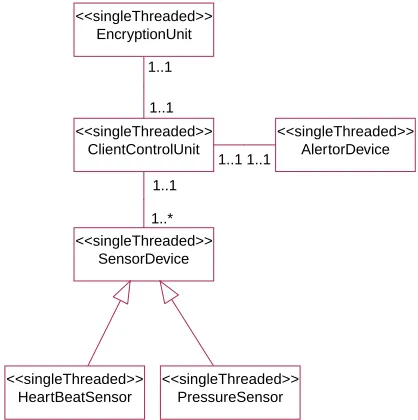
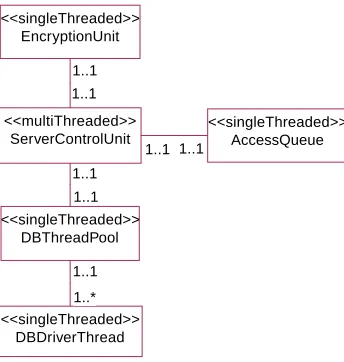
The class diagrams in Figures 1 and 2 show the main object types involved in gath-ering patient data and communicating it to a health care centre database. Note that the design diagrams mainly address distributed communication. Issues such as the user in-terface need to be looked at separately and are of no concern here.
HeartBeatSensor <<singleThreaded>>
PressureSensor <<singleThreaded>> EncryptionUnit
<<singleThreaded>>
SensorDevice <<singleThreaded>>
AlertorDevice <<singleThreaded>> ClientControlUnit
<<singleThreaded>> 1..1
1..1 1..1
1..1
1..1
1..* 1..1
1..*
1..1 1..1 1..1 1..1
Fig. 1. UML class diagram of the Client
SensorDeviceis an abstract type for all types of medical sensor devices attached to patients.HeartBeatSensor andPressureSensor are two concrete object types in-heriting from theSensorDeviceclass. TheAlertorDevicerepresents the device that a patient activates to get medical attention. TheClientControlUnitis used by sensor devices to send updates and alert messages to the health care centre server.EncryptionUnit ensures a secure communication channel as well as providing a non-repudiation service, which will be used when charging patients for services.
All patient data are stored in a central database at the health care centre. All incoming data from patients are logged and appropriate updates are made to the central database. ServerControlUnitis the main co-ordinator class on the server side. This type is re-sponsible for communicating information between the patients and the health care cen-tre, and its capable of servicing several patients simultaneously. In order to obtain this parallelism, it uses a multi-threading technique. TheDBThreadPoolrepresents a
fixed-size collection ofDBDriverThreadobjects, which it manages. Each time theServerControlUnit receives a message from a patient it asks theDBThreadPool object to provide a free
DBDriverThread <<singleThreaded>>
EncryptionUnit <<singleThreaded>>
DBThreadPool <<singleThreaded>>
1..1
1..* 1..1
1..*
AccessQueue <<singleThreaded>> ServerControlUnit
<<multiThreaded>> 1..1 1..1 1..1 1..1
1..1 1..1 1..1 1..1
1..1 1..1 1..1 1..1
Fig. 2. UML class diagram of the Server
a task theDBDriverThreadobject reports back to theDBThreadPoolobjects and is deemed free once again. In the case of having no freeDBDriverThread objects the ServerControlUnitwill store all new incoming messages in theAccessQueue ob-ject. As theDBDriverThreadobjects start becoming free again, messages can be de-queued from theAccessQueueobject and serviced, in a first-in-first-out order. In the event of allDBDriverThread object being occupied and theAccessQueuebeing at full capacity theServerControlUnit will have to reject any messages which it re-ceives.
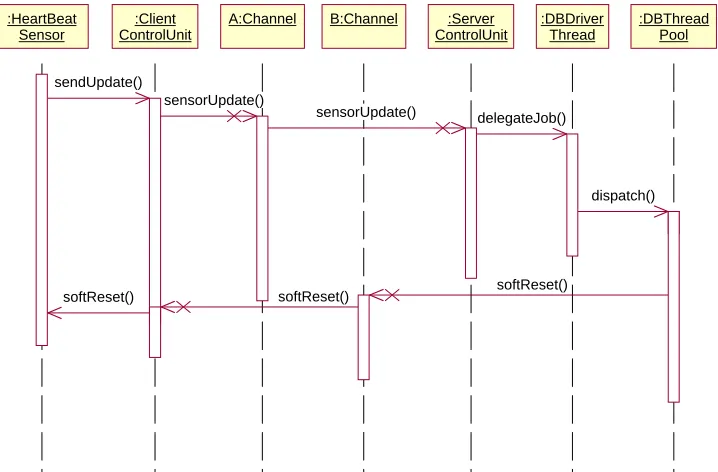
Class diagrams are used to describe the structure and hierarchy in a design, thus con-taining static information. Whilst a sequence diagram represents a given scenario of how instances of classes interact with each other, thus containing dynamic information. The sequence diagram in Figure 3 describes the interactions of aHeartBeatSensorobject to update information of a health care centre. Due to lack of space theEncryptionUnit has not been included in the sequence diagram, but its exemption does not alter the be-haviour.
3
Deadlock in Distributed Object Systems
:HeartBeat Sensor
:Client ControlUnit
A:Channel B:Channel :Server ControlUnit
:DBThread Pool :DBDriver
Thread
sendUpdate()
sensorUpdate()
sensorUpdate() delegateJob()
dispatch()
softReset() softReset()
softReset()
Fig. 3. Sequence diagram of a routine sensor update
The sequence diagram shown in Figure 3 actually results in a deadlock. First the HeartBeatSensordevice sends an update through theClientControlUnit, in the form of a synchronous request. Upon arrival on the server-side aDBDriverThread in-stance is assigned to deal with this message. Control is not returned back to the client until theDBDriverThreadhas finished processing the request. TheDBDriverThread concludes that a soft reset of the sensor device is required and so it sends the reset com-mand by invoking a synchronous request to theHeartBeatSensor object. Thus we have a case where the Client is blocked waiting for a response from theDBDriverThread and vice versa, thus causing a deadlock chain. This deadlock is not easily spotted, be-cause as mentioned before the threading behaviour is determined at a type-level of ab-straction and the synchronization behaviour is modelled at an instance level of abstrac-tion. Only the combined knowledge of the two allows designers to consider the liveness issues. In order to demonstrate the idea we kept the interaction small. But the reader should note that such a detection would have been a lot more difficult in a real world industrial case, where the number of objects involved in an interaction may be consid-erably larger.
dis-tributed applications make the task of testing more difficult by adding new dimensions of complexity. Prime examples of such complexities are hardware heterogeneity, a lack of global memory and physical clock and absence of bounds on transmission delays. We argue that the exponential growth in likely scenarios makes the conventional methods of testing much less effective and scalable. We argue that model checking provides a suitable method of overcoming this complexity dilemma as well tackling it with a rigour and thoroughness that cannot be expected from a human being.
4
Semantics of Stereotypes
A process algebra was chosen to define the semantics of the stereotypes ahead of alter-natives such as denotational and axiomatic models, since it provides a more powerful mathematical model of concurrency. Process algebra operators offer direct support for modelling the inherent parallelism in distributed systems. The syntax allows for hierar-chical description of processes, a valuable feature for compositional reasoning, verifica-tion and analysis.
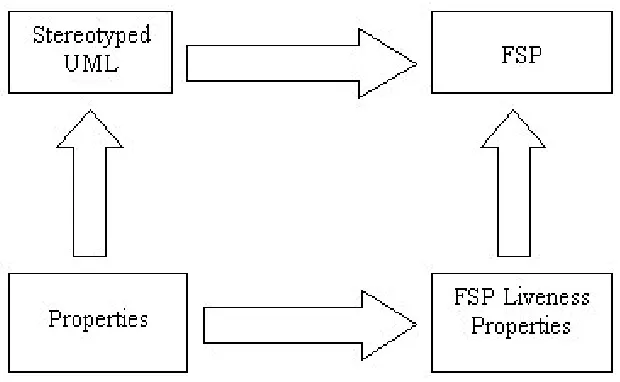
Fig. 4. Relation of FSP to design modelling
Figure 4 further demonstrates the reasoning behind choosing a process algebra for modelling the semantics of stereotypes. We are specifically referring to the FSP [9] pro-cess algebra. We would like to generate FSP specification from stereotyped UML mod-els. There are liveness properties which the designer would like to have in these models such as deadlock safety, which are directly supported by the liveness properties exper-essed in FSP.
events. This service offers added capabilities such as being able to choose a level of Quality of Service and event filtering at the server-end. All client/server interactions in Figure 3 are taking place through such Channel objects. The generated FSP must exactly follow the semantic behaviour of the synchronization primitives and threading policies as outlined in Section 1.
4.1 Synchronization Primitives
The process algebra model in Figure 5 defines thehhSynchronousiistereotype seman-tic of requests. TheClientprocess engages in an actionSendRequestand does not return until it receives a reply using theReceiveReplyaction. By using relabelling we have synchronized the ClientSendRequest with the ChannelReceiveRequestand the ClientReceiveReplywith the ChannelSendReply. So by making the Channel process engage in a SendReply action only after receiving a reply from the server, we define thehhsynchronousiistereotype.
Client=(SendRequest->ReceiveReply->Client).
Channel=(ReceiveRequest->RelayRequest->ReceiveReply-> SendReply->Channel).
||System=(c:Client || a:Channel) /{c.SendRequest/a.ReceiveRequest,
c.ReceiveReply/a.SendReply}.
Fig. 5. Process Algebra Definition of Synchronous Stereotype
The process algebra model in Figure 6 defines the hhDeferredSynchronous ii
stereo-type request semantic. TheClient process invokes a request by engaging in actionpush _sendRequest which is synchronized with thepush ReceiveReply. TheWaitTimeconstant defines
the number of time units that theClientprocess continues executing before blocking to receive any results from the server. TheClient is unblocked when theChannel pro-cess engages in actionpush sendReply, which is called only when the server returns a result to theChannel.
4.2 Threading Policies
const WaitTime=3 range T = 0..WaitTime
Client = (push_SendRequest->Client[0]),
Client[i:T]= if (i<WaitTime) then (execute->Client[i+1]) else (push_ReceiveReply -> Client).
Channel=(push_ReceiveRequest->push_SendRequest->push_ReceiveReply-> push_SendReply->Channel).
||System=(c:Client || a:Channel)
/{c.push_SendRequest/a.push_ReceiveRequest, c.push_ReceiveReply/a.push_SendReply}.
Fig. 6. Process Algebra Definition of the Deferred Synchronous Stereotype
client request, if there are any available threads the synchronised actiongetFreeThread is taken which starts theThreadPool process. This further causes theThread pro-cess to be initiated using the shareddelegateTaskaction. Once the request has been serviced the responsibleThreadprocess engages in aReceiveReplyaction which is shared with theChannel process, causing the results to be sent back to the client. If the number of used has reached the maximum the server attempts to add the message to the queue. ThisaddToQueuesucceeds if there are free queue slots left, otherwise the message is being rejected.
5
Generating FSP Models From UML Diagrams
const PoolSize=16 const QueueSize = 10 range T=0..PoolSize range Q=0..QueueSize
Channel=(
push_ReceiveRequest->push_SendRequest->push_ReceiveReply ->push_SendReply->Channel).
Thread=(delegateTask->taskExecuted->push_ReceiveReply->Thread).
ThreadPool = ThreadPool[0],
ThreadPool[i:T] = if (i<PoolSize) then
(getFreeThread->delegateTask->ThreadPool[i+1] | taskExecuted -> ThreadPool[i-1])
else (noFreeThreads -> ThreadPool[i]).
Queue = Queue[0],
Queue[j:Q] = if (j<QueueSize) then (
inspectQueue-> if(j>0) then (dequeueMessage-> Queue[j-1] | addToQueue[j] -> Queue[j+1]) else (addToQueue[j] -> Queue[j+1]))
else (rejectMessage -> Queue[j]).
Server = Server[0][0], Server[i:T][j:Q]=(
push_ReceiveRequest-> if (i<PoolSize) then (
getFreeThread-> Server[i+1][j]) else
(noFreeThreads->
if (j<QueueSize) then (addToQueue[j]->Server[i][j+1]) else (rejectMessage-> Server[i][j]))).
||System=(a:Channel||s:Server||s:ThreadPool||s:Thread||s:Queue) /{a.push_SendRequest/s.push_ReceiveRequest,
a.push_ReceiveReply/s.push_SendReply}.
6
Detecting Deadlocks By Model Checking
Once we have derived the FSP specification, we can use a model checker to do an ex-haustive search for deadlocks. The Labelled Transition System Analysis tool that is avail-able for FSP performs a compositional reachability analysis [2] in order to compute the complete state space of the model. This tool operates by mapping the specification into a Labelled Transition System [11]. A deadlock is detected by looking for states with in-going but no outin-going transitions.
In the case of a deadlock detected, the LTSA will provide us with a trace of actions leading to the deadlock. From this trace we can single out the starting and ending link in the deadlock chain. In FSP terminology these links are processes and within each process we can find the actual action statement leading to deadlock. Figure 8 shows the output produced by the LTSA when processing the FSP specification of the example we have been discussing through out this paper. This FSP specification is formed by combining the specifications in Figures 5 and 7. As you can see the composition time is fairly quick, however the state space of the output is very large and its rate of growth is well above a linear relationship.
State Space:
4 * 4 * 4 * 385 * 33 * 9 * 21 * 3 = 461039040 Composing
potential DEADLOCK
States Composed: 10 Transitions: 9 in 10ms
Fig. 8. Output of the LTSA for the discussed example
7
Related Work
Process algebra representations, such as CSP [8], CCS [10], the-calculus [11] or FSP [9] can be used to model the concurrent behaviour of a distributed system. Tools, such as the Concurrency workbench [3] or the Labelled Transition System Analyzer available for FSP can be used to check these models for violations of liveness or safety properties. The problem with both these formalisms and tools is, however, that they are difficult to use for the practitioner and that they are general purpose tools that do not provide built-in support for the synchronization and activation primitives that current object middleware supports.
In [7] CCS is used to define the semantics of CORBA’s asynchronous messaging. The paper however, fails to realize that the synchronization behaviour alone is insuffi-cient for model checking as deadlocks can be introduced and resolved by the different threading policies that the object adapters support.
8
Acknowledgements
I would like to thank Wolfgang Emmerich for his continual feedback and useful sugges-tions. I am also indebted to Jeff Magee for expressing his views on an earlier version of this paper.
References
1. R. Allen and D. Garlan. A Formal Basis for Architectural Connection. ACM Transactions on Software Engineering and Methodology, 6(3):213–249, June 1997.
2. S.-C. Cheung and J. Kramer. Checking Safety Properties Using Compositional Reachability Analysis. ACM Transactions on Software Engineering and Methodology, 8(1):49–78, 1999. 3. R. Cleaveland, J. Parrow, and B. Steffen. The Concurrency Workbench: A Semantics Based Tool for the Verification of Concurrent Systems. ACM Transactions on Programming Lan-guages and Systems, 15(1):36–72, 1993.
4. E. di Nitto and D. Rosenblum. Exploiting ADLs to Specify Architectural Styles Induced by Middleware Infrastructures. In Proc. of the21
st
Int. Conf. on Software Engineering, Los Angeles, California, pages 13–22. ACM Press, 1999.
5. W. Emmerich. Engineering Distributed Objects. John Wiley & Sons, Apr. 2000.
6. W. Emmerich and N. Kaveh. Model Checking Distributed Objects. In B. Balzer and H. Ob-bink, editors, Proc. of the4
th
International Software Architecture Workshop, Limerick, Ire-land, 2000. To appear.
7. M. Gaspari and G. Zavattaro. A Process Algebraic Specification of the New Asynchronous CORBA Messaging Service. In Proceedings of the13
th
European Conference on Object-Oriented Programming, ECOOP’99, volume 1628 of Lecture Notes in Computer Science, pages 495–518. Springer, 1999.
8. C. A. R. Hoare. Communicating Sequential Processes. Prentice-Hall, 1985.
9. J. Magee and J. Kramer. Concurrency: Models and Programs – From Finite State Models to Java Programs. John Wiley, 1999.
10. R. Milner. Communication and Concurrency. Prentice-Hall, 1995.
11. R. Milner. Communicating and Mobile Systems: the-calculus. Cambridge University Press, 1999.
12. C. Nentwich, W. Emmerich, A. Finkelstein, and A. Zisman. Browsing Objects in XML. Re-search Note RN/99/41, University College London, Dept. of Computer Science, 1999. 13. Object Management Group. The Common Object Request Broker: Architecture and
Specifi-cation Revision 2.0. 492 Old Connecticut Path, Framingham, MA 01701, USA, July 1995. 14. M. Shaw and D. Garlan. Software Architecture: Perspectives on an Emerging Discipline.