Succinct Non-Interactive Secure Computation
∗Andrew Morgan Cornell University
Rafael Pass† Cornell Tech
Antigoni Polychroniadou‡ J.P. Morgan AI Research
February 20, 2020
Abstract
We present the firstmaliciously secureprotocol forsuccinct non-interactive secure two-party computation (SNISC): Each player sends just a single message whose length is (essentially) independent of the running time of the function to be computed. The protocol does not require any trusted setup, satisfies superpolynomial-time simulation-based security (SPS), and is based on (subexponential) security of the Learning With Errors (LWE) assumption. We do not rely on SNARKs or “knowledge of exponent”-type assumptions.
Since the protocol is non-interactive, the relaxation to SPS security is needed, as standard polynomial-time simulation is impossible; however, a slight variant of our main protocol yields a SNISC with polynomial-time simulation in the CRS model.
∗
A preliminary version of this paper will appear in the proceedings of EUROCRYPT 2020; this is the full version. †
Supported in part by NSF Award SATC-1704788, NSF Award RI-1703846, and AFOSR Award FA9550-18-1-0267. This research is based upon work supported in part by the Office of the Director of National Intelligence (ODNI), Intelligence Advanced Research Projects Activity (IARPA), via 2019-19-020700006. The views and conclusions contained herein are those of the authors and should not be interpreted as necessarily representing the official policies, either expressed or implied, of ODNI, IARPA, or the U.S. Government. The U.S. Government is authorized to reproduce and distribute reprints for governmental purposes notwithstanding any copyright annotation therein.
‡
1
Introduction
Protocols for secure two-party computation (2PC) allow two parties to compute any function (f) of their private inputs (x and y) without revealing anything more than the output f(x, y) of the function. Since their introduction by Yao [Yao82] and Goldreich, Micali and Wigderson [GMW87], they have become one of the most central tools in modern cryptography. In this work, our focus is on 2PC in a setting with anon-interactivity requirement: each player sends just asingle message. The first player—typically referred to as thereceiver (orR)—computes some messagem1 based on
its inputxand sendsm1 to the second player. The second player—referred to as thesender (S)— next computes a response m2 (based on its input y and the message m1 it received) and sends it back to the receiver. Upon receiving the responsem2, the receiver can finally compute and output f(x, y). (Note that in such a non-interactive scenario, it is essential that only the receiver obtains the output—in other words, that the functionality is “one-sided”; otherwise, since the protocol only has two rounds, the sender will be able to compute the output given only m1, meaning that
it could obtain f(x, y∗) on any number of inputs y∗ of its choice.)
SNISC: Succinct Non-Interactive Secure Computation. As far as we know, this notion of non-interactive 2PC was first formally studied in [IKO+11] under the name non-interactive secure computation (NISC); however, informal versions of it became popular in connection with Gentry’s breakthrough result onfully homomorphic encryption (FHE) [Gen09]. One of the original applications of FHE was the private outsourcing of some computation to a remote party: for instance, consider a scenario where a client (the receiver) has some secret input x and wishes a powerful server (the sender) to compute some potentially time-consuming function f on x (and potentially another inputybelonging to the server). Using FHE, the client/receiver simply letsm1
be an FHE encryption of x; the server/sender can next use homomorphic evaluation to obtain an encryption m2 of f(x, y) to send back, which can be decrypted by the client/receiver. Indeed, an FHE scheme not only directly yields a NISC, but it also yields a succinct NISC (SNISC)—where both the communication complexity of the protocol and the running time of an honest receiver are “essentially” independent of the running time of f. More formally, we define a SNISC as a NISC where the communication complexity and receiver running time depend only on the length of the inputs and outputs, and polylogarithmically on the running time of the function f to be computed (where we assume that f is given as a Turing machine).
The problem with this folklore approach towards private outsourcing/succinct NISC is that using FHE alone only satisfies semi-honest security, as opposed to fully malicious security. For instance, a malicious sender could decide to compute any other function of its choice instead of the correct f! Of course, we could always extend the protocol using ZK-SNARKs (succinct non-interactive arguments of knowledge) [Mic94, Gro10, BCCT13, BCI+13, GGPR13] to prove correctness of the messagesm1andm2, but doing so comes at a cost. First, we now need to assume some trusted setup, such as acommon reference string(CRS). Additionally, all known constructions of SNARKs are based on knowledge- or extractability-type assumptions, which in general are known to be problematic with respect to arbitrary auxiliary input [BCPR14, BP15].1 Thus, the question
as to whether succinct non-interactive secure computation with malicious security is possible in
the plain model remains open:
Does there exist a succinct non-interactive secure computation protocol without any trusted setup (and without using extractability assumptions)?
NISC protocols in models with trusted setup have been extensively studied. There exist known constructions of NISC in the OT-hybrid model [IKO+11], in the CRS model based on cut-and-choose [AMPR14, MR17], assuming stateful [GIS+10] and stateless [HPV16, BJOV18] tamper-proof hardware tokens, and in the global random oracle model [CJS14]. As far as we know, none of the above protocols are succinct.
The plain model, however, presents additional complications: Goldreich-Oren’s [GO94] clas-sic impossibility result for two-round zero-knowledge proofs immediately shows that even a non-succinct (let alone non-succinct) NISC with malicious security cannot satisfy the standard polynomial-time simulation-based notion of security.2 Thus, to get any NISC, let alone a succinct one, we need to use some relaxed notion of simulatability for the definition of secure computation. Superpolynomial-time simulation-based security (SPS) [Pas03, PS04] has emerged as the stan-dard relaxation of simulation-based security: under SPS security, the attacker is restricted to be a non-uniform polynomial time algorithm, but the simulator (in the definition of secure com-putation) is allowed to run in (slightly) superpolynomial time (e.g., in quasi-polynomial time). Non-succinct NISC protocols with SPS simulation are known under various standard assumptions [Pas03, SU11, BGI+17]. Most notably, the work of [BGI+17] constructs a maliciously secure (non-succinct) NISC with quasi-polynomial simulation in the plain model which can securely compute any functionality based on the subexponential security of various standard hardness assumptions; we return to this result in more detail later on. However, all previous works only construct NISC protocols that are non-succinct.
Towards achieving succinctness for NISC, a very recent work by Brakerski and Kalai [BK18] takes us a step on the way: they focus on a notion of “private delegation” where the receiver’s/ client’s input x is publicly known (and thus does not need to be kept hidden) but the input y of the sender/server is considered private. The authors present a delegation protocol that achieves witness indistinguishability (WI) for the sender—as shown in [Pas03], WI is a strict relaxation of SPS security.3 While their protocol achieves the desired notion of succinctness, it still falls short of the goal of producing a succinct NISC protocol due to the fact that its only considers privacy for one of the players (namely, the sender); this significantly simplifies the problem. Additionally, their notion of privacy (witness indistinguishability) is also weaker than what we are aiming to achieve (i.e., simulation-based SPS security).
1.1 Our Results
In this work, we provide an affirmative answer to the above question, presenting the first SNISC for general functionalities. Our protocol is in the plain model (i.e., no trusted setup), and we do not rely on any extractability-based assumptions.
2Furthermore, if we restrict to black-box simulation, [KO04] proved that four rounds are necessary and sufficient for secure one-sided 2PC in the plain model.
Theorem 1 (Informally stated). Assuming subexponential security of the LWE assumption, there exists a maliciously SPS-secure SNISC for any efficient functionality. Furthermore, the simulator of the protocol runs in quasi-polynomial time.
Our protocol relies on three primitives:
• A (leveled) FHE scheme [Gen09] with quasi-polynomial security. For our purposes, we ad-ditionally require the FHE to satisfy perfect correctness. Such schemes can be based on the (quasi-polynomial security of the) LWE (Learning With Errors) assumption [Reg05], as shown in [BGV12, GKP+13].
• A (non-private) delegation scheme for polynomial time computations with quasi-polynomial security. For our purpose, we require a scheme that satisfiesperfect completeness and allows the sender to adaptively choose the functionality (i.e., we need what is referred to as an “adaptive delegation scheme”). Such schemes can in fact be based on the above notion of quasi-polynomial FHE, and hence in turn on the quasi-polynomial security of the LWE assumption [BHK17].
• A (non-succinct) SPS-secure NISC for general functionalitiesf with a quasi-polynomial sim-ulator. Such a scheme exists based on the existence of a subexponentially-secure “weak oblivious transfer” protocol4 [BGI+17]5, which in turn can be based on the subexponential security of any one of the DDH [NP01], Quadratic Residuosity, or Nth Residuosity [HK12]
assumptions, or (as shown in [BD18]) on subexponential security of the LWE assumption.
More precisely, if the underlying NISC protocol has a T(n)·poly(n)-time simulator, and if all the other primitives are secure againstT(n)·poly(n) time attackers, the final protocol is secure and has a T(n)·poly(n)-time simulator:
Theorem 2(Informally stated). Assuming the existence of aT(n)-time simulatable NISC protocol, a subexponentially sound adaptive delegation scheme for polynomial-time computations with perfect completeness, and a subexponentially secure leveled FHE scheme with perfect correctness, there exists T(n)·poly(n)-time simulatable SNISC for any efficient functionality.
As a corollary, we can directly instantiate our protocol using a NISC with polynomial-time simulation in the CRS model (see Appendix A) based on a two-round universally composable OT protocol (in the CRS model), which [PVW08] shows can be based on the polynomial security of LWE. Hence:
Corollary 1(Informally stated). Assuming the polynomial security of the LWE assumption, there exists a maliciously-secure SNISC (with a polynomial-time simulator) in the CRS model for any efficient functionality.
4
Roughly speaking, a weak oblivious transfer protocol is an OT protocol that satisfies SPS-security against a malicious receiver, but only indistinguishability-based (“game-based”) security against a malicious sender.
1.2 Technical Overview
At a high level, our approach begins with the semi-honestly secure approach of using FHE (which we detailed in the introduction) and attempts to compile it to become secure with respect to malicious attackers. Instead of using ZK-SNARKs (which rely on non-standard assumptions and trusted setup), we will instead use an adaptive delegation scheme and a non-succinct NISC. For our approach to work, we will strongly rely onperfect correctness/completeness properties of both the FHE and the delegation scheme; as far as we know, perfect correctness of these types of primitives has not previously been used to enable applications (where the goal itself isn’t perfect correctness).6. Despite this, though, recent constructions (or slight variants) of both FHE and delegation protocols fortunately do provide these guarantees.
Adaptive Delegation: A Starting Point. To explain the approach, we shall start from a (flawed) candidate which simply combines an FHE scheme and an adaptive delegation scheme. In an adaptive delegation scheme (as given in [BHK17]), a verifier generates a public/secret key-pair (pk,sk) and sends pk to the prover. The prover next picks some statement ˜x and function g, computes the output ˜y = g(˜x), and produces a “short” proof π of the validity of the statement that ˜y=g(˜x). The prover finally sends (˜x, g,y, π˜ ) to the verifier, who can use its secret keysk to check the validity of the proof. We will rely on an adaptive delegation scheme satisfying perfect completeness—that is, for all public keys in the range of the key generation algorithm, the prover can convince the verifier with probability 1.
The candidate SNISC leverages delegation to “outsource” the computation of the homomor-phic evaluation to the sender: specifically, the receiver first generates a public/secret key-pair (pkFHE,skFHE) for the FHE, encrypts its inputx using the FHE (obtaining a ciphertextctx), gener-ates a public/secret key pair (pkDel,skDel) for the delegation scheme, and finally sends (ctx,pkFHE,
pkDel) to the sender. The sender in turn encrypts its input y, obtaining a ciphertext cty; next, it lets g be the function for homomorphically evaluating f on two ciphertexts, computes g(ctx,cty) (i.e., homomorphically evaluates f on ctx and cty) to obtain a ciphertext ctout, and computes a delegation proofπ (with respect topkDel) of the validity of the computation ofg. Finally, the sender sends (cty,ctout, π) to the receiver, who verifies the proof and, if the proof is accepting, decrypts
ctout and outputs it.
Intuitively, this approach hides the input x of the receiver, but clearly fails to hide the input
y of the sender, as the receiver can simply decrypt cty to obtain y. So, rather than providingcty and π in the clear (as even just the proof π could leak things about cty), we instead use the (non-succinct) NISC to run the verification procedure of the delegation scheme. That is, we can add to the protocol a NISC instance where the receiver inputsskDel, the sender inputs ctx,cty,ctout, π, and the functionality runs the verification algorithm for the delegation scheme, outputting either ⊥if verification fails or, otherwise, ctout (which can be decrypted by the receiver).
Input Independence: Leveraging Perfect Correctness of FHE. The above approach in-tuitively hides the inputs of both players, and also ensures that the function is computed correctly. But there are many problems with it. For instance, while it guarantees that the sender does not learn the receiver’s inputx, it doesnot guarantee “input independence”, or that the sender’s input
6
does not depend on the receiver’s somehow: for instance, the sender can easily maulctx into, say, an encryption cty of x+ 1 and use that as its input. On a more technical level, simulation-based security requires the simulator to be able to extract the inputs of malicious players, but it is not clear how this can be done here—in fact, a simulator cannot extract the sender’s input y due to the above malleability attack.
To overcome this issue, we again leverage the non-succinct NISC to enable extractability: we add x and the randomness, rx, needed to generate ctx as an input from the receiver, and we add
ctx (i.e., the ciphertext obtained from the receiver), y, and the randomness needed to generate
cty as input from the sender. The functionality additionally checks that the ciphertexts ctx,cty respectively are valid encryptions of the inputs x, y using the given randomness. (It is actually essential that the sender includes the ciphertext ctx from the receiver as part of its input, as opposed to having the receiver input it, as otherwise we could not guarantee that the receiver is sending the same ciphertext to the sender as it is inputting to the NISC). If we have perfect correctness for the underlying FHE scheme with respect to the public-keys selected by the receiver, this approach guarantees that we can correctly extract the inputs of the players. The reason that we need perfect correctness is that the NISC only guarantees that the ciphertexts have been honestly generated using some randomness, but we have no guarantees that the randomness is honestly generated. Perfect correctness ensures that all randomness is “good” and will result in a “well-formed” ciphertext on which homomorphic computation, and subsequently decryption, will always lead to the correct output.
Dealing with a Malicious Receiver: Interactive Witness Encryption and Perfectly Correct Delegation. While the above protocol suffices to deal with a malicious sender (although, as we shall discuss later on, even this is not trivial due to the potential for “spooky interactions” [DLN+04]), it still does not allow us to deal with a malicious receiver. The problem is that the
receiver could send invalid public keys, either for the FHE or for the delegation scheme. For instance, if the public key for the FHE is invalid, perfect correctness may no longer hold, and we may not be able to extract a correct input for the receiver. Likewise, if the public key for the delegation scheme is invalid, we will not be able to determine whether the verification algorithm of the delegation scheme will be accepting, and thus cannot carry out a simulation. Typically, dealing with a malicious receiver would require adding a zero-knowledge proof of well-formedness of its messages; however, given that the receiver is sending the first message, this seems problematic since, even with SPS-security, one-message ZK is impossible (with respect to non-uniform attackers [Pas03, BP04]).
verification of the delegation scheme (as once again, in this case, perfect correctness guarantees that there is no “bad” randomness).
We still have an issue: perfect correctness of the FHE will ensure that the decryption of the out-put is correct, but we also need to ensure that we can simulate the ciphertext outout-put by the NISC. While this can be handled using an FHE satisfying an appropriate rerandomizability/simulatability property (also with respect to maliciously selected ciphertext), doing so introduces additional com-plications. Furthermore, while we motivated the above modification using witness encryption, currently known constructions of witness encryption rely on non-standard, and less understood, hardness assumptions; as such, we would like to altogether avoid using it as an underlying primi-tive.
So, to circumvent the use of witness encryption—while at the same time ensuring that the out-put of the NISC is simulatable—we realize that in our context, it in fact suffices to use atwo-round version of witness encryption, where the receiver of the encryption chooses the statement and can first send a message corresponding to the statement. And such a non-interactive version of witness encryption can be readily implemented using a NISC! As we are already running an instance of a NISC, we can simply have the NISC also implement this interactive witness encryption. More precisely, we now additionally require the receiver to provide its witness—i.e., the randomness for the key generation algorithms—as an input to the NISC, while the sender additionally provides the public keys pkFHE and pkDel which it receives. The functionality will now only release the output
ctout if it verifies that the keys input by the sender are correctly generated from the respective ran-domness input by the receiver. Better still, since the ranran-domness used to generate the public/secret key-pair is now an input to the functionality, the functionality can also recover the secret key for the FHE, and next also decrypt ctout and simply output plain text corresponding to ctout. This prevents the need for rerandomizingctout, since it is now internal to the NISC instance (and is no longer output). With all of the above modifications, we can now prove that the protocol satisfies SPS security.
The Final Protocol. For clarity, let us summarize the final protocol.
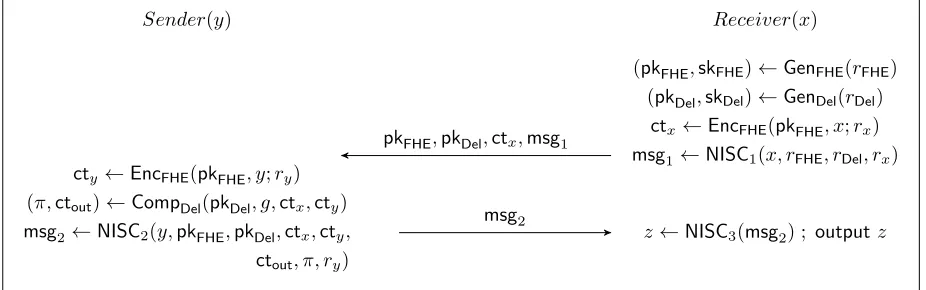
• The Receiver generates (pkFHE,skFHE) and (pkDel,skDel) using randomness rFHE and rDel (re-spectively) and generates an encryptionctx of its inputx using randomnessrx. It then sends (pkFHE,pkDel,ctx) and the first messagemsg1 of a NISC using the inputx0 = (x, rFHE, rDel, rx) (for a functionality to be specified shortly).
• The Sender, upon receivingpkFHE,pkDel,msg1 generates an encryptioncty of its inputy using randomnessry, applies the homomorphic evaluation off toctxandcty to obtain a ciphertext
ctout = g(ctx,cty), generates a proof π using the delegation scheme (w.r.t. pkDel) of the correctness of the computation thatctout =g(ctx,cty), and finally sends the second message
msg2 of the NISC using the inputy0= (y,pkFHE,pkDel,ctx,cty,ctout, π, ry).
• Finally, the receiver, upon getting msg2, computes the output z of the NISC protocol and outputs it.
• The functionality computed by the NISC on inputx0= (x, rFHE, rDel, rx) and y0 = (y,pkFHE,
pkDel,ctx,cty,ctout, π, ry) does the following: it checks that:
Sender(y)
(pkFHE,skFHE)←GenFHE(rFHE) (pkDel,skDel)←GenDel(rDel)
ctx←EncFHE(pkFHE, x;rx) msg1←NISC1(x, rFHE, rDel, rx)
z←NISC3(msg2) ; output z
pkFHE,pkDel,ctx,msg1
Receiver(x)
msg2 cty←EncFHE(pkFHE, y;ry)
(π,ctout)←CompDel(pkDel, g,ctx,cty)
msg2←NISC2(y,pkFHE,pkDel,ctx,cty,
ctout, π, ry)
Figure 1: The final SNISC protocol. (NISC1,NISC2,NISC3) denotes the underlying (non-succinct)
NISC protocol and and the functionality g denotes the homomorphic evaluation g(c1, c2) = EvalFHE(pkFHE, f, c1, c2).
2. the ciphertextsctx,cty are respectively encryptions ofx, yusing randomnessrx, ry; and,
3. π is a valid proof ofctout=g(ctx,cty) w.r.t. (pkDel,skDel) (as generated from rDel).
If the checks pass, it decrypts ctout (by first generating skFHE from rFHE), obtaining the plaintextz, and finally outputs z. (If any of the checks fail, it instead outputs⊥.)
A summary of the message flow can be found in Figure 1.
A Subtlety in the Security Proof One subtle point that arises in the proof of security is that, to simulate a malicious sender, we need to simulate the ciphertext ctx without knowledge of
x. But the functionality of the underlying NISC takes as input the randomness used for both the key generation ofpkFHEand for encrypting ctx, and thus the functionality implicitly knows how to decrypt ctx. A similar issue has arisen in the related context of constructing delegation schemes from FHE and related primitives (see [DLN+04]), where it was shown that so-called “spooky interactions” can arise, where a malicious sender (even though it does not how to decrypt the ciphertext) can in fact use this dependence to make the receiver output values that correlate in undesirable ways with the input x (in particular, in ways that would not have been possible if using an “idealized” FHE). Fortunately, in our context, we are able to overcome this issue by using the perfect correctness of the FHE scheme and soundness of our underlying delegation scheme to perform a carefully designed hybrid argument.
2
Preliminaries
Notation. Let N denote the set of natural numbers (positive integers), and let [n] denote the
set of natural numbers at most n, or {1,2, . . . , n}. For n ∈ N, we denote by 1n the string of
n ones, which will be used to provide a security parameter as input to an algorithm (this is by convention, so that the input length is bounded below by the security parameter). We assume the reader is familiar with polynomial-time and probabilistic polynomial time (PPT) algorithms. We say a function (·) is negligible if, for any polynomial p(·), (n) < 1/p(n) for all sufficiently large
n∈N—that is, if(·) is asymptotically smaller than any inverse polynomial.
2.1 Fully Homomorphic Encryption
Intuitively, a fully homomorphic encryption (FHE) scheme [Gen09] is an encryption scheme with the additional property that computations may, using the public key, be performed on ciphertexts for respective inputs in such a way that the result will be a ciphertext for the correct output. We formalize this as follows:
Definition 1 (based on [Gen09]). A fully homomorphic encryption (FHE) scheme consists of a tuple of algorithms (Gen,Enc,Eval,Dec), where Gen, Enc are PPT and Eval, Dec are (deter-ministic) polynomial-time algorithms, such that:
• (pk,sk) ← Gen(1n;ρ): takes the security parameter n as input and outputs a public key pk
and secret keysk.
• ct← Enc(pk, m;ρ): takes as input a public key pk and a message m∈ {0,1}, and outputs a ciphertext ct. (For multi-bit messages −→m ∈ {0,1}p(n), we let −→ct ← Enc(pk,−→m) be such that cti =Enc(pk, mi).)
• ct0 = Eval(pk, C,→−ct): takes as input a list of ciphertexts −→ct and a circuit description C of some function to evaluate and outputs a ciphertext ct0.
• m0 ←Dec(sk,ct): takes as input a ciphertext ct and outputs a message m0.
We furthermore require that the following properties are satisfied:
1. Full homomorphism: There exist sets of boolean circuits{Cn}n∈N, negligible function (n), and polynomialp(·)such thatC=S
nCnincludes the set of all arithmetic circuits overGF(2)7,
and, for any n∈N, we have that, for all C∈ Cn and →−m ∈ {0,1}p(n):
Pr[z6=C(−→m) : (pk,sk)←Gen(1n),−→ct ←Enc(pk,−→m),
z←Dec(sk,Eval(C,pk,−→ct))]< (n),
Furthermore, if this probability is identically zero, we refer to the scheme as having perfect correctness.
2. Compactness: There exists a polynomial q(·) such that the output length of Eval given (any number of ) inputs generated with security parameter n is at most q(n).
7
Definition 2 (based on [GM84]). We say that an FHE (Gen,Enc,Eval,Dec) is secure if, for all non-uniform PPT D, there exists a negligible (·) such that for any n∈N:
|Pr[D(1n,pk,Enc(pk,0)) = 1]−Pr[D(1n,pk,Enc(pk,1)) = 1]|< (n)
over (pk,sk)←Gen(1n). If this condition holds also with respect to subexponential-size distinguish-ers D (i.e., algorithms implemented by circuits of size poly(2n) for some >0), we refer to the scheme as being subexponentially secure.
We have the following consequence for encryptions ofpoly(n)-bit messages−→m0,−→m1:
Fact 1. If an FHE scheme (Gen,Enc,Eval,Dec) is secure (resp., subexponentially secure), then, for any polynomialp(·) and for any non-uniform PPT (resp., subexponential-size) (A, D) where A outputs messages −→m0,−→m1∈ {0,1}p(n) for polynomial p(·), there exists a negligible (·) such that for
anyn∈N:
|Pr[D(1n,pk,Enc(pk,−→m0)) = 1]−Pr[D(1n,pk,Enc(pk,−→m1)) = 1]|< (n)
where
(pk,sk)←Gen(1n),(−→m0,−→m1)← A(1n,pk)
We can construct an FHE scheme with all of the above properties based on the Learning With Errors (LWE) assumption:
Theorem 3 ([BGV12, GKP+13, AEKP19]). Based on computational (resp., subexponential) hard-ness of the Learning With Errors assumption, there exists a secure (resp., subexponentially secure) fully homomorphic encryption scheme satisfying perfect correctness.
2.2 Adaptive Delegation Schemes
A delegation scheme allows for the effective “outsourcing” of computation from one party to an-other; that is, using delegation, the sender can compute both the correct result of some (possibly expensive) computation on a receiver’s input and a (short) proof which can convince the receiver of the correctness of the computation without requiring the receiver to perform the computation themselves. We consider a notion of delegation with the additional property, formalized in [BHK17], that the functionalityf(·) whose computation is to be delegated can be decidedadaptively after the keyspk,sk are computed (i.e., the key-generation algorithmGenis independent fromf). Formally:
Definition 3 (based on [BHK17]). An adaptive delegation scheme is given by a triple of algorithms (Gen,Comp,Ver), where Comp and Ver are (deterministic) polynomial-time algorithms and Genis PPT, such that:
• (pk,sk) ← Gen(1n;ρ) takes as input a security parameter n and probabilistically outputs a public key pk and secret key sk.
• (y, π,1T)←Comp(pk, f,−→x) takes as input a Turing machine description of the functionality
• {Accept,Reject} ← Ver(sk, f,−→x , y, π, T) takes as input the functionality f to be computed, inputs −→x, resulty, proof π, and running time T, and returns Accept or Rejectdepending on whether π is a valid proof off(−→x) =y.
Furthermore, we require the following properties:
1. Completeness: There exists a negligible function (·) such that, for any n ∈ N, any f
computable by a Turing machine that runs in time at most 2n, and any −→x in the domain of
f:
Pr(pk,sk)←Gen(1n); (π, y,1T) =Comp(pk, f,−→x) :Ver(sk, f,→−x , π, y, T) =Reject< (n)
In addition, if the above probability is identically zero, we say that the adaptive delegation scheme satisfies perfect completeness.
2. Correctness: For any n∈N, any f computable by a Turing machine that runs in time at
most 2n, and any −→x in the domain of f:
Pr[(pk,sk)←Gen(1n) :Comp(pk, f,−→x) = (f(−→x),·,·)] = 1
3. Soundness: For any non-uniform PPT adversary A, there exists a negligible function (·) such that, for any n∈N:
Pr
(pk,sk)←Gen(1n),(f,−→x , y1, y2, π1, π2,1T1,1T2)← A(1n,pk) :
T <2n∧Ver(sk, f,−→x , y1, π1, T1) =Accept
∧Ver(sk, f,−→x , y2, π2, T2) =Accept∧y1 6=y2]< (n)
Furthermore, if this condition holds with respect to subexponential-size adversaries, we say that the scheme is subexponentially sound.
A construction of an adaptive delegation scheme with perfect completeness can be found in the work of Brakerski et al. [BHK17], and is based on a secure private information retrieval (PIR) scheme, which in turn can be constructed based on a leveled FHE scheme (including the one presented in Theorem 3). Hence:
Theorem 4 ([BGV12, GKP+13, BHK17, AEKP19]). Based on computational (resp., subexponen-tial) hardness of the Learning With Errors assumption, there exists a sound (resp., subexponentially sound) adaptive delegation scheme satisfying perfect completeness.
2.3 Non-Interactive Secure Computation
Definition 4 (based on [Yao82, GMW87, BGI+17]). A non-interactive two-party computa-tion protocolfor computing some functionalityf(·,·)(wheref is computable by a polynomial-time Turing machine) is given by three PPT algorithms (NISC1,NISC2,NISC3) defining an interaction
• (msg1, σ) ← NISC1(1n, x) generates R’s message msg1 and persistent state σ (which is not
sent toS) given the security parameter n and R’s input x.
• msg2←NISC2(msg1, y)generatesS’s messagemsg2 givenS’s inputy andR’s messagemsg1.
• out←NISC3(σ,msg2) generates R’s output out given the state σ and S’s message msg2.
Furthermore, we require the following property:
• Correctness. For any parameter n∈Nand inputs x, y:
Pr[(msg1, σ)←NISC1(1n, x) :NISC3(σ,NISC2(msg1, y))6=f(x, y)]≤(n)
Defining non-interactive secure computation will require us to add a security definition, which we formalize as follows:
Security. We adopt a standard notion of simulation-based security, with the relaxation that we allow superpolynomial-time simulation (as pioneered by [Pas03, PS04]). We define security by comparing two experiments conducted between the sender and receiver, either of whom may be corrupted and act arbitrarily (while the other is honest and follows the protocol). In the real experiment, the two parties will perform the actual protocol; in the ideal experiment, the two parties will instead send their inputs to a “trusted third party” who performs the computation and returns the result only to, in this case (because the protocol is one-sided), the receiver. Informally, we say that a protocol is secure if, for any adversaryAagainst thereal experiment, acting either as the sender or receiver, there is a simulated adversaryS in the ideal experiment which produces a near-identical (i.e., computationally indistinguishable) result; intuitively, if this is the case, we can assert that the real adversary cannot “learn” anything more than they could by interacting with a trusted intermediary. Let us formalize this notion for the case of SNISC:
• Let the real experiment be defined as an interaction between a sender S with input y and a receiverR with input x, defined as follows:
– R computes (msg1, σ)←NISC1(1n, x), stores σ, and sends msg1 toS.
– S, on receivingmsg1, computes msg2←NISC2(msg1, y) and sendsmsg2 toR.
– R, on receiving msg2 computes out←NISC3(σ,msg2) and outputs out.
In this interaction, one party I ∈ {S, R} is defined as the corrupted party; we additionally define anadversary, or a polynomial-time machine A, which receives the security parameter 1n, an auxiliary inputz, and the inputs of the corrupted partyI, and sends messages (which it may determine arbitrarily) in place of I.
Letting Π denote the protocol to be proven secure, we shall denote by OutΠ,A,I(1n, x, y, z) the random variable, taken over all randomness used by the honest party and the adversary, whose output is given by the outputs of the honest receiver (if I = S) and the adversary (which may output an arbitrary function of its view).
– R sends x toTf, andS sends y toTf.
– Tf, on receivingx and y, computesout=f(x, y) and returns it toR.
– R, on receiving out, outputs it.
As with the real experiment, we say that one partyI ∈ {S, R}is corrupted in that, as before, their behavior is controlled by an adversaryA. We shall denote by OutTf
Πf,A,I(1
n, x, y, z) the
random variable, once again taken over all randomness used by the honest party and the adversary, whose output is again given by the outputs of the honest receiver (if I =S) and the adversary.
Given the above, we can now formally define non-interactive secure computation:
Definition 5 (based on [Yao82, GMW87, Pas03, PS04, BGI+17]). Given a function T(·), a non-interactive two-party protocol Π = (NISC1,NISC2,NISC3) between a sender S and a receiver R,
and functionality f(·,·) computable by a polynomial-time Turing machine, we say that Πsecurely computesf with T(·)-time simulation, or thatΠ is a non-interactive secure computation
(NISC) protocol (with T(·)-time simulation) for computing f, if Π is a non-interactive two-party computation protocol for computing f and, for any polynomial-time adversary A corrupting partyI ∈ {S, R}, there exists aT(n)·poly(n)-time simulatorS such that, for anyT(n)·poly(n)-time algorithm D:{0,1}∗ → {0,1}, there exists negligible (·) such that for any n∈N and any inputs
x, y∈ {0,1}n, z∈ {0,1}∗, we have:
Pr[D(OutΠ,A,I(1
n, x, y, z)) = 1]−PrhD(OutTf
Πf,S,I(1
n, x, y, z)) = 1i
< (n)
where the experiments and distributions Out are as defined above.
Furthermore, if Π securely computes f with T(·)-time simulation for T(n) = nlogc(n) for some
constant c, we say that Π securely computes f with quasi-polynomial simulation.
Succinctness. The defining feature of our construction will be a notion ofsuccinctness; specifi-cally, for functionalityf(·,·) with Turing machine descriptionM and running time bounded byTf, we show the existence of a NISC protocol Π = (NISC1,NISC2,NISC3) for computing f whose
mes-sage length (i.e., the combined output length ofNISC1 and NISC2) and total receiver running time
on input 1nare relatively short and essentially independent of the running time of f. Formally:
Definition 6. We say that a NISC protocol Π = (NISC1,NISC2,NISC3) has communication complexityρ(·) if, for anyn∈N, x, y∈ {0,1}n, andz∈ {0,1}∗, the outputs ofNISC
1(1n, x) and
NISC2(1n, y, z) contain at most ρ(n) bits.
We shall define a NISC protocol which, given functionality f : {0,1}n× {0,1}n ← {0,1}`(n)
computable by a Turing machine M with running time Tf(n), features communication complex-ity and receiver running time bounded above by p(n,log(Tf(n)),|M|, `(n)) for an a priori fixed polynomial p.
Theorem 5 ([BGI+17, BD18], see also Appendix A). Assuming subexponential hardness of the Learning With Errors assumption, for any functionality f(·,·) computable by a polynomial-time Turing machine there exists a (non-succinct) non-interactive secure computation protocol for com-puting f with quasi-polynomial simulation.
We note that this theorem essentially follows from [BGI+17, BD18]; however, [BGI+17] required as an additional assumption the existence of anonto one-way function. In Appendix A, we present a variant which demonstrates how to prove Theorem 5 without this added assumption.
3
Protocol
We state our main theorem:
Theorem 6. Assuming subexponential hardness of the Learning With Errors assumption, there exists polynomial p(·,·,·,·) such that, for any polynomials Tf(·) and `(·) and any Turing machine
M with running time bounded byTf(·)computing functionalityf(·,·) :{0,1}n×{0,1}n← {0,1}`(n),
there exists a non-interactive secure computation protocol for computing f with quasi-polynomial simulation which is additionally succinctin that both its communication complexity and the running time of the honest receiver are at most p(n,log(Tf(n)),|M|, `(n)).
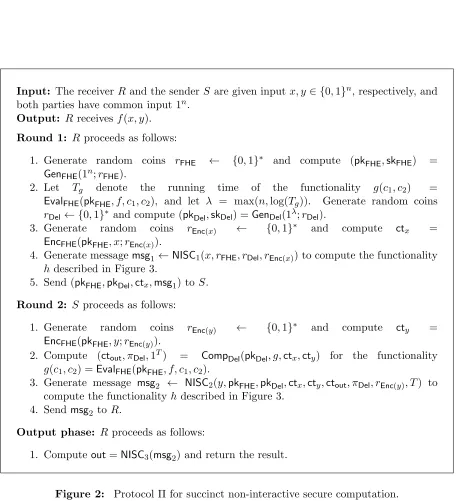
We propose the protocol Π given in Figure 2 for secure non-interactive secure computation of a function f(x, y) given a receiver input x and sender input y, where Π shall use the following primitives:
• Letπ= (NISC1,NISC2,NISC3) be a non-succinct NISC protocol withT(n)-time simulation for T(n) =nlogc(n) (i.e., quasi-polynomial simulation), whose functionalityh will be determined in the first round of the protocol. (The existence of such a primitive is guaranteed by Theorem 5 under subexponential LWE.)
• Let (GenFHE,EncFHE,DecFHE,EvalFHE) be a fully homomorphic encryption scheme satisfying perfect correctness, compactness, and subexponential security (in particular, with respect to
T(n)·poly(n)-time adversaries). (The existence of such a primitive is guaranteed by Theorem 3 under subexponential LWE.)
• Let (GenDel,CompDel,VerDel) be an adaptive delegation scheme with perfect completeness, correctness, and subexponential soundness (in particular, with respect toT(n)·poly(n)-time adversaries). (The existence of such a primitive is guaranteed by Theorem 4 under subexpo-nential LWE.)
4
Proof
Input: The receiver R and the senderS are given input x, y∈ {0,1}n, respectively, and both parties have common input 1n.
Output: R receivesf(x, y).
Round 1: R proceeds as follows:
1. Generate random coins rFHE ← {0,1}∗ and compute (pkFHE,skFHE) =
GenFHE(1n;rFHE).
2. Let Tg denote the running time of the functionality g(c1, c2) =
EvalFHE(pkFHE, f, c1, c2), and let λ = max(n,log(Tg)). Generate random coins
rDel ← {0,1}∗ and compute (pkDel,skDel) =GenDel(1λ;rDel).
3. Generate random coins rEnc(x) ← {0,1}∗ and compute ctx =
EncFHE(pkFHE, x;rEnc(x)).
4. Generate messagemsg1 ←NISC1(x, rFHE, rDel, rEnc(x)) to compute the functionality h described in Figure 3.
5. Send (pkFHE,pkDel,ctx,msg1) to S.
Round 2: S proceeds as follows:
1. Generate random coins rEnc(y) ← {0,1}∗ and compute cty =
EncFHE(pkFHE, y;rEnc(y)).
2. Compute (ctout, πDel,1T) = CompDel(pkDel, g,ctx,cty) for the functionality
g(c1, c2) =EvalFHE(pkFHE, f, c1, c2).
3. Generate message msg2 ← NISC2(y,pkFHE,pkDel,ctx,cty,ctout, πDel, rEnc(y), T) to
compute the functionalityh described in Figure 3. 4. Send msg2 toR.
Output phase: R proceeds as follows:
1. Compute out=NISC3(msg2) and return the result.
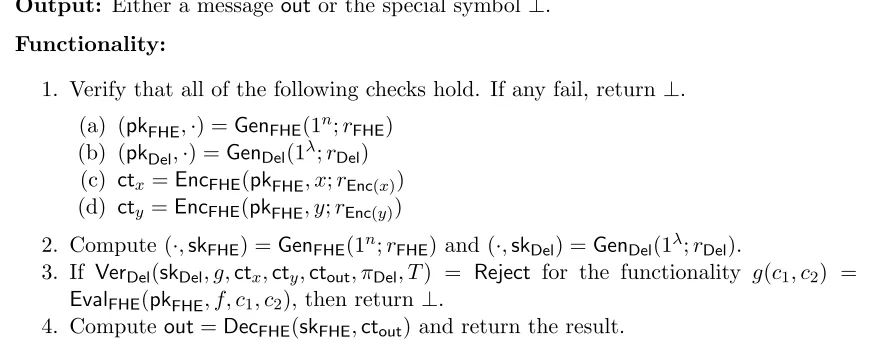
Input: The receiver R has input (x, rFHE, rDel, rEnc(x)), and the sender S has input
(y,pkFHE,pkDel,ctx,cty,ctout, πDel, rEnc(y), T)
Output: Either a message outor the special symbol⊥.
Functionality:
1. Verify that all of the following checks hold. If any fail, return⊥.
(a) (pkFHE,·) =GenFHE(1n;rFHE) (b) (pkDel,·) =GenDel(1λ;rDel)
(c) ctx =EncFHE(pkFHE, x;rEnc(x))
(d) cty =EncFHE(pkFHE, y;rEnc(y))
2. Compute (·,skFHE) =GenFHE(1n;rFHE) and (·,skDel) =GenDel(1λ;rDel).
3. If VerDel(skDel, g,ctx,cty,ctout, πDel, T) = Reject for the functionality g(c1, c2) = EvalFHE(pkFHE, f, c1, c2), then return ⊥.
4. Compute out=DecFHE(skFHE,ctout) and return the result.
Figure 3: Functionalityh used for the underlying 2PC protocol π.
take care to formally reduce this transformation to the simulation-based security of the underlying protocol. Crucially, this will rely on the fact that we restrict our attention to two-round protocols. Next, in the second step, we can create and prove the respective simulators for a corrupted sender and corrupted receiver in theTh-hybrid model. The corrupted receiver case follows in a fairly straightforward way, relying on the perfect correctness and completeness of the delegation and FHE schemes. The corrupted sender case, however, has some interesting subtleties in the reduction, and in fact will require another hybrid with a slightly different third party Th0 to complete; we discuss these subtleties in more detail when they arise during the proof.
We begin the formal proof by proving that the protocol Π is succinct:
Lemma 1. There exists polynomial p(·,·,·,·) such that, for any polynomialsTf(·) and`(·)and any
Turing machine M with running time bounded by Tf(·) computing functionality f(·,·) :{0,1}n× {0,1}n ← {0,1}`(n), the respective non-interactive secure computation protocol Π has
communi-cation complexity and honest receiver running time bounded above by p(n,log(Tf(n)),|M|, `(n)).
Proof. To lead, we point out that, while Tf(n) and `(n) are given to be poly(n), we deliberately quantify them after p(n) in order to treat them separately in the analysis below, as we specifically wish to show that the communication complexity of Π is at most polylogarithmic in the running timeTf(n) for any possible polynomial-time Turing machine computable functionalityf(·,·). Fur-thermore, we assume without loss of generality that the input lengths provided to sub-algorithms are correct, as in the event that an adversary provides incorrectly sized inputs the algorithms may simply abort.
ciphertext ctx. pkFHE has length poly(n) since GenFHE is a polynomial-time algorithm running on input 1n, and the ciphertextct
x (which consists of a ciphertext for each bit inx∈ {0,1}n) also has length poly(n) since EncFHE is polynomial-time and is run on inputs of length poly(n). pkDel will have length poly(n,log(Tf)); specifically, its length is given to bepoly(λ) =poly(n,log(Tg)), where
Tgis the running time of the functionalityg(c1, c2) =EvalFHE(pkFHE, f, c1, c2) with inputs generated
from common input 1n. However, since pkFHE haspoly(n) length, the input ciphertexts both have
poly(n) length by the efficiency ofEncFHE, andf in this case is given as acircuit description, which will have size poly(Tf(n)), we have by the efficiency of EvalFHE that Tg =poly(n, Tf(n)), implying
poly(λ) =poly(n,log(Tf(n))).
So it suffices now to bound the length of the NISC messages msg1 and msg2. Specifically, even for a non-succinct NISC protocol π, the honest sender and receiver must be efficient, and so the message length is still at most polynomial in the input length and running time of the functionality
h. We argue that these are poly(n,log(Tf(n)),|M|, `(n)) to complete the proof of the claim:
• The input length toπis given as the size of the inputs (x, rFHE, rDel, rEnc(x)) from the receiver
and (y,pkFHE,pkDel,ctx,cty,ctout, πDel, rEnc(y), T) from the sender. x and y have length n by
assumption. pkFHE,ctx, andctyhave lengthpoly(n) as argued above, andctout(which consists of a ciphertext output fromEvalFHEfor each bit off(x, y)∈ {0,1}`(n)) has lengthpoly(n, `(n)) by the compactness of the underlying FHE scheme. pkDel has length poly(n,log(Tf(n))) as argued above, and πDel also has length poly(λ) = poly(n,log(Tf(n))); T will have size
λ = poly(n,log(Tf(n))) as T ≤ 2λ is required by the properties of the delegation scheme. Lastly, the randomnessrFHE, rDel, rEnc(x), rEnc(y) cannot have length greater than the running
times of the respective algorithmsGenFHE,GenDel,EncFHE, all of which we have already noted are at mostpoly(n,log(Tf(n))).
• To bound the running time of the functionality h, notice that it consists of the following:
– GenFHE (run twice), EncFHE (run 2ntimes, once for each bit of x and y), EvalFHE (run
`(n) times, once for each bit of out), all of which are efficient algorithms run on inputs of at most length poly(n) (and hence have running time poly(n));
– DecFHE (run `(n) times), which has inputs skFHE with size poly(n) and ctout with size
poly(n, `(n)), and hence has running timepoly(n, `(n));
– GenDel (run twice), which runs in timepoly(λ) =poly(n,log(Tf(n)));
– VerDel (run once), which, given inputs skDel, πDel of size poly(λ) = poly(n,log(Tf(n))),
ctx,cty of sizepoly(n),ctoutof sizepoly(n, `(n)),g(the description ofg(c1, c2) =EvalFHE(
pkFHE, f, c1, c2), where we here interpret f as the Turing machine M) of sizepoly(|M|),
and T ≤2λ of size at mostλ=poly(n,log(T
f(n))), has running time which is at most
poly(n,log(Tf(n)),|M|, `(n));
and apoly(n) number of comparisons between input values and function outputs which have already been established to have at mostpoly(n,log(Tf(n))) length.
Towards proving security for Π, let OutΠ,A,I(1n, x, y, z) denote the random variable, taken over all randomness used by the honest party and the adversary, of the outputs of the honest receiver (if I =S) and the adversary in the execution of protocol Π given adversaryA controlling corrupted partyI ∈ {S, R}, receiver input x, sender input y, and adversary auxiliary inputz. Let
ExecΠ,A,I(1n, x, y, z) denote the respective experiment.
Let us also define the “ideal” execution by lettingTf denote the ideal functionality corresponding to the computation target f(x, y) and letting Πf be the “ideal” version of the protocol where R sends x to Tf,S sends y toTf, and then R finally outputs the result outoutput by Tf. We want to show the following theorem:
Theorem 7. Assume, given functionalityf(·,·), the respective protocolΠdescribed in Figure 2 and the assumptions required in Theorem 6, and let T(·) be such that the underlying NISC π is secure with T(·)-time simulation. For any efficient adversary A corrupting party I ∈ {S, R}, there exists a T(n)·poly(n)-time simulator S such that, for any non-uniform polynomial-time distinguisher D, there exists a negligible function(·)such that, for alln∈N,x, y∈ {0,1}n, and auxiliary inputz,D
distinguishes the distributionsOutΠ,A,I(1n, x, y, z) andOut Tf
Πf,S,I(1
n, x, y, z)with at most probability
(n).
Notice that correctness of Π holds trivially from the perfect correctness of the underlying FHE, the correctness and perfect completeness of the underlying adaptive delegation scheme, and the correctness of the underlying NISC protocol π; hence, Theorem 7, which proves security, and Lemma 1, which proves succinctness, will in conjunction directly imply Theorem 6 (where quasi-polynomial simulation results from our use of an underlying NISC protocol with quasi-quasi-polynomial simulation, as given in Theorem 5). The remainder of the section, then, is devoted to proving Theorem 7.
4.1 Comparing Real and Hybrid Executions
We begin by defining a “trusted third party” Th which executes the ideal functionality for h— that is, given the corresponding sender and receiver inputs, Th outputs the correct value of h computed on those inputs. Our first task is to show, then, that the “real” experiment’s outputs
OutΠ,A,I(1n, x, y, z) cannot be distinguished from those of a “hybrid” experiment, which we shall denote byOutTh
Πh,A0,I(1
n, x, y, z).
Formally, we let Πh denote a protocol which is identical to Π with the exception that, in rounds 1 and 2, rather than generatingmsg1 andmsg2,R and S instead send the respective inputs toTh, and, in the output phase,R receives and returns the output from Th rather than unpacking msg2. We then prove the following lemma:
Lemma 2. For any efficient adversaryAcorrupting partyI ∈ {S, R}, there exists aT(n)·poly(n) -time adversary A0 such that, for any non-uniform polynomial-time distinguisher D, there exists a negligible function(·)such that, for alln∈N,x, y∈ {0,1}n, and auxiliary inputz,Ddistinguishes
the distributionsOutΠ,A,I(1n, x, y, z) and OutTΠhh,A0,I(1n, x, y, z) with at most probability (n).
Proof. We separate into two cases, based on whether I = R (the receiver is corrupted) or I =S
Corrupted Receiver. In this case we begin by, given some adversary A against the real ex-periment ExecΠ,A,R(1n, x, y, z), defining an adversary Ah against the underlying 2PC protocol π. Without loss of generality, let A be a deterministic algorithm which uses the auxiliary input z as its source of randomness for rFHE, rDel, and rEnc(x). Ah(1n, z) will behave identically to A(1n, z) (acting as the corrupted receiver), with the exception thatAh will only sendmsg1 in round 1. On receiving msg2 from the honest sender, Ah will run the output phase of Aonce again, using msg2
as the input from the second round, to determine A’s final outputoutA and return the result. Now, consider the following adversary A0
Real(1n, z) in the real experiment, which runs Ah:
1. Run Ah(1n, z), which will start by producing a message msg1 for π. Also run A(1n, z) to produce a message (pkFHE,pkDel,ctx,·), and send (pkFHE,pkDel,ctx,msg1) to the senderS.
2. S will return a message msg2 forπ. Run the output phase of Ah on this message.
3. Ah will output outAh; return it.
Also consider a T(n)·poly(n)-time adversary A0 in the hybrid experiment ExecTh
Πh,A0,R(1
n, x, y, z)
which runs the (T(n)·poly(n)-time) simulatorShcorresponding to the adversaryAh(as guaranteed by the definition of simulation-based security for π). A0(1n, z) will do as follows:
1. RunSh(1n, z), which will start by producing a messagem1 to send to the ideal functionality Th; forward this message. Also run A(1n, z) to produce a message (pk
FHE,pkDel,ctx,msg1),
and send (pkFHE,pkDel,ctx) to the senderS.
2. S will provide its input to Th, and subsequently Th will return a result out. Forward outto Sh.
3. Sh will return a simulated message outS; return it.
We can use these adversaries to show thatOutΠ,A,R(1n, x, y, z) andOutΠThh,A0,R(1n, x, y, z) cannot be distinguished with non-negligible probability, based on the following two claims:
Claim 1. OutΠ,A,R(1n, x, y, z) and OutΠ,A0 Real,R(1
n, x, y, z) are identically distributed.
Proof. Importantly, recall that the adversariesAandAhare deterministic and usezas their source of randomness. We begin by reproducing the experimentExecΠ,A,R(1n, x, y, z) for clarity:
1. Run A(1n, z) to produce a message (pk
FHE,pkDel,ctx,msg1), and send it to the senderS.
2. S will return a message msg2 forπ. Run the output phase of Aon this message.
3. Awill output outA; return it.
There are two semantic differences between the two experiments. Namely, A0Real uses Ah(1n, z) rather than A(1n, z) to produce msg
1, as well as to produce the final output. However, by the
definition ofAh, for any auxiliary inputzit is clearly the case thatAh(1n, z) andA(1n, z) compute
msg1and their final output in an identical way; hence, the full experiments are completely identical.
So it is equivalent to compare OutΠ,A0 Real,R(1
n, x, y, z) and OutTh
Πh,A0,R(1
n, x, y, z). The following
Claim 2. For any polynomial-time non-uniform distinguisher D, there exists negligible (·) such that, for anyn∈Nand inputsx, y, z, the distributionsOutΠ,A0
Real,R(1
n, x, y, z)andOutTh
Πh,A0,R(1 n, x,
y, z) cannot be distinguished by D with probability greater than (n).
Proof. This will intuitively follow from the simulation-based security of the underlying protocol π. Formally, assume for contradiction that there exists a non-uniform polynomial-time distin-guisher D and polynomialp(·) such that, for infinitely many n∈ N, there are inputs x, y, z such thatDis able to distinguish the two distributionsOutΠ,A0
Real,R(1
n, x, y, z) andOutTh
Πh,A0,R(1
n, x, y, z)
with probability 1/p(n). In this case, for each such n, there must exist some assignment r∗ of the (honest) sender’s randomness rEnc(y) such that D distinguishes OutΠ,A0
Real,R(1
n, x, y, z)| r∗ and
OutTh
Πh,A0,R(1
n, x, y, z)|
r∗ (which denote the respective experiments with rEnc(y) fixed to r∗) with probability at least 1/p(n).
Given fixed x, y, z and fixed rEnc(y) = r∗, recall the inputs x0 = (x, rFHE, rDel, rEnc(x)) and y0= (y,pkFHE,pkDel,ctx,cty,ctout, πDel, rEnc(y), T) provided by the receiver and sender (respectively)
to the protocolπ; all randomness used to generate these inputs is now fixed (sincerFHE, rDel, rEnc(x)
are given by z), which means that each assignment of inputs x, y, z, r∗ for Π corresponds uniquely to fixed inputs x0, y0, z for the underlying protocol π.
This implies that we can use the distinguisher D directly to break the simulation-based secu-rity of the underlying protocol π. Specifically, given the previously fixed x, y, z, r∗, consider the distributionsOutπ,Ah,R(1
n, x0, y0, z) andOut
πh,Sh,R(1
n, x0, y0, z), whereπ
h is the idealized version of
π (as executed in Πh) where both parties send their respective inputsx0, y0 to the functionalityTh, which computes h(x0, y0).
Since, by definition, the outputs of A0
Real and A0 (fixing inputs x, y, z, r∗) are given by the outputs ofAh andSh (fixing the corresponding inputsx0, y0, z) in the respective experimentsπ and
πh, we have that
OutΠ,A0 Real,R(1
n, x, y, z)|
r∗ =Outπ,A
h,R(1
n, x0, y0, z)
and
OutTh
Πh,A0,R(1
n, x, y, z)|
r∗ =Outπ
h,Sh,R(1 n, x0
, y0, z)
But, since D distinguishes OutΠ,A0 Real,R(1
n, x, y, z)|
r∗ and OutTh
Πh,A0,R(1
n, x, y, z)|
r∗ with probabil-ity 1/p(n), it must also distinguish Outπ,Ah,R(1
n, x0, y0, z) and Out
πh,Sh,R(1
n, x0, y0, z) with the
same probability. And, as this holds for infinitely many n ∈ N, it follows that D contradicts the simulation-based security of the underlying protocol π (w.r.t. non-uniform polynomial-time distinguishers), which is a contradiction.
Corrupted Sender. Given an adversaryAagainst the real experimentExecΠ,A,S(1n, x, y, z), let Ah as before be the respective adversary against simulation-based security of the 2PC protocol
π. Now Ah receives message msg1 from the honest receiver and must generate msg2 using A;
however, A also requires the public parameters (pkFHE,pkDel,ctx) from the receiver’s first-round message as input. As such, we concatenate these parameters with the auxiliary inputzprovided to Ah. Formally, we let Ah(1n,(pkFHE,pkDel,ctx, z)) given message msg1 runA(1n, z) given message
(pkFHE,pkDel,ctx,msg1). Then let A0Real(1n, z) in the real experiment proceed as follows:
1. Receive a message (pkFHE,pkDel,ctx,msg1) from the receiver R.
2. Run Ah(1n, z0 = (pkFHE,pkDel,ctx, z)) with msg1 as the input from the receiver; forward the
3. Output whateverAh outputs.
By simulation-based security, then, there is also a simulator Sh in the idealized experiment for π
which sends the relevant inputs to the ideal functionalityTh but returns no output to the receiver. Let A0(1n, z) be a T(n)·poly(n)-time adversary in the hybrid experiment ExecTh
Πh,A0,S(1
n, x, y, z)
which does the following:
1. Receive a message (pkFHE,pkDel,ctx) from the receiver R.
2. Run Sh(1n, z0 = (pkFHE,pkDel,ctx, z)). Sh will produce a message m2 to send to the ideal
functionality Th; forward it toTh.
3. Output whateverSh outputs.
We must show that, given this A0, both (1) the outputs of the adversary and (2) the out-puts of the honest receiver R between ExecΠ,A,S(1n, x, y, z) and ExecTΠhh,A0,S(1n, x, y, z) cannot be distinguished. The following claims imply the desired conclusion:
Claim 3. OutΠ,A,S(1n, x, y, z) and OutΠ,A0 Real,S(1
n, x, y, z) are identically distributed.
Proof. This follows directly from the fact that the adversariesA andAh are deterministic and use
zas their source of randomness, and the fact thatAh(1n,(pkFHE,pkDel,ctx, z)) given messagemsg1
behaves identically to A(1n, z) given message (pk
FHE,pkDel,ctx,msg1), implying that msg2 and the
output ofA (resp. Ah) are identically distributed between the experiments.
So it suffices to compare OutΠ,A0 Real,S(1
n, x, y, z) and OutTh
Πh,A0,S(1
n, x, y, z), which we do as
fol-lows:
Claim 4. For any polynomial-time non-uniform distinguisher D, there exists negligible (·) such that, for anyn∈Nand inputsx, y, z, the distributionsOutΠ,A0
Real,S(1
n, x, y, z)andOutTh
Πh,A0,S(1 n, x,
y, z) cannot be distinguished by D with probability greater than (n).
Proof. Once again this will intuitively follow from the simulation-based security of the underlying protocolπ.
Formally, assume for contradiction that there exists a non-uniform polynomial-time distin-guisher D and polynomialp(·) such that, for infinitely many n∈ N, there are inputs x, y, z such
thatDis able to distinguish the two distributionsOutΠ,A0 Real,S(1
n, x, y, z) andOutTh
Πh,A0,S(1
n, x, y, z)
with probability 1/p(n). As with the corrupted receiver case, for each such n, there must exist some assignment r∗ of the (honest) receiver’s randomness rR = (rFHE, rDel, rEnc(x)) such that D
distinguishes OutΠ,A0 Real,S(1
n, x, y, z)|
r∗ and OutTh
Πh,A0,S(1
n, x, y, z)|
r∗ (which once again denote the respective experiments with rS fixed tor∗) with probability at least 1/p(n).
As before, consider the distributions Outπ,Ah,R(1
n, x0, y0, z0) and Out
πh,Sh,R(1
n, x0, y0, z0), where
πh is the idealized version ofπ (as executed in Πh) where both parties send their respective inputs
x0, y0 to the functionalityTh. As before, the outputs of A0Real and A0 (fixing inputs x, y, z, r∗) are given by the outputs of Ah and Sh (fixing the corresponding inputs x0, y0, z0) in the respective experiments π and πh; furthermore, by the definition of the protocols Π and P ih, the (honest) receiver’s outputs are given by the outputs ofπ andπh (respectively). So we once again determine that
OutΠ,A0 Real,S(1
n, x, y, z)|
r∗ =Outπ,A
h,S(1
n, x0, y0, z0)
and
OutTh
Πh,A0,S(1
n, x, y, z)|
r∗ =Outπ
h,Sh,S(1 n, x0
, y0, z0)
which, sinceDdistinguishesOutΠ,A0 Real,S(1
n, x, y, z)|
r∗ andOutTh
Πh,A0,S(1
n, x, y, z)|
r∗ with probability 1/p(n), implies that it must also distinguishOutπ,Ah,S(1
n, x0, y0, z0) andOut
πh,Sh,S(1
n, x0, y0, z0) with
the same probability. Thus, since the above implies that there exist x0, y0, z0 for infinitely many
n ∈ N such that D distinguishes the respective distributions, it follows that D contradicts the
simulation-based security ofπ(w.r.t. non-uniform polynomial-time distinguishers), a contradiction.
4.2 Comparing Hybrid and Ideal Executions
Next, we need to compare the hybrid execution ExecTh
Πh,A0,I(1
n, x, y, z) to the “ideal” execution
ExecTf
Πf,S,I(1
n, x, y, z) to finish the proof of Theorem 7.
Lemma 3. For any T(n)·poly(n)-time adversary A0 corrupting party I ∈ {S, R}, there exists a
T(n)·poly(n)-time simulator S such that, for any non-uniform polynomial-time distinguisher D, there exists a negligible function (·) such that, for all n ∈ N, x, y ∈ {0,1}n, and auxiliary input
z, D distinguishes the distributions OutTh
Πh,A0,I(1
n, x, y, z) and OutTf
Πf,S,I(1
n, x, y, z) with at most
probability (n).
Proof. We again separate into two cases, based on whether I = R (the receiver is corrupted) or
I =S (the sender is corrupted).
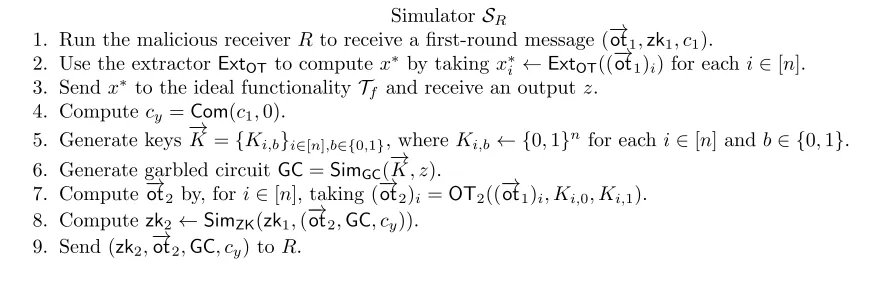
Corrupted Receiver. In this case, define a T(n) ·poly(n)-time simulator SR which does as follows:
1. Run the corrupted receiverA0. A0, in the first round, will output a message (x, rFHE, rDel, rEnc) to be sent toTh. Send x to the ideal functionalityTf.
2. Receive an output message outfrom the ideal functionality Tf. If outis ⊥, return ⊥ to A0 (as the output of Th).
3. Verify the following. If any checks fail, return⊥toA0.
(c) ctx =EncFHE(pkFHE, x;rEnc(x))
4. If all checks in the previous step pass, returnouttoA0. Finally, output whateverA0 outputs.
It suffices here to argue that the output which SR returns to A0 in the ideal experiment is identically distributed to the output which Th would return to A0 in the hybrid experiment, as this, combined with the observation that the only inputA0 receives (aside from the auxiliary input
z) is the output from Th, allows us to conclude that A0’s views in ExecTh
Πh,A0,R(1
n, x, y, z) and
ExecTf
Πf,SR,R(1
n, x, y, z) (and henceA0’s outputs) are likewise identically distributed. We can argue
this using the following claims:
Claim 5. If S is honest, then, given messages (x, rFHE, rDel, rEnc) and (pkFHE,pkDel,ctx) from A0,
step (4) of SR succeeds (i.e., does not return ⊥) in Πf if and only if all checks in step (1) of the
functionality h described in Figure 3 succeed in the respective instance ofΠh.
Proof. The “if” direction is trivial since the checks in step (4) ofSRare a strict subset of the checks in step (1) of h.
The “only if” direction follows from the assumption that S is honest, and will hence compute
cty =EncFHE(pkFHE, y;rEnc(y)) correctly using the correct inputs.
Claim 6. If S is honest and all checks in step (1) of the functionality h described in Figure 3 succeed in Πh, then, with probability 1, step (3) of the functionality h will not return ⊥.
Proof. Since step (1) is successful, we know that (pkDel,skDel) = GenDel(1λ, rDel); moreover, since
S is honest, we know that it must have computed (ctout, πDel,1T) = CompDel(pkDel, g,ctx,cty) correctly (and using the correct pkDel and ctx, since the checks in step (1) passed). It follows by perfect completeness of the delegation scheme (GenDel,CompDel,VerDel) that
VerDel(skDel, g,ctx,cty,ctout, πDel, T) =Accept
as desired.
Claim 7. IfS is honest and, in Πh, all checks in step (1) of the functionality hdescribed in Figure
3 succeed, and step (3) of the functionality h does not return ⊥, then the value of outreturned by step (4) of h will be equal to f(x, y) with probability 1.
Proof. Since S is honest and step (1) is successful, we know, as in the previous claim, that (pkDel,skDel) =GenDel(1λ, rDel) and (ctout, πDel,1T) = CompDel(pkDel, g,ctx,cty). It follows by cor-rectness of the delegation scheme (GenDel,CompDel,VerDel) that
ctout=g(ctx,cty) =EvalFHE(pkFHE, f,ctx,cty)
It suffices to show that this will decrypt to the correct output out= f(x, y). This holds due to perfect correctness of the FHE scheme (GenFHE,EncFHE,DecFHE,EvalFHE); specifically, since ctx and cty are encryptions of x andy, respectively:
Chaining together Claims 5, 6, and 7 leads us to the conclusion that (by Claim 5),SRreturns⊥ inExecTf
Πf,SR,R(1
n, x, y, z) if and only ifT
hwould return⊥(from step (1)) in the respective execution ofExecTh
Πh,A0,R(1
n, x, y, z), and furthermore, if this event does not occur, then (by Claims 6 and 7 as
well as the definition ofSR) bothSR(inExec Tf
Πf,SR,R(1
n, x, y, z)) andT
h (in the respective execution of ExecTh
Πh,A0,R(1
n, x, y, z)) will return an output out that is precisely equal to f(x, y), where x is
the value sent by the adversary to Th and y is the (honest) sender’s input. This completes the argument for the caseI =R.
Corrupted Sender. In the case I =S, define aT(n)·poly(n)-time simulator SS which does as follows:
1. GeneraterFHE, rDel, rEnc(x)← {0,1}∗
and (pkFHE,·) =GenFHE(1n;rFHE),(pkDel,·) =GenDel(1λ;rDel),ctx=EncFHE(pkFHE,0;rEnc(x))
2. Run the corrupted sender A0 using input (pk
FHE,pkDel,ctx). A0 will generate a message (y0,pk0FHE,pk0Del,ct0x,ct0y,ct0out, πDel0 , r0Enc(y), T0) to send to Th. Perform the following checks to verify this message, and return ⊥toTf (causing it to output ⊥) if any of them fail.
(a) pkFHE =pk0FHE,pkDel=pk0Del,ctx=ct0x. (b) ct0y =EncFHE(pkFHE, y0;r0Enc(y))
(c) VerDel(skDel, g,ctx,cty,ct0out, π0Del, T
0) =Accept
for the functionalityg(c1, c2) =EvalFHE(pkFHE, f, c1, c2).
3. Otherwise (if the above checks pass), send y0 toTf. Finally, output whateverA0 outputs.
As this case has interesting subtleties, we lead the formal proof with a brief overview. Recall that, for this case, we need not only to verify that the adversary A0’s views in the experiments
ExecTh
Πh,A0,S(1
n, x, y, z) andExecTf
Πf,SS,S(1
n, x, y, z) (and henceA0’s outputs) cannot be distinguished,
but also that the honest receiverR’s outputs cannot be distinguished between the two experiments. The natural way to do this would be to begin by creating a hybrid protocol Π0h where the receiver, instead of sending a ciphertext of their inputxin the first round, sends the corresponding ciphertext of 0 (as the simulator does when running A0 in Πf). Ostensibly, this would allow us to show that the output distributions between Πh and Π0h are close by using the CPA-security of the underlying FHE protocol to assert that the ciphertexts, and hence the views of A0, are indistinguishable between the two experiments. And while this does indeed directly imply that the adversary’s outputs are close, we run into an issue the moment we consider the receiver’s output; specifically, the receiver’s output is the output from the ideal functionalityTh, which among other things depends on the secret key skFHE and the randomness rFHE used to generate it. In fact, this makes a reduction from Π0hto the security of the FHE scheme impossible (using current techniques), since a hypothetical adversary simulating this functionality would only know pkFHE.