Highly-Efficient and Reusable Private Function Evaluation with
Linear Complexity
Osman Bi¸cer1, Muhammed Ali Bing¨ol2,3, Mehmet Sabır Kiraz3,4, Albert Levi2 1
Ko¸c University, ˙Istanbul, Turkey
2 Sabancı University, Faculty of Engineering and Natural Sciences, ˙Istanbul, Turkey 3
Cyber Technology Institute, De Montfort University, UK 4
nChain, UK
[email protected], [email protected], [email protected], [email protected], [email protected], [email protected]
Abstract. Private function evaluation aims to securely compute a function f(x1, . . . , xn) without leaking any information other than what is revealed by the output, wherefis a private input of one of the parties (sayParty1) andxiis a private input of thei-th partyPartyi. In this work, we propose a novel and securetwo-party private function evaluation (2PFE) scheme based on the DDH assumption. Our scheme introduces a reusability feature that significantly improves the state-of-the-art. Accordingly, our scheme has two variants, one is utilized in the initial execution of the functionf, and the other is utilized in its subsequent evaluations. To the best of our knowledge, this is the first and most efficient 2PFE scheme that enjoys a reusablity feature. Our protocols achieve linear communication and computation complexities and a constant number of rounds which is at most three.
Keywords: Private function evaluation, Secure 2-party computation, Communication complexity, Cryptographic protocol.
1
Introduction
Development of computing devices with the proliferation of the Internet has prompted enormous opportu-nities for cooperative computation. These computations could occur between trusted or partially trusted partners, or even between competitors. Secure multiparty computation (MPC) protocols allow two or more parties to collaborate and compute a public functionality using their private inputs without the need for a trusted third-party. However, the generic solutions for MPC are not adequate for some particular cases where the function itself is also sensitive and required to be kept private. Private function evaluation (PFE) is a special case of MPC, where the function to be computed is known by only one party. PFE is useful in several real-life applications where an algorithm or a function itself needs to remain secret for reasons such as protecting intellectual property or security classification level. Recently, designing efficient PFE proto-cols have been a challenging and attractive task for cryptography researchers [PSS09, KM11, MS13, Sad15, BBKL19, Bin19, KS16, GKS17].
Efficient and practical PFE schemes are becoming increasingly important as many real-world applications require protection of their valuable assets. For example, many software companies targeting the global market are extremely concerned about illegal reproduction of their software products. Software obfuscation methods usually prevent reverse engineering, but still allow direct copying of programs. Another solution could be providing the software-as-a-service in the cloud to eliminate the risk of exposure. However, this solution also causes another issue, i.e., threatening the privacy of customer data, since computations need to take place at the hands of software vendors.
and output sizes, but does not depend on the size off [BDGM19]. However, FHE schemes suffer a polynomial blow up factor (in the security parameter) to the ciphertext size, so that affecting the overall communication cost. Therefore, they are still far from being practical [LN14b, LN14a, OSPG18, GH19, NDR+19].
Another approach targeting those problems falls into the category of PFE. Compared to FHE, PFE is currently much closer to practical use. Moreover, in many occasions such a PFE scheme is quite beneficial, including the ones where a service provider may opt keeping the functionality and/or its specific implemen-tation confidential, and the ones where the disclosure of the function itself means revelation of sensitive information, or causes a security weakness.
The current research goal for secure computation protocols (including PFE) is efficient and practical solutions with low round, communication, and computation complexities. Among these three measures, as also pointed out by Beaver, Micali, and Rogaway, the number of rounds is the most valuable resource [BMR90]. The other important research goal in this area is the minimization of communication complexity. Since hardware trends show that computation power progresses more rapidly compared to communication channels, the main bottleneck for many applications will be the bandwidth usage.
In this paper, we consider the two-party PFE (2PFE) setting where the first party (say Party1) has a function inputf (compiled into a boolean circuitCf) and optionally a private input bit stringx1, whereas the other party (sayParty2) has an input bit stringx2. The parties aim to evaluatef onx1andx2so that at least one of them would obtain the resultingf(x1, x2) without any of them deducing any information about the other one’s private input beyond whatf(x1, x2) itself reveals.
1.1 Related Work
First proposed by Andrew Yao [Yao82,Yao86], secure two-party computation (2PC) comprises the techniques for joint evaluation of a function by two parties on their respective secret inputs. In recent years, there has been a promising progress over the original Yao’s protocol [BMR90,NPS99,KS08a,PSSW09,KMR14,ZRE15, KKS16]. As a consequence of these improvements, secure computation techniques now have promising results. 2PFE differs from the standard 2PC in that the latter involves both parties evaluating a publicly known function on their private inputs, whereas in the former, the function itself is also a private input. 2PFE concept is first appeared in [AFK87, AF90]. So far, there are basically two main approaches that PFE solutions are built upon.
The first one is based on a universal circuit which takes a boolean circuit C with circuit size less than g and an input (x1, . . . , xn), and outputsC(x1, . . . , xn). The idea is that if the regular secure computation techniques can be applied on a universal circuit, then a PFE scheme can be obtained. Consequently, the efforts targeting the efficiency ofuniversal circuit based PFEshave generally been towards reducing the size of universal circuits, and the cost of their secure computation [KS08b, SS09, KS16, GKS17].
The second approach is avoiding the use of universal circuits and designing special purpose PFE protocols. Following this line of work, several PFE schemes have been proposed, e.g., as [PSS09, KM11, MS13, Sad15, BBKL19]. A remarkable work embracing this approach issingly homomorphic encryptionbased 2PFE scheme of Katz and Malka (KM11) applied on boolean circuits [KM11]. In KM11 [KM11], the authors utilize a singly homomorphic scheme (e.g., ElGamal [EG85] or Paillier [Pai99]) for the generation of the two random tokens5 on each wire, later utilized in the 2PC stage. They first propose a basic version of their protocol in [KM11, Sect. 3.1] (which we call KM11-1st) and for the efficiency concerns they propose a more efficient variant in [KM11, Sect. 3.2] (which we call KM11-2nd). Both schemes have only three rounds, and provide O(g) asymptotic complexity in terms of communication and computation, where g denotes the circuit size. The latter one reduces the communication and offline computation complexity.
In [MS13], Mohassel and Sadeghian proposed 2PFE schemes, for boolean circuits and arithmetic circuits. Considering boolean circuits, they propose two types of protocols: one is based on oblivious evaluation of
switching networks (OSN)6 (which we call MS13-OSN) and the other one is based on singly homomorphic encryption (which we call MS13-HE). Even though MS13-OSN is efficient for small sized circuits, it is still inefficient for large circuits due to its O(glog(g)) communication and computation complexities. It fails to outperform asymptotically linear communication and computation complexities of [KM11]. On the other hand, MS13-HE provides linear communication and computation complexities and slightly outperforms KM11-2nd. We remark that to the best of our knowledge, a reusability feature cannot be adapted7 to protocols proposed in [KM11] and [MS13].
In [MS13], the authors also propose a protocol for arithmetic circuits based on partial (singly) homomor-phic encryption. This protocol has equal number of rounds to its gates (see [MS13, p. 570]), whereas the other PFE protocols for boolean circuits have constant number of rounds. For large circuits the number of rounds will be a bottleneck8. [MS13] also proposes a multi-party PFE variant based on OSN that remains the most efficient one to date. Their proposals are essentially secure in the semi-honest model, and has later been extended to the malicious model by [MSS14].
Recently BBKL18 [BBKL19] improves the OSN based 2PFE protocol of [MS13]. They show how to utilize the elegant half gates technique [ZRE15] to their 2PFE scheme. The optimization of BBKL18 improves MS13-OSN by reducing the overall communication cost about 40%.
1.2 Our Contributions
In this work, we propose a highly efficient 2PFE scheme for boolean circuits secure in the semi-honest model. Our scheme enjoys the cost reduction due to the reusability of tokens that will be used in the 2PC stage. This eliminates some of the computations and exchanged messages in the subsequent executions for the same function. Therefore, one of the strongest aspects of our proposed protocol is the remarkable cost reduction if the same function is evaluated more than once (possibly on varying inputs). We highlight that such a cost reduction is not applicable to the protocols of KM11 [KM11] and MS13 [MS13] since they require running the whole protocol from scratch for each execution. In this respect, we present two protocols of our scheme: (1) a protocol for initial executions (InExe), (2) a resumption protocol for subsequent executions (ReExe). The former protocol is utilized in the first evaluation of the function, while the latter one is utilized in the second or later subsequent evaluations of the same function. We note that the latter protocol is more efficient than the former one due to the fact that it benefits from the reusable tokens generated already in InExeprotocol. The latter case is likely to be encountered more frequently in practice, compared to the cases where a function is evaluated only once.
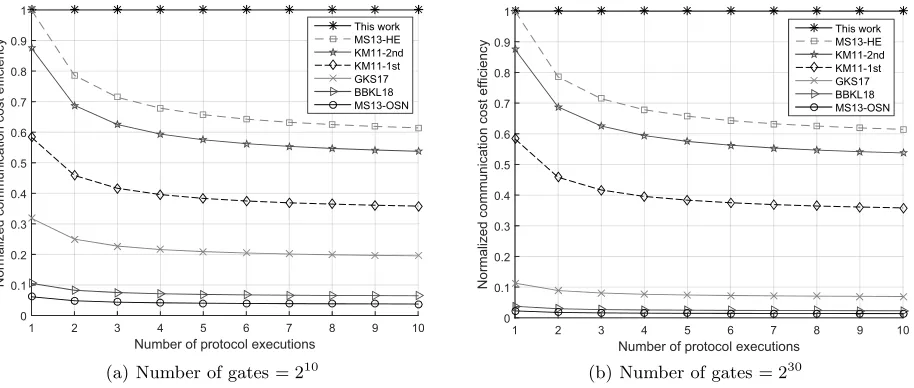
Our proposed protocols significantly enhances the state-of-the-art in terms of communication cost. Com-pared to MS13-OSN [MS13], BBKL18 [BBKL19], and GKS17 [GKS17] protocols, we achieve an asymptotic cost reduction. Namely, while the asymptotic communication costs of those protocols are equal toO(glog(g)), our scheme providesO(g) communication complexity wheregis the number of gates. To illustrate this asymp-totic difference, for a thousand-gate circuit, our cost reduction is about 94% over MS13-OSN, about 88% over BBKL18, and about 68% over GKS17. For a billion-gate circuit, our cost reduction is about 98% over MS13-OSN, about 96% over BBKL18, and about 89% over GKS17. The protocols of MS13-HE, KM11-1st, KM11-2nd and ours have linear asymptotic complexity. Thanks to the reusability feature, the advantage of our scheme becomes more pronounced when the number of PFE execution is more than one. Namely, for two executions our cost reduction is about 54% over KM11-1st, 30% over KM11-2nd, and 20% over MS13-HE.
6
The OSN mechanism is introduced in [MS13] to achieve a solution for the oblivious extended permutation (OEP) problem. OEP allows the oblivious transition of each masked gate output to the input(s) of the next connected gate(s). We refer the readers to the references in [MS13, Bin19, BBKL19] for detailed explanation on OSN. 7 This is due to the fact that the blinding operations in these protocols are one-time pads (XOR or cyclic addition),
therefore, reusing the blinded values inevitably leaks information about the truth values of intermediate wires. On the other hand, our mechanism relies on DDH so that the blinding values would remain unknown to the respective parties.
8
For ten executions our cost reduction is about 63% over KM11-1st, 44% over KM11-2nd, and 37% over MS13-HE.
The number of rounds of our InExe protocol is 3 and the number of rounds of our ReExe protocol is equal to 1, or 2, or 3 depending on the input string length ofParty1(i.e., owner off)9. This also reflects the improvement ofReExeprotocol over the existing 2PFE protocols in terms of round complexity (see Table 1). We also deal with the case thatParty1runs the 2PFE protocol for the same private function with various Party2s separately. This is a common scenario whereParty1may run a business with many customers for her algorithm/software. Trivially, ourReExeprotocol can be utilized between the same two parties in the second and subsequent evaluations after the first evaluation. Instead of running the initial execution protocol with eachParty2, we propose a more efficient mechanism for the generation of the reusable tokens by employing a threshold based system.
1.3 Organization
In Section 2, we give a preliminary background that is used throughout the paper. Section 3 presents the descriptions of our InExe and ReExe protocols, and a method for the case where Party1 would like to execute 2PFE with variousParty2s separately. Section 4 provides a performance analysis of our protocols, and compare them with the existing state-of-the-art 2PFE protocols. In Section 5, we give the security proofs of our protocols in the semi-honest model. Finally, Section 6 concludes our paper.
2
Preliminaries
This section provides some background information on the DDH assumption, describes some notations used in this paper and briefly summarize the concept of the 2PFE framework.
2.1 Decisional Diffie-Hellman Assumption
The Decisional Diffie-Hellman (DDH) assumption forGprovides that the following two ensembles are
com-putationally indistinguishable
{(P1, P2, a·P1, a·P2) :Pi∈G, a∈RZ∗q} ≈c
{(P1, P2, a1·P1, a2·P2) :Pi∈G, a1, a2∈RZ∗q}.
whereX≈cY denotes that the setsXandY are computationally indistinguishable,Gis a group (represented
in additive notation) of prime orderq(of size 2λwhere λis a security parameter), andP1, P2∈RG.
The security of our protocols is based on the following lemma of Naor and Reingold [NR04] providing a natural generalization of the DDH assumption form >2 generators.
Lemma 1 ( [NR04]). Under the DDH assumption onG, for any positive integer m,
{(P1, . . . , Pm, a·P1, . . . , a·Pm) :Pi∈G, a∈RZ∗q} ≈c
{(P1, . . . , Pm, a1·P1, . . . , am·Pm) :Pi∈G, a1, . . . , am∈RZ∗q}.
There exist certain elliptic curve groups where the DDH assumption holds. We will not go through the details of these primitives and refer the reader to [Bon98, HMV03]. The main advantage of the elliptic curve DDH assumption over the discrete logarithm based DDH assumption is that the discrete logarithm DDH problem requires sub-exponential time [LV01] while the current best algorithms known for solving the elliptic curve DDH problem requires exponential time resulting the same security with smaller key sizes. Therefore,
9
More concretely, ifParty1 hasx1 =⊥, then the number of rounds is equal to 1. IfParty1 has a non-empty input
the elliptic curve based systems are more practical than the classical discrete logarithm systems since smaller parameters may be chosen to ensure the same level of security. In fact, attacks on elliptic-curve groups require running time that is a square root of the group size10.
1
G
2G
4G
5G
5 ow 6 ow 1 iw 2 iw 3 iw 4 iw 1y
2y
1 ow(a)
1 iw 4 iw 5 iw 6 iw 7 iw(b)
4 n 3g m
2g10 2 ow 3 ow 4 ow 9 iw 6 iw 8 iw 7 iw 2 iw 3 iw 8 iw 1 ow 2 ow 3 ow 4 ow 5 ow 6 ow 5 iw 3
G
ow77 ow 9 iw 10 iw 10 iw
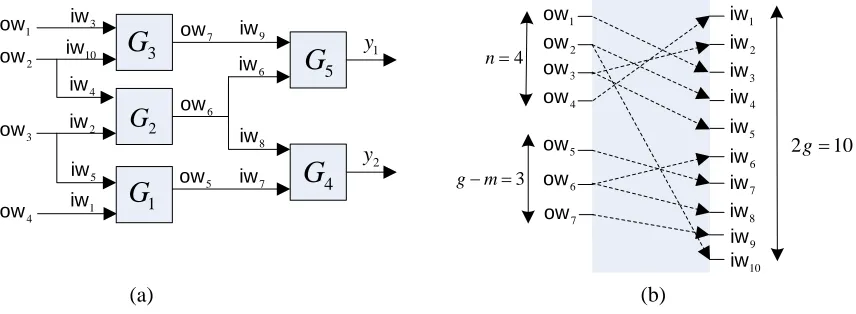
Fig. 1.(a) A circuit representationCf of a functionf. (b) The mappingπf off.
2.2 Notations and Concept of 2PFE Framework
In a two-party private function evaluation (2PFE) scheme,Party1 has a function input f (compiled into a boolean circuit Cf) and optionally a private input bit string x1, whereasParty2 has an input bit string x2. The parties aim to evaluatef onx1andx2so that at least one of them would obtain the resultingf(x1, x2). The recent 2PFE schemes [KM11, MS13] conform to a generic 2PFE framework (formalized by [MS13]) that basically reduces the 2PFE problem to hiding both parties’ input strings and topology of the circuit. The framework is not concerned with hiding the gates since it allows only one type of gate in the circuit structure. In a nutshell the 2PFE framework is as follows. Before starting the 2PFE protocol, Party1 compiles the function into a boolean circuit Cf consisting of only one type of gates (e.g.,NANDgates). During the protocol execution,Party1andParty2first engage in a mapping evaluation protocol whereParty2obliviously obtains the tokens on gate inputs, and then they mutually run a 2PC protocol where Party2 garbles each gate separately using those tokens, andParty1 evaluates the garbled circuit. As a result,Party1 obtains the garbled tokens that map to the corresponding outputs of the function (i.e.,y=f(x1, x2)).
Let g, n, and m denote the number of gates (circuit size), the number of inputs, and the number of outputs ofCf, respectively. LetOW= (ow1, . . . ,own+g−m) denote the set of outgoing wires that is the union of the input wires of the circuit and the output wires of its non-output gates. Note that the total number of elements inOW isM =n+g−m. Similarly, let IW = (iw1, . . . ,iw2g) denote the set of incoming wires that is the union of the input wires of each gate in the circuit. Note also that the total number of elements in IW is N = 2g. Throughout this paper, M and N denote the numbers of outgoing and incoming wires, respectively. Letπf be a mapping such that j←πf(i) if and only if owi∈OWandiwj ∈IW correspond to the same wire in the circuitCf (see Figure 1).
We define the public information of the circuit Cf as PubInfoCf which is composed of: (1) the number of each party’s input bits, (2) the number of output bits, (3) the total number of incoming wires N and that of outgoing wiresM, (4) the incoming and outgoing/output wire indices that belong to each gate, (5)
10
the outgoing wire indices corresponding to each party’s input bits. Note that, it is a common assumption among PFE schemes [KM11, MS13, BBKL19] that both parties have pre-agreement on the number of gates (g), the number of input wires (n), the number of output wires (m), the number of input bits ofParty1 (q). Both parties generate PubInfoCf at the beginning of the protocol execution (without an additional round of communication). Namely, each party runs the following deterministic procedure to obtain PubInfoCf on public input (g, n, m, q):
– SetN := 2g,M :=n+g−m.
– Fori= 1, . . . , g, setiw2i−1andiw2i as the incoming wires of the gate Gi. – Fori= 1, . . . , g−m, setowi as the outgoing wire of the gateGi.
– Fori= 1, . . . , q, set owg−m+i as the outgoing wire corresponding to Party1’si-th input bit. – Fori= 1, . . . , n−q, set owg−m+q+i as the outgoing wire corresponding toParty2’si-th input bit. – Fori= 1, . . . , m, set the output wireyi as the output ofGg−m+i.
– ReturnPubInfoCf := (M, N,OW,IW, y).
Next, Party1 generatesπf (i.e., the connection between incoming and outgoing wire indices) using the following randomized procedure on input (Cf,OW,IW).
– Randomly permute the indices 1, . . . , g−m, and assign it to an ordered setA. – Fori= 1, . . . , g−m, assignGA[i] to thei-th non-output gate in topological order. – Fori= 1, . . . , m, assignGg−m+i to i-th output gate.
– Extractπf from Cf according to the connections betweenows andiws. – Returnπf.
We next define Reusable Mapping Template in which the efficiency of our scheme mostly due to the reusability of this template.11
Definition 1 (Reusable Mapping Template). Let πf−1(j) be the inverse mapping of πf that denotes
the index of the outgoing wire connected to iwj. A Reusable Mapping Template is a set ReuseTempf := (P,Q) such that P := (P1, . . . , PM) where Pi is a generator of the group picked for owi by Party2 and
Q := (Q1, . . . , QN) where Qj :=tj·Pπ−1
f (j) is a group element generated for iwj by Party1 fortj ∈R Z
∗
q, i= 1, . . . , M, andj= 1, . . . , N.
3
Our PFE Scheme
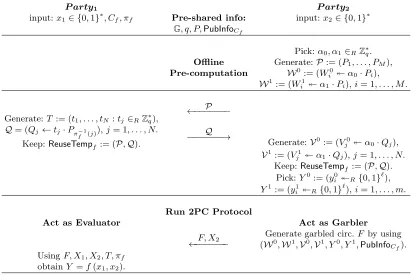
In this section, we first present our protocol for initial executionsInExewhich is optimized by offline/online decomposition (Figure 2). We next introduce our efficient resumption protocol for subsequent executions ReExe(Figure 3). We then propose an efficient method for executions with multipleParty2s.
3.1 The description of our InExe protocol
InExe scheme is optimized by carrying out some of the computations in the off-line stage. In general, such precomputation techniques enhance real-time performance at the cost of extra preliminary computations and storage consumption. Besides, in today’s technological perspectives, memory consumption is rarely considered to be a serious drawback since storage units are abundant in many recent devices. In what follows, we give the full protocol steps of our optimized initial executionInExeprotocol. Also, Figure 2 depicts the protocol steps of ourInExeprotocol. The computations that can be carried out in the precomputation phase include the generation ofP, and the computation of the sets W0andW1 byParty
2.
In accordance with the generic 2PFE framework the description of ourInExeis as follows.
P arty1 P arty2
input:x1 ∈ {0,1}∗, Cf, πf Pre-shared info: input:x2∈ {0,1}∗
G, q, P,PubInfoCf
Offline Pre-computation
Pick:α0, α1∈RZ∗q.
Generate:P:= (P1, . . . , PM), W0
:= (Wi0α0·Pi), W1
:= (Wi1α1·Pi),i= 1, . . . , M.
P ←−−−−−−− Generate:T := (t1, . . . , tN:tj∈RZ∗q),
Q= (Qj←tj·Pπ−1 f (j)
),j= 1, . . . , N.
Keep:ReuseTempf := (P,Q).
Q −−−−−−−→
Generate:V0:= (V0
j α0·Qj), V1:= (V1
j α1·Qj),j= 1, . . . , N. Keep:ReuseTempf := (P,Q).
Pick:Y0:= (y0
i R{0,1}`), Y1:= (yi1R{0,1}`),i= 1, . . . , m.
Run 2PC Protocol
Act as Evaluator Act as Garbler
F, X2 ←−−−−−−−
Generate garbled circ.F by using (W0
,W1
,V0
,V1
, Y0, Y1,PubInfoCf).
UsingF, X1, X2, T, πf obtainY =f(x1, x2).
Fig. 2. Sketch of our InExe2PFE Protocol. ReuseTempf and T are stored (if needed) for the later PFE runs by
(ReExe) protocol. Note that in caseParty1 has inputs (x1) then OT protocol is required (to send the corresponding garbledX1) which can be trivially combined with the protocol rounds (i.e., the first round of OT protocol is sent accompanied by P message and second one byQand third one by F, X2) for minimization of the total number of rounds.
Inputs Prior to the protocol execution, both parties should have a pre-agreement on a cyclic groupGof large prime orderq (where|q|= 2λ) with a generatorP and thePubInfoCf on inputs (g, n, m, q). Each party has the following inputs: (1)Party1holds a boolean circuit Cf consisting of only one type of gates (e.g.,NAND gates) and the corresponding mapping πf, and (possibly but not necessarily) his inputx1 (2) Party2 holds his inputsx2.
Offline pre-computation phase Party2generates the setPofMrandom generators. It also picksα0, α1∈RZ∗q, and prepares the group element setsW0 := (W0
1, . . . , WM0 : W 0
i α0·Pi, i= 1, . . . , M) for FALSEs and
W1:= (W1
1, . . . , WM1 :W 1
i α1·Pi, i= 1, . . . , M) forTRUEs, wherePi is thei-th element inP and each Wb
i is a token forowi∈OW,b∈ {0,1}.Party2 storesP,W0,W1,α0, andα1.
Online phase Online phase consists of three rounds as follows. Round 1:Party2 sendsP toParty1.
Round 2: Party1 generates the blinding set T := (t1, . . . , tN :tj ∈R Z∗q, j = 1, . . . , N), computes the set
Q= (Q1, . . . , QN :Qj ←tj·Pπ−1
f (j), j = 1, . . . , N), whereπ
−1
f (j) denotes the index of the outgoing wire connected toiwj.Party1sendsQtoParty2. Now, both parties have the knowledge of the setReuseTempf := (P,Q).
Party2 prepares the group element sets corresponding to iwj ∈ IW. The set V0 is for FALSE, V1 is for TRUEsemantic values.
V0:= (V10, . . . , VN0 :Vj0α0·Qj, j= 1, . . . , N),
V1:= (V1 1, . . . , V
1 N :V
1
j α1·Qj, j= 1, . . . , N).
Party2 next picks the following two randomly chosen ordered sets for output wires of the circuit
Y0:= (y10, . . . , y0m:y0i R{0,1}`, i= 1, . . . , m), Y1:= (y11, . . . , y1m:y1i R{0,1}`, i= 1, . . . , m),
where ` is the bit length of a group element (i.e., ` = dlog2(q)e). For the later PFE runs with the same function (if needed),Party2 storesReuseTempf.
Round 3: Now, both parties then engage in a 2PC protocol where Party2 and Party1 play the garbler and evaluator roles, respectively. Party2 garbles the whole circuit by using W0, W1, V0, V1, Y0, Y1, and PubInfoCf. Note that in contrast to the usual garbling in [KM11, MS13], in our garbling phase, Party2 has group elements instead of random tokens. To use group elements as keys, we now define an instantiation of a dual-key cipher (DKC) notion of [BHR12] using a pseudorandom function as
EncP1,P2(m) := [H(P1, P2,gateID)]`⊕m
whereP1 andP2 are two group elements used as keys,mis the`-bit plaintext,gateIDis the index number of the gate,H :G×G× {0,1}∗ → {0,1}`+τ is a hash-function (which we model as a random oracle),τ is
an integer such that τ >2 log2(4g) for preventing collisions in theτ rightmost bits of hashes, and [H(X)]` denotes the truncated hash value (of the message X) which is cropped to the ` leftmost bits of H(X) for someX. Also, we denote [H(X)]τ for the truncated hash value (of the messageX) which is cropped to the τ rightmost bits of H(X) for some X. The former truncated hash value is used for encryption, while the latter is utilized for the point and permute optimization of Beaver et al. [BMR90]. Note that the encryption scheme Enc is based on the encryption scheme in [LPS08] and differs from it only by utilization of group elements as keys.
LetGa be a non-outputNANDgate for somea∈ {1, . . . , g}. Let alsoiwi,iwj be the incoming wires and owz be the outgoing wire ofGa where i, j∈ {1, . . . , M} andz ∈ {1, . . . , N}. To garbleGa,Party2 prepares the following four ciphertexts
ct1a:=EncV0 i,Vj0(W
1 z), ct
2
a:=EncV0 i,Vj1(W
1 z), ct3a :=EncV1
i,Vj0(W 1 z), ct
4
a :=EncV1 i,Vj1(W
0 z) whereW1
z andWz1are the`-bit string representations of the group elements. Similarly, letGbbe an output NANDgate for someb∈ {1, . . . , g}. Let alsoiwi,iwjbe the incoming wires andzbe the output wire index of Gb wherei, j∈ {1, . . . , M} andz∈ {1, . . . , m}. To garbleGb,Party2prepares the following four ciphertexts
ct1b:=EncV0 i,Vj0(y
1 z), ct
2
b :=EncV0 i,Vj1(y
1 z), ct3b :=EncV1
i,Vj0(y 1 z), ct
4
b :=EncV1 i,Vj1(y
0 z).
For the point and permute optimization [BMR90], for each gate Ga in the circuit,Party2 picks random indicesI1
a, Ia2∈ {1, . . . , τ} such that
{(X[Ia1],X[Ia2]),(Y[Ia1],Y[Ia2]),(Z[Ia1],Z[Ia2]),(T[Ia1],T[Ia2])}=
{(0,0),(0,1),(1,0),(1,1)}where
X = [H(V0
P arty1 P arty2
input:x1,k∈ {0,1}∗, Cf, πf, T Pre-shared info: input:x2,k∈ {0,1}∗
G, q, P,PubInfoCf,ReuseTempf
Offline Pre-computation
Pick:α0,k, α1,k∈RZ∗q.
Generate:W0
k:= (Wi,k0 α0,k·Pi),
W1
k:= (Wi,k1 α1,k·Pi),i= 1, . . . , M.
V0
k:= (V
0
j,kα0,k·Qj),
V1
k:= (Vj,k1 α1,k·Qj),j= 1, . . . , N.
Pick:Yk0:= (y
0
i,kR{0,1}`), Yk1:= (y1i,kR{0,1}`),i= 1, . . . , m.
Generate garbled circ.Fk by using (W0
k,Wk1,Vk0,Vk1, Yk0, Yk1,PubInfoCf). Run 2PC Protocol
Act as Evaluator Act as Garbler
Fk, X2,k
←−−−−−−−−−−− UsingFk, X1,k, X2,k, T, πf OT (if needed) ←−−−−−−−−−−−→ obtainY =f(x1,k, x2,k).
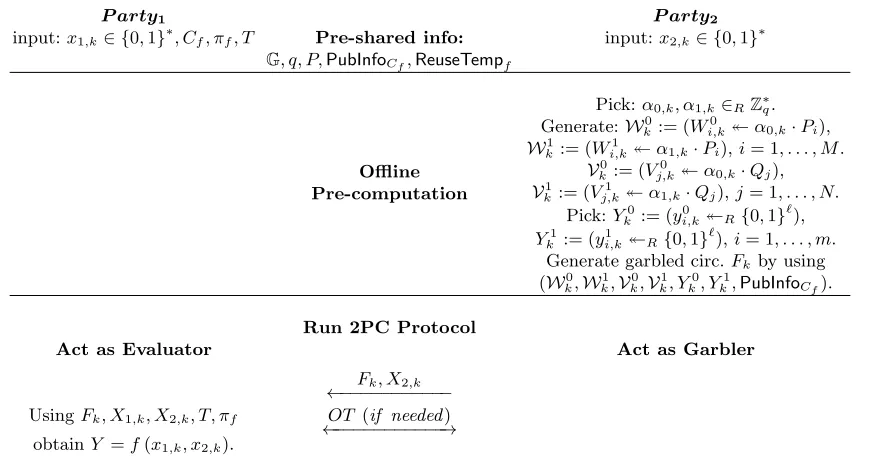
Fig. 3.Sketch of ourReExeprotocol for thek-th execution (k >1). The number of rounds is equal to 1, or 2, or 3 depending on the input string length ofParty1.
of four`-bit ciphertexts,ct1
a,ct2a,ct3a, andct4a, and an index pair (Ia1, Ia2). Note that the set of ciphertexts in theGGa are ordered according toIa1-th andIa2-th bits of their correspondingX,Y,Z, andTvalues. For example, let X= 011001. . .1, Y = 101111. . .0,Z = 110001. . .0, and T = 010111. . .1. If (I1
a, Ia2) = (1,5) then (X[1],X[5]) = (0,0), (Y[1],Y[5]) = (1,1), (Z[1],Z[5]) = (1,0), (T[1],T[5]) = (0,1), and therefore, we haveGGa = (ct1a,ct4a,ct3a,ct2a, (Ia1, Ia2)). A trivial method for finding such a pair (Ia1, Ia2) could be as follows. First,Party2 can find Ia1 such that{X[Ia1],Y[Ia1],Z[Ia1],T[Ia1]} ={0,0,1,1} with probability of 6/16 in each trial. Then, I2
a could also be found with probability of 4/16 in each trial. Therefore, the expected number of trials to find a pair of (I1
a, Ia2) is 7. Party2garbles all the gates in the circuit in the above-mentioned way, and obtains the garbled circuitF.Party2 then sendsF and its garbled inputX2(i.e., theWigroup elements for outgoing wires corresponding tox2) to Party1. As usual,Party1 gets its own garbled inputX1 (i.e., the Wi group elements for outgoing wires corresponding to x1) from Party2 using oblivious transfers (OT) (or one invocation of the OT extension schemes [IKNP03, KK13, ALSZ13]). Note that this does not increase the round complexity of our overall protocol, since the exchange messages needed for OT rounds can be accompanied to the protocol rounds (i.e., the first round of OT is sent withP message and second one with
Qand third one withF, X2).
Using F, the garbled input X = (X1, X2), T, and πf, Party1 evaluates the whole garbled circuit in topological order. If an outgoing wireowd is mapped to an incoming wireiwe, then the group elementVeof thee-th incoming wire is computed by the multiplication of the group elementWdof thed-th outgoing wire and the blinding valuete(i.e., ifπf(d) =e, thenVe=te·Wd). Each garbled gateGGacan be evaluated when both group elements (Vi,Vj) on its incoming wires (iwi, iwj) are computed. To evaluate each GGa,Party1 first computesH(Vi, Vj,gateID), and then XORs the ciphertext in theGGa pointed byIa1-th andIa2-th bits of the H(Vi, Vj,gateID)τ. At the end,Party1 obtains the token set Y = (y1, . . . , ym) for the output bits of the functiony=f(x1, x2).
3.2 Optimization with reusability feature: Our ReExeprotocol
parties. This feature is quite beneficial in relevant real-life scenarios where individuals (or enterprises) can mutually and continuously have long-term business relationship instead of a single deal. Note that such a cost reduction is not available in the protocols of KM11 [KM11] and MS13 [MS13], since they require that token generation and 2PC procedures be repeated in all executions. However, our scheme involvesReusable Mapping Tamplate (ReuseTempf := (P,Q)) that is reusable for the generation of tokens on incoming and outgoing wires. The reusability of ReuseTempf incurs upto 42% reduction in communication overhead over [MS13], i.e., asymptotically approaching 42% as protocol is re-executed for the same function.
Figure 3 depicts the sketch of our optimized ReExeprotocol. InReExeprotocol most of the calculations are performed in the offline pre-computation phase. For the k-th evaluation,Party2 picks α0,k, α1,k ∈R Z∗q values then prepares the setsW0
k,Wk1,Vk0,Vk1,Yk0andYk1. Then usingWk0,Wk1,Vk0,Vk1, Yk0, Yk1andPubInfoCf, Party2 prepares the garbled circuitF as in theInExeprotocol. The online phase then includes only the 2PC stage that also runs the same way as in Section 3.1. During the evaluation procedure of the 2PC stage,Party1 always use the sameT in all protocol runs.
3.3 Executing with VariousParty2s
In the previous section, we have addressed the case where the same two parties would like to evaluate the same function multiple times. In this section, we deal with the case thatParty1 would like to run the 2PFE protocol for the same private function with various Party2s separately. This is a relevant scenario where Party1 may run a business with many customers for her algorithm/software. Suppose that a cryptological research institution invents a practical algorithm for breaking RSA. Since such an algorithm would clearly attract a substantial demand, the institution may prefer hiding the details of the algorithm selling only its use. On the other hand, in many cases the clients would not like to share the keys (i.e., private inputs) with the institution. This is one of the several scenarios that a 2PFE protocol for the same private function with variousParty2s is suitable for.
First of all, we recall that the execution of our second protocol in Figure 3 requires the preknowledge of ReuseTempf := (P,Q) byParty2 and the set T byParty1. Trivially, onceReuseTempf and T are produced during InExe with anyParty2 as in our first protocol in Figure 2, then they can be stored, and our second protocol can be made use of in the subsequent executions with the sameParty2. We are here interested in a more efficient mechanism running with various Party2s by eliminating the costs of our first protocol for generating the preknowledge. The goal of this mechanism is to generate the generator setPin such a way that Party1does not know the relation between any two of its elements.T andQcan be subsequently computed, once the generator setP is given toParty1. In order to do so, we utilize a distributed system12 based on a t-out-of-nthreshold mechanism (fault tolerant against arbitrary behaviour of up totmalicious and colluding authorities) which takes (G, q, P, M) as input and outputsP. For further reducing communication and round
costs in the first execution,P might be generated via a random oracle by both parties in an offline phase. This will result in reduction of one round andM tokens ofInExe.
In the offline stage of our new mechanism, the generator setP is generated by the distributed authorities, and given to Party1. Next, Party1 computes the sets T and ReuseTempf. It then publishes PubInfoCf and ReuseTempf so that any prospectivek-th partyParty2,kcan utilize them in a 2PFE protocol run. This offline stage is dealt with only once, and its outputs (i.e.,T andReuseTempf) are used in the subsequent executions. Note that the flow of re-executions for allParty2,ks is exactly the same as ourReExeprotocol. We would like to stress that the costs of any execution in our new mechanism with a distributed system does not differ from theReExeprotocol.
4
Complexity Analysis
In this section, we first present the costs of ourInExeandReExeprotocols in terms of communication, online computation, and round complexities. We then compare these protocols with the existing boolean circuit 12
Table 1.Comparison of the existing 2PFE schemes in terms of overall communication (in bits) and online computa-tion costs (in terms of symmetric-key operacomputa-tions), offline computacomputa-tion costs (in terms of symmetric-key operacomputa-tions), and the number of rounds.
Communication Online Comp. Offline Comp. Rounds
KM11-1st [KM11] (4M+ 10N)λ N Asym.+ 2.5N Sym. 4(M+N)Asym. 3 KM11-2nd [KM11] (2M+ 7N)λ N Asym.+ 2.5N Sym. 2(M+N)Asym. 3 MS13-OSN [MS13] (10Nlog2N+ 4N+ 5)λ (6Nlog2N+ 2.5N+ 3)Sym. O(λ)Sym. 6 MS13-HE [MS13] (2M+ 6N)λ N Asym.+ 2.5N Sym. 2(M+N)Asym. 3 GKS17 [GKS17] (2Nlog2N)λ 0.7Nlog2N Sym. 2Nlog2N Sym. 3 BBKL18 [BBKL19] (6Nlog2N+ 0.5N+ 3)λ (6Nlog2N+N+ 3)Sym. O(λ)Sym. 6
Our InExe (2M+ 6N)λ 4N Asym.+ 2.5N Sym. (3M−1)Asym. 3
Our ReExe 4N λ N Asym.+ 0.5N Sym. 2(M+N)Asym.+ 2Sym.1 / 2 / 3
based 2PFE schemes.M,N andλdenote the number of outgoing wires (i.e., equal ton+g−m), the number of incoming wires (i.e.,N = 2g) and the security parameter, respectively.
4.1 Complexity of Our Scheme
Communication cost Considering our InExe protocol, the overall communication overhead is (2M + 6N)λ bits, composed of (i) the setP (M of 2λ-bit strings) is sent byParty2in Round 1, (ii) the setQ(N of 2λ-bit strings) is sent byParty1in Round 2, (iii) the garbled circuit (2N of 2λ-bit strings) is sent byParty2in Round 3, whereM is the number of outgoing wires andN is the number of incoming wires (N = 2g). Considering our ReExeprotocol, the use of ReuseTempf eliminates the transmission of (2M + 2N)λbits (required for token generation). Therefore, in total only 4N λbits (required for the garbled circuit) are transmitted.
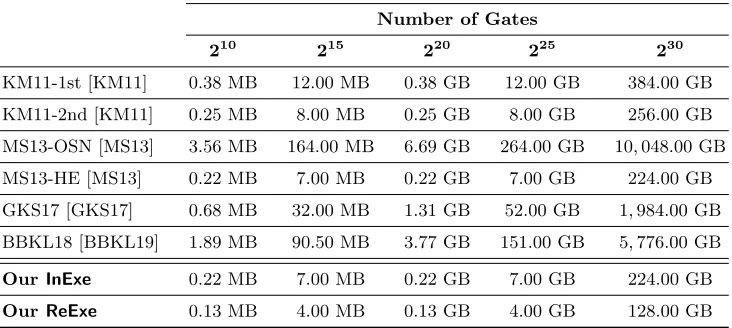
Table 2.Comparison of the existing 2PFE schemes in terms of overall communication costs for various circuit sizes. Here we takeN= 2M andλ= 128.
Number of Gates
210 215 220 225 230
KM11-1st [KM11] 0.38 MB 12.00 MB 0.38 GB 12.00 GB 384.00 GB KM11-2nd [KM11] 0.25 MB 8.00 MB 0.25 GB 8.00 GB 256.00 GB MS13-OSN [MS13] 3.56 MB 164.00 MB 6.69 GB 264.00 GB 10,048.00 GB MS13-HE [MS13] 0.22 MB 7.00 MB 0.22 GB 7.00 GB 224.00 GB GKS17 [GKS17] 0.68 MB 32.00 MB 1.31 GB 52.00 GB 1,984.00 GB BBKL18 [BBKL19] 1.89 MB 90.50 MB 3.77 GB 151.00 GB 5,776.00 GB Our InExe 0.22 MB 7.00 MB 0.22 GB 7.00 GB 224.00 GB Our ReExe 0.13 MB 4.00 MB 0.13 GB 4.00 GB 128.00 GB
Note that Beaver’s OT pre-computation technique [Bea95] can be used for decomposing OT’s for Party1’s input bits into online/offline stages. This eliminates online public-key operations of OT by carrying out them offline.
Number of rounds OurInExeprotocol has 3 rounds. The number of rounds of ourReExeprotocol is equal to 1, or 2, or 3 depending on the input string length ofParty1. Namely, ifParty1hasx1=⊥, then the number of rounds is equal to 1 (i.e., no rounds needed for OT). IfParty1’s input bits are not many, it is more efficient to use separate OTs for Party1’s input tokens in parallel instead of an OT extension scheme. There exists OT schemes with 2 rounds (e.g., [Bea95] and [NP01]). Hence, this choice results in a PFE scheme with overall 2 rounds. If Party1’s input bits are many, then using an OT extension scheme is more efficient. Note that Ishai based OT extension schemes are composed ofO(λ) parallel OTs (again can be realized by Naor and Pinkas’s OT [NP01]) and an additional round. Similarly, this choice results in a PFE scheme with overall 3 rounds.
4.2 Comparison
We now compare our 2PFE protocols with the state-of-the-art constant-round 2PFE protocols. In our scheme, we utilize an EC cyclic group where the DDH assumption holds for state-of-the-art efficiency. For [KM11], we take into account both protocols: (1) their “C-PFE protocol” (see [KM11, Sect. 3.1], which we call KM11-1st) and (2) their “A More Efficient Variant” (see [KM11, Sect. 3.2], which we call KM11-2nd). For a fair comparison, we assume that the point and permute optimization [BMR90] is directly applied to the MS13 and KM11 protocols during the 2PC phase13. Regarding the HE based schemes, for a fair comparison, we assume that EC-ElGamal is used. Also, considering KM11 and our protocols, we assume that each element ofGhas a length`= 2λbits for aλ-bit security.
Table 1 compares the existing 2PFE schemes in terms of overall communication cost, online/offline computation costs, and the number of rounds. We also provide Table 2 that depicts a comparison in terms of overall communication costs for various circuit sizes. In general, MS13-OSN, GKS17, BBKL18 performs O(N logN), whereas MS13-HE, KM11 and our protocols achieves linear complexity14. Note that although the complexity of MS13-HE is same as ourInExeprotocol, for the later executions ourReExeprotocol enjoys a significant cost reduction due to the reusability feature, which is not possible for MS13-HE and KM11 protocols. For all circuit sizes, the communication costs of ReExeprotocol are significantly lower than that of existing 2PFE protocols.
The advantage of our scheme becomes more pronounced when the number of executions is more than one. To demonstrate this, we define the normalized cost efficiency (N CE) function that takes a protocol (Proti), a circuitCf and the number of executions (k), then outputs an efficiency ratio wrt our scheme. The normalized cost efficiency is calculated via dividing the cumulative communication cost of our protocol by that ofProti.
N CE(Proti, Cf, k) = fc(InExe, Cf) + (k−1)fc(ReExe, Cf)
kfc(Proti, Cf) ,
wherefc is the cost function that outputs the communication cost value for given protocol andCf. Figure 4 depicts the normalized cost efficiency comparison of the protocols for circuits with 210 and 230 gates. Also, without loss of generality, we take N = 2M. Considering MS13-HE, although it performs the same efficiency in the initial execution, after the second execution, its efficiency is about 0.8 (meaning that our protocol saves about 20% bandwidth as compared to MS13-HE), and after ten executions it is about 0.63 (i.e., we achieve 37% saving). Moreover, for two executions our cost reduction is about 54% over KM11-1st, 30% over 2nd. For ten executions our cost reduction is about 63% over 1st, 44% over KM11-2nd. For large number of runs (e.g. a hundred runs) our savings over KM11-1st, KM11-2nd and MS13-HE are 66%, 50% and 43%, respectively.
13
In [MS13] and [KM11], for the 2PC phases, the authors do not suggest any optimization. However, a point and permute optimization is available for both schemes.
14
Figure 4 (a) and (b) shows how the normalized cost efficiency changes wrt circuit size. For the protocols that has linear complexity, the normalized cost efficiency does not change as the number of gates increases. However, for the protocols with O(N logN) complexity, their normalized efficiency dramatically decreases. For instance, after two executions, our cost reduction is about 74% and 91% over GKS17; about 91% and 97% over BBKL18; and about 95% and 98% over MS13-OSN for a thousand and a billion-gate circuits, respectively.
(a) Number of gates = 210 (b) Number of gates = 230
Fig. 4. Comparision of cummulative communication cost via normalized bandwidth efficiency vs. number of PFE executions. (a) gives a comparison using a circuit 210 gates where (b) gives a comparison using a circuit 230 gates.
Regarding the computation costs, Table 1 gives both asymmetric (denoted by Asym.) and symmetric (denoted by Sym.) cryptographic operations, separately. On the other hand, comparing the complexity of asymmetric operations with symmetric operations is subject to discussion. To compare with each other, one can define a computation cost ratio as the cost of a primitive asymmetric operation divided by the cost of a primitive symmetric operation for the same security level. Note that the value of this ratio depends upon several factors such as the software implementations, the underlying symmetric-key encryption scheme, the availability of short-cut algorithms, the type of the chosen elliptic curve, the hardware infrastructure, and the type of utilized processors. For example, according to [EIV18], in a setting where curve25519 and SHA256 are picked as the EC and the hash function, respectively, and the operations take place on an Intel Xeon Processor E3-1220 v6 (amd64, 4x3GHz), this ratio is roughly 130.
Among all protocols, ourReExeprotocol performs the best result in terms of round complexity. Namely, the number of rounds inReExeis equal to 1 ifParty1hasx1=⊥, or 2 ifParty1has a non-empty inputx1 in such that the OT extension is not applicable for its garbled input, or 3 otherwise. Note that the arithmetic circuit based protocol of [MS13] providesO(g) round complexity (see [MS13, p. 570])).
5
Security of Our Protocols
In this section, we give simulation-based security proofs of our InExe protocol in Figure 2, ReExeprotocol in Figure 3, and our mechanism with various Party2s in Sect. 3.3 in accordance with the security proof of [KM11].
H : G×G× {0,1}∗ → {0,1}`+τ involved in the instantiation of DKC scheme is modeled as a random oracle, (3) the OT scheme securely realizes FOT functionality in the OT-hybrid model against semi-honest
adversaries.
Proof. First, consider the case thatParty1is corrupted. For any probabilistic polynomial time adversaryA1, controllingParty1in the real world, we construct a simulatorS1 that simulatesA1’s view in the ideal world.
S1 runs A1 on Party1’s inputs, f and x1, the function output token set Y = (y1, . . . , ym), the pre-shared group parameters, andPubInfoCf as follows.
1. S1 generates the generator set ˜P := ( ˜P1, . . . ,P˜M). S1 also prepares the group element sets ˜W0 := ( ˜W0
1, . . . ,W˜M0 : ˜W 0
i α˜0,i·P, α˜0,i ∈R Zq∗, i = 1, . . . , M) and ˜W1 := ( ˜W11, . . . ,W˜M1 : ˜W 1
i α˜1,i· P, α˜1,i∈RZ∗q, i= 1, . . . , M).S1 gives ˜P to A1.
2. S1 receives the blinding setT := (t1, . . . , tj : tj ∈R Z∗q, j = 1, . . . , N) from A1, and prepares the sets ˜
V0:= ( ˜V0
1, . . . ,V˜N0 : ˜V 0
j tj·W˜π0−1 f (j)
, j = 1, . . . , N) and ˜V1 := ( ˜V1
1, . . . ,V˜N1 : ˜V 1
j tj·W˜π1−1 f (j)
, j =
1, . . . , N).
3. S1 prepares the garbled circuit ˜F by garbling each gate as follows. S1 garbles each non-output NAND gate by encrypting only the group element for FALSEon its outgoing wire with all four possible input token combinations (i.e., for a gate whose incoming wires are iwi and iwj, outgoing wire is owz, S1 prepares the following four ciphertexts: ˜ct1a=EncV˜0
i,V˜j0( ˜W 0 z), ˜ct
2
a =EncV˜0 i,V˜j1( ˜W
0 z), ˜ct
3
a=EncV˜1 i,V˜j0( ˜W
0 z), ˜
ct4a = EncV˜1 i,V˜j1( ˜W
0
z). To garble an output NAND gate whose incoming wires are iwi and iwj, and output wire is z, S1 prepares the four ciphertexts: ˜ct
1
b = EncV˜0 i,Vj0(yz),
˜
ct2b = EncV˜0 i,V˜j1(yz),
˜ ct3b = EncV˜1
i,V˜j0(yz), ˜
ct4b =EncV˜1
i,V˜j1(yz). For each garbled gate ˜GGa,S1then permutes ˜ct 2 a, ˜ct
3 a, ˜ct
4
a, and picks ˜
I1
a,I˜a2∈R{1, . . . , τ}, and places ˜ct 1
a in the order pointed by ˜Ia1-th and ˜Ia2-th bits of [H( ˜Vi0,V˜j0,gateID)]τ among the other three ciphertexts. Each garbled gate GG˜ a is then composed of four `-bit ciphertexts and two log2(τ)-bit random values ˜I1
a and ˜Ia2.
4. S1gives ˜FtoA1along with the simulated garbled input consisting of only the group elements forFALSEs on both parties’ input wires ˜X = ( ˜X1,X˜2). This completes our simulation.
In what follows, we prove that the information obtained by Party1 in the real execution (P,W, F) is identically distributed to ( ˜P,W˜,F), where for outgoing wires,˜ Party1 obtains the group elements W = (W1, . . . , WM) whileA1obtaining the group elements ˜W= ( ˜W10, . . . ,W˜M0). We now show the computational indistinguishability of (P,W) and ( ˜P,W˜) by utilizing Lemma 1, which ultimately ties the security of our protocol to the DDH assumption. More concretely, we need to show
{(P1, . . . , PM, W1, . . . , WM)} ≈c{( ˜P1, . . . ,PM˜ ,W˜10, . . . ,W˜ 0
M)}
{(r1·P, . . . , rM·P, αb1·(r1·P), . . . , αbM·(rM·P))} ≈c {(˜r1·P, . . . ,rM˜ ·P,α˜0,1·P, . . . ,α˜0,M·P)}
where bi ∈ {0,1} is the semantic value onowi and ˜Pi = ˜ri·P. For the sake of a simpler representation, we replaceαbiri withrM+i, and ˜α0,iwith ˜rM+i fori= 1, . . . , M. Note that (r1, . . . , r2M) is not identically distributed to (˜r1, . . . ,r2˜M), while it is only sufficient to show that
{(r1·P, . . . , r2M·P)} ≈c{(˜r1·P, . . . ,˜r2M ·P)}.
For this purpose, we generate a new set R:= (R1, . . . , R2M) by picking 2M random generators. Hence, we now need to show
{(R1, . . . , R2M, r1·P, . . . , r2M·P)} ≈c
Thanks to Lemma 1 and the underlying DDH assumption, we have both
{(R1, . . . , R2M, γ·R1, . . . , γ·R2M)} ≈c
{(R1, . . . , R2M, r1·P, . . . , r2M ·P)} and
{(R1, . . . , R2M, γ·R1, . . . , γ·R2M)} ≈c
{(R1, . . . , R2M,r1˜ ·P, . . . ,˜r2M ·P)}
whereγ∈RZ∗q. Hence, the following sets are computationally indistinguishable
{(r1·P, . . . , r2M ·P)} ≈c{(˜r1·P, . . . ,˜r2M ·P)}
which effectively concludes the proof for{(P,W)} ≈c{( ˜P,W˜)}. Furthermore, since the same values inT are used among the outgoing wire tokens and incoming wire tokens in both the real and the ideal executions, we have {(P,W,V)} ≈c {( ˜P,W˜,V˜)} where for each incoming wire V = (V1, . . . , VN) is the set of tokens obtained byParty1 and ˜V = ( ˜V0
1, . . . ,V˜N0) is the set of tokens obtained byA1. In contrast to [KM11], it is relatively simple to prove the computational indistinguishability of F and ˜F in our scheme since we use a hash function modeled as random oracle during garbling. Once the distribution of four hash outputs for each gate (in the real and ideal executions) are proven to be computationally indistinguishable random values, outputs of our instantiation of DKC is also proven to be computationally indistinguishable. This results in the computational indistinguishability of each garbled gate GGa and GG˜ a, and eventually computational indistinguishability ofF and ˜F. For a gate whose incoming wires areiwi andiwj, in the real execution, we have four hash outputs involved in the garbling as follows:
H(Vi0, Vj0,gateID), H(Vi0, Vj1,gateID), H(Vi1, Vj0,gateID), H(Vi1, Vj1,gateID).
Similarly, for each gate, in the ideal execution, we have the following four hash outputs in the garbling as follows:
H( ˜Vi0,V˜ 0
j ,gateID), H( ˜V 0 i ,V˜
1
j,gateID), H( ˜Vi1,V˜j0,gateID), H( ˜Vi1,V˜j1,gateID).
Since inParty1’s view, resulting from the indistinguishability ofVand ˜V, the hash inputs are computationally indistinguishable, and therefore, the hash outputs are computationally indistinguishable random values. This completes the proof for{(P,W, F)} ≈c{( ˜P,W˜,F˜)}.
We now consider the case thatParty2 is corrupted. For any probabilistic polynomial-time adversaryA2, controllingParty2during our first protocol in the real world, we construct a simulatorS2that simulatesA2’s view in the ideal world.S2runs A2onParty2’s input, and the pre-shared group parameters, andPubInfoCf as follows.
1. S2 asksA2 to generate ˜P Init(G, q, P, M) and receives ˜P.
2. S2then picks ˜tj∈RZ∗q forj= 1, . . . , N, and computes ˜Qj˜tj·P which are now random group elements in G. S2assigns ˜Q= ( ˜Q1, . . . ,Q˜N), and gives ˜QtoA2. This completes our simulation.
In the real execution of our protocol, Party2 receives only the message Q := (Q1, . . . , QN : Qj tj·Pπ−1
Theorem 2. If the 2PFE protocol proposed in Figure 2 is secure against semi-honest adversaries (i.e., the three conditions in Theorem 1 are satisfied), then the 2PFE protocol proposed in Figure 3 is also secure against semi-honest adversaries.
Proof (Sketch).The main difference of theReExeprotocol from the first one is the utilization ofReuseTempf. Therefore, the proof will be complete once we show that the utilization of the sets W0
k, W 1 k, V
0
k, and W 1 k computed from the same ReuseTempf in thek-th execution gives Party1 no advantage in deducingParty2’s inputs.
We now show that in Party1’s view, (Wk,Vk,Wk+1,Vk+1) in two consecutive real executions are compu-tationally indistinguishable from ( ˜W1,V˜1,W˜2,V˜2) where ˜W1 := ( ˜W1,1, . . . ,W˜M,1 : ˜Wi,1 = ˜qi,1·P, q˜i,1 ∈R
Z∗q, i = 1, . . . , M), ˜V1 := ( ˜V1,1, . . . ,V˜N,1 : ˜Vj,1 tj ·W˜π−1
f (j),1, j = 1, . . . , N), ˜W2 := ( ˜W1,2, . . . , ˜ WM,2 : ˜
Wi,2= ˜qi,2·P, q˜i,2∈RZ∗q, i= 1, . . . , M), and ˜V2:= ( ˜V1,2, . . . ,V˜N,2: ˜Vj,2tj·W˜π−1
f (j),2, j= 1, . . . , N). More concretely, we have
{((1, k), . . . ,(M, k), t1·(πf−1(1), k), . . . , tN ·(πf−1(N), k),
(1, k+ 1), . . . ,(M, k+ 1), t1·(πf−1(1), k+ 1), . . . , tN ·(πf−1(N), k+ 1))}
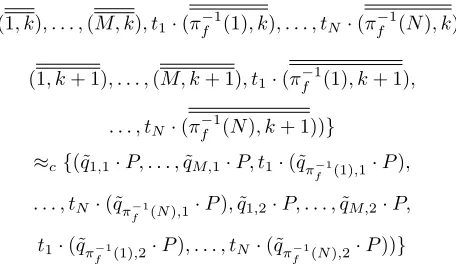
≈c{(˜q1,1·P, . . . ,q˜M,1·P, t1·(˜qπf−1(1),1·P), . . . , tN ·(˜qπ−f1(N),1·P),q˜1,2·P, . . . ,q˜M,2·P, t1·(˜qπ−f1(1),2·P), . . . , tN·(˜qπf−1(N),2·P))}
where (i, j) is the abbreviation forαbi,j,j·Pi, andbi,k ∈ {0,1} is the semantic bit value ofowi in thek-th execution. The proof of their indistinguishability relies on the same flow as the proof of Theorem 1, which depends on Lemma 1 and ultimately on the DDH assumption.
Theorem 3. If the threshold system is secure against malicious adversaries at most t−1 of whom are allowed to collude, and the 2PFE protocol proposed in Figure 3 is secure against semi-honest adversaries; then our mechanism with various Party2s in Sect. 3.3 is also secure against semi-honest adversaries.
Proof (Sketch).First, theParty1’s view in the 2PFE mechanism is equivalent to the one in the protocol in Figure 3. Observe that the generator set is generated by the distributed system and the tokens (that are used in preparation of the garbled inputXk and the garbled circuit Fk) are computed fromα0,k or α1,k in each evaluation as in Figure 3. Therefore, the 2PFE mechanism prevents Party1 from deducing any information aboutParty2,k’s input. Second,Party2,ks cannot obtain any information aboutParty1’s input in none of the executions since the OT outputs are only obtained byParty1 due theFOT functionality in the OT-hybrid model. Also, due to Theorem 1, no one can obtain information aboutπf from theReuseTempf. Moreover, anyParty2,k has a negligible advantage on distinguishing the exchanged messages in an evaluation between Party1andParty2,l from a random string due to the underlying DDH assumption forl6=k. More concretely, the tokens (that are used in preparation of Party2,l’s garbled input X2,l and the garbled circuit Fl) are computed by multiplying the elements of theReuseTempf with the private valuesα0,l or α1,l ofParty2,l.
6
Conclusion
frequent in practice, compared to the cases where parties execute a function only once. We note that such cost reduction by the reusability feature is not applicable in the existing PFE protocols (i.e., for each PFE execution the parties should run the all the steps from scratch). Our protocols achieve linear communication and computation complexities and a constant number of rounds which is at most three. To the best of our knowledge, this is the first and most efficient 2PFE scheme that enjoys a reusablity feature.
Our scheme asymptotically reduces the communication cost compared to MS13-OSN [MS13], BBKL18 [BBKL19], and GKS17 [GKS17] protocols (i.e., fromO(glog(g)) toO(g) wheregis the number of gates). For instance, for a billion-gate circuit, our cost reduction is about 98% over MS13-OSN, about 96% over BBKL18, and about 89% over GKS17. Comparing with the protocols that has linear complexity, for ten executions (re-gardless of number of gates) our cost reduction is about 63% over KM11-1st, 44% over KM11-2nd, and 37% over MS13-HE.
We also propose a solution for the case thatParty1runs the 2PFE protocol for the same private function with various Party2s separately. This is a common scenario where Party1 may run a business with many customers for her algorithm/software. Instead of runningInExeprotocol with eachParty2, we have proposed a more efficient mechanism for the generation of the reusable tokens by utilizing a threshold based system.
References
AF90. Mart´ın Abadi and Joan Feigenbaum. Secure circuit evaluation. Journal of Cryptology, 2(1):1–12, Feb 1990.
AFK87. M. Abadi, J. Feigenbaum, and J. Kilian. On hiding information from an oracle. InProceedings of the Nineteenth Annual ACM Symposium on Theory of Computing, STOC ’87, pages 195–203. ACM, 1987. ALSZ13. Gilad Asharov, Yehuda Lindell, Thomas Schneider, and Michael Zohner. More Efficient Oblivious Transfer
and Extensions for Faster Secure Computation. InProceedings of the 2013 ACM SIGSAC Conference on Computer & Communications Security, CCS ’13, pages 535–548, New York, NY, USA, 2013. ACM. BBKL19. Muhammed Ali Bing¨ol, Osman Bi¸cer, Mehmet Sabir Kiraz, and Albert Levi. An efficient 2-party private
function evaluation protocol based on half gates. Comput. J., 62(4):598–613, 2019.
BDGM19. Zvika Brakerski, Nico D¨ottling, Sanjam Garg, and Giulio Malavolta. Leveraging linear decryption: Rate-1 fully-homomorphic encryption and time-lock puzzles. In Theory of Cryptography - 17th International Conference, TCC 2019, Nuremberg, Germany, December 1-5, 2019, Proceedings, Part II, pages 407–437, 2019.
Bea95. Donald Beaver. Precomputing Oblivious Transfer. In Proceedings of the 15th Annual International Cryptology Conference on Advances in Cryptology, CRYPTO ’95, pages 97–109, London, UK, UK, 1995. Springer-Verlag.
BHR12. Mihir Bellare, Viet Tung Hoang, and Phillip Rogaway. Foundations of Garbled Circuits. InACM CCS 2012, CCS ’12, pages 784–796, New York, NY, USA, 2012. ACM.
Bin19. Muhammed Ali Bing¨ol.Efficient and secure schemes for private function evaluation. PhD thesis, Sabanci University, 2019. http://research.sabanciuniv.edu/36861/1/10229989_MuhammedAliBingol.pdf,. BMR90. D. Beaver, S. Micali, and P. Rogaway. The round complexity of secure protocols. InProceedings of the
Twenty-second Annual ACM Symposium on Theory of Computing, STOC ’90, pages 503–513. ACM, 1990. Bon98. Dan Boneh. The decision diffie-hellman problem. InANTS-III Portland, Oregon, USA, June 21–25, pages
48–63, Berlin, Heidelberg, 1998. Springer Berlin Heidelberg.
BV11. Z. Brakerski and V. Vaikuntanathan. Efficient fully homomorphic encryption from (standard) lwe. In 2011 IEEE 52nd Annual Symposium on Foundations of Computer Science, pages 97–106, Oct 2011. BV14. Zvika Brakerski and Vinod Vaikuntanathan. Lattice-based fhe as secure as pke. InProceedings of the 5th
Conference on Innovations in Theoretical Computer Science, ITCS ’14, page 1–12, New York, NY, USA, 2014. Association for Computing Machinery.
CKMZ14. Seung Geol Choi, Jonathan Katz, Alex J. Malozemoff, and Vassilis Zikas. Efficient three-party computation from cut-and-choose. In Juan A. Garay and Rosario Gennaro, editors,CRYPTO 2014, August 17-21, 2014, Proceedings, pages 513–530, Berlin, Heidelberg, 2014. Springer Berlin Heidelberg.
EG85. Taher El Gamal. A public key cryptosystem and a signature scheme based on discrete logarithms. In Proceedings of CRYPTO 84 on Advances in Cryptology, pages 10–18, New York, NY, USA, 1985. Springer-Verlag New York, Inc.
Gen09. Craig Gentry. Fully homomorphic encryption using ideal lattices. InProceedings of the Forty-first Annual ACM Symposium on Theory of Computing, STOC ’09, pages 169–178, New York, NY, USA, 2009. ACM. GH19. Craig Gentry and Shai Halevi. Compressible fhe with applications to pir. 11892:438–464, 2019.
Gir16. Damien Giry. Keylength – cryptographic key length recommendation, 2016.http://www.keylength.com/ (accessed on 2017-05-17).
GKS17. Daniel G¨unther, ´Agnes Kiss, and Thomas Schneider. More Efficient Universal Circuit Constructions. In Advances in Cryptology - ASIACRYPT 2017 - 23rd International Conference on the Theory and Applica-tions of Cryptology and Information Security, Hong Kong, China, December 3-7, 2017, Proceedings, Part II, pages 443–470, 2017.
HMV03. Darrel Hankerson, Alfred J. Menezes, and Scott Vanstone.Guide to Elliptic Curve Cryptography. Springer-Verlag New York, Inc., Secaucus, NJ, USA, 2003.
HS18. Shai Halevi and Victor Shoup. Faster homomorphic linear transformations in helib. In Hovav Shacham and Alexandra Boldyreva, editors,Advances in Cryptology – CRYPTO 2018, pages 93–120, Cham, 2018. Springer International Publishing.
IKNP03. Yuval Ishai, Joe Kilian, Kobbi Nissim, and Erez Petrank. Extending Oblivious Transfers Efficiently. InAdvances in Cryptology - CRYPTO 2003, volume 2729 of Lecture Notes in Computer Science, pages 145–161. Springer Berlin Heidelberg, 2003.
KK13. Vladimir Kolesnikov and Ranjit Kumaresan. Improved OT extension for transferring short secrets. In Advances in Cryptology - CRYPTO 2013 - 33rd Annual Cryptology Conference, Santa Barbara, CA, USA, August 18-22, 2013. Proceedings, Part II, pages 54–70, 2013.
KKS16. Carmen Kempka, Ryo Kikuchi, and Koutarou Suzuki. How to circumvent the two-ciphertext lower bound for linear garbling schemes. InASIACRYPT 2016: Hanoi, Vietnam, December 4-8, 2016, pages 967–997, Berlin, Heidelberg, 2016. Springer Berlin Heidelberg.
KM11. Jonathan Katz and Lior Malka. Constant-round private function evaluation with linear complexity. In ASIACRYPT 2011, Seoul, South Korea, December 4-8, pages 556–571, Berlin, Heidelberg, 2011.
KMR14. V. Kolesnikov, P. Mohassel, and M. Rosulek. Flexor: Flexible garbling for xor gates that beats free-xor. InAdvances in Cryptology – CRYPTO 2014: 34th Annual Cryptology Conference, Santa Barbara, CA, USA, August 17-21, 2014, Proceedings, Part II, pages 440–457, Berlin, Heidelberg, 2014. Springer Berlin Heidelberg.
KS08a. Vladimir Kolesnikov and Thomas Schneider. Improved garbled circuit: Free xor gates and applications. InICALP 2008, Reykjavik, Iceland, July 7-11, 2008, pages 486–498, Berlin, Heidelberg, 2008. Springer Berlin Heidelberg.
KS08b. Vladimir Kolesnikov and Thomas Schneider. A practical universal circuit construction and secure evalu-ation of private functions. InFC 2008, pages 83–97, Berlin, Heidelberg, 2008. Springer Berlin Heidelberg. KS16. Agnes Kiss and Thomas Schneider. Valiant’s universal circuit is practical. In´ EUROCRYPT 2016, Vienna, Austria, May 8-12, 2016, Proceedings, Part I, pages 699–728, Berlin, Heidelberg, 2016. Springer Berlin Heidelberg.
LN14a. Tancr`ede Lepoint and Michael Naehrig. A comparison of the homomorphic encryption schemes fv and yashe. Cryptology ePrint Archive, Report 2014/062, 2014. https://eprint.iacr.org/2014/062. LN14b. Tancr`ede Lepoint and Michael Naehrig. A comparison of the homomorphic encryption schemes fv and
yashe. In David Pointcheval and Damien Vergnaud, editors,Progress in Cryptology – AFRICACRYPT 2014, pages 318–335, Cham, 2014. Springer International Publishing.
LPR13a. Vadim Lyubashevsky, Chris Peikert, and Oded Regev. On ideal lattices and learning with errors over rings. J. ACM, 60(6), November 2013.
LPR13b. Vadim Lyubashevsky, Chris Peikert, and Oded Regev. A toolkit for ring-lwe cryptography. In Thomas Johansson and Phong Q. Nguyen, editors, Advances in Cryptology – EUROCRYPT 2013, pages 35–54. Springer Berlin Heidelberg, 2013.
LPS08. Y. Lindell, B. Pinkas, and N. Smart. Implementing two-party computation efficiently with security against malicious adversaries. In Security and Cryptography for Networks: 6th International Conference, SCN 2008, Amalfi, Italy, September 10-12, 2008. Proceedings, pages 2–20, Berlin, Heidelberg, 2008. Springer Berlin Heidelberg.
LV01. Arjen K. Lenstra and Eric R. Verheul. Selecting cryptographic key sizes.Journal of Cryptology, 14(4):255– 293, 2001.
MSS14. Payman Mohassel, Saeed Sadeghian, and Nigel P. Smart. Actively secure private function evaluation. In Advances in Cryptology – ASIACRYPT 2014, volume 8874 ofLecture Notes in Computer Science, pages 486–505. Springer Berlin Heidelberg, 2014.
NDR+19. Hamid Nejatollahi, Nikil Dutt, Sandip Ray, Francesco Regazzoni, Indranil Banerjee, and Rosario Cam-marota. Post-quantum lattice-based cryptography implementations: A survey. ACM Comput. Surv., 51(6), January 2019.
NP01. Moni Naor and Benny Pinkas. Efficient oblivious transfer protocols. InProceedings of the Twelfth Annual ACM-SIAM Symposium on Discrete Algorithms, SODA ’01, pages 448–457, Philadelphia, PA, USA, 2001. Society for Industrial and Applied Mathematics.
NPS99. Moni Naor, Benny Pinkas, and Reuben Sumner. Privacy preserving auctions and mechanism design. In Proceedings of the 1st ACM Conference on Electronic Commerce, pages 129–139. ACM Press, 1999. NR04. Moni Naor and Omer Reingold. Number-theoretic constructions of efficient pseudo-random functions. J.
ACM, 51(2):231–262, March 2004.
OSPG18. Tobias Oder, Tobias Schneider, Thomas P¨oppelmann, and Tim G¨uneysu. Practical CCA2-Secure and Masked Ring-LWE Implementation. IACR Transactions on Cryptographic Hardware and Embedded Sys-tems, 2018(1):142–174, Feb. 2018.
Pai99. Pascal Paillier. Public-key cryptosystems based on composite degree residuosity classes. In Jacques Stern, editor,EUROCRYPT ’99, May 2–6,, pages 223–238, Berlin, Heidelberg, 1999. Springer Berlin Heidelberg. PSS09. Annika Paus, Ahmad-Reza Sadeghi, and Thomas Schneider. Practical secure evaluation of semi-private
functions. InACNS 2009, pages 89–106, Berlin, Heidelberg, 2009. Springer Berlin Heidelberg.
PSSW09. Benny Pinkas, Thomas Schneider, Nigel P. Smart, and Stephen C. Williams. Secure two-party computation is practical. InASIACRYPT 2009, December 6-10, 2009, pages 250–267, Berlin, Heidelberg, 2009. Springer Berlin Heidelberg.
Sad15. SeyedSaeed Sadeghian. New Techniques for Private Function Evaluation. PhD thesis, University of Calgary, 2015.
SS09. Ahmad-Reza Sadeghi and Thomas Schneider. Generalized universal circuits for secure evaluation of private functions with application to data classification. InICISC 2008, pages 336–353, Berlin, Heidelberg, 2009. Springer Berlin Heidelberg.
SZ13. Thomas Schneider and Michael Zohner. Gmw vs. yao? efficient secure two-party computation with low depth circuits. In Ahmad-Reza Sadeghi, editor,FC 2013, Okinawa, Japan, April 1-5, 2013, pages 275–292, Berlin, Heidelberg, 2013. Springer Berlin Heidelberg.
Yao82. Andrew C. Yao. Protocols for Secure Computations. In Proceedings of the 23rd Annual Symposium on Foundations of Computer Science, SFCS ’82, pages 160–164, Washington, DC, USA, 1982. IEEE Computer Society.