Attribute-Sets: A Practically Motivated
Enhancement to Attribute-Based Encryption
Rakesh Bobba, Himanshu Khurana and Manoj Prabhakaran
University of Illinois at Urbana-Champaign
{rbobba,hkhurana,mmp}@illinois.edu
July 27, 2009
Abstract
In distributed systems users need to share sensitive objects with others based on the recipients’ ability to satisfy a policy. Attribute-Based Encryption (ABE) is a new paradigm where such policies are specified and cryptographically enforced in the encryption algorithm itself. Ciphertext-Policy ABE (CP-ABE) is a form of ABE where policies are associated with encrypted data and attributes are associ-ated with keys. In this work we focus on improving the flexibility of representing user attributes in keys. Specifically, we propose Ciphertext Policy Attribute Set Based Encryption (CP-ASBE) - a new form of CP-ABE - which, unlike existing CP-ABE schemes that represent user attributes as a monolithic set in keys, orga-nizes user attributes into a recursive set based structure and allows users to impose dynamic constraints on how those attributes may be combined to satisfy a policy. We show that the proposed scheme is more versatile and supports many practical scenarios more naturally and efficiently. We provide a prototype implementation of our scheme and evaluate its performance overhead.
1
Introduction
CP-ABE is more intuitive as it is similar to traditional access control model where data is protected with access policies and users with credentials satisfying the policy are allowed access to it. Among the various CP-ABE schemes proposed the one proposed by Bethencourtet al.[2], which we will hereafter refer to as BSW, is the most practical to date. It supports arbitrary strings as attributes, numerical attributes in keys and integer comparisons in policies and provides a means for periodic key refreshment. Furthermore, the authors have developed a software prototype with a friendly interface for integration in systems. However, BSW and other CP-ABE schemes are still far from being able to support the needs of modern enterprise environments, which require considerable flexibility in specifying policies and managing user attributes as well as increased efficiency. This is in part due to the fact that keys in current CP-ABE schemes can only support user attributes that are organized logically as a single set;i.e., users can use all possible combinations of attributes issued in their keys to satisfy policies. This, we observe, imposes some undesirable restrictions which are outlined below.
First, this makes it both cumbersome and tedious to capture naturally occurring “compound attributes”,i.e., attributes build intuitively from other (singleton) attributes, and specifying policies using those attributes. For example, attributes that combine a traditional organizational role with short-term responsibilities result in useful com-pound attributes; e.g., ‘Faculty’ in ‘College of Engineering’ serving as ‘Committee Chair’ of a ‘University Tenure Committee’ in ‘Spring2009’ are all valid attributes in their own right and are likely to be used to describe users. The only way to prevent users from combining such attributes in undesirable ways when using cur-rent CP-ABE schemes is by appending the (singleton) attributes as strings; i.e., fac-ulty collegeOfEngineering committeeChair univTenureCommittee Spring2009. But this approach has an undesirable consequence in that it makes it challenging to support policies that involve other combinations of singleton attributes used to build the com-pound attribute;e.g., policies targeting “all committee chairs in Spring2009” or “fac-ulty serving on tenure committees”. This is because the underlying crypto in CP-ABE schemes can only check for equality of strings and thus cannot extract the “faculty” or “committeeChair” attributes from a compound attribute such as the one described above.
Second, CP-ABE schemes that support numerical attributes (i.e., allow numerical comparisons in policies) are limited to assigning only one value to any given numerical attribute within a key. But there are many real world systems where multiple numerical value assignments for a given attribute are common;e.g., students enrolled in multiple courses identified by numeric course numbers in a given semester, users with multiple accounts at a particular bank, disease codes for individual diseases and disease classes used widely in health care. Furthermore, the ability to compare across such multiple value assignments adds flexibility to policy specification. For example, consider a col-lege student enrolled in two junior level courses,357and373, and two senior level courses,411 and418respectively. Without support for multiple numerical value as-signments for a given attribute specifying policies to target students enrolled in senior level courses, such as “course number greater than or equal to400and less than500” is tedious and cumbersome.
Encryption (CP-ASBE), a form of CP-ABE, that addresses the above limitations of CP-ABE by introducing a recursive set based structure on attributes associated with user keys. Specifically CP-ASBE allows, 1) user attributes to be organized into a re-cursive family of sets and 2) policies that can selectively restrict decrypting users to use attributes from within a single set or allow them to combine attributes from mul-tiple sets. Thus, by grouping user attributes into sets such that those belonging to a single set have no restrictions on how they can be combined, CP-ASBE can support compound attributes without sacrificing the flexibility to easily specify policies involv-ing the underlyinvolv-ing sinvolv-ingleton attributes. Similarly, multiple numerical assignments for a given attribute can be supported by placing each assignment in a separate set.
While restricting users to use attributes from a single set during decryption can be thought of as a regular CP-ABE scheme, the challenge in constructing a CP-ASBE scheme is in selectively allowing users to combine attributes from multiple sets within a given key while still preventing collusion,i.e., preventing users from combining at-tributes from multiple keys. We provide a construction for a CP-ASBE scheme that builds on BSW and evaluate its performance through a prototype implementation. We show that our construction is secure against chosen-plaintext attacks in the generic group model. However, our construction can be efficiently extended to be secure againstchosen-ciphertext attacksusing a transformation like Fujisaki-Okamoto [8, 20] or the techniques of Canetti, Halevi and Katz [?] just like the BSW scheme [2].
The rest of this paper is organized as follows. Section 2 further motivates CP-ASBE. Section 3 discusses related work. In Section 4 we give some preliminaries. We present our construction and discuss its security in Section 5. In Section 6 we discuss efficiency of the scheme, give details of our prototype implementation and discuss performance. Section 7 concludes the paper and discusses future directions.
2
Motivation
The ability to group attributes into sets and to frame policies that can selectively restrict the decrypting key to use attributes belonging to the same set is a powerful feature more than one might realize initially. In this section we illustrate its versatility by solving various problems in different contexts which did not have any reasonably efficient so-lutions prior to this.
2.1
Supporting Compound Attributes Efficiently
While existing CP-ABE schemes offer unprecedented expressive power for addressing users, for several natural scenarios they are inadequate. We illustrate this with the following natural example and show how CP-ASBE provides a simple solution.
different sets to circumvent the policy. We point out a few possible options of using CP-ABE, but all unrealistic or unsatisfactory. The efficiency parameters considered are the number of designed attributes given to each student, and the size of the designed policy (a circuit, with designed attributes as inputs, for enforcing the policy).
• For each course that the student has taken, let there be a single designed (boolean) attribute that she gets (e.g.cyg:373 2008 4). But the designed policy will have to (unrealistically) anticipate all such attributes that will satisfy the policy (e.g.,
cyg:300 2007 3 or cyg:301 2007 3 or. . .or cyg:399 2010 4).
• Anticipate (again, unrealistically) all possible policies that may occur which the student’s attributes will satisfy, and give her compound boolean attributes cor-responding to each of these policies (e.g., cyg:373 2008 4, cyg:373 2008,
cyg:(≥300) 2008,cyg:(≥400) 2007-or-cyg:(≥300) 2008 (≥3),. . .). In this case our designed policy is minimal, with just an input gate (labeled by the at-tributecyg:(≥300,<400) (≥2007) (>2)) and an output gate.
• Fix an upper bound on the number of courses a student could ever take, say 50, and give all attributes indexed by a counter (e.g. Course#1, Year#1, Grade#1 etc.); then the policy will have to incorporate several cases (e.g., (400<Course#1
≥300and Year#1≥2007and Grade#1>2) or . . . or (400<Course#50≥300 and Year#50≥2007and Grade#50>2)). This increases the policy size by a factor of 50.
If a policy can refer to more than one course, all these approaches will lead to even more inefficiency or restrictions. In particular, in the third (and the most efficient) approach, if a policy refers to just two courses, the blow up will be by a factor of 2500 instead of 50.
We stress that these are not the only possibilities when using CP-ABE. In general, by giving more attribute keys, the circuit complexity of the policies can be reduced (the first two options above being close to the two extremes). One could achieve slightly smaller policies by adding judiciously chosen auxiliary attributes and adding some structure to values taken by these attributes (for instance, in the third option above, one can let the counter monotonically increase with the course number). However, the resulting schemes are still unrealistically inefficient in terms of policy size and/or number of keys, andfurthermakes attribute revocation even less efficient.
A CP-ASBE scheme can be used to overcome these issues by assigning multiple values to the group of attributes but in different sets. In our example, for each course that a student has taken, she gets a separate set of values for the attributes (Course, Grade, Year). Thus the number of designed attributes she receives is comparable to the number of natural attributes she has; further, the designed policy is comparable in size to that of a policy that did not enforce the requirement that attributes from different courses should not be mixed together. In short, using CP-ASBE, we can obtain efficient ciphertext policy encryption schemes for several scenarios where existing CP-ABE scheme are insufficient.
an entry in a database table. In such a table — which we will call theattribute table— each row stands for a user and each column (other than user identity) for an attribute.1
The policy associated with a cipher-text could be considered a query into this table, to identify all users whose attributes satisfy a certain predicate.
The expressive power of a CP-ABE scheme is given by the class of queries into this table that the scheme can support. For instance, BSW CP-ABE [2] supports a large class of such queries. One challenge to increase the expressive power would be to broaden this class. However, there is another important dimension in which the expressive power of CP-ABE scheme can be improved, by supporting a more general class of attribute tables. The above description of CP-ABE required that each user ID appears in only one row in the table. (In other words, the user ID must be a “superkey” in the attribute table.) Of course, a table can be forced to have this property, but leading to large blow ups in the number of designed attributes that a user receives or the size of the designed policy. On the other hand, a CP-ASBE scheme can directly support a table with multiple rows per user: attributes in each row is given as a separate set.
2.2
Supporting Multiple Value Assignments
A major motivation for CP-ASBE is to support multiple value assignments for a given attribute in a single key.2 To illustrate this, supposescoreis a 6-bit integer representing
the score a user receives in a game. (The user may possess several other attributes in the system.) The user can play the game several times and receive several values forscore. This numerical attribute will be represented by 12 boolean attributes: score bit0 0,
score bit0 1,. . .,score bit6 0andscore bit6 1, corresponding to the values 0 and 1 for the six bits in the binary representation of the value. Now consider a user who has two values ofscore, 33 (binary 100001) and 30 (binary 011110). By obtaining attributes for the bit values of these two numbers, the user gets all 12 boolean attributes, effectively allowing him to pretend to have any score he wants.
CP-ASBE solves this problem elegantly: each value assignment of the numerical attribute is represented in a separate set with six boolean attributes each (one for each bit position). Note that attributes other thanscoreneed not be repeated.
Application: Efficient revocation. ABE schemes suffer from lack of an effective revocation mechanism for keys that have been issued (just like IBE). To address this in CP-ABE in a limited manner, Bethencourtet al.[2] propose adding anexpiration time
attribute to a user’s key indicating the time (i.e., a numerical value) until which the key is considered to be valid. Then a policy can include a check on theexpiration time at-tribute as a numerical comparison. However, in practice the validity period of sensitive attributes has to kept small to reduce thewindow of vulnerabilitywhen a key is com-promised,e.g. a day, a week or a month. At the end of this period the entire key will have to be re-generated and re-distributed with an updated expiration time imposing a heavy burden on the key server and key distribution process.
1In the case of a “large universe” of attributes, the number of columns could be very large — say all
strings of 256 bits – and the resulting sparse table will never be stored directly as a table. Our examples shall mostly use the small universe scenarios, though they extend to the large universe setting as well.
2Note that multiple values for an attribute is relevant only when the attribute in question is not a boolean
CP-ASBE solves this problem more efficiently. First, we observe that while key validity is limited because of the window of vulnerability, the actual attribute assign-ments change far less frequently. Second, we observe that it is possible to add attributes retroactively to a user key, both in BSW CP-ABE and CP-ASBE, if key server is able to maintain some state information about the user key. Then, by allowing multiple value assignments to theexpiration timeattribute we can simply add a new expiration value to the existing key. Thus, while we require the key server to maintain some state we avoid the need to generate and distribute new keys on a frequent basis. This reduces the burden on the key server by a factor proportional to the average number of attributes in user keys.
3
Related Work
While the concepts and ideas related to Attribute-Based Encryption have been alluded to in literature as far back as [4, 7] Sahai and Waters [16] proposed what is considered the first ABE scheme. Their scheme supported policies with a single threshold gate. Furthermore, the threshold valuek, and size of the gatenused in a policy, are fixed during setup in theirLarge Universeconstruction. Pirrettiet al., [15] showed how to overcome this limitation of fixedkandnand demonstrated the use of threshold access policies for two applications. Traynoret al., [19] further demonstrated its scalability by applying it to massive conditional access systems. Goyalet al., [11] first defined the two complimentary forms of ABE, namely, KP-ABE and CP-ABE, and provided a construction for a KP-ABE3 scheme. The proposed KP-ABE scheme supported all monotonic boolean encryption policies and was later extended by Ostrovskyet al., [14] to support non-monotonic boolean formulas.
Bethencourt et al., [2] gave the first construction for a CP-ABE scheme. Their construction supported all monotonic boolean encryption policies and the security of their scheme was argued in the generic group model. Cheung and Newport [6] gave the first standard model construction of CP-ABE scheme. While their scheme sup-ported both positive and negative attributes it was limited to policies with single AND gates. Nishideet al., [13] extended the scheme in [6] to support policy secrecy. Goyal et al.gave the first standard model construction of CP-ABE scheme that could support flexible policies [10]. Their scheme can realize all non-monotonic boolean formulas. However, since it is constructed using a KP-ABE scheme of [11], it is inefficient and has bounded ciphertext,i.e., the size of supported policies is fixed at setup. Katzet al. proposed a KP-ABE scheme in [12] that can support flexible policies and achieve pol-icy secrecy. This scheme can be used to realize CP-ABE schemes but such schemes have a bounded ciphertext. All the above ABE schemes are designed to work with one Attribute Authority (AA), a trusted entity that generates master parameters and distributes keys to users, and hence limited to a single domain. Chase extended [16] to multiple authorities in [5]. While most of the past work on CP-ABE schemes is focused on improving the expressibility of encryption policies and providing policy privacy ours is the first work to consider the flexibility of representing attributes in
keys. All CP-ABE schemes to date can only support a monolithic set of user attributes which makes them inflexible and inefficient to capture naturally occurring “compound attributes”. Our CP-ASBE scheme is the first to organize user attributes in keys and allow users to impose dynamic constraints on how attributes can be combined to satisfy policies, allowing our scheme more flexibility and efficiency when supporting “com-pound attributes”.
Support for numerical attributes was first discussed in [2]. While the technique may be applicable to other schemes none of the existing CP-ABE schemes can support multiple value assignments for a given numerical attribute within a single key. Our CP-ASBE scheme is the first scheme to do so allowing it to support applications where such attribute assignments are needed without sacrificing flexibility of range queries (i.e., numerical comparisons) in policies for those attributes.
4
Preliminaries
Bilinear Maps. LetG1,G2,GT be cyclic (multiplicative) groups of orderp, where
pis a prime. Letg1 be a generator ofG1, and g2 be a generator ofG2. Then e :
G1×G2→GT is a bilinear map if it has the following properties:
1. Bilinearity: for all u ∈ G1, v ∈ G2 and a, b ∈ Zp, we have e(ua, vb) =
e(u, v)ab.
2. Non-degeneracy:e(g, h)6= 1.
Usually,G1=G2=G.Gis called a bilinear group if the group operation and the
bilinear mapeare both efficiently computable.
Key Structure. In CP-ABE schemes, an encryptor specifies an access structure for a ciphertext which is referred to as the ciphertext policy. Only users with secret keys whose associated attributes satisfy the access structure can decrypt the ciphertext. In CP-ABE schemes so far, a user’s key can logically be thought of as a set of elements each of which corresponds to an associated attribute, such that only elements within a single set may be used to satisfy any given ciphertext policy (i.e.collusion resistance). In our scheme however, we use a recursive set based key structure where each element of the set is either a set itself (i.e. a key structure) or an element corresponding to an attribute. We define a notion ofdepth for this key structure, which is similar to the notion of depth for a tree, that limits this recursion. That is, for a key structure with depth2, members of the set at depth 1can either be attribute elements or sets but members of a set at depth2 may only be attribute elements. The following is an example of a key structure of depth2:
n
CS-Department, Grad-Student,{Course101, TA},{Course525, Grad-Student}o
[?], our construction is easily generalized to support keys of any depthdwheredis fixed at setup.
The key structure defines unique labels for sets in the key structure. For key struc-tures of depth2, just an index (arbitrarily assigned) of the set among sets at depth2 is sufficient to uniquely identify the sets. Thus if there aremsets at depth2then an unique indexiwhere1≤i≤mis (arbitrarily) assigned to each set. The set at depth1 is referred to as set0or simply the outer set. Ifψrepresents a key structure then letψi represent theith set inψ. Individual attributes inherit the label of the set they are con-tained in and are uniquely defined by the combination of their name and their inherited label. That is, while a given attribute might appear in multiple sets it can appear only once in any set. In the above example, the outer set and{Course525, Grad-Student}
are assigned labels0 and2respectively, and the two instances of the attribute Grad-Studentare distinguished by the unique combination of their inherited set label and attribute name, (0,Grad-Student) and (2,Grad-Student), respectively. By default, a user may only use attribute elements within a set to satisfy a given ciphertext policy. That is, a user with the key structure from the above example may combine individual attributes either from the outer set (i.e.,{CS-Department, Grad-Student}) or from the set{Course101, TA} or from the set{Course525, Grad-Student} to satisfy the pol-icy associated with a given ciphertext but may not combine attributes across the sets. However, an encryptor may choose to allow combining attributes from multiple sets to satisfy the access structure by designatingtranslating nodesin the access structure as explained below.
Access Structure. We build on the access structure used in [2] which is a tree whose non-leaf nodes are threshold gates. Each non-leaf node of the tree is defined by its children and a threshold value. Let ncx denote the number of children and kx the threshold value of nodex, then0 < kx ≤ ncx. Whenkx = 1, the threshold gate is an OR gate and whenkx = ncxit is an AND gate. The access tree also defines an ordering on the children of a node,i.e., they are numbered from1toncx. For nodex
such a number is denoted byindex(x). Each leaf nodeyof the tree is associated with an attribute which is denoted byatt(y). Furthermore, the encrypting user may designate some nodes in an access tree astranslating nodes. Their function will become clear as we discuss below the conditions under which a key structure is said to satisfy an access tree.
LetT be an access tree whose root node isr. LetTxdenote a subtree ofT rooted at nodex. ThusTris the same asT. Now we will define the conditions under which a key structureψis said to satisfy a given access treeT assuming there are no designated translating nodes in the access tree. We will then extend the definition to consider the presence of translating nodes. A key structureψis said to satisfy the access treeT if and only ifT(ψ)returns a non-empty setSof labels. We evaluateTx(ψ)recursively as follows. Ifxis a non-leaf node we evaluateTx0(ψ)for all childrenx0ofx. Tx(ψ)
returns a setSxcontaining unique labels such that for every labellbl∈Sxthere exists at least one set ofk ≥kxchildren such that for each childx0 of thesekchildrenSx0
access tree. Note that attributes belonging to multiple sets in the key structure cannot be combined to satisfy the access tree.
However, if there are designated translating nodes in the access tree, the algorithm
T(ψ)is modified as follows. The algorithmTx(ψ)is the same as above when xis a leaf node. Whenxis a non-leaf node we evaluateTx0(ψ)for all childrenx0 ofx.
Tx(ψ) returns a setSx containing unique labels such that for every label lbl ∈ Sx there exists at least one set ofk ≥kxchildren such that for each childx0 of thesek childrenSx0 either contains the labellblorx0is a translation node andSx0 6=∅. Thus,
if nodexis a designated translating node then, even if the attribute elements used to satisfy the predicate represented by the subtree rooted atxbelong to a different set in the key structure than those used to satisfy the predicates represented by the siblings of
xthe decrypting user is able to combine them to satisfy the predicate represented by the parent node ofx.
Syntax of CP-ASBE Scheme. A CP-ASBE scheme consists of four algorithms, Setup,KeyGen,EncryptandDecrypt. The algorithmSetupproduces a master key and a public key for the scheme.KeyGentakes as input the master-key, a user’s iden-tity and an attribute set; it produces a secret key for the user. Encrypttakes as input the public key of the scheme, a message and an access tree, and outputs a ciphertext. Finally,Decrypttakes a ciphertext and a secret-key (produced byKeyGen), and if the access-tree used to construct the ciphertext is satisfied by the attribute set for which the secret-key was generated, then it recovers the message from the ciphertext.
Security of CP-ASBE Scheme. Our notion ofmessage indistinguishabilityfor CP-ASBE scheme againstchosen-plaintext attacksis similar to that for CP-ABE schemes [2].
Setup. The challenger runs the Setup algorithm and gives public parameters, PK, to the adversary.
Phase 1. The adversary makes repeated queries for private keys corresponding to attribute setsA1, . . . ,
Aq1.
Challenge. The adversary submits two equal length messages M0 andM1, and a challenge access structure T∗ such that none of the private keys obtained in Phase 1 corresponding to attribute setsA1, . . . ,Aq1 satisfy the access structure.
The challenger flips a random coinb, and encryptsMb underT∗. The resulting ciphertext CT is given to the adversary.
Phase 2. Phase 1 is repeated with the restriction that none of the attribute sets
Aq1+1, . . . ,Aqsatisfy the access structure corresponding to the challenge.
Guess.The adversary outputs a guessb0ofb.
The advantage of an adversaryAin this game is defined asP r[b0 =b]−1 2. This game could easily be extended to include chosen-ciphertext attacks by allowing for decryption queries in Phase 1 and Phase 2.
5
Our CP-ASBE Construction
A key challenge in designing CP-ABE schemes is preventing users from pooling to-gether their attributes. BSW CP-ABE achieves this by binding toto-gether all the attribute key components for each user with a random number unique to the user. Since in a CP-ASBE scheme one must prevent arbitrary combination of attributes belonging to different sets (even if they belong to the same user), a natural idea would be to sim-ilarly use a unique random number for binding together attribute key components for each set, in addition to using a random number for each user. However, a CP-ASBE scheme must also supportspecific combinations of attributes from different sets, as specified in an access-tree. The key idea in our construction is to include judiciously chosen additional values in the ciphertext (and in the key) that will allow a user to com-bine attributes from multiple sets all belonging to the same user. As it turns out, such a modification could introduce new subtle ways for multiple users to combine their attributes. Our construction shows how to thwart such attacks, using appropriate levels of randomization among different users’ keys.
LetG0be a bilinear group of prime orderpand letg be a generator ofG0. Let
e:G0×G0 →G1denote a bilinear map. LetH :{0,1}∗ →G0be a hash function that maps any arbitrary string to a random group element. We will use this function to map attributes described as arbitrary strings to group elements.
Setup(d= 2). The setup algorithm chooses random exponentsα, βi∈Zp∀i∈ {1,2}. The algorithm sets the public key and master key as:
PK=(G, g, h1=gβ1, f1=g 1
β1, h2=gβ2, f2=g 1
β2, e(g, g)α)
MK=(β1, β2, gα)
Note that to support key structures of depthd,iwill range from1tod.
KeyGen(MK,A,u). Hereuis the identity of a user andA={A0, A1, . . . , Am}is a key structure. A0is the set of individual attributes in the outer set (i.e. set0) andA1 toAmare sets of attributes at depth2 that the user has. LetAi ={ai,1, . . . , ai,ni}. That is,ai,jdenotes thej-th attribute appearing in setAi, andnidenotes the number of attributes in the setAi. (Note that for different values of(i, j),ai,jcan be the same attribute.) The key generation algorithm chooses a unique random number,r{u}∈
Zp,
for useru. It then chooses a set ofmunique random numbers,ri{u}∈Zp, one for each
setAi∈A,1≤i≤m. For setA0,r{ u}
0 is set to be the same asr{
u}. It also chooses a set of unique random numbers,r{i,ju}∈Zp, one for each(i, j),0≤i≤m,1≤j≤ni.
The issued key is:
SKu =
A, D=g
(α+r{u}) β1 ,
Di,j=gr
{u}
i ·H(a i,j)r
{u}
i,j , D0 i,j =g
ri,j{u} for0≤i≤m,1≤j ≤n i,
Ei=g
(r{u}+ri{u})
β2 for1≤i≤m
Note that the operations on the exponents in the above equations are modulo the order of the group, which is prime. Hence division in the exponent is well-defined. We omit themodfor convenience. ElementsEienable translation fromr{
u}
i (i.e., setAiat depth 2) tor{u}(i.e., the outer or parent setA
0at depth1) at the translating nodes. Elements
EiandEi0can be combined asEi/Ei0to enable translation fromr{u}
i0 (i.e., setAi0) to ri{u}(i.e., the setAi) at the translating nodes. Similarly, for a key structure of depthd, there will elements that enable translation from a set at depthdto its parent set at depth
d−1and they will useβdand random numbers corresponding to the appropriate sets. Encrypt(PK, M,T). Mis the message,T is an access tree. The algorithm associates a polynomialqτwith each nodeτ(including the leaves) in the treeT. These polynomials are chosen in the following way in a top-down manner, starting from the root node R. For each internal nodeτin the tree, the degreedτof the polynomialqτis set to be one less than the threshold valuekτ of that node, that is,dτ =kτ−1. For leaf nodes the the degree is set to be0. For the root nodeRthe algorithm picks a randoms∈Zpand setsqR(0) =s. Then, it choosesdRother points randomly to define the polynomialqR completely. For any other nodeτ, it setsqτ(0) = qparent(τ)(index(τ))and chooses
dτ other points randomly to completely defineqτ. Hereparent(τ)denotes the parent node ofτ. LetYdenote the set of leaf nodes inT. LetXdenote the set oftranslating
nodesin the access treeT. Then the ciphertext CT returned is as follows: CT= T, C˜=M ·e(g, g)α·s, C =h1s,C¯ =hs2, ∀y∈Y:Cy =gqy(0),
Cy0 =H(att(y))qy(0), ∀x∈
X: ˆCx=h qx(0) 2
Translating valuesCˆx0stogether withEi0sin user keys allow translation between sets at a translating nodexas will be described in the Decrypt function. Note that the element
¯
Cis the same asCˆrwhererdenotes the root node. A variant of the scheme would be whereC¯ is not included in the ciphertext but is only released at the discretion of the encrypting user asCˆr. This would restrict decrypting users to only use individual attributes in the outer set except when explicitly allowed by the encrypting user by designating translating nodes.
Decrypt(CT, SKu). Here we describe the most straightforward decryption algorithm without regard to efficiency. The decryption algorithm is a recursive algorithm similar to the tree satisfaction algorithm described in Section 4. The decryption algorithm first runs the tree satisfaction algorithm on the access tree with the key structurei.e.,T(A), and stores the results of each of the recursive calls in the access treeT. That is, each nodetin the tree is associated with a setStof labels that was returned byTt(A). If Adoes not satisfy the treeT then the decryption algorithm returns⊥. Otherwise the
decryption algorithm picks one of the labels,i, from the set returned byT(A)and calls a recursive functionDecryptNode(CT, SKu,t,i) on the root node of the tree. Here CT is the ciphertext CT= (T,C, C,˜ ∀y ∈ Y : Cy, Cy0,∀x∈ X : ˆCx), SKu is a private key, which is associated with a key structure denoted byA,tis a node fromT, andiis
a label denoting a set ofA. Note that the ciphertext CT now contains tree information
that is augmented by the results fromT(A).DecryptNode(CT, SKu,t,i) is defined as
Ift ∈ Y,i.e., nodet is a leaf node, thenDecryptNode(CT, SKu,t,i) is defined
as follows. Ifatt(t)∈/ Ai whereAi ∈AthenDecryptN ode(CT,SKu, t, i) =⊥. If
att(t) =ai,j∈AiwhereAi∈Athen:
DecryptN ode(CT,SKu, t, i) =e(Di,j, Ct)
e(D0i,j, Ct0)
=e(g
r{iu}·H(a i,j)r
{u}
i,j , gqt(0))
e(gri,j{u}, H(ai,j)qt(0))
=e(g, g)r{iu}·qt(0)
Note that set from which the satisfying attributeai,jwas picked is implicit in the result
e(g, g)r{iu}·qt(0)(i.e., indicated byr{u}
i ). Whent /∈Y,i.e., nodetis a non-leaf node, thenDecryptN ode(CT,SKu, t, i)proceeds as follows:
1. ComputeBtwhich is an arbitraryktsized set of child nodeszsuch thatz∈Bt only if either (1) labeli ∈ Sz or (2) labeli0 ∈ Sz for somei0 6= iandz is a translating node. If no such set exists then return⊥.
2. For each nodez ∈Btsuch that labeli ∈SzcallDecryptN ode(CT,SKu, t, i) and store output inFz.
3. For each nodez∈Btsuch thati0 ∈Szandi0 6=icallDecryptN ode(CT,SKu, t, i0) store output inF0
z. Ifi6= 0then translateFz0 toFzas follows:
Fz=e( ˆCz, Ei/Ei0)·Fz0
=e(gβ2·qz(0), g
r{iu}−r{u} i0
β2 )·e(g, g)r
{u}
i0·qz(0) =e(g, g)r
{u}i·qz(0)
Otherwise, translateFz0toFzas follows:
Fz=
e( ˆCz, Ei0) F0
z
=e(g
β2·qz(0), g
r{u}+r{u} i0 β2 )
e(g, g)r{i0u}·qz(0)
=e(g, g)r{u}·qz(0)
4. ComputeFtusing polynomial interpolation in the exponent as follows:
Ft=
Y
z∈Bt
F∆k,Bz0(0)
z , wherek=index(z), Bz0 ={index(z) :z∈Bt}
and Lagrange coefficient∆i,S(x) =
Y
j∈S,j6=i
x−j
i−j
=
(
e(g, g)ri{u}·qt(0) wheni6= 0
e(g, g)r{u}·q
t(0) wheni= 0
The output ofDecryptN ode(CT,SKu, r, i)function on the root noderis stored inFr. Ifi = 0we haveFr = e(g, g)r
{u}·qr(0)
= e(g, g)r{u}·s otherwise we have
Fr=e(g, g)r
{u}
F = e( ˆCr, Ei)
Fr
= e(g
β2·qr(0), g
r{u}+r{iu} β2 )
e(g, g)r{iu}·qr(0)
=e(g, g)r{u}·qr(0)=e(g, g)r{u}·s
OtherwiseF =Fr. The decryption algorithm then computes following: ˜
C·F
e(C, D) =
M ·e(g, g)α·s·e(g, g)r{u}·s
e(gs·β1, g (r{u}+α)
β1 )
=M
Note how two elementsEiandEi0 together with a translating valueCˆtat a node twere used to translate between setsiandi0 at nodetin step 3. Similarly, note how a single elementEitogether with a translating value was used to translate between set
iand the outer set. We note that ifβ1 =β2then the scheme would become insecure as colluding users could transitively translate from inner seti to outer set and then from one key to the other by using theDelements from their keys. Thus we need a uniqueβfor every level that we need to support. When using key structures of depth
d, translating values,Cˆs, that help translate between sets at depthdor between a set at depthdand its parent at depthd−1will useβd. And to allow translations across multiple levels at a given node, multiple translating values using differentβs will need to be released at that node.
Usage Example. We now demonstrate the usage of CP-ASBE with the example policy from Section 2.1. When using two level key structures, the policy can be written as follows using threshold gates:
4OF4
(Course >300),(Course <400),(Grade >2),(Y ear >2007)
Here, predicates such as Course > 300will further be expanded and written using their constituent boolean attributes. Recall that numerical attributes in CP-ASBE are represented using a bag of bits representation, with a boolean attribute used to represent each bit of the numerical value, as described in Section 2.2. Users can be given keys with two levels. For example, for a user who has taken two courses the structure of the issued key is as follows:
n
{Course = 304, Grade = 2, Year = 2007},{Course = 425, Grade = 3, Year = 2008}o
While the user’s key will contain translation elements Ei’s, as long as there is no designated translation node in the policy (i.e., ciphertext) the user will not be able to combine hisGradeandYearattributes forCourse 425with that ofCourse 304to satisfy the above policy. The form of the policy and keys for this example when using three level key structures is shown in the full version [?].
5.1
Security
advantage of any adversary in the CP-ASBE security game is negligible, as long as it uses the underlying groups and hash functions in a generic manner, and makes only polynomially many accesses to them.
Generic Bilinear Group [3]. A generic group G0 with a bilinear mape : G0 ×
G0 → G1 can be modeled by an oracle which uses random strings as handles for the elements in the two groupsG0 andG1.4 More precisely, we consider an oracle
O, which picks two random encodings of the additive groupFp into sufficiently long strings,i.e., injective mapsψ0, ψ1 : Fp → {0,1}m, wherem >3 log(p). We write
G0 = {ψ0(x)|x ∈ Fp}andG1 = {ψ1(x)|x ∈ Fp}. The oracle provides access to the group operations (which we shall refer to as multiplication) in either group: for example, queries of the form (multiply0, h, h0) and (inverse0, h), will be answered respectively byψ0(ψ0−1(h) +ψ
−1
0 (h0)),ψ0(−ψ0−1(h)). Ifhorh0is not in the range of
ψ0, then the oracle returns⊥. The oracle also provides access to the identity elements (ψ0(0), ψ1(0)), and canonical generators (ψ0(1), ψ1(1)) in the two groups, as well as the ability to sample random elements in the groups. In addition, given a query (pair, h, h0), whereh= ψ0(α)andh0 =ψ0(β),Oreturnsh00 =ψ1(αβ). To relate to the notation of bilinear groups used in our construction, we will denoteψ0(1)byg andψ0(x)bygx. Similarly we will lete(g, g)ydenoteψ1(y). Then the above pairing query to the oracle will be written ase(gα, gβ)and the response ase(g, g)αβ.
Finally, the oracleOalso includes a random functionH :{0,1}∗ →
G0. It takes queries of the form(hash, a)for arbitrarily long stringsaand returnsH(a).
Theorem 2. LetO,G0,G1, andH be as defined above. For any adversaryAwith access toO in the security game for the CP-ASBE scheme in Section 5 (usingG0,
G1, andH), suppose qis an upper-bound on the total number of group elements it receives from queries toOand interaction with the CP-ASBE security game. Then the advantage ofAin the CP-ASBE security game isO(q2/p).
Proof Intuition. Let us say thatsis the random secret split according to the access structureT as described in theEncryptfunction of Section 5. LetT0 be an access structure derived fromT by removing the sub-trees under all translating nodes,i.e., translating nodes become leaf nodes. For simplicity, let us assume for now that all the leaves ofT0are translating nodes in the original access structureT. Letqt(0)represent the secret share associated with a translating nodet. A user has to obtaine(g, g)αs to recover the message encrypted using the access structureT. He could pairC =gβ1s
given in the ciphertext withD=g(α+r{u})/β1in his key to obtaine(g, g)αs+r{u}s,i.e.,
e(g, g)αsblinded bye(g, g)r{u}s. A user can cancel oute(g, g)r{u}sonly if he satisfies the tree,i.e., by obtaining a set ofe(g, g)r{u}q
t(0)that can reconstructe(g, g)r{u}s. One can think of the key components given for each set of attributes in the key structure as a unique key under the BSW scheme. That is, ifr{u} is the unique random number used in our CP-ASBE key then the set of key components (including the translation element) corresponding to each setAican be thought of as a BSW key issued using a
4We remark that it is not important to model the handles asrandomstrings, but only as distinct handles
master secret key(β2, gr
{u}
). Furthermore, each of the sub-trees rooted at a translating node can be thought of an access structure under the BSW scheme. Thus a given sub-tree can only be satisfied using attributes from a single set,i.e. a single BSW key, as BSW is collusion resistant. The proof below shows that the additional group elements that are available to an adversary in our scheme do not adversely affect this collusion resistance. Thus a user who has a key with a set that can satisfy the sub-tree under a translating nodetcan obtaine(g, g)r{u}q
t(0). And sincer{u}is unique to a CP-ASBE key, only attributes from sets within a single CP-ASBE key can be used to satisfyT0 and thus the original access structure.
Proof. Recall that in the CP-ASBE security game the adversary has to distinguish be-tween challenge ciphertextsM0·e(g, g)α·sandM1·e(g, g)α·s. By a standard hybrid argument one can consider a modified security game in which the adversary has to distinguish between challenge ciphertextse(g, g)α·sande(g, g)θ, whereθis selected uniformly at random formFp. It is easy to show that any adversary that has
advan-tagein the original CP-ASBE game can be transformed into an adversary that has an advantage of at least/2in the modified game. We will now bound the adversary’s advantage in the modified game to prove the theorem.
For this we describe a simulation of the modified game, such that the adversary’s view in the simulation is distributed identical to that in the modified security game with challenge ciphertext e(g, g)θ. Further, conditioned on an event of probability 1−O(q2/p)in the simulation, we will show that this view is identical to what it would have been in the modified security game, with challenge ciphertexte(g, g)α·s. Thus we will conclude that the advantage of the adversary is at mostO(q2/p).
At the setup time the simulation choosesα, β1, β2 at random fromFp. Ifβ1 = 0 orβ2 = 0then setup is aborted just as it would be in the actual scheme. The public parametersh1 = gβ1, h2 = gβ2, f1 = g
1 β1, f
2 = g 1
β2, ande(g, g)α are sent to the adversary.
When the adversary or the simulation call for evaluation ofHon any new attribute stringa, a new random valuetais chosen fromFp, and the simulation providesgtaas the response toH(a)and stores it to respond to future queries ona. When the adversary makes itsk0thkey generation query for attribute setAk, the simulation picks, (1) a new
random valuer{k} from
Fp, (2) a new random valuer{ik}for every subsetAki ∈ Ak and (3) a new random valuer{i,jk} for everyai,j ∈ Aki, for everyAki ∈ Ak. It then computes, (1)D =g(α+r{k})/β
1, (2)D
i,j =gr
{k}
i +tj·r
{k}
i,j andD0 i,j =g
r{i,jk}
for each
j ∈ Ak
i and eachAki ∈Ak and (3)Ei =g(r
{k}+r{k}
i,j )/β2 for eachAk
i ∈Ak. These values are passed on to the adversary.
In the challenge phase the adversary outputs a challenge access structureT∗along with two equal length messagesMO, M1 ∈ G0. LetX∗ denote the set ofconverging
nodesinT∗. Let
Y∗denote the set of leaf nodes in the access treeT∗. The simulator
chooses a randoms∈Fpand uses the linear secret sharing scheme associated withT∗ as described inEncryptfunction of Section 5 to construct sharesqy(0)ofof s∀y∈Y∗.
Note that every leaf node is a descendent of a uniqueconverging node. Letλx,j representqy(0) wherey ∈ Y∗ is a descendent of x ∈ X∗ and represents attribute
j5. Furthermore, note that the choice ofδxcan be perfectly simulated by choosingv random valuesµ1, . . . , µvuniformly and independently fromFp, for some value ofv,
and then lettingδxbe fixed public linear combination ofµv0sands. Similarly, we can think ofλx,j0sas a fixed linear combination of some constantsµ01, . . . , µ0uandδx. We will think of theδx0sandλx,j0sas such linear combinations later.
Finally the simulation chooses a random θ ∈ Fp, and constructs the encryption as follows: C˜ = e(g, g)θ, C = hs
1,∀y ∈ Y∗, Cy = gλx,j andCy0 = gtj·λx,j, and
∀x∈X∗Cˆ
x=hδ2x. These values are sent to the adversary.
When the adversary makes a query to the group oracles, if the adversary provides as input a handlehthat it did not receive from the oracle, then with probability1−
O(1/p2) such a handle is not in the range ofψ
0 orψ1. So, by conditioning on an event of probability1−O(q/p2)(q being an upperbound on the number of oracle queries made during the entire simulation), we can assume that the oracle provides answers to only queries which use handles already given out by the oracle. As such we may keep track of the algebraic expressions being called for from the oracles as long as no “accidental collisions” occur. Specifically, we think of an oracle query being a rational functionν =η/ξin the variablesθ, α, β1, β2, tj0s, rk
0
s, rk i 0
s, rk i,j
0
s, s, and
µv0s. An accidental collision is said to occur if two distinct formal queriesη/ξ6=η0/ξ0 have the same value due to random choices of the variables. We now condition that no such “accidental collisions” in either group G0 or G1. For any pair of distinct formal queriesη/ξandη0/ξ0within a group, an accidental collision occurs only if the non-zero polynomialηξ0 −ξη0 evaluates to zero. The total degree ofηξ0−ξη0 in our case is a constant (at most 5). Then by the Schwartz-Zippel lemma [17, 21] the probability of an accidental collision between any pair of formal queries isO(1/p). By a union bound, the probability that any such collision happens in our simulation is at mostO(q2/p). Thus we can condition on no “accidental collisions” occurring while retaining1−O(q2/p)of the probability mass.
Now we show that, subject to the condition that no “accidental collisions” occur, the view of the adversary is identically distributed when we setθ=α·sin the simulation. Since we are in the generic group model where each group element is uniformly and independently chosen the only way that the adversary’s view can differ in the case
θ=α·sis if there are two queriesνandν0 intoG1such thatν 6=ν0butν |θ=α·s=
ν0 |θ=α·s. Since θonly occurs as e(g, g)θ inG1, the only dependenceν or ν0 can have onθ is by having some additive terms of the formγ·θwhereγis a constant. Therefore we must have thatν−ν0 =γ·α·s−γ·θfor some constantγ 6= 0for the adversary’s view to be different in the two simulations. We can then artificially add the queryν −ν0+γ·θ = γ·α·sto the adversary’s queries. We will now do a case analysis based on the information given to the adversary by the simulation to show that an adversary can never construct a query fore(g, g)γ·α·swhich will establish the theorem.
5Note we are assuming here that a given attribute is not represented by multiple leaf nodes descending
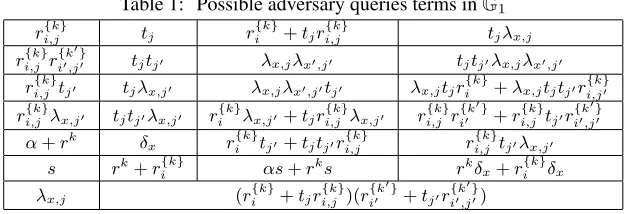
Table 1: Possible adversary queries terms inG1 r{i,jk} tj r
{k}
i +tjr
{k}
i,j tjλx,j
ri,j{k}ri{0k,j0}0 tjtj0 λx,jλx0,j0 tjtj0λx,jλx0,j0
r{i,jk}tj0 tjλx,j0 λx,jλx0,j0tj0 λx,jtjr{k}
i +λx,jtjtj0r{k}
i,j0
ri,j{k}λx,j0 tjtj0λx,j0 r{ik}λx,j0+tjr
{k}
i,j λx,j0 r{i,jk}r{k 0}
i0 +r
{k}
i,j tj0r{k 0}
i0,j0
α+rk δx ri{k}tj0+tjtj0r{i,jk} ri,j{k}tj0λx,j0
s rk+r{k}
i αs+r
ks rkδ x+r
{k}
i δx
λx,j (r
{k}
i +tjr
{k}
i,j )(r
{k0}
i0 +tj0r{k 0}
i0,j0)
Table 1 enumerates all the possible queries intoG1by means of the bilinear map and group elements given to the adversary by the simulation except for those that involveβ1 orβ2in every monomial as they will not be relevant for constructing a query involving
α·s. Here the variablesj andj0are possible attribute strings, variableskandk0 are indices of secret key queries made by the adversary, and variablesiandi0are indices of attribute subsets in a given secret key. The queries are given in terms ofλx,j0sandδx0s and not in terms ofµv0sandµ0u
0
s. The adversary has access to1andαin groupG1in addition to the queries shown in Table 1. The adversary can query for an arbitrary linear combination of these and we will show that no such linear combination can produce a polynomial of the formγ·α·sfor some constantγ6= 0.
From Table 1 we see that the only way for an adversary to create a term containing
αsis by pairingsβ1with(α+r{k})/β1to getαs+rks. The adversary could create a query polynomial of the formγαs+P
k∈Tγkr
ks, for some setT and constants
γ, γk 6= 0. In order for the adversary to get a query polynomial of the formγαsthe adversary must add other terms in order to cancel the terms ofP
k∈Tγkrks. Observe that the only terms of the formrksthat the adversary has access to are obtained by pairingβ2δx terms with(rk +r
{k}
i )/β2terms, sinceδx0sare linear combinations of
µv0sands. The adversary could create a query polynomial of the form for setsTk0 and constantsγ(i,k,x)6= 0:
γαs+X
k∈T
γkr{k}s+
X
(i,x)∈T0
k
γ(i,k,x) r{k}δx+r {k} i δx
By design there exists at least one non empty set of δx0sthat can reconstructs. Without loss of generality we will assume that∀k ∈ T the adversary picks a setTk0
such that the set{δx|(i, x) ∈ Tk0} can reconstructs. (For otherwise the adversary’s polynomial cannot be of the formγαsthus proving the theorem.) The adversary still needs to add other terms to cancel terms of the formP
(i,x)∈T0
kγ(i,k,x)r {k}
i δx,∀k∈T in order to obtain a query polynomial of the formγαs. Note that the only other terms of the formri{k}δxthat the adversary has access to are obtained by pairingr
{k} i +tjr
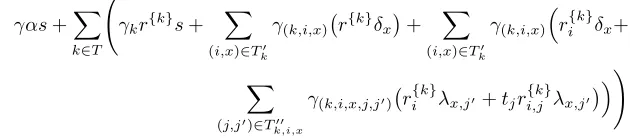
could create a query polynomial of the following form:
γαs+X
k∈T
γkr{k}s+
X
(i,x)∈T0
k
γ(k,i,x) r{k}δx
+ X
(i,x)∈T0
k
γ(k,i,x)
ri{k}δx+
X
(j,j0)∈T00
k,i,x
γ(k,i,x,j,j0) r{
k}
i λx,j0+tjr{i,jk}λx,j0
!
The following case analysis concludes the proof:
Case 1: There exists somek∈T :∃(i, x)∈Tk0 such that the set of sharesLk,i,x =
{λx,j0 : ∃j : (j, j0)∈T00
k,i,x}do not allow for the reconstruction ofδx. In this case, the termr{ik}δxwill not be canceled and the adversary’s query polynomial cannot be of the formγαs.
Case 2: For allk ∈ T and∀(i, x) ∈ T0
k the set of shares Lk,i,x = {λx,j0 : ∃j :
(j, j0)∈Tk,i,x00 }allow for the reconstruction ofδx. Then the only terms left in the adversary’s query polynomial other thanγαsare of the formtjr
{k}
i,j λx,j0 and
the adversary needs to add other terms to cancel them from the query. As seen in Table 1, the only term the adversary has access to that he can use to cancel terms of the formtjr{
k}
i,j λx,j0 is the termri,j{k}tj0λx,j0 but only whenj =j0. We will
now show that there is at least one term of the formtjr {k}
i,j λx,j0in the adversary’s
query polynomial such thatj6=j0to complete the proof.
Fix anyk∈T. ConsiderAkthe set of attributes corresponding tok0thadversary key. By the assumption that no key should pass the challenge access structure, and the properties of the secret sharing scheme we know that there exists aδx:
∃i: (i, x)∈Tk0 such that the set of sharesL0k,i,x={λx,j :j∈Aki :Aki ∈Ak} cannot reconstructδxfor any i : Aki ∈ Ak. Thus there must exist at least one
λx,j0 ∈Lk,i,xthat is linearly independent ofL0
k,i,xwhen written in terms ofδx andµv0s. Thus for at least for oneλx,j0 ∈ Lk,i,xthere will be a term of the
formtjr {k}
i,j λx,j0 : j 6= j0 left behind in the query for the adversary does not
have access to a term that can cancel it as evident from Table 1. Therefore no adversary query polynomial can be of the formγαs.
6
Evaluation
In this section we discuss the efficiency of CP-ASBE scheme instantiated with two-levels, describe its implementation and evaluate its performance overhead relative to BSW CP-ABE.
two exponentiations for every attribute in the key issued to the user and two exponen-tiations for every set (including recursive sets for a scheme with levels>2) in the key. In terms of key size, the private key contains two group elements per attribute and one group element per attribute set. Compared to BSW the additional key generation cost is two exponentiations for every attribute set in terms of computation and one group element per attribute set in terms of size. Encryption involves two exponentiations per leaf node in the tree and one exponentiation per translating node in the tree. The cipher-text contains two group elements per leaf node and one group element per translating node. Compared to BSW the additional cost is one exponentiation per translating node in terms of computation and one group element per translating node in terms of size. The cost of decrypting a given ciphertext however varies depending on the key used for decryption. Even for a given key there might be multiple ways to satisfy the associated access tree. The decrypt algorithm needs, 1) two pairings for every leaf node used to satisfy the tree, 2) one pairing for every translating node on the path from the leaf node used to the root and 3) one exponentiation for every node on the path from the leaf node to the root. However, by employing the optimization technique of flattening the recur-sive calls toDecryptNode, as described in BSW [2] albeit modified to accommodate translating nodes, we can reduce the cost to 1) two pairings and one exponentiation per leaf node used and 2) one pairing and one exponentiation per translating node on the path from a used leaf node to the root. Compared to BSW the additional cost is one pairing and one exponentiation per translating node on the path from a used leaf node to the root. In a multi-level (level>2) instantiation the overhead will be per transla-tion rather than per translating node as multiple translatransla-tions may be needed at a given translating node for such instantiations.
Implementation. We have implemented a two-level CP-ASBE scheme as described in Section 5. The only difference is that the implemented decryption function is optimized to improve the efficiency and performance.
Our implementation leverages thecpabetoolkit (http://acsc.csl.sri.com/ cpabe/) developed for BSW which uses the Pairing-Based Cryptography library (http://crypto.stanford.edu/pbc/). The interface for thecpasbetoolkit is similar to that ofcpabetoolkit and is as follows:
cpasbe-setup Generates a public key and a master key.
cpasbe-keygen Given a master key, generates a private key for a given set of attributes; compiles numerical attributes into ’bag of bits’ representation and treats the re-sulting attributes as a ’set’.
cpasbe-enc Given a public key, encrypts a file under a given access policy; numerical comparisons in the policy are represented by access sub-trees comprising ’bag of bits’ representation of the numerical attribute with the root node of the sub-tree treated as a translating node.
cpasbe-dec Decrypts a file, given a private key.
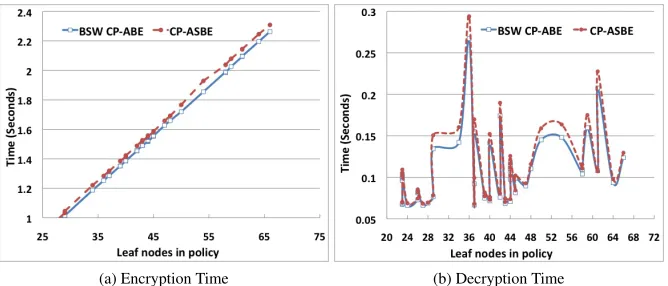
(a) Encryption Time (b) Decryption Time
Figure 1: Encryption and Decryption Times
cpabetoolkit, numerical attributes incpasbeare treated as sets and thuscpasbetoolkit supports multiple numerical value assignments to a given attribute in a single private key. Thus a user with a private key generated using the following command cannot claim any score other than33and30.
$cpasbe-keygen-o tom-priv-key pub-key master-key ’score=33’ ’score=30’ tom
Performance Overhead. A two-level CP-ASBE scheme provides better functionality over CP-ABE schemes in terms of, 1) better supporting compound attributes and 2) supporting multiple numerical value assignments for a given attribute in a single key. In order to gauge the cost of this additional functionality we compared the encryption, decryption and key generation times using randomly generated policies and associated keys with those of BSW CP-ABE scheme. The policies used to encrypt data were randomly generated formulae in the disjunctive normal form with the number of leaf nodes ranging from23to66. For each policy, a representative set of keys that satisfy the policy are generated and used for decryption. Specifically, 1) a key is generated for each conjunctive clause in the policy such that it satisfies the clause and 2) a key is generated for each combination of conjunctive clauses in the policy such that the key satisfies all the clauses in the combination. The generated keys had boolean attributes, ranging from1to422,i.e., including the “bag of bits” representation for numbers with 64 bits used to represent each integer. Decryption time for a policy is the average of decryption times with all the keys generated for that policy as described above. Experiments were run on a Linux box with quad core3.0Ghz Intel Xeon and 2GB of RAM. Both implementations used a 160-bit elliptic curve group constructed on the curvey2=x3+xover a 512-bit field.
While key generation time are not shown due to space constraints, as expected, they were found to be linear in the number of attributes in the key, and CP-ASBE imposed very little overhead over BSW CP-ABE. On an average, CP-ASBE imposed18ms
compared to BSW CP-ABE. On an average, CP-ASBE imposed8.3msoverhead per translating node in the policy. Since decryption time is dependent on both the structure of the policy tree and the key used for decryption, it varied significantly even for a given policy size. However, in this case too CP-ASBE scheme imposed very little to no overhead over BSW CP-ABE,6.7mson average. Overhead results are consistent with our efficiency analysis and performance numbers in general are consistent with those reported in [2].
7
Conclusion and Future Work
In this work we proposed CP-ASBE a form of CP-ABE that organizes user attributes into a recursive family of sets and allows users to impose dynamic constraints on how attributes may be combined. We demonstrated how CP-ASBE can naturally support compound attributes, and numerical attributes with multiple value assignments. We showed that it achieves this versatility with very little overhead through efficiency analysis and performance evaluation of a prototype implementation. An interesting direction for future research is to study the potential of CP-ASBE schemes and ABE schemes in general in supporting constructs similar to “OR roles” [9] and constraints like “dynamic mutually exclusive roles” that are common in traditional mediated RBAC settings. Other directions for future work are the design of efficient CP-ASBE schemes that are secure in the standard model and extending CP-ASBE to a multi-authority setting.
References
[1] M. Bellare and P. Rogaway. Random oracles are practical: A paradigm for design-ing efficient protocols. InACM Conference on Computer and Communications Security, pages 62–73, 1993.
[2] J. Bethencourt, A. Sahai, and B. Waters. Ciphertext-policy attribute-based en-cryption. InIEEE Symposium on Security and Privacy, 2007.
[3] D. Boneh, X. Boyen, and E.-J. Goh. Hierarchical identity based encryption with constant size ciphertext. In R. Cramer, editor, EUROCRYPT, volume 3494 of Lecture Notes in Computer Science, pages 440–456. Springer, 2005.
[4] D. Boneh and M. Franklin. Identity-Based Encryption from the Weil Pairing. Advances in Cryptology-Crypto 2001: 21st Annual International Cryptology Conference, Santa Barbara, California, USA, August 19-23, 2001, Proceedings, 2001.
[6] L. Cheung and C. Newport. Provably secure ciphertext policy abe. InCCS ’07: Proceedings of the 14th ACM conference on Computer and communications se-curity, pages 456–465, New York, NY, USA, 2007. ACM.
[7] C. Cocks. An identity based encryption scheme based on quadratic residues. In B. Honary, editor, IMA Int. Conf., volume 2260 ofLecture Notes in Computer Science, pages 360–363. Springer, 2001.
[8] E. Fujisaki and T. Okamoto. Secure Integration of Asymmetric and Symmetric Encryption Schemes. In M. J. Wiener, editor,CRYPTO, volume 1666 ofLecture Notes in Computer Science, pages 537–554. Springer, 1999.
[9] L. Giuri. A New Model for Role-Based Access Control. InAnnual Computer Security Application Conference, pages 249–255, December 1995.
[10] V. Goyal, A. Jain, O. Pandey, and A. Sahai. Bounded Ciphertext Policy Attribute Based Encryption. In L. Aceto, I. Damg˚ard, L. A. Goldberg, M. M. Halld´orsson, A. Ing´olfsd´ottir, and I. Walukiewicz, editors,ICALP (2), volume 5126 ofLecture Notes in Computer Science, pages 579–591. Springer, 2008.
[11] V. Goyal, O. Pandey, A. Sahai, and B. Waters. Attribute-based encryption for fine-grained access control of encrypted data. InACM Conference on Computer and Communications Security, pages 89–98, 2006.
[12] J. Katz, A. Sahai, and B. Waters. Predicate Encryption Supporting Disjunctions, Polynomial Equations, and Inner Products. In N. P. Smart, editor,EUROCRYPT, volume 4965 ofLecture Notes in Computer Science, pages 146–162. Springer, 2008.
[13] T. Nishide, K. Yoneyama, and K. Ohta. Attribute-based encryption with partially hidden encryptor-specified access structures. In S. M. Bellovin, R. Gennaro, A. D. Keromytis, and M. Yung, editors,ACNS, volume 5037 ofLecture Notes in Com-puter Science, pages 111–129, 2008.
[14] R. Ostrovsky, A. Sahai, and B. Waters. Attribute-based encryption with non-monotonic access structures. InACM Conference on Computer and Communica-tions Security, 2007.
[15] M. Pirretti, P. Traynor, P. McDaniel, and B. Waters. Secure attribute-based sys-tems. InACM Conference on Computer and Communications Security, pages 99–112, 2006.
[16] A. Sahai and B. Waters. Fuzzy identity-based encryption. In R. Cramer, editor, EUROCRYPT, volume 3494 ofLecture Notes in Computer Science, pages 457– 473. Springer, 2005.
[18] V. Shoup. Lower bounds for discrete logarithms and related problems. In EURO-CRYPT, Lecture Notes in Computer Science, pages 256–266, 1997.
[19] P. Traynor, K. Butler, W. Enck, and P. McDaniel. Realizing massive-scale con-ditional access systems through attribute-based cryptosystems. InProceedings of The 15th Annual Network and Distributed System Security Symposium (NDSS), February 2008.
[20] P. Yang, T. Kitagawa, G. Hanaoka, R. Zhang, K. Matsuura, and H. Imai. Applying Fujisaki-Okamoto to Identity-Based Encryption. In M. P. C. Fossorier, H. Imai, S. Lin, and A. Poli, editors,AAECC, volume 3857 ofLecture Notes in Computer Science, pages 183–192. Springer, 2006.