Randomizing the Montgomery Powering Ladder
Duc-Phong Le1, Chik How Tan1, and Michael Tunstall2
1
Temasek Laboratories, National University of Singapore, 5A Engineering Drive 1, #09-02, Singapore 117411
{tslld,tsltch}@nus.edu.sg
2
Rambus Cryptography Research Division, 425 Market Street, 11th Floor, San Francisco,
CA 94105, United States
Abstract. In this paper, we present novel randomized techniques to enhance Montgomery powering ladder. The proposed techniques increase the resistance against side-channel attacks and especially recently published corre-lation collision attacks in the horizontal setting. The first of these operates by randomly changing state such that the difference between registers varies, unpredictably, between two states. The second algorithm takes a random walk, albeit tightly bounded, along the possible addition chains required to compute an exponentiation. We also generalize the Montgomery powering ladder and present randomized (both left-to-right and right-to-left)m-ary exponentiation algorithms.
Keywords: Montgomery Powering Ladder, Side-Channel Analysis, Countermeasures.
1 Introduction
Side-channel analysis is one of the most serious threats to the security of a given implementation of a cryptographic algorithm. In the traditional model, a given cryptographic algorithm is typically proven secure against various attacks under assumptions regarding the computational complexity of an attack. However, in a more practical scenario, Kocher noted that the time required to compute a cryptographic algorithm could reveal information on the keys used [1]. This was then extended to analyze differences in the power consumption of a microprocessor [2] and the variations in the surrounding electromagnetic field [3, 4]. The simplest such attack is based on the inspection of an acquired power consumption (resp. electromagnetic emanation) trace to derive information. This is referred to as Simple Power Analysis (SPA) (resp. Simple ElectroMagnetic Analysis (SEMA)). The exploitation of statistical differences in the instantaneous power consumption proposed by Kocher et al. [2] is termed Differential Power Analysis (DPA) (resp. Differential ElectroMagnetic Analysis (DEMA)), and alternatives have been proposed using, for example, a model and Pearson’s correlation coefficient [5] or mutual information [6].
curves. Witteman et al. [14] demonstrated that this attack works on an ASIC implementation. Kim et al. [15] also determined how one could apply such an attack to the Montgomery ladder [16, 17]. The attack model was extended by Hanley et al. [18] to include an attacker that computes the correlation between carefully chosen points in a trace to detect where the output of one operation is used as the input to another operation. In this paper, we present randomized variants of the Montgomery powering ladder that are resistant to SPA and power collision correlation attacks in the horizontal setting. The first algorithm is based on an amalgamation of two simple variants of the Montgomery powering ladder, where the content of the registers becomes unpredicable. The second algorithm is based on blinding addition chains, i.e. it takes tightly bounded random walks to compute an exponentiation. We also generalize the Montgomery powering ladder and present randomizedm-ary exponentiation algorithms. This algorithm is not entirely resistant, but presents a significant increase in attack complexity compared to a na¨ıve implementation of the Montgomery powering ladder, and therefore an adversary requires a significantly lower error rate to succeed. Furthermore, this variant will prevent lattice-based attacks [19] when used, for example, in implementations of ECDSA, as an adversary cannot derive information on individual bits.
The organization of the paper is as follows. Section 2 presents a strong attack model such that we can present a pessimistic security analysis of our algorithms. We also recall the Montgomery powering ladder and define the properties of variants of this algorithm in this section. In Section 3, we first describe a few simple variants, and then show how these can be combined to produce a secure algorithm. We introduce a randomized Montgomery powering ladder, that randomly changes state such that the difference between registers varies, unpredictably, between two states. In Section 4, we show how the Montgomery powering ladder can be modified to conduct a random walk through the addition chains that can be used to compute an exponentiation. Section 5 generalize the Montgomery powering ladder and present randomized m-ary exponentiation algorithms. We conclude in Section 6.
2 Preliminaries
2.1 Attack Model
In this paper we shall predominantly be considering an adversary that is able to take power consumption traces (or something equivalent) while a microprocessor is computing a group exponentiation algorithm. The adversary is then able to make deductions on what the microprocessor is computing. We shall consider three different attacks that require a limited number of traces when discussing the effects of our modifications to the Montgomery powering ladder.
1. The first attack is Simple Power Analysis (SPA) where one observes differences in the power consump-tion caused by different operaconsump-tions taking place. This was first demonstrated by Kocheret al.[2] who showed that one could, given a na¨ıve implementation, observe the difference between operations during the computation of an exponentiation in(Z/NZ)∗. Regular algorithms [9, 17, 20] can be used to thwart SPA attacks.
2. Another attack is the use of Pearson’s correlation coefficient to detect collisions in variables to de-duce key values [11]. For example, during the computation of an exponentiation in (Z/NZ)∗ using Coron’s square-and-multiply-alwaysexponentiation algorithm, one could seek to determine the loca-tions of multiplicaloca-tions with the same input. That is, operaloca-tions that both take the same input should show a significant cross-correlation.
where a complete defense is not possible. However, limiting the information available to an adversary can make the attack impractical since it has been shown that the error rate for this attack is significantly higher than a straightforward comparison of operations [18].
We do not consider attacks that require chosen inputs, such as the doubling attack [7] or statistical differences in the power consumption over time [2, 5]. This is because these attacks are typically prevented by padding or blinding the input by using a redundant representation where the details depend on the group being used [9, 21]. For example, in many instances the input will also be padded such that an attacker cannot control, or predict, the input to a group exponentiation algorithm.
Typically, a blinded exponent is used, which is equivalent to the actual exponent, meaning that each trace must be attacked independently. The discussion of the security of the proposed algorithms will be largely informal, except where we wish to make specific claims about the amount of information available to an adversary.
2.2 The Montgomery Powering Ladder
The Montgomery powering ladder was originally proposed as a means of speeding up scalar multiplica-tion over elliptic curves [16], and was later shown to be applicable to all multiplicatively written abelian groups [17]. The Montgomery powering ladder is an instance of an addition chain-based exponentiation algorithm that is often cited as an alternative to the binary exponentiation algorithm for resource constrained device such as smart cards. We recall the definition of an addition chain and define some notation.
Definition 1. An addition chain of length`in groupGfor a group elementx ∈ Gis a sequence of group elements(a0, a1, a2, . . . , a`)such thata0 = 1G,a1 =xandak =ai·aj,0 ≤i≤j < k≤`and·is the group operation. The values ofiandjare chosen such thatakis a chosen power ofa1.
For ease of expression we will denote then-th power of x asxn. Similarly, much of the discussion will implicitly assume that the computation is taking place inZwithout loss of generality.
We recall the description of the Montgomery powering ladder given by Joye and Yen [17]. We consider the problem of computingy=xkinGfor inputsxandk. LetPni=0−1ki2ibe the binary expansion ofκwith
bit lengthn. For ease of expression we shall also denote this as(kn−1, . . . , k0)2. The Montgomery powering
ladder relies on the following observation. DefiningLj =Pni=−j1ki2i−jandHj =Lj + 1, we have
Lj = 2Lj+1+kj =Lj+1+Hj+1+kj −1 = 2Hj+1+kj−2 (1) and so we obtain
(Lj, Hj) =
(
(2Lj+1, Lj+1+Hj+1) ifkj = 0,
(Lj+1+Hj+1,2Hj+1) ifkj = 1.
(2)
If we consider one register containingxLj and another containingxHj then (2) implies that
(xLj, xHj) =
xLj+12, xLj+1·xHj+1
ifkj = 0,
xLj+1·xHj+1, xHj+12
ifkj = 1.
Given thatL0 =κone can build an exponentiation algorithm that requires two group operations per bit of
Algorithm 1:Montgomery Powering Ladder Input:x∈G, ann-bit integerκ= (kn−1, kn−2, . . . , k0)2
Output:xκ
1 R0←1G;R1←x;
2 fori=n−1down to0do 3 R¬ki ←Rki·R¬ki;
4 Rki←(Rki)
2 ;
5 end
6 returnR0
The Montgomery powering ladder, as described in Algorithm 1, has several properties that make it useful when defining a side-channel resistant implementation of an exponentiation. However, the Montgomery Powering ladder also has been shown to be vulnerable to recent collision correlation attacks in the horizontal setting [12, 18]. The attack in [18] functions by detecting where the outputs of lines 3 and 4 are used in the next iteration of the main loop. In the reminder of this paper we propose alternative versions of the Montgomery powering ladder to enhance its security against horizontal collision correlation attacks.
Definition 2. We define a variant of the Montgomery powering ladder as an exponentiation algorithm that has the following properties.
1. The algorithm uses two registers in the main loop containing group elements, both of which are updated in each iteration.
2. Each iteration of the main loop treats one bit of the exponent and contains no more than two group operations.
3. The operands in the first group operation will only involve one or both of the registers used in the main loop.
4. The operands in the second group operation can involve one or both of the registers used in the main loop and/or some precomputed value.
The 3rd and4th properties allow for variants of the Montgomery ladder to be defined. That is, the Mont-gomery ladder is in the set of possible algorithms that satisfy these criteria.
For brevity in defining algorithms, we shall concentrate on the main loop of the algorithm. The com-putation before and after the main loop may containif-statements. We shall not give fully secure versions where solutions are widely known, e.g. dummy operations or redundant representations [9, 21, 22].
3 Randomizing the Montgomery Powering Ladder
We note that when computingxnusing the Montgomery powering ladder, as defined in Algorithm 1, then at the end of each iteration we will have the condition whereR1/R0 =x, or equivalentlyR0·x=R1. Thus,
using the notation given above, and we allow some precomputed values to be used in the algorithm, then (2) can be rewritten as
(Lj, Hj) =
(
(2Lj+1, Lj+ 1) ifkj = 0,
(Lj+1+Hj+1, Lj+ 1) ifkj = 1.
(3)
Implying that
(xLj, xHj) =
(
xLj+12, xLj·x
ifkj = 0,
xLj+1·xHj+1, xLj·x ifk
From which we can define Algorithm 2.
Algorithm 2:A Straightforward Variant I Input:x∈G, ann-bit integer
κ= (kn−1, kn−2, . . . , k0)2
Output:xκ
1 R0←1G;R1←x;
2 fori=n−1down to0do
3 R0←R0·Rki;
4 R1←R0·x;
5 end
6 returnR0
Algorithm 3:A Straightforward Variant II Input:x∈G, ann-bit integer
κ= (kn−1, kn−2, . . . , k0)2, andkn−1 = 1
Output:xκ
1 R0←1G;R1←1G;
2 fori=n−1down to0do 3 R1←R0·R¬ki;
4 R0←R1·x;
5 end
6 returnR0
Following the reasoning used to define (1), we can instead defineLj =Pni=−j1ki2i−j andHj =Lj−1, giving
Lj = 2Lj+1+kj =Lj+1+Hj+1+kj + 1 = 2Hj+1+kj+ 2 (4) and so, as with (3), we obtain
(Lj, Hj) =
(
(Hj+ 1, Lj+1+Hj+1) ifkj = 0,
(Hj+ 1,2Lj+1) ifkj = 1.
(5)
If we consider one register containingxLj and another containingxHj then (5) implies that
(xLj, xHj) =
(
xHj·x, xLj+1·xHj+1 ifk
j = 0,
xHj·x, xLj+12
ifkj = 1.
From which we can define Algorithm 3. We note that at the end of each iteration we will have the condition whereR0/R1 =x, or equivalentlyR1·x=R0.
Suppose that an adversary can distinguish multiplications from squaring operations, then the two above variants of Montgomery powering ladder are not immune to SPA. In line 3 of both algorithms, a squaring operation will occur for certain bit values. That is, a squaring operation will be computed if the bit valueki=
0in Algorithm 2 and in Algorithm 3 a squaring operation occurs whenki = 1. The following randomized algorithm will deal with this problem.
We observe that Algorithms 2–3 can be blended together. That is, in loop`, for some`∈ {1, . . . , n−1}, of Algorithm 2 ifk` = 1one could compute R1 ← (R0)2 followed byR0 ← R1·x. Before this step
R1/R0 =x, and afterwards one bit of the exponent is treated andR0/R1 =x. Hence, one could continue
to compute an exponentiation using Algorithm 3.
Likewise, in loop `, for some ` ∈ {1, . . . , n −1}, of Algorithm 3, if k` = 0, one could compute
R0 ← (R0)2 followed byR1 ← R0·x. Afterwards one bit of the exponent is treated andR1/R0 = x.
Hence, one could continue to compute an exponentiation using Algorithm 2. We define Algorithm 4 as an example of how Algorithms 2 and 3 could be randomly blended together. We use a random generator producing a random bitbto determine when to change from one algorithm to the other, and to determine which algorithm is used to start the exponentiation algorithm. Ifb = 0, the exponentiation is computed by using Algorithm 2, that isR1/R0 = x. Otherwise, the exponentiation is computed by using Algorithm 3,
Algorithm 4:Randomized Montgomery Pow-ering Ladder
Input:x∈G, ann-bit integer
κ= (kn−1, kn−2, . . . , k0)2, andkn−1 = 1
Output:xκ
1 b←R− {0,1};R0←1G;
2 ifb= 0then
3 R1←x;
4 else
5 R1←1G;
6 end
7 fori=n−1down to0do
8 ifb⊕ki= 1then
9 b←R− {0,1};
10 end
11 Rb←R0·Rb⊕ki;
12 R¬b←Rb·x;
13 end
14 returnR0
Algorithm 5:A Straightforward Variant III Input:x∈G, ann-bit integer
κ= (kn−1, kn−2, . . . , k0)2
Output:xκ
1 R0←1G;R1←1G;
2 fori=n−1down to0do
3 Rki←(R0)
2 ;
4 R¬ki ←Rki·x;
5 end
6 returnR0
When b⊕ki = 1(i.e., b 6= ki) in Algorithm 4, there will be two multiplications involved the bit ki if one continues to compute an exponentiation using the current algorithm (i.e., Algorithm 2 or Algorithm 3). Algorithm 4 will generate a random bitbto decide whether two Algorithms 2–3 are blended together or not. In the case of blending, two multiplications will be replaced by one squaring, and then one multiplication.
Suppose that an adversary is able to distinguish a multiplication from a squaring operation. Then, she would be able to determine individual bits of the exponent if she could determine ifR0/R1 =xorR1/R0=
x. However, the following lemma shows that this information is not available.
Lemma 1. An adversary analyzing an instance of Algorithm 4 is able to reduce the hypotheses for the exponent fromκtoκ1112 by distinguishing a multiplication from a squaring operation.
Proof. If an adversary observes a squaring operation followed by a multiplication in the loop using indexi, then the adversary knows one of the following operations has occurred:
1. WhereR1/R0 =xandki= 0. 2. WhereR0/R1 =xandki= 1.
3. WhereR1/R0 =xchanges toR0/R1 =xandki = 1. 4. WhereR0/R1 =xchanges toR1/R0 =xandki = 0.
At an arbitrary point, each of these occur with probability 14. Likewise, if an adversary observes two multi-plications in the loop using indexi, hence the adversary knows one of the following operations has occurred:
1. WhereR1/R0 =xandki= 1. 2. WhereR0/R1 =xandki= 0.
Each of these occur with probability 12. Hence, there is no information available to an adversary since for any observed sequence of operationsPr(ki= 0) = Pr(ki= 1) = 12.
since the following bit has to be the same and the randomly generated bit has to be a specific value. The, by definition, the expected length of a run of multiplication is 43 operations, where each observation would therefore provide an expected 43 −1 = 13 of a bit of the exponent. A pair of multiplications will occur with probability 14, giving an expected n/4bits for ann-bit exponent. For ann-bit exponent an expected
1 3 ×
n
4 =
n
12 bits can expected to be derived. Hence,κ hypotheses can be expected to be reduced toκ 11 12
hypotheses. ut
As with the Montgomery powering ladder shown in Algorithm 1, an attack using collisions based on the reuse of variables is not possible, but a collision attack based in the use of the output of operations is possible. One can attempt to observe whether the second operand in line 11 of Algorithm 4 is created from line 11 or line 12 in the previous iteration of the exponentiation loop. However, an analysis based on this will return the wrong key hypothesis when the algorithm changes from using (3) to (5).
Lemma 2. An adversary analyzing an instance of Algorithm 4 using a collision attack an adversary would be able to reduce the hypotheses for the exponent fromκtoκ34.
Proof. If we, arbitrarily, consider the`-th loop of the exponentiation loop, we havePr(b⊕ki = 1) = 12 and the probability thatbchanges, and hence the algorithm being used, is also 12. An adversary making a deductions using a collision attack will have to guess the value ofbin two consecutive loops of the algorithm. Given a correct guess forbit will remain the same with probability 34. On the assumption that an attack will validate bin the first loop the value ofbin the second loop will remain the same with probability 34. If it changes an incorrect result will be given. Hence, the probability that a collision would detect an incorrect key bit is 14, and an adversary would be able to determine a given bit with a probability 34 leading to a
reduction in the number of hypotheses fromκtoκ34. ut
Given that an adversary could potentially obtain bits of an exponent if they analyze Algorithm 4, and are able to distinguish a multiplication from a squaring operation, it would be tempting to ensure that no pairs of multiplications occur. That is, make the algorithm change rather than compute two multiplications resulting in Algorithm 5. This is equivalent to thesquare-and-multiply-alwaysexponentiation algorithm proposed by Coron [9]. This is a widely studied algorithm with numerous analyses in the literature, which will not be repeated here.
4 Random Walk Method
In this section, we generalize the difference between the two registers used in the Montgomery powering lad-der to be some arbitrary power of the input. This leads to an algorithm that computes a group exponentiation taking a random, albeit tightly bounded, walk through the possible addition chains.
If one is working in a group where computing the inverses of an element can be readily computed, then other options for a variant of the Montgomery powering ladder are possible. We note that (2) can be rewritten as
(Lj, Hj) =
(
(Hj−1, Lj+1+Hj+1) ifkj = 0,
(Lj+1+Hj+1, Lj+ 1) ifkj = 1.
(6)
Implying that
(xLj, xHj) =
(
xHj·x−1, xLj+1·xHj+1 ifk
j = 0,
xLj+1·xHj+1, xLj ·x ifk
(6) can be rewritten as follows:
(Lj, Hj) =
(
(Lj+1+Hj+1, Lj−1) ifkj = 0,
(Lj+1+Hj+1, Lj+ 1) ifkj = 1.
(7)
Implying that
(xLj, xHj) =
(
xLj+1·xHj+1, xLj·x−1 ifk
j = 0,
xLj+1·xHj+1, xLj·x ifk
j = 1.
From which we can define Algorithm 6. In previous examples of Montgomery powering ladders presented in this paperR0has acted as an accumulator and returned the result. In Algorithm 6 the accumulator, i.e. the
register containing the correct power ofxat the end of each loop, shifts depending on the value of the bit of the exponent being treated. Hence,R¬k0 is returned at the end of the algorithm.
Algorithm 6:Variant with Inverses
Input:x∈G, ann-bit integerκ= (kn−1, kn−2, . . . , k0)2 Output:xκ
1 R0←1G;R1←x;
2 U0←x−1 ;U1 ←x;
3 fori=n−1down to0do 4 R0 ←R0·R1;
5 R1 ←R0·Uki; 6 end
7 returnR¬k0
In analyzing an instance of Algorithm 6, an adversary would not be able to determine any information on bits of the exponent based on distinguishing a multiplication from a squaring operation, since no squaring operations take place. However, a collision attack is possible by observing where the multiplication withUi, fori ∈ {0,1}, collides with the multiplications used to generate these values in line 2. If an adversary is able to determine whetherUki =x
−1 orU
ki =xwas used, for somei∈ {0, . . . , n−1}, then individual
bits of the exponent can be determined.
We can modify (7) by choosingL0j+1=Lj+1+αandHj0+1 =Hj+1+β, giving
(L0j, Hj0) =
(
(L0j+1+Hj0+1, L0j−1) ifkj = 0,
(L0j+1+Hj0+1, L0j+ 1) ifkj = 1.
(8)
whereL0j =Lj+γ,Hj0 =Hj+µ, andγ =α+β. If we chooseγas a random element from{−h, . . . h} for some small integerh, thenαandβcan be chosen such thatγ =α+β. If we assume thatαis fixed then
β =γ−α, i.e.,Hj0+1=Hj+1+γ−α. Given thatHj0+1is computed fromL0j+1this can be done by
Hj0+1 =
(
Lj+1+ (γ−α−1) =L0j+1+ (γ−2α−1) ifkj = 0,
Lj+1+ (γ−α+ 1) =L0j+1+ (γ−2α+ 1) ifkj = 1.
This also removes the need to have the accumulating register change as described for Algorithm 6. If we define a valueL0j =Lj+γj then (8) can be rewritten as(Lj+γj, Hj+ (γj−1−γj) =
(
Lj+1+γj+1+Hj+1+ (γj−γj+1), L0j+ (γj−1−2γj−1)
ifkj= 0,
Lj+1+γj+1+Hj+1+ (γj−γj+1), L0j+ (γj−1−2γj+ 1) ifkj= 1.
If we consider one register containingxL0j and another containingxH
0
j then (9) implies that
(xL0j, xH
0
j) =
xL0j+1·xH
0
j+1, xL
0
j·x∆
where
∆=
(
γj−1−2γj−1 ifkj = 0,
γj−1−2γj+ 1 ifkj = 1.
Given thatL0=κone can build an exponentiation algorithm as shown in Algorithm 7 where we setγ0 = 0
to produce the correct result. Assume that γ can be arbitrarily chosen from the set{−h, . . . , h} in each iteration of computation, then∆∈ {−3h−1, . . . ,3h+ 1}. Hence, our algorithm makes use of an array of
6h+ 3elements that stores the required values ofx∆.
Algorithm 7:Blinded Montgomery Powering Ladder
Input:x∈G, ann-bit integerκ= (kn−1, . . . , k0)2, small integerh∈Z
Output:xκ
Uses:Ua6h+ 3element array.
1 U3h+1←1G;
2 fori= 1to3h+ 1do
3 U3h+1+i←U3h+i·x;
4 U3h+1−i←U3h+2−i·x−1;
5 end
6 R0←1G;R1←1G;α= 0;
7 fori=n−1down to1do
8 R0←R0·R1;
9 γ←R− {−h, . . . , h}; 10 `←γ−2α+ki− ¬ki;
11 R1←R0·U3h+1+`;
12 α←γ;
13 end
14 R0←R0·R1;
15 R0←R0·U3h+1−α−¬k0;
16 returnR0
An adversary who is able to distinguish a multiplication from a squaring operation would not be able to determine any information on bits of the exponent used since no squaring operations take place. However, a cross correlation attack is possible by observing where the multiplication withUd, ford∈ {0, . . . ,6h+ 2}, collides with the multiplications used to generate these values in line 11. From these values, an adversary can derive the addition chain that was used to compute the exponentiation. This will not give an adversary the exponent, since there is no means to map the digits used to bits of the exponent, but would give an adversary an equivalent addition chain.
In determining whether an attack is practical Hanley et al. [18] determine that when analyzing an im-plementation 192-bit exponentiation, the error rate need to be less than 22 bits. This is determined to be less than254 operations, based on the boundary set for block ciphers by Biryukov et al. [23]. That is, a
key operations are typically more time consuming to compute, one can increase the speed of exhaustive searches by using the multiplicative group structure [24], hence justifying the use of the same threshold. The expected number of operations can be determined using Stinson’s algorithm [25], where ant-bit error in an-bit hypothesis leads to the exponent in time complexityOnPdt/2e
i=0
n/2
i
[25]. Once a hypothesis for the exponent used in an implementation of the Montgomery ladder is deduced one cannot directly apply Stinson’s algorithm. This is because each time one wishes to flip a bit all the bits that are less significant also need to be flipped. However, adapting the algorithm is straightforward and the expected time complexity of an attack will be the same. If an attacker were to target Algorithm 7 then the error rate would need to be much lower to fall below time complexity254. In applying the baby-step giant-step algorithm to correct errors in hypotheses for digits used in Algorithm 7 one would divide the digits into two sets and attempt to find two divisions where the number of incorrect digits is the same. Given Lemma 3 (see Appendix A), we have the following corollary.
Corollary 1. We consider set ofµdigits representing the multiplications in an addition chain wheretdigits are incorrect. There will exist a set ofµ/2contiguous digits wherebt/2cdigits are incorrect.
Then one can apply a version of Stinson’s algorithm where one has to treat all the values that digits can take. Given a small integerh, as defined in Algorithm 7, at-digit error in anµ-bit hypothesis leads to the exponent in time complexityOµ µ/t/22
(2h+ 1)µ2
. That is, there areµpossible divisions of the digits, each of which
will have µ/t/22ways of selectingt/2digits and each digit can take(2h+ 1)values. In practice,twill not be known so the analysis will have time complexity OµPdt/2e
i=0
µ/2
i
(2h+ 1)i
further reducing the required error rate for a successful attack.
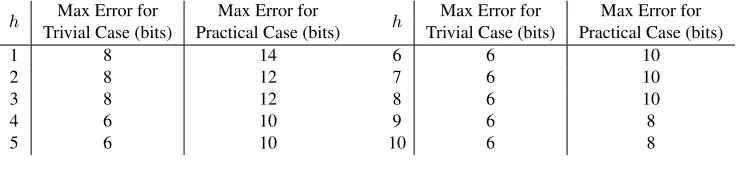
Hanley et al. [18] define a practical attack to have time complexity less than254 operations, based on the boundary set for block ciphers by Biryukov et al. [23], and a trivial attack to have time complexity less than240. For a 192-bit exponent, this means that for single bit errors we can definet≤21to be a practical attack andt ≤13to be a trivial attack. In Table 1 we show how these thresholds change ash is increased in Algorithm 7. Far fewer errors can be tolerated by an adversary before an attack becomes unfeasible even for very small values ofh, although there are diminishing returns ashincreases.
Table 1.Time complexity of Stinson’s algorithm for smallh.
h Max Error for Max Error for h Max Error for Max Error for
Trivial Case (bits) Practical Case (bits) Trivial Case (bits) Practical Case (bits)
1 8 14 6 6 10
2 8 12 7 6 10
3 8 12 8 6 10
4 6 10 9 6 8
5 6 10 10 6 8
al. [28] demonstrated that, in practice, the lattice attack required as few as four bits of the ephemeral expo-nent assuming that some hundreds of such signatures could be obtained. However, this information would not be available to an adversary.
A more memory-efficient version of Algorithm 7 is described in Algorithm 8. This is a security-memory trade off where the value ofγj is still chosen at random, but the value range depend on the previous value
γj+1. Although the available choices forγj decreases, Algorithm 8 requires only2h+ 2registers to store pre-computed values instead of6h+ 3registers in Algorithm 7.
Algorithm 8:Blinded Montgomery Powering Ladder II
Input:x∈G, ann-bit integerκ= (kn−1, kn−2, . . . , k0)2, small integerh∈Z,Ua look-up table of2h+ 2precomputed valuesx−h, . . . , xh+1.
Output:xκ
1 Uh←1G;
2 fori= 1tohdo 3 Uh+i←Uh+i−1·x;
4 Uh−i←Uh+1−i·x−1;
5 end
6 U2h+1←U2h·x; R0←1G;R1←1G; α←0;
7 fori=n−1down to1do
8 R0←R0·R1;
9 ifα≥0then
10 γ←R− {2α−h, . . . , h+ 1−ki};
11 end
12 else
13 γ←R− {−h−ki, . . . ,2α+h−1};
14 end
15 R1←R0·Uh+γ+ki;
16 α←2α−γ;
17 end
18 R0←R0·R1;
19 R0←R0·Uh+α+k0;
20 returnR0
5 Generalizing the Montgomery Powering Ladder
The square-and-multiply (left-to-right and right-to-left)) exponentiation algorithms are the most efficient implementations for raisingx to the powerκ when the exponent is treated bit-by-bit. Furthermore, these exponentiation algorithms extend easily to any radix m for the purpose of speeding the computation. In this section, by using the random walk technique, we generalize the (both left-to-right and right-to-left) exponentiation algorithms and present new blindedm-ary exponentiation algorithms.
5.1 Left-to-right algorithms
We first consider the left-to-right exponentiation. Letκ= (w`−1, w`−2, . . . , w0)2 be them-ary
representa-tion ofκ, where06=wi< m,w`−1 6= 0, and`is the length ofκin radixm. As in Section 2.2, by defining
Lj =m Lj+1+wj (10) From then, the exponentiation algorithm will performxLj = (xLj+1)m·xwj.Noting thatxL0 =xκ. Using
the random walk technique as in Section 4, we modify L0j = Lj +γj where γj can be chosen from a pre-defined set{−h, . . . , h}for some small integerh. Then(10)can be rewritten as
Lj +γj =m Lj+1+γj +wj =m L0j+1−m γj+1+γj+wj (11) This leads to a randomized algorithm (Algorithm 9) that computes a group exponentiation taking a random, albeit tightly bounded, walk through the possible addition chains. As with Algorithm 8, Algorithm 9 also requires a look-up table of2(m+ 1)h+m−1values to stores precomputated values. Algorithm 9 can be used in the cases where the computation of inversions is cheap, otherwise Algorithm 10 is more suitable.
Algorithm 9: Randomized Left-to-Right m -ary Exponentiation
Input:x∈G, an integerκ= (w`−1, w`−2, . . . , w0)m,
where0≤wi< mandw`−16= 0, small integer
h∈Z,Ta look-up table of2(m+ 1)h+m−1 precomputed values
x−(m+1)h−m+1, . . . , x(m+1)h+m−1.
Output:xκ
1 R←1G,α←0 2 fori=`−2to1do
3 R←Rm;
4 γ←R− {−h, . . . , h}; 5 R←R·xm α−γ+wi;
6 α←γ;
7 end
8 R←Rm;
9 R←R·xm α+w0; 10 returnR
Algorithm 10:Randomized Left-to-Right m -ary Exponentiation without Inversions
Input:x∈G, an integerκ= (wn−1, wn−2, . . . , w0)m,
wherewiism-bit words, small integerh∈Z,T a look-up table ofm(h+ 1)−1precomputed valuesx, . . . , xm(h+1)−1.
Output:xκ
1 R←1G,α←0 2 fori=`−2to1do
3 R←Rm;
4 γ←R− {0, . . . ,min(h, m α+wi)};
5 R←R·xm α−γ+wi;
6 α←γ;
7 end
8 R←Rm;
9 R←R·xm α+w0; 10 returnR
We note that Algorithm 10 works in a similar way to the Overlapping Windows method [29] for a fixed basem = 2k−hOW M andm(h+ 1) = 2k3. The main difference is that our algorithm generateson-the-fly
a randomized recoding of the binary representation of the secret exponentκ. This allows our algorithm to avoid side-channel attacks in the recoding phase.
5.2 Right-to-left algorithm
Likewise, we can devise a randomized right-to-left m-ary algorithm. Let κ = (w`−1, w`−2, . . . , w0)m, wherew`−1 6= 0, the principle of theright-to-leftm-ary exponentiation algorithm, as shown by Yao [30],
makes use of the is relied on the following equality:
xκ = Y
0≤i≤`−1
di=1
xmi· Y
0≤i≤`−1
di=2
x2·mi· · · Y
0≤i≤`−1
di=m−1
x(m−1)·mi =
m−1
Y
j=1
Y
0≤i≤`−1
di=j
xmi j
.
3
Theright-to-leftm-ary exponentiation algorithm uses(m−1)accumulators,R[1], . . . , R[m−1]. At each iteration, it applieswsuccessive squarings to computeA=xmjfromxm(j−1), then multiplies the result to some accumulatorsR[k]. LetR[k](j)(resp.A(j)) denote the value of the accumulatorR[k](resp.A) before entering stepj. We have:
R[k](j+1)=R[k](j)·A(j) fork=wj,
R[k](j+1)=R[k](j) fork6=wj,
andA(j+1) = (A(j))m. At the end of the loop each accumulatorR[k]contains the productQ
0≤j≤`−1
wj=k
xmj.
The different accumulators are finally aggregated asQ
0≤j≤`−1R[k]k =xκ. By definingLj =Pji=0wi·mi, we have
Lj+1=mj+1·wj+1+Lj (12)
Noting thatL`−1 =κ. Similar, we use the random walk technique and modifyL0j =Lj−mj+1·γj, then equation (12) can be rewritten as:
Lj+1−mj+2·γj+1=mj+1·wj+1+Lj −mj+2·γj+1
=m·wj+1+L0j +mj+1·γj−mj+2·γj+1 = (γj −m·γj+1+wj+1)mj+1+L0j
This leads to a randomizedright-to-leftm-ary exponentiation algorithm (Algorithm 11). In this algorithm, we make use of2(m+1)h+m−1accumulatorsR[j], where−(m+ 1)h−m+ 1≤j ≤(m+ 1)h+m−1. EachR[j]is initialized to1G, and then updated ifα−mγ+wi=j. The different accumulators are finally aggregated asQh
j=1 R[j]·(R[−j]) −1j
=xκ.
Algorithm 11:Randomized Right-to-Leftm-ary Exponentiation Input:x∈G, ann-bit integerκ= (w`−1, w`−2, . . . , w0)m, small integerh∈Z.
Output:xκ
1 for j= 0to(m+ 1)h+m−1do 2 R[j]←1G;R[−j]←1G;
3 end
4 A←x; α←0;
5 fori= 0to`−1do 6 γ←R− {−h, . . . , h};
7 R[α−mγ+ki]←R[α−mγ+ki]·A;
8 α←γ; A←A2;
9 end
6 Conclusion
In this paper we presented variants of the Montgomery powering ladder which have properties that increase the side-channel resistance of the exponentiation algorithm. The first of these operates by randomly changing states such that the difference between the two registers varies, unpredictably, between two states. The second variant of the Montgomery powering ladder that we presented takes a random walk, albeit tightly bounded, among the possible addition chains required to compute an exponentiation. While this variant is not resistant to all side-channel analysis, it will prevent lattice-based attacks when used, for example, in implementations of ECDSA. In other cases, significantly more computation is required to derive any exploitable information and, therefore, an adversary requires a lower error rate to succeed. By applying the random walk method, we also generalized the Montgomery powering ladder and present randomized (both left-to-right and right-to-left)m-ary exponentiation algorithms.
References
1. Kocher, P.: Timing attacks on implementations of Diffie-Hellman, RSA, DSS, and other systems. In Koblitz, N., ed.: CRYPTO ’96. Volume 1109 of LNCS., Springer (1996) 104–113
2. Kocher, P., Jaffe, J., Jun, B.: Differential power analysis. In Wiener, M.J., ed.: CRYPTO ’99. Volume 1666 of LNCS., Springer (1999) 388–397
3. Quisquater, J.J., Samyde, D.: Electromagnetic analysis (EMA): Measures and counter-measures for smart cards. In Attali, I., Jensen, T.P., eds.: E-smart 2001. Volume 2140 of LNCS., Springer (2001) 200–210
4. Gandolfi, K., Mourtel, C., Olivier, F.: Electromagnetic analysis: Concrete results. In Koc¸, C.K., Naccache, D., Paar, C., eds.: CHES 2001. Volume 2162 of LNCS., Springer (2001) 251–261
5. Brier, E., Clavier, C., Olivier, F.: Correlation power analysis with a leakage model. In Joye, M., Quisquater, J.J., eds.: CHES 2004. Volume 3156 of LNCS., Springer (2004) 16–29
6. Gierlichs, B., Batina, L., Tuyls, P., Preneel, B.: Mutual information analysis. In Oswald, E., Rohatgi, P., eds.: CHES 2008. Volume 5154 of LNCS., Springer (2008) 426–442
7. Fouque, P.A., Valette, F.: The doubling attack — Why upwards is better than downwards. In Walter, C.D., Koc¸, C¸ .K., Paar, C., eds.: CHES 2003. Volume 2779 of LNCS., Springer (2003) 269–280
8. Chari, S., Rao, J.R., Rohatgi, P.: Template attacks. In Jr., B.S.K., Koc¸, C.K., Paar, C., eds.: CHES 2002. Volume 2523 of LNCS., Springer (2002) 13–28
9. Coron, J.S.: Resistance against differential power analysis for elliptic curve cryptosystems. In Koc¸, C.K., Paar, C., eds.: CHES 1999. Volume 1717 of LNCS., Springer (1999) 292–302
10. Walter, C.D.: Sliding windows succumbs to big mac attack. In C¸ . K. Koc¸, Naccache, D., Paar, C., eds.: CHES 2001. Volume 2162 of LNCS., Springer (2001) 286–299
11. Clavier, C., Feix, B., Gagnerot, G., Giraud, C., Roussellet, M., Verneuil, V.: ROSETTA for single trace analysis. In Galbraith, S., Nandi, M., eds.: INDOCRYPT 2012. Volume 7668 of LNCS., Springer (2012) 140–155
12. Clavier, C., Feix, B., Gagnerot, G., Roussellet, M., Verneuil, V.: Horizontal correlation analysis on exponentiation. In: Pro-ceedings of the 12th international conference on Information and communications security. ICICS’10, Berlin, Heidelberg, Springer-Verlag (2010) 46–61
13. Bauer, A., Jaulmes, E., Prouff, E., Wild, J.: Horizontal collision correlation attack on elliptic curves. In Lange, T., Lauter, K., Lisonek, P., eds.: SAC 2013. Volume 8282 of LNCS., Springer (2013) 553–570
14. Witteman, M.F., van Woudenberg, J.G.J., Menarini, F.: Defeating RSA multiply-always and message blinding countermea-sures. In Kiayias, A., ed.: CT-RSA 2011. Volume 6558 of LNCS., Springer (2011) 77–88
15. Kim, H., Kim, T.H., Yoon, J.C., Hong, S.: Practical second-order correlation power analysis on the message blinding method and its novel countermeasure for RSA. ETRI Journal32(1) (2010) 102–111
16. Montgomery, P.: Speeding the Pollard and elliptic curve methods of factorization. Mathematics of Computation48(177) (1987) 243–264
17. Joye, M., Yen, S.M.: The Montgomery powering ladder. In Jr., B.S.K., C¸ . K. Koc¸, Paar, C., eds.: CHES 2002. Volume 2523 of LNCS., Springer (2003) 291–302
19. Howgrave-Graham, N.A., Smart, N.P.: Lattice attacks on digital signature schemes. Design, Codes and Cryptography23
(2001) 283–290
20. Joye, M.: Highly regular right-to-left algorithms for scalar multiplication. In Paillier, P., Verbauwhede, I., eds.: CHES 2007. Volume 4727 of LNCS., Springer (2007) 135–147
21. Win, E.D., Mister, S., Preneel, B., Wiener, M.: On the performance of signature schemes based on elliptic curves. In Buhler, J.P., ed.: ANTS 1998. Volume 1423 of LNCS., Springer (1998) 252–266
22. Mangard, S., Oswald, E., Popp, T.: Power Analysis Attacks — Revealing the Secrets of Smart Cards. Springer (2007) 23. Biryukov, A., Dunkelman, O., Keller, N., Khovratovich, D., Shamir, A.: Key recovery attacks of practical complexity on
AES-256 variants with up to 10 rounds. In Gilbert, H., ed.: EUROCRYPT 2010. Volume 6110 of LNCS., Springer (2010) 299–319
24. Bernstein, D.J., Lange, T.: Two grumpy giants and a baby. Cryptology ePrint Archive, Report 2012/294 (2012)http: //eprint.iacr.org/.
25. Stinson, D.: Some baby-step giant-step algorithms for the low Hamming weight discrete logarithm problem. Mathematics of Computation71(237) (2002) 379–391
26. X9.62, A.: Public key cryptography for the financial services industry, the elliptic curve digital signature algorithm (ECDSA) (1999)
27. Boneh, D., Venkatesa, R.: Hardness of computing the most significant bits of secret keys in Diffie-Hellman and related schemes. In Koblitz, N., ed.: CRYPTO ’96. Volume 1109 of LNCS., Springer (1996) 129–142
28. Mulder, E.D., Hutter, M., Marson, M.E., Pearson, P.: Using bleichenbacher”s solution to the hidden number problem to attack nonce leaks in 384-bit ECDSA. In Bertoni, G., Coron, J.S., eds.: CHES 2013. Volume 8086 of LNCS., Springer (2013) 435–452
29. Itoh, K., Yajima, J., Takenaka, M., Torii, N.: Dpa countermeasures by improving the window method. In: Revised Papers from the 4th International Workshop on Cryptographic Hardware and Embedded Systems. CHES ’02, London, UK, UK, Springer-Verlag (2003) 303–317
30. Yao, A.C.C.: On the evaluation of powers. SIAM J. Comput.5(1) (1976) 100–103
A The Discrete Logarithm Problem
In this section, we describe how the errors in the attacks given in this paper can be corrected so that an adversary could derive an unknown exponent. To start, we recall the discrete logarithm problem:
Definition 3. Letα ∈ G, for some Abelian groupG, and supposeα ∈ hβi. The discrete logarithmlogαβ
is the unique integerxsuch that0≤x≤ord(α)−1andαx=β. The Discrete Logarithm Problem (DLP) is to computelogαβ, givenαandβ.
In a side-channel analysis of a given instance of an exponentiation algorithm, the results can only give the best guess of the exponent. Stinson describes a variant of the Baby-Step/Giant-Step algorithm, where it is assumed that the exponent has a small Hamming weight [25]. Stinson’s algorithm requires the existence of a means of splitting a string of bits into two sets of equal Hamming weight.
Lemma 3. We consider an integer of bit lengthn, as a string of bits of lengthn∈2Zand Hamming weight
0< t < n. There will exist a set of contiguous bits with Hamming weightbt/2c.
We present a somewhat simplified version of Stinson’s proof:
Proof. We begin with the case wheretis even. LetXbe an string of bits of lengthnwith Hamming weight
t ∈ 2Z. Let eachYi for i ∈ {1, . . . , n/2}represent one of then/2sets of contiguous bits starting from thei-th bit of the string. LetHbe a function that returns the Hamming weight, thenH(Y1) =t− H(Yn/2).
Given that H(Yi)− H(Yi+1) will be in {−1,0,1}, there will exist be some set of contiguous bits with Hamming weightn/2. Iftis odd, then the first bit of the bit string can be set to zero putting us the case described above. The bit can be returned to one once two sets of equal Hamming weight are found. Giving
This is sufficient for our requirements. We refer the reader to Stinson for versions of this proof wherenis odd [25].
Given an estimate for the exponentx0wherex=x0⊕e, for some unknowneof Hamming weightt, we can attempt to determinexby guessinge. We letzi denote theith bit ofzfor ann-bit numberz. Given an
n-bit numberz, we define the vector˚zas follows
˚zi =
0 Ifzi = 0,
1 Ifzi = 1andx0i = 0,
−1Ifzi = 1andx0i = 1.
For a vector˚z, we define
g˚z=
n
Y
i=1
g˚zi·2n−i .
If we setβ0 =αx0, then given a proposed value ofe, such thatx =x0⊕e, we can test whether it is correct by checking whether we haveβ=β0·α˚e. The errorecan be divided into two setse1ande2, wheree1and
e2have a Hamming weight oft/2given by a splitting algorithm. We also defineaandbas two integers such
thatx0 =a+band the only bits that can be set to one foraandbare at the indexes defined by the splitting algorithm fore1ande2, respectively. Then,αx = (αaα˚e1)(αbα˚e2).
We produce a list of error vectors of Hamming weightt/2, where we define thei-th error from the set of
possible errorse1asei,1. We define the Giant-Steps to be the table that consists of all pairs
β
αaα˚ei,1, a+ ˚ei,1
,
for allei,1. We define the Baby-Steps as pairs αbα˚ej,2, b+ ˚ej,2
, for allej,2. As in the
Baby-Step/Giant-Step method, we can terminate the method when a collision is found between β αaα˚ei,1
and αbα˚ej,2for
a giveni, j. We can then derive the exponent asx= (a+ ˚ei,1) + (b+ ˚ej,2).
For ann-bit exponent, one would be required to compute t/n2Giant-Steps and t/n2Baby-Steps for an error of Hamming weightt. The above assumes thattis even. Iftis odd, then the extra bit can be assigned, arbitrarily, to the computation of baby steps. The required computation then becomes bt/n2c Giant-Steps and bt/2nc+1Baby-Steps for an error of Hamming weightt.
Other than the inclusion of an initial guess, this algorithm is the same as that defined by Stinson [25], and has time complexity ofOn n/t/22
. However, this assumes thattis known. Iftis not known, then an adversary has to start witht= 1and increase the Hamming weight untiltis found. One would expect the resulting time complexity to beOnPt
i=0
n/2
i/2
. However, by Lemma 3, we can ignore the cases where
iis odd since the required baby and giant steps will be computed for the casesi−1andi+ 1. The resulting time complexity is thereforeOnPdt/2e
i=0
n/2
i