Comparing Reordering Constraints for SMT
Using Efficient B
LEUOracle Computation
Markus Dreyer, Keith Hall, and Sanjeev Khudanpur Center for Language and Speech Processing
Johns Hopkins University
3400 North Charles Street, Baltimore, MD 21218 USA
{dreyer,keith hall,khudanpur}@jhu.edu
Abstract
This paper describes a new method to compare reordering constraints for
Statis-tical Machine Translation. We
investi-gate the best possible (oracle) BLEUscore
achievable under different reordering con-straints. Using dynamic programming, we efficiently find a reordering that
approxi-mates the highest attainable BLEU score
given a reference and a set of reordering constraints. We present an empirical eval-uation of popular reordering constraints: local constraints, the IBM constraints, and the Inversion Transduction Grammar (ITG) constraints. We present results for a German-English translation task and show that reordering under the ITG constraints can improve over the baseline by more
than 7.5 BLEUpoints.
1 Introduction
Reordering the words and phrases of a foreign sen-tence to obtain the target word order is a fundamen-tal, and potentially the hardest, problem in machine translation. The search space for all possible per-mutations of a sentence is factorial in the number of words/phrases; therefore a variety of models have been proposed that constrain the set of possible per-mutations by allowing certain reorderings while dis-allowing others. Some models (Brown et al. (1996), Kumar and Byrne (2005)) allow words to change place with their local neighbors, but disallow global
reorderings. Other models (Wu (1997), Xiong et al. (2006)) explicitly allow global reorderings, but do not allow all possible permutations, including some local permutations.
We present a novel technique to compare achiev-able translation accuracies under different reorder-ing constraints. While earlier work has trained and tested instantiations of different reordering models and then compared the translation results (Zens and Ney, 2003) we provide a more general mechanism to evaluate the potential efficacy of reordering con-straints, independent of specific training paradigms. Our technique attempts to answer the question:
What is the highest BLEUscore that a given trans-lation system could reach when using reordering constraints X? Using this oracle approach, we
ab-stract away from issues that are not inherent in the reordering constraints, but may nevertheless influ-ence the comparison results, such as model and fea-ture design, feafea-ture selection, or parameter estima-tion. In fact, we compare several sets of reorder-ing constraints empirically, but do not train them as models. We merely decode by efficiently search-ing over possible translations allowed by each model and choosing the reordering that achieves the
high-est BLEUscore.
We start by introducing popular reordering
con-straints (Section 2). Then, we present
dynamic-programming algorithms that find the highest-scoring permutations of sentences under given re-ordering constraints (Section 3). We use this tech-nique to compare several reordering constraints em-pirically. We combine a basic translation framework with different reordering constraints (Section 4) and
present results on a German-English translation task (Section 5). Finally, we offer an analysis of the results and provide a review of related work (Sec-tions 6–8).
2 Reordering Constraints
Reordering constraints restrict the movement of words or phrases in order to reach or approximate
the word order of the target language. Some of
the constraints considered in this paper were origi-nally proposed for reordering words, but we will de-scribe all constraints in terms of reordering phrases. Phrases are units of consecutive words read off a phrase translation table.
2.1 Local Constraints
Local constraints allow phrases to swap with one another only if they are adjacent or very close to each other. Kumar and Byrne (2005) define two local reordering models for their Translation Tem-plate Model (TTM): In the first one, called MJ-1, only adjacent phrases are allowed to swap, and the movement has to be done within a window of 2. A sequence consisting of three phrases abc can there-fore become acb or bac, but not cba. One phrase can jump at most one phrase ahead and cannot take part in more than one swap. In their second strategy, called MJ-2, phrases are allowed to swap with their immediate neighbor or with the phrase next to the immediate neighbor; the maximum jump length is 2. This allows for all six possible permutations of abc. The movement here has to take place within a win-dow of 3 phrases. Therefore, a four-phrase sequence
abcd cannot be reordered to cadb, for example.
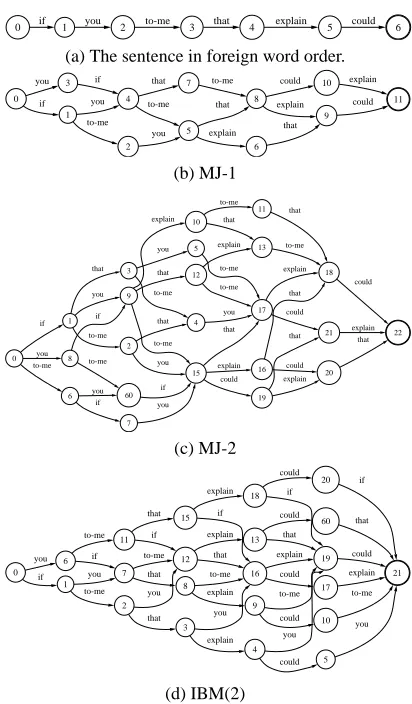
MJ-1 and MJ-2 are shown in Figure MJ-1.
2.2 IBM Constraints
First introduced by Brown et al. (1996), the IBM constraints are among the most well-known and most widely used reordering paradigms. Transla-tion is done from the beginning of the sentence to the end, phrase by phrase; at each point in time, the
constraints allow one of the firstkstill untranslated
phrases to be selected for translation (see Figure 1d,
fork=2). The IBM constraints are much less
restric-tive than local constraints. The first word of the in-put, for example, can move all the way to the end,
independent of the value ofk. Typically,kis set to
4 (Zens and Ney, 2003). We write IBM withk=4 as
IBM(4). The IBM constraints are supersets of the local constraints.
0 if 1 you 2 to-me 3 that 4 explain 5 could 6
(a) The sentence in foreign word order.
0
Figure 1: The German word order if you to-me that explain
could (’wenn Sie mir das erkl¨aren k¨onnten’) and all possible
reorderings under different constraints, represented as lattices. None of these lattices contains the correct English order if you
could explain that to-me. See also Table 1.
2.3 ITG Constraints
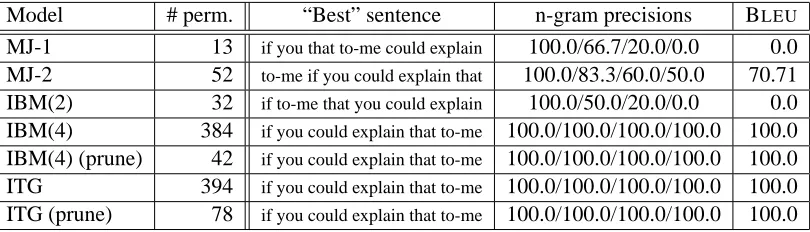
Model # perm. “Best” sentence n-gram precisions BLEU
MJ-1 13 if you that to-me could explain 100.0/66.7/20.0/0.0 0.0 MJ-2 52 to-me if you could explain that 100.0/83.3/60.0/50.0 70.71
IBM(2) 32 if to-me that you could explain 100.0/50.0/20.0/0.0 0.0
IBM(4) 384 if you could explain that to-me 100.0/100.0/100.0/100.0 100.0
IBM(4) (prune) 42 if you could explain that to-me 100.0/100.0/100.0/100.0 100.0
ITG 394 if you could explain that to-me 100.0/100.0/100.0/100.0 100.0
ITG (prune) 78 if you could explain that to-me 100.0/100.0/100.0/100.0 100.0
Table 1: Illustrating example: The number of permutations (# perm.) that different reordering paradigms consider for the input
sequence if you to-me that explain could, and the permutation with highest BLEUscore. The sentence length is 7, but there are only 6! possible permutations, since the phrase to-me counts as one word during reordering. ITG (prune) is the ITG BLEUdecoder with the pruning settings we used in our experiments (beam threshold 10−4). For comparison, IBM(4) (prune) is the lattice BLEUdecoder with the same pruning settings, but we use pruning only for ITG permutations in our experiments.
Figure 2: The example if
you to-me that explain could
and its reordering to if you
could explain that to-me
us-ing an ITG. The alignments are added below the tree, and the horizontal bars in the tree indicate a swap.
ITG decoder runs in polynomial time and allows for long-distance phrasal reordering. A phrase can, for example, move from the first position in the input to the last position in the output and vice versa, by swapping the topmost node in the constructed bi-nary tree. However, due to the bibi-nary bracketing constraint, some permutations are not modeled. A four-phrase sequence abcd cannot be permuted into
cadb or bdac. Therefore, the ITG constraints are not
supersets of the IBM constraints. IBM(4), for exam-ple, allows abcd to be permuted into cadb and bdac.
3 Factored BLEUComputation
The different reordering strategies described allow for different permutations and restrict the search
space in different ways. We are concerned with
the maximal achievable accuracy under given con-straints, independent of feature design or parameter estimation. This is what we call the oracle accuracy under the reordering constraints and it is computed on a dataset with reference translations.
We now describe algorithms that can be used to find such oracle translations among unreordered
translation candidates. There are two equivalent
strategies: The reordering constraints that are
be-ing tested can be expressed as a special dynamic-programming decoder which, when applied to an unreordered hypothesis, searches the space of per-mutations defined by the reordering constraints and returns the highest-scoring permutation. We employ this strategy for the ITG reorderings (Section 3.2). For the other reordering constraints, we employ a more generic strategy: Given the set of reorder-ing constraints, all permutations of an unreordered translation candidate are precomputed and explicitly represented as a lattice. This lattice is passed as in-put to a Dijkstra-style decoder (Section 3.1) which traverses it and finds the solution that reachest the
highest BLEUscore.1
3.1 Dijkstra BLEUDecoder
The Dijkstra-style decoder takes as input a lattice in which each path represents one possible permutation of an unreordered hypothesis under a given reorder-ing paradigm, as in Figure 1. It traverses the lat-tice and finds the solution that has the highest
ap-proximate BLEU score, given the reference. The
dynamic-programming algorithm divides the prob-lem into subprobprob-lems that are solved independently, the solutions of which contribute to the solutions
of other subproblems. The general procedure is
sketched in Figure 3: for each subpath of the lat-tice containing the precomputed permutations, we store the three most recently attached words
(Fig-1
β([0, k, len+ 1, w2, w3, wnew]) = max w1
(get bleu( [0, j, len, w1, w2, w3],[j, k, wnew] ) ) (1)
function get bleu( [0, j, len, w1, w2, w3],[j, k, wnew] ) :=
update ngrams(0, j, k, len, w1, w2, w3, wnew) ;
returnexp 14
4
X
n=1 log
ngramsi([0, k, len+ 1, w2, w3, wnew])
len−n+ 1
!
;
(2)
Figure 3:Top: The BLEUscore is used as inside score for a subpath from 0 tokwith the rightmost wordsw2,w3,wnewin the
Dijkstra decoder. Bottom: Pseudo code for a functionget bleuwhich updates the n-gram matches ngrams1(. . .), ngrams2(. . . ), ngrams3(. . .), ngrams4(. . . ) for the resulting subpath in a hash table[0, k, len+ 1, w2, w3, wnew]and returns its approximate BLEUscore.
("","","") 0/0/0/0
("","to","me") 2/1/0/0
("to","me","if") 3/1/0/0
("me","if","you") 4/2/0/0
("if","you","could") 5/3/1/0
("you","could","explain") 6/4/2/1
("could","explain","that") 7/5/3/2
0
6 to-me
if you
7 if
you
15 you
19 could
that explain
20 explain
that
22 that
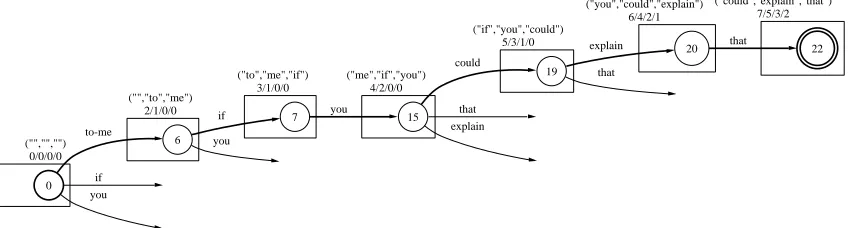
Figure 4: Three right-most words and n-gram matches: This shows the best path for the MJ-2 reordering of if you to-me that
explain could, along with the words stored at each state and the progressively updated n-gram matches. The full path to-me if you could explain that has 7 unigram matches, 5 bigram, 3 trigram, and 2 fourgram matches. See the full MJ-2 lattice in Figure 1c.
ure 4). A context of three words is needed to
com-pute fourgram precisions used in the BLEU score.
Starting from the start state, we recursively extend a subpath word by word, following the paths in
the lattice. Whenever we extend the path by a
word to the right we incorporate that word and use
update ngramsto update the four n-gram counts
for the subpath. The functionupdate ngramshas
access to the reference string2and stores the updated
n-gram counts for the resulting path in a hash table.3
The inside score of each subpath is the approximate
BLEU score, calculated as the average of the four
n-gram log precisions. An n-gram precision is al-ways the number of n-gram matches divided by the
length len of the path minus (n−1). A path of
length 4 with 2 bigram matches, for example, has
a bigram precision of 2/3. This method is similar to
Dijkstra’s algorithm (Dijkstra, 1959) composed with a fourgram finite-state language model, where the scoring is done using n-gram counts and precision
2
Multiple reference strings can be used if available.
3An epsilon value of1−10is used for zero precisions.
scores. We call this the Dijkstra BLEUdecoder.
3.2 ITG BLEUDecoder
For the ITG reordering constraints, we use a dy-namic program that computes the permutations im-plicitly. It takes only the unreordered hypothesis as input and creates the possible reorderings under the ITG constraints during decoding, as it creates a parse chart. The algorithm is similar to a CKY parsing algorithm in that it proceeds bottom-up and combines smaller constituents into larger ones
re-cursively. Figure 5 contains details of the
algo-rithm. The ITG BLEUdecoder stores the three
left-most and the three rightleft-most words in each
con-stituent. A constituent from position i to
posi-tion k, with wa, wb, and wc as leftmost words,
and wx, wy, wz as rightmost words is written as
[i, k,(wa, wb, wc),(wx, wy, wz)]. Such a constituent
non-β([i, k,(wa, wb, wc),(wx, wy, wz)]) = max
β()([i, k,(wa, wb, wc),(wx, wy, wz)]),
β<>([i, k,(wa, wb, wc),(wx, wy, wz)])
(3)
β<>([i, k,(wa, wb, wc),(wx, wy, wz)]) =
max
j,wa0,wb0,wc0,wx0,wy0,wz0
get bleu
j, k,(wa, wb, wc),(wx0, wy0, wz0),
[i, j,(wa0, wb0, wc0),(wx, wy, wz)]
(4)
Figure 5:Equations for the ITG oracle BLEUdecoder.[i, k,(wa, wb, wc),(wx, wy, wz)]is a constituent fromitokwith leftmost
wordswa,wb,wcand rightmost wordswx,wy,wz. Top: A constituent can be built with a straight or a swapped rule. Bottom: A swapped rule. Theget bleufunction can be adapted from Figure 3
swapped constituents. Our ITG BLEUdecoder uses
standard beam search pruning. As in Zens and Ney (2003), phrases are not broken up, but every phrase is, at the beginning of reordering, stored in the chart as one lexical token together with the precomputed n-gram matches and the n-gram precision score.
In addition to standard ITG we run experiments with a constrained ITG, in which we impose a bound
ρon the maximum length of reordered constituents,
measured in phrases. If the combined length of two constituents exceeds this bound they can only be combined in the given monotone order. Experiments with this ITG variant give insight into the effect that various long-distance reorderings have on the final
BLEU scores (see Table 3). Such bounds are also
effective speedup techniques(Eisner and Tromble, 2006).
3.3 BLEUApproximations
BLEU is defined to use the modified n-gram
preci-sion, which means that a correct n-gram that oc-curs once in the reference, but several times in the system translation will be counted only once as
correct. The other occurrences are clipped. We
do not include this global feature since we want a dynamic-programming solution with polynomial size and runtime. The decoder processes subprob-lems independently; words are attached locally and stored only as boundary words of covered paths/ constituents. Therefore we cannot discount a locally attached word that has already been attached else-where to an alternative path/constituent. However, clipping affects most heavily the unigram scores
which are constant, like the length of the sentence.4
4Since the sentence lengths are constant for all reorderings
of a given sentence we can in our experiments also ignore the brevity penalty which cancels out. If the input consists of
sev-We also adopt the approximation that treats every sentence with its reference as a separate corpus (Till-mann and Zhang, 2006) so that ngram counts are not accumulated, and parallel processing of sentences becomes possible. Due to these two approximations, our method is not guaranteed to find the best reorder-ing defined by the reorderreorder-ing constraints. However, we have found on our heldout data that an oracle that does not accumulate n-gram counts is only min-imally worse than an oracle that does accumulate
them (up to 0.25 BLEU points).5 If, in addition,
clipping is ignored, the resulting oracle stays
virtu-ally the same, at most 0.02 BLEUpoints worse than
the oracle found otherwise. All results in this paper
are computed with the original BLEUformula on the
sentences found by the oracle algorithms.
4 Creating a Monotone Translation Baseline
To compare the reordering constraints under ora-cle conditions we first obtain unreordered candi-date translations from a simple baseline translation model. For each reordering paradigm, we take the candidate translations, get the best oracle reorder-ings under the given reordering constraints and pick
the best sentence according to the BLEUscore.
The baseline translation system is created using probabilistic word-to-word and phrase-to-phrase
ta-eral sentences of different lengths (see fn. 1) then the brevity penalty can be built in by keeping track of length ratios of at-tached phrases.
5
bles. Using the translation probabilities, we create a lattice that contains word and phrase translations for every substring of the source sentence. The re-sulting lattice is made of English words and phrases of different lengths. Every word or phrase
transla-tion probabilitypis a mixture ofp(f|e)andp(e|f).
We discard short phrase translations exponentially by a parameter that is trained on heldout data. Inser-tions and deleInser-tions are handled exclusively by the use of a phrase table: an insertion takes place wher-ever the English side of a phrase translation is longer than the foreign side (e.g. English presidential
can-didate for German Pr¨asidentschaftskandidat), and
vice versa for deletions (e.g. we discussed for wir
haben diskutiert). Gaps or discontinuous phrases
are not handled. The baseline decoder outputs the n-best paths through the lattice according to the
lat-tice scores6, marking consecutive phrases so that the
oracle reordering algorithms can recognize them and keep them together. Note that the baseline system is trained on real data, while the reordering constraints that we want to test are not trained.
5 Empirical Comparison of Reordering Constraints
We use the monotone translation baseline model and
the oracle BLEU computation to evaluate different
popular reordering strategies. We now describe the experimental settings. The word and phrase transla-tion probabilities of the baseline model are trained on the Europarl German-English training set, using GIZA++ and the Pharaoh phrase extraction algo-rithm. For testing we use the NAACL 2006 SMT Shared Task test data. For each sentence of the test set, a lattice is created in the way described in Sec-tion 4, with parameters optimized on a small heldout
set.7 For each sentence, the 1000-best candidates
ac-cording to the lattice scores are extracted. We take the 10-best oracle candidates, according to the
ref-erence, and use a BLEU decoder to create the best
permutation of each of them and pick the best one. Using this procedure, we make sure that we get the highest-scoring unreordered candidates and choose the best one among their oracle reorderings. Table 2
6We use a straightforward adaption of Algorithm 3 in Huang
and Chiang (2005)
7We fill the initial phrase and word lattice with the 20 best
candidates, using phrases of 3 or less words.
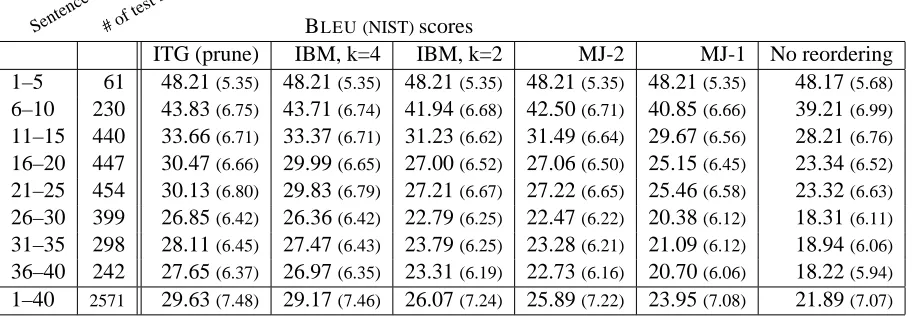
and Figure 6 show the resulting BLEUscores for
dif-ferent sentence lengths. Table 3 shows results of the
ITG runs with different length boundsρ. The
aver-age phrase length in the candidate translations of the test set is 1.42 words.
Oracle decodings under the ITG and under IBM(4) constraints were up to 1000 times slower than under the other tested oracle reordering ods in our implementations. Among the faster meth-ods, decoding under MJ-2 constraints was up to 40% faster than under IBM(2) constraints in our imple-mentation.
20 25 30 35 40 45
5 10 15 20 25 30 35 40
BLEU
Sentence length ITG IBM, k=4 IBM, k=2 MJ-2 MJ-1 Baseline
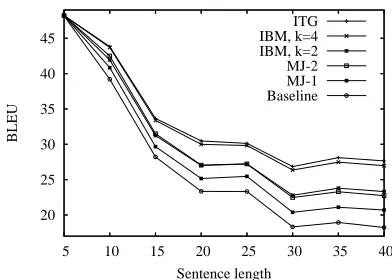
Figure 6: Reordering oracle scores for different sentence
lengths. See also Table 2.
6 Discussion
The empirical results show that reordering un-der sufficiently permissive constraints can improve a monotone baseline oracle by more than 7.5
BLEU points. This gap between choosing the best
unreordered sentences versus choosing the best op-timally reordered sentences is small for short sen-tences and widens dramatically (more than nine
BLEUpoints) for longer sentences.
The ITG constraints and the IBM(4) constraints both give very high oracle translation accuracies on the German-English translation task. Overall, their
BLEUscores are about 2 to more than 4 points
bet-ter than the BLEU scores of the best other
Sentence length
# of
testsentences
BLEU(NIST)scores
ITG (prune) IBM, k=4 IBM, k=2 MJ-2 MJ-1 No reordering
1–5 61 48.21(5.35) 48.21(5.35) 48.21(5.35) 48.21(5.35) 48.21(5.35) 48.17(5.68)
6–10 230 43.83(6.75) 43.71(6.74) 41.94(6.68) 42.50(6.71) 40.85(6.66) 39.21(6.99)
11–15 440 33.66(6.71) 33.37(6.71) 31.23(6.62) 31.49(6.64) 29.67(6.56) 28.21(6.76)
16–20 447 30.47(6.66) 29.99(6.65) 27.00(6.52) 27.06(6.50) 25.15(6.45) 23.34(6.52)
21–25 454 30.13(6.80) 29.83(6.79) 27.21(6.67) 27.22(6.65) 25.46(6.58) 23.32(6.63)
26–30 399 26.85(6.42) 26.36(6.42) 22.79(6.25) 22.47(6.22) 20.38(6.12) 18.31(6.11)
31–35 298 28.11(6.45) 27.47(6.43) 23.79(6.25) 23.28(6.21) 21.09(6.12) 18.94(6.06)
36–40 242 27.65(6.37) 26.97(6.35) 23.31(6.19) 22.73(6.16) 20.70(6.06) 18.22(5.94)
1–40 2571 29.63(7.48) 29.17(7.46) 26.07(7.24) 25.89(7.22) 23.95(7.08) 21.89(7.07)
Table 2: BLEUand NIST results for different reordering methods on binned sentence lengths. The ITG results are, unlike the
other results, with pruning (beam10−4). The BLEUresults are plotted in Figure 6. All results are computed with the original BLEUformula on the sentences found by the oracle algorithms.
BLEUscores for sentences longer than 30 sentences.
This advantage in translation accuracy comes with high computational cost, as mentioned above.
Among the computationally more lightweight re-ordering methods tested, IBM(2) and MJ-2 are very close to each other in translation accuracy, with IBM(2) obtaining slightly better scores on longer sentences, while MJ-2 is more efficient. MJ-1 is less successful in reordering, improving the
mono-tone baseline by only about 2.5 BLEUpoints at best,
but is the best choice if speed is an issue.
As described above, the reorderings defined by the local constraints MJ-1 and MJ-2 are subsets of IBM(2) and IBM(3). We did not test IBM(3), but the values can be interpolated between IBM(2) and IBM(4). The ITG constraints do not belong in this family of finite-state contraints; they allow reorder-ings that none of the other methods allow, and vice versa. The fact that ITG constraints can reach such high translation accuracies supports the findings in Zens et al. (2004) and is an empirical validation of the ITG hypothesis.
The experiments with the constrained ITG show the effect of reorderings spanning different lengths (see Table 3). While most reorderings are
short-distance (<5 phrases) a lot of improvements can still
be obtained whenρis increased from length 5 to 10
and even from 10 to 20 phrases.
7 Related Work
There exist related algorithms that search the space
of reorderings and compute BLEU oracle
approxi-Len. ρ=0 ρ=5 ρ=10 ρ=20 ρ=30 ρ=40
26–30 18.31 24.07 26.40 26.79 26.85 26.85
31–35 18.94 25.10 27.21 28.00 28.09 28.11 36–40 18.22 24.46 26.66 27.53 27.64 27.65
26–40 18.49 24.74 26.74 27.41 27.50 27.51
Table 3:BLEUresults of ITGs that are constrained to
reorder-ings not exceeding a certain span lengthρ. Results shown for different sentence lengths.
mations. Zens and Ney (2005) describe a dynamic-programming algorithm in which at every state the number of n-gram matches is stored, along with a multiset that contains all words from the reference that have not yet been matched. This makes it pos-sible to compute the modified ngram precision, but the search space is exponential. Tillmann and Zhang
(2006) use a BLEU oracle decoder for
discrimina-tive training of a local reordering model. No de-tails about the algorithm are given. Zens and Ney (2003) perform a comparison of different reorder-ing strategies. Their study differs from ours in that they use reordering models trained on real data and may therefore be influenced by feature selection, parameter estimation and other training-specific
is-sues. In our study, only the baseline translation
BLEUoracle approach. In Wellington et al. (2006), hand-aligned data are used to compare the standard ITG constraints to ITGs that allow gaps.
8 Conclusions
We have presented a training-independent method to compare different reordering constraints for ma-chine translation. Given a sentence in foreign word order, its reference translation(s) and reordering constraints, our dynamic-programming algorithms efficiently find the oracle reordering that has the
ap-proximately highest BLEU score. This allows
eval-uating different reordering constraints experimen-tally, but abstracting away from specific features, the probability model or training methods of the re-ordering strategies. The presented method evaluates the theoretical capabilities of reordering constraints, as opposed to more arbitrary accuracies of specifi-cally trained instances of reordering models.
Using our oracle method, we presented an em-pirical evaluation of different reordering constraints for a German-English translation task. The results show that a good reordering of a given monotone translation can improve the translation quality dra-matically. Both short- and long-distance reorderings
contribute to the BLEUscore improvements, which
are generally greater for longer sentences. Reorder-ing constraints that allow global reorderReorder-ings tend to reach better oracles scores than ones that search more locally. The ITG constraints and the IBM(4) constraints both give the highest oracle scores.
The presented BLEU decoder algorithms can be
useful in many ways: They can generally help de-cide what reordering constraints to choose for a
given translation system. They can be used for
discriminative training of reordering models (Till-mann and Zhang, 2006). Furthermore, they can help detecting insufficient parameterization or incapable training algorithms: If two trained reordering model instances show similar performances on a given task, but the oracle scores differ greatly then the training methods might not be optimal.
Acknowledgments
This work was partially supported by the National Science Foundation via an ITR grant (No 0121285), the Defense Advanced Research Projects Agency
via a GALE contract (No HR0011-06-2-0001), and the Office of Naval Research via a MURI grant (No N00014-01-1-0685). We thank Jason Eisner, David Smith, Roy Tromble and the anonymous reviewers for helpful comments and suggestions.
References
A. V. Aho and J. D. Ullman. 1972. The Theory of Parsing,
Translation, and Compiling. Prentice Hall.
A.L. Berger P. F. Brown, S. A. Della Pietra, V. J. Della Pietra, J. R. Gillett, J. D. Lafferty, R. L. Mercer, H. Printz, and L. Ures. 1996. Language translation apparatus and method using context-based translation models. United States Patent No. 5,510,981.
E.W. Dijkstra. 1959. A note on two problems in connexion with graphs. Numerische Mathematik., 1:269–271.
J. Eisner and R. W. Tromble. 2006. Local search with very large-scale neighborhoods for optimal permutations in Ma-chine Translation. In Proc. of the Workshop on
Computa-tionally Hard Problems and Joint Inference, New York.
L. Huang and D. Chiang. 2005. Betterk-best parsing. In Proc.
of IWPT, Vancouver, B.C., Canada.
S. Kumar and W. Byrne. 2005. Local phrase reordering models for Statistical Machine Translation. In Proc. of
HLT/EMNLP, pages 161–168, Vancouver, B.C., Canada.
C. Tillmann and T. Zhang. 2006. A discriminative global train-ing algorithm for Statistical MT. In Proc. of ACL, pages 721–728, Sydney, Australia.
B. Wellington, S. Waxmonsky, and D. Melamed. 2006. Empir-ical lower bounds on the complexity of translational equiv-alence. In Proc. of COLING-ACL, pages 977–984, Sydney, Australia.
D. Wu. 1997. Stochastic inversion transduction grammars and bilingual parsing of parallel corpora. Computational
Lin-guistics, 23(3):377–404.
D. Xiong, Q. Liu, and S. Lin. 2006. Maximum entropy based phrase reordering model for Statistical Machine Translation. In Proc. of COLING-ACL, pages 521–528, Sydney, Aus-tralia.
R. Zens and H. Ney. 2003. A comparative study on reordering constraints in Statistical Machine Translation. In Proc. of
ACL, pages 144–151, Sapporo, Japan.
R. Zens and H. Ney. 2005. Word graphs for Statistical Machine Translation. In Proc. of the ACL Workshop on Building and
Using Parallel Texts, pages 191–198, Ann Arbor, MI.
![Figure 5: Equations for the ITG oracle BLEU decoder. [ i , k , ( wa, w b, w c) , ( wx, w y, w z) ] is a constituent from i to k with leftmostwords waw ,bw ,c and rightmost words wxw ,yw ,z](https://thumb-us.123doks.com/thumbv2/123dok_us/735609.1083319/5.612.104.536.67.147/figure-equations-oracle-decoder-constituent-leftmostwords-rightmost-words.webp)