Volume 8, No. 4, May 2017 (Special Issue)
International Journal of Advanced Research in Computer Science
REVIEW ARTICLE
Available Online at www.ijarcs.info
Body Sensor Networks: In the Era of Big Data and Beyond
Smita dinker1 , Anjali2 and Sumit Kumar Sharma
3
Department of Electrical and Electronics Engineering
Shri Ram Murti Smarak College of Engineering and Technology, Bareilly, India
1
, anjali4878mail.com2, [email protected]
Abstract: Body sensor networks (BSN) have emerged as an active field of research to connect and operate sensors within, on or at close proximity to the human body. BSN have unique roles in health applications, particularly to support real-time decision making and therapeutic treatments. Nevertheless, challenges remain in designing BSN nodes with antennas that operate efficiently around, ingested or implanted inside the human body, as well as new methods to process the heterogeneous and growing amount of data on-node and in a distributed system for optimized performance and power consumption. As the battery operating time and sensor size are two important factors in determining the usability of BSN nodes, ultralow power transceivers, energy-aware network protocol, data compression, on-node processing, and energy-harvesting techniques are highly demanded to ultimately achieve a self-powered BSN.
Keywords: Big data, body area network (BAN), cooperative networks, embedded systems, network security, wearable devices, wearable antenna.
I. INTRODUCTION
BODY SENSOR NETWORKS (BSN), sometimes also referred as body area networks (BAN), body area sensor networks, or wireless BAN, are designed to connect and operate sensors within, on or at close proximity to the human body [1], [2]. BSN have been applied for various purposes, for example, to monitor vital signs [3]–[5], daily activities [6], [7], gait patterns [8], [9], motor fluctuations in Parkinson’s patients [10], balance and fall [11], [12]. State-of-the-art sensor node and radio frequency (RF) technologies for BSN are becoming mature and various prototypes are commercially available. In particular, nowadays, consumer electronics (such as mobile phones) are often incorporated with sensors, which when used innovatively can provide valuable health information. BSN, together with the well-networked home appliances (such as television) and medical instruments in hospitals, form an excellent platform for collecting vast amounts of personal health data. Both the volume and the type of data that can be collected via BSN have grown tremendously and are now beyond the ability of commonly used software tools to process within a “tolerable elapsed time.” In particular, real-time decision support is in high
demand in the medical and healthcare domains, which make BSN a crucial building block for future healthcare information
systems, since they can be used to collect health information and deliver health decisions or therapeutic treatments to the users. The rest of the paper is structured as follows. Section II examines the field of BSN in relationship with its predecessors: wearable sensing and personal area network (PAN). Section III discusses the communication protocols for BSN and the challenges in RF and radio propagation modeling for BSN. Section IV discusses the hardware design of sensor nodes of BSN. Section V reviews software platforms and challenges to implement algorithms for using BSN to support real-time health decision making. Activity recognition (AR) is selected as an example for better illustration. Section VI concludes the paper by suggesting future directions for BSN research.
II. EMERGENCE OF BSN
The emergence of BSN was mainly driven by two key technological areas: wearable sensing [13] and PAN [14]. The advancement in wearable sensing or wearable computing is a result of the computer industry’s huge steps in miniaturization with an aim to turn the tethered computers into wearable devices that can otherwise be a normal pair of eyeglasses, clothing, etc. [15]. PAN was proposed, on the other hand, around the same time due to the anticipation of the need of a method to allow the sharing of data between personal electronic devices that were becoming smaller, lower in power requirements, and less expensive [14]. The need of BAN, which should have clearly distinctive aims than PAN, was soon raised [16]. Several important issues concerning BAN, but had yet been addressed in PAN were summarized as follows [16]: 1) the support of flexible and heterogeneous networks for using multiple physical links, e.g., a mix of wired, RF, and infrared links; 2) the exchange of information between components rather than devices; 3) the ability to interface with other BAN and other networks; 4) the use of relaying techniques to form an ad-hoc network for the even shorter communication range available (targeting at 2 m for BAN as compared to 10 m for PAN); and lastly but most importantly 5) the focus of implementation of terminals on consumer gadgets,
© 2015-19, IJARCS All Rights Reserved 114
wearable accessories or even clothing instead of personal computing products (e.g., laptop and desktop computers) or portable devices. It soon became apparent that the knowledge of the two areas must be merged in order to further bring the field forward. Although the applications of BSN are wide, its role in medical and healthcare settings is important. An objective of BSN is to provide long-term monitoring of health with the aim of capturing life-threatening events and enable early interventions. Ideally, nodes of BSN should operate reliably for long periods of time (i.e., days and months) without recharging/replacing its battery, but yet miniature in size. Since the communication range of the BSN nodes commonly targets to be less than 2 m, gateway devices are often needed to connect them to remote stations and data repositories. Fig. 1 shows a body control unit (BCU) (e.g., a smart phone) that is used as a gateway to transmit the collected data from sensor nodes to remote stations (e.g., a remote PC) using a second wireless link. Through a gateway device, sensor devices worn or implanted in the human body can be connected to the internet. Several interconnecting networks are often needed for a typical healthcare system. Wearable sensors need to communicate directly with the gateway device through a star topology. In case of multiple users in the same environment, the same star topology can be used to connect several gateway devices to a remote station [17]. Unlike wearable sensors, gateway devices can be placed at a close proximity to the human body but not necessarily to be worn on the body, for example, an ambient sensor can also act as a gateway device. Communication between gateway devices and remote stations can use short range wireless PAN, long-range wireless local area networks, or 3G/4G mobile data network to extend the communication range to beyond the 10-m limit.
III. NETWORK
The IEEE wireless BAN standard (IEEE 804.15.6 TG6) [18] is formed in order to standardize the Physical Layer (PHY) and Medium Access Control (MAC) protocols for short-range, low-power, and reliable wireless body sensors. Some important features of this standard are [18]: 1) support of scalable data rates; 2) low power consumption; 3) small and lightweight sensor nodes (i.e., wearable); 4) Quality-of-service (QoS) support that has ability to prioritize medical data transmission of crucial signals; 5) secure data transmission; 6) coexistence with other wireless technologies; 7) formation of a communication network with a control device up to 2 m. A. Physical Layer Several communication media have been proposed for BSN, including using electroactive polymer-based e-textile materials as a wired medium [19], [20], electromagnetic or inductive coupling techniques for implants, and in-body RF communication such as the Medical Implant Communication Service bands [21]. A main challenge of a wireless BSN, when compared to conventional wireless systems, is that the channel over which the communication takes place is highly affected by the proximity of the human body, which is a highly lossy and dispersive media. The human body therefore will attenuate, delay, and distort the transmitted signal. Moreover, the complex geometry of the human body will also heavily affect the field distribution around it, due to the scattering from different surfaces. Finally, the presence of human tissues close to the antennas may cause detuning and pattern distortion effects. Therefore, in order to design a
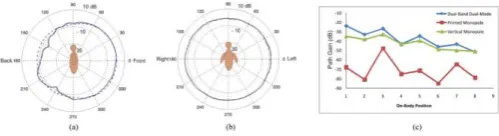
[image:2.595.319.569.554.622.2]reliable and efficient BSN, a proper analysis and modeling of the radio channel including the human body is required. It is important to investigate and characterize antennas and RF devices that are suitable for both on-body and off-body communication, with an aim to optimize power consumption and satisfy coexistence conditions [22], [23]. Various antennas and propagation studies have been focused on the ISM 2.4-GHz and 5.8-2.4-GHz frequencies, and the 3.1–10.6 2.4-GHz ultrawideband (UWB) [22], [24]–[27]. These studies provide excellent candidates for initial analysis of diversity and multimode concepts in relation to BSN. Although narrowband wearable antennas can be designed with mode switching capability to improve onbody and off-body communication links [28]–[30], these antennas that work in specific bands limit the choice of spectrum space to use and, therefore, may lead to congestion of certain frequency bands in indoor environments. On the other hand, compact wearable antennas modeled on FR4 substrate with a thickness of 1.57 mm and a ground plate of 60 × 60 mm2 are designed to operate at two bands (1.9 and 2.4 GHz) with dual radiation modes [30]. As shown in Fig. 2, improvements as large as 20 dB have been shown for on-body path loss in comparison with conventional printed antennas. Since different body shapes and sizes can significantly affect the channel performance of BSN [31], [32], numerical human models are needed to estimate the impact caused by the morphologic variations of the human body to the propagation of radio waves. Geometrical models are often too simple to reflect the realistic variations of the body shapes for this purpose [33]. Inhomogeneous models [34], based on computed tomography and sectioning of cadavers, can be used to analyze radio propagation inside the body to design antennas for ingestible or implantable devices. Nevertheless, these models are difficult to generate and, therefore, to study on body propagation, especially at frequencies such as the ISM band (2.4 GHz) where signal penetration into the body is very low, scenario numerical models with homogeneous lossy dielectric properties are often used. Whole body voxel models can be obtained by segmenting images from magnetic resonance imaging [35]. Parameters generated from 50 statistical shape models have been used to ensure high data reliability of a belt-to-chest link by modeling path loss as a linear function of the logarithmic distance between the two [36].
Fig. 3. Sensor placed on the male model provided by the visible U.S. human project [37].
Antennas have to be efficient and immune from frequency and polarization detuning. In addition to understanding the antenna radiation pattern when placed on the human body, it is also important to specify how coupling occurs during propagation, either as a surface wave, free space wave or a combination of both. If the sensor is placed too close to the human body, it will have low efficiency due to signal loss but good coupling to surface wave. For example, when a sensor is placed on the human chest, as shown in Fig. 3, the antenna performance can be optimized using various numerical and experimental tools to improve the gain value by 2.4 dB. This allows the range of coverage to be increased up to 10 m, as compared to a maximum of 2 m in a conventional wire antenna [36], [37]. B. MAC Protocols RF transmission of a sensor node in BSN is usually one of the most power hunger entities. To minimize power consumption of the sensor node, the MAC sublayer must be carefully designed to provide controlling or duty cycling the RF module. A MAC protocol for BSN normally operates at very low duty cycles to extend the lifetime of the sensor nodes. Main requirements for a MAC protocol are reliability, flexible transmission mechanism, high channel efficiency, and a low end-to-end delay time [21]. For BSN, three main classes of MAC protocols have been proposed: 1) time division multiple access (TDMA), 2) polling, and 3) contention-based protocols, which are also known as random access protocols. The TDMA and polling protocols are contention free but centralized in nature. The TDMA protocol introduces a strict synchronization requirement, whereas a polling network requires a high overhead of polling message transmission. ALOHA and carrier sense multiple access (CSMA) have been proposed for low-power sensor network applications. These protocols do not require any centralized control signal from the control unit. They are also dynamic in nature and offer minimum packet transfer delays for a low-traffic network. The performance of a contention-based protocol degrades when the total traffic load increases significantly. CSMA can also use a collision avoidance (CA) mechanism (so called CSMA/CA) to allow only one sensor node to communicate and send a packet at one time to avoid the interference and collision between sensor nodes. The CSMA/CA MAC protocol is also used by the IEEE802.15.4 (wireless PAN) standard and offers lower delay and reliable transmission of packets in small-size networks. MAC protocols based on carrier sensing and clear channel assessment are not preferred for UWB-based devices because of difficulty in assessing the channel condition of pulse-based communications. The IEEE802.15.6 standard [18] defines the detailed MAC architecture for in-body and on-body wireless communications for both narrowband and UWB technologies. The star topology is suggested with a super frame structure. There are three access modes in the standard; beacon enabled with super frame boundaries, non beacon enabled with super
frame, and non beacon without super frame. The medium access mechanisms explained above can be integrated in sensor nodes using these three modes. The scheduling of data communication using methods such as polling can be implemented with non beacon mode with super frame. A CSMA/CA protocol for beacon enabled is used in the standard with exclusive access phase (EAP) and random access phase. EAP is suggested for higher priority data transmission. Various groups have devoted themselves to the study of network topology and transmission protocols for BSN [23], [38], [39]. It is worth pointing out that since applications for BSN are highly dynamic, CSMA or TDMA protocols are often nonideal. To provide the necessary bandwidth and robust communication link, a highly optimized approach would be needed, especially for operating in the tiny sensors with limited computational power.
Fig. 4. Total energy consumption against margins for multi-hop (MH) and single-multi-hop (SH) for sensor (S3) placed at the back of the human torso and S4 placed at the back of the head with the sink on the right wrist [37].
[image:3.595.331.524.241.344.2]© 2015-19, IJARCS All Rights Reserved 116
[image:4.595.38.285.103.290.2]hospitals, elder care or athlete monitoring, while enhancing network efficiency and reliability. IV. SENSOR At present, sensor nodes placed on the human body are mostly battery operated. Low power consumption is a major design
Fig. 5. Example of body sensor node with battery.
Fig. 6. Examples of wearable sensors using narrow-band communication technology. (a) Oxygen saturation and heart rate ring sensor . (b) e-AR sensor for detecting gait impairment . (c) Clip-free eyeglasses for measuring heart rate .
challenge for BSN nodes. Fig. 5 shows the block diagram of a typical BSN node. Since physiological signals or physical activities obtained from the human body are usually very weak and noisy signals, they should be first amplified and filtered (A/F). A multiplexer is then used to switch between each sensor node if more than one sensor signal is required. An analog-todigital conversion (ADC) stage is required to digitize the body signals for further processing. The microcontroller will code the data before the data are sent to a radio transceiver. A multiaccess protocol is usually implemented in the microcontroller to ensure network reliability.
A. Narrowband-Based
Sensor Nodes Narrowband communication at 2.4-GHz ISM band is one of the earliest and most commonly used wireless technologies for sensor nodes of BSN, as summarized in Table I. In order to be unobtrusive, sensor nodes of BSN are often embedded into gadgets and accessories, such as a finger-ring earpiece and eyeglasses as shown in Fig. 6. The greatest advantage of embedded sensors into finger-rings is that people seldom takeoff their rings, even during shower or sleep. Twenty-four-hour monitoring can, therefore, be achieved with this sensor-embedded ring. By placing sensor nodes on the earlobe, one can measure pulse waveform and temperature.This system uses a Bluetooth module (KC Wirefree Inc.)
and a PSoC microcontroller (Cypress Semiconductor) that combines analog and digital signal processing for medical signal. A very compact node, 26 (L) × 15 (W) × 7 (H) mm3, for monitoring ECG has also been developed using Nordic’s nRF24E1 transceiver, a 2.4-GHz RF transceiver together with an embedded 8051-compatible microcontroller (DW8051) with 512 byte ROM, 4K RAM, and 9-bit ADC. E Watch is a wearable sensing platform built into a wrist watch and uses the Bluetooth wireless link to commutate with a cellular phone or a remote computer. The eWatch platform is designed to sense light, motion, audio, and temperature. It uses a MEMS accelerometer device (ADXL202) to measure planar
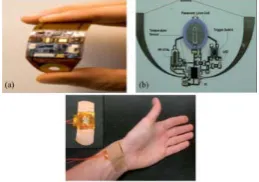
acceleration of the human hand. The microcontroller is an ARM7 from Phillips with 128Kb FLASH and 64 kB of RAM. The sensor data are obtained from an external 10-bit ADC and is stored in 1-MB external FLASH memory. Flexible materials and textile technology can be used to integrate sensor electronics, boards, and connectors wirelessly for BSN, leading to lighter, more comfortable and easier attachment on the human body. Examples are a wireless ECG patch that has been developed on a flexible circuit board by IMEC, Belgium , as shown in Fig. 7. The electronics have been integrated on a flexible substrate (polyimide substrate) as well as textile material that can easily be worn by patients because of its flexibility and stretchability. The antenna has been placed at one side while one connector for the location of an Ag/AgCl electrode is printed on the opposite side. In addition to fabricating electronics on a flexible substrate, flexible sensor nodes can also be developed using inkjet-printing technology . The prototype measures temperature wirelessly using a transmission frequency of 904.4 MHz. The dimension of the device is about 8.2 cm × 4.5 cm. Fig. 7(c) presents a polymer-based flexible sensor, which can be placed over the radial artery on the wrist to measure the pulse wave. When integrated witha wireless unit and a microcontroller, these flexible sensors can be embedded into clothing or fabrics as smart apparel.
B. UWB-Based
[image:4.595.368.498.470.561.2]Body Sensors Compared to narrowband systems, UWB wireless technology has the following advantages: low-power transmitter design, low RF and electromagnetic interference effects in medical environment, small-size antenna, and high data rate capability. UWB wireless devices have been used efficiently for simultaneous monitoring of many continuous physiological signals such as EEG, ECG, and EMG , detecting neural signals for brain–computer interfaces because of its high data rate capability , and capturing videos from the gastrointestinal tract via
[image:4.595.361.506.610.729.2]Fig. 7. Flexible BSN nodes. (a) Wireless ECG patch developed by IMEC on a flexible substrate . (b) Sensor node developed using inkjet-printing technology . (c) Flexible pressure sensor .
ingestible wireless capsules . Unlike narrowband technologies, UWB can support scalable data rates in a single node. For example, it can easily be designed to transmit from 10 bps to 10 Mbps without introducing much additional complexity in the hardware. An example of an UWB-based sensor node is described. The sensor node, 30 mm × 25 mm in size, consists of three major sections: a pulse generator, a RF circuit and a controller. Narrow square pulses ranging from 0.5–2 ns are generated and modulated by the data bits. UWB sensor nodes are usually designed to operate in the band of 3.5–4.5 GHz. To ensure safety, the power level of the frequency spectrums for UWB signals should be less than the maximum allowable power level defined by the FCC (−41.3 dBm/MHz). C. Commercial Sensor Nodes A number of sensor platforms are commercially available, using either ZigBee (IEEE 802.15.4) or Bluetooth (IEEE 802.15.1) protocols that operate in the 2.4-GHz ISM band. Fig. 8 shows some of the smallest existing sensor platforms for BSN in the early days, e.g., Mica2DOT [61] and T-node . Fitbit has developed a wireless sensor node that tracks motion of a human body. It contains of a 3-D motion sensor for estimating health indices such as calories burned, steps taken, distance traveled, and sleep quality. The senor can be worn on the waist, in pocket or on undergarments. Shoes companies such as Adidas and Nike have also entered the market to produce body worn devices—Nike+iPod and miCoach Pacer—for sportive activities. Shimmer sensor is an activity monitoring body sensor that can wirelessly capture physiological and kinematic data, including ECG, EMG, GSR, accelerometer. The platform contains a Bluetooth module, IEEE 802.15.4 compliant (CC2420) radio transceiver, microcontroller-MSP430 from Texas Instruments, and microSD card socket which can store data up to 2 GB of data. Fig. 9. Upcoming smartphone platforms. (a) Apple Watch. (b) Samsung GearS . (c) Sony SmartWatch. Corventis, Inc., has developed a small sensor node called PiiX for wireless cardiovascular solutions [65]. It uses a wireless gateway device named zLink to communicate with the monitoring center. PiiX is intended to be used by a single patient and cannot cope with implantable devices. The unique features of this device are leadless and water-resistant. It eliminates the cumbersome leads and wires and can still operate during showering or sleeping. PiiX sensor is quite small and can easily be attached to the body like a plaster. Philip has recently launched a disposable adhesive patch for Chronic Obstructive Pulmonary Disease sufferers, allowing diagnostic stats like heart rate, respiratory function and physical activity (or inactivity) to be gathered continuously, transferred to the patient’s mobile device and uploaded to a cloudbased healthcare repository . VitalConnect, on the other, introduced a HealthPatch that consists of a family of biosensors, which is the first solution of its kind capable to capture clinical-grade measurements in a continuous, configurable and unobtrusive manner using a small yet powerful patch worn on the chest. The FDA-cleared patch provides a serious of parameters including single-lead ECG, heart rate, heart rate variability, respiratory rate, skin temperature, body posture for fall detection/severity, steps, stress, and sleep staging (hypnogram)/quality. Moreover, sensors are often incorporated in personal consumer electronics nowadays, e.g., on the smartphone platforms. Upcoming smartphone platforms shown in Fig. 9, such as Apple Watch , Samsung GearS , and Sony SmartWatch, further enable real hands-free mobile experience and unobtrusive measurements.
With the increasing number of commercial platforms available, the collection for vast amount of health and medical data via BSN is becoming possible in this era of big data.
IV. TOWARD SELF-POWERED SENSING
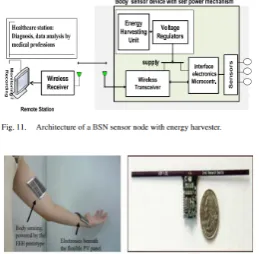
[image:5.595.308.438.390.517.2]A grand challenge for BSN is the limited power source for the sensor nodes. Although small rechargeable batteries are currently available for BSN, it is not always possible or convenient to replace batteries. The solution to successfully develop selfpowered sensor nodes relies on energy-harvesting techniques that extract energy from the surrounding environment, motions and/or heat generated by the human body. Wirelessly charging or using energy-harvesting methods to provide a continuous power source will enable a complete selfsustaining body sensor device for medical monitoring. For example, WISP sensor node in Table I is an RFID-based sensing mechanism operating without a battery . Fig. 11 shows a general block diagram representing a body sensor with energy harvesting. The power is recovered from the external ambient such as solar and RF or vibration and motion from the human body and then regulated or stored to provide power supply for the wireless body sensor device. In the implantable case, human intervention in replacing the batteries should be kept at a minimum level to avoid frequent surgical procedures. For implantable medical sensors, the energy is provided to the body sensor device wirelessly using inductive links. The charging transmitter should be very close to the patient’s skin to charge or energize the body sensor device
© 2015-19, IJARCS All Rights Reserved 118
conventional digital processor, it is not feasible to achieve self-powered sensing, where the body sensor will be self-powered solely by energyharvesting techniques. With the advances in semiconductors, recent ultra-low power processors can operate with submilliwatt power. However, this requirement is still much higher than energy-harvesting mechanisms can provide. For instance, a piezoelectric energy harvester can supply up to
60 μW , and a MEMS electrostatic harvester can provide up to
80 μW. To further reduce power consumption and enable selfpowered sensing, the signal processing and pattern recognition process will have to be implemented in low-power analog or digital circuits [2]. Using the AR application as an example, all four stages of the recognition process can be implemented in lowpower analog form, except for the feature selection/projection process. For the feature extraction phase, although not all features can be implemented in analog form (ex. variance), many features can be extracted using analog circuits, such as zero-crossing and Fourier features . As feature selection is an iterative process and data projection transforms data into different spaces, these processes cannot be implemented in analog form. However, relevant features can be selected offline and a classifier can be configured to use only the selected features. In terms of classifiers, most classifiers can be implemented in analog form, for example, HMM, SVM, SOM , and MLP. The energy consumption of an analog classifier can be as low as 200 nW, which can potentially be powered by energy-harvesting mechanism. In summary, the battery operating time and sensor size are two important factors in determining the usability of BSN sensors. Future research should be conducted in ultralow power transceivers, energy-aware network protocols, and data compression. The most effective way to reduce the power consumption is to process the sensor data on-node. Although not all signal processing and machine learning algorithms can be implemented on miniaturized sensor nodes, many machine learning techniques can be built in BSN sensors. However, there are very few studies have actually implemented the processing on the sensor node. This could be due to the lack of suitable machine learning software tool for BSN sensors. On the other hand, to further reduce the power consumption, low-power analog circuit methods can be introduced and implemented into the sensor circuits or ASIC, which could facilitate the realization of self-powered sensing.
REFERENCES
[1] C. C. Y. Poon, Y. T. Zhang, and S. D. Bao, “A novel biometrics method to secure wireless body area sensor networks for telemedicine and mhealth,” IEEE Commun. Mag., vol. 44, no. 4, pp. 73–81, Apr. 2006.
[2] B. Lo, S. Thiemjarus, A. Panousopoulou, and G.-Z. Yang, “Bioinspired design for body sensor networks,” IEEE Signal Process. Mag., vol. 30, no. 1, pp. 165–170, Jan. 2013.
[3] R. S. Istepanian, E. Jovanov, and Y. Zhang, “Introduction to the special section on m-health: Beyond seamless mobility and global wireless health-care connectivity,” IEEE Trans. Inf. Technol. Biomed., vol. 8, no. 4, pp. 405–414, Dec. 2004. [4] Y. L. Zheng, X. R. Ding, C. C. Y. Poon, B. P. L. Lo, H. Y. Zhang, X. L. Zhou, G. Z. Yang, N. Zhao, and Y. T. Zhang, “Unobtrusive sensing and wearable devices for health informatics,” IEEE Trans. Biomed. Eng., vol. 61, no. 3, pp. 1538–1554, May 2014.
[5] Y.-L. Zheng, B. P. Yan, Y.-T. Zhang, and C. C. Y. Poon, “An armband wearable device for overnight and cuff-less blood pressure measurement,” IEEE Trans. Biomed. Eng., vol. 61, no. 7, pp. 2179–2186, Jul. 2014.
[6] J. A. Ward, P. Lukowicz, G. Troster, and T. E. Starner, “Activity recognition of assembly tasks using body-worn microphones and accelerometers,” IEEE Trans. Pattern Anal. Mach. Intell., vol. 28, no. 10, pp. 1553–1567, Oct. 2006. [7] B. Perriot, J. Argod, J. L. Pepin, and N. Noury, “Characterization of physical activity in COPD patients: Validation of a robust algorithm for actigraphic measurements in living situations,” IEEE J. Biomed. Health Informat., vol. 18, no. 4, pp. 1225–1231, Jul. 2014.
[8] S. J. M. Bamberg, A. Y. Benbasat, D. M. Scarborough, D. E. Krebs, and J. A. Paradiso, “Gait analysis using a shoe-integrated wireless sensor
system,” IEEE Trans. Inf. Technol. Biomed., vol. 12, no. 4, pp. 413–423, Jul. 2008.
[9] D. Jarchi, C. Wong, R. M. Kwasnicki, B. Heller, G. A. Tew, and G. Z. Yang, “Gait parameter estimation from a miniaturized ear-worn sensor using singular spectrum analysis and longest common subsequence,” IEEE Trans. Biomed. Eng., vol. 61, no. 4, pp. 1261–1273, Apr. 2014.
[10] S. Patel, K. Lorincz, R. Hughes, N. Huggins, J. Growdon, D. Standaert, M. Akay, J. Dy, M. Welsh, and P. Bonato, “Monitoring motor fluctuations in patients with Parkinson’s disease using wearable sensors,” IEEE Trans. Inf. Technol. Biomed., vol. 13, no. 6, pp. 864–873, Nov. 2009.
[11] H. Ghasemzadeh, R. Jafari, and B. Prabhakaran, “A body sensor network with electromyogram and inertial sensors: Multimodal interpretation of muscular activities,” IEEE Trans. Inf. Technol. Biomed., vol. 14, no. 2, pp. 198–206, Mar. 2010. [12] C. F. Lai, M. Chen, J. S. Pan, C. H. Youn, and H. C. Chao, “A collaborative computing framework of cloud network and WBSN applied to fall detection and 3-d motion reconstruction,” IEEE J. Biomed. Health Informat., vol. 18, no. 2, pp. 457–466, Mar. 2014.
[13] A. Pentland, “Looking at people: Sensing for ubiquitous and wearable computing,” IEEE Trans. Pattern Anal. Mach. Intell., vol. 22, no. 1, pp. 107–119, Jan. 2000.
[14] T. G. Zimmerman, “Personal area networks: near-field intrabody communication,” IBM Syst. J., vol. 35, pp. 609–617, 1996.
[15] S. Mann, “Wearable computing: A first step toward personal imaging,” Computer, vol. 30, pp. 25–31, Feb. 1997. [16] K. Van Dam, S. Pitchers, and M. Barnard, “From PAN to BAN: Why body area networks,” in Proc. Wireless World Res. Forum Second Meeting, 2001, pp. 10–11.
[17] M. R. Yuce, “Implementation of wireless body area networks for healthcare systems,” Sens. Actuators A, Phys., vol. 162, pp. 116–129, 2010.
[18] (2012). IEEE 804.15.6 Standard on Wireless Body Area Networks.[Online].Available:
[19] D. Marculescu, R. Marculescu, N. H. Zamora, P. Stanley-Marbell, P. K. Khosla, S. Park, S. Jayaraman, S. Jung, C. Lauterbach, W. Weber, T. Kirstein, D. Cottet, J. Grzyb, G. Troster, M. Jones, T. Martin, and Z. Nakad, “Electronic textiles: A platform for pervasive computing,” Proc. IEEE, vol. 91, no. 12, pp. 1995–2018, Dec. 2003.
[21] S. Ullah, H. Higgins, B. Braem, B. Latre, C. Blondia, I. Moerman, S. Saleem, Z. Rahman, and K. S. Kwak, “A comprehensive survey of wireless body area networks on PHY, MAC, and network layers solutions,” J. Med. Syst., vol. 36, pp. 1065–1094, Jun. 2012.
[22] P. S. Hall and Y. Hao, Antennas and Propagation for Body-Centric Wireless Communication, 2nd ed. Norwood, MA, USA: Artech House, 2012.
[23] R. Di Bari, Q. H. Abbasi, A. Alomainy, and H. Yang, “Statistical analysis of small-scale channel parameters for ultra wideband radio channels in body-centric wireless networks,” in Proc. IEEE Int. Symp. Antennas Propag., 2011, pp. 412–415. [24] A. Alomainy, Y. Hao, A. Owadally, C. G. Parini, Y. Nechayev, C. C. Constantinou, and P. S. Hall, “Statistical analysis and performance evaluation for on-body radio propagation with microstrip patch antennas,” IEEE Trans. Antennas Propag., vol. 55, no. 1, pp. 245–248, Jan. 2007. [25] Q. H. Abbasi, A. Sani, A. Alomainy, and H. Y, “Numerical characterization and modeling of subject-specific ultrawideband body-centric radio channels and systems for healthcare applications,” IEEE Trans. Inf. Technol. Biomed., vol. 16, no. 2, pp. 221–227, Mar. 2012.
[26] A. Guraliuc, A. Serra, P. Nepa, and G. Manara, “Path gain models for onbody communication systems at 2.4 and 5.8 GHz,” Ann. Telecommun., vol. 66, pp. 205–212, 2011.
[27] W. Zheyu, Z. Lanlin, D. Psychoudakis, and J. L. Volakis, “Flexible textile antennas for body-worn communication,” in Proc. IEEE Int. Workshop Antenna Technol., 2012, pp. 205– 208.
[28] B. Sanz-Izquierdo, F. Huang, J. C. Batchelor, and M. I. Sobhy, “Study of single and dual band wearable metallic button antennas for personal area networks (PANs),” in Time Domain Methods in Electrodynamics, vol. 121, P. Russer and U. Siart, Eds. New York, NY, USA: Springer, 2008, pp. 173– 187.
[29] G. A. Conway and W. G. Scanlon, “Antennas for over-body-surface communication at 2.45 GHz,” IEEE Trans. Antennas Propag., vol. 57, no. 4, pp. 844–855, Apr. 2009. [30] M. M. Khan, Q. H. Abbasi, A. Alomainy, C. Parini, and Y. Hao, “Dual band and dual mode antenna for power efficient body-centric wireless communications,” in Proc. IEEE Int. Symp. Antennas Propag., 2011, pp. 396–399.
[31] Z. Yan, A. Sani, H. Yang, L. Su-Lin, and Y. Guang-Zhong, “A subjectspecific radio propagation study in wireless body area networks,” in Proc. Antennas Propag. Conf., 2009, pp. 80–83.
[32] Q. H. Abbasi, A. Sani, A. Alomainy, and Y. Hao, “Numerical characterization and modeling of subject-specific ultrawideband body-centric radio channels and systems for healthcare applications,” IEEE Trans. Inf. Technol. Biomed., vol. 16, no. 2, pp. 221–227, Mar. 2012.
[33] F. Keshmiri and C. Craeye, “Moment-method analysis of normal-tobody antennas using a green’s function approach,” IEEE Trans. Antennas Propag., vol. 60, no. 9, pp. 4259–4270, Sep. 2012.
[34] L. Ho-Yu, M. Takahashi, K. Saito, and K. Ito, “Characteristics of electric field and radiation pattern on different locations of the human body for in-body wireless communication,” IEEE Trans. Antennas Propag., vol. 61, no. 10, pp. 5350–5354, Oct. 2013.
[35] S.-L. Lee, K. Ali, A. Brizzi, J. Keegan, Y. Hao, and G.-Z. Yang, “A whole body statistical shape model for radio frequency simulation,” in Proc. Annu. Int. Conf. IEEE Eng. Med. Biol. Soc., 2011, pp. 7143–7146.
[36] A. Alomainy, Y. Hao, and F. Pasveer, “Numerical and experimental evaluation of a compact sensor antenna for healthcare devices,” IEEE Trans. Biomed. Circuits. Syst., vol. 1, no. 4, pp. 242–249, Dec. 2007.
[37] A. Alomainy, R. DiBari, Q. H. Abbasi, and Y. Chen, Co-operative and Energy Efficient Body Area and Wireless Sensor Networks for Healthcare Applications. London, U.K.: Academic, 2014.
[38] E. B. Hamida, R. D’Errico, and B. Denis, “Topology dynamics and network architecture performance in wireless body sensor networks,” in Proc. 4th IFIP Int. Conf. New Technol. Mobility Security., 2011, pp. 1–6.
[39] W. Joseph, B. Braem, E. Reusens, B. Latre, L. Martens, I. Moerman, and C. Blondia, “Design of energy efficient topologies for wireless on-body channel,” in Proc. 11th Eur. Sustainable Wireless Technol., 2011, pp. 1–7.
![Fig. 3. Sensor placed on the male model provided by the visible U.S. human project [37]](https://thumb-us.123doks.com/thumbv2/123dok_us/689631.1076370/3.595.331.524.241.344/fig-sensor-placed-model-provided-visible-human-project.webp)