Cenny Wenner
Department of Computer Science, Faculty of Science Lund University, Sweden
[email protected] http://cennywenner.com
Abstract
In this paper, we present concise but robust rules for dependency-based logical form identification with high accuracy. We de-scribe our approach from an intuitive and formalized perspective, which we believe overcomes much of the complexity. In comparison to previous work, we believe ours is more compact and involves less rules and exceptions. We also provide the reader with a comparison of the respective impacts of the most essential rules on the logical form identification task of the 2004 Senseval 3 test set.
1 Introduction
The logical form of a text segment is a first-order logic (FOL) well-formed formula (wff) represent-ing the meanrepresent-ing of the segment. Such a represen-tation is used for a number of problems involving semantics and inference, for instance question an-swering (QA) (Moldovan et al., 2003) and tex-tual entailment (TE) (Bar-Haim et al., 2006; Tatu et al., 2006). Moldovan and Rus (2001) intro-duced a simplified representation where the wff is restricted to a conjunction of predicates and where functions/functors are not allowed as argu-ments. The arguments are partitioned into two sets: events and objects. Conventionally, objects are called entities and we extend that term to re-fer to both events and objects. With this represen-tation, more complicated constructions of natural language are ignored but these are not crucial to the previously mentioned problems.
As an example, the representation ofJohn and the dog ran to his caris
John: n(x1),and(x2, x1, x3),dog: n(x3), run: v(e1, x2;x4),to(e1, x4),his(x4),car: n(x4), (1)
where the arguments of the formxiandeidenotes objects and events respectively. In this particular example,x1 is John,x3 the dog,x2 John and the dog as a group,x4 his car, ande1 the event that they are running. Thetopredicate expresses a re-lation between the eventrunand the car, while the predicatehisexpresses a quality of the car alone. Note that John is not present in thehispredicate, this is a task for a coreference solver. The suf-fixes: nand : vdenote nouns and verbs respec-tively. For verbs, complements are listed after a semicolon.
A task for identifying these logical forms was introduced at the 2004 Senseval 3 conference. 27 teams were registered, although only five submit-ted sensible results, whereof one involved manual parsing (Rus, 2004). Our work builds on the re-sults of these systems and we use the conference’s annotated and unannotated data sets to evaluate and verify our approach.
The goal of this article is to present the reader with a robust rule-based scheme which only relies on a few exceptions to the simple default search rules. The transformation takes as input a depen-dency graph, a sequence of tokens, the tokens’ parts of speech (POS), and morphological base forms (lemmatised word form). We briefly de-scribe how to produce the input from raw English text in Sect. 3. The transformation is done in two steps. The first step constructs predicates with ar-gument placeholders, called slots, and we cover this in Sect. 4. Sect. 5 deals with the second step where we substitute the placeholders with real ar-guments. The later step is more complicated and we devote several subsections to it. We evaluate the system on the Senseval 3 test set in Sect. 6 and concludes the paper with a discussion of these re-sults and potential further work.
2 Previous Work
All contemporary systems for logical form iden-tification rely on a syntactical parser. Constituent trees appear to be the most frequent approach to-day, introduced by Rus (2001). Two rivals to this approach are depedency graphs (Anthony and Patrick, 2004) and link grammar (Bayer et al., 2004). However, these systems seems to employ a large number of rules for only a slight improve-ment in accuracy. Some systems seems to use over a hundred rules (Bayer et al., 2004; Ahn et al., 2004). Unfortunately, descriptions of these sys-tems only mention a few of the rules and do little evaluation of their respective impacts. We aim to give a concise but robust overview that will allow the readers to replicate the system and compare the different rules.
Other work on logical form identification in-cludes Mohammed et al. (2004), Moldovan and Rus (2001), and van Eijck and Alshawi (1992).
3 Preprocessing
As mentioned in the introduction, the system’s transformation from a sentence to a simplified logical form relies on a dependency graph, an associated sequence of tokens, the tokens’ parts of speech, and morphological base forms. Five modules are used to extract this information: a sentence splitter, a tokenizer, a POS tagger, a dependency-graph parser, and a morphological parser. For the first two modules we use simple regular expressions. We also check each subse-quence of tokens and substitute collocations with a single token. For this, we use a list containing collocations extracted from WORDNET, that was supplied for the Senseval 3 task.
We represent the sequence, or list, of lexical to-kens withW = (w1, . . . , wn), wi = (i, ti)where
iis the position of the token in the sequence andti
is the string representation. We also define a total orderwi ≺wj ≡i < j.
3.1 Part-of-speech tagging
We denote the particular part of speech of a to-ken with POS(wi). As POS tagger we have tried the STANFORD LOG-LINEAR POS TAG
-GER (Toutanova and Manning, 2000; Toutanova et al., 2003), MXPOST (Ratnaparkhi, 1996), and TREETAGGER (Schmid, 1994). The results we list in Sect. 5 are for MXPOST.
3.2 Dependency-graph parsing
We consider dependency graphs to be directed acyclic graphs (DAGs) D = (W, A) where A is the ordered set of labeled arcs(wi, r, wj), r ∈R,
r the dependency function,1 and whereR in par-ticular contains the functions subject (SUB), ob-ject (OBJ), and verb chain (VC). We also use the notationwi
r −
→ wj to denote(wi, r, wj) ∈ Aand
rel(wi, wj) = r ⇔ (wi, r, wj) ∈ A. We have
tried MSTPARSER (McDonald et al., 2006) and Nivre’s MALTPARSER 0.4 ENGSVM (Nivre et al., 2006). The results in Sect. 5 are for MALT -PARSER.
3.3 Morphological parsing
For the simplified logical forms, the head of the predicates should consist of the token’s base form and a part-of-speech suffix. We use WORDNET
to identify the base forms, performing a call for each token independent of its neighbours. See for instance Fellbaum (1998).
4 Predicate Introduction
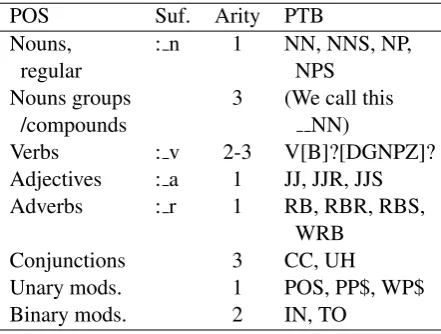
Tokens are divided into two simple groups based on the class of supported and ignored parts of speech. The forms used at Senseval 3 ignores for instance determiners because they complicate matters and do not have a great impact for many inference and semantics tasks. For each token of a supported part of speech, we create a predicate with its base form as head and a number of slots equal to its arity2. Table 1 lists the arities of differ-ent part-of-speech classes. For the tokens of parts of speech in the ignored set, we do nothing. The exceptions to this are noun groups and noun com-pounds for which an additional predicate is intro-duced to refer to the group/compound rather than to the components.
After these steps, our first example (Eqn. 1) would be equivalent to
John: n(s1,1),and(s2,1, s2,2, s2,3),
dog: n(s3,1),meet: v(s4,1, s4,2, s4,3),
at(s5,1, s5,2),his(s6,1),car: n(s7,1), (2)
where si,j are argument placeholders. We repeat
that we call the placeholders slots.
1Also called the dependency relation and dependency la-bel.
2
Table 1:Suffixes and arities of our part-of-speech classes, and the classes equivalences in the PTB.
POS Suf. Arity PTB
Nouns, : n 1 NN, NNS, NP,
regular NPS
Nouns groups 3 (We call this
/compounds NN)
Verbs : v 2-3 V[B]?[DGNPZ]? Adjectives : a 1 JJ, JJR, JJS Adverbs : r 1 RB, RBR, RBS,
WRB
Conjunctions 3 CC, UH
Unary mods. 1 POS, PP$, WP$ Binary mods. 2 IN, TO
The dependency graph models relations be-tween nodes. This is interpreted here as relations between entities. The entity that is involved in this kind of relation is the first argument of each pred-icate. For example, the arguments of theto pred-icate in our first example (Eqn. 1) aree1 andx4. These two entities are also the first arguments of other predicates,x4is the first argument of thedog predicate ande1 is the first argument of the event run. Furthermore, every entity in Eqn. 1 is the first argument of a verb, noun, or conjunction.
The primary POS tags that we use are listed in Table 1 along with the equivalent tags in the Penn-Treebank (Santorini, 1991).
We believe our system can relatively easily be extended to different arities and with support for any part of speech. At least as long as inference is not required in the transformation step. For in-stance, the meaning of the sentence Do not not breatheis that one should breathe, with a slightly different emphasis. This sentence is represented as
do: v(e1, x1, e2)∧not: r(e2, e3)
∧not: r(e3, e4)∧breathe: v(e4, x1), (3)
which could be reduced to
do: v(e1, x1, e4)∧breathe: v(e4, x1) (4)
(Do breathe). If reductions such as the above are required, it might not be straightforward to extend the system.
Let {pi = predi(si,1, . . . , si,arity(pi))} denote
the set of created predicates where w(pi) is the
associated token, POS(pi), its part of speech3, arity(pi), the predicate’s arity, andsi,j, thejthslot of theithpredicate.
5 Argument identification
So far, the steps have only involved simple rules directly given by the representation or relying on existing systems. The last step is less trivial and consists of identifying the real arguments for the slots.
5.1 Formalization
We introduce some notation that we use in the lat-ter sections. We letarg(si,j)be the function that maps thejthslot of theithpredicate to an entity. Witharg(si,j) ∈E andarg(si,j) ∈O we denote that the argument is an event and object, respec-tively.
The meaning of Eqn. 1 would be the same if we replaced all the occurrences of x1 with x5, sincex5does not appear elsewhere in the formula, i.e. we merely create an unique entity for it. At this point, we therefore concentrate on finding out what slots are mapped to the same arguments and not so much which specific entity it is. In fact, once we know which arguments should be same and which ones should not, it is an easy task to find a satisfying substitution since there are no re-strictions on the number of entities we may create. Aside from identifying which arguments are the same, we must determine if they are events or ob-jects. We will handle these two tasks in different sections even though the problems overlap.
5.2 Simplifications
Each predicate has an associated token and this to-ken has a node in the dependency graph. We also said that the first slot of each predicate should be the entity that participates in the relation that the dependencies model. We therefore do not always distinguish between tokens, predicates, nodes, and entities when talking about argument identifica-tion.
We define the argument search space of a slot to be a list of nodes in the DG that will we search through for a suitable argument. The slot is con-tained in a predicate and the predicate has an as-sociated node in the dependency graph. The space we use is defined as a region in relation this node.
3
Note that the space is over nodes in the graph and not entities.
For a dependency graph, the arguments of a predicate are usually found in the near vicinity of its node in the dependency graph. Particularly of-ten among its children or siblings, and occasion-ally its parent or grandchildren. It is also not cer-tain that a suitable argument exists in the sentence. We therefore restrict our argument search space to consist of the node’s parent, children, and sib-lings. If no suitable argument is found among these, we assume that the slot should contain an entity that does not appear elsewhere in the for-mula. To model preferences between nodes, we order the search space in different ways depend-ing on the parts of speech. This is covered in Sect. 5.3.
Different parts of speech also put different re-quirements on their arguments. For instance, ad-jectives generally only modify objects, not events. We collect these constraints under a function that depends on the parts of speech, among other things. We handle these functions, which we call argument constraint functions, in Sect. 5.4.
5.3 Argument search spaces
If p is a node in the dependency graph, then let
P(p), C(p), S(p), SL(p), SR(p)be the lists of,
re-spectively; the parents of the node4, the children of the node, the siblings of the node, the left siblings of the node, and the right siblings of the node. The lists should be sorted according to the order of ap-pearance of the nodes’ respective tokens in the to-ken sequence.
We use the set notation for operations on or-dered lists and with this, we implicitly mean that the elements of the resulting list follow the same order as the source list. One could see it as picking elements from left to right from the input list, pro-cess it, and place the result in the output list from left to right.
Take these equations as an example:
Y = (x∈X|x∈N ouns),
X= (saw,cat,yard,in). (5)
We first pick saw and discard it. Next we pick catand place it inY, andyardwhich we place to the right of cat. We finally discardin to get the resulting list:(cat,yard).
4
N.B. there is only one parent per node in dependency graphs.
With the described notation, we may formally define the left- and right-siblings:
SL(p) = (p0∈S(p)|t(p0)≺t(p)) (6)
SR(p) = (p0∈S(p)|t(p0)t(p)) (7)
For our simplified logical forms, we search for suitable arguments for up to two slots for each predicate. The slots for which we do not per-form search we call stable, and the remaining slots unstable. The stable slots are the first slots of all noun, verb, and conjunction predicates. Since the only classes with an arity of three are noun groups/compounds, verbs, and conjunctions, no predicate contains more than two unstable slots.
We have noticed that the arguments for the first and second unstable slots are found in a bit dif-ferent locations. We therefore separate the argu-ment search space for the first and second unsta-ble slot. Note that the spaces contains the same nodes, we only permute them differently. We call theseA1(p)andA2(p, q), where the latter term is the argument search space for the second unsta-ble slot of a nodep, given that we have identified the first argument as q (which is another node in the graph, recall that the argument spaces consists of nodes). We first introduce some of our com-mon spaces that we then use to define the above mentioned terms with respect to the nodes’ part of speech. The selection of the proper order is part linguistics and part understanding or mak-ing observations about the structure of dependency graphs. The permutations we describe are those that we through iterative experiments and analysis have found work well.
LetXR denote the listX in reverse order, and let multiplication implicitly denote concatenation of tuples, we describe the most common permuta-tions of the search space with
ALcrp(p) =SL(p)R·C(p)·SR(p)·P(p) (8)
ApLcr(p) =P(p)·SL(p)R·C(p)·SR(p) (9)
ArpLc(p) =SR(p)·P(p)·SL(p)R·C(p) (10)
AcrpL(p) =C(p)·SR(p)·P(p)·SL(p)R (11)
Notice how ALcrp(p) is equivalent to a preorder traversal of the nodes in the argument search space, except with the left siblings reversed. The other spaces are also given by shifting terms.
first unstable slot of nodep, and withADef,2(p, q),
the argument space function for the second unsta-ble argument of nodep, given that its first iden-tified argument is q. We define a shifted order,
AShi,1(p), because it is very similar to the default
and we refer to it later.
ADef,1(p) = (
ALcrp(p) p, P(p)∈N ouns ApLcr(p) else
(12)
AShi(p) = (
ArpLc(p) p, P(p)∈N ouns AcrpL(p) else
(13)
ADef,2(p, q) = (
ADef,1(p) q /∈SL(p) AShi(p) q ∈SL(p)
(14)
The default argument search spaces are used for nouns (N), conjunctions (C), adjectives (A) and adverbs (R). Ifk= 1,2, then
AN,k =AC,k =AA,k=AR,k=ADef,k (15)
The three exceptions to the default rule are: verbs (V), for which we prefer subject, object or verb chain functions, and unary (U) and binary (B) modifiers, for which we always use the shifted or-der.
AV,1(p) = (pi|w(p)−−−→SU B w(pi))· ADef,1(p)
(16)
AV,2(p, q) = (pi|w(p) r
−
→w(pi))· ADef,2(p, q),
r ∈ {OBJ, V C}
(17)
AU,1(p) =AB,1(p) =AB,2(p, q) =AShi(p) (18)
We may now define the search space for the first and secon arguments with respect to their part of speech as
Ak(p)≡ APOS(p),k(p) (19)
5.4 Argument constraint functions
The default constraint function, which we call
cDef, merely ensures that the first and second ar-guments are different, the arity of both is at least zero and if both belong to the preceding siblings, then the first argument must not precede the sec-ond.qandrare here the first and second identified arguments of the nodep.
cDef(p, q, r)⇔arity(q),arity(r)>0
∧q 6=r∧(q, r∈SL(p)⇒q r) (20)
As with the argument search space, we define the constraint functioncwith respect to its part of speech,
c(p, q, r)≡cPOS(p)(p, q, r) (21)
There are five classes with more specific re-quirements than the default but at least unary and binary modifiers are defined as the default con-straint function and the rest rely on it. Further-more, during evaluation, we found that the special constraint functions for conjunctions and adverbs virtually contribute with nothing over the default.
- Noun groups/compounds (N): All argu-ments are restricted to nouns.
- Verbs (V): Except for SUB/OBJ/VC func-tions, arguments must be nouns, conjunctions or verbs. These three classes are called stable and are described in the next section.
- Conjunctions (C): Generally both argu-ments, and subsequently its first argument, are either all events or all objects.
- Adjectives (A):Restrict to objects.
- Adverbs (R): We restrict adverbs to only modify events.
Recall thatE is the set of events, O the set of objects, and withrel(wi, wj), we denote the de-pendency relation between nodeswiandwj. The above explanations are formally defined as
cN(p, q, r)⇔POS(q),POS(r)∈N ouns
∧cDef(p, q, r) (22)
cV(p, q, r)⇔(POS(q)∈Stable∨rel(p, q)∈(∗))
∧(POS(r)∈Stable∨rel(p, r)∈(∗))
∧cDef(p, q, r) (23)
cC(p, q, r)⇔(q∈E⇔r ∈E)
∧cDef(p, q, r) (24)
cA(p, q, r)⇔q, r∈O
∧cDef(p, q, r) (25)
cR(p, q, r)⇔q, r∈E
∧cDef(p, q, r) (26)
5.5 Argument introduction
The next step is merely to test each predicate or pair of predicates in the argument search spaces for each predicate. The first predicate or pair of predicates that fulfills the constraint function is the best candidate as argument(s).
As mentioned earlier, the first slot of each node represents it in the relations. With potential argu-ments identified, we may therefore simply intro-duce equalities to represent these in terms of the predicates’ slots. If we find thatpkis the first
pred-icate in the search space for slotsi,j that satisfies
the constraints, thenarg(si,j) = arg(sk,1). Whenever we during search encounter nouns in the argument search space, we first check any as-sociated noun groups/compounds and any children that are conjunctions. This could be formalized as a function of a node which by default only lists the node itself and where nouns are the only ex-ceptions.
The constraint functions are defined with re-spect to both arguments, but in our system we use a simplified version; we begin by selecting a first argument that could fulfill the constraints for some second argument, we then search for the second argument. If no satisfying second argument can be found, we still keep the first:
ˆ
c(p, q)≡ ∃rc(p, q, r) (27)
It would be preferable to balance the position of the first and second argument in the ordered argu-ment space.
We conclude this step by merely going through slots and assigning entities. If an equality to an-other slot with an assigned entity exists, we assign the same entity to this slot; if none exists, we cre-ate a new entity.
5.6 Entity partitioning
[image:6.595.320.555.102.188.2]By default, all entities are considered objects. If it appears in the first slot of a verb, or in a conjunc-tion where all the children are events, it is how-ever considered an event. Because some constraint functions require knowledge of whether an entity is an event or not, the argument identification and entity partitioning decisions cannot be made inde-pendently. To handle this, our system identifies equalities like the ones above in two steps: the first step containing predicates which do not rely on whether slots refer to events or not, and the sec-ond containing those that do.
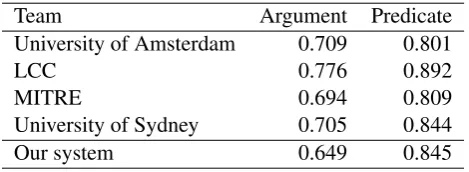
Table 2: Argument and predicate F-score for the systems of Senseval 3. The values are±0.001.
Team Argument Predicate
University of Amsterdam 0.709 0.801
LCC 0.776 0.892
MITRE 0.694 0.809
University of Sydney 0.705 0.844
Our system 0.649 0.845
5.7 Verb complements
As mentioned in Table 1 and as seen in Eqn. 1, verbs may have additional arguments besides their standard one or two. We have taken a simple ap-proach for identifying these modifier arguments: We check every path from the parent that does not contain another verb node. If a modifier at, by, for,from,in,of,onortois encountered, introduce an equality to its second argument. Preferably one would want to require the first argument to refer to be the verb in question but this lowers the accu-racy of our system. This list needs to be extended but we have not explored this further.
6 Results
For the logical forms identification task at Sense-val 3, eSense-valuation was done on a test set of 300 sen-tences. Participating teams submitted their out-puts, which were compared to a gold standard. To evaluate our system, we have use the anno-tated test set of the Senseval 3 conference and a released evaluation script. The evaluation is done in two parts: F-score on predicates and F-score on arguments. The systems at Senseval 3 achieved an argument F-score between 0.694 and 0.776 and a predicate F-score between 0.801 and 0.892. We report here an argument F-score of 0.649 and a predicate F-score of 0.845 on this test set5. Table 2 lists the respective systems and their F-scores. The values have been calculated from Rus (2004). We therefore do worse than the systems at Sen-seval 3 on the argument level but good on the pred-icate level, placing just below second place. The evaluation script does not seem to take into con-sideration all the equalities or inequalities between arguments or whether they are events or entities though.
5
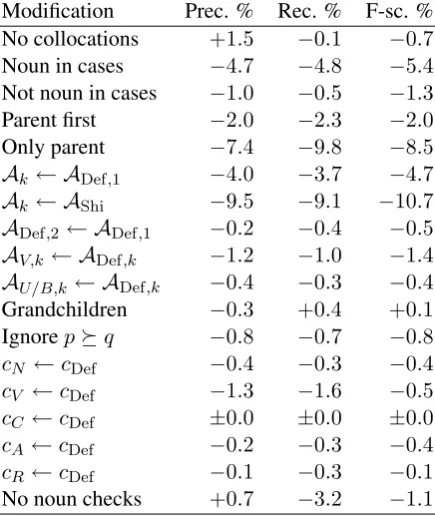
Table 3: Impact on the argument precision, re-call and F-score for different modifications. The changes are absolute, not relative.
Modification Prec. % Rec. % F-sc. %
No collocations +1.5 −0.1 −0.7
Noun in cases −4.7 −4.8 −5.4
Not noun in cases −1.0 −0.5 −1.3
Parent first −2.0 −2.3 −2.0
Only parent −7.4 −9.8 −8.5
Ak← ADef,1 −4.0 −3.7 −4.7 Ak← AShi −9.5 −9.1 −10.7 ADef,2 ← ADef,1 −0.2 −0.4 −0.5
AV,k ← ADef,k −1.2 −1.0 −1.4
AU/B,k← ADef,k −0.4 −0.3 −0.4
Grandchildren −0.3 +0.4 +0.1
Ignorepq −0.8 −0.7 −0.8
cN ←cDef −0.4 −0.3 −0.4
cV ←cDef −1.3 −1.6 −0.5
cC ←cDef ±0.0 ±0.0 ±0.0
cA←cDef −0.2 −0.3 −0.4
cR←cDef −0.1 −0.3 −0.1
No noun checks +0.7 −3.2 −1.1
The impact on the argument F-score for differ-ent rules are given in Table 3.
7 Discussion
Observing the mean F-score, our system, the Uni-versity of Amsterdam, and MITRE are very close to each other. There is then a large difference with University of Sydney and even greater with LCC. We still believe our results are good in comparison to the other systems if they have larger rule sets. Our approach is simple, robust, general and un-cluttered and there is a lot of work that can be done to improve it further without being constrained by a complicated or brittle design.
Auxiliary verbs are ignored by the simplified logical forms but it is not trivial as to what should be considered auxiliary verbs in specific contexts. We have difficulties in consistently separating the cases without introducing rules which are too spe-cific. Since this appears even in the development set, we expect it to have a large impact on the test set.
All argument search spaces we described have been permutations of the nodes in the subgraph rooted at a node’s parent, excluding the node itself. It seems like the argument search space should fre-quently contain grandchildren or nodes past the
parent, such as the grandparent or uncles. How-ever, carelessly including these classes in all the argument search spaces reduces the accuracy. This is because the search then discovers too many false equalities.
We notice that a fairly large portion of the errors originate from the preprocessing step. A mistake by the POS tagger propagates to the dependency graph, morphological parser, and the application of transformation rules. On the development set, we at one point noticed a difference of 4% in the logical form identification accuracy caused only be a 1% improvement in POS tagging (absolute units). It seems the accuracy would benefit a fair amount from further improvement of the part-of-speech and dependency-graph modules in particu-lar.
Our system assumes that all noun
groups/compounds should consist of compo-nents of exactly two objects each. In one example however, a noun group/compound of three objects was used with an arity of four. A related difficulty is the nesting of conjunctions in which its not immediately clear how the dependency-graph parser deals with them from case to case.
8 Conclusions
It appears as though we can conclude that trans-forming dependency graphs to the simplified log-ical forms with high accuracy is possible through a few simple rules. Formalizing them as search rules has reduced the complexity particularly and we believe this scheme should make further im-provement easy. Previous work in the area (Ahn et al., 2004) confirms the conclusion that it is rel-atively straightforward to implement a fair trans-formation scheme. We would like to add that im-plementing such a system is anything but complex or time-consuming, given the modules mentioned above.
9 Future Work
We have experimented with statistical logical form identification and believe that the scheme we have presented here provides a useful basis. There are however still a variable number of parameters for the decisions and they might not be as indepen-dent as preferable. A downside today is the lack of training data.
We have described three simplifications in our system: 1) we restrict the search space to nodes at distance one and two, 2) we greedily select the first argument before the second even though this is not warranted, and 3) we process slots which depend on whether other slots are events or not without any particular order after those that do not share this dependency. It would exciting to explore how to relieve or better handle these simplifications, in particular without causing an explosion of the ar-gument search space.
10 Acknowledgment
The work presented here has received much sup-port and guidance from Pierre Nugues at Lund university, both on the construction of the system and in particular on the authoring of this paper. He would likely have wanted to make many more sug-gestions on both.
References
David Ahn, Sisay Fissaha, Valentin Jijkoun, and Maarten De Rijke. 2004. The University of Amster-dam at Senseval-3: Semantic roles and Logic forms.
In Senseval-3, pages 49–53. Association for
Com-putational Linguistics.
Stephen Anthony and Jon Patrick. 2004. Dependency
based logical form transformations. InSenseval-3,
pages 54–57. Association for Computational Lin-guistics.
Roy Bar-Haim, Ido Dagan, Bill Dolan, Lisa Ferro, Danilo Giampiccolo, Bernardo Magnini, and Idan
Szpektor. 2006. Proceedings of the Second
PAS-CAL Challenges Workshop on Recognising Textual Entailment.
Samuel Bayer, John Burger, John Greiff, and Ben Well-ner. 2004. The mitre logical form generation
sys-tem. In Senseval-3, pages 69–72. Association for
Computational Linguistics.
Fellbaum. 1998. WordNet: An Electronic Lexical
Database. The MIT Press.
R. McDonald, K. Lerman, and F. Pereira. 2006. Mul-tilingual dependency analysis with a two-stage dis-criminative parser.
Altaf Mohammed, Dan Moldovan, and Paul Parker. 2004. Senseval-3 logic forms: A system and
pos-sible improvements. InSenseval-3, pages 163–166.
Association for Computational Linguistics.
Dan I. Moldovan and Vasile Rus. 2001. Logic form transformation of wordnet and its applicability to
question answering. In ACL ’01, pages 402–409.
Association for Computational Linguistics.
Dan Moldovan, Christine Clark, Sanda Harabagiu, and Steve Maiorano. 2003. Cogex: a logic prover for
question answering. In NAACL ’03, pages 87–93.
Association for Computational Linguistics.
Joakim Nivre, Johan Hall, and Jens Nilsson. 2006.
Maltparser: A data-driven parser-generator for de-pendency parsing. pages 2216–2219.
Adwait Ratnaparkhi. 1996. A maximum entropy
model for part-of-speech tagging. In Proceedings
of the Conference on Empirical Methods in Natural Language Processing.
Vasile Rus. 2001. High precision logic form
transfor-mation. InICTAI, pages 288–.
Vasile Rus. 2004. A first evaluation of logic form iden-tification systems. InSenseval-3, pages 37–40. As-sociation for Computational Linguistics.
Beatrice Santorini. 1991. Part-of-speech tagging
guidelines for the penn treebank project.
Helmut Schmid. 1994. Probabilistic part-of-speech tagging using decision trees. InInternational Con-ference on New Methods in Language Processing. unknown.
Marta Tatu, Brandon Iles, John Slavick, Adrian Novis-chi, and Dan Moldovan. 2006. Cogex at the second
recognizing textual entailment challenge. In
Pro-ceedings of the Second PASCAL Challenges Work-shop on Recognising Textual Entailment.
Kristina Toutanova and Christopher D. Manning.
2000. Enriching the knowledge sources used in
a maximum entropy part-of-speech tagger. In
EMNLP/VLC-2000.
Kristina Toutanova, Dan Klein, and Christopher D. Manning. 2003. Feature-rich part-of-speech
tag-ging with a cyclic dependency network. In
Proceed-ings of HLT-NAACL 03.
J. van Eijck and H. Alshawi. 1992. Logical forms.
In The Core Language Engine, pages 11–40. MIT