R E S E A R C H
Open Access
Towards next generation
software-defined radio access network–architecture,
deployment, and use case
Fangmin Xu
*†, Haipeng Yao
†, Chenglin Zhao and Chao Qiu
Abstract
As one of the key enabling technologies of the fifth generation wireless network (5G), software defined network (SDN) offers a logically centralized control model, flexible programmability, and a flow-based paradigm that is ideally suited for highly scalable wireless networks, from access to core part. Following this paradigm, a novel software-defined radio access network (SDRAN) architecture and the function modules have been proposed in this paper. In particular, the motivation, challenge, and deployment roadmap of SDRAN framework are discussed. The relationships between alternative solutions (Cloud RAN, network function virtualization) and complementary technologies (cognitive radio, self-organizing network, big data analysis) are analyzed in detail. Taking interference management of heterogeneous mobile network as the example use case, scheme design and preliminary system evaluations are given to show the benefit of SDRAN architecture.
Keywords: Software-defined network (SDN), radio access network (RAN), network function virtualization (NFV), the fifth generation wireless network (5G)
1 Introduction
With the maturing of the fourth generation wireless (4G) technologies and the ongoing widely deployment of 4G networks, research activities on 5G communication tech-nologies have emerged in both the academic and indus-trial communities. To support ultra-dense network traffic and massive connections with low latency, rethinking and restructuring of the current wireless network architecture is required [1].
As a networking paradigm that separates the control and data forwarding planes, software-defined networking (SDN) is currently being considered as an alternative to traditional distributed approaches based on highly spe-cialized hardware. With SDN, network operators can con-figure the behavior of both the traffic and the network in a centralized way. Until now, most of the use cases for SDN paradigm have been limited to wired environments or core part of the wireless network [2]. By separating the
*Correspondence: [email protected]
†Equal contributors
School of Information and Communication Engineering, Beijing University of Posts and Telecommunications, Xitucheng Road, No 10, Beijing, People’s Republic of China
control plane and data plane, building software via pro-gramming interfaces and virtualization technology, it is possible to achieve lower cost and higher efficiency using SDN and network function virtualization (NFV) [3].
There have also been some efforts looking at the use of SDN in wireless networks. OpenRoad [4] project at Stanford University introduced OpenFlow to wireless net-works to enhance the control plane. SoftRAN [5] from Alcatel-Lucent considered a logically centralized control plane and scalable distributed enforcement of quality of service (QoS) policies in the data plane. The control plane in SoftRAN programs and manages the abstracted radio resources in multiple dimensions. A SDN-like mobile net-work architecture was proposed in [6] with the example case on mobility management. Both RAN side and CN side are enhanced with programmability. Mobile network SDN controller manages the shared radio access and core network among multiple (virtual) operators. MobileFlow [7] from Huawei was another software-defined future mobile network architecture that enables operators to capitalize on a flow-based forwarding model. The virtual MobileFlow controller programs the forwarding of the user plane in a software-defined fashion. SoftMobile [8]
provided a SDN-based control framework to coordinate radio access functions(including mobility, load balancing, spectrum allocation, interference management, etc.) in heterogeneous networks.
In summary, above literatures discussed the architec-tures by the introduction of SDN to cellular network. However, few works have addressed the practical feasibil-ity aspects, such as challenges and roadmap in the evo-lution, whether the control functions could be virtualized and programmed in centralized controller, the potential gain of SDN-based RAN and the practical design.
To address above issues, the paper represents deep rethinking on the architecture of SDN-based wireless access network (SDRAN), including the driving force, challenge, and the evolution roadmaps from mobile oper-ators’ view. Based on the virtualization and orchestration of network components, virtual centralized or distributed controllers in SDRAN separates the complicated control function from data plane. In addition, the relationships between SDN-based RAN and C-RAN, NFV are clarified. And then a typical example case (interference manage-ment in heterogeneous network) is provided to show the possible advantage of the design.
The rest of this article is organized as follows. We first present the architecture SDRAN and its key ben-efits and challenges in Section 2. Section 3 focuses on the joint consideration of SDRAN and C-RAN, NFV, and SON. Section 4 presents a special use case developed on SDRAN, and simulation are illustrated to show the poten-tial benefits. A brief conclusion with some discussion on
the current implementations and further developments of SDRAN is presented in Section 5.
2 SDN-based radio access network architecture
and evolution roadmap
In this section, we will discuss the architecture of SDN-like radio access network and the motivation to deploy it from operators’ view. Moreover, we analyze the imple-mentation roadmaps of SDN-based radio access network.
2.1 Why use SDN here?
Unlike the evolution from 2G to 3G or from 3G to 4G, the motivation to enhance the current cellular network archi-tecture from 4G to 5G is driven by the mobile network operator in addition to the requirements from upcoming use cases. For instance, machine-to-machine communi-cation scenario requires exchange of huge amounts of small data among massive devices, and autonomous vehi-cle control requires real-time and reliable data exchanges. All of these diverse quality of service(QoS) requirements determine the transformation of next generation mobile network architecture in addition to the evolution of air interface technologies.
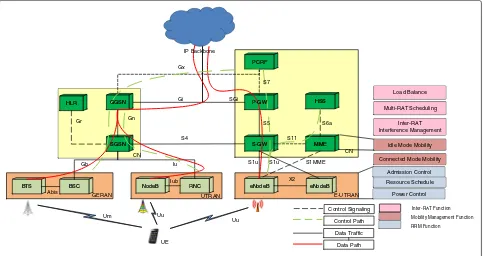
As illustrated in Fig. 1, in LTE networks, the user equip-ment (UE) connects to an eNodeB where data packets are transferred through a serving gateway (S-GW). The traffic tunneling origins from S-GW to the packet data network gateway (P-GW). The P-GW enforces QoS poli-cies and monitors traffic to perform charging. The P-GW also connects to the Internet and other cellular networks.
Uu
Control Path Mobility Management Function Idle Mode Mobility
Besides above data plane functionalities, the eNodeB, S-GW, and P-GW also participate in several control plane functions. Cooperating with the Mobility Management Entity (MME), they handle functions such as session setup, reconfiguration, as well as mobility management. The Policy and Charging Rules Function (PCRF) manages flow-based charging and QoS policy based on the user’s subscription profile. In addition, the Home Subscriber Server (HSS) contains subscription information for each user.
Today’s cellular network architectures have several major limitations. The contradiction between centralized data-plane functions and decentralize control plane is the main reason. For instance, centralized data-plane func-tions force all traffic through the P-GW, while the QoS functionality at the P-GW introduces scalability chal-lenges. In respect of the mobile operator, the existing cellular network architecture has the following problems.
• High Capital Expenditure (CAPEX)/Operating Expense (OPEX)
Dedicate hardware are designed to support different Radio Access Technologies (RATs) or services. In order to support advanced features or new functions of network devices, operators need update and replace the network hardware. Therefore, it introduces extra CAPEX and OPEX in network deployment and update.
• Low resource utilization efficiency
The resource (spectrum, computing, power and storage resource) for each RAT is unable to be integrated and virtualized. Thus, the problem of inefficient resource allocation and sharing is severe for the next generation wireless network. Also the performance of distributed resource management is far away from optimal.
• Complex interworking and interoperation The network equipment has vendor-specific configuration interfaces, and understanding of functionalities and implementation of interfaces between network devices is inconsistent. Therefore, interoperation among multiple RATs, even
coordination among multiple operators is complicated and inefficient based on the current structure.
Correspondingly,the SDN-like RAN architecture pro-vides following interesting features from the operator’s side.
• Reduce operation CAPEX/OPEX
On one hand, common network hardware could be configured and updated programmatically to act as any kinds of network devices. On the other hand, the
dummy and simple hardware of network device may lower the entry threshold of network device industry.
• Simpler interworking and interoperation by network virtualization, slice and isolation
Physical wireless network resources can be abstracted into virtual wireless network resources holding certain corresponding functionalities, and shared by multiple parties. Firstly, the centralized controller facilitates the coordination and cooperation of various RATs. Secondly, the network resource and infrastructure sharing will raise new security risk in interworking and interoperation, while virtual network isolation would alleviate the possible security risk.
• Optimized resource utilization efficiency by global view and centralized control
A SDN-enabled centralized controller will have a global view of the resource allocation, interference distribution, and resource usage. In addition, a SDN controller running on a commodity server would have much more computing resources than current network devices. As a result, a SDN controller can make a more efficient management of radio resources.
Meanwhile, the successful story and commercial matu-rity of SDN technology in wired network made all the things possible in technical aspect. The timing is ripe for the introduction of SDN to the future radio access network.
2.2 What is the architecture?
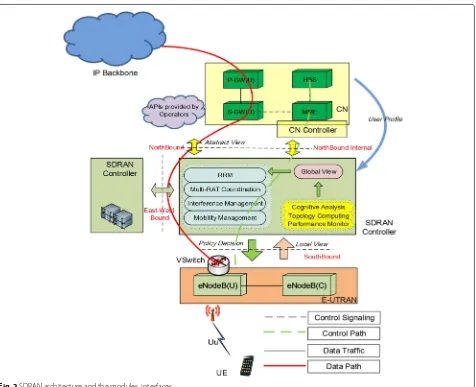
Figure 2 shows the proposed SDN-based cellular net-work architecture. Without loss of generality, we use eNodeB to represent the NodeB+RNC in 3G, etc. Com-pared with traditional cellular network architecture in Fig. 1, the main difference consisted of the following three points.
• Separate data and control path
As shown in Fig. 2, the control path (green dash line) and data path (red full line) are separated in both RAN side and core network (CN) side. In RAN side, the eNodeB could be logically split into two parts: eNodeB(U) and eNode(C), where the former implements the radio transmission with
configurations interpreted by eNode(C) according to delivered policy. Besides, eNode(C) reports local view (i.e., network status, such as network load and interference) to the central controller. Note that eNode(C) may also implement some control functions that are not suitable for virtualization or centralization. In the CN side, the P-GW and S-GW could also be virtualized into P-GW(U) and
Fig. 2SDRAN architecture and the modules, interfaces
The separation of data and control path is useful for the deployment and update of new service, facilitate the realization of centralized controller. However, the scalability (responsible for hundreds of data plane elements), reliability (what if a controller in failure), security (executing the network functions in this virtualized multi-tenant environment) and
consistency (ensure consistency between controllers) issues should be taken into account.
• Centralized regional controller in RAN
In the proposed architecture, the controllers could be logically divided into RAN controller and CN controller depending on the location of control entities. Only SDRAN controller is discussed in the article. As shown in Fig. 2, the SDRAN controller obtains the local view from eNode(C), and constructs the global resource and network topology view from the collected local views and subscriber profiles.
There are four interfaces defined for SDRAN controller.
Northbound interface to external API controlled by operators allowing them to dynamically change the share of resources and policy at any time or location. Northbound internal interface to CN controller. Information between SDRAN controller and CN controller is exchanged via the interface, enabling the cooperation and coordination of RAN and CN functions.
Southbound interface to RAN entity (eNodeB). This interface is used by the SDRAN controller to enforce different policies according to requests from the virtual operators and realize effective virtualization of the access network and resource, enable quick configuration of network parameters.
East-West bound interface to other SDRAN
of SDRAN controller, the east-west bound interfaces provide policies exchanged among inter-domain adjacent SDRAN controllers.
• Flow-like policy control
The flow paradigm of SDN is particularly well suited to provide end-to-end communications across multiple distinct technologies, such as 4G, and Wi-Fi. Flows can have granular policies for effective traffic isolation and QoS management. At the data plane, a flow is a programmable set of packets that share the same properties. The per-flow policy control allows the policy decision/enforcement for flow according to the user profile, network topology and status. The architecture could provide per-fow QoS and control actions.
2.3 Which function could be virtualized/centralized? The programmable configuration of the RAN functions allows the best dynamic use of available resource. How-ever, not all control functions are suitable for virtualized or centralized management. Firstly, the criteria which decide the functions could be virtualized/centralized are investigated as following.
• Need of coordination (in brief, NC)
All decisions that influence the decision-making at neighbouring cells should be made at the controller, since such decisions need to be coordinated across eNodeBs.
• Not delay sensitive (in short, DS)
The decisions which depend on rapidly varying network parameters or status can only be optimized at the eNodeB due to inherent delay between the SDRAN controller and eNodeB.
• Not bandwidth constrained (briefly, BC) Similar with delay constraint, the limited link
bandwidth between controller and eNodeB is another bottleneck, especially considering the high network density and scalability.
• With Abstracted View (in brief, AV)
The SDRAN controller obtains the global view from local view (information including but not limited to, network status and load situation) generated by eNodeBs. However, due to the feedback latency and bandwidth constraint, the abstraction of local detail view is vital for controller. Abstracted view is the abstraction of collected statistics and events, such as network status, surrounding environment, traffic load and network overload. However, some information required by some control functions is not suitable to abstract as local view, such as the transmitted data.
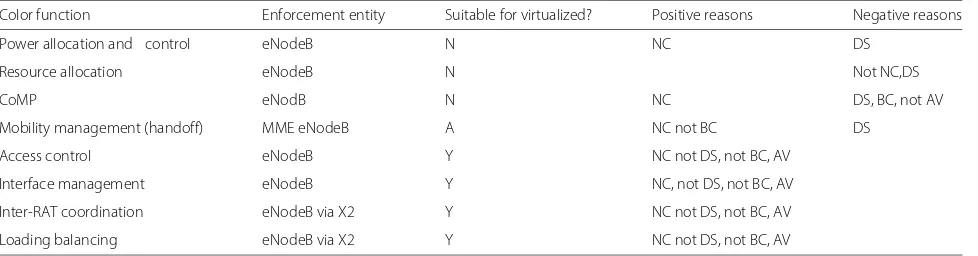
Among all functions in RAN side (not only limited to the functions implemented by RAN device(eNodeB) but also including functions with the cooperation of eNodeB), Table 1 shows the conclusion after analysis, where three situations are categorized: “Y,” “N” and “A.” Literally, “Y” and “N” presents the case that function could or could not be virtualized respectively. “A” stands for the function which could be assisted by centralized controller.
For instance, the resource allocation function does not have an impact on the decision-making at the neighbour-ing eNodeBs (Not NC) and will be influenced by the channel quality measurement reported by UEs in short period (DS); therefore, resource allocation task should be done by the eNodeB rather than at the SDRAN controller. In Coordinated Multiple Point Transmission (CoMP), joint transmission(JT) relies on the data sharing among different transmission points. As mentioned before, the transmission data is unsuitable to abstracted into local view.
2.4 How to realize the SDRAN architecture?
Considering the challenges to realize the SDRAN archi-tecture based on current networks, the following issues in the implementation are discussed from the view of mobile operator.
Table 1Summary of the feasibility of virtualized/centralized control functions
Color function Enforcement entity Suitable for virtualized? Positive reasons Negative reasons
Power allocation and control eNodeB N NC DS
Resource allocation eNodeB N Not NC,DS
CoMP eNodB N NC DS, BC, not AV
Mobility management (handoff) MME eNodeB A NC not BC DS
Access control eNodeB Y NC not DS, not BC, AV
Interface management eNodeB Y NC, not DS, not BC, AV
Inter-RAT coordination eNodeB via X2 Y NC not DS, not BC, AV
2.4.1 Evolutional or clean slate?
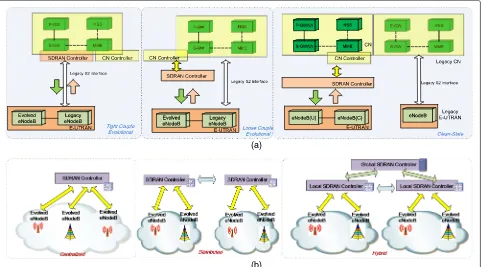
To solve the challenge of consistency, two different mod-els can be adopted to implement the SDRAN architecture: “evolutionary” and “clean slate.” The evolutionary model allows for gradually deployment based in existing net-works: legacy control plane entities from operators can connect to the core network without modifying the exist-ing interfaces. SDRAN controller implements backward-compatible interfaces to support the interworking with legacy network entities. There are two modes to couple the legacy architecture and future evolutional architec-ture: loose couple (fully decouple the legacy control plane entities and evolved control plane entities) and tight cou-ple (reuse the legacy control plane entities with evolved structure as much as possible).
In the clean slate model, the centralized control func-tions are constructed directly independent of legacy net-work. Although the deployment cost of this approach is relatively high, it enables the deployment of novel function and service easier and faster, as it can be directly imple-mented on the new controller and does not have an impact on legacy interfaces and devices. The illustrations of these models are given in Fig. 3a.
2.4.2 Centralized, distributed or hybrid?
Considering the scalability and limited capability of con-troller, with regarding the relationship between SDRAN
controllers, there are three possible ways: Central-ized, distributed and hybrid structure, as illustrated in Fig. 3b.
The centralized approach simplifies managing flows that are related to specific applications. But as networks scale and become more distributed, centralized control requires hardware with stronger computation and storage capability; therefore, it is less flexible and costly for mobile operator.
In the distributed structure, a centralized controller manages distributed data planes. From the implementa-tion view, there is a lot more complexity in deploying a distributed network. It may not be possible to get to all of the domains to create the same policy since there are latency and synchronization issues. The good aspects about distributed structure is that they are evolutionary and easy to scale, rather than replace treatment in the centralized structure.
The hybrid structure utilizes the benefits of the sim-ple control of managing specific data flows as in the centralized structure with the scalability and resiliency of the distributed structure. The hybrid approach allows for more flexible policy definition and enforcement in various scenarios (no matter in local scenario or large-scale deployment). However, the multiple-level structure will introduce inevitable latency and higher operation cost.
(a)
(b)
3 Relationships with alternative solutions and technologies
C-RAN and NFV are different ways to realize the effective usage of resource as SDRAN. In addition, there are some technologies that could be employed to assist the SDRAN architecture.
3.1 C-RAN
Cloud-RAN(or centralized RAN) is a centralized, cloud computing-based cellular network architecture that sup-ports efficiently centralize computational resource. By separating the BBUs from the radio access devices and migrating baseband units(BBUs) to the cloud forming a baseband resource pool for centralized processing, radio signals are exchanged over fronthaul between remote radio heads (RRHs) and the data center [9].However, full-scale coordination leads to high computational overhead and control signaling flooding in the BBU pool, espe-cially for a large-scale network. Therefore, C-RAN can be regarded as a specific component of SDN. With the assistance of SDN, the above control signaling problem in C-RAN could be possibly alleviated.
Literally, both C-RAN and SDRAN are featured by cen-tralized resource management and sharing. However, the different contents are centralized. In C-RAN, baseband data are collected by fronthaul, while SDRAN controller implements centralized control functions by gathered sig-naling and information rather than the data.Embedding C-RAN into the SDRAN architecture is a promising way to reduce the burden of controllers and integrates the wired and wireless sides of SDN seamlessly. Tak-ing C-RAN into account along with the SDN approaches will help in terms of reducing the overall signaling and simplifying the network topology from the controller perspective [14].
3.2 NFV
SDN and NFV are always linked together. NFV refers to the implementation of network functions by software running on general purpose computing platforms. Com-pared with the conventional network which implements network functions on dedicated and specific hardware, the main idea behind NFV is to reduce life and innova-tion cycles within telecommunicainnova-tion networks through software update rather than hardware update or replace. European Telecommunications Standards Institute (ETSI) has initiated working group and published whitepaper on NFV to show the benefits and challenges for NFV technologies to be deployed by network operators [12].
Naturally, SDN and NFV are complementary: The for-mer decouples control from the data path network func-tions, and the later decouples placement of the network functions from the underlying hardware. SDN owns the programmatic control and configuration of the devices
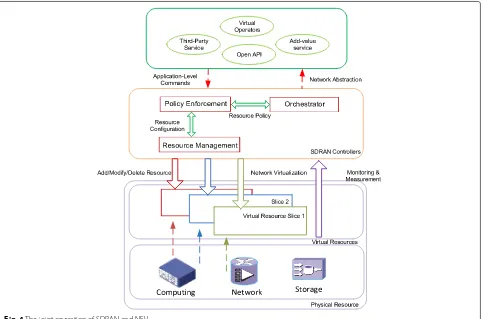
and network functions while NFV deals with the lifecycle of those functions. From an operator’s perspective, on the one hand, less update cost could be expected by the fea-ture of NFV due to the share of general computation and storage resource. On the other hand, virtual operators and novel services could be flexibly supported by the network abstraction and virtualization as shown in Fig. 4.
Physical wireless infrastructure and radio resources that belong to one or more mobile network operators(MNOs) could be abstracted to a virtual resource pool via NFV. Afterward, the virtual resources are isolated into mul-tiple virtual resource slices, which then can be offered to different virtual network operators(VNOs) or service providers(SPs) by the orchestration of SDRAN controller. SDRAN controller receives the application-level com-mand from SPs, inner orchestrator delivers delicate pol-icy and allocates or release dedicated resource slice for the SP.
With the joint cooperation of SDRAN and NFV, VNOs can lease virtual networks from MNOs, and MNOs can gain greater number of subscribers and revenues attracted from flexible services provided by VNOs or SPs. For MNOs themselves, since the network can be isolated into several slices, any upgrading and maintenance in one slice will not affect other services in other slices. For SPs, renting virtual networks helps them flexibly control of underlay infrastructure without vast investment, so that customized and more flexible services can be provided more easily and the QoS guarantee can be enhanced as well.
3.3 Self-organizing network (SON)
SON [10] is an automation technology designed to make the planning, configuration, management, optimization and healing of RAN simpler and faster. SON has recently attracted interests from operators since SON provides capabilities such as significant reductions in CAPEX and OPEX during both network deployment and operation period, improvements in network quality and quality of experience for users and provides optimized performance from adapting the network to environments and other operational conditions.
Fig. 4The joint operation of SDRAN and NFV
3.4 Cognitive radio
Few efforts are paid on the monitoring and learn-ing ability of SDN. Compared with wired networks, it could be harder to monitor the status of wireless net-works because the users and traffic patterns are always changing. Cognitive radio is a promising technology to improve the spectrum utilization efficiency, and it adapt dynamically to the outside RF environment by observing the radio scene in real-time and making deci-sions based on reasoning (facilitated by the learning capability).
Similarly, the basic functions for cognitive cycle, i.e. awareness of the environment and intelligence learning could be stretched from spectrum utilization to general resource utilization. Awareness of the radio environment stands for monitoring and sensing the radio system sta-tus. For instance, instead of reporting from user termi-nals, local status could be collected by dedicate cognitive nodes deployed in the area. Learning engine plays an important role in the system as it introduces intelligence to reduce complexity. The networks are configured to the optimal states by the reinforcement learning process automatically.
3.5 Big data analytics
The emerging big data paradigm will help to not only collect and filter network information but also present valuable sight and understanding for the operation of the network. Big data analytics can extract much more insightful information than traditional data analytics and can help improve the performance mobile cellular net-works and maximize the revenue of operators.
Particularly, with the global view of the wireless net-work, the logically centralized controller in SDRAN can collect kinds of large data from different components and layers with arbitrary granularity, such as channel state information at physical layer, packets information at link/network layers. Although sharing information among different layers can improve network performance, the network will become so complex that traditional approaches are inadequate to design and optimize such networks. Fortunately, big data analytics, which leverages analytical methods to obtain insights from data to assist decisions, can help the design and operation of control and management in SDRAN.
Firstly, unlike the common policy delivered for all users in the traditional wireless network, data analytic tools (clustering or classification algorithms) enable the per-user policy based on per-user preference and service features analyzed by history data stored in SDRAN controller.For instance, after classification based on user’s preference data on access networks (Wi-Fi or LTE), different users could be classified into several groups, the controller could make smart access decision for the users belong to the same group.
Secondly, mobile cellular networks’ operational deci-sions are usually made manually or depending on the algorithms inside the hardware. With the development of big data analytics, the operations of mobile cellular net-works can be higher availability, higher precision, dynamic and importantly in real-time. Real-time reactions bring in better performance, not only for the optimization of the network but also for the quality of user experience.
Furthermore, the prediction of user mobility and traf-fic patterns based on previous data is more accurate and efficient. Accurate prediction is necessary for adap-tively configuring the network policies and managing network resources, which are of importance for the pro-posed architecture.For example, the mobility prediction is useful for the mobility management in RAN, and SDRAN controller could allocate resource ahead of time for possible handover based on the prediction of users’ position.
4 Case study of software-defined RAN
The following case studies provide an illustration of intro-ducing SDN into radio access networks. As pointed out beforehand, logically centralized control allows for effi-cient resource coordination among cells, which is partic-ularly useful for solving inter-cell interference problem as described in the use cases below.
With the increase of network density and traffic density, inter-cell interference can lead to a significant degrada-tion in user throughput and service quality. Overlapping adjacent cells need to coordinate their resource alloca-tions (time/frequency/spatial dimension) to reduce harm-ful interference to users in overlapping area. There are a number of techniques proposed in 3GPP to alleviate the impact of inter-cell interference.
• Inter-cell interference coordination (ICIC; for release 8/9)
ICIC reduces the power for some sub-channels in the frequency domain. Relative narrowband transmit power indicator (RNTP), high interference indicator (HII) and interference overload indicator (OI) are defined to negotiate the interference between overlapping cells by X2 interface. RNTP, HII and OI are indication of possible downlink interference,
uplink interference (proactively triggered) and uplink interference (actively triggered), respectively.
• Enhanced inter-cell interference coordination (eICIC; for release 10)
eICIC is designed for the scenario where macrocell are complemented with low-power picocells in the hotspot area by coordination in time domain. Almost blank subframe (ABS) is designed that during ABS aggressor macrocell inflicting high interference onto victim picocell users are muted. In this way, the picocell users that are suffering from interference from the aggressor macrocell have a chance to be served in ABS.
There are some drawbacks for current inter-cell interference coordination techniques. Firstly, current inter-cell interference management is performed in a dis-tributed manner [11]. Generally, the processing complex-ity and overhead of distributed interference management impose high computing and resource burden on the RAN side. Secondly, the lack of global view and information exchanged lead to poor performance.
SDN-enabled access network offers the possibility to overcome the limitations described for inter-cell interference management. As shown in Fig. 2, the log-ically centralized controller enables radio resource allo-cation decisions to be made with global visibility across many base stations, which is far more optimal than the distributed interference management. By centralizing net-work intelligence and computation resources, resource allocation decisions can be adjusted based on the dynamic power and subcarrier allocation profile of each base sta-tion. In addition, scalability is improved because as new users are added, the required computing capacity at each base station remains low because these processing is cen-tralized in the SDRAN controller.
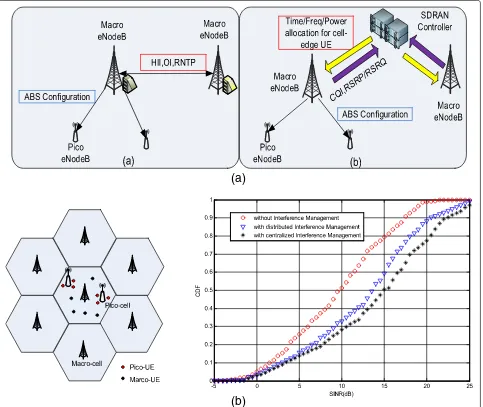
As given in Fig. 5, up-left and up-right figures show the difference of traditional distributed interference man-agement and logically centralized interference manage-ment. The SDRAN controller collects the necessary information such as CQI/RSRP/RSRQ measurement and bandwidth requirement from macrocells and picocells. The centralized interference management algorithm in SDRAN controller makes decision on frequency sub-channels/ABS configuration/power level (interference policy) for macrocells and picocells. Examples of such centralized algorithms are developed based on graph col-oring and optimization theory.
For instance, there are two picocells support ICIC and EICIC separately, denoted asPCf andPCt. The two
(a)
(b)
Fig. 5Illustration and system evaluation of inter-cell interference management scheme.aInterference management mechanisms andbSimulation scenario and results
the first time. SDRAN controller records the information into database. In eICIC, ABS patterns are configured in semi-statically and signaled between the macrocell and picocells over the X2 interface. The SDRAN controller is supposed to decide which subframes are to be set as ABS depending on different information. The picocell or macrocell initiate ABS request by sending load informa-tion (LI) to SDRAN controller. In addiinforma-tion, the SDRAN controller can ask the macrocell to communicate the utilization of the allocated ABS resources by starting a resource status (RS) reporting initialization mechanism. The macrocell responds and provides the required infor-mation with a RS update with ABS status.
Based on the ABS status from the macrocell, the SDRAN controller has sufficient information to deter-mine whether to use more or less subframes as ABS before
deciding on a new ABS muting pattern. The SDRAN controller answers by sending back LI message with ABS information (ABS ratio) to macrocell, and macro-cell will send another LI message which includes the ABS muting pattern. If the macrocell makes the decision of changing the ABS muting pattern, it informs the pico-cells within the cluster by means of an ABS information message.Periodically, SDRAN implement following algo-rithm to determine the ABS ratio(denoted byβ) and/or sub-channel ratio(denoted by α) among macrocell and picocells.
γk=
power,N0and B represents the noise power density and bandwidth, respectively.
In the presence of inter-cell interference, SNR is replaced by SINR, which can be obtained as
γk(f,t)=
the interfering celli.
Step 2: Label the edge UEs in victim cell based on following criteria:
γk(f,t)≤γth (3)
where γth is the minimal SINR threshold for UE.
Oth-erwise, the UEs are labeled as center UEs of victim cell. Calculate the traffic belong to the edge UEs in victim cell, denoted asuedge, while the total traffic of macrocell (interference cell) isumacro.
Step 3: SDRAN controller determines the ABS ratio(β) and sub-channel ratio(α) according to following algorithm.
1: Initiateα=β=0
2: Inputuedge,umacroProtocol version 3: Switch(Protocol version)
4: Case Release 8 or 9:
5: α=uedge/umacro 6: Case Release 10: 7: β=uedge/umacro 8: End switch
9: Outputα,β
Step 4: Macrocell eNB determine the ABS pattern or fre-quency sub-channels allocation based on parametersβ/α from SDRAN controller.
Some system-level simulations are implemented to prove the performance of proposed scheme. The simu-lation scenario is configured according to case 1 config-uration 4a (corresponds to the macrocell and picocells deployment with 6 dB range expansion) defined in the 3GPP [Ref TBA]. The scenario is composed of 21 macro-cells (i.e. seven three-sector co-sites macro-cells) and 2 picomacro-cells per macrocell. Thirtty UEs are dropped per macrocell area, where four UEs are located in each picocell. The remaining UEs are dropped randomly in the macrocell area without overlapping with picocell. Figure 5 shows the simulation scenario and the cumulative distribution
function (CDF) of signal-to-interference-plus-noise ratio (SINR) obtained in this scenario.
The distributed interference management scheme denotes the traditional approaches with the decision in each macrocell. We observe that the improvement on the SINR distribution for logically centralized interfer-ence management facilitated by the SDRAN architecture is about 2 dB compared with the distributed scheme.
5 Conclusions
In this article, we have identified the key benefits and challenges that software-defined networking can bring to radio access networks. We have presented a high-level general architecture of SDRAN along with some of its most relevant design and implementation details. Next, some alternative technologies such as C-RAN and NFV were discussed with the emphasis on the differences and complementation. Finally, a simple use case (interference management in heterogeneous network) is discussed to show the practical implementation and benefits of logi-cally centralized control.
This paper is only the first step towards the completion of a complete solution. In fact, several issues remain open, such as the compatibility with the current standards and the feasibility of virtualized control functions. The com-plete design of SDN-based RAN architecture is an exciting avenue for the future work.
Acknowledgements
This work is supported by the Key Program of the National Natural Science Foundation of China (Grant No. 61431008), BUPT Youth Research and Innovation Project (2015RC01).
Competing interests
The authors declare that they have no competing interests.
Received: 1 August 2016 Accepted: 26 October 2016
References
1. MY Arslan, K Sundaresan, S Rangarajan, Software-defined networking in cellular radio access networks: potential and challenges. IEEE Commun. Mag.53(1), 150–156 (2015)
2. X Zhou, Z Zhao, R Li, Y Zhou, T Chen, Z Niu, H Zhang, Toward 5G: When explosive bursts meet soft cloud. IEEE Netw.28(6), 12–17 (2014) 3. C Liang, Yu FR, Wireless network virtualization: a survey, some research
issues and challenges. IEEE Commun. Surv. Tutorials.17(1), 358–380 (2015) 4. K-K Yap, M Kobayashi, R Sherwood, N Handigol, T-Y Huang, M Chan, N
McKeown,OpenRoads: Empowering Research in Mobile Networks. (ACM SIGCOMM, Spain, Barcelona, 2009)
5. A Gudipati, D Perry, LE Li, S Katti,SoftRAN: Software defined radio access Network, HotSDN’13, (Hong Kong, 2013)
6. CJ Bernardos, A De La Oliva, P Serrano, A Banchs, LM Contreras, H Jin, JC Zu?niga, An Architecture for software defined wireless networking. IEEE Wirel. Commun.21(3), 56–61 (2014)
7. K Pentikousis, Y Wang, W Hu, MobileFlow: Toward Software-Defined Mobile Networks. IEEE Commun. Mag.51(7), 44–53
8. T Chen, Zhang H, X Chen, O Tirkkonen, SoftMobile: Control Evolution for Future Heterogeneous Mobile Networks. IEEE Wirel. Commun.21(6), 70–78 9. R Wang, H Hu, X Yang, Potentials and Challenges of C-RAN Supporting
10. A Imran, A Zoha, Challenges in 5G: How to Empower SON with Big Data for Enabling 5G. IEEE Netw.28(6), 27–33
11. OpenFlow-enabled mobile and wireless networks (2013). https://www. opennetworking.org/images/storiessdn-resources/solution-briefs/sb-wireless-mobile.pdf
12. Network functions virtualisation in ETSI (2015). http://www.etsi.org/ technologies-clusters/technologies/nfv
13. 3GPP TS36.101 Specification (2016). http://www.3gpp.org/ftp/Specs/ archive/36_series/36.101/36101-am0.zip
14. C Yang, Z Chen, B Xia, J Wang, When ICN meets C-RAN for HetNets: an SDN approach. IEEE Commun Mag.53(11), 118–125 (2015)
Submit your manuscript to a
journal and benefi t from:
7Convenient online submission 7Rigorous peer review
7Immediate publication on acceptance 7Open access: articles freely available online 7High visibility within the fi eld
7Retaining the copyright to your article