R E S E A R C H
Open Access
Global exponential synchronization of
networked dynamical systems under
event-triggered control schemes
Jie Gao
1,2*and Peiyong Zhu
2*Correspondence:
1School of Sciences, Southwest
Petroleum University, Chengdu, 610500, China
2School of Mathematical Sciences,
University of Electronic Science and Technology, Chengdu, 611731, China
Abstract
This paper investigates exponential synchronization of networked dynamical systems under event-triggered control schemes. Two event-triggered sampled-data
transmission schemes, which only need the latest observations of their neighborhood and the virtual leader to predict the next observation time, are designed to realize exponential synchronization of networked dynamical systems. That is, the coupled information is updated only when the triggered conditions are violated. Hence, continuous communication can be avoided and the number of information transmission is reduced. A positive lower bound for inter-event intervals is achieved to exclude Zeno behavior. Finally, two numerical simulation examples are provided to illustrate the effectiveness of the proposed results.
Keywords: exponential synchronization; networked dynamical systems; networked dynamical systems; event-triggered; Zeno behavior
1 Introduction
Networked control dynamical systems (NCDSs) have been widely studied over the past decades [–]. It is usually investigated in the NCDSs that all oscillators approach a uni-form dynamical behavior, that is, all the nodes in the NCDSs reach synchronization even-tually. In the process of synchronization, the couplings among nodes and/or external dis-tributed and cooperative control between nodes exist inevitably and meanwhile conflicts may exist due to the limitations of network resources and traffics []. In most previous ref-erences [–], each node received their neighbors’ information continuously, which may cost much. As an important component in NCDSs, intermittent sampling has emerged as an interesting topic to avoid communication continuously [–]. Nevertheless, sampled-data systems are usually applied periodically in time [, ], that is, time-triggered sam-pling, which might be conservative in terms of the number of control updates.
In order to utilize the real-time information sufficiently and to reduce communication and computation load in NCDSs, aperiodic event-triggered sampling, which is triggered only when measurement error signal violates a prescribed threshold [–], is proposed in the last few years. As pointed out in [], event-triggered sampling was proved to possess a better performance than time-triggered sampling. In event-triggered sampling control, the control law is updated only when some specific significant events occur, other state changes or occurrences of real-time entity are considered insignificant and are neglected
[–]. Event-triggered sampling control could adjust task periods to variations in sys-tem states adaptively, which produces longer task periods than time-triggered sampling control. In [], the authors studied the event-triggered distributed average-consensus of discrete-time first-order multi-agent systems with limited communication data rate and general directed network topology. The authors of [] studied the problem of average consensus over directed and time-varying digital networks of discrete-time first-order multi-agent systems with limited communication data transmission rates. Each agent has a real-valued state but can only exchange binary symbolic sequence with its neighbors due to bandwidth constraints.
Recently, great efforts are still made on applying event-triggered scheme (ETS) to coop-eration of multi-agent systems. A key issue of the event-triggered scheme is how to design and optimize event-based conditions and a big challenge is how to prove that inner-event time intervals are positive which can assure the absence of Zeno behavior. In [], leader-following consensus of general linear multi-agent is investigated by the event-triggered scheme. Three types of schemes, namely, distributed ETS, centralized ETS, and clustered ETS for different network topologies are proposed. All these schemes guarantee that all followers can track the leader eventually. In [], event-triggered coupling configurations are utilized to realize synchronization of linearly coupled dynamical systems. The diffu-sion couplings are set up from the latest observations of the nodes and their neighbor-hood and the next observation time is triggered by the proposed criteria based on the local neighborhood information as well. However, the graph in [] is undirected and connected.
Motivated by above statement, the objective of this paper is to design two event-triggered schemes for exponential synchronization of networked dynamical systems. The contributions of this paper are listed as follows. First of all, the network topology is directed and contains a directed spanning tree rooted at a virtual node. All the nodes are equipped with nonlinear dynamics. Thus, the model of this paper is more general than in [, , ]. Second, two distributed event-triggered schemes are proposed to realize exponential synchronization of the networked dynamical systems. The main difficulty of this paper is to prove the Zeno behavior is excluded under the two event-triggered schemes. In addi-tion, to further reduce the number of updatings, two distributed self-triggered schemes are proposed. It is proved that the exponential synchronization can be achieved and the Zeno behavior can be excluded simultaneously under the two self-triggered schemes.
The remainder of this paper is outlined as follows. In Section , preliminaries includ-ing some necessary definitions and lemmas and the model description are stated. In Sec-tion , event-triggered schemes are proposed to realize exponential synchronizaSec-tion and the Zeno behavior can be excluded under the proposed schemes. In Section , the dis-tributed self-triggered schemes are presented according to the event-triggered schemes. In Section , some numerical examples are given to show the effectiveness of the theoret-ical results. Finally, the conclusion is drawn in Section .
Notation Throughout this study,RnandRn×nrepresent the set of allndimensional real column vectors and the set of alln×ndimensional real matrices. The superscriptT rep-resents the transpose. · denotes the Euclidean norm, that is, for any vectorξ ∈Rn,
ξ= (ξ , . . . ,ξn)
.xp= (xTPx) for some positive definite matrixP∈Rn×n.λmax(A)
andλmin(A) are respectively the maximum and minimum eigenvalues of matrixA.⊗
2 Preliminaries and problem formulation
The dynamics of generally networked systems under pinning control can be described as follows:
˙
xi(t) =fxi(t)+ N
j=
aijxj(t) –xi(t)+ui(t), i= , . . . ,N, ()
whichxi(t) = (xi(t),xi(t), . . . ,xin(t))T∈Rndenotes the state vector of nodeiand the con-tinuous mapf(·) :RN →RN denotes the identical node dynamics if there is no coupling.
∈Rn×ndescribes the inner-coupling positive definite matrix between the subsystems. A= (aij)∈RN×N is the weighted adjacency matrix of the directed graphG ={V,E}with the node set V and the link setE:aij> if there exists a directed link from nodejto i at timet;aij= , otherwise. Define the graph Laplacian matrix ofAasL= (lij)∈RN×N, in whichlij= –aij, fori=j, andaii=
N
j=aij.ui(t) is the pinning control input to be de-signed. The information in the networks is usually considered to communicate continu-ously. However, when the nodes are equipped with limited computation capability, limited capability of communication, actuation, and limited onboard energy source, it is not eco-nomic to communicate information continuously.
Therefore, an intermittent event-triggered information transmission mechanism emerges reducing the number of communications and computations. In this paper, two distributed event-triggered schemes will be adopted to synchronize the network () with a certain desired states(t) which can be an equilibrium point, periodic orbit or chaotic attractor in the phase space satisfying
˙
s(t) =fs(t), ()
wheres(t) = (s(t),s(t), . . . ,sn(t))T∈Rnis a virtual node. The virtual node and the directed
graph constitute an augmented graphG.
Then the network model with event-triggered diffusive coupling under pinning control is investigated as follows:
˙
xi(t) =fxi(t)+ N
j=
aijxjtkii–xitkii–dixitkii–stkii, t∈tkii,tkii+, ()
whereti
ki,i= , . . . ,N, represents theith node’s latest triggering time instant before timet, ti
ki+is the next triggering time instant. When theith node is pinned by the virtual node,
di> ; otherwise,di= . Fort∈[ti
ki,tkii+),i= , . . . ,N, synchronization error and measurement error of nodei
are respectively defined asei(t) =xi(t) –s(t), andδi(t) =xi(tkii) –xi(t),δj(t) =xj(tkii) –xj(t), j=i,δ(t) =s(tkii) –s(t).
Then one can get
˙
ei(t) =fei(t)– N
j=
lijejtkii–dieitiki, ()
The objective of this paper is to design appropriate event-triggered schemes such that () and () can reach exponential synchronization.
Throughout the rest of the paper, the following assumptions and lemma are needed.
Definition Consider the node dynamics mapf(·) :RN →RN. If there exist a positive definite matrixP∈Rn×n, constantα∈R, and positive constantβ> such that,
(u–v)TPf(u) –f(v) –α(u–v)≤–β(u–v)T(u–v) ()
holds for allu,v∈RN. Then we say it belongs to some map classQuad(P,α,β). Assumption There exists a positive constantksuch that for anyu,v∈Rn,
f(u) –f(v)≤ku–v.
Assumption The augmented graph contains a directed span tree rooted at the virtual node.
Lemma Let L be the Laplacian matrix of a non-negatively weighted digraphG and D= diag{d, . . . ,dN}be a nonnegative diagonal matrix.Then we have the following facts:
() IfG is balanced,then L+LT +D> if and only ifG is weakly connected. () IfG has a directed spanning tree,then there exists a positive diagonal matrix
=diag{ξ, . . . ,ξN},such that
(L+D) + (L+D)T> . ()
Then all the eigenvaluesλi of(L+D) + (L+D)Tare positive.That is, <λ≤λ≤ · · · ≤λN.
Remark In [], the trajectories of all nodes commonly converge to a time-varying weighed average x¯=Nj=ξjxj(t). All the nodes in this paper could synchronize with an arbitrary desired states(t) which can be an equilibrium point, periodic orbit or chaotic attractor. In addition, the authors of [] make use of the general algebraic connectivity to reach global synchronization, which is fit for a strongly connected network. This paper only requires the augmented graph contains a directed spanning tree rooted at the virtual node which does not require the coupling matrix to be symmetric.
3 Event-triggered scheme for pinning synchronization
In this section, pinning synchronization of the considered network () with () is inves-tigated under event-triggered mechanism. The following algorithm [] is proposed to determine at least how many and what kinds of nodes should be pinned such that As-sumption holds.
Step : Check whether there exists at least one nodenkbelonging toGh, which is reachable from a nodengbelonging toGj,j= , , . . . ,ω,j=h. If it holds, go to Step ; if it does
not hold, go to Step .
Step : Check whether the following condition holds:h<ω. If so, leth=h+ and return Step ; else stop.
Step : Arbitrarily having selected one node inGhand pinned, letmh= . Check whether
the following condition holds:h<ω. If so, leth=h+ and return Step ; else stop.
Remark Using Algorithm , we should select at leastδ=ωi=minodes inG(A) to be pinned such that Assumption holds. That is, Assumption can never be ensured if there are onlyμnodes to be pinned, whereμ<δ.
Based on the above analysis, one may obtain the following theorem, which summarizes the main result of this section.
Theorem Suppose Assumptions-are satisfied and f ∈Quad(P,α,β)with a positive matrix P andα<ξλ
max,β> ,and Pis semipositive definite,whereξmax=max{ξ, . . . ,ξN}.
Pick <β<β.Denoteκi(t) = N
j=lijδj(t) +di(δi(t) –δ(t)).Then either one of the
fol-lowing two updating rules can guarantee that()synchronize with()exponentially.
() Setti
kias the triggering time point by the rule
tkii+=max
() Settkii as the triggering time point by the rule
tkii+=max
Then, by using (), () can be rewritten as
Consider the following Lyapunov function:
Taking the derivative ofV(t) along the trajectories () gives
˙
Under the conditionα<ξλ
max, one obtains
˙
V(t)≤–βV(t) +ελmax(P)V(t) +
ε
N
i=
ξiκi(t)
= –β–βV(t) +–β+ελmax(P)
V(t) +
ε
N
i=
ξiκi(t), ()
where <β<β.
() If it is guaranteed that
N
i=
ξiκi(t)≤ε
β–ελmax(P)
N
i=
ξieTi(t)Pei(t) ()
for some constantε> , then one gets
˙
V(t)≤–β–βV(t). ()
That is, the network () can synchronize with () exponentially fast with the rate of (β–β).
A sufficient condition for () is that
κi(t)≤ε(β
–ελ
max(P))
Nξmax
N
i=
ξieTi (t)Pei(t). ()
Notemaxε>{ε(β
–ελmax(P))
Nξmax }=
β
Nξmaxλmax(P), whenε=
β λmax(P).
Then () can be guaranteed whenε=β/λmax(P).
() Takeε= β/λmax(P). If it is guaranteed that
κi(t)≤aexp(–bt), ()
one gets
˙
V(t)≤–β–βV(t) +a
λ
max(P)
N i=ξi
β exp(–bt), ()
which implies thatV(t) converges to exponentially.
Remark In Theorem , two event-triggered conditions () and () are proposed. At the triggering timeti
ki, the left-hand termκi(tiki)= . In (), if there exists at least one node which does not synchronize withs(t), the right-hand term must be positive. Therefore, the next triggering timeti
Next, it is proved in detail that under the two updating rules () and (), the inter-event sampling time instantstkii+–tikifor each node is strictly positive, that is, the coupled net-work can avoid the Zeno behavior.
Theorem Suppose Assumptions-are satisfied and f ∈Quad(P,α,β)with a positive matrix P andα<ξλ
max,β> ,and Pis semipositive definite.For any <β
<βand any
initial condition,the following two propositions are hold.
() Under the event-triggered scheme(),each node has positive interevent interval which is lower bounded by a constantτDi.
() Under the event-triggered scheme(),the interevent interval of every node is strictly positive and is lower bounded by a common constantτDi.
Proof () Under the updating rules (), fort∈[tiki,tiki+), one has
≤
Sincef ∈Quad(P,α,β) andf satisfies Assumption , there exists someσ(possibly neg-ative) such that
Used for the continuity ofκi(t) between the event-triggered time instantstkii andtkii+,
the event-triggered time instant tkii+ should satisfyκi(tiki+)= √ β Nξmaxλmax(P)
V(tkii+).
Hence, combining with () and (), in order to ensure event-triggered condition () is satisfied after instantti
ki, it is necessary to require the time instantt i
Therefore, it is concluded that the inter-event timeti
() Under the updating rules (), fort∈[tiki,tiki+), by (), one obtains
V(t)≤ρexp(–bt), ()
whereρ=V() + aλmax(P) β(β–β–b)
N i=ξi.
Then
ei(t)˙ ≤
k+
N
j=
|lij|+di
ρ
Nξminλmin(P)
+a
exp–btiki
=ηiexp
–btkii, ()
whereηi= (k+ N
j=|lij|+di)
ρ
Nξminλmin(P)+a.
Hence,
κi(t)≤
N
j=
|lij|ηj+diηi
exp–btikit–tkii. ()
Therefore, () can be guaranteed if the following inequality holds:
N
j=
|lij|ηj+diηi
t–tiki≤aexp–bt–tkii. ()
Since whent=ti
ki,κi(t)= . Under the updating rule (), the next event will not be triggered until κi(t)=aexp(–bt). Thus, the inter-event timetki
i+–t i
ki of the nodeiis lower bounded by the solutionτDi of the following equation:
N
j=
|lij|ηj+diηi
τDi =aexp–bτDi. ()
It can be seen that this equation has a positive solution.
This completes the proof.
Remark In Theorem , it is proved that under the two event-triggered schemes, the
Zeno behavior can be excluded. From () and (), it can be seen that the interevent interval of every node is strictly positive and is lower bounded by a common constantτDi.
4 Self-triggered scheme for pinning synchronization
Under the updating rules () and (), one is required to verify the event-triggered condi-tion continuously. To avoid continuously communicacondi-tion among nodes, a self-triggered scheme based on Theorem is proposed. Under the self-triggered scheme, each node in the network can predict next triggered time instant ti
ki+ only based on the received
Supposet∈[tkii,tkii+) andjis the neighbor of the nodei. Before the next event-triggered time instant of nodej, one can obtain
xj(t) =xj Following from the Grönwall inequality, one gets
ej(t) –ej
In the following, combining with the event-triggered schemes () and (), two self-triggered algorithms are given as follows.
Algorithm (Self-triggered algorithm)
Step : Initialization: setti= , for alli= , , . . . ,N.
Step : At time tkii, ki≥, solve the following equation to find the next triggering time
Step : If nodeidoes not receive the renewed information from any of its neighbors during
(tiki,tiki+), nodeiis triggered on time instanttiki+.
Step : If nodeireceives the renewed information from its neighborjat timetik
i<t
max,β> ,and Pis semipositive definite.Then,for any positive
<β<β,under the self-triggered Algorithm, ()can achieve synchronization with() exponentially.Moreover,the difference of the inter-event sampling time instantτDi for node i is lower bounded by a common positive instant which is given as
sup
Proof Under the self-triggered Algorithm , one can have
κi(t)≤
Then, according to Theorem , () can achieve synchronization with () exponentially. Next, it is only proved that the inter-event interval of nodeiis strictly positive and has a lower boundτDi, which is given as (). Furthermore
Hence, a sufficient condition to satisfy the updating rule () is N
Thus, for each node, under the self-triggered Algorithm , the lower bound of the inter-event sampling time can be given by
sup
Remark In (), ifτDi = , the left-hand term equals zero, while the right-hand term is nonzero. Therefore, the inter-event interval of nodeiis strictly positive and has a lower boundτi
D, which is given as (). To predict the next triggering time, each node only re-quires the states of itself and its neighbors at the last triggering time.
According to the event-triggered scheme (), one can get the following result.
Theorem Suppose Assumptions-are satisfied and f ∈Quad(P,α,β)with a positive matrix P andα< λ
ξmax,β> ,and Pis semipositive definite.For any positive <β <β,
set inter-event intervalτDi by
τDi =sup
τ≥ :( N
j=|lij|ϕj+diϕi) k
exp(kτ) – ≤aexp–btiki+τ. ()
The triggering time ti
kiis by the following algorithm:
() Initialization:setti
= ,for alli= , , . . . ,N.
() At timetiki,ki≥,solve the following equation to find the next triggering timetiki+:
(Nj=|lij|ϕj+diϕi) k
expkτDi– ≤aexp–btkii +τDi. ()
() Trigger nodeiby changingti kiintot
i ki+=t
i ki+τ
i D.
Then()can synchronize with()exponentially and the Zeno behavior can be excluded.
The proof of this theorem is similar to Theorem .
5 An illustrative example
In this section, two numerical simulation examples are given to illustrate the effectiveness of the proposed methods. The system is an array of linearly coupled Chua circuits with the node dynamics
fxi(t)= ⎛ ⎜ ⎝
p∗(–xi+xi–g(xi))
xi–xi+xi
–q∗xi
⎞ ⎟
⎠, ()
wherexi(t) = (xi(t),xi(t),xi(t))T, andg(v) =m∗v+ (m–m)∗(|v+ |–|v– |)/ with
the parametersp= .,q= .,m= –.,m= –.. The intrinsic node dynamics
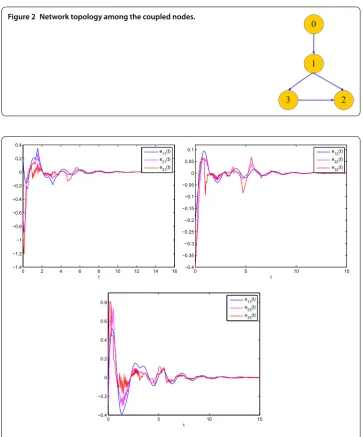
Figure 2 Network topology among the coupled nodes.
Figure 3 Synchronization errors of the 3 nodes under the updating rule (7).
(without diffusion) has a double-scrolling chaotic attractor [], which is shown in Fig-ure . The coupling graph topology is shown in FigFig-ure . Node is the virtual node. To validate theQuadcondition, letP==I, whereIstands for the identity matrix of three
dimensions. Noting the Jacobin matrices off is one of the following:
A=
⎛ ⎜ ⎝
–. . – –.
⎞ ⎟
⎠, A=
⎛ ⎜ ⎝
. . – –.
⎞ ⎟
⎠, ()
then we can estimateβ=α–λmax((A)s) =α– ., where . is the largest
eigen-value of the symmetry parts of all Jacobin matrices off. In the following, we pickα= ,
β= .. Thus,f satisfies theQuadcondition. Pickd= .,d=d= . Then there
Figure 4 Synchronization errors of the 3 nodes under the updating rule (8).
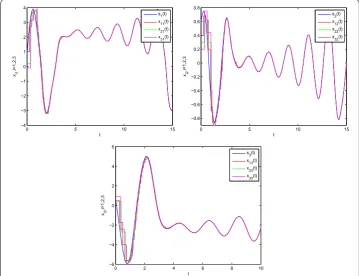
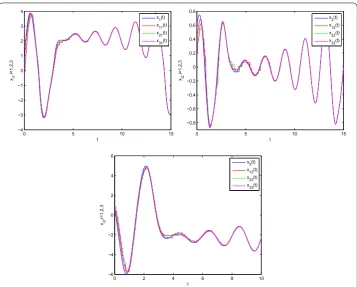
Figure 6 Tracking trajectories between the virtual node and the 3 nodes under the updating rule (45).
with eigenvaluesλ= .,λ= .,λ= .. The ordinary differential () and ()
are numerically solved by the Runge-Kutta method with a time step . (seconds) and the time duration of the numerical simulations is [, ] (seconds). Under the updating rule (), Figure shows the synchronization errors of the nodes. We take the same value ofdi as above anda= . andb= .. Figure shows the synchronization errors of the nodes under the updating rule (). The tracking trajectories between the virtual node and the nodes under the updating rule () and () are shown in Figures and , respectively.
6 Conclusions
In this paper, event-triggered schemes and self-triggered schemes are investigated to re-alize the exponential synchronization of the networked dynamical systems. The coupled information under these schemes is updated only when the triggering conditions are vi-olated. The next observation time for these nodes is predicted only based on the latest observations of their neighborhood and the virtual leader. Thus, continuous communica-tion can be avoided and the number of informacommunica-tion transmission is largely reduced. More-over, a positive lower bound for inter-event intervals is achieved and the Zeno behavior can be excluded. Finally, two numerical simulation examples are provided to illustrate the effectiveness of the proposed results. In the future, we will focus on the related applica-tions of the event-triggered scheme in the coupled neural networks with time-delays and quantization.
Competing interests
Authors’ contributions
All authors contributed equally to the writing of this paper. All authors read and approved the manuscript.
Acknowledgements
This work was supported by the National Natural Science Foundation of China (11501391, 11601449) and by the Key Program of Sichuan Provincial Department of Education (16ZA0066).
Received: 17 May 2016 Accepted: 19 October 2016
References
1. Hespanha, JP, Naghshtabrizi, P, Xu, Y: A survey of recent results in networked control systems. Proc. IEEE95(1), 138-162 (2007)
2. Huang, C, Ho, DW, Lu, J, Kurths, J: Pinning synchronization in T-S fuzzy complex networks with partial and discrete-time couplings. IEEE Trans. Fuzzy Syst.23(4), 1274-1285 (2015)
3. Tang, Y, Gao, H, Kurths, J: RobustH∞self-triggered control of networked systems under packet dropouts (2015). doi:10.1109/TCYB.2015.2502619
4. Lu, J, Zhong, J, Tang, Y, Huang, T, Cao, J, Kurths, J: Synchronization in output-coupled temporal Boolean networks. Sci. Rep.4, 6292 (2014)
5. Wang, T, Gao, H, Qiu, J: A combined adaptive neural network and nonlinear model predictive control for multirate networked industrial process control. IEEE Trans. Neural Netw. Learn. Syst.27(2), 416-425 (2016)
6. Su, H, Rong, Z, Chen, MZ, Wang, X, Chen, G, Wang, H: Decentralized adaptive pinning control for cluster synchronization of complex dynamical networks. IEEE Trans. Cybern.43(1), 394-399 (2013)
7. Yu, W, Chen, G, Lu, J, Kurths, J: Synchronization via pinning control on general complex networks. SIAM J. Control Optim.51(2), 1395-1416 (2013)
8. Deng, L, Wu, Z, Wu, Q: Pinning synchronization of complex network with non-derivative and derivative coupling. Nonlinear Dyn.73(1-2), 775-782 (2013)
9. Wu, Z-G, Shi, P, Su, H, Chu, J: Sampled-data exponential synchronization of complex dynamical networks with time-varying coupling delay. IEEE Trans. Neural Netw. Learn. Syst.24(8), 1177-1187 (2013)
10. Wen, G, Yu, W, Chen, MZ, Yu, X, Chen, G: Pinning synchronization of directed networks with aperiodic sampled-data communications. IEEE Trans. Circuits Syst. I, Regul. Pap.61(11), 3245-3255 (2014)
11. Li, H, Liao, X, Huang, T, Zhu, W, Liu, Y: Second-order global consensus in multiagent networks with random directional link failure. IEEE Trans. Neural Netw. Learn. Syst.26(3), 565-575 (2015)
12. Zhang, L, Gao, H, Kaynak, O: Network-induced constraints in networked control systems - a survey. IEEE Trans. Ind. Inform.9(1), 403-416 (2013)
13. Gao, H, Chen, T, Lam, J: A new delay system approach to network-based control. Automatica44(1), 39-52 (2008) 14. Wang, X, Lemmon, MD: Self-triggering under state-independent disturbances. IEEE Trans. Autom. Control55(6),
1494-1500 (2010)
15. Wang, X, Lemmon, MD: Event-triggering in distributed networked control systems. IEEE Trans. Autom. Control56(3), 586-601 (2011)
16. Hu, W, Liu, L, Feng, G: Consensus of linear multi-agent systems by distributed event-triggered strategy. IEEE Trans. Cybern.46(1), 148-157 (2016)
17. Åström, KJ, Bernhardsson, B: Comparison of Riemann and Lebesgue sampling for first order stochastic systems. In: Proceedings of the 41st IEEE Conference on Decision and Control, vol. 2, pp. 2011-2016. IEEE Press, New York (2002) 18. Garcia, E, Antsaklis, PJ: Model-based event-triggered control for systems with quantization and time-varying network
delays. IEEE Trans. Autom. Control58(2), 422-434 (2013)
19. Hu, S, Yue, D: Event-triggered control design of linear networked systems with quantizations. ISA Trans.51(1), 153-162 (2012)
20. Li, H, Liao, X, Chen, G, Hill, DJ, Dong, Z, Huang, T: Event-triggered asynchronous intermittent communication strategy for synchronization in complex dynamical networks. Neural Netw.66, 1-10 (2015)
21. Li, H, Liao, X, Huang, T, Zhu, W: Event-triggering sampling based leader-following consensus in second-order multi-agent systems. IEEE Trans. Autom. Control60(7), 1998-2003 (2015)
22. Guo, G, Ding, L, Han, Q-L: A distributed event-triggered transmission strategy for sampled-data consensus of multi-agent systems. Automatica50(5), 1489-1496 (2014)
23. Li, H, Chen, G, Huang, T, Dong, Z, Zhu, W, Gao, L: Event-triggered distributed average consensus over directed digital networks with limited communication bandwidth. IEEE Trans. Cybern. (2016). doi:10.1109/TCYB.2015.2496977 24. Li, H, Chen, G, Huang, T, Dong, Z: High-performance consensus control in networked systems with limited
bandwidth communication and time-varying directed topologies. IEEE Trans. Neural Netw. Learn. Syst. (2016). doi:10.1109/TNNLS.2016.2519894
25. Xu, W, Ho, DW, Li, L, Cao, J: Event-triggered schemes on leader-following consensus of general linear multiagent systems under different topologies. IEEE Trans. Cybern. (2015). doi:10.1109/TCYB.2015.2510746
26. Lu, W, Han, Y, Chen, T: Synchronization in networks of linearly coupled dynamical systems via event-triggered diffusions. IEEE Trans. Neural Netw. Learn. Syst.26(12), 3060-3069 (2015)
27. Wen, G, Yu, W, Zhao, Y, Cao, J: Pinning synchronisation in fixed and switching directed networks of Lorenz-type nodes. IET Control Theory Appl.7(10), 1387-1397 (2013)
28. Tarjan, R: Depth-first search and linear graph algorithms. SIAM J. Comput.1(2), 146-160 (1972)
29. Li, L, Ho, DW, Cao, J, Lu, J: Pinning cluster synchronization in an array of coupled neural networks under event-based mechanism. Neural Netw.76, 1-12 (2016)