R E S E A R C H
Open Access
Modulational instability and higher-order
rogue wave solutions for an integrable
generalization of the nonlinear Schrödinger
equation in monomode optical fibers
Xiao-Yong Wen
**Correspondence:
[email protected] Department of Mathematics, School of Applied Science, Beijing Information Science and Technology University, Beijing, 100192, China
Institute of Systems Science, AMSS, Chinese Academy of Sciences, Beijing, 100190, China
Abstract
We consider the integrable generalization of the nonlinear Schrödinger equation that arises as a model for nonlinear pulse propagation in monomode optical fibers. The existent conditions for its modulational instability to form the rogue waves is given from its plane-wave solutions. We propose a generalized (n,N–n)-fold Darboux transformation for this system by using theNth-order Darboux matrix, Taylor expansion, and a limit procedure. As an application, we use the generalized perturbation (1,N– 1)-fold Darboux transformation to generate higher-order rogue wave solutions of this system. The dynamics behavior of the first-, second-, and third-order rouge wave solutions are shown graphically. These results may be useful for understanding some physical phenomena in optical fibers.
Keywords: an integrable generalization of the nonlinear Schrödinger equation; modulational instability; generalized (n,N–n)-fold Darboux transformation (DT); symbolic computation
1 Introduction
Recently, rogue waves (RWs) have attracted more and more theoretical and experimental attention []. The RWs were first observed in deep oceans, and later these studies gradu-ally extended to other fields, such as fiber optics, Bose-Einstein condensates, and capillary waves [–]. In fact, RWs are taken as a new type of explicit rational solutions of nonlin-ear wave equations. The nonlinnonlin-ear Schrödinger equation is one of the most fundamental modes admitting RWs []. Until now, many nonlinear Schrödinger-type equations have been reported to have rogue wave solutions [–]. In [], multirogue wave solutions of a Schrödinger equation with higher-order terms employing the generalized DT and some related properties of the nonautonomous rogue waves are investigated analytically. Based on the similarity transformation, several families of nonautonomous wave solutions have been studied for the generalized coupled cubic-quintic nonlinear Schrödinger equation with group-velocity dispersion, fiber gain-or-loss, and nonlinearity coefficient functions, which describes the evolution of a slowly varying wave packet envelope in the
inhomo-geneous optical fiber []. TheNth-order rogue wave solutions have been obtained for a
higher-order variable coefficients nonlinear Schrödinger equation, which plays an impor-tant role in the control of the ultrashort optical pulse propagation in nonlinear optical
systems []. Based on theNth-iterated generalized DT formula, the vector bright soliton
solution and vector rogue wave solution have been systematically derived for the coher-ently coupled nonlinear Schrödinger system []. In [, ], the authors have presented some soliton, breather, and rogue wave solutions for the ( + )-dimensional derivative nonlinear Schrödinger equation and ( + )-dimensional nonlinear Schrödinger equation
via theNth-order generalized Darboux transformation. In the present paper, based on
our proposed generalized (n,N–n)-fold DT method by using the Taylor expansion of the
Darboux matrix [, ], which is different from the iterated generalized DT in [, , –], we will investigate the following integrable generalization of the nonlinear Schrödinger equation (gNLS) [–]:
uxt+αβu– iαβux–αuxx–iαβ|u|ux= , ()
where u=u(x,t) is the slowly varying complex envelope of the wave,α andβ are real
constants, andiis the imaginary number unit (i= –). Equation () may model nonlinear
pulse propagation in monomode optical fibers. In [], anN-fold DT is constructed for Eq.
(), one- and two-soliton solutions are obtained from the trivial solution, and two classes of new explicit solutions are given explicitly from a plane wave solution as the seeding solution. For some relevant research results on Eq. (), we refer the reader to [–] and references therein. However, Eq. () is different from other NLS equation and its
gener-alization forms [, , –, –] owing to the termuxt; to the best of our knowledge,
the modulational instability, generalized (n,N–n)-fold DT, and higher-order rogue wave
solutions for Eq. () have not been studied yet.
So, in this paper, we make further investigation on Eq. () via our proposed generalized
(n,N–n)-fold DT technique [, ]. The rest of the paper is as follows. In Section , the
modulational instability of Eq. () is investigated. In Section , based on the DT in [],
we give a brief introduction to theN-fold DT of Eq. (). In Section , we construct the
generalized (n,N–n)-fold DT of Eq. (). In Section , based on the generalized (,N–
)-fold DT, we give some higher-order rogue wave solutions, and the dynamics behavior of those solutions are shown by some figures. Finally, we address the conclusions in Section .
2 Modulational instability of plane wave states
Before we study higher-order RW solutions of Eq. (), we investigate the modulational instability of Eq. (). We start with its plane wave solution in the form
u=cei[ax+(αa+αβ+αβc+αβ
a )t], ()
wherecis a real amplitude, andais a real wave number. Substituting the perturbation
solu-tionu(x,t) = [c+εU(x,t)]ei[ax+(αa+αβ+αβc+αβa)t]into Eq. () yields the linearized equation
(only considering the linear term ofε)
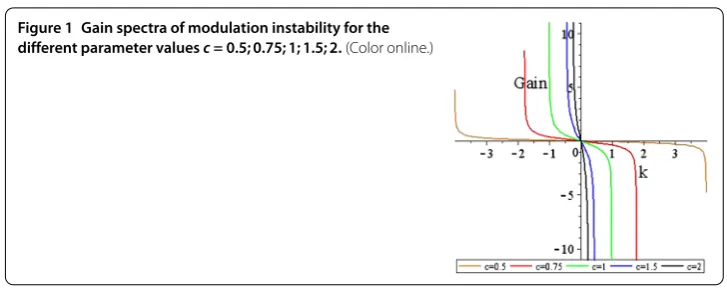
Figure 1 Gain spectra of modulation instability for the different parameter valuesc= 0.5; 0.75; 1; 1.5; 2.(Color online.)
We consider the solution to Eq. () with the wave numberkand frequencyωin the form
U=Fcos(kx–ωt) +iGsin(kx–ωt), ()
whereFandGare real amplitudes. Substituting () into () yields the following dispersion
relation for the perturbations, obtained as the condition for the existence of nontrivial solutions forFandG(i.e.,FG= ):
ω=αk(ak
–a+aβc+aβ±β√ac+ ac+k)
a(a–k) . ()
Whenac+ ac+k< , the frequencyωbecomes complex, and the disturbance grows
with time exponentially. In the following, we consider the gain spectrum of modulational instability. The power gain is obtained from () by
g(k) =Im(ω) =|αkβ
|√–ac– ac–k
|a(a–k)| , ()
whereg(k) stands for the gain withac+ ac+k< . In what follows, we assume that
α=β = anda= –c and choose different values of the parameterc, showing the gain
spectra at five power levels in Figure .
3 TheN-fold DT for Eq. (1)
In this part, we give a brief introduction of theN-fold DT for Eq. (). According to [],
the Lax pair for Eq. () is as follows:
ϕx=Uϕn=
–i
λ
ux λ
–u∗x
λ i
λ
ϕ, ()
ϕt=Vϕn=
i
αβ
|u|–iμ α λux+
i
αβ u
–αλu∗x+iαβu∗ –iαβ|u|+iμ
ϕ, ()
where∗represents the complex conjugation,ϕ= (φ,ψ)T(the superscript T denotes the
vector transpose) is the vector eigenfunction,λis the spectral parameter, andμ=√α(λ–
βλ). Here, to construct RW solutions for Eq. (), it is worth pointing out that we have
Ut–Vx+UV–VU= between Eqs. () and () gives rise to Eq. (). In the following,
we proceed by establishing theN-fold DT of Eq. (). For this reason, we introduce the
transformation
Hereby, we assume that theNth-order Darboux matrixTis of the form
T=
spectral parameterλkand seed solutionu. Of course, it should be noted that the Darboux
matrix () here is a little different from that in [], owing to the variation of the spectral
parameterλin Lax pair. The Nnonzero variablesA(j)andB(j+)can be determined by
Nequations in () when the spectral parametersλkare suitably chosen.
According to the steps in [], the usualN-fold Darboux transformation of Eq. () is
andB(N–)is given by the determinant
erences therein, where the proof process is similar. The aim of this paper is to construct
the generalized (n,N–n)-fold DT and higher-order rogue wave solutions in terms of
de-terminants. Hereby, the proof is omitted for simplicity. Transformations () and () are
called an N-DT of Eq. (). By applying theN-fold DT, higher-order soliton solutions (or
higher-order breather solutions) for Eq. () are obtained by choosing the constant seed solution (or plane wave solutions) [].
4 Generalized(n,N–n)-fold DT for Eq. (1)
For theN-fold DT withNdistinct spectral parameters, we can derive a N-soliton
solu-tion in terms of the determinant representasolu-tion. However, for the generalized (n,N–n
)-fold DT for Eq. (), the main difference is that we can adjust the number of the spectral
parameter: the least may be , and the most may beN. Here, we consider the case withn
distinct spectral parametersλi(i= , , . . . ,n), ≤n≤N.
Here we still consider the Darboux matrix (), but withnspectral parametersλi(i=
, , . . . ,n), ≤n≤N, and not withN (N> ) distinct spectral parameters, in which the is greater than that of equations, so that we have some free functions. To determine these
N unknown functionsA(j) andB(j+), we need to find additional (N–n) equations
for N functionsA(j) andB(j+)so that we would have N equations for Nfunctions
A(j)andB(j+). Determining these NfunctionsA(j)andB(j+), we then can obtain ‘new’ solutions of Eq. () in terms of DT.
Thus, we have
T(λi+ε)ϕ(λi+ε) =
+∞
k=
k
j=
T(j)(λ)ϕ(k–j)(λi)εk, ()
whereϕi(k)(λi) = k! ∂
k
∂λkiϕi(λ)|λ=λi, andεis a small parameter.
It follows from Eq. () and
lim
ε→
T(λi+ε)ϕ(λi+ε)
εki = ()
fori= , , . . . ,nandki= , , . . . ,mithat we obtain the linear algebraic system with N
equations (N=n+ni=mi,i= , , . . . ,n):
T()(λi)ϕ()(λi) = ,
T()(λi)ϕ()(λi) +T()(λi)ϕ()(λi) = ,
. . . ,
mi
j=
T(j)(λi)ϕ(mi–j)(λi) = ,
()
in which we have some first systems for every indexi, that is,T()(λ
i)ϕ()(λi) =T(λi)ϕ(λi) =
are just ones in system (), but they are different if there exist at least one indexmi= .
Here the numbermi(mi= , , , . . .) is the highest order perturbation derivatives
corre-sponding toλi(i= , , . . . ,n), where the nonnegative integersn,miare required to satisfy
N=n+ni=mi, andNis the same as in the Darboux matrixT().
Therefore, we have obtained system () containing N algebraic equations with N
unknowns functionsA(j) andB(j+)(j= , , . . . ,N– ). When the eigenvalueλ
iis
suit-ably chosen so that the determinant of the coefficients for system () is nonzero, the
transformation matrixTis uniquely determined by system (). It can be shown that the
aboveN-fold DT still holds for the Darboux matrix () withA(j),B(j+)(j= , , . . . ,N– )
determined by system (). Owing to new distinct functionsA(j),B(j+)obtained in the
Nth-order Darboux matrixT, we can derive the ‘new’ DT with theneigenvaluesλ=λi.
We call Eqs. () and () associated with new functionsA(j),B(j+)determined by system
() a generalized (n,N–n)-fold DT. So we have the following theorem for the generalized
(n,N–n)-fold DT of Eq. ().
Theorem The spectral problem()-()is covariant with respect to the transformations
(),and
˜
with B(N–)=(n)B(N–)
that system () in the generalized (n,N–n)-fold DT is very important; its role is similar
to that of Eqs. () of theN-fold DT; both of them can determine the Nunknown
func-tionsA(j),B(j+)(≤j≤N– ), but they are different from each other: Eqs. () have N
spectral parameters, whereas system () only has nspectral parameters. Owing to
dif-ferentA(j),B(j+)(≤j≤N– ), the former can lead to theN-soliton solutions, whereas the latter may generate higher-order rogue wave solutions. In the following, we will use
the generalized perturbation (,N– )-fold Darboux transformation to investigate
higher-order rogue wave solutions of the gNLS equation () from the initial plane wave solution.
5 Higher-order RWs of Eq. (1)
In this section, we give some rogue wave solutions in terms of determinants of Eq. () using
u=cei[ax+(αa+αβ+αβ
vector functionϕ in () as Taylor series atε= . Because the expansion expression of
ϕ(ε) is too complicated, in the following discussions, we may seta= –
In the following, we discuss the higher-order rogue wave solutions of the four cases with
N= , , , for Eq. (). It is particularly worth pointing out that we only derive the trivial
solution for the case N= , which is omitted here. Relevant structure figures for other
three casesN= , , are shown in Figures -.
(I) WhenN= , solving the linear algebraic system () leads to
B()=B
()
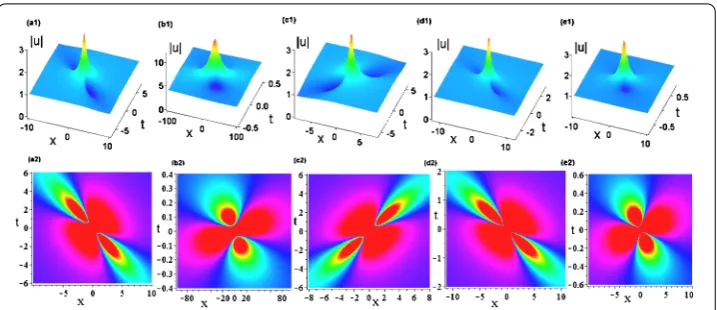
Figure 2 First-order rogue wave solution (30) with different parameters. (a1)-(a2)c= 1,α= 1,β= 1; (b1)-(b2)c= 4,α= 1,β= 1;(c1)-(c2)c= 1,α= –1,β= 1;(d1)-(d2)c= 1,α= 4,β= 1;(e1)-(e2)c= 1,α= 1,
β= 4. (Color online.)
Figure 3 Second-order rogue wave solutionu˜2withc=α=β= 1 given by Eq. (32) at different values ofb1,d1. (a1)-(a2)b1=d1= 0;(b1)-(b2)b1= 1,000,d1= 0;(c1)-(c2)b1= –1,000,d1= 0;(d1)-(d2)b1= 0,
d1= 1,000;(e1)-(e2)b1=d1= 1,000. (Color online.)
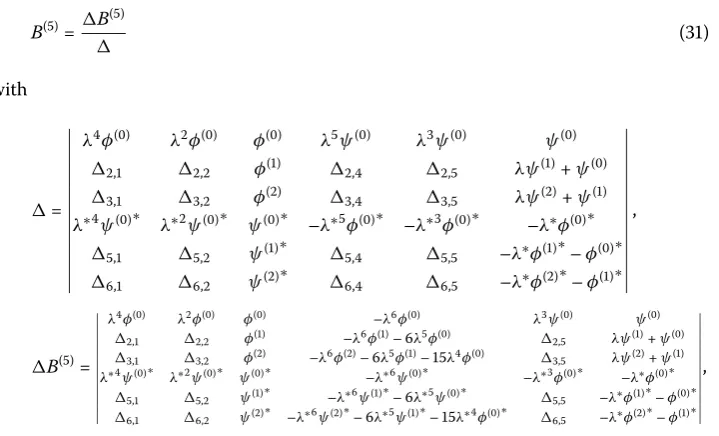
with
=
λφ() φ() λψ() ψ() λφ()+ λφ() φ() λψ()+ λψ() λψ()+ψ()
λ∗ψ()∗ ψ()∗ –λ∗φ()∗ –λ∗φ()∗ λ∗ψ()∗+ λ∗ψ()∗ ψ()∗ –λ∗φ()∗– λ∗φ()∗ –λ∗φ()∗–φ()∗
and
B()=
λφ() φ() –λφ() ψ() λφ()+ λφ() φ() –λφ()– λφ() λψ()+ψ()
λ∗ψ()∗ ψ()∗ –λ∗ψ()∗ –λ∗φ()∗ λ∗ψ()∗+ λ∗ψ()∗ ψ()∗ –λ∗ψ()∗– λ∗ψ()∗ –λ∗φ()∗–φ()∗
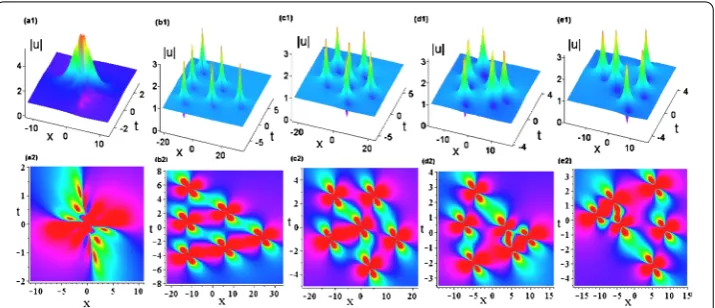
Figure 4 Third-order rogue wave solutionu˜3withc=α= 1,β= 2 given by Eq. (33) at different values ofbi,di(i= 1, 2). (a1)-(a2)b1=d1=b2=d2= 0;(b1)-(b2)b1= 1,000,d1=b2=d2= 0;(c1)-(c2)b2= 10,000, b1=d1=d2= 0;(d1)-(d2)b1= 90,b2= –1,080,d1=d2= 0;(e1)-(e2)b1= –140,b2= 2,300,d1=d2= 0. (Color online.)
Based on the generalized perturbation (, )-fold DT, we can obtain the first-order rogue
wave solution with three free constant parametersα,β,cof Eq. ():
˜
u=u+B()=cei[ax+(αa+αβ+αβ c+αβ
a )t]+B(), ()
and the analytical expression of solution () witha= –
c is
tance of its two holes) is √
(+αcβ+αcβ+α)
√
|α|βc , its minimum value is zero, andu˜→|c| as|x| → ∞. From the previous analysis we see that the parameters α,β, ccan change
the width and direction of the RW, the parametercdetermines the amplitude of RW, so
we can control rogue waves by changing parametersα,β,c. Next, we discuss the RWu˜
by choosing different parametersα,β,c; the related RW structure figures are displayed
in Figure . From Figure , and regardless of choosingα,β,c, the solutionu˜always has
the maximum amplitude at (x,t) = (, ), the minimum amplitude is always zero, and the
maximum amplitude depends on the parameterc, so we can see that the maximum
α= ,β= , the minimum amplitude is zero at (x,t) = (±
parametersα,β,con the RW structure by comparing their values in Figure .
(II) WhenN= , solving the linear algebraic system () leads to
B()=B
Based on the generalized perturbation (, )-fold DT, we can derive the second-order
RW solution with four arbitrary constant parametersα,β,c,b,dof Eq. ():
˜
u=u+B()=cei[ax+(αa+αβ+αβ c+αβ
a )t]+B(), ()
the analytical expression of solution () witha= –c is too complicated and therefore is
omitted here. Next, we discuss some special structures of the second-order RW for the following two cases:
• For solutionu˜with parametersc=α=β= andb=d= , we see thatu˜→as
x→ ∞andt→ ∞and that the second-order RW generates the strong interaction
and crowd around the origin; the corresponding wave profiles are shown in Figure (a)-(a).
• For solutionu˜with parametersc=α=β= ,d= , andb= (e.g.,b= ,) or
c=α=β= ,b= , andd= (e.g.,d= ,), we see thatu˜→asx→ ∞and
t→ ∞, the second-order RW generates a weak interaction, and, at the same time, it is
split into three first-order RWs with a triangle array structure (see Figure (b)-(b),
(d)-(d)), and the triangle structure becomes larger as|b|or|d|increases. When
b= –,ord= –,, the triangle structure rotates degrees with respect to
b= ,,d= ,), the second-order RW is also split into three first-order RWs with a triangle array structure (see Figure (e)-(e)), and comparing Figure (e)-(e) with Figure (b)-(b), (d)-(d), we see that the triangle structure also rotates.
(III) WhenN= , based on the generalized perturbation (, )-fold DT, we can derive
the third-order RW solution with seven arbitrary constant parametersα,β,c,b,d,b,d: ˜
u=u+B()=cei[ax+(αa+αβ+αβ c+αβ
a )t]+B(), ()
where the determinant form ofB()is omitted here. The analytical expression ofu˜
with
a= –
c is very complicated and therefore is omitted here. Next, we discuss some special
structures of the third-order RW for the following four cases:
• For solutionu˜with parametersc=α= ,β= ,b=d=b=d= , we see that
˜
u→asx→ ∞andt→ ∞and that the third-order RW generates a strong
interaction and crowd round the origin; the corresponding wave profiles are shown in Figure (a)-(a).
• For solutionu˜with parametersc=α= ,β= ,d=b=d= ,b= (e.g.,
b= ,) orc=α=β= ,b=b=d= ,d= (see Figure (b)-(b)), we see that
˜
u→asx→ ∞andt→ ∞, the third-order RW generates a weak interaction, and,
at the same time, it is split into six first-order RWs with a regular triangle array
structure, and the triangle structure becomes larger as|b|or|d|increases.
• For solutionu˜with parametersc=α= ,β= ,b=d=d= ,b= (e.g.,
b= ,) orc=α=β= ,b=d=b= ,d= (see Figure (c)-(c)), we see
thatu˜→asx→ ∞andt→ ∞, the third-order RW generate the weak interaction,
and, at the same time, the third-order RW is split into six first-order RWs with a
regular pentagon array structure, and the pentagon structure becomes larger as|b|or
|d|increases.
• For solutionu˜with parametersc=α=β= andbb= ,d=d= orbd= ,
d=b= ordb= ,b=d= ordd= ,b=b= , solutionu˜→asx→ ∞
andt→ ∞, the third-order RW may be split into six first-order RWs (or one
second-order RW and three first-order RWs or two second-order RWs) with a static
irregular array structure. Whenc=α= ,β= ,b= ,b= –,,d=d= or
c=α= ,β= ,b= –,b= ,,d=d= , the third-order RW with weak interaction has an irregular structure; the corresponding wave profiles are shown in Figure (d)-(d), (e)-(e). However, it is obvious that the influences for two sets of parameters are different through comparing Figure (d)-(d) with Figure (e)-(e); different parameters can change the space arrangement of the third-order RW.
With the aid of symbolic computationMaple, solutions (), () and () have been
verified by substituting them into Eq. ().
6 Conclusions
Equation () can model nonlinear pulse propagation in monomode optical fibers. In this
paper, we have constructed the perturbation (n;N–n)-fold DT for Eq. (). As an
applica-tion, the generalized perturbation (,N– )-fold DT method with the same one spectral
structures withN= ; Figure exhibits the second-order RW interaction structures with
N= ; Figure exhibits the third-order RW interaction structures withN= . Solutions
and figures obtained in this paper might be helpful for understanding physical phenomena in optical fibers described by Eq. (). We hope that our results are useful for understanding the generation mechanism and finding possible application of RWs. We believe that the method in this paper can be generalized to seek for some other types of nonlinear wave models, and we will carry out a further investigation in the future.
Appendix
φ()= – e
i
(–x–tα+tαβ)√–itα– tα+ tα+ x+ +i+ xtα – ixtα– ixtαβ+ itαβ– tαβ– x+ iαβt – itαβ– xtαβ– αβt– ix,
ψ()= i e
–i(–x–tα+tαβ)√x+ x– itα+ +i – ixtα+ tα+ tα– itαβ– xtαβ– αβt – ixtαβ+ iαβt+ xtα– itαβ– ix– tαβ,
φ()= –
e
i
(–x–tα+tαβ)√– + tαβ+ x– xtα+ itαβ+ tα + itαβ– tαβ+ tαβ+ xtα+ xtα– tαβ+ b – ixtαβ+ ixtα– xtαβ– xtαβ– xtαβ+ αβt + tα– x– tα+ xtαβ+ tαβb– tαβd+ xtαβ + xtαβ– tαβx+ xtαβ– bx– xd– tαb– tαd + tαβ+ tαβ– tαβ+ ix– ixtαβ+ itαβd – ixtαβ– ixtαβ– itαβ+ itαβ– ixtα+ x – ixtα+ id+ itαβb+ ix+ ixtα+ itαb+ ixtαβ + ixtαβ+ itαβ– ix+ i– ix+ itαβ– itαd – itαβ+ ixtα+ itαβ+ itα+ ibx+ itα – itα– itα– ixd+ itαx
,
ψ()= i
e
–i(–x–tα+tαβ)√– + tαβ– x– xtα– tα+ tαβ – tαβ– xtα– xtα+ tαβ– b– itαβ+ itαx + xtαβ+ xtαβ+ xtαβ– αβt– tα– x– tα
+ ixtαβ+ itαβ+ ix– ixtαβ+ itαβ+ ixtα
+ ix– x– itαβ+ itαβd+ ix– id+ ixtα + i+ ixtαβ+ itαβ+ itα– itαβ+ ixtα+ ix + itα– ixd+ itα+ ixtαβ
,
φ()= –
,e
i
(–x–tα+tαβ)√– – ,xd
– ,bx– ,ixd
+ tαβ – tαβ+ itα– ,tαβ– ,xtα+ ,x – tαβ– ,ib+ ,id+ ,ix– ix– ,ix– ,ix + ,id+ ix– ,itαβb– ,tαb– ,xtα+ ,ibx – tαx+ ,tαβ+ itαβx– ,ixtαb– ,xtα – ,itα– ,ixd
+ tα– ,ixdtα+ ,itαβd + ,itαβb– ,itαdβ+ ,itαβbx– ,ixtαb – ,ixtαβd– ,ixdtαβ– ixtαβ– ,ixtαβ
+ ,idb– itαβx+ ixtαβ+ itαβx+ ixtαβ + ,itαβx– itαβx+ ixtαβ+ ixtαβ
+ ixtαβ+ ixtαβ+ ,ixtαβ+ ,ixtαβ+ ,ixtαβ
+ ,ixtαβ+ ixtαβ– itαβx– ixtαβ
+ itαβx– ,ibx– ,ixtαβ– ,ixtαβ– ,xtα + ,ibxtαβ+ ,itαbβ+ ,tαβ+ ,tαβ+ xtα + xtα– tαβ+ ,ix– ,b– ,d+ ,b – ,tαd– ixb– itαβx– itα+ ,ixtαβ + ,ibx+ ,itα– xtαβ+ ,xtαβ+ ,xtαβ + ,αβt+ ,ixd+ ,tα– ,itα– ,x– ,tα – xtα+ ,ixtα– ,xtαβ– ,tαβb+ ,tαβd – ,xtαβ– ,xtαβ+ ,tαβx– tαβx– ,xtαβ
+ ,xtαβ– ,tα+ ,bx+ ,xd– ,x+ tαβ + ,tαb+ ,tαd+ ,tαβ– ,tαβ– tαβ + itαβ– itαβ+ ixtα+ ,itα+ ,ixtα
+ ,xtαd– ,tαβd– ,tαβb+ tαβb– xtαβ + tαβ– tαx– tαx– tαβ + tαd– xtα + tαβ– ,xtαβb– ,xtαβb– ,xtαβd– tα – tαβx+ tαβx– xtαβ– xtαβ+ xtαβ
– xtαβ+ xtαβ+ xtαβ+ tαβx+ tαβx – tαβx– tαβx+ xtαβ– tαβx– ,itαb – itαb+ ,ixtαβ+ ixtαβ+ ,itαβ– ixtα + ,itαb– itαx– itαx– ixtα– itαx– itαβ + itαβ+ xtαβ– ,xtαb– ,tαβd+ itαβ + ,itαβ+ ,itαβ– itαβ+ itαβ– itαβ
+ itαx+ ,itαβ– ,itαd+ itαβ + ,itαb + x+ ,itαβd+ ,ixtαβd– ,itαβb+ ,tαβb – ,xtαd+ ,tαβb+ ,tαβd+ xtαβ
+ ,xtαβ+ xtαβ– tαβx– tαβx– ,id – ,itαβd+ ,itαβb+ ,ibxtα– ,i+ ,ib + ,xtαβb+ itαβd– itαβx+ ,itαβd
,
ψ()= i
,e
–i(–x–tα+tαβ)√– + itαβ+ ,xd
+ ,bx
+ tαβ – tαβ– ,tαβ– ,xtα– ,x
+ ixtαβ– tαβ– ,ib– ,ixdtαβ– ,ixd – ,tαb– ,xtα+ ,idb– ,ixtαb– tαx + ,tαβ– ,xtα+ ,ixtαβ+ itαβx– ,itα
– tα– ,ixtαβd– ,ix– ,xtα– ,tαβ – ,tαβ– xtα– xtα+ tαβ+ ,itαb
+ ,b
+ ,d– ,b– ,tαd+ ,ibx+ ,ixtαβ– ,ixtα – itαβ– itαβx– ,itαβd– ,itαx– ,itαβb + xtαβ– ,xtαβ– ,xtαβ– ,αβt– ,tα– itα
– ,x– ,tα– xtα+ ixtαβ+ itαβx
– ,xtαβ– ,tαβb+ ,tαβd– ,xtαβ– ,xtαβ + ,tαβx– tαβx– ,xtαβ+ ,xtαβ– ,tα
– tαβ+ tαβ– tαβ + ,tαd+ xd– ,bx – ,xd+ ,db+ ,b– x– ,d+ ,tαβb
– ,tαβd+ ,xtαd+ ,xtαd– ,tαβd – ,tαβb+ tαβb– xtαβ+ tαβ– tαx – tαx– tαβ + tαd– xtα+ tαβ– ,xtαβb – ,xtαβb– ,xtαβd– tα– tαβx+ tαβx – ,itα– xtαβ– xtαβ+ xtαβ– xtαβ
+ xtαβ+ xtαβ+ tαβx+ tαβx– tαβx – tαβx+ xtαβ– tαβx+ ixtαβ+ ,ixtαβ
+ itαβ + itαβ– ,itαdβ+ ,ixtαβ– ix – itαβ– xtαβ+ ,xtαb+ ,tαβd– itαβx – itαβx+ ,ixtαβ– itαb
+ ,itαβbx– ix – ,ixtα+ ,itαβ– x– ixtα+ itαβd + itαβ+ ,itαd– ,ibx– ,itαb+ ,itαβd + ,ixtαβ– ,ibxtαβ+ ,ixtαβ– ,tαβb + ,xtαd– ,tαβb– ,tαβd– xtαβ
– ,xtαβ– xtαβ+ tαβx+ tαβx+ ixtαβ
– itαx– ,itα+ ,ixtαβ– ,ixtαb+ itαβ – ,ib– ,ixtαβd– itαβ– ,itαd– itαβ – ,ix+ ,itαβx– ixtα+ ,ixd+ ,itαβ – ,ixtα– ,itαβd– ,itαβd+ ,itαβb – ,xtαβb+ ixtαβ+ ixtαβ– itαx– ,ixtα + ixtαβ– ,ibxtα– ,itα– ,ix+ ,itαd – ,id+ itαβ+ ,ixdtα+ ixtαβ– ,itαbβ – ixtα+ itαβ– itαx+ ,ixd+ ,itαβb + ,itαβb+ ixtαβ– ,itαb– itαβx– itαx + ixtαβ+ ,itαβ– ,ix– ,i+ ,id+ ,id – ,ixtα– ixb+ ,itαβ– itαβx
Competing interests
The author declares that he has no competing interests.
Author’s contributions
The only author has made all contributions. The author has read and approved the final manuscript.
Acknowledgements
The author thanks the editor and reviewers for their valuable suggestions. This work has been supported by the National Natural Science Foundation of China under Grant No. 11375030, China Postdoctoral Science Foundation under Grant No. 2015M570161, and the Beijing Natural Science Foundation under Grant No. 1153004.
Received: 22 October 2016 Accepted: 11 November 2016 References
1. Zhai, BG, Zhang, WG, Wang, XL, Zhang, HQ: Multi-rogue waves and rational solutions of the coupled nonlinear Schrödinger equations. Nonlinear Anal., Real World Appl.14, 14-27 (2013)
2. Guo, BL, Ling, LL, Liu, QP: Nonlinear Schrödinger equation: generalized Darboux transformation and rogue wave solutions. Phys. Rev. E85, 026607 (2012)
3. Wang, DS, Chen, F, Wen, XY: Darboux transformation of the general Hirota equation: multi-soliton solutions, breather solutions and rogue wave solutions. Adv. Differ. Equ.2016, 67 (2016)
4. Wen, XY, Yan, ZY: Modulational instability and higher-order rogue waves with parameters modulation in a coupled integrable AB system via the generalized Darboux transformation. Chaos25, 123115 (2015)
5. Wen, XY, Yan, ZY, Yang, YQ: Dynamics of higher-order rational solitons for the nonlocal nonlinear Schrödinger equation with the self-induced parity-time-symmetric potential. Chaos26, 063123 (2016)
6. Yu, FJ: Nonautonomous rogue waves and ‘catch’ dynamics for the combined Hirota-LPD equation with variable coefficients. Commun. Nonlinear Sci. Numer. Simul.34, 142-153 (2016)
7. Yu, FJ: Nonautonomous soliton, controllable interaction and numerical simulation for generalized coupled cubic-quintic nonlinear Schrödinger equations. Nonlinear Dyn.85, 1203-1216 (2016)
8. Zhang, HQ, Chen, J: Rogue wave solutions for the higher-order nonlinear Schrödinger equation with variable coefficients by generalized Darboux transformation. Mod. Phys. Lett. B30, 1650106 (2016)
9. Zhang, HQ, Yuan, SS, Wang, Y: Generalized Darboux transformation and rogue wave solution of the coherently-coupled nonlinear Schrödinger system. Mod. Phys. Lett. B30, 1650208 (2016)
10. Wen, LL, Zhang, HQ: Rogue wave solutions of the (2 + 1)-dimensional derivative nonlinear Schrödinger equation. Nonlinear Dyn.86, 877-889 (2016)
11. Zhang, HQ, Liu, XL, Wen, LL: Soliton, breather, and rogue wave for a (2 + 1)-dimensional nonlinear Schrödinger equation. Z. Naturforsch. A71, 95-101 (2016)
12. Geng, XG, Lv, YY: Darboux transformation for an integrable generalization of the nonlinear Schrödinger equation. Nonlinear Dyn.69, 1621-1630 (2012)
13. Fokas, AS: On a class of physically important integrable equations. Physica D87, 145-150 (1995)
14. Lenells, J, Fokas, AS: On a novel integrable generalization of the nonlinear Schrödinger equation. Nonlinearity22, 11-27 (2009)
15. Yan, ZY, Dai, CQ: Optical rogue waves in the generalized inhomogeneous higher-order nonlinear Schrödinger equation with modulating coefficients. J. Opt.15, 064012 (2013)
16. Guo, R, Hao, HQ: Breathers and multi-soliton solutions for the higher-order generalized nonlinear Schrödinger equation. Commun. Nonlinear Sci. Numer. Simul.18, 2426-2435 (2013)
17. Geng, XG, Ham, HW: Darboux transformation and soliton solutions for generalized nonlinear Schrödinger equations. J. Phys. Soc. Jpn.68, 1508-1542 (1999)
18. Li, WB, Xue, CY, Sun, LL: The general mixed nonlinear Schrödinger equation: Darboux transformation, rogue wave solutions, and modulation instability. Adv. Differ. Equ.2016, 233 (2016)
19. Wen, XY, Hu, XY:N-Fold Darboux transformation and solitonic interactions for a Volterra lattice system. Adv. Differ. Equ.2014, 213 (2014)