R E S E A R C H
Open Access
Sampled-data state estimation for neural
networks of neutral type
Changchun Yang
1, Yongqing Yang
1,2*, Manfeng Hu
1and Xianyun Xu
1*Correspondence: [email protected] 1School of Science, Jiangnan University, Wuxi, 214122, China 2Key Laboratory of Advanced Process Control for Light Industry (Ministry of Education), Jiangnan University, Wuxi, 214122, China
Abstract
In this paper, the sampled-data state estimation is investigated for a class of neural networks of neutral type. By employing a suitable Lyapunov functional, a
delay-dependent criterion is established to guarantee the existence of the
sampled-data estimator. The estimator gain matrix can be obtained by solving linear matrix inequalities (LMIs). A numerical example is given to show the effectiveness of the proposed method.
Keywords: neural network; sampled-data; state estimation; neutral type; LMIs
1 Introduction
Over the past decades, considerable attention has been devoted to the study of artificial neural networks due to their extensive application in signal and image processing, pattern recognition, and combinatorial optimization [, ]. Numerous models of neural networks such as cellular neural networks, Hopfield-type neural networks, Cohen-Grossberg neural networks, and bidirectional associative memory neural networks have been extensively investigated in the literature [–].
In recent years, the state estimation problem has been a hot topic because of its great significance to estimation of the neuron states through available output measurements. Many results have been available. For example, the state estimation problem for delayed neural networks was discussed in []. Huang and Feng investigated the state estimation of recurrent neural networks with time-varying delay. A delay-dependent condition was derived to guarantee the existence of a desired state estimator [, ]. By constructing a Lyapunov-Krasovskii functional and using a convex combination technique, the exponen-tial state estimation for Markovian jumping neural networks with time-varying discrete and distributed delays was investigated []. The state estimation of discrete-time neural networks and fuzzy neural networks was studied in [–]. Recently, the state estimation problem of neural networks of neutral type has motivated a great deal of interest. Parket al.investigated the state estimation of neural networks of neutral type with interval time-varying delays [–]. A delay-dependent condition was proposed for neural networks of neutral type with mixed time-varying delays and Markovian jumping parameters [].
At the same time, the sampled-data state estimation of neural networks has gradually caused researchers’ concern with the development of computer hardware technology. For instance, Hu investigated the sampled-data state estimation of delayed neural networks with Markovian jumping parameters [], and in [] the sampled-data state estimator was
designed for Markovian jumping fuzzy cellular neural networks with mode-dependent probabilistic time-varying delays. In order to effectively deal with the sampled-data, the author investigated the sampled-data state estimation of neural networks by using a dis-continuous Lyapunov functional approach [, ]. It is worth mentioning that the ap-proach to estimate the neuron states through the output sampled measurement needs less information from the network outputs, which can lead to a significant reduction of the information communication burden in the network. To the best of our knowledge, the sampled-data state estimation of neural networks of neutral type has not been investigated so far.
Motivated by the above discussion, in this paper, we aim to deal with the sampled-data state estimation problem for neural networks of neutral type. By utilizing Lyapunov func-tional, Jensen’s inequalities and Schur complement, a delay-dependent criterion is given to guarantee the existence of the state estimator of neural networks of neutral type. The estimator gain matrix can be obtained in terms of LMIs.
The organization of the rest is as follows. In Section , the problem is formulated and some lemmas are introduced. In Section , some sufficient conditions are given to guar-antee the existence of the sampled-data estimator. An example is given to exemplify the usefulness of our theoretical results in Section . And in the last section, Section , we give some conclusions.
2 Problem formulation
In this paper, the sampled-data state estimation problem will be investigated. Consider the following neural networks of neural type:
˙
x(t) = –Ax(t) +Wf
x(t)+Wg
xt–h(t)+Vx˙t–d(t)+J,
y(t) =Cx(t),
()
where x(t) = [x(t), . . . ,xn(t)]T ∈Rn is the neuron state vector associated with n
neu-rons.f(x(t)) = [f(x(t)), . . . ,fn(xn(t))]T∈Rnandg(x(t–h(t))) = [g(x(t–h(t))), . . . ,gn(xn(t– h(t)))]T∈Rnare the neuron activation functions.J= [J, . . . ,Jn]Tis the external input
vec-tor at timet.y(t)∈Rm is the measurement output.A=diag(a
,a, . . . ,an) is a positive
diagonal matrix.W,W, andVare the interconnection matrices representing the weight
coefficients of the neurons.C∈Rm×nis a known constant matrix.h(t) > andd(t) > are
axonal signal transmission delays that satisfy the following inequalities:
<h(t)≤ ¯h, h˙(t)≤hD,
<d(t)≤ ¯d, d˙(t)≤dD< .
Assumption The neuron activation functionsf(·),g(·) satisfy the Lipschitz condition
f(x) –f(x)≤F(x–x),
g(x) –g(x)≤G(x–x),
The aim of this paper is to present an efficient estimation algorithm to observe the neu-ron states from the available network sampling output. To this end, the following full order observer is proposed:
˙ˆ
x(t) = –Axˆ+Wf
ˆ
x(t)+Wg
ˆ
xt–h(t)+Vx˙ˆt–d(t)+J+u(t),
ˆ
y(t) =Cxˆ(t),
()
wherexˆ(t)∈Rnis the estimation of neuron statex(t).ˆy(t)∈Rmis the estimated output
vector.u(t)∈Rnis the control input, which is assumed to use sampled data as follows:
u(t) =Ky(tk) –yˆ(tk)
=KCx(tk) –xˆ(tk)
, k= , , , . . . , ()
wheretkdenotes the sampling instant and satisfieslimk→∞tk=∞.
Assumption Fork≥, there exists a known positive constantτ¯such that the sampling instanttksatisfiestk+–tk≤ ¯τ.
Define the error vector to bee(t) =x(t) –xˆ(t), and
φ(t) =fx(t)–fxˆ(t),
ϕ(t) =gx(t)–gxˆ(t).
()
Letτ(t) =t–tk,tk≤t<tk+, the controller () can be represented as follows:
u(t) =KCe(tk)
=KCet–τ(t), tk≤t<tk+. ()
Therefore, the error dynamical system can be expressed by
˙
e(t) = –Ae(t) –KCet–τ(t)+V˙et–d(t)+Wφ(t) +Wϕ
t–h(t), ()
whereτ(t) satisfies ≤τ(t)≤ ¯τ.
The following lemmas will be used in deriving the main results.
Lemma ([], Jensen’s inequality) For any constant matrix Q∈Rn×n,Q=QT> ,scalar b> ,and vector function x: [,b]→Rn,one has
– b
xT(s)Qx(s)ds≤–
b
b
x(s)ds T
Q
b
x(s)ds .
Lemma ([], Schur complement) Given constant matricesΩ,Ω,andΩ,whereΩ=
ΩTandΩ> ,then
if and only if
In this section, we derive a new delay-dependent LMI criterion for the existence of state estimator () for neural networks ().
Theorem For given matrices F, G,positive scalars h and¯ <α < ,the error system
()is globally asymptotically stable if there exist eight positive definite matrices P,Qi(i=
Proof Consider the following Lyapunov functional:
Calculating the derivative ofVialong the trajectories of system (), we have
By Lemma , we have
From Assumption and (), for positive scalarsβi(i= , ), we have the following
By combining ()-(), it is not difficult to deduce that
˙
V =
i=
˙
Vi
≤eT(t)
–PA–ATP+Q+Q+Q+GTQG–
¯
τQ– (αh¯)
–Q
+βFTF e(t) + eT(t)
–PKC+ ¯ τQ e
t–τ(t)
–eTt–τ(t) ¯ τQ e
t–τ(t)+ eT(t)[PV]˙et–d(t)
–˙eTt–d(t)( –dD)Q
˙
et–d(t)+ eT(t)[PW]φ(t)
–φT(t)[βI]φ(t) + eT(t)[PW]ϕ
t–h(t)
–ϕTt–h(t)( –hD)Q+βI
ϕt–h(t)
+ eT(t)(αh¯)–Q
et–αh(t)–eTt–αh(t)( –αhD)Q
+ (h¯–αh¯)–Q+ (αh¯)–Q
et–αh(t)
+ eTt–τ(t) ¯
τQ e(t–τ¯) –e
T(t–τ¯)
¯
τQ e(t–τ¯) + eTt–αh(t)(h¯–αh¯)–Q
et–h(t)
–eTt–h(t)( –hD)Q+ (h¯–αh¯)–Q+ (h¯)–Q+βGTG
et–h(t)
+ eTt–h(t)h¯–Q
e(t–h¯) –eT(t–h¯)h¯–Q+Q
e(t–h¯)
+e˙T(t)[hQ¯ +τ¯Q+Q]˙e(t). ()
LetΥ= [–A–KC V WW], andηT(t) = [eT(t)eT(t–τ(t))eT(t–τ¯)eT(t–h(t))eT(t–
¯
h)eT(t–αh(t))e˙T(t–d(t))φT(t)ϕT(t–h(t))]. From (), we havee˙(t) =Υ η(t). Therefore,
˙
eT(t)[hQ¯ +τ¯Q+Q]˙e(t) =ηT(t)
ΥT(hQ¯ +τ¯Q+Q)Υ
η(t). ()
Thus, changing the variable asX=PK, equation () can be rewritten as
˙
V≤ηT(t)Λ+ΥT(hQ¯ +τ¯Q+Q)Υ
η(t), ()
whereΛcan be seen from Theorem .
In view of the fact –PQ–
P≤–(P–Q), –PQ– P≤–(P–Q), –PQ– P≤–(P–Q).
From (), we can obtain the following inequality:
Λ ΛT
∗ –Λ
< , ()
where
Λ=
⎡ ⎢ ⎣ ¯
hPTQ–
P
∗ τ¯PTQ– P
∗ ∗ PTQ–
P
Pre- and post-multiplyingdiag{I,I,I,I,I,I,I,I,I,QP–,QP–,QP–}anddiag{I,I,I,I,I,I,
Q)Υ] < . This implies that the error dynamic () is asymptotically stable. This completes
the proof.
Remark In the paper, the controlleru(t) =K[y(tk) –yˆ(tk)] is designed by the sampled
data, which needs less information from the network outputs than the controller in [, ]. The sampled-data estimation approach can lead to a significant reduction of the in-formation communication burden in the network and save more computing cost.
To this end, the sampled-data estimation problem has been solved and the desired es-timator can be designed by Theorem . In the next section, the effectiveness of the devel-oped sampled-data estimation approach for the neural network of neutral type is shown by a numerical example.
4 Simulation example
In this section, a numerical example with simulation results is employed to demonstrate the effectiveness of the proposed method.
Example Consider the neural networks of neutral type with the following parameters:
f(x) = .tanh(x), gxt–h(t)= .tanhxt–h(t),
x() = [–. –.]T, h(t) = . –sin(t),
d(t) = . –sin(t), τ¯= ., α= ..
From the parameters above, it can be verified thatF= .I,G= .I. By solving LMI given in Theorem , the feasible solutions are obtained as follows:
P=
Thus, the estimator gain matrixKis as follows:
K=P–X=
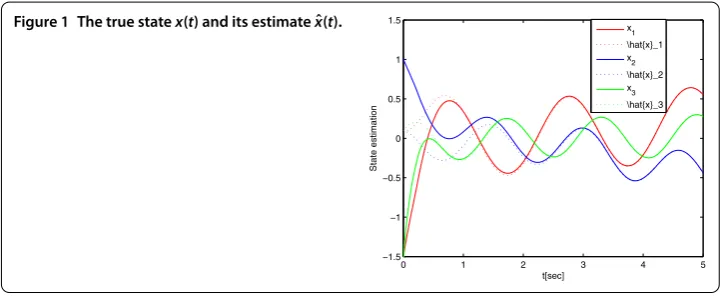
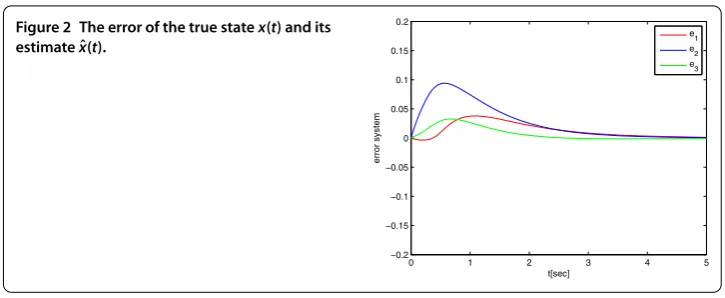
The simulation results are shown in Figures and . It is easy to find that the responses of the state estimators track to true states very quickly.
Figure 2 The error of the true statex(t) and its estimatexˆ(t).
5 Conclusion
In this paper, the sampled-data state estimation has been investigated for a class of neural networks of neutral type. By employing a Lyapunov functional, a delay-dependent condi-tion is established to guarantee the existence of the desired state estimator. The feasible solution can be obtained easily by Matlab LMI toolbox. In the end, the numerical example is given to show the effectiveness of the proposed estimator. This work can be extended to the state estimation problem of general systems. This will be done in the near future.
Competing interests
The authors declare that they have no competing interests.
Authors’ contributions
CY carried out the main results of this paper and drafted the manuscript. YY directed the study and helped to inspect the manuscript. All authors read and approved the final manuscript.
Acknowledgements
This work was jointly supported by the National Natural Science Foundation of China under Grant 60875036, the Foundation of Key Laboratory of Advanced Process Control for Light Industry (Jiangnan University), Ministry of Education, P.R. China the Fundamental Research Funds for the Central Universities (JUSRP51317B, JUDCF13042).
Received: 18 January 2014 Accepted: 21 April 2014 Published:09 May 2014 References
1. Elanayar, V, Yung, C: Radial basis function neural network for approximation and estimation of nonlinear stochastic dynamic systems. IEEE Trans. Neural Netw.5, 594-603 (1994)
2. Joya, G, Atencia, M, Sandoval, F: Hopfield neural network for optimization: study of different dynamic. Neurocomputing43, 219-237 (2002)
3. Cao, J, Zhou, D: Stability analysis of delayed cellular neural networks. Neural Netw.11, 1601-1605 (1998) 4. Liu, X, Teo, K, Xu, B: Exponential stability of impulsive high-order Hopfield-type neural networks with time-varying
delays. IEEE Trans. Neural Netw.16, 1329-1339 (2005)
5. Cao, J, Liang, J: Boundedness and stability for Cohen-Grossberg neural network with time-varying delays. J. Math. Anal. Appl.296, 665-685 (2004)
6. Arik, S: Global asymptotic stability analysis of bidirectional associative memory neural networks with time delays. IEEE Trans. Neural Netw.16, 580-586 (2005)
7. Park, J, Park, C, Kwon, O, Lee, S: A new stability criterion for bidirectional associative memory neural networks of neutral-type. Appl. Math. Comput.199, 716-722 (2008)
8. He, Y, Wang, Q, Wu, M, Lin, C: Delay-dependent state estimation for delayed neural networks. IEEE Trans. Neural Netw.
17, 1077-1081 (2006)
9. Huang, H, Feng, G, Cao, J: An LMI approach to delay-dependent state estimation for delayed neural networks. Neurocomputing71, 2857-2867 (2008)
10. Huang, H, Feng, G: State estimation of recurrent neural networks with time-varying delay: a novel delay partition approach. Neurocomputing74, 792-796 (2011)
11. Zhang, D, Yu, L: Exponential state estimation for Markovian jumping neural networks with time-varying discrete and distributed delays. Neural Netw.35, 103-111 (2012)
12. Balasubramaniam, P, Vembarasan, V, Rakkiyappan, R: Delay-dependent robust exponential state estimation of Markovian jumping fuzzy Hopfield neural networks with mixed random time-varying delays. Commun. Nonlinear Sci. Numer. Simul.16, 2109-2129 (2011)
14. Liu, Y, Wang, Z, Liu, X: State estimation for discrete-time Markovian jumping neural networks with mixed mode-dependent delays. Phys. Lett. A372, 7147-7155 (2008)
15. Mou, S, Gao, H, Qiang, W, Fei, Z: State estimation for discrete-time neural networks with time-varying delays. Neurocomputing72, 643-647 (2008)
16. Park, J, Kwon, O, Lee, S: State estimation for neural networks of neutral-type with interval time-varying delays. Appl. Math. Comput.203, 217-223 (2008)
17. Park, J, Kwon, O: Further results on state estimation for neural networks of neutral-type with time-varying delay. Appl. Math. Comput.208, 69-75 (2009)
18. Park, J, Kwon, O: Design of state estimator for neural networks of neutral-type. Appl. Math. Comput.202, 360-369 (2008)
19. Lakshmanan, S, Park, J, Jung, H: State estimation for neural neutral-type networks with mixed time-varying delays and Markovian jumping parameters. Chin. Phys. B21(10), 100205 (2012)
20. Hu, J, Li, N, Liu, X, Zhang, G: Sampled-data state estimation for delayed neural networks with Markovian jumping parameters. Nonlinear Dyn.73, 275-284 (2013)
21. Rakkiyappan, R, Sakthivel, N, Park, J, Kwon, O: Sampled-data state estimation for Markovian jumping fuzzy cellular neural networks with mode-dependent probabilistic time-varying delays. Appl. Math. Comput.221, 741-769 (2013) 22. Lakshmanan, S, Park, J, Rakkiyappan, R, Jung, H: State estimator for neural networks with sampled data using
discontinuous Lyapunov functional approach. Nonlinear Dyn.73, 509-520 (2013)
23. Rakkiyappan, R, Zhu, Q, Radhika, T: Design of sampled data state estimator for Markovian jumping neural networks with leakage time-varying delays and discontinuous Lyapunov functional approach. Nonlinear Dyn.73, 1367-1383 (2013)
10.1186/1687-1847-2014-138