R E S E A R C H
Open Access
Stability analysis of a fractional-order SIS
model on complex networks with linear
treatment function
Na Liu
1, Jie Fang
1*, Wei Deng
1and Jun-wei Sun
1*Correspondence:
1School of Electric and Information Engineering, Zhengzhou University of Light Industry, Zhengzhou, China
Abstract
In recent years, many research works have been focusing on the propagation dynamics of infectious diseases in complex networks, and some interesting results have been obtained. The main purpose of this paper is to investigate the stability of a fractional SIS model on complex networks with linear treatment function. Based on the basic reproduction number, the stability of the disease-free equilibrium point and the endemic equilibrium point is analyzed in detail. That is, whenR0≤1, the
disease-free equilibrium point is globally asymptotically stable and the disease will die out ultimately; whenR0> 1, there exists a unique endemic equilibrium point, and
both the disease-free equilibrium point and the endemic equilibrium point are stable and the disease will not spread to all individuals. Finally, numerical simulations are presented to demonstrate the theoretical results. Moreover, the influence of the fractional-order parameter and the coefficient of the linear treatment function on the decay rate of the infectious is depicted separately.
Keywords: Fractional-order; Stability; Treatment function; Complex network
1 Introduction
Many physical systems exhibit fractional-order dynamical behaviors due to their special material and chemical properties. When the fractional-order model is used to describe the objects with fractional-order characteristics, the essential characteristics and behaviors of the objects can be better revealed. Compared with the integer-order model, the fractional-order model has clearer physical meaning and simpler expression when describing com-plex physical and mechanical problems. Fractional calculus has memory function, which ensures revealing the influences of historical information on present and future, and hence is beneficial to improving the quality of control. Fractional calculus has been used to model the real world problems [1–7]. It is playing a very important role in the field of science, engineering, finance, communication, epidemic, etc. In the branch of fractional calculus, fractional derivatives and fractional integrals are important aspects. Like that for the clas-sical integral-order differential systems, stability analysis is an important research topic for fractional-order differential systems. The concepts of Lyapunov function and direct Lyapunov method have been extended to differential equations of fractional order [8–16]. Li et al. [8,9] proposed the definition of Mittag-Leffler stability and introduced the frac-tional Lyapunov’s second method. Liu et al. [10,11] dealt with fractional nonlinear systems
and several algebraic criteria of Mittag-Leffler and asymptotical stability were obtained. Zhang et al. [12] studied the stability of nonlinear fractional differential systems with Ca-puto derivatives by using the comparison method. Wu et al. [16] analyzed the stability of nonlinear discrete fractional systems via the Lyapunov second direct method. Mean-while, however, numerical algorithms for fractional differential equations are not mature enough. On the premise of the reliability and accuracy of calculations, there still exist some challenges to improve the computational efficiency, e.g., to lower the computational burdens and storage consumptions. To solve fractional differential equations, many nu-merical algorithms have been developed [2,17,18], including finite difference method, finite element method, polynomial configuration method, etc. Among these methods, the finite difference method is most commonly used.
As we all know, the classical models for disease dynamics are the Susceptible-Infected-Susceptible (SIS), Susceptible-Infected-Susceptible-Infected-Recovered (SIR), Susceptible-Infected- Susceptible-Infected-Recovered-Susceptible (SIRS), and Susceptible-Infected-Recovered-Susceptible-Exposed-Infected- Recovered (SEIR) models, which represent different stages of infection for individuals in a population. Based on the mem-ory function of a fractional-order system, many scholars use fractional-order differential equations to analyze the transmission dynamics of infectious diseases, which has more re-alistic significance than using the integer-order differential equation [19–23]. However, as the transmission dynamics of an infectious disease is greatly affected by inter-individual connections, also known as network topology, it has practical significance to analyze the transmission characteristics of fractional-order infectious diseases in complex networks. Specifically, infectious diseases spread out in population through certain types of inter-personal contacts. Such contacts naturally form into a complex social network, where a network node represents an individual, and the inter-personal contacts through which the disease can transmit are represented as edges. A large number of different network transmission models have been proposed (e.g., [24–28]). Zhu et al. [29] provided a typical mean-field modeling framework to describe the time-evolution dynamics and offer some theoretical analyses to study the spreading threshold and the global stability of the model. In Ref. [30], a general SIS model with infective vectors on complex networks was studied, and a new technique based on the basic reproduction matrix was introduced. Wang et al. [31] reviewed two node-based SIR models incorporating degree correlations and an edge-based SIR model without considering the degree correlation to predict the disease evolution on correlated networks. Huo [32] proposed a fractional SIR model with birth and death rates on heterogeneous complex networks and investigated the stability of a disease-free equilibrium point and an endemic equilibrium point.
Despite of these extensive efforts, only a few studies have investigated the fractional epidemic models on complex networks under disease control. By adopting some control strategies, the disease may only be able to spread in a finite population, or even disappear ultimately. We shall use a linear proportion control named linear treatment to control the disease propagation. The main objective is to analyze the stability of the disease-free equilibrium point and the endemic equilibrium point for a fractional-order SIS network model with linear treatment function, based on the reproduction number.
point and the endemic equilibrium point is discussed in detail. In Sect.5, an example is presented to verity the effectiveness of the theoretical results. Finally, Sect.6concludes the whole report.
2 Preliminaries
Let us recall some basic definitions on Caputo differential operator of fractional calculus. Firstly, we introduce the definition of Caputo fractional derivative.
Definition 1([14]) Suppose thatα> 0,t>t0,α,t0,t∈R. The Caputo fractional derivative
whereΓ denotes the gamma function. Ifn= 1, then 0 <α< 1 and
For simplicity, the Caputo fractional derivativec
t0Dαt is always rewritten asDα.
Considering the following general type of fractional differential equations involving Ca-puto derivative:
Dαx(t) =f(x,t), (1)
with the initial conditionx0=x(t0), we have the following definition.
Definition 2 The constantx∗ is an equilibrium point of the Caputo fractional dynamic system (1) if and only iff(t,x∗) = 0.
When 0 <α< 1, the Caputo fractional-order system (1) has the same equilibrium points as the integer-order system dx
dt =f(t,x).
3 Model description and basic reproduction number
Based on the Caputo derivative, we propose a fractional SIS complex network model as follows:
whereDαis the Caputo derivative,α(0 <α< 1) is the order of the differential operator for
system (2).Sk(t),Ik(t) are respectively the densities of the susceptible and infected nodes
λ(k) is the infection rate and satisfiesc≤λ(k)≤d,Θ(t) =k–1n
k=1ϕ(k)P(k)Ik is the
probability that a randomly chosen edge emanating from a node of degreekpoints to an infected node of degreek.ϕ(k) is the density of nodek,P(k) is the degree distribution of nodek, andkis the average degree of the network. It can be seen that the spread of disease networks is influenced by the topological structure of social networks.
The effective management of infectious diseases is treatment. In this paper the linear treatment functionT(Ik) =aIkis introduced. Then system (2) is rewritten as follows:
⎧
For system (3), the equilibrium points should satisfy
⎧
4 The stability of the equilibrium points
In this section, we prove the stability ofE0andE∗, which is one of the most important
topics in the study of mathematical biology.
Theorem 1 For system(3),when R0≤1,the disease-free equilibrium point is
asymptot-ically stable,and the disease will die out ultimately;when R0> 1,there exists a unique
endemic equilibrium point,and the disease-free equilibrium point and the endemic equi-librium point are both stable,which means that the disease will not spread to all individ-uals.
2(t). Consider the comparing system
(3) For Eq. (6), whenR0> 1 (r> 0),DαΘ(t)≤rΘ(t) –cΘ2(t).
from the above analysis, we can derive that the solution of Eq. (7) is stable. Applying Lemma 1, we have that whenr> 0, no matter the equilibrium point is disease free or endemic,Θ(t) is stable. In other words, the disease will not spread to all individuals.
The proof is completed.
In this section, numerical simulations are presented to illustrate the above-mentioned the-oretical results. There are many numerical methods for solving the fractional equation. In this manuscript, the finite difference method is used, and the simulation results are pre-sented as follows.
For system (3) on a BA random scale-free network, the number of nodes on the net-works isn= 200, the degree distributionP(k) satisfiesP(k) = 2m2k–3. For simplicity, let ϕ(k) =k,λ(k) =λk,b= 0.01,λ= 0.03,β= 0.01,γ = 0.02,μ= 0.01, and the initial condition is (0.7, 0.3). At this moment, there is a disease-free equilibrium pointE0= (1, 0) and an
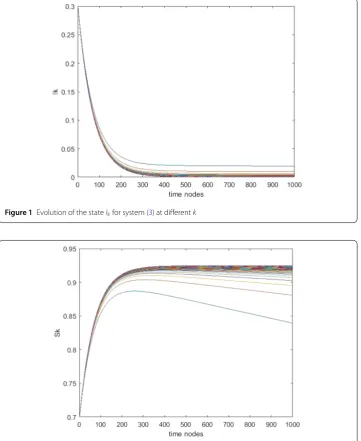
endemic equilibrium pointE∗= (0.93, 0.02) for system (3), which are both stable. By cal-culation, the basic reproduction number isR0= 1.3238 > 1. Figure1and Fig.2show time
series plots for the infectious nodesIkand the susceptible nodesSkrespectively, when
de-greekchanges from 1 to 200. From Fig.1and Fig.2we can observe that the disease will not spread to all individuals. Besides, we can find that the larger the degree of node is, the quicker the disease will decay.
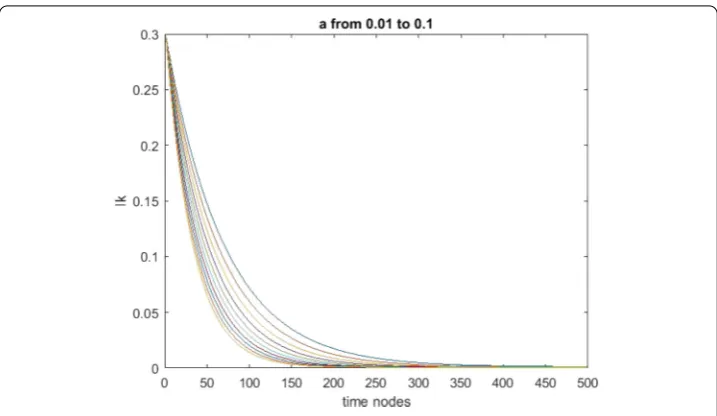
From Fig.3we can observe that, with the help of the linear treatment function, the in-fectious scale would decrease much quicker. The larger the parameterais, the smaller the basic reproduction number is and the faster the disease decreases. For example, when
a= 0.02,R0= 0.8825 < 1; whena= 0.03,R0= 0.7565 < 1. But no matter how small the
Figure 1Evolution of the stateIkfor system (3) at differentk
Figure 2Evolution of the stateSkfor system (3) at differentk
From Figs.1–4, we can observe that without control, the disease may continue to spread over a small area and would not be extinct. By contrast, with treatment function the disease will decrease more quickly and be extinct ultimately. Moreover, it also takes much less time to reach a steady state.
6 Conclusions
In this article, the stability of a fractional-order SIS complex network model with linear treatment function has been investigated. The expression of the basic reproduction num-berR0was provided and some theoretical results have been obtained. WhenR0≤1, the
disease-free equilibrium point is asymptotically stable, and the disease will become extinct ultimately regardless of the initial density of the infected individuals. WhenR0> 1, there
Figure 3The influence of parameteraon the decay rate whenk= 20
Figure 4The influence of parameterαon the decay rate whenk= 20
Acknowledgements
The authors are grateful to the referees for their careful reading of this paper and valuable comments.
Funding
This work was funded by the National Natural Science Foundation of China under Grants 61775198 and 61603348. This work was also sponsored by the Natural Science Foundation of Henan Province under Grant 162300410323, Science and Technology Project in Henan province under Grant 182102210160, and Doctor Scientific Research Fund of Zhengzhou University of Light Industry under Grant No. 2014BSJJ047.
Competing interests
The authors declare that they have no competing interests.
Authors’ contributions
All authors worked together to produce the results, read and approved the final manuscript.
Publisher’s Note
Springer Nature remains neutral with regard to jurisdictional claims in published maps and institutional affiliations.
Received: 12 March 2019 Accepted: 11 July 2019 References
1. Wu, G.-C., Zeng, D.-Q., Baleanu, D.: Fractional impulsive differential equations: exact solutions, integral equations and short memory case. Fract. Calc. Appl. Anal.22, 180–192 (2019)
2. Hajipour, M., Jajarmi, A., Baleanu, D., Sun, H.G.: On an accurate discretization of a variable-order fractional reaction-diffusion equation. Commun. Nonlinear Sci. Numer. Simul.69, 119–133 (2019)
3. Baleanu, D., Jajarmi, A., Asad, J.H.: Classical and fractional aspects of two coupled pendulums. Rom. Rep. Phys.71(1), 103 (2019)
4. Baleanu, D., Sajjadi, S.S., Jajarmi, A., Asad, J.H.: New features of the fractional Euler–Lagrange equations for a physical system within non-singular derivative operator. Eur. Phys. J. Plus134, 181 (2019)
5. Baleanu, D., Asad, J.H., Jajarmi, A.: The fractional model of spring pendulum: new features within different kernels. Proc. Rom. Acad., Ser. A: Math. Phys. Tech. Sci. Inf. Sci.19(3), 447–454 (2018)
6. Kumar, D., Singh, J., Tanwar, K., Baleanu, D.: A new fractional exothermic reactions model having constant heat source in porous media with power, exponential and Mittag-Leffler laws. Int. J. Heat Mass Transf.138, 1222–1227 (2019) 7. Singh, J., Kumar, K., Baleanu, D.: On the analysis of fractional diabetes model with exponential law. Adv. Differ. Equ.
2018, 231 (2018)
8. Li, Y., Chen, Y.-Q., Podlubny, I.: Mittag-Leffler stability of fractional order nonlinear dynamic systems. Automatica45, 1965–1973 (2009)
9. Li, Y., Chen, Y.-Q., Podlubny, I.: Stability of fractional-order nonlinear dynamic systems: Lyapunov direct method and generalized Mittag-Leffler stability. Comput. Math. Appl.59, 1810–1830 (2010)
10. Liu, S., Jiang, W., Li, X.-Y., Zhou, X.-F.: Lyapunov stability analysis of fractional nonlinear systems. Appl. Math. Lett.51, 13–19 (2016)
11. Liu, S., Zhou, X.-F., Li, X.-Y., Wei, J.: Asymptotical stability of Riemann–Liouville fractional singular systems with multiple time-varying delays. Appl. Math. Lett.65, 32–39 (2017)
12. Zhang, F., Li, C., Chen, Y.-Q.: Asymptotical stability of nonlinear fractional differential system with Caputo derivative. Int. J. Differ. Equ.12, 635165 (2011)
13. Liu, P., Zeng, Z.-G., Wang, J.: Global synchronization of coupled fractional-order recurrent neural networks. IEEE Trans. Neural Netw. Learn. Syst., 1–11 (2018).https://doi.org/10.1109/TNNLS.2018.2884620
14. Cruz, V.D.-L.: Volterra-type Lyapunov functions for fractional-order epidemic systems. Commun. Nonlinear Sci. Numer. Simul.24, 75–85 (2015)
15. Aguila-Camacho, N., Duarte-Mermoud, M.-A., Gallegos, J.-A.: Lyapunov functions for fractional order systems. Commun. Nonlinear Sci. Numer. Simul.19, 2951–2957 (2014)
16. Wu, G.-C., Baleanu, D., Luo, W.-H.: Lyapunov functions for Riemann–Liouville-like fractional difference equations. Appl. Math. Comput.314, 228–236 (2017)
17. Goswami, A., Kumar, D., Singh, J., Sushila: An efficient analytical approach for fractional equal width equations describing hydro-magnetic waves in cold plasma. Physica A524, 563–575 (2019)
18. Singh, J., Kumar, D., Baleanu, D., Rathore, S.: An efficient numerical algorithm for the fractional Drinfeld–Sokolov–Wilson equation. Appl. Math. Comput.335, 12–24 (2018)
19. El-Saka, H.A.A.: Backward bifurcations in fractional-order vaccination models. J. Egypt. Math. Soc.23, 49–55 (2015) 20. Özalp, N., Demirci, E.: A fractional order SEIR model with vertical transmission. Math. Comput. Model.54, 1–6 (2011) 21. Angstmann, C.-N., Henry, B.-I., McGann, A.-V.: A fractional-order infectivity SIR model. Physica A452, 86–93 (2016) 22. Elvin, J.-M., Sekson, S., Sanoe, K.: A Caputo–Fabrizio fractional differential equation model for HIV/AIDS with the
treatment compartment. Adv. Differ. Equ.2019, 200 (2019)
23. Delavari, H., Baleanu, D., Sadati, J.: Stability analysis of Caputo fractional-order nonlinear systems revisited. Nonlinear Dyn.67(4), 2433–2439 (2012)
24. Zhang, J., Sun, J.: Stability analysis of an SIS epidemic model with feedback mechanism on networks. Physica A39, 24–32 (2014)
25. Wang, Y., Cao, J.: A note on global stability of the virose equilibrium for network-based computer viruses’ epidemics. Appl. Math. Comput.244, 726–740 (2014)
26. Pastor-Satorras, R., Vespignani, A.: Epidemic spreading in scale-free networks. Phys. Rev. Lett.86(14), 3200 (2001) 27. Wang, J., Wang, J., Liu, M., Li, Y.: Global stability analysis of a SIR epidemic model with demographics and time delay
28. Xu, D.-G., Xu, X.-Y., Yang, C.-H., Gui, W.-H.: Spreading dynamics and synchronization behavior of periodic diseases on complex networks. Physica A466, 544–551 (2016)
29. Zhu, G., Fu, X., Tang, Q., Li, K.: Mean-field modeling approach for understanding epidemic dynamics in interconnected networks. Chaos Solitons Fractals80, 117–124 (2015)
30. Juang, J., Liang, J.-H.: Analysis of a general SIS model with infective vectors on the complex networks. Physica A437, 382–395 (2015)
31. Wang, Y., Cao, J., Alofi, A., Al-Mazrooei, A., Elaiw, A.: Revisiting node-based SIR models in complex networks with degree correlations. Physica A437, 75–88 (2015)
32. Huo, J.-J., Zhao, H.-Y.: Dynamical analysis of a fractional SIR model with birth and death on heterogeneous complex networks. Physica A448, 41–45 (2016)
33. Hajipour, M., Jajarmi, A., Baleanu, D.: On the accurate discretization of a highly nonlinear boundary value problem. Numer. Algorithms79(3), 679–695 (2018)