IJEDR1603128
International Journal of Engineering Development and Research (www.ijedr.org)780
How Computer Simulation can be used in Operating
Room Schedule Development: A Case Study
1
Balagopal Gopakumar
1Department of Management Engineering, 1Virtua Health, New Jersey, USA
________________________________________________________________________________________________________ Abstract - The rise in the number of hip & knee replacement surgeries in the United States has given impetus to the opening of dedicated surgical centers. Balancing the utilization of the operating room and admitted beds are critical for such centers. We propose a discrete event based simulation modeling approach to evaluate the impact of bed occupancy due to different surgical schedules. Simulation study was able to determine the best surgical schedule which accommodated the budgeted surgical volume while ensuring that the bed occupancy on weekends were minimal, enabling the nursing unit to close during Sundays.
Index Terms – discrete event simulation (DES), surgical scheduling.
________________________________________________________________________________________________________
I. INTRODUCTION AND BACKGROUND
The topography of healthcare has been rapidly changing over the past few decades. Some of the changes are due to the increased pressure on the system to reduce cost and handle additional volume of patients. It has also been driven by the advances in technology. One these change has been the development of surgical centers. Forty years ago, most of the surgeries were carried out in a hospital setting. Since the first ambulatory surgical center (ASC) was opened in Phoenix, Arizona, there has been a steady migration of outpatient surgeries to such standalone facilities.
A similar transition has been going on in the area inpatient of surgeries. In the recent years, advances in the areas of knee and hip replacements have led to significant reduction in the post-operative length of stay from several weeks to between three to six days [2]. With the emergence of minimally invasive surgical options, the LOS has reduced in certain cases to as low as 2 days and even same day discharges. It is expected that the demand for knee replacement in the United States could increase by 673% by 2030 [3]. There has been an emergence in dedicated surgical centers focused specifically on knee and hip replacements. Such centers are usually co-located within the hospital setting, yet having its dedicated resources and services. Efficient operation is even more paramount for such centers, since they are very resource heavy. Developing a surgical schedule which can maximize the utilization of the operating rooms and inpatient bed are critical.
Role of Simulation
Simulation can be defined as a collection of methodologies and tools which can be used to model a system and replicate its behavior closely. Discrete event simulation (DES) is a tool in which a mathematical model is built to act like (simulate) a system of interest (the OR) in certain important respects (case scheduling). There are many types of simulation models (Monte-Carlo, discrete event, system dynamics, agent based etc. DES modeling is well suited for capturing complex systems, across multiple domains, especially where quantitative models fail to provide the flexibility. Discrete event simulation was originally developed as method to analyze the parts moving through the assembly process in various manufacturing systems. The modeling of parts as entities and operators are resources was a natural fit for early simulation models. However, with the improvements in the processing powers of desktop computers, allowed for more sophisticated simulations models to be built and utilized across multiple industries. It also extended the use of simulation from industry professionals to academicians, consultants and regular users [4].
In the recent years, the increased demand for hospital care has provided an impetus for identifying newer methods to analysis and process improvement. This has enabled the healthcare industry in the later years to adopt simulation as a credible tool for system modeling and analysis. In the healthcare industry also, the patients flowing through the system modeled as entities, doctors, nurses modeled as resources allowed for natural fit within the existing simulation framework [5]. The inherent stochastic nature of healthcare operations is another reason for the wide range of applicability for simulation tools. The stochastic nature combined with the high level of variability, results in many healthcare problems to lack closed end analytic solutions. Hence, simulation provides an excellent platform to study such problems. Some of the proposed benefits of DES are as follows:
1. Simulation helps develop a holistic understanding view of the system being studied: The modeler utilizes detailed observations and data to create a replica of the system in the simulation model. Through the study and development process of the simulation model, a detailed understanding of the issues of the system, its shortcomings, bottlenecks, potential solutions etc. can be identified.
IJEDR1603128
International Journal of Engineering Development and Research (www.ijedr.org)781
3. Rapid development and cost effectiveness: While testing various alternatives to analyze the impact, no physicalchanges are required to be made to the actual process or system. Hence, simulation is a fast and cost effective methodology for process improvement planning.
4. Simulation models generate quantitative outputs: These outputs can be used in two different ways. Firstly, it can be used to understand the performance of the existing system under changes to the different parameters. Secondly, the outputs from proposed alternative can be compared quantitatively and the best can be picked.
Goals of the study
This study was conducted as part of the operational planning for opening the surgical center. The purpose of developing a surgical schedule was three fold. First, to determine number of the days the ORs will need to be operational to meet the budgeted surgical volumes: The objective here was to determine if the surgical center needed to operate 5 days (traditional) or whether there are other scheduling options which will allow fewer days of OR. Balancing the surgical volume and number of days of OR operation, can allow for significant costs savings. The second goal was to minimize the number of patients (bed occupancy/ census) during the weekends: The idea here was – “would it be possible to schedule the patients such that it would be possible to close the inpatient unit during the weekends”? Most inpatient nursing units are impacted by the swings in bed occupancy between weekdays and weekends. If the surgical schedule can be designed such that all patients would be discharge by Friday or Saturday, it would allow the inpatient unit to be closed for 1 or 2 days of the weekend. This would solve the problems of low bed occupancy levels leading to inefficient nursing ratios during the weekends. Finally, to determine the number of staff needed to efficiently staff the surgical center: If the number of operating days for the ORs and the bed occupancy can be identified, it would then be feasible to determine the exact number of staff to be hired (and scheduled on the roster).
II. SYSTEM DESCRIPTION
This study was conducted at a stand-alone surgical center specializing in orthopedic surgeries (knee and hip replacement). The center comprises of 3 operating rooms (total planned capacity of 6 ORs), pre & post-operative recovery beds, along with 30 dedicated inpatient beds.
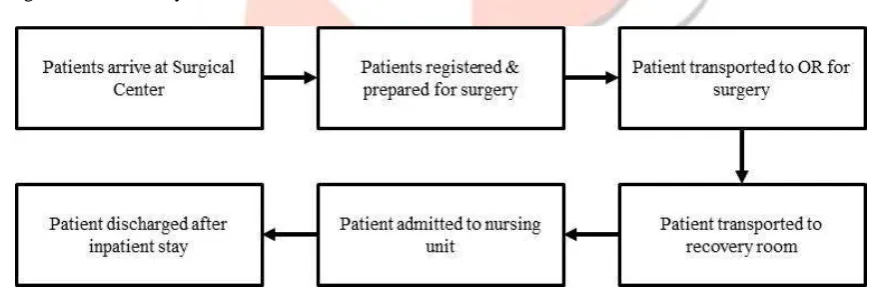
The patient flow is presented in (Fig. 1). The patient population consists of 100% of the elective procedures and hence they arrive to the surgical center on the day of the procedure. Usually, patients arrive 1.5 hours to 2 hours prior to scheduled start time. All the patients arriving to the surgical center complete the registration process and then admitted to the preparation area. Here all the necessary paperwork (consents, History & Physical etc.) and the patient preparations (changing to gowns, IV placement etc.) were conducted. The patients are then transported to the operating room for the procedure. Once the surgery and the recovery processes are completed, the patients are directly admitted to the dedicated inpatient nursing units. In the current model, 5% of the patients were modeled to be discharged on the day of the procedure. This assumption was based on the expectations of the surgeons involved in surgical center of study.
Figure 1: Patient Flow within Surgical Center
III. METHODS
The study was conducted in stages. In the first stage, various permutations of the surgical schedule were developed. This was followed by developing a discrete event model of the surgical center. The simulation model provided the expected bed occupancy for each of the surgical schedules. The results from model were then used to identify the best option which will meet most of the objectives. In the final stage of the study, the bed occupancy levels and the surgical schedule (best option) were used to determine the number of staff needed (based on existing staffing ratios) for each of the departments within the surgical center. In the sections below, details of the first two stages are provided.
Development of surgical schedules
IJEDR1603128
International Journal of Engineering Development and Research (www.ijedr.org)782
Table 1 Surgical Scheduling OptionDay
Option 1: 4 Day OR Option 2: 3 Day OR Option 3: 3 Day OR
Surgeon Surgeon Surgeon
1 2 3 1 2 3 1 2 3
Monday 6 6 5 6 5
Tuesday 5 5 OR Closed 4 5
Wednesday 6 6 5 6 5
Thursday 4 5 4 5 OR Closed
Friday OR Closed OR Closed OR Closed
Developing a Discrete Event Simulation Model
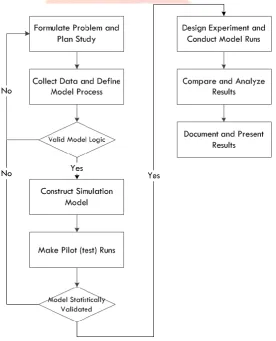
Simulation generally requires the development of a mathematical model that is a representation of the real system under study. Usually, this involves extensive use of computer modeling. Computer modeling refers to the methods for studying a wide variety of models of real systems by numerical evaluation using software. The purpose of conducting numerical evaluation is to facilitate a realistic understanding of the behavior of the system for a given set of conditions. The process of building and developing a simulation model involves an incremental and iterative procedure [1]. It is highly unlikely that the most accurate simulation model of the system can be developed in the first attempt. The series of steps that should be followed for a sound simulation study is shown in Figure 2. Details of some of the main steps involved in a simulation study are further elaborated here.
Figure 2 Outline of the Methodology to Conduct Simulation Study
IJEDR1603128
International Journal of Engineering Development and Research (www.ijedr.org)783
Data collection and definition is the next step in the simulation study. The data utilized for this study is presented in Table 2. The total budgeted weekly cases for each surgeon was made available from forecasted budgets, while the expected patient length of stay were estimated from existing surgical data for the surgeons for total knee replacement procedures.Table 2 Data Used for Model Development
Surgeon Weekly Budgeted
Cases
OR Time Required per Cases (in Minutes)
Expected Inpatient Length of Stay (in days)
Surgeon 1 16 120 2.5
Surgeon 2 10 120 2.6
Surgeon 3 5 120 2.6
Construction of the model: This step involves the development of the simulation model using either a general process programming language or DES software. For the purposes of this study ARENA 10.0 was utilized.
Verification: This step ensures that the logic of the model and flow of entities is correct. It also involves conducting the debugging of the computer model (if necessary). One of the most common techniques utilized is visual verification in which flow of the entities are closely monitored to check for the logical consistency of the model. In this study, visual verification technique was utilized.
Validation is the stage in model development in which the outcomes (performance metrics) from the model is compared against the real world system under study. The most common methods used for this are expert validation and statistical validation. For the purposes of this study, expert validation was utilized, since no prior data existed for this system.
IV. RESULTS
Option 1 presents a four day surgical schedule with the OR closed on Fridays and the total budgeted cases distributed across Mondays to Thursdays (Table 1). Option 2 for the surgical schedule presents a slightly unorthodox approach with the OR being closed for surgeries on both Tuesdays and Fridays (3 day operating model for the ORs). The schedule offers no difference in the workload for Surgeon 1 and rearranges the schedule for the other two surgeons to achieve such an operation schedule. Option 3 also presents a three day operating model with the OR being closed for surgeries on both Thursdays and Fridays. In this option, the entire surgical schedule is loaded up on Mondays & Tuesdays. On comparing Option 2 & Option 3, it can be seen that there is rearrangement of schedule needed for Surgeon 2 & Surgeon 3. It can be seen that Mondays & Wednesdays would be heavily utilized in all three schedules with variation seen on the utilization levels for Tuesdays and Thursdays.
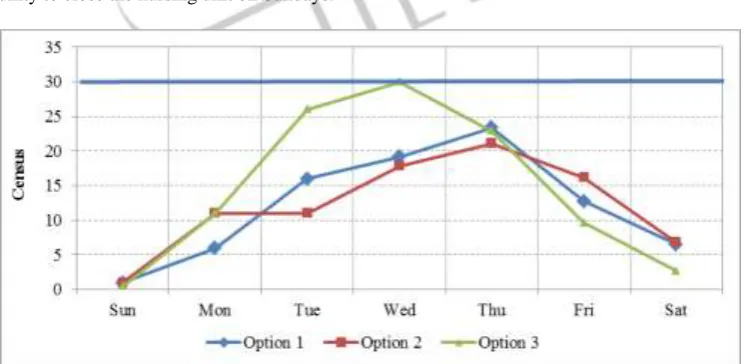
Figure 3 presents the comparison of the bed occupancy levels across the days of the week for each of the surgical schedule options. Option 1 (four day model) and Option 2 (3 day model) both displayed similar bed occupancy trends. The highest occupancy (21 – 23) in both these models was reached on Thursday, which was well below the available beds (30 beds). Similarly, the occupancy levels on Saturday for these models were around 7 and Sunday occupancy around 0.4. Option 3 has an occupancy distribution which is significantly different from rest of the options. The peak occupancy is reached by Wednesday (all the surgeries are carried out Monday – Wednesday) and the occupancy sharply drops for rest of the week. The maximum occupancy predicted by the simulation model is 30. However, the occupancy level over the weekends falls to very low levels and thereby providing the opportunity to close the nursing unit on Sundays.
Figure 3 Comparison of Inpatient Bed Occupancy
V. DISCUSSION
IJEDR1603128
International Journal of Engineering Development and Research (www.ijedr.org)784
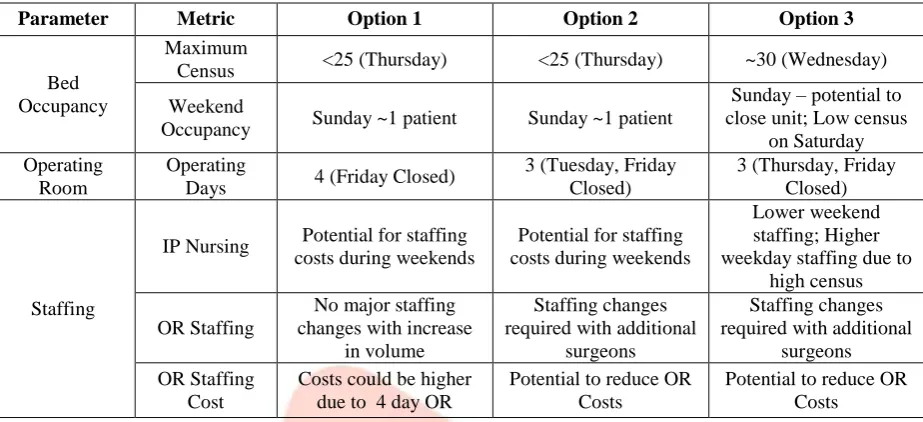
challenge of trying to minimize the total cost of running both operating rooms as well as inpatient beds. One of the immediate challenges is the low weekend occupancy levels. The solution was to develop a surgical schedule which can minimize the occupancy levels during the weekend. The DES model was able to determine the daily occupancy levels for the outlined surgical schedules.Table 3 Comparison of Schedules
Parameter Metric Option 1 Option 2 Option 3
Bed Occupancy
Maximum
Census <25 (Thursday) <25 (Thursday) ~30 (Wednesday) Weekend
Occupancy Sunday ~1 patient Sunday ~1 patient
Sunday – potential to close unit; Low census
on Saturday Operating
Room
Operating
Days 4 (Friday Closed)
3 (Tuesday, Friday Closed)
3 (Thursday, Friday Closed)
Staffing
IP Nursing Potential for staffing costs during weekends
Potential for staffing costs during weekends
Lower weekend staffing; Higher weekday staffing due to
high census OR Staffing
No major staffing changes with increase
in volume
Staffing changes required with additional
surgeons
Staffing changes required with additional
surgeons OR Staffing
Cost
Costs could be higher due to 4 day OR
Potential to reduce OR Costs
Potential to reduce OR Costs
The comparison of the bed occupancy levels of the three models provide an additional variable to help decide on the most appropriate surgical schedule. For closed system such as the one described, OR capacity cannot be used as the sole criteria for decision making. It can be seen that all the three selected surgical schedules allows for low bed occupancy levels during the weekends. Option 1 presents the simplest option, with 4 days of staffed ORs while ensuring that the maximum bed occupancy less that the available beds and low bed occupancy levels during the weekends.
Option 2 provides a radically different approach for a 3 day operating model, with no surgeries being scheduled on Tuesdays. The weekend occupancy levels from this option are very similar to that option 1, however with the added benefit of requiring only 3 days of staffed ORs.
Option 3 provides the strongest possibility of achieving no patients in the inpatient unit during Sundays and hence the ability to close the unit. It also only requires the operating rooms to be staffed for three days. However, it also comes with the risk of exceeding the maximum available beds in the center during Wednesdays. The decision to select the best model would require balancing the cost savings and the risks associated with exceeding bed capacity.
Besides the factors of OR staffing costs, bed capacity restrictions, ease of staffing should also be considered while selecting a surgical schedule. A four day operating model may provide an easier nurse rostering from an OR staff perspective. Option 1 & Option 3 provides an easier schedule to fill for required OR staff (3 shifts of 8 hours etc.) compared to Option 2.
VI. CONCLUSIONS AND FUTURE WORK
The system under study represents a rather uncommon situation with 100% of the cases being elective. Usually, surgical schedule is affected by emergency and add-on cases. Secondly, the system also has a dedicated inpatient unit to support patients emerging from the surgery. Hence, the bed occupancy is impacted only by the surgical cases (not by any medical admissions from the emergency room/direct admissions etc.). Such a situation also allows for a relative ease in determining the staffing schedule for the inpatient unit, as well as the operating rooms. Hence generalizability of this study will be limited, keeping in my mind that the approach can be extended to suit any general patient flow process.
Capacity factors related to the operating room (such as equipment, surgical trays, implants etc.) have not been modeled. In a real world scenario, delays in such factors often lead to delays in case starts and often case cancellations. Also, the surgical schedule was optimized to suit the surgical volumes & LOS behavior for each of the selected surgeons. For maintaining the performance of the system, surgical schedule will need to be regularly evaluated.
IJEDR1603128
International Journal of Engineering Development and Research (www.ijedr.org)785
REFERENCES[1] Law AM, Kelton WD. Boston, Mass: McGraw-Hill; 2000. Simulation Modeling and Analysis.
[2] Gulotta LV, Padgett DE, Sculco TP, Urban M, Lyman S, Nestor BJ. Fast Track THR: One Hospital's Experience with a 2-Day Length of Stay Protocol for Total Hip Replacement. HSS J.2011 Oct; 7(3):223-8.
[3] Kurtz S, Ong K, Lau E, Mowat F, and Halpern M., “Projections of primary and revision hip and knee arthroplasty in the United States from 2005 to 2030,” The Journal of Bone & Joint Surgery—American Volume, vol. 89, no. 4, pp. 780–785, 2007.
[4] Mahachek AR. An introduction to patient flow simulation for health-care managers. J Soc Health Syst 1992;3:73–81