Stabilization of Clay Soil Using Fly Ash and
Lime for Construction Work
Surendra Maharjan
1, Hussain Saliq
2B. Tech Student, Department of Civil Engineering, JNTUH Engineering College, Kukatpally, Hyderabad, India1
B. Tech Student, Department of Civil Engineering, JNTUH Engineering College, Kukatpally, Hyderabad, India2
ABSTRACT:Site feasibility study for geotechnical projects is of far most beneficial before a project can take off. Site survey usually takes place before the design process begins in order to understand the characteristics of subsoil upon which the decision on location of the project can be made. The following geotechnical design criteria have to be
considered during site selection.Abandoned sites due to undesirable soil bearing capacities dramatically increased, and
the outcome of this was the scarcity of land and increased demand for natural resources. Affected areas include those which were susceptible to liquefaction and those covered with soft clay and organic soils. Other areas were those in a landslide and contaminated land. However, in most geotechnical projects, it is not possible to obtain a construction site that will meet the design requirements without ground modification. The current practice is to modify the engineering properties of the native problematic soils to meet the design specifications. Nowadays, soils such as, soft clays and organic soils can be improved to the civil engineering requirements. This state of the art review focuses on soil stabilization method which is one of the several methods of soil improvement.
KEYWORDS:lime, fly ash, black cotton soil, Maximum Dry density, Optimum Moisture Content, CBR, Plastic limit, Liquid Limit.
I. INTRODUCTION
Lime stabilization is a method of chemically transforming unstable soils into structurally sound construction foundations. Lime stabilization is particularly important in the construction of highway for modifying subgrade soils, subbase materials, and base materials. The improved engineering characteristics of materials which are treated with lime provide important benefits to portland cement concrete (rigid) and asphalt (flexible) pavements. Lime stabilization creates a number of important engineering properties in soils which includes improved strength; improved resistance to fracture, fatigue, and permanent deformation; reduced swelling; and resistance to the damaging effects of moisture. The most substantial improvements in above said properties are seen in moderately to soils with high plasticity, such as heavy clays. Then soil stabilization occurs when lime is added to a reactive soil to generate long-term strength gain through a pozzolanic reaction. That reaction produces stable calcium silicate hydrates and calcium aluminate hydrates as the calcium from the lime reacts with the aluminates and silicates solubilized from the clay. This pozzolanic reaction can continue for a very long period of time, even decades -- as long as enough lime is present and the pH remains high (above 10). As a result of this, lime treatment can produce high and long-lasting strength. Lime in the form of quicklime (calcium oxide – CaO), hydrated lime (calcium hydroxide – Ca[OH]2), or lime slurry can be used to treat the soils. Hydrated lime is created when the quicklime chemically reacts with water. It is hydrated lime that reacts with particles of clay and permanently transforms them into a strong cementious matrix.
II. EXPERIMENTAL RESULTS
liquid limit and plastic limit
shrink or reduce in volume due to evaporation of water and they become harder. The quantity of lime needed to effectively treat a soil to develop increased strength varies with the type of clay mineral present.
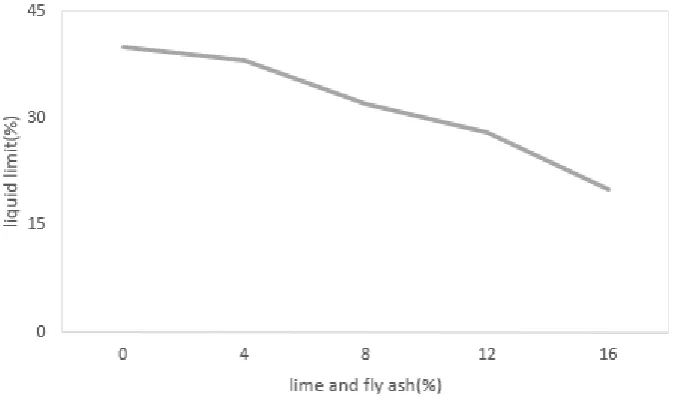
Liquid limit and Plastic Limit of black soil is decreases with addition of fly ash and lime content. The primary clay mineral present in the black cotton soil is montmorillonite. The variation of liquid limit and Plastic limit on addition of fly ash to the black cotton soil is shown in Fig.1.
Fig 1.
As we can see from the graph the liquid limit goes on decreasing as the percentage of the lime and fly ash is increased. There is drastic decrease in the liquid limit as the content of the lime is increased.Addition of various percentages of mine tailings to black cotton soil, liquid limit decreases for immediate testing due to reduction in the specific surface area of the soil, the consequent decrease in the diffuse double layer thickness possibly accounts for the lower liquid limit of the treated soil during initial stages. Addition of mine tailings, decreases the liquid limit of black cotton soil and mine tailings mixture immediately due to replacement of exchangeable ions particularly monovalent ions by calcium ions and decrease the thickness of the diffused double layer leading to decrease in the water holding capacity.
Fig 2.
The decrease in plastic limit is due to decrease in diffused double layer thicken of clay particles leads to increase in shearing resistance, the soil fabric varies with changes in exchangeable cation and mine tailings concentration like fly ash and lime. Depending upon the particles arrangement size and shape of the pores vary
Maximum dry density
When dry soil is crushed in the hand, it can be seen that it is composed of all kinds of particles of different sizes. Most of these particles originate from the degradation of rocks; they are called mineral particles. Some originate from residues of plants or animals (rotting leaves, pieces of bone, etc.), these are called organic particles (or organic matter). The soil particles seem to touch each other, but in reality have spaces in between. These spaces are called pores. When the soil is "dry", the pores are mainly filled with air. After irrigation or rainfall, the pores are mainly filled with water. Living material is found in the soil. It can be live roots as well as beetles, worms, larvae etc. They help to aerate the soil and thus create favourable growing conditions for the plant roots.
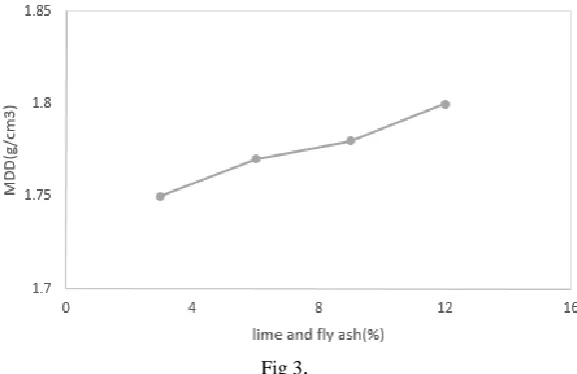
Maximum dry Density (MDD) the compaction characteristics for modified Proctor comp active effort for the black Cotton soil- lime and fly ash mixes reveal that the MDD decreases with increasing lime. That is shown in Fig.3.
As we can see from the graph the MDD value goes on increasing as the lime and the fly ash is increased.Addition of various percentages of mine tailings like lime and fly ash to black cotton soil the shrinkage limit and MDD increases with increase in curing period. Addition of optimum 3% of lime to black cotton soil and mine tailings mixture, the shrinkage limit is found to be 21.7% at immediate testing and further it increases
Compaction
Soil compaction occurs when soil particles are pressed together, reducing pore space between them. Heavily compacted soils contain few large pores and have a reduced rate of both water infiltration and drainage from the compacted layer. This occurs because large pores are the most effective in moving water through the soil when it is saturated. In addition, the exchange of gases slows down in compacted soils, causing an increase in the likelihood of aeration-related problems. Finally, while soil compaction increases soil strength-the ability of soil to resist being moved by an applied force-a compacted soil also means that roots must exert greater force to penetrate the compacted layer.
Soil compaction changes pore space size, distribution, and soil strength. One way to quantify the change is by measuring the bulk density. As the pore space is decreased within a soil, the bulk density is increased. Soils with a higher percentage of clay and silt, which naturally have more pore space, have a lower bulk density than sandier soils.
The change compaction of the soil with increase in the lime and fly ash percentage is shown in the Fig 4.
Fig 4.
As we can see from the graph the OMC goes on decreasing as the lime and fly ash content goes on increasing.This is because of increase in the particles in the mixture to share the available water provided for the test.
CBR Test
The California Bearing Ratio, believe it or not, was developed by The California State Highways Department.It is in essence a simple penetration test developed to evaluate the strength of road subgrades.
This consists of causing a plunger of standard area to penetrate a soil sample, (this can be in the laboratory or on site). The force (load) required to cause the penetration is plotted against measured penetration, the readings noted at regular time intervals.
This information is plotted on a standard graph, and the plot of the test data will establish the CBR result of the soil
tested.It sounds complicated, but the basis behind it is quite simple.We are determining the resistance of the subgrade,
wheels.Even more simply put, ''How strong is the ground upon which we are going to build the road''.
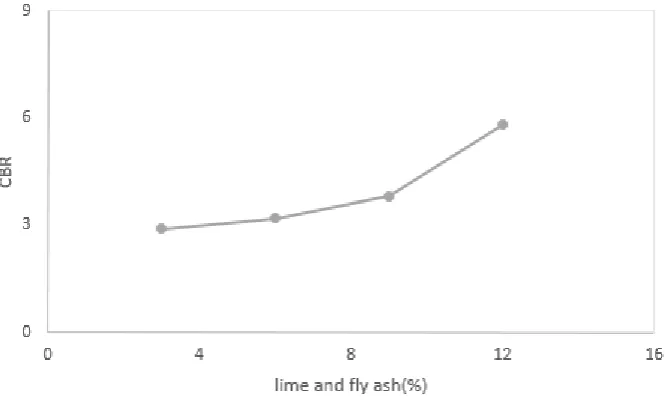
The stronger the subgrade (the higher the CBR reading) the less thick it is necessary to design and construct the road pavement, this gives a considerable cost saving.Conversely if CBR testing indicates the subgrade is weak (a low CBR reading) we must construct a suitable thicker road pavement to spread the wheel load over a greater area of the weak subgrade in order that the weak subgrade material is not deformed, causing the road pavement to fail.The result of the black cotton soil sample is shown below Fig 5.
Fig 5.
As we can see the CBR values goes on increasing with the rise in the amount of lime and the fly ash. The reason for the increase in CBR value with increasing lime and fly ash is related to these voids which are not filled with cementing products. The bonding of clay particles due to the pozzolanic(lime) reaction was limited by increasing fly ash and lime, also due to the presence of water particles.
III. CONCLUSION
Lime is used as an excellent soil stabilizing materials for highly active soils which undergo through frequent
expansion and shrinkage.
Lime acts immediately and improves various property of soil such as carrying capacity of soil, resistance to shrinkage
during moist conditions, reduction in plasticity index, increase in CBR value and subsequent increase in the compression resistance with the increase in time.
The reaction is very quick and stabilization of soil starts within few hours.
The graphs presented above give a clear idea about the improvement in the properties of soil after adding lime.
REFERENCES
[1] Chaddock, B. C. J., “The Structural Performance of Stabilized Road Soil in Road Foundations,” Lime stabilization. a. Thomas Telford, Vol .11, pp. 10-16, 1962.
[2] Evans, P., “Lime Stabilization of Black Clay Soils in Queensland, Australia,” Presentation to the National Lime Association Convention, San Diego, California,Vol.3,pp.20-24, 1998.
[4] Basma, A. A., and Tuncer, E. R., “Effect of Lime on Volume Change and Compressibility of Expansive Clays,” Transportation Research Record No. 1295, Vol.7, pp.31-40, 1991.
[5] Dawson, R. F., and McDowell, C., “A Study of an Old Lime-Stabilized Gravel Base,” Highway Research Board, Lime Stabilization: Properties, Mix Design, Construction Practices and Performance, Bulletin 304, Vol.15, pp.31-35, 1990.