Design and Implementation of Secured Online
Census Information Management System
Based on B/S Structure
Usman Waziri
1, Mohammed Joda Usman
2, Abdulrauf Garba
3and Wadzani A. Gadzama
4Lecturer, Mathematical Sciences, Bauchi State University, Gadau, Bauchi State, Nigeria1
Lecturer, Mathematical Sciences, Bauchi State University, Gadau, Bauchi State, Nigeria2
Lecturer, Computer Sciences, North-West University, Kano, Kano State, Nigeria3
Lecturer, Department of Mass Communication Federal Polytechnic Mubi, Adamawa State4
Abstract: With advances in information and communication technology, online transaction over the Internet has become an integral part of day to day life. An online census is the web-based application which allows respondents to complete the census via the internet. This paper aims at upgrading and integrating the efficiency of census data collection management system. Traditionally, census data collection demands an authorized enumerator, who collects the census data manually which is time consuming and waste of resource. A secure online census system based on B/S structure can overcome these problems. MyEclipse was used as an integrated environment for development of web-base system and JSP, were served as the programming language. SQL server (2005) served as a relational data web-base. By adopting the idea of differential equation and exponential function the system can predict the future population of the country that will encourage cooperation and collaboration among federal agencies.
Keywords:Application, Census, Enumerator, Population, Programming.
I. INTRODUCTION
II. RELATED WORK
The absence of virtually any reliable current census data collections has not prevented national and international bodies from generating estimates and projections of population growth in Nigeria. Many approaches have been widely investigated toward solving census related challenges. A recent research in Nigeria, secured census information management system [3]. Another work discussed the putting of census information on the web for access, by applying the internet as an information dissemination tool [4]. An online internet based application for census counting was presented in another work [5]. Biometrics has been applied and integrated into information systems in some studies [6]. Another study reinforced the need for an efficient land use planning, and represented the first approach integrating satellite imagery with population census data for studying the human environment in the Caribbean [7]. The processes put in place to provide an internet option to the Australian public at the 2006 Census, was briefly outlined in another work [8]. Another work describes India census data collection using PDA, which is the design and implementation of census Data collection system using PDA [9]. Voter Privacy which is one of the main security issues in the election process can be guaranteed by using blind signatures for confidentiality and voter's digital signature for voter's authentication [10] [11][12]. However, most of these approaches are yet to success in providing an update census data. This Paper aim at developing a secure online census information management system (OCIMS) based on Browser-server structure, user- friendlier and widely accessible to users, taking advantage of new technologies to better meet the purpose. It was suggested that every effort be made to reduce the number of inaccuracy and manual method in the area of census data collections.
III.BROWSER-SERVER
Browser-Server is internet access to the server and can be either open to all or limited access to those with passwords and or privileges (such as a company server) etc. This could be a private server but with internet based access rather than LAN (Local Area Network) access. The server has a three-step response to a client. First, it accepts the connection, and then it reads and processes the client‟s request. Finally, it sends a reply to the client. For some client-server relationships, like a database server, there may be multiple requests and replies. Since database requests may take a long time to process, the server must be multi-threaded in order to handle concurrent requests. In the case of HTTP, a single request will lead to multiple replies [14][15].
3.1 Why Browser-Server Structure
BSS which is so-called Browser-Server Structure of the biggest advantages is that you can in any place operate it without having to install any special software. As long as there is a computer with internet access one will be able to use the client zero maintenance. The expansion of the system is very easy, as long as there is access to the Internet, and provides a user name and password, you can use the application.
3.2 Browser-Server Structure Architecture
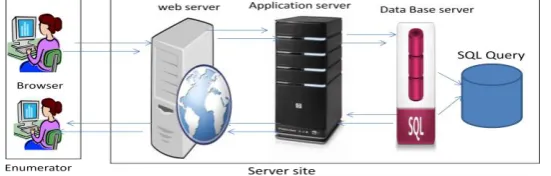
B/S structure is three-layered Browser-Web server-Database Server structure in essence. The browser which serves as client software is responsible for displaying information and data collection, and communicating with web server through Internet, realizing the interaction of information between users and systems. Web server which is in charge of the main application processing tasks is responsible for business logic operation of all sorts of function modules and information issues including HTTP(Hyper Text Transfer Protocol) request and connection and interaction with database server. Database server is responsible for storage and management of system data as shown in Fig. 1:
As shown in Fig. 1, client runs browser software, and browser proposes requirements of accessing database in hypertext forms. After received by Web server, request will be converted to SQL (Structural Query Language) statement and submitted to the database server. Database server verifies its validity and deals with the data, and then returns results back to the Web server. Web server handles data to logic operation of various functions according to the demand, and eventually transfers the results.
IV.MATERIALS AND METHODS 4.1 Data Collection
Data was collated by conducting discrete census activity with some selected categories of people within some selected regions of the Azare, Bauchi State Nigeria. Azare is located in Katagum local government of Bauchi state. We tested our system with few data for a start. About 25-50 individuals were counted with our application and the results were promising. These different individuals were registered based on the bio-data based application in order to guarantee security and a safer census activity.
4.2 System Design Architecture
The system must be portable and extendable to accommodate future changes in hardware, software and networking. Keeping in view these factors, the solution Nigerian Population has developed is based on two components: the server side and the enumerator side, which runs on the browser. The server is a set of applications that serve the requests made by an enumerator. Data server which is responsible for managing tabular data at the server side and sending the information to the client. This system is viewed in any standard web browser. The advantage of this approach that there is no need to download any plug-ins on the client side. The performance of the system is measured by the ability to respond to requests faster, and the reliability of the system. Typically, the response to a certain query must not take longer than 25 second. The overall system performance is dependent on the combination of browser, server and networking performance, not the individual components, and is controlled by the weakest component within the total solution. In this phase of the project, one server machine is used for the functionality of the web server and data server, which are installed together. The diagram below illustrates a general view of the system design architecture.
Fig. 2 System architecture of secure online census based on B/S.
The above system is 3-tier architecture by inserting another program at the server level. We call this the server application. Now the client application no longer directly queries the database; it queries the server application, which in turn queries the data server. The advantage of this system, when the enumerator wants to register or retrieve data the following happens: The enumerator on browser asks the web server, the web server asks the server application and the server application queries the data server, the data server serves up a recordset with all the populations‟ data. The server application does all the processing to determine the data and serves up the final data to the web server. The web server displays the final data information to the enumerator. The three tiers in three-tier architecture are:
1. Web server known as Presentation Tier: it interacts closely with the user. Occupies the top level and displays information related to services available on a website. This tier communicates with other tiers by sending results to the browser and other tiers in the network.
2. Application server known as Application Tier: Also called the middle tier, logic tier, business logic or logic tier, this tier is pulled from the presentation tier. It controls application functionality by performing detailed processing.
4.3 System Design and modelling
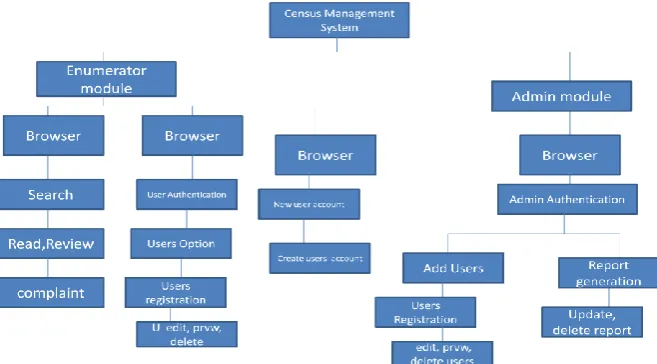
System design is the creative process of transforming a real-life problem into a solution. This is done through the description of the structure of the software to be implemented, data which is part of the system, and the interfaces between system components. For this system, the structure will be represented through its logical design and functional decomposition. The logical design specifies the methods of interaction of system components like the input and outputs, menu structures, procedures, controls and functions and command structures. For this census information management system, it comprises of three essential modules, namely: the enumerator module, the system administration module and the census registration module. As shown in Fig. 3 below. While a decomposition diagram shows a top-down functional decomposition of a system and exposes the system's structure. The objective of the Functional Decomposition is to break down a system step by step, beginning with the main function of a system and continuing with the interim levels down to the level of elementary functions. As shown in figure 4 below;
Fig. 3 Logical design of OCIMS.
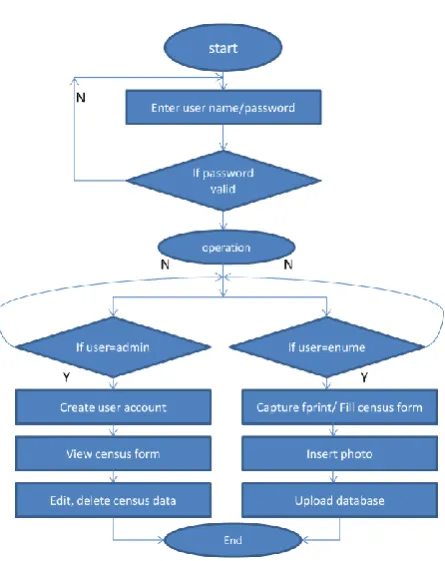
System modelling involves the evaluation of system components in relationship with one another to determine their requirements and how to satisfy them. Some system modelling tools will be employed during the course of this project that will support development tasks, from analysis to design, then to implementation. This will be represented with the use of the sequence diagram for the census information system.
Fig. 5 Basic flow chart of OCIMS.
4.4 Implementation
We have used the MyEclipse Integrated Development Environment as it provides an excellent way of developing the modules and adding library easily. The deployment of the servlet and applets on a web server is easy using MyEclipse and JSP were served as programming language. It was easy to integrate it with Microsoft SQL Server; Microsoft SQL Server (2005) is a relational database management application that handles robust and complex data rather effectively.
V. RESULTS AND DISCUSSION
The online census management system helps to ensure the conduct of a good and credible census program throughout the nation. This system comprised of many modules, some these are:
1. Administrator module 2. Enumerator module 3. Login module 4. Registration module 5.1 Administrator module
The administrator is the one who fills or changes the census form, is the superior of this management system. The administrator is responsible for all the activities that are done in the system. As mentioned earlier the administrator is the one who provide privileges and authorizes the enumerator. The administrator views the census report and can also access all the information. The administrator can edit or delete census data from the census database. The administrator can also view the census report, population projection etc.
5.2 Enumerator module
5.3 Login Module
This is the Login page through which administrator, enumerator or specifies user with national ID card can be granted access the census forms. Both admin and users access is denied until he enters a valid ID number and password. Login module is the first module in this system. As shown in figure 5.3 below.
Fig 6. System login page.
5.4 Welcome Home Page
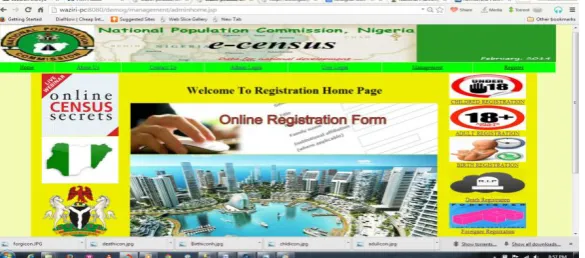
After the enumerator has entered a valid National ID Number and Password, and it has been authenticated. He/she is allowed access the system. Where there is a choice of functionalities. He can either choose to register an individual, view an individual‟s records, delete an individual, or update individual details. Depending on the selected function, the corresponding page is executed. Fig. 7 depicts this:
Fig. 7 System Welcome Home Page 5.5 Registration module
After clicking on the register icon, the system navigates to a form where the enumerator is required to fill in certain information about the respondent as pre-requisite to registration. The individuals are grouped into categories which the enumerator is required to select one between Children registration this meant an individual below 18 years, adult registration this meant an individual above 18 years, or any category of vital registrations such as birth, death or foreigner‟s registration category. As shown below.
5.6 Online Adult Registration
This is the category been selected from registration home page, enabling to census individual above 18 years only. Any violation will trigger a prompt requesting for the appriate age range. Fig. 9 below shows
Fig. 9 A screen shot category of Online Adult Registration
5.7 Online Birth Reigistration
Online Birth registration form is another category been selected from admin home page. Admin has access to register a new born baby, also generate national Birth registration number serially according to their state. Fig. 10 below shows online birth registration form page.
Fig. 10 A screen shot of Online Birth Reigistration form
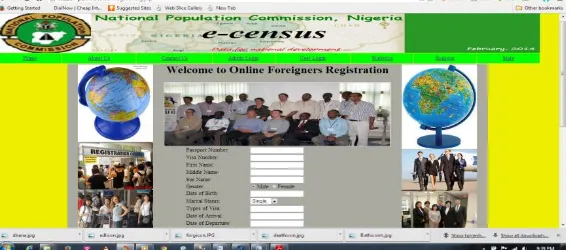
5.8 Online Foreigner Registration
Foreigner registration form is another category from admin home for instance the foreigner category, the new category becomes displayed as shown in Fig. 11 In the foreigner category below; there is a constraint that accepts only visa number and international passport. Admin enable to register all foreigners arrived to the nation.
5.9 Population Model
The system we design is guarantees of having accurate census data; therefore we proposed to analyse the data by adopting the idea of differential equation and exponential growth equation which explain the relationship between population size and the four demographic processes as shows below:
Pt = P + Bt – Dt + It – Et (1)
Whereas Pt is Future population at a time t = n, P: initial population of arbitrary time t = 0, Bt: total number of births at
the time t=n, Dt: total number of deaths at the time t=n, It: the total number of immigrants in the same time interval, Et: total number of emigrants in the same time interval.
For simplicity, this exercise ignores immigration and emigration by considering closed population. Our equation becomes;
Pt = P + Bt – Dt (2)
When we take birth rate and death rate into consideration together, it's possible to combine them to produce a value that reflects the overall net rate of population growth, (r). Remember: r is a rate! And r = b – d, 0≤ r ≤1.
b = 𝐵𝑡
𝑃 => Bt = bP and d = 𝐷𝑡
𝑃 => Dt = dP Pt – P = (b - d)P (3) By integrated Eq. (3) both sides, we arrived at
Pt = P0𝑒(𝑏−𝑑 )𝑡 (4)
Where e is the base of natural logarithms (about 2.718), solve for Pt and we get a continuous model that predicts population size. In order to predict the population increase per day we use equation (4) as shown below:
Pd=Po𝑒(𝑏−𝑑)𝑡- Po (5)
Pd is the future population per day.
This model can give statisticians the actual total population, total births, total deaths, total immigrations and total emigrations, not only that also enable to predict Nigerian population for future use.
5.9.1 REPORT CAPABILITIES
This system is capable of generating different types of reports based on the data collected and the population model, these could help the economic policies makers to have an efficient data that can be used in the country in implementation of budget by different organization.
Fig. 12-13 below shows the sample report generated by the system with the sample of data used to test the capability of the system and Fig. 14 below is the forecast future population in the country.
Fig. 13 Birth & Death rate Report
Fig. 14 Predict population report
VI.CONCLUSIONS
We have implemented the secure online census system base on browser-structure. It is our believe that with the adoption of this system prototype and implementation on a large scale, a guaranteed safe, secured and reliable to both the quality and use of data on the population census to encourage cooperation and collaboration among federal agencies by:
Adopting the population model it could help the demographers to forecast and advise the government to plans for new generations.
Widening access to information on the population census through periodic publications and other means.
Promoting communication among data producers, researchers, and public policy- makers.
Coordinating the development and use of statistical databases among federal agencies.
Identifying information gaps and data inconsistencies.
Investigating questions of data quality.
Encouraging cross-national research and data collection on the census.
REFERENCES
[1] Anguilla Census 2001, Statistical Unit Ministry of Finance The Secretariat The Valley, Anguilla http://www.gov.ai/statistics/census/body.htm
[2] NPC Nigeria http://www.population.gov.ng.
[3] Anil Arora, “Statistics Canada – Census on the net” Statistical Journal of the United Nations ECE 23 (2006). IOS Press. Pp. 11–22
[4] Olugbenga Oluwagbemi, Maria Keshinro and Charles K. Ayo, “Design and Implementation of a Secured Census Information Management System”. Egyptian Computer Science Journal Vol. 35 No.1 Jan2011. Pp. 2-10
[5] D Martin, J Harris, J Sadlert, NJ Tate, 1998, Putting the Census on the Web: Lessons from Two Case Studies, Area, Interscience Wiley, 1998, Vol. 30, No. 4 pp. 311-320.
0 20 40 60 R at e pe r thous and
Birth rate & Death rate at Nigeria
Birth Rate Death Rate 0 100 200 300 Po p u la ti o n i n M il li o n s
Predicts Nigerian population
[6] Arora, A., & Gilmour, G. (2005, June). Statistics Canada: Census on the Net. Paper presented at the Statistical Commission and Economic Commission for Europe Conference of European Statisticians, Geneva, Switzerland. Available:http://www.unece.org/stats/documents/2005/seminars/si.2.add.2.e.pdf
[7] D Weibel, E Schelling, B Bonfoh, J Utzinger, J Hattendorf, M Abdoulaye, T Madjiade, J Zinsstag, (2008), Demographic and health surveillance of mobile pastoralists in Chad: integration of biometric fingerprint identification into a geographical information system, (2008), Geospatial Health Vol.3, Issue 1,pp. 113-124.
[8] S Martinuzzi, WA Gould, OM Ramos Gonzalez, (2007), Land development, land use, and urban sprawl in Puerto Rico integrating remote sensing and population census data, Landscape and Urban Planning , Landscape and Urban Planning Volume 79, Issues 3-4, Pages 288-297.
[9] P. Williams, The Australian 2006 Census and the Internet, (2007), Statistical Journal of the IAOS, Volume 24, Issue 3-4, Pages 173 – 182.
[10] A.Vijayaraj and P.DineshKumar. “Design and Implementation of Census Data Collection System use PDA” international journal of computer Applications (0975-8887). Volume 9-No.9, November 2010, pp 28-31.
[11] Anane R, Freeland R, Theodoropoulos G, “e-Voting Requirements and Implementation”, E-Commerce Technology and the 4th IEEE International Conference on Enterprise Computing, E-Commerce, and E-Services, 23-26 July 2007, pp.382-392.
[12] F Mimiko, 2006, Census in Nigeria: The Politics and the Imperative of Depoliticization. African and Asian Studies, Volume 5, Number 1 2006, pp.1-22(22)
[13] P. Williams, The Australian 2006 Census and Internet, (2007), Statistical Journal of the IAOS, Volume 24, Issue 3-4, Pages 173-182. [14] U. Waziri “Online Integrated Information System for Demography In Nigeria Based On B/S Structure”. Volume 3, Issue 2, Feb. 2014. Pp
80-84.
[15] Yang Bensheng, Wang Qiaoyun, and Zhang Fangming, „Security Architecture Design of Bidding MIS Based on B/S‟. Proceedings of the 2009 International Workshop on Information Security and Application. ISBN 978-952-5726-06-0, Page 74-77.
BIOGRAPHY
Usman Waziri is a Graduate Assistant at Department of Mathematical Sciences, Bauchi State University Gadau, Bauchi State of Nigeria. And attended Bayero University, Kano, Nigeria, for his first degree in Mathematics and currently pursuing a master's degree in computer science at Liaoning University of technology, Jinzhou china.
Mohammed Joda Usman is a Lecturer at Department of Mathematical Sciences, Bauchi State University Gadau, Bauchi State of Nigeria.
Abdulrauf Garba is a Graduate Assistant at Department of Computer Sciences, North-West University Kano. And attended Bayero University, Kano, Nigeria, for his first degree in Computer Science and currently pursuing a master's degree in computer science at Liaoning University of technology, Jinzhou china.