Journal of Chemical and Pharmaceutical Research, 2014, 6(4):839-844
Research Article
CODEN(USA) : JCPRC5
ISSN : 0975-7384
The design and implementation of intelligent library
management system based on RFID/GRPS
Fu-Zhen Xie
School of Mechanical Engineering, Xinyu University, Xinyu, P.R. China
_____________________________________________________________________________________________
ABSTRACT
With the development of modern technologies, it becomes increasingly important to find a way to effectively utilize and management the intelligent library. For this reason, the intelligent library management system is designed and implemented based on RFID / GRPS. The final experimental results suggest that the proposed approach is feasible and correct.
Key words: Design; Implementation; Intelligent Library; Management System
_____________________________________________________________________________________________
INTRODUCTION
During recent years, the database technique has developed rapidly and relevant technologies become more and more mature. As a result, more and more data have been accumulated. It becomes increasingly important to find a way to effectively utilize and analyze these data to obtain what we want. Current database systems can basically realize data entry, search and statistics, but they can not effectively find or administrate some laws and relevant regulations in databases. A new technology emerges since effective analysis and research on mass data can forecast the future de-velopment trend. It is just data mining based on artificial intelligence which owns great application prospects and development space. Actually, the database system based on data mining is the focus and hotspot of future database researches and it has drawn attentions and researches of many experts, scholars and relevant technical personnel. In the field of library and information, data mining has also aroused public attentions. Informationization degree and digital library construction in universities have obtained great achievements. Therefore, it is particularly crucial for libraries to explore how to use data mining to process their redundant information so as to provide better service and effective, valid information for readers.
University libraries own their natural advantages in data mining process, because libraries themselves pay many attentions to the classification and archiving of different information resources such as books and magazines etc. and they also attach great importance to the accumulation process of these resources, usually reassembling these re-sources according to their major features. All the above have provided great convenience and laid a solid foundation for an effective data mining. Most of current university libraries have realized informationization and office automa-tion, so the circulation data, various visit data and web logs in library website in library information management system can act as source data for the future data mining.
thod. Finally, the university teaching is cyclical and periodic, so library work should also obey this law. In a word, the vertical and horizontal data mining on previous readers can provide not only great convenience for library work but also reading guidance for future readers.
LITERATURE REVIEW
Since the early 20th century, continuously developed information technology has changed the traditional learning and work mode, greatly influencing human development. As the core of information technology, computer has fun-damentally changed human’s thinking mode and ideology. The most important development link of computer is computer software that has penetrated into all aspects of human daily life and become the development pillar of emerging industries in the new century. With the further informationization, some traditional service management modes in libraries can not serve readers effectively and conveniently any longer, besides, information management and search becomes more and more difficult since more and more resources and books are added in libraries. Therefore, traditional service and management mode can not satisfy current demand and how to take the place of traditional, manually library management modes with informationalized methods is extremely urgent.
For along time, some management work in libraries is manually done, which is not only inefficient, but also a waste of labor and financial resources. Informationalized methods can avoid this phenomenon and even serve more readers. The application of computers in libraries has reduced library staffs and people waiting for returning and borrowing books become fewer. Later, the new technology barcode emerged and it has improved the library information man-agement system unprecedentedly. Barcodes are basically corresponding to books one-to-one, reducing error rates of library staff, preventing book loss and thus greatly improving the work efficiency.
With the constant development of information and era, consulting culture has emerged and drawn public attention. At the same time, the emergence of knowledge economy has made libraries the most important consulting service place. However, in some large-scale libraries, people usually should wait for a long time in queue to borrow or re-turn books and books are even stolen sometimes. It seems urgently necessary to apply some new techniques in li-brary administration. Currently, the effective combination of RFID, data mining and computer software can not only avoid a large waste of labor, material and financial resources in libraries, but also regulate library information high-efficiently, thus broadening library service. Besides, data mining can improve the work efficiency to a large extent and provides better service for readers in library management and lending.
(1) Data mining can summarize some information and data in library information system and then, through processing and analysis, provide some ordered decision-making information for administrators.
(2) Through making multi-dimensional analysis and comparison on relevant objects, data mining can improve the reliability of decision making, allocate resources reasonably and finally realize the optimization of library resource allocation.
(3) Data mining can abstract some principles and models from past data and then make adjustments and predictions by itself, which has actually realized semi-intelligence and is of great importance for the building of digital libraries.
PLATFORM ARCHITECTURE
As the environment for integrated operation of all information systems in the enterprise, traditional manufacturing enterprise resource platform includes ERP (enterprise resource plan), PDM (product data management) and CAM (computer aided manufacture) among which, PDM is the core of enterprise resource.
Fig. 1. Enterprise Resource Platform Architecture
RFID-BASED TRACKING SYSTEM
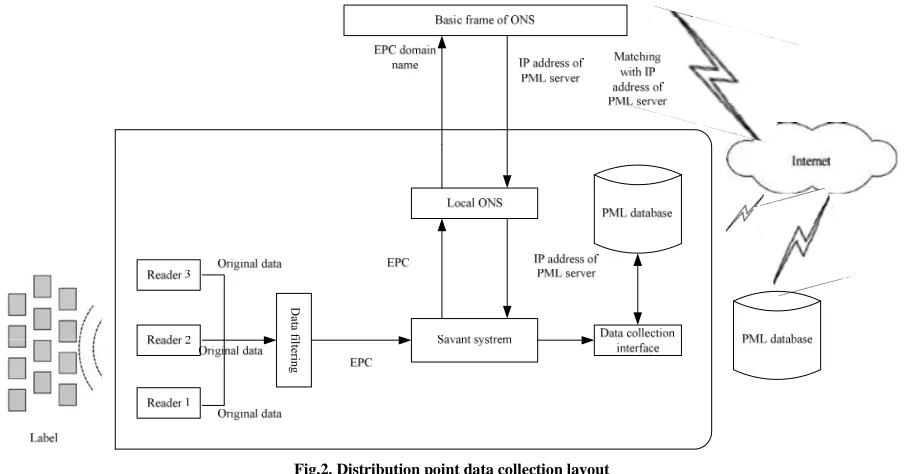
The tracking system is established based on their network, realizing the tracking through collecting product circula-tion informacircula-tion. The tracking system takes each distribucircula-tion point in the sales network as the data colleccircula-tion point and than in each data collection point, installs a set of Electronic Product Code (EPC) system that can collect data about products flowing into and out of all distribution points and save them in Physical Markup Language (PML) database of each distribution point. As the inverse of the tracking system, the traceability system collects product circulation data from each circulation distribution point, then integrates them with geographic information of each point and provides them to users in GIS platform. The above two systems form a complete tracking and traceability system. The following are detailed discussion on the two systems. Data capture of distribution point is summarized as Fig. 2.
D
at
a
fil
te
rin
[image:3.595.80.533.404.641.2]g
Fig.2. Distribution point data collection layout
The following is an application instance of some enterprise taken to introduce the data collection in details.
transmits it to ONS base frame and applies for IP address of remote PML server that matches with EPC domain name.
3) The local server links with remote PML server through the obtained IP address and applies for book information and then the PML server of manufacturers returns the quality management document and relevant transaction records and logistics records of book products.
4) Based on the book information returned by remote PML server (for example, name, type, production date, expiry date) and contents such as manufacturer, purchasing number, purchasing date identified by warehouse quality reader, the local server creates an acceptance record, stores it in local PML server and at the same time saves the IP address of manufacturer’s PML server.
During the book product sales process, the above book product data collection process performs on each distribution point of the circulation network and PML documents for book product tracking are created and saved constantly in different distribution points so as to provide traceability data for the traceability system.
GENERAL FRAME DESIGN
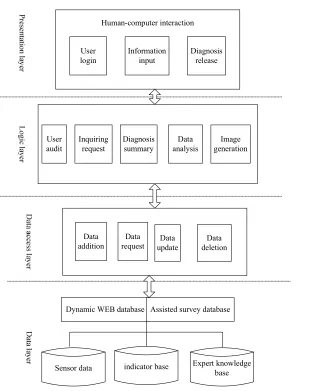
With B/S (browser/server) structure, this system collects processes and stores data through the data layer, data access layer, logic layer and presentation layer and finally provides condition data, diagnosis and management in-formation for users timely.
1) The data layer locates on the database server, composed of upload data, expert knowledge, condition and key dis-aster indicators distributed in all monitoring nodes. The condition and key disdis-aster indicators can be modified and updated constantly by experts through remote interaction so as to enrich the contents and improve the quality of data. The dynamic database formed by real-time collected data has laid a solid core data basis for the system due to its continuity, accuracy and auto update.
2) The data access layer is responsible for the data access, addition, deletion, modification and search of the database. It makes responses to the database upon the data request of Web server and then returns computational results to Web server.
3) The business logic layer is responsible for the main function of the system and is the core processing part of business logic. It sends data processing request to database server according to users’ task, makes computational analysis and logic judgments on all original data, and then judges the condition. Based on expert knowledge and relevant indicators, finally provides corresponding solutions and administration suggestions and sends these infor-mation to the presentation layer.
4) The presentation layer is responsible for controlling the presentation logic of the system. It is the interface be-tween users and the system. When users login the system, they will send requests to Web server. After verifying us-ers’ identities, Web server will process requests according to input parameters, create dynamic pages with data anal-ysis results, the condition diagnosis and monitoring data and finally return results to the client.
With three-layer framework design, the system owns good expansibility and maintainability. The dependence and convergence among its different layers are very low, beneficial to system standardization and reuse of logic in all layers. Frame structure design of the system is shown in Fig. 3.
SYSTEM IMPLEMENTATION
1) Development environment: the server adopts Windows Server 2003 operating system, IIS WEB server (internet information server) and SQL Server 2005 as the database server.
User login
Information input
Diagnosis release Human-computer interaction
User audit
Inquiring request
Data analysis Diagnosis
summary
Image generation
Data addition
Data request
Data update
Data deletion
Dynamic WEB database Assisted survey database
Sensor data indicator base Expert knowledge
[image:5.595.161.487.69.460.2]base
Fig. 3. Frame Structure Design of the System
(1) Data Acquisition and Construction of Network Database
Basic databases of the system contain automatic monitoring database and assisted survey database. Specifically, automatic monitoring database includes sensor data, images and videos uploaded automatically, while assisted sur-vey database mainly includes assisted data submitted remotely by expert users in all sites.
Automatic monitoring data are collected by wireless remote monitoring stations distributed in all sites. Monitoring stations collect data mainly through wireless sensor network (like ZigBee), namely forming an automatic network system with large amount of sensor data (like temperature, moisture etc.) through wireless communication, then acquiring the data about the covered area collaboratively and finally sending them through the sink node to data center. Since network communication conditions are different in different area, the system makes heterogeneous integration through several network techniques such as WLAN (LIKE Wi-Fi), mobile wireless communication net-work (like 2G/3G) and wireless sensor netnet-work, further increasing the safety and utility of netnet-work transmission, then transmits the collected data and stores them in remote database server.
(2) Cross-platform Data Service
and there are no relations between Web service and programming language, operating system of the client. Web ser-vice has provided a platform for the distributed application of the system. In this system, web serser-vice, on one hand, serves users that need service data, on the other hand, provides interfaces for the development of smart mobile handsets (such as smart phones, PPC, PAD etc.).
2) Socket communication. Socket communication owns high-efficient communication function and it can exist un-der Framework 2.0 independence of IIS, which has avoided the defect that Web service can not separate with IIS under Framework 2.0. LED large screen displaying system in this system has employed Socket communication to communicate with monitoring center.
Through interaction with management center, mobile handsets (like smart phones, PPC and PAD) and LED large screen have obtained data support and will show diagnosis information and timely obtained data in the form of fig-ures, images and graphs to users timely, thus forming a fast and accurate multi-platform management mode.
CONCLUSION
The contribution of this paper can be summarized as follows: the intelligent library management system is designed and implemented based on RFID / GRPS. The final experimental results suggest that the proposed approach is feas-ible and correct.
REFERENCES
[1]OY Adisa, Construction Management and Ec., 2010, 28(5), 509-526 [2]JS Shane, J. MANAGE. ENG., 2009, 25(4), 221-229
[3]M Dorigo; A Colorni; V. Maniezzo, IEEE T. SYST. MAN. CY. A., 1996, 26(1), 29-41 [4]M Dorigo; LM Gambardella, IEEE T. EVOLUT. COMPUT., 1997, 1(1), 53-66
[5]LM Gambardella; ED Tailard; M Dorigo, 1999. J. OPER. RES. SOC., 1999, 50(2), 1167-1176 [6]D Costa; A Hertz, J. OPER. RES. SOC., 1997, 48, 295-305
[7]Lin C; Hu J; Kong XZ, Chinese Journal., 2012, 35(1), 1-15 [8]Hu CP; Deng SL, J. INTELL., 2006, 24(3), 321-325
[9]L Dudek, ACM Trans. Comput. Hum. Interact., 2006, 18(1), 1-30 [10]Li XQ, J. INTELL., 2010, 28(5), 763-767
[11]Pang QH, Computer Engineering, 2007, 33(18), 59-61