Vol. 4, Issue 1, January 2015
Combustion in Compression Ignition Engine
Using CFD
Avinash Patidar 1, N.K.Sagar 2
P.G. Student, Department of Mechanical Engineering, SIRT Engineering College, Bhopal, M.P., India1 Professor, Department of Mechanical Engineering, SIRT Engineering College, Bhopal, M.P., India2
ABSTRACT: Strength of modern computer for computational analysis is increasing day by day. It is easy to perform
complicated analysis for saving time and money. CFD is a very efficient tool for the research in diesel engine. CFD could be very effective to analyse and predict the behaviour of parameter like diesel combustion, pressure, temperature and emission. In the present work a model is created in ANYSY 14.5 and combustion is performed in FLUENT.
.
KEYWORDS:CFD, Combustion, k- ε model
I. INTRODUCTION
The compression ignition engine is an internal combustion engine which uses the increase in temperature during compression stroke to ignite fuel charge (fuel-air mixture). This is also called auto-ignition.Generally aluminum alloy and cast iron have been the preferential materials used for manufacturing of most diesel and conventional gasoline-powered engine blocks. However, to increases the efficiency of the engine via weight reduction & to withstand the forces of an engine with the necessary strength, manufacturers have began to look for alternative alloys that are lighter than aluminum alloy and cast iron. In order for CI engines to meet the functional requirements, the engineering material(s) used to manufacture the product must possess high strength, modulus of elasticity, abrasion resistance, and corrosion resistance. High strength is a particular concern in diesel engines, since compression ratios are normally 17.0:1 or higher. The material should also have a low density, thermal expansion and thermal conductivity. Good machinability and castability of the metal alloy are also important factors in selecting the proper material, as the harder it is to machine the product, the higher the costs of manufacturing. In addition to the previously mentioned properties, the alloys must possess good vibration damping to absorb the shuddering of the moving parts.
CI engine is always fuel injected. Piston compresses the air drawn into the cylinder through the intake manifold. The main function of the CI engine combustion chamber is to mix air fuel mixture properly in short time to lessen the ignition lag phase. Contribution of the roundness of cylinder liner is studied by Wang H. Sun et al [1]. The analysis considered both mechanical and thermal load and the cooling effect as obtained from simulation study. Results have indicated that thermal factors have very significant influence on the distortion of cylinder liner. Micklow et al [2] have investigated the in-take and in-cylinder flow field of a four valve direct injection C. I. engine using a 3-D unsteady turbulent compressible Navier- Stoke solver KIVA3V. Li and Song [3] have formulated heat transfer for multi-dimensional engine. The formulations have been validated against analytical solution. The model is able to predict unsteady and non-uniform temperature distribution on the chamber surface. Computer-aided conversion of a direct injection diesel engine into CNG dedicated or dual fuel combustion has been presented by Donateo et al [4]. Tanner et al [5] have developed a CFD based optimization of fuel injection using an adaptive gradient method. The engine simulations have been performed with a CFD code KIVA-3 which is equipped with well established spray combustion and emission models.
Vol. 4, Issue 1, January 2015
II. PROCEDURE
Fluent software (ANSYS 14.5) is used to simulate the combustion of compression ignition engine and different equations of the multi-dimensional model were solved by the software automatically. Engine speed, injection details, bore; stroke, connecting rod length, initial pressure and temperature are the main inputs. The simulation model predicts the cylinder pressure, cylinder temperature, heat release rate, emission etc.
A centrally located injector was considered with 2D cylinder geometry. Mesh generation plays an important role in finding accurate results, mesh is created using ANSYS. ANSYS 14.5 (FLUENT) is used for creating quadrilateral mesh. Mesh generated is uniform throughout the area. The complete meshed geometry contains 21403 faces, and 10804 nodes.
Table 1 shows the dimension of engine. Connecting rod length 140mm
Bore 80mm Crank Radius 55mm Crank shaft speed 1500rpm
Table 1: Dimension of engine
Figure 1 shows the meshed geometry of cylinder.
Figure 1: Meshed geometry of a cylinder
k-ε MODEL
It is the most common model used in Computational Fluid Dynamics (CFD) to simulate mean flow characteristics for turbulent flow conditions. It is a two equation model which gives a general description of turbulence by means of two transport equations. The original impetus for the K-epsilon model was to improve the mixing-length model, as well as to find an alternative to algebraically prescribing turbulent length scales in moderate to high complexity flows.
The first transported variable determines the energy in the turbulence and is called turbulent kinetic energy (k).
Vol. 4, Issue 1, January 2015
III.BOUNDARY CONDITIONS
For considering eddy dissipation viscous standard k-ε model is enabled, after modeling the geometry. Geometry is subjected to motion of piston; dynamic meshing is enabled subjected to suitable boundary condition for walls, piston, cylinder etc. Combustion in a CI engine (diesel) involves the transient injection of finely atomized liquid fuel into the air at high temperature and pressure. Location of the injector, size of the injector, injection temperature and pressure, mass flow rate etc are the fuel injection parameters. These parameters have significant effect in diesel combustion modelling.
Table 2 gives the injection parameters. X-position 113.68mm Y-position 468m/s
Diameter 0.286mm Temperature 341K
Flow rate 0.001044kg/S Start crank angle 710deg Stop crank angle 725deg
Table 2: Injection parameters
IV.EXPERIMENTAL RESULTS
CYLINDER PRESSURE AND TEMPERATUR
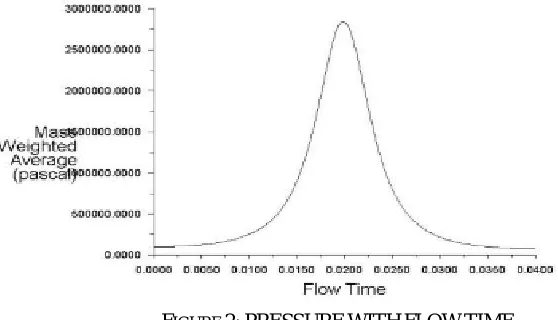
FIGURE 2:PRESSUREWITHFLOWTIME
Vol. 4, Issue 1, January 2015
Figure 3: TEMPERATURE WITH FLOW TIME
The maximum temperature is 1700 K at time 0.02 second. It is observed from figure 2 and figure 3 that the maximum value of pressure and temperature occurs at the same time interval.
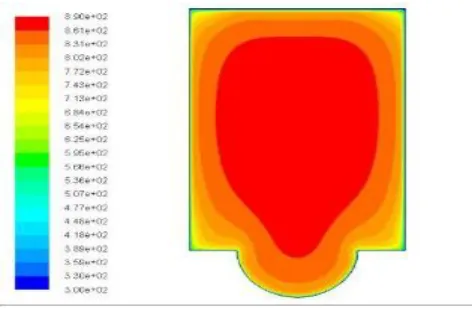
Figure 4: CONTOURS OF STATIC PRESSURE
Above figure 4 shows the contours of static pressure which is generated during analysis on software. As we can see from figure the maximum & minimum pressures is shown by red & blue colours respectively. It is observed that the pressure increment and pressure drop during the process is uniform.
Vol. 4, Issue 1, January 2015
V. CONCLUSION
It is observed that the developed model is good for predicting the behaviour of compressed ignition engine. It is observed that we can find the good injection timing and combustion by changing the parameters like peak pressure and temperature.
REFERENCES
1. Wang, H., Sun, J., Zhao, X.-Y., Gui, C.-L., “Simulation study on influencing factors to the roundness of cylinder liner in diesel engines” CSICE, 29 (4), pp. 370-377.
2. Micklow, G.J., Gong, W.D., “Intake and in-cylinder flow field modeling of a four-valve diesel engine” Journal of Automobile Engineering, 221 (11), pp. 1425-1440.
3. Yuanhong Li, Song-Charng Kong, “Coupling conjugate heat transfer with in-cylinder combustion modeling for engine simulation” International Journal of Heat and Mass Transfer 54 (2011) 2467-2478.
4. Teresa Donateo, Federica Tornese, Domenico Laforgia, “Computer-aided conversion of an engine from diesel to methane” Applied Energy 108 (2013) 8023