University of Windsor University of Windsor
Scholarship at UWindsor
Scholarship at UWindsor
Electronic Theses and Dissertations Theses, Dissertations, and Major Papers
1-1-2006
A longitudinal study of the effectiveness of a multimedia
A longitudinal study of the effectiveness of a multimedia
education program to enhance parents knowledge of children's
education program to enhance parents knowledge of children's
safety in vehicles.
safety in vehicles.
Sarah E. Harvey University of Windsor
Follow this and additional works at: https://scholar.uwindsor.ca/etd
Recommended Citation Recommended Citation
Harvey, Sarah E., "A longitudinal study of the effectiveness of a multimedia education program to enhance parents knowledge of children's safety in vehicles." (2006). Electronic Theses and Dissertations. 7054. https://scholar.uwindsor.ca/etd/7054
A Longitudinal Study of the Effectiveness of a Multimedia Education Program to Enhance Parents Knowledge of Children's Safety in Vehicles
by
Sarah E. Harvey
A Thesis
Submitted to the Faculty of Graduate Studies and Research through the Faculty of Nursing
in Partial Fulfillment of the Requirements for the Degree of Master of Science at the
University of Windsor
Windsor, Ontario, Canada
2006
Library and Archives Canada
Bibliotheque et Archives Canada
Published Heritage Branch
395 W ellington Street Ottawa ON K1A 0N4 Canada
Your file Votre reference ISBN: 978-0-494-35915-0 Our file Notre reference ISBN: 978-0-494-35915-0
Direction du
Patrimoine de I'edition
395, rue W ellington Ottawa ON K1A 0N4 Canada
NOTICE:
The author has granted a non exclusive license allowing Library and Archives Canada to reproduce, publish, archive, preserve, conserve, communicate to the public by
telecommunication or on the Internet, loan, distribute and sell theses
worldwide, for commercial or non commercial purposes, in microform, paper, electronic and/or any other formats.
AVIS:
L'auteur a accorde une licence non exclusive permettant a la Bibliotheque et Archives Canada de reproduire, publier, archiver,
sauvegarder, conserver, transmettre au public par telecommunication ou par I'lnternet, preter, distribuer et vendre des theses partout dans le monde, a des fins commerciales ou autres, sur support microforme, papier, electronique et/ou autres formats.
The author retains copyright ownership and moral rights in this thesis. Neither the thesis nor substantial extracts from it may be printed or otherwise reproduced without the author's permission.
L'auteur conserve la propriete du droit d'auteur et des droits moraux qui protege cette these. Ni la these ni des extraits substantiels de celle-ci ne doivent etre imprimes ou autrement reproduits sans son autorisation.
In compliance with the Canadian Privacy Act some supporting forms may have been removed from this thesis.
While these forms may be included in the document page count,
their removal does not represent
Conformement a la loi canadienne sur la protection de la vie privee, quelques formulaires secondaires ont ete enleves de cette these.
ABSTRACT
In Canada, approximately 10,000 children under the age of 12 years are injured
annually as a result of vehicle collisions (Transport Canada, 2002). Motor vehicle
collisions are the leading cause of death of children under the age of 14 (Safe Kids
Canada, 2004). A longitudinal multi-site intervention study using a pre-test/post-test
design was conducted in four Ontario cities to test the longitudinal effectiveness of an
educational program on parents’ knowledge and use of safety system use for children.
At one year post-test parents’ knowledge and confidence were significant for the
transition from booster seat to seatbelt and the weight to transition from forward facing to
booster seat. These findings carry significant implications as it is more likely that parents
will safely transition children in safety seats when they are confident in their knowledge
DEDICATION
To my family, whose love, patience, understanding and support of this endeavour
ACKNOWLEDGEMENTS
I would like to express my sincere appreciation to my advisory committee
members and to the other faculty members who have helped to guide me through this
process.
I would also like to acknowledge AUT021 and the Network Centres of
Excellences, who helped make this research possible.
I would like to sincerely thank my parents for all of their encouragement and
TABLE OF CONTENTS
ABSTRACT... iii
DEDICATION... iv
ACKNOWLEDGEMENTS...v
LIST OF TA B LES...viii
LIST OF FIGURES...ix
CHAPTER I. INTRODUCTION Introduction... 1
Purpose... 2
II. REVIEW OF LITERATURE Introduction... 4
Injury Outcomes in Children...4
Patterns o f Utilization...10
M isuse...12
Proper Use... 16
Infant Seats... 17
Forward-Facing Seats...18
Booster S ea ts... 19
Vehicle Seatbelts... 19
Legislation... 21
Intervention Studies... 22
Intervention Research... 23
Clinical Significance... 25
III. THEORETICAL FRAMEWORK Neuman’s Systems M odel... 27
IV. DESIGN AND METHODOLOGY Research D esign...34
Research Hypotheses... 34
Setting...34
Sample...35
Development o f the Intervention Program: Preliminary Focus
Groups... 37
Intervention Program... 38
Storybook and Parent Guide:... 38
CD ROM:...39
The Car Seat Safety Chart:... 40
Fridge Magnet:... 40
Fact Sheet and the “Do’s and Don’ts” L ist... 41
Instrument... 41
Procedure... 42
Data Analysis...45
Validity and Reliability... 47
Ethical Considerations... 51
V. ANALYSIS OF RESULTS Results...52
Parent Demographics... 53
Effectiveness o f Intervention on Parent Knowledge... 53
Parent Confidence...59
Ranking o f Transition Factors...61
Parent’s Actual Use o f Safety Systems... 61
VI. CONCLUSIONS AND RECOMMENDATIONS Discussion... 67
Limitations... 78
Implications fo r Nursing Research... 79
Summary... 83
REFEREN CES... 85
APPENDICES Appendix A - Neuman’s Systems Theory Model... 93
Appendix B - Average Height and Weight Measurements for Young Children 94 Appendix C - Pre-Test Questionnaire... 95
Appendix D - Six Week Post-Test Questionnaire...108
LIST OF TABLES
Table
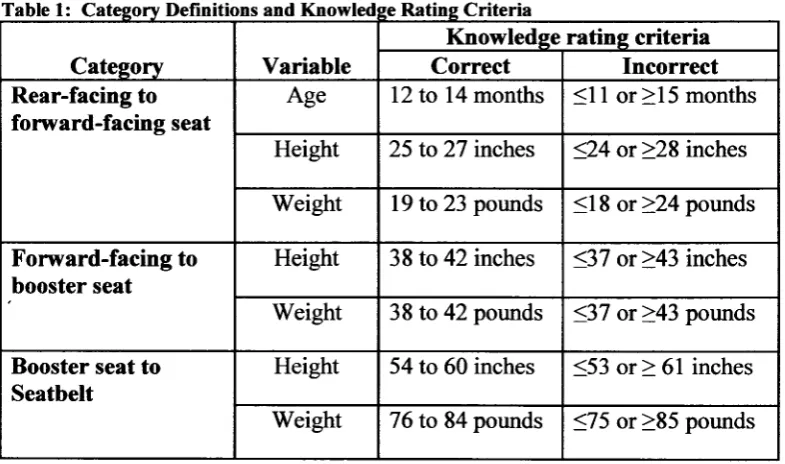
1 Category Definitions and Knowledge Rating Criteria
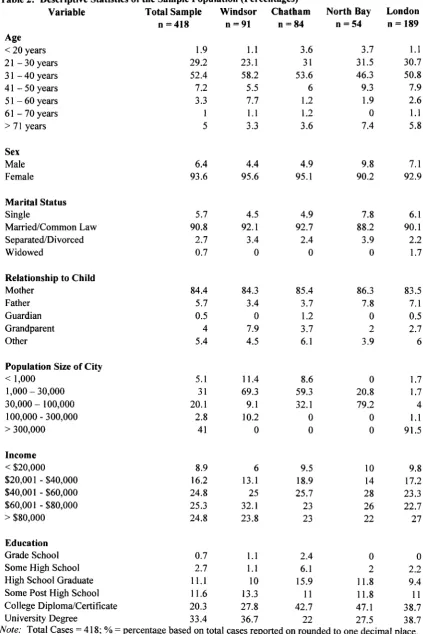
2 Descriptive Statistics of the Sample Population
3 Percentage of Correct Responses
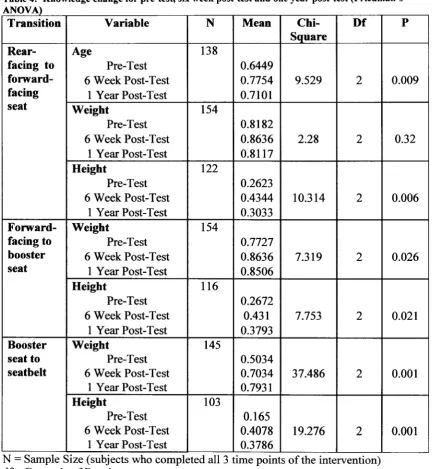
4 Knowledge change for pre-test, six week post-test and one year post-test (Friedman’s ANOVA)
5 Knowledge change from pre-test to six week post-test and pre-test to one year post-test (Pair-wise Sign Tests)
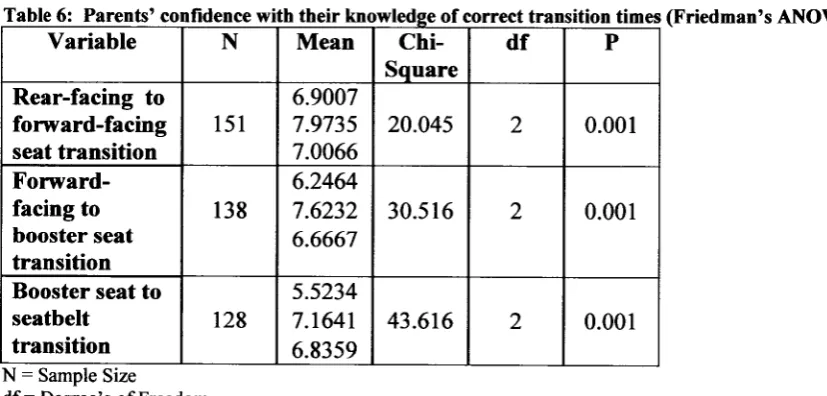
6 Parent’s confidence with their knowledge of correct transition times (Friedman’s ANOVA)
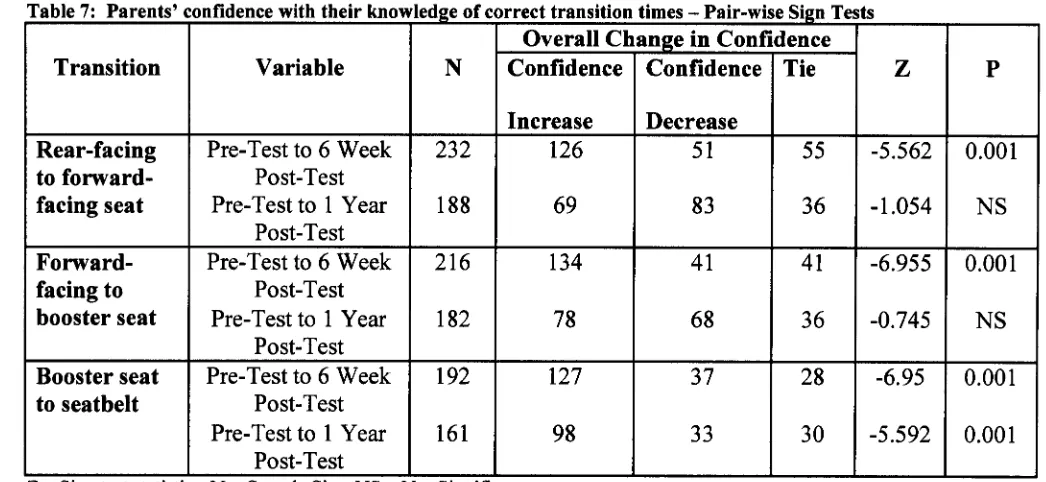
7 Parent’s confidence with their knowledge of correct transition times (Pair-wise Sign Tests)
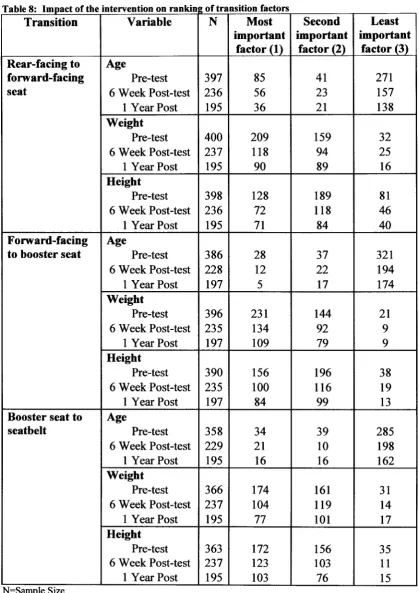
8 Impact of the intervention on ranking of transition factors
LIST OF FIGURES
Figure
1A Rear Facing Convertible 118
IB Rear Facing Only 118
2A Combination Child Restraint 118
2B Forward Facing Convertible Booster 118
3A Low Back Booster 119
3B High Back Booster 119
4 Vehicle Seat Belt 119
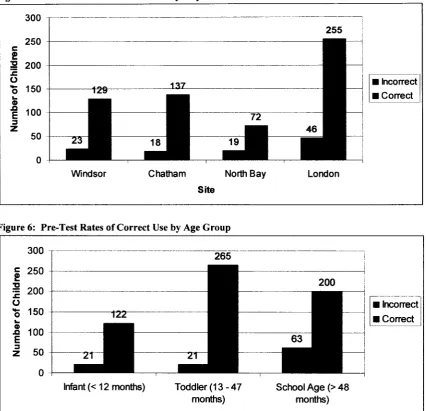
5 Pre-Test Rates of Correct Use by City 64
6 Pre-Test Rates of Correct Use by Age Group 64
7 One Year Post-Test Rates of Correct Use by City 65
CHAPTER I
INTRODUCTION
Introduction
The leading cause of death for children between the ages of 0 and 14 years is
motor vehicle collisions (Safe Kids Canada, 2004). In Canada, approximately 10,000
children under the age of 12 years are injured annually as a result of vehicle collisions
(Transport Canada, 2002). The majority of Canadian parents attempt to use child
restraint devices to protect their children in vehicles. However, misuse of child restraint
devices continues to be the main factor contributing to such high rates of morbidity and
mortality (Biagioli, 2002). A study in the United States found that, when used properly,
child restraint devices reduce fatal injuries by 71% for infants and by 67% among young
children (NHTSA, 2002). Despite the importance of accurate and safe use of safety seats
for children traveling in vehicles, fewer than 20% of parents use safety seats accurately
and effectively enough to keep their children safe in vehicles (Biagioli, 2002; Safe Kids,
2002).
One of the most effective road safety interventions ever implemented was the use
of the seatbelt. Non-use or misuse of seatbelts and child restraint devices have been
shown to be a risk factor for the injuries and fatalities that result from motor vehicle
collisions (WHO, 2004). As children grow and develop, fewer are appropriately
restrained when traveling in a motor vehicle (Weber, 2002). The risk of death and
serious injury can be significantly reduced through the proper use o f child safety devices
When children are traveling in motor vehicles they are especially vulnerable to
injuries or death during a motor vehicle collision. Child restraint devices are designed to
provide specific protection for children whose bodies are still developing (Weber, 2000).
To properly protect the child from potential injuries sustained during a motor vehicle
collision, the child restraint device must be the correct seat, the correct fit, and must be
correctly placed in the vehicle (Bems, 2001; Weber, 2000). A reduction in young
children’s morbidity and mortality is linked to the proper use of child restraint devices
(Weber, 2000; Rivara, Bennett, Crispin, Kruger, Ebel & Sarewitz, 2001).
Purpose
Misuse of child restraint devices continues to be a major risk for children’s safety
in vehicles. Children traveling in motor vehicles remain unprotected and are left
susceptible to serious injuries and even death due to misuse (Biagioli, 2002). How a
child is restrained is primarily the decision of the parent or caregiver. While many
parents know child restraint devices are important, approximately 80% of seats are being
used incorrectly, and parents are often unaware o f the risks children face while traveling
in vehicles (Biagioli, 2002; Safe Kids, 2002).
The purpose of this research was to investigate the long-term effectiveness of a
multi-media intervention designed to increase parents’ knowledge of correct use of child
restraint devices for children 0 months of age to 12 years of age. This study is an
extension of an existing research program that seeks to increase parent knowledge and
one year following the intervention program; and (ii) the prevalence o f correct use of
safety seats for the study participants will be greater at one year following the
CHAPTER II
REVIEW OF LITERATURE
Introduction
One of the major causes of illness and death for children in North America is
motor vehicle crashes (MVCs). Research has shown that the use of child restraint
devices (CRDs) has effectively reduced injuries among children in MVCs (Johnston,
Rivara, & Soderberg, 1994; NHTSA, 2000). The proper use o f CRDs, such as child car
seats and vehicle seatbelts, has the potential to reduce injuries by 67 percent and deaths
by 71 percent (American Academy of Pediatrics, 1996; NHTSA, 2004). Weber (2002)
has since found that when CRDs are used properly, serious injury and death can be
reduced by as much as 74%. Despite parents knowledge that CRDs are important and
can reduce injuries during an MVC, more than 80% of car seats are misused (Biagioli,
2002). There continues to be persistent misuse of CRDs in Canada resulting in injuries
and deaths due to MVCs, which is the leading cause of death for children in Canada.
Injury Outcomes in Children
Motor vehicle crashes (MVCs) are the leading cause of trauma related hospital
admissions in North America (Sahai, Pitblado, Bota & Rowe, 1998). In Ontario, between
2003 and 2004 MVCs were responsible for over 58,780 days in hospital, which is 10% of
days in hospital due to injury (CIHI - Ontario Trauma Registry, 2006). For children
older than 1 year of age, MVCs are the leading cause of acquired disability and death
The main goal of vehicle restraint systems is to minimize the risk of injury to the
occupant by protecting the central nervous system (Weber, 2000). Injuries such as
broken bones and soft tissue damage can heal, but damage to the brain and spinal cord is
often irreversible and life threatening (Weber, 2000). The intraabdominal organs of a
child are less protected than those of an adult because children are still developing and
growing. Furthermore, the protective structures such as the pelvis, bony thorax and iliac
crests are not fully developed in children and thus cannot serve as anchor points for
seatbelts, like they do for adults. Also, when children use only a seatbelt it tends to ride
up over the soft part of their abdomen which can cause injuries to their intra-abdominal
organs (Statter & Vargish, 1998). A child does not fit into an adult seatbelt until
approximately 8 years of age, and when the child’s femur is long enough for the child to
properly sit against the back of the seat and the anterior superior iliac spines are
sufficiently developed to effectively anchor the seatbelt (Winston et al., 2000).
Therefore, children younger than 8 years of age are not anatomically developed to be
restrained safely by only a seatbelt.
An additional goal of vehicle restraint systems is to limit and control the rate of
overall deceleration of the body during a motor vehicle crash (Weber, 2000). During a
motor vehicle collision there are a series o f collisions that occur: (i) the primary impact
between the vehicle and another object, while the occupants continue to travel forward;
(ii) the second collision is between the occupants and their restraint system (i.e. seatbelt,
etc.); and (iii) the final collision that occurs is between the occupants body’s internal
organs and the bony structures enclosing them (Weber, 2000). Controlling the body’s
which minimizes the differential motion between the skeleton and the internal organs
(Weber, 2000). The rapid deceleration of the body as well as the impact of the motor
vehicle structure on the body’s surfaces can both be associated with severe injuries
during MVCs. The objective of vehicle restraint systems is to create a tight coupling
with the crushing vehicle, while distributing the remaining load as widely as possible
over the body’s strongest anatomical structures (Weber, 2000). When children use CRDs
they are restrained by both the vehicle seatbelt as well as the harness of the CRDs.
Because of this tight coupling and increased restraint of the child, they are better able to
ride down the crash and this decreases their motion and movement during the crash
(Weber, 2000).
The effectiveness of vehicle restraint systems is dependent on the appropriate
CRD and correct anchorage o f the CRD. This ensures the best protection for the child
during a MVC. The proper use includes: (a) the correct seat for the child, based on age,
height and weight; (b) the correct placement of the seat in the vehicle; (c) the correct
installation of the CRD into the vehicle; and (d) the correct use of the restraint system
(i.e. buckles, clips, harnesses and straps) (Bull, Stoup, Gerhard, 1988). Educational
programs are needed to increase child restraint knowledge and awareness to ensure that
parents understand the importance of using child restraint equipment properly
(Mcllvenny, S., et al., 2004). The force o f the crash is spread over the hard bony
structures of a child’s body when they are fitted correctly to the CRD in the event of an
a child who is properly fitted into a CRD (Berg, Cook, Vernon, Dean, 2000; Weber,
2000).
The misuse of a CRD can lead to devastating injuries for the child occupant
during a MVC. Mechanisms that could be considered misuse and potentially cause
injuries include: non-use of the harness straps, non-use of the locking clip, non-use of the
harness retainer clip, non-use of the tether straps, failure to secure the UAS clip, or
improper routing o f the vehicle seatbelt through the frame of the CRD. Misuse of any of
these mechanisms can result in situations where the child could be thrown from the seat
or the child and the seat could become a projectile during the crash (Block et al., 1998,
Bull et al., 1988, Morris et al., 2000, Stokes et al., 2000). “Injury to the child is most
often caused by secondary impact with the vehicle interior, another passenger, the road or
other nearby objects” (Stokes, Martin, Holmes, Jex & Lopreiato, 2000, p.867).
Secondary impacts such as “with the vehicle interior, another passenger, the road or other
nearby object” (Stokes et al., 2000, p.867), cause the majority o f deaths in MVCs. Brain
and spinal cord damage in MVCs is the most frequent, serious, non-fatal type of injury
(National Safe Kids Campaign, 1997).
The term “seatbelt syndrome” and “jack-knifing” are two terms used
interchangeably by health care professionals to describe the serious injuries of children in
MVCs. In MVCs, when a child is using an ill-fitting CRD or adult seatbelt, they can
suffer from serious abdominal and spinal cord injuries, which is called seatbelt syndrome
(Lane, 1994). There are several common and life threatening injuries associated with
seatbelt syndrome which include: lacerated liver, lacerated bowel, lacerated spleen,
of the child jack-knifing during the crash, hence the two terms are used interchangeably.
During an MVC, jack-knifing occurs when the head of the child meets the knees of the
child, as the body is thrust forward, this causes very serious intra-abdominal, spinal cord,
and head injuries (Winston et al., 2000). When a child is prematurely transitioned into a
seatbelt, because of their small stature the child can also “submarine” or tunnel under the
lap belt during a crash (Winston et al., 2000).
One of the most common factors associated with serious injury in children is the
premature graduation from CRDs to seatbelts. Adult seatbelts alone are considered
dangerous for children before they have reached 145 centimeters (or 57 inches tall), a
weight of 36 kilograms (or 80 pounds), and a sitting height of 74 centimeters (or 29
inches) (Bems et al., 2001, Klinich, Pritz, Beebe, Welty, & Burton, 1994, Weber, 2002).
Injuries that a young child sustains while improperly restrained in an adult seatbelt during
an MVC are usually disabling and/or fatal (Berg et al., 2000).
The literature strongly suggests that CRDs provide more effective protection for
children than adult seatbelts since a child’s physical characteristics that do not fit
properly into an adult seatbelt. Researchers have found that children between the ages of
2 and 5 years of age who were only using an adult seatbelt were 3.5 times more likely to
suffer significant injuries, and 4 times more likely to endure significant head injury, and
significant abdominal injuries, than their properly CRD restrained counterparts (Winston
et al., 2000). Decina and Knoebel (1997) observed 5,900 young children in Mississippi,
The Canadian Motor Vehicle Traffic Collision Statistics showed that in 2004
children in the 0 to 4 years of age group had: 13 fatalities, 292 serious injuries and a total
o f 2,717 injuries; and, children in the 5 to 14 years of age group had: 79 fatalities, 896
serious injuries and a total of 11,729 injuries (Transport Canada, 2004). One of the most
compelling features of the Transport Canada (2004) data is the difference in outcomes for
younger children (aged 0 to 4 years) versus older children (aged 5 to 14 years). Clearly,
children in the 5 to 14 years of age group are approximately four times more likely to be
injured in an MVC than their younger counterparts. The children aged 5 to 14 years had
the lowest overall appropriate restraint use of all the age groups. In Canada, between
1998 and 2002 there were a total of 402 fatalities of child occupants in vehicles. O f those
fatally injured, unsuitable restraint (meaning either an unrestrained child or a child using
a seatbelt prematurely) was found to be: 66% of children under 1 year; 50% of children
aged 1 to 3 years; 97% of children aged 4 to 8 years and 31% of children aged 9 to 14
years (Chouinard & Hurley, 2005). There were a total of 3,201 major injuries o f child
occupants in Canada between 1998 and 2002. Of those children suffering major injuries,
unsuitable restraint was responsible for the injuries in: 92% of children under 1 year of
age; 74% for children aged 1 to 3 years; 96% for children aged 4 to 8 years and 20% for
children aged 9 to 14 years (Chouinard & Hurley, 2005).
The leading cause of morbidity and mortality among children continues to be road
crashes (Block et al., 1998). A review of the literature suggests that there are several
Patterns o f Utilization
The majority o f children who are transitioned early from a rear-facing infant car
seat to a forward-facing car seat are inadequately restrained (Morris et al., 2000, Ramsey
et al., 2000). The 1997 Canadian national survey revealed that 90% of drivers and
occupants use vehicle restraints (Transport Canada, 1998). However, provincially, the
data revealed that 73% of children under 1 year of age were properly restrained, 71% of
children aged 1 to 4 years were properly restrained, 99.7% of children aged 5 to 9 years
were properly restrained, and 100% of children aged 10 to 15 years were properly
restrained (Transport Canada, 1998). During Transport Canada’s observational survey,
children were considered to be properly restrained if: (i) for an infant seat: the harness
was in use, the vehicle belt was used to restrain the carrier and the seat was installed
facing the rear; (ii) for a forward-facing seat: the harness was in use, the child seat was
secured with the seatbelt and the tether strap was used; (iii) for a booster seat: if the
seatbelt was used to secure the seat; and finally a child 3 to 4 years of age was considered
properly restrained if they were secured by a seatbelt (Transport Canada, 1997).
Chouinard and Hurley (2005) have suggested that the rate of unrestrained children in
1997, in Canada’s last roadside survey was about 13%. The critical, missing component
of the 1997 survey data was that the weight and height of children were not used as an
indicator to determine the appropriate restraint type and use, and misuse was based solely
on age of the child (Transport Canada, 1998). More recent guidelines suggest that the
definition of appropriate restraint used for this survey. Children were using the
appropriate restraint if children between the age of 3 and 4 were in a child seat, a booster
seat or a seatbelt, and for children aged 5 to 9 years of age that they were in a booster seat
or a seatbelt (Transport Canada, 1998). This is a limitation because the Ontario Ministry
of Transportation recommends that children stay in a forward-facing child seat until they
are 40 pounds, regardless of their age, and Transport Canada deemed a child to be
appropriately restrained solely on their age (Ontario Ministry of Transportation, 2003).
An additional limitation of the Transport Canada (1998) survey data was the method of
data collection. A “drive-by” approach which provided very limited accuracy in
measures of safety system use, since it only provided the observer with a moment to
evaluate CRD use with very limited detail.
Programs need to be developed to increase parents’ awareness of injury outcomes
when children are not properly restrained in vehicles. More data needs to be collected
following an MVC about the type o f CRD used or misused for the child, the location of
the CRD, etc. Knowing the results of a comprehensive assessment of CRD use during an
MVC could assist in developing effective education programs around the proper use of
CRDs, common errors made with CRDs, and proper transition times between CRDs.
Data on child restraint use in Canada (1998) revealed that “restraint usage was
lowest for the 5 to 9 year olds” (p.3). O f the restraints used by children age 5 to 9 years
old, 78.9% were restrained using an adult seatbelt, 15.4% were totally unrestrained, and
only 4.5% were using a booster seat (Transport Canada, 1998). The 5 to 9 year old age
group is the group that had the lowest appropriate use of restraints o f any group and they
Canada, 1998). In Canada, vehicle restraints have been legislated as mandatory since
1976 (Transport Canada, 1995). Until recently CRDs were only required for children by
law from birth until they reach 18 kilograms (or 40 pounds). Thus, a child over 18
kilograms (or 40 pounds) according to this criteria was properly restrained in an adult
seatbelt (Ontario Provincial Offences, 2000). However, on September 1st, 2005, new
legislation in Ontario requires children to travel in a booster seat until they meet one of
the following criteria: 1) the child turns eight years old, (2) the child weighs 36 kg (or 80
lbs), or (3) the child is 145cm (or 4 feet, 9 inches) tall (Ontario Ministry of
Transportation, 2005). This new booster seat law may help to increase the use of booster
seats in Ontario, and ensure that more children are properly restrained until they can sit
properly in the vehicle using only a seatbelt.
Misuse
The most prevalent pattern of misuse involves the premature transitioning of a
growing child into the next CRD or into an adult seatbelt (Ramsey et al., 2000). The
literature suggests that many parents report that they are unsure what the appropriate age
and weight is for their child to be in a booster seat, as well as they incorrectly identified
the age at which it was safe for a child to use only a seatbelt (Rivara et al., 2001). The
most common reason that children were transitioned to an adult seatbelt was that the
parent perceived that their child was large enough to not have to use a booster seat
(Ramsey et al., 2000). Parents’ misconceptions about the appropriate CRD transition
misuse include: (a) using the wrong CRD for the child, (b) improper installation of the
CRD into the vehicle, and (c) poor use o f positioning straps, harnesses, buckles and
tethers.
Both parents and health care professionals report uncertainty as to the correct
transition time for children from a forward-facing car seat to a booster seat (Bems et al.,
2001). Most parents described discontinuing the use of their child’s car seat between the
age of 3 and 4 years old (Bems et al., 2001). Studies show that as the age of the child
increases, or as the number of passengers in the vehicle increases the use o f booster seats
decrease (Ramsey et al., 2000). A large body of literature indicates that the most
common reason that parents transition their child to a seatbelt is because the parents feel
their child is the correct size to safely use a seatbelt (Morris et al., 2000, Ramsey et al.,
2000; Safe Kids Canada, 2004). Studies have frequently shown that children at very
young ages are being transitioned into adult seatbelts. Winston et al. (1999) found that
few children between the ages of 4 and 8 years old were properly restrained for their age,
and that use of an adult seatbelt started as early as age 2. Although Ontario’s rates of
CRDs are reported to be quite high, the effectiveness of the CRD may be hindered by the
misuse or early transition o f a child into an adult seatbelt (Transport Canada, 1998).
Another form of misuse is the incorrect installation of CRDs into vehicles. The
findings from Transport Canada’s 1997 observational survey estimated that at least 33
percent o f child seats are installed incorrectly and that more than 30 percent o f toddler
seats are installed without a tether strap. In child seat clinics held across Ontario, four out
o f five child seats were either improperly installed or incorrectly used (Ontario Ministry
of CRDs into motor vehicles stems from the numerous models and styles o f CRDs and
confusion around how to install the different types into the many different vehicle
interiors (Block et al., 1998, Murphy, 1999, NHTSA, 1998).
There are a broad range of available resources for parents to get product
information on use of child seats. As an example, they may speak to sales personnel,
family or friends who will all offer their own opinions regarding use o f CRDs. Research
suggests that only 50% of parents actually read the product manual on how to properly
install and secure the CRD into the vehicle. However, the comprehension level and
vocabulary o f product manuals often exceeds the parents’ ability to readily understand
the information and follow the instructions (Block et al., 1998, Decina & Knoebel, 1997,
Gaines, Layne & DeForest, 1996, Huggins, 2003, Margolis, Wagenaar & Molnar, 1992,
Wegner & Girasek, 2003). Product manuals are often difficult to comprehend and this
may contribute to the misuse of CRDs (Block et al., 1998). Block et al. (1998) also noted
that families who acquired a second-hand or used safety seat reported that quite often the
product instruction manual was missing. Studies by Bull et al. (1988) and Rivara et al.
(2001) both reported that second-hand or used CRDs often did not meet safety standards
for use in vehicles.
Installation and fit of the safety seat into the motor vehicle were other factors in
parents’ misuse. Parents expressed difficulty in fitting the CRD into the vehicle, fitting
multiple seats into the vehicle and handling the bulkiness of the seats (Ramsey et al.,
other caregivers are transporting children on a regular basis, and as such the CRD must
be transferred from vehicle to vehicle (Snowdon et al., 2006). Decina & Knoebel (1997)
reported that when a CRD is frequently moved between vehicles, there is a higher
percentage of misuse. The time and inconvenience of moving a CRD repeatedly from
one vehicle to another was also identified as a factor contributing to misuse (Campbell,
MacDonald & Richardson, 1997, Ramsey et al., 2000).
Decina & Knoebel (1997) found that parents describe and rationalize not using a
CRD because of their child’s fussiness and discomfort. Other reasons parents report not
using CRDs include: the child did not like the seat, the seat was uncomfortable, the child
refuses to ride in the seat, CRDs are inconvenient, CRDs are difficult to use, and CRDs
are too expensive (Biagioli, 2005; Geilen et al., 1984, Neumann, Neumann & Cockrell,
1974; Verrealt, Stulginskas & Keyl, 1982).
Another common misuse of CRDs addressed in the literature is that many parents
admitted to owning a booster seat however, they also admitted to not using the seat for
their children (Ramsey et al., 2000). With so many different brands and makes of booster
seats, parents have expressed difficulty in making decisions about which booster seat to
purchase (Margolis et al., 1992, Ramsey et al., 2000). However, the research is primarily
focused on U.S. populations. In Canada, only 28% of parents with children reported
using a booster seat (Safe Kids Canada, 2004). The actual use o f booster seats is likely
lower than 28%, as the 1997 Transport Canada observational survey found booster seat
use to be less than 5% (Safe Kids Canada, 2004; Transport Canada, 1998). In a survey
child was large enough at age 6 to use a seatbelt. This is a large area of misuse, as a child
is too small to fit into a seatbelt properly at the age of 6.
In summary, the barriers to proper use of CRDs include: confusion about the
appropriate weight and height for use of safety seats; lack of understanding of when to
transition to safety systems; misuse of the CRD components (e.g. not using the tether
strap); difficulty installing CRDs; uncertainty and frustration about which CRD to
purchase; child’s resistance to using the CRD; difficulty finding information on CRD use;
the frustration of transferring the CRD from one vehicle to another; and finally parents
transitioning their child to an adult seatbelt too early.
The literature demonstrates that lack of parental knowledge may contribute to
rates of misuse of CRDs and this continues to be a major challenge. The actual MYC
may not be the only cause of injury to the child, injury could also be attributed to the
misuse of the CRD as well as the early use o f an adult seatbelt. Improper use of CRDs
increases the risks of injuries and death for children traveling in motor vehicles (Gaines et
al., 1996).
Proper Use
CRDs can vary in their design, the direction they face, the method as to how they
restrain the child, as well as their method o f installation. However, when the CRD is
used and secured properly, serious injury and death can be reduced by as much as 74%
(Weber, 2002). The rapid rate of development in children requires the existence of
According to the Ontario Ministry of Transportation (2003), Transport Canada,
the American Academy of Pediatrics (2006) and the Children’s Hospital of Philadelphia
(2006), the best practice guidelines for transitioning a child in CRDs include: (1) a rear-
facing infant seat used for children from birth to one year of age and 9 kilograms (or 20
pounds); (2) a forward-facing child seat for children between 9 kilograms (or 20 pounds)
and up to 18 kilograms (or 40 pounds); (3) a booster seat for children from 18 kilograms
(or 40 pounds) and up to 36 kilograms (or 80 pounds); and (4) a vehicle seatbelt is used
when the child reaches 145 centimeters (57 inches) in height, weighs 36 kilograms (or 80
pounds) or more, and a sitting height of 74 centimeters (or 29 inches) (Bems et al., 2001;
Ramsey et al., 2000; Weber, 2000). The next four sections will describe the CRDs use at
each transition time: the rear-facing infant seat, the forward-facing seat, the booster seat
and the vehicle seatbelt.
Infant Seats
Rear-facing restraint systems are used from birth to a weight of 8 kilograms (or 20
pounds) and the child is at least one year of age. The infant car seat is also referred to as
a rear-facing convertible restraint or a rear-facing only restraint (Figure 1A and Figure
IB). The rear-facing only restraint type is designed to be used only as a rear-facing CRD.
However, the rear-facing convertible CRD is designed to be turned around and used as a
forward-facing convertible CRD when the transition time is appropriate. “Beyond
weight, the effective limit for either type is the seated height of the child, the top of the
head should not be above the top of the restraint device to minimize the risk of head-
contact and neck-compression injury” (Weber, 2000, p. 6). Therefore, if an infant’s
be used until a weight of 8 kilograms (or 20 pounds) is reached. Both types of infant
CRDs need to be anchored to the motor vehicle with the vehicle seatbelt or the
L.A.T.C.H. (Lower Anchors and Tethers for Children) attachments. The harness straps
or strap plus a shield must be properly secured at or below shoulder level and they should
fit snugly to accommodate no more than one finger between the harness and the infant’s
collar bone. If the infant CRD has a chest clip, it should be placed at the level of the
infant’s armpits. Straps should be adjusted as the infant grows for both safety and for
comfort. In a motor vehicle, the infant CRD should be installed in the centre of the back
seat, away from air bags and the infant CRD always faces to the rear of the vehicle.
Forward-Facing Seats
Forward-facing CRDs are designed to accommodate children from 9 kilograms
(or 20 pounds) to 18 kilograms (or 40 pounds) and a height of 102 centimeters (or 40
inches). There are two types of forward-facing CRDs: (1) combination child restraint
booster and (2) forward-facing convertible (Figure 2A and Figure 2B). The forward-
facing CRD allows the child to face forward in the vehicle, and there are two main steps
to follow when using one: (1) the child needs to be correctly secured by the harness
straps and (2) the forward-facing CRD needs to be correctly anchored to the vehicle seat.
The harness should be secured at the child’s shoulder level or slightly below, harness
straps need to lie flat, and all twists and wrinkles should be removed (Infant and Toddler
Safety Association, 2001; Transport Canada, 2005; AAP, 2006). The chest clips should
the seat is properly anchored, the parent pushes the forward-facing seat down into the
vehicle seat and pulls the vehicle seatbelt as tight as possible allowing only 1 inch of
movement or less in any direction when the seat movement is tested after installation.
Booster Seats
Booster seats are to be used for children between 18 kilograms (or 40 pounds) and
36 kilograms (or 80 pounds) and at a height of less than 145 cm (or 4 feet, 9 inches). The
primary objective of a booster seat is to provide the correct anatomical fit of the seatbelt
to the child’s physical frame (German, Gardner, Howard, Mackay and Letts, 1999;
Winston et al., 2000). Booster seats are a type of CRD that are designed to raise the child
up and forward from the vehicle seat to better facilitate the placement of the lap shoulder
seatbelt over the top of the thigh and over the mid-clavicle respectively (Decina &
Knoebel, 1997; Weber, 2000). There are two types of booster seats: (1) a low back
booster and (2) a high back booster (Figure 3A and Figure 3B).
The correct fit of the child to the booster seat is very important. The lap belt must
be snugly positioned flat across the child’s upper thighs and the shoulder belt must cross
the centre of the child’s chest passing over mid-clavicle (Weber, 2000). Correct
installation of the booster seat into the motor vehicle is a cmcial step, and therefore
referring to the instruction manual for the booster seat as well as the vehicle manual are
necessary for ensuring correct installation.
Vehicle Seatbelts
Vehicle seatbelts are designed to fit 95th adult percentile male passengers
(Transport Canada, 2005). Because children’s bodies are still developing and growing,
same force as an adult body (Decina & Knoebel, 1997). A child should not be placed
into a vehicle seatbelt until he or she weighs 36 kilograms (or 80 pounds) and has a
height of 145 cm (or 4 feet, 9inches) (Ontario Ministry of Transportation, 2003) (Figure
4).
CRDs are not an alternative to a vehicle seatbelt, but rather are designed to fit
with the preexisting vehicle seatbelt system to augment safety for child occupants. CRDs
provide additional protection for children because of their smaller size and weight. The
primary goal of the different types of CRDs is to provide appropriate positioning of the
vehicle seatbelt around the child’s physical frame in order to minimize occupant
displacement and/or ejection during a crash (Bems et al., 2001; Weber, 2000). While it is
safer in most cases for a child to ride in an ill-fitting CRD rather than no CRD at all,
many injuries have been associated with ill-fitting CRDs (Winston et al., 2000). One of
the major benefits of CRDs that Winston et al. (2000) identified was that if a child is
prematurely graduated from a CRD to a vehicle seatbelt, it puts the child at greater risk of
injury or death during a crash.
The first step in providing sufficient protection for children traveling in vehicles is
to identify and follow the appropriate transition times. For the child to be properly
protected while traveling in a vehicle, they need to be in the correct seat according to
their weight and height. Use o f an incorrect CRD, even if it is correctly secured and
installed will only provide the child with minimal protection. It is important that children
Legislation
In Ontario, mandatory restraint laws in vehicles have been in place and have been
enforced since 1976. The law, in effect from 1976 to August 31st, 2005, stated that any
child weighing more than 40 pounds (lbs) could be restrained in a vehicle with only a
seatbelt (Ontario Provincial Offences, 1999; Transport Canada, 1995), however, this does
not provide adequate protection for the child traveling in the vehicle. A new law came
into effect, September 1st, 2006 requiring children to meet any one of the following
criteria before transitioning to an adult seatbelt: (1) the child turns eight years old, (2) the
child weighs 36 kg (or 80 lbs), or, (3) the child is 145cm (or 4 feet, 9 inches) tall (Ontario
Ministry of Transportation, 2003). The effectiveness of legislation on use of CRD’s has
not been studied in Canada. The main limitation with the Ontario booster seat legislation
is that guidelines suggest that the appropriate CRD used for the child should be in
accordance with the child’s weight and height, rather than chronological age (Ramsey et
al., 2000, Winston et al., 2000). The new legislation, allows that a child in Ontario can be
transitioned from a booster seat to a seat belt at 8 years of age, even though they may not
be the correct weight and height to be properly restrained during an MVC.
In the United States, there are two types of enforcement for seat belt laws. The
first type of law is primary enforcement which allows law enforcement officers to stop a
vehicle and issue a fine based simply on observing an unbelted passenger. Secondary
enforcement means that a law enforcement officer can only issue a fine for not wearing a
seat belt if the vehicle has been stopped for another infraction, they cannot issue a fine
based solely on observing improper vehicle restraint use. States with primary
enforcement legislation is a positive motivator for use of restraints. Traffic fatalities, in
general, peaked in the 1970’s, which led to the implementation of seatbelt legislation. A
combination of factors over the years have helped to decrease the number of factors,
including: interventions to get Canadians to use their seat belt; interventions to get
Canadians to not drink and drive; improved safety standards; safer road designs;
improved medical services and tougher police enforcement (National Scientific Advisory
Committee, 2004). Canadian restraint laws are heavily enforced with fines and demerit
points, which in turn can influence the cost of insurance. However, a recent Canadian
study revealed that seat belt use among back seat passengers, who are predominately
children and youth, was less than 60% (Safe Kids Canada, 2004).
Intervention Studies
In Canada and the United States there have been several different types of
interventions and programs such as: car seat clinics, car seat inspection clinics, public
health programs, Project Safe Kids, and Boost America, which have targeted education
and training for child care providers, teachers, health care providers as well as
neighbourhoods and community organizations about vehicle safety for children.
However, these types of interventions and programs are very limiting as they focus solely
on vehicle inspections and not specifically on increasing parental knowledge of CRDs.
Currently there is no unified education program about CRD use, and there is no
consistency in public awareness about CRD use from governments, law enforcement,
Intervention Research
To date, there have been several intervention studies which test and develop
strategies to promote and teach about the use of restraints for children when traveling in a
motor vehicle. One American study looked at CRD use by observing the parents placing
the children into the CRD, before traveling in the motor vehicle (Gaines, Layne &
DeForest, 1996). A two-day training and education session for health care personnel was
required so they could detect use error, and to give information and education about
correct utilization (Gaines et al., 1996). The health care personnel set up safety checks at
various locations such as: day care centers, shopping malls and health fairs. During the
safety checks, health care personnel only described to the parents the errors noted in CRD
use as they were not certified to physically correct the misuse themselves (Gaines et al.,
1996). The types of errors most commonly reported were: failure to stabilize the seat
with the locking clip, misplacement of the vehicle seatbelt across the child’s neck or
under the arm, child seated in the most hazardous location in the car and, non-use o f CRD
for their child (Gaines et al., 1996). From this study, researchers learned that parents
“will not master all the material after a simple reminder or even after one educational
session” (Gaines et al., 1996, p. 151). Study findings suggest that CRD use should
become part of every health assessment as this may increase parents’ awareness of risks
and the importance of proper use of CRDs. The findings also suggested that text in any
educational materials needs to be simple, clear and accurate, and that illustrations would
be very beneficial.
A similar intervention study was recently carried out using home visiting nurses,
misuse through observation as mothers prepared their infant or toddler for vehicle
transport (Block et al., 1998). The study taught the mothers proper CRD use through
verbal instruction and demonstrations using the family vehicle (Block et al., 1998). The
training for each visiting nurse involved extensive instruction regarding the use of CRDs
and on the multiple models of CRDs that are available. The findings from this study
found that: the home visits took longer than expected, three-quarters of CRDs were
incorrectly used and one third of the mothers were aware of their incorrect use (Block et
al., 1998). Neither o f these two studies offered longitudinal data to measure the
persistence of the learned skills and the retention of information of the mothers (Block et
al., 1998, Gaines et al., 1996).
Another study promoted vehicle safety through a five day educational program
for preschoolers (Ameson, & Triplett, 1990). Following the study, the researchers found
that in general children were more knowledgeable after the education program, however,
the use of seatbelts remained unchanged in this study (Ameson & Triplett, 1990). This
study demonstrated that an educational intervention on its own is not sufficient to change
behaviour (Ameson, Triplett, 1990). Consistent with a study by Hazinski, Eddy and
Morris (1995) the study concluded that a comprehensive school-based intervention
program targeting Kindergarten to Grade 2 students resulted in an increase in seatbelt use
among children and their parents. Most intervention studies to date have been limited to
the United States’ population. Canadian intervention studies have not yet been
Clinical Significance
To date, literature regarding CRDs has focused mainly on use, non-use and
misuse. One of the large gaps in the literature is a lack of parental knowledge around the
proper CRD transition times and the risks associated with the early transition of children
from CRDs to an adult seatbelt. Ramsey et al. (2001) found that transitions out of a CRD
to an adult seatbelt can begin as early as one year of age. According to the normal
growth and development patterns of children, the average child should not transition to an
adult seatbelt until they are nine years of age or older (Wong, 1999). A child should be
transitioned from a CRD to an adult seatbelt based on their weight and height as opposed
to their chronological age.
The majority of research about CRDs has been based in the United States, and
although Canadians share a similar lifestyle to Americans, patterns of CRD use and
misuse vary significantly and this limits generalizability of U.S. findings to Canadians
(Gaines et al., 1996; Margolis et al., 1992; Transport Canada, 1998). Transport Canada’s
1997 Child Restraint survey data is limited due to their operational definition for
appropriate restraint and that it was a purely observational, “drive by” survey.
While children are traveling in motor vehicles it is critical that they are traveling
in the appropriate CRD based on their height and weight. Ramsey et al. (2000) identified
that it was important to promote CRD use to school aged children as well as educate
parents about the risks of lap-shoulder belts. Most parents are receptive to learning
which car safety seat is best for their children. The first step to providing a safe
environment for children while they are traveling in a motor vehicle is that they are
height and weight, not solely on their chronological age. Parents/caregivers need to be
educated on CRD transition times so they can make an informed decision about when to
move their child into the correct seat.
“Motor vehicle crashes are one of the most common causes of preventable
childhood injuries and fatalities” (Stokes et al., 2000, p. 875). Health care professionals
need to work together to create effective strategies to reduce the number of preventable
injuries and deaths of children who are involved in an MVC. Parents and caregivers need
to be educated about the correct CRDs as well as the correct times to transition their child
to the next CRD. This purpose of this study was to test the longitudinal effectiveness of
an education program for parents in relation to children’s safety when traveling in motor
vehicles. To date, there have been no longitudinal intervention studies in Canada or the
U.S.. Yet, “the consistent and proper use of restraint systems by infants and children in
passenger vehicles can prevent hundreds of deaths and thousands of injuries each year”
CHAPTER III
THEORETICAL FRAMEWORK
Neuman’s Systems Model
The theoretical framework that guided the theoretical context for this research
was the Neuman Systems Model (Neuman & Fawcett, 2002). When a child is
inappropriately restrained or is not using a child restraint device (CRD) in a vehicle, and
that vehicle is involved in a motor vehicle crash (MVC), it can potentially lead to injury,
trauma or even death. The Neuman Systems model is a model that uses a systems
approach to examine health (Neuman & Fawcett, 2002). The model uses a systems
approach to examine health challenges such as injury prevention for children (Neuman &
Fawcett, 2002). This systems approach to health promotion/injury prevention will be
used in this study to try to prevent the potential for injury, trauma and death among
children following a MVC, by promoting the appropriate and proper use o f child restraint
devices.
In this study the child is viewed as a member of the family system whose primary
focus is the health, safety and well-being of the child as they grow and develop over time.
The purpose of this intervention was to support a child’s safety while traveling in
vehicles by enhancing parents’ knowledge of correct use of child restraint devices for
children 0 months of age to 12 years of age. The safety o f children when they are
traveling in vehicles is related to parents’ knowledge of safety seats and their decision to
use safety seats for their children. The parent-child interaction is viewed as a dynamic
component o f the family system, which directly influences a child’s safety and well
engage in health behaviours in order to protect their children from harm and ensure the
family system remains healthy and strong.
The family system in this study is viewed as part of the larger community system
in that in the community there are resources such as car seat clinics, health professionals
(physicians, nurses, health units) which are all valuable resources and excellent sources
o f information for parents to strengthen the lines o f defence against injury within the
family system. The community system can also function as a support system for the
family should the family system be involved in a motor vehicle collision. The
community provides the support necessary to assist the family to strengthen their lines of
defence and return to a normal system state, or an enhanced system state (Neuman &
Fawcett, 2002).
The community functions within the Canadian health and social system. In the
event of a motor vehicle collision, a family will interact with the Canadian health system
which will work to strengthen the lines o f defence and return the family system to its
normal state. The Canadian health system also works to prevent motor vehicle collisions
by providing education and information to the family system about child safety seats and
the importance of their use, which helps to strengthen the lines of defence. In addition,
the Canadian social system supports the enforcement of the child passenger laws to
ensure children are properly restrained while traveling in vehicles with the goal of
preventing injuries or deaths, thereby strengthening the family’s lines o f defence. The
children and each contributes to enhancing the family systems’ lines o f defence to
prevent or mitigate the potential for injury, trauma or death.
The Neuman Systems Model describes ten assumptions; six of these assumptions
were used to provide the theoretical context for the study. The first assumption states that
individuals and groups are unique, and although each system is similar in its basic
structure, there are different characteristics to each system (Neuman & Fawcett, 2002).
In this study, the system is a family system and although one might be inclined to say that
a family is a family, all families are different in that some are single parent families, in
some families the grandparents act as the main caregivers, etc. Although the basic
structure of the family, i.e. parents and children and their needs are all similar, each
family is unique.
The second assumption of the model is that the client is constantly interacting
with the environment (Neuman & Fawcett, 2002). In this study, the family is constantly
interacting within the vehicle environment as they travel with their children on Ontario
roadways. It is assumed that both parents and children interact with each other within the
vehicle environment. Specifically, the interactions within the vehicle include what child
seat or safety restraint is used for each family member, where the child is seated in the
vehicle, and in what type of vehicle they are traveling.
The third assumption is that there are many “known, unknown, and universal
environmental stressors” within a system (Neuman & Fawcett, 2002, p. 14), and each can
affect the family system in different ways. For example, when the family system
interacts with the environment and is involved in a motor vehicle collision, the collision
vehicle collision is typically unknown to the family system as it was not a planned event
and the stressor is universal because any individual traveling in a vehicle is at risk of
being involved in a motor vehicle collision. The injuries sustained by the child or parents
during the collision are most often serious and disabling injuries that impact the health
and well-being o f family members for many years. In the event of a death, the
psychological and emotional impact often has devastating effects on the family system.
The intervention in this study was designed to strengthen the lines of defence by
educating parents on the proper transition times for children and perhaps help to prevent
the stressors related to an MVC.
The next assumptions can be combined, in that each system has a normal range of
responses to the environment, and when the lines of defence can no longer protect the
system from the environment, the system will react in a negative way until the system’s
lines of defence are rebuilt or strengthened (Neuman & Fawcett, 2002). The death of a
child or any family member is a life changing stressor that changes the family system,
causing a breakdown in the lines of defence, which requires significant time and energy
to strengthen and rebuild in order for the family system to regain its functioning. The
study aims to educate and raise parents’ awareness o f the importance o f accurate use of
restraints for their children when they are traveling in vehicles. Ultimately, the
devastating impact of very serious injuries or death of a child may possibly be prevented.
The final assumption of the Neuman Systems Model that is related to this study is
death due to vehicle collisions include: little awareness of the risk, limited knowledge of
correct use of safety seats, and the impact of children’s influence on parents’ decision to
use safety seats while traveling in vehicles. The goal of this study is to better educate the
family system in hopes that parents will use the information to properly restrain their
children. If children are properly restrained while they are traveling in vehicles, they are
less susceptible to serious injuries and death in the event of a motor vehicle collision than
their improperly restrained counterparts. This potential for the reduction of the injuries of
children and possible death associated with a motor vehicle collision, in relation to the
family system can be seen as a reduction or mitigation of a possible environmental
stressor.
Limitations of the model include, that the model focuses mostly on the individual
and the individual system, “the client as a system represents an “individual”, a “person”,
or “man”” (Neuman & Fawcett, 2002, p. 15). The model, as shown in Appendix A,
focuses mostly on an individual and how an individual’s system is protected by lines of
defence and affected by stressors. However, Neuman & Fawcett (2002) do state that the
system may also represent more than one person, such as a family, a community or a
social issue. Neuman & Fawcett (2002) identify that the systems model can be applied
either to a narrowly defined system, such as a family, or to a more broadly defined
system, such as a community or a country. In this study, the Neuman model was used
specifically to apply to the family system as they travel in vehicles.
In this study the Neuman Systems Model will be used to define the family system.
A diagram of the model can be seen in Appendix A. The centre of the diagram in
the “basic survival factors common to the species, such as variables contained within it,
innate or genetic features, and strengths and weaknesses of the system parts” (p. 17). The
concept of the basic resources in this study relates to the parents’ knowledge of the
correct use of child safety seats, as well as the awareness of the risk of injury for children
traveling in motor vehicles who experience motor vehicle collisions. Another basic
resource of the family system is the community enforcement of the Ontario child safety
seat legislation. Enforcement of safety seat laws reinforces correct use through negative
consequences such as fines or demerit points for the driver. Another basic resource that
the family system has and needs is the financial resources to purchase a safety seat for
their child.
Neuman & Fawcett (2002) describe the lines of defence, be it flexible or normal,
as a protective element of the system, used to prevent the invasion of stressors to the
system. The lines of defence for the family system in this model relate to the information
available to parents, such as through the government, from health professionals, car seat
clinics, etc. The information that is available to parents provides the family system with
the ability to enhance their knowledge and ensure that their child or children are properly
seated when they are traveling in a vehicle. The knowledge does not necessarily elicit a
change in behaviour but provides the family system with information to support their safe
use of safety seats for their children while travelling in vehicles. If parents are aware of
the risks of improperly restraining a child in a vehicle, the parents as well as the family
(Neuman & Fawcett, 2002, p.21). The stressor can have either a positive or a negative
outcome however this largely depends on the client’s perception and ability to manage
the effects of the stressor (Neuman & Fawcett, 2002). Stressors in this study relate to the
serious injuries sustained by children in MVCs because of misuse o f child safety seats.
In Canada, approximately 10,000 children under the age of 12 are injured and over 90
children die every year as a result of vehicle collisions (Transport Canada, 2002). In
Canada and the United States, motor vehicle collisions are the leading cause of death of
children between the ages of 2 and 14 years of age (Transport Canada, 2004; National
Highway Traffic Safety Administration (NHTSA), 2002).
The Bobby Shooster educational intervention is designed to educate and provide
the family system with the ability to strengthen its lines of defense. In an earlier study,
the intervention significantly enhanced parents’ knowledge o f correct use of safety seats
as a strategy to protect the basic structure of the system (High, 2005). Ideally the
strengthened lines of defense will assist parents in correctly seating their children when
they are traveling in vehicles, and thus help to prevent stressors to the family system such
as the serious injuries and death that may occur if children are improperly seated in
vehicles during a motor vehicle collision. This study examines the long term
effectiveness of the education program on families’ knowledge and correct use of safety
CHAPTER IV
DESIGN AND METHODOLOGY
Research Desisn
A longitudinal, multi-site intervention study that used a pre-test, post-test quasi-
experimental design (Polit & Beck, 2004) was conducted in four Ontario cities to test the
effectiveness of the Bobby Shooster education program for parents and their children. A
one group pre-test, post-test design is a design that involves one set of measurements
taken before and after the group receives treatment. This measurement of the group
before and after the intervention determines the effectiveness of the treatment (Polit &
Beck, 2004), a longitudinal measure of treatment outcomes strengthens this design. This
study examined the longitudinal outcomes of the educational intervention with parents in
Ontario Early Years programs one year following the implementation of the educational
intervention.
Research Hypotheses
The following hypotheses were tested in this study:
Hypothesis 1: Parental knowledge of the correct child restraint device for
the child’s weight and height will be maintained or be greater than their
pre-test knowledge one year following the intervention program
Hypothesis 2: Rate of correct use of safety seats for the study participants
will be greater at one year following the intervention program than at the
2002) and London, with a population of 336,539 (Statistics Canada, 2002). The study
also included two small rural communities, Chatham which has a population of 107,341
(Statistics Canada, 2002) and North Bay with a population of 52,771 (Statistics Canada,
2002).
Participants were recruited from community literacy programs (Early Years
Centres) that are provincially funded to support early literacy development in Ontario.
This setting allowed researchers to access both parents and their child/ren as they were
attending the literacy program. Post-test surveys were provided to the parents to be
returned by mail, however due to a low rate of returned surveys, parents were contacted
via telephone to answer the post-test questionnaire. Again, at the one year post-test
parents were contacted via telephone either at home or at the number they provided on
the consent form.
Sample
A convenience sample of 450 families was obtained from community literacy
programs across 4 cities. A sample size of 418 families with complete data sets reported
on use of safety seats for 732 children. To participate in the study, parents had to have
one or more children attending the community literacy programs. Permission to
approach the parents to participate in the study was requested through the administrator
in charge of the community literacy program. Selection criteria included: parents were
able to speak and read English, and the parents had to have at least one child.
Parents were approached to participate in the research study first by the staff at
the Early Literacy programs to inform the parents that the study was taking place and to
approval, the researcher approached the parent to introduce themselves and obtain
consent and collect the pre-test survey data. While obtaining consent for the initial pre
test and post-test, parents were asked to consent to participate in a one year follow-up
survey. Parents who had consented to be contacted for one year follow-up were
contacted via telephone. The parents’ consent to be contacted one year later was reviewed
and was completed by telephone interview.
Intervention Program
This intervention program was developed based on earlier survey investigations
which were part o f the larger AUT021 study. In the larger survey study, 2,199 children
were described by their parents in terms of how parents were using vehicle safety systems
and parents knowledge of vehicle safety system use. Based on the previous findings of
the early survey phase of the research, four patterns of misuse were clearly identified: (1)
incorrect CRD used for the height and weight of the child; (2) poor fit of the child in the
CRD; (3) child seated in the inappropriate location of the motor vehicle; and (4)
widespread premature transition to new CRD (Snowdon, Polgar, Patrick, Stamler, 2006).
The intervention program was developed around three key concepts: (1) correct
use of safety seats in vehicles; (2) accurate decision making regarding transitioning
children into new safety seats; and (3) pertinent information regarding injury outcomes
for children traveling in vehicles (Snowdon, et al.). These three key concepts provided
the framework for the intervention program as well these concepts were incorporated into