Abstract
ROGERS, BRIAN MICHAEL
Memory Predecryption: Hiding the Latency Overhead
of Memory Encryption.
(Under the direction of Dr. Yan Solihin)
Security has emerged as an important area in the field of computer research to-day. With the emergence of hardware-based attacks, research has been done not only on software solutions to security, but also on providing security with the help of architectural support. More specifically, hardware encryption and authentication of off-chip memory have recently been studied as ways to ensure that malicious agents cannot see data in its plaintext form or tamper with data in an undetected manner during an application’s exe-cution. When used in combination, encryption and authentication can help to provide a secure processing environment.
MEMORY PREDECRYPTION: HIDING THE LATENCY
OVERHEAD OF MEMORY ENCRYPTION
by
BRIAN MICHAEL ROGERS
A thesis submitted to the Graduate Faculty of
North Carolina State University
in partial fulfillment of the
requirements for the Degree of
Master of Science
COMPUTER ENGINEERING
Raleigh
2005
APPROVED BY:
Dr. Gregory T. Byrd
Dr. Jun Xu
BIOGRAPHY
Brian Rogers was born on April 28, 1981, in Greensboro, NC. In May 2003, he received his Bachelors degree in Computer Science, along with a minor in Business Ad-ministration from the University of North Carolina at Chapel Hill.
ACKNOWLEDGEMENTS
First of all, I would like to thank my parents, Gary and Carol Rogers, and my brother Scott. Their endless support and guidance both in life and in my academic career have been such a blessing to me. They have made so many things so easy for me, and I could never fully express what they have meant to me. Without their help, none of this would have been possible for me.
I would like to thank Dr. Yan Solihin for giving me the opportunity to work under his guidance and support. He has made me feel like a part of his research group from day one, and I have learned countless things in the past year while doing research, including much about computer architecture, how to conduct research effectively and efficiently, how to write research papers, how to more effectively give oral presentations, and how to man-age time wisely. The concern and time that Dr. Solihin puts into preparing his students for their future is always evident, and I want to thank him for that as well.
I would like to thank Mazen Kharbutli for being my mentor when I joined the research group, and giving me lots of valuable knowledge and understanding into the SESC simulator used by our group. I would also like to thank Seongbeom Kim, Rithin Shetty, Dhruba Chandra, Fei Guo, and Radha Venkatagiri who were never too busy to offer advice or suggestions to problems that I encountered during the past year.
TABLE OF CONTENTS
LIST OF TABLES . . . vi
LIST OF FIGURES . . . vii
1. Introduction . . . 1
1.1 Current Approaches . . . 1
1.2 Our Approach . . . 3
1.3 Paper Organization . . . 4
2. Predecryption Mechanism . . . 5
2.1 Qualitative Comparison with OTP . . . 7
3. Prefetching Algorithms . . . 10
3.1 Stream Prefetcher . . . 10
3.2 Correlation Prefetcher . . . 12
4. Evaluation Setup . . . 15
5. Evaluation . . . 18
6. Conclusions . . . 26
LIST OF TABLES
Table 1: Qualitative comparison between our predecryption approach
LIST OF FIGURES
Figure 1: Predecryption mechanism for a processor with two
levels of on-chip caches. . . 6 Figure 2: Structure of the Correlation Table, and an example of its operation
with a sample miss stream. . . 13 Figure 3: SPEC2K app. performance with different predecryption schemes . . . 19 Figure 4: Non-SPEC app. performance with different predecryption schemes . . . 19 Figure 5: Average performance of all apps. with different predecryption schemes . . . . 19 Figure 6: Predecryption benefit over standard prefetching for SPEC2K apps. . . 21 Figure 7: Predecryption benefit over standard prefetching for non-SPEC2K apps. . . . 21 Figure 8: Average predecryption benefit over standard prefetching for all apps. . . 21 Figure 9: Prediction performance of SPEC2K apps. for
different predecryption schemes. . . 22 Figure 10: Prediction performance of non-SPEC2K apps. for
different predecryption schemes. . . 22 Figure 11: Average prediction performance of all apps. for
1. Introduction
Increasingly numerous and sophisticated security threats are creating a growing need for processing environments resistant to software piracy and security attacks. While remote software-only attacks are receiving much of the attention in this area, hardware attacks are also possible and feasible. For example, on the X-Box game console a bus or DRAM override can be accomplished by inserting an inexpensive chip on the bus, allowing unauthorized playing of games [7]. Such violations of the Digital Rights Management (DRM) policy can be very costly - software piracy has cost the software industry billions of dollars per year in recent years due to unauthorized copying of restricted software [9]. One promising solution for hardware-based attacks is to encrypt data as it leaves the processor chip and decrypt it when it is brought back on-chip.
1.1. Current Approaches
take up to hundreds of cycles using the popular AES algorithm.
latency-hiding opportunity is lost unless sequence numbers are kept in fast and relatively large on-chip storage. On-chip storage is still not sufficient for sequence numbers of all
blocks in memory, so storage of sequence numbers also imposes a significant memory space overhead. Finally, when sequence numbers wrap around, the encryption key must be changed to avoid using the same pads again. This requires re-encryption of the entire memory, which is a significant overhead. The frequency of wrap-arounds can be reduced by using large sequence numbers, but then even more space is needed to store them.
1.2. Our Approach
latency by modifying the encryption scheme. Third, unlike OTP-like schemes, predecryp-tion does not use sequence numbers, so no memory space is needed for them and there is no need to periodically re-encrypt the entire memory when a sequence number wraps around. Finally, when the data needs to be communicated to other devices, such as other processors in a multiprocessor system, the key needs to be passed to these devices only once. In OTP-like schemes, the sequence number needed to generate the pad for a block must be communicated between devices together with the encrypted block itself.
1.3. Paper Organization
2. Predecryption Mechanism
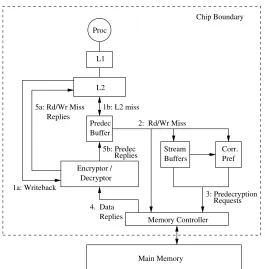
Figure 1 shows the mechanism for predecryption. When an L2 cache line is re-placed or flushed, it is encrypted before it is written back to the memory (Step 1a). A write-back is typically not a latency-critical operation; therefore we do not attempt to hide the encryption latency. Instead, we mainly focus on hiding the decryption latency, which affects time-critical fetches from memory into the L2 cache upon an L2 cache miss. When an L2 cache miss occurs, instead of requesting the line from memory, we first check the predecryption buffer for a match (Step 1b). If the missed line is found in the predecryp-tion buffer, it is moved to the L2 cache. Otherwise, the miss is forwarded to the memory controller for fetching and to the prefetcher (Step 2). The prefetcher’s stream buffers use the miss to identify streams and predecrypt them. If the miss is not identified as a part of a stream, the miss is forwarded to the correlation prefetcher to record the address in its table and make its prediction on future misses. Thus, the correlation prefetcher only sees addresses that are not sequential. In this way, the correlation table can be smaller because it is only used for “difficult” misses that can not be handled by stream buffers. A similar optimization has been used in past studies on prefetching [17, 18].
Corr. Pref Buffers
Stream L1
L2
Encryptor / Decryptor
Memory Controller
Main Memory 1a: Writeback
4. Data Replies Replies
Replies 1b: L2 miss
Requests 3: Predecryption 2: Rd/Wr Miss
5a: Rd/Wr Miss Proc
Chip Boundary
Buffer Predec
5b: Predec
Figure 1: Predecryption mechanism for a processor with two levels of on-chip caches.
2.1. Qualitative Comparison with OTP
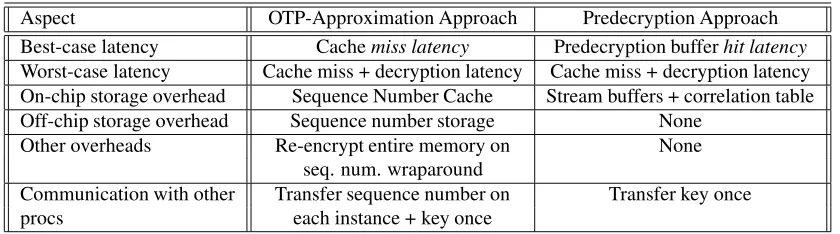
Table 1 qualitatively compares the properties of our predecryption scheme with encryption based on One-Time Pad (OTP) approximation, which was previously pro-posed [20, 21]. For a cache miss, in the best case scenario, OTP finds the needed sequence number on chip in the sequence number cache(SNC), and can overlap pad generation la-tency with memory lala-tency. The best case for predecryption is when the requested line has already been fetched and decrypted into the predecryption buffer, in which case predecryp-tion completely hides decryppredecryp-tion and memory latencies. The worst-case latency for OTP is when the sequence number is not found in the SNC and needs to be fetched before decryp-tion can be performed, in which case the sequence number must be retrieved from memory before pad generation can begin. Therefore, the overall latency of the entire operation is the sum of memory and pad generation (encryption) latency. The worst-case latency for predecryption is the same, because a cache line must be fetched and then decrypted before it can be used by the processor.
Table 1: Qualitative comparison between our predecryption approach and OTP-approximation approach.
Aspect OTP-Approximation Approach Predecryption Approach Best-case latency Cachemiss latency Predecryption bufferhit latency
Worst-case latency Cache miss + decryption latency Cache miss + decryption latency On-chip storage overhead Sequence Number Cache Stream buffers + correlation table Off-chip storage overhead Sequence number storage None
Other overheads Re-encrypt entire memory on None seq. num. wraparound
In terms of storage, OTP stores a sequence number for each block in memory, either in the SNC on-chip, or off-chip. Predecryption requires prediction information on-chip. If only stream buffers are used, they occupy little storage space, in our case 1KB to store information from multiple streams, 64B to store the addresses of the previous misses, and 16KB for their predecryption buffer. However, to perform well a correlation table may need to be very large, such as 1 MB used in past studies [18, 1, 2, 10, 12]. Reducing the size of the correlation table without significantly affecting its effectiveness is a topic for future work.
OTP also complicates communication with other processors in a multiprocessor environment and with other devices. When an off-chip device accesses a datum, it needs the encryption key and the sequence number. The sequence number is different for each line and must be fetched from memory or, if the number is still in the SNC, from the processor that last updated the line. This could be a significant overhead, especially for parallel or I/O intensive programs. In contrast, with predecryption external devices only need the key, which can be supplied to them once. Therefore, predecryption has virtually no additional run-time overhead for parallel and I/O intensive programs.
number on-chip, and thus overlap the data fetch with the decryption latency since we are using OTP-based encryption. In other words, some of the L2 cache misses that suffer the worst case latency in our predecryption scheme can instead suffer from the best case latency of the OTP-based scheme. A small percentage of L2 misses will still suffer from the worst case latency, which is the same for both schemes.
3. Prefetching Algorithms
This section describes the stream and correlation prefetch units in greater detail. As mentioned, when both prefetchers are utilized, the correlation prefetcher only sees misses that are not part of sequential streams so that it can use its storage space to keep track of only the more difficult miss patterns.
3.1. Stream Prefetcher
The stream prefetcher utilizes two structures in addition to the prefetch buffer which holds prefetched, decrypted cache blocks. One structure is a FIFO queue which stores the addresses of the lastNmisses. The other structure is used to identify a limited number of current streams that have been detected by the stream prefetcher.
When an L2 cache miss occurs, the stream prefetcher is accessed. If the block is found in the prefetch buffer, then it is removed from the prefetch buffer and placed into the L2 cache. Then the structure that identifies the current streams is checked to see if it is still tracking the stream where the prefetch buffer hit came from. If so, then requests are generated for the next sequential data blocks from the stream, and the stream information is updated to reflect the current state. It should be noted that in all cases, predecryption requests are only generated if the block is not already stored in the prefetch buffer or in the L2 cache. If the block is not found in the prefetch buffer, then the following steps are taken. First, the block address of the miss is compared to each address in the queue of the
sequential data blocks.
3.2. Correlation Prefetcher
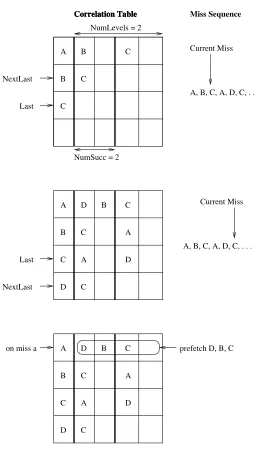
Correlation prefetching [1, 2, 10, 12, 17, 18] is used to capture and prefetch seem-ingly erratic, but repeating data access patterns in an application. Our correlation prefetch-ing algorithm is based on theReplicatedcorrelation table structure described in [18]. The table structure and an example of its operation on a sequence of L2 cache misses is shown in Figure 2.
The table has four parameters used that describe its setup: NumRows,Assoc, Num-Succ, andNumLevels. NumRowsandAssocdescribe the number of rows in the table and the associativity of the table respectively. Each table row stores the tag of an address and
NumLevels columns with each column holdingNumSucc addresses of successor misses.
NumLevels = 2 Correlation Table
NumSucc = 2
A B C
C B
C Last NextLast
Miss Sequence
Current Miss
A, B, C, A, D, C, . . . Correlation Table
Correlation Table Correlation Table
Last
NextLast
A, B, C, A, D, C, . . . Current Miss A
B
C
D D
C
A
C
B C
A
D
on miss a
C
D A
B
C
D D
C
A
B C
A
prefetch D, B, C
is allocated, possibly overwriting and existing row. Then the table rows pointed to by the
NumLevelspointers, are accessed one by one, and the current miss address is stored in one
4. Evaluation Setup
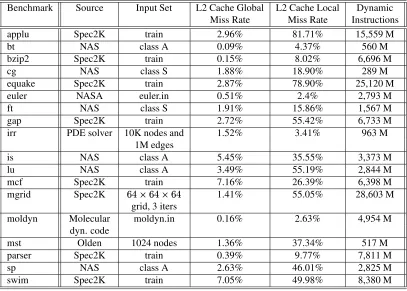
To evaluate our approach, we use 18 applications, mostly from the Spec2000 [19] and NAS benchmark suites. Table 2 lists these applications and their characteristics. The selected applications show varying sizes and L2 cache miss rates. The evaluation is done using the SESC simulator from the Univeristy of Illinois. The SESC simulator performs detailed execution-driven simulation of an out-of-order, superscalar processor. The rele-vant simulation parameters are shown in Table 3, together with descriptions of specific configurations used in our experimental evaluation.
Table 2: The applications used in our evaluation.
Benchmark Source Input Set L2 Cache Global L2 Cache Local Dynamic Miss Rate Miss Rate Instructions
applu Spec2K train 2.96% 81.71% 15,559 M
bt NAS class A 0.09% 4.37% 560 M
bzip2 Spec2K train 0.15% 8.02% 6,696 M
cg NAS class S 1.88% 18.90% 289 M
equake Spec2K train 2.87% 78.90% 25,120 M
euler NASA euler.in 0.51% 2.4% 2,793 M
ft NAS class S 1.91% 15.86% 1,567 M
gap Spec2K train 2.72% 55.42% 6,733 M
irr PDE solver 10K nodes and 1.52% 3.41% 963 M 1M edges
is NAS class A 5.45% 35.55% 3,373 M
lu NAS class A 3.49% 55.19% 2,844 M
mcf Spec2K train 7.16% 26.39% 6,398 M
mgrid Spec2K 1.41% 55.05% 28,603 M
grid, 3 iters
moldyn Molecular moldyn.in 0.16% 2.63% 4,954 M dyn. code
mst Olden 1024 nodes 1.36% 37.34% 517 M
parser Spec2K train 0.39% 9.77% 7,811 M
sp NAS class A 2.63% 46.01% 2,825 M
Table 3: Parameters and configurations of the simulated architecture. Latencies correspond to contention-free conditions. RT stands for round-tripfrom the
pro-cessor. We assume an AES encryption/decryption algorithm is used and can be
performed in 128 cycles. This is roughly in line with 14-cycle latency on a spe-cialized 154 MHz AES processor reported in [16].
PARAMETERS
4 GHz, 6-way out-of-order issue Processor Int, fp, ld/st FUs: 4, 3, 4
Branch penalty: 17 cycles ROB size: 248
L1-Inst: 16 KB, 2 way, 32-B line, WB, RT: 2 cycles, LRU, Outstanding ld+st misses: 16+16.
Memory L1-Data: 16 KB, 2 way, 64-B line, WB, RT: 3 cycles, LRU, Outstanding ld+st misses: 24+24.
L2-Unif. (shared/per proc): 1 MB, 8-way, 64-B line, RT: 16 cycles, LRU, Out-standing ld+st: 24+24.
Predecryption Buffer: 4-way, LRU, 64-B line, 16KB for Sbuff and 32KB for CP (48KB in Sbuff+CP)
Memory bus: 1 GHz, 4-Byte wide, split-transaction RT memory latency: 275 cycles
Stream Buffers Maximum 16 streams, 8 entries/buffer
Correlation Table Replicated organization [18], 64K entries, 2-way, 2 levels, 2 successors/level, 8-cycle access, 647KB total
Encr./Decrypt 128 cycles for each cache line
CONFIGURATIONS
NoEnc No encryption/decryption delay and no predecryption Enc Encryption/decryption delay and no predecryption
Sbuff No encryption/decryption delay and prefetching with stream buffers Enc+Sbuff Encryption/decryption delay and predecryption with stream buffers CP No encryption/decryption delay and prefetching with correlation table Enc+CP Encryption/decryption delay and predecryption with correlation table
CP+Sbuff No encryption/decryption delay and prefetching with both stream buffers and cor-relation table
Enc+CP+Sbuff Encryption/decryption delay and predecryption with both stream buffers and cor-relation table (SPEC2K benchmarks use delta scheme for the corcor-relation table with this configuration)
at one time. Finally, each time a miss is detected as part of a stream, the prefetcher attempts to generate predecryption requests for the next 8 sequential data blocks, as long as they are not already stored in the predecryption buffer or the L2 cache.
The correlation table has 64K entries. Each entry contains a tag of 11 bits, and multiple successors, where each successor is stored as an offset to the current miss address, and is encoded with 17 bits. Therefore, the total table size is !
" Kbytes. The table is also 2-way associative, with 2 levels per entry, and 2 successors
5. Evaluation
Figure 3 plots the execution time for each SPEC2K benchmark, Figure 4 plots the execution time for each non-SPEC2K benchmark, and the average of all the benchmarks is shown in Figure 5, when no encryption is applied (NoEnc), when encryption is applied (Enc), and when various predecryption schemes are applied (Enc+Sbuff, Enc+CP, and
Enc+CP+Sbuff). All bars are normalized to theNoEnc case. Figure 5 shows that on
av-erage, adding a 128 cycle encryption/decryption delay to all memory accesses increases the execution time by 21%. Predecryption with stream buffers (Enc+Sbuff) reduces this overhead to a little over 1%, whereas a correlation predictor alone (Enc+CP) reduces this overhead to 16%. A combination of both predecryption schemes (Enc+CP+Sbuff) results in the same execution time as in the NoEncconfiguration. This result shows that, as ex-plained in Section 1, a predecryptor eliminates some of the performance lost to memory encryption. However, these figures do not indicate what part of the miss latency is hidden by predecryption: memory latency alone, or both memory and decryption latency. Fig-ures 6, 7, and 8 help to answer this question.
en-0% 20% 40% 60% 80% 100% 120% 140% 160%
APPLU BZIP2 EQUAKE GAP MCF MGRID PARSER SWIM
Benchmark N o r m a liz e d E x e c ution Ti m e
NoEnc Enc Enc+Sbuff Enc+CP Enc+CP+Sbuff
Figure 3: SPEC2K app. performance with different predecryption schemes.
0% 20% 40% 60% 80% 100% 120% 140% 160%
BT CG EULER FT IRR IS LU MOLDYN MST SP
Benchmark N o rma li ze d Exec u ti o n T ime
NoEnc Enc Enc+Sbuff Enc+CP Enc+CP+Sbuff
Figure 4: Non-SPEC app. performance with different predecryption schemes.
0% 20% 40% 60% 80% 100% 120% 140% 160% AVG N o r m a li z e d E x e c u ti o n T im e NoEnc Enc Enc+Sbuff Enc+CP Enc+CP+Sbuff
cryption. If a prefetcher is only able to hide memory latency alone, the relative execution time inEnc+CP+Sbuffwould be higher than that inNoEnc+CP+Sbuff. If a predecryptor is equally good at hiding decryption latency as it is at hiding memory latency, the relative exe-cution time inEnc+CP+Sbuffwould be similar to that inNoEnc+CP+Sbuff. Finally, if the prefetcher is better at hiding decryption latency than it is at hiding memory latency alone, the relative execution timeEnc+CP+Sbuffwould be lower than that inNoEnc+CP+Sbuff.
Our results in Figures 6-8 indicate that in most applications the prefetcher is at least as good at hiding decryption latency as it is at hiding memory latency, and in some appli-cations it is noticeably better. This indicates that the prefetcher is indeed hiding some of the decryption latency in addition to the memory latency. In fact, the fraction of decryption latency that the prefetcher hides is often larger than the fraction of the memory latency it hides. Overall, without encryption, a prefetcher reduces execution time by 12% on aver-age, while the reduction is 16% in a system with memory encryption. This indicates that predecryption is a promising scheme for alleviating the performance impact of memory encrytion.
However, one disappointment in our current setup is the lack of significant benefit from adding a correlation predictor to the stream buffers mechanism. To investigate this, we evaluate the performance of predictors in different configurations, and show the results in Figures 9, 10, and 11.
0% 20% 40% 60% 80% 100% 120%
APPLU BZIP2 EQUAKE GAP MCF MGRID PARSER SWIM
Benchmark N o rma li ze d Exec u ti o n T ime
NoEnc NoEnc+CP+Sbuff Enc Enc+CP+Sbuff
Figure 6: Predecryption benefit over standard prefetching for SPEC2K apps.
0% 20% 40% 60% 80% 100% 120%
BT CG EULER FT IRR IS LU MOLDYN MST SP
Benchmark N o rma li ze d Exec u ti o n T ime
NoEnc NoEnc+CP+Sbuff Enc Enc+CP+Sbuff
Figure 7: Predecryption benefit over standard prefetching for non-SPEC2K apps.
0% 20% 40% 60% 80% 100% 120% AVG N o r m a li z e d E x e c u ti o n T im e NoEnc NoEnc+CP+Sbuff Enc Enc+CP+Sbuff
0% 20% 40% 60% 80% 100% 120% 140% 160% 180% 200% APP LU (Enc+S buff) APP LU (Enc +CP ) APP LU (Enc +C P+S buff) BZI P2 (Enc +Sbu ff) BZI P2 (Enc +CP ) BZI P2 (Enc +C P+Sbu ff) EQ UA KE (Enc+ Sbu ff) EQ UA KE (Enc+
CP)
EQ UA KE (Enc+ CP+ Sbu ff GAP (Enc+ Sbu ff) GAP (Enc+
CP)
GAP (Enc+ CP+ Sbu ff) MC F(Enc +Sbu ff) MC F(Enc +CP ) MC F(Enc +CP+Sbuff ) MG RID (Enc +Sbu ff) MG RID (Enc +CP ) MG RID (Enc +C P+Sbu ff) PAR SE
R (E nc+
Sbu ff)
PAR SE
R (E nc+
CP)
PA RSE
R (E nc+
CP+ Sbu
ff)
SW IM (Enc
+Sbu ff)
SW IM (Enc
+CP )
SW IM (Enc
+C P+Sbu ff) Benchmark P r e di c tion P e r fo r m a n c e
Correct Prediction Misses Wrong Prediction
Figure 9: Prediction performance of SPEC2K apps. for different predecryption schemes. 0% 20% 40% 60% 80% 100% 120% 140% 160% 180% 200% BT (Enc +Sbu ff) BT (Enc +CP ) BT (Enc +CP +Sbu ff) CG (Enc +Sbuff ) CG (Enc +CP ) CG (Enc +CP +Sbuff ) EU LER (Enc +Sbu ff) EU LER (Enc +CP )
EULE
R (E
nc+C
P+S
buff)
FT (E
nc+S
buff)
FT (E
nc+CP
)
FT (E
nc+CP +Sbu ff) IRR (Enc +Sbu ff) IRR (Enc +CP ) IRR (Enc +CP +Sbu ff)
IS (E
nc+S
buff)
IS (E
nc+C
P)
IS (E
nc+C P+S buff LU (Enc +Sbu ff) LU (Enc +CP ) LU (Enc +CP+Sbu ff) MO LDY N(E nc+S buff) MO LDY N(E nc+CP ) MO LDY N(E nc+CP +Sbu ff) MS T(E nc+S buff ) MS T(E nc+C P) MS T(E nc+C P+S buff) SP (Enc +Sbu ff) SP (Enc +CP ) SP (Enc +CP +Sbu ff) Benchmark P r e d ic ti o n P e r fo r m a n c e
Correct Prediction Misses Wrong Prediction
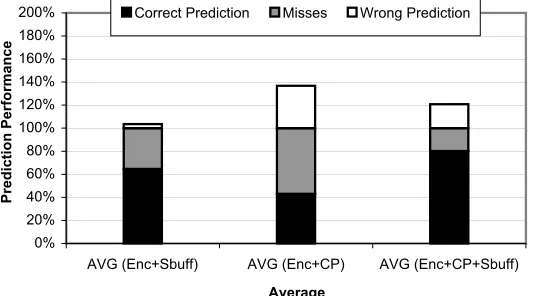
Figure 10: Prediction performance of non-SPEC2K apps. for different predecryp-tion schemes. 0% 20% 40% 60% 80% 100% 120% 140% 160% 180% 200%
AVG (Enc+Sbuff) AVG (Enc+CP) AVG (Enc+CP+Sbuff)
Average P re d ic ti o n P e rf o rm a n c e
Correct Prediction Misses Wrong Prediction
full or partial miss latency (which includes memory latency and decryption latency) of these accesses is hidden and the data is read from the predecryption buffer. The middle segment shows the percentage of L2 cache misses that go to the main memory and also suffer the full decryption latency. In other words, this is the percentage of L2 cache misses that do not benefit at all from predecryption. The top segment shows the number of blocks that are predecrypted needlessly, meaning that the blocks are either never needed, or they are replaced from the predecryption buffer before they are actually requested by the processor. All bars are shown relative to the number of L2 misses in the baseline configuration. On average, the correlation predictor alone successfully predecrypts about 43% of the original L2 cache misses. However, this scheme also causes an extra 37% more predecryptions of data that is not useful to the application. These extra predecryptions could be the reason for the lack of performance benefit when the correlation predecryptor is added to the stream buffers. These extra memory accesses cause contention delays and interfere with memory requests for valid data. This is clearly evident in theis benchmark, where the addition of correlation prefetching slows down the execution of the benchmark, due to a high number of wrong predictions and low number of correct ones.
match an entry in the correlation table. However, a larger table may not be feasible to put on-chip, and our future work will focus on improving the table’s hit rate while maintain-ing or further reducmaintain-ing its size. Our results show that stream buffers are very accurate in terms of predecrypting only useful data, and they also act as a filter that helps utilize the correlation table better. The combination of the two prediction mechanisms can predecrypt a very high percentage of L2 cache misses (80%), while only generating 20% additional unnecessary predecryptions, as shown in Figure 11.
Another interesting observation that can be made from Figures 3 and 4, and Figures 9 and 10 is that in four benchmarks (applu, bt, ft, and mcf), we correctly predecrypt a large portion of L2 cache misses, but the execution compared with Enc is still similar. This is because many of the correct predecryptions in these applications only hide partial miss latency, and a significant fraction of the latency remains. This, combined with the increase in bus traffic due to mispredictions (top segment of each bar in Figures 9-11), results in a low overall benefit from predecryption. This confirms that reducing these extra predecryptions should make our scheme even more attractive.
but by prefetching far ahead we are able to hide decryption latency as well. We find this re-sult promising because with many processors today already having prefetching hardware, it may be possible to tune them to prefetch further ahead to support direct memory encryption with a reasonable overhead.
0.00 0.20 0.40 0.60 0.80 1.00 1.20 1.40 A P P L U B T B Z IP 2 C G E Q U A K E E U L E R FT G A P
IRR IS L
U M C F MGRID M O L D Y N M S T P A R S E R S P S W IM A V G Benchmark N o rma li ze d Exec u ti o n T ime NoEnc+CP+Sbuff Enc+CP+Sbuff
6. Conclusions
Our results show that predecryption compares favorably to schemes such as one-time-pad because the execution time of some benchmarks can actually be reduced even with the extra latency of memory encryption. This is due to the fact that in the worst case scenarios of predecryption and one-time-pad, the latency overhead is the same, but the best case latency of predecryption can be much lower than the best case latency of one-time-pad for an L2 cache miss. Additionally, in schemes such as one-time-pad there will always be some slowdown in execution time because the decryption delay of a memory request can never be fully hidden as it can in our scheme. Since the data shows that the correlation predecryptor does not provide much performance improvement over simply using stream buffers alone, we feel that this scheme will appear even more attractive once the correlation predecryptor implementation is optimized.
References
[1] T. Alexander and G. Kedem. Distributed Predictive Cache Design for High Per-formance Memory Systems. In the Second International Symposium on
High-Performance Computer Architecture, pages 254–263, February 1996.
[2] M. J. Charney and A. P. Reeves. Generalized Correlation Based Hardware
Prefetch-ing. Technical Report EE-CEG-95-1, Cornell University, February 1995.
[3] T. F. Chen and J. L.Baer. Reducing Memory Latency via Non-Blocking and Prefetch-ing Cache. In the 5th International Conference on Architectural Support for
Pro-gramming Languages and Operating Systems, pages 51–61, October 1992.
[4] K. Farkas, P. Chow, N. Jouppi, and Z. Vranesic. Memory-system design considera-tions for dynamically-scheduled processors. InProc. of the 24th Annual International
Symposium on Computer Architecture, 1997.
[5] T. Gilmont, J-D. Legat, and J-J. Quisquater. Enhancing the Security in the Memory Management Unit. InProc. of the 25th EuroMicro Conference, 1999.
[6] G. Hinton, D. Sager, M. Upton, D. Boggs, D. Carmean, A. Kyker, and P. Roussel. The Microarchitecture of the Pentium 4 Processor. Intel Technology Journal, (First Quarter), 2001.
[8] IBM. IBM Power4 System Architecture White Paper, 2002. http://www-1.ibm.com/servers/ eserver/pseries/hardware/whitepapers/power4.html.
[9] International Planning and Research Corporation. Sixth Annual BSA Global Software
Piracy Study, 2001. http://www. bsa.org/resources/2001-05-21.55.pdf.
[10] D. Joseph and D. Grunwald. Prefetching Using Markov Predictors. Inthe 24th
Inter-national Symposium on Computer Architecture, pages 252–263, June 1997.
[11] N. Jouppi. Improving Direct-Mapped Cache Performance by the Addition of a Small Fully-Associative Cache and Prefetch Buffers. Inthe 17th International Symposium
on Computer Architecture, pages 364–373, May 1990.
[12] A. Lai, C. Fide, and B. Falsafi. Dead-Block Prediction and Dead-Block Correlating Prefetchers. In the 28th International Symposium on Computer Architecture, pages 144–154, June 2001.
[13] D. Lie, J. Mitchell, C.A. Thekkath, and M. Horowitz. Specifying and Verifying Hard-ware for Tamper-Resistant SoftHard-ware. In IEEE Symposium on Security and Privacy, 2003.
[14] D. Lie, C.A. Thekkath, M. Mitchell, P. Lincoln, D. Boneh, J. Mitchell, and M. Horowitz. Architectural Support for Copy and Tamper Resistant Software. In
Proc. of the 9th International Conference on Architectural Support for Programming
[15] S. Palacharla and R. Kessler. Evaluating Stream Buffers as a Secondary Cache Re-placement. In the 21st International Symposium on Computer Architecture, pages 24–33, April 1994.
[16] P.R. Schaumount, H.Kuo, and I.M. Verbauwhede. Unlocking the Design Secrets of a 2.29 Gb/s Rijndael Processor. InDesign Automation Conference, 2002.
[17] T. Sherwood, S. Sair, and B. Calder. Predictor-Directed Stream Buffers. Inthe 33rd
International Symposium on Microarchitecture, pages 42–53, December 2000.
[18] Y. Solihin, J. Lee, and J. Torrellas. Using a user-level memory thread for correlation prefetching. In29th International Symposium on Computer Architecture (ISCA), May 2002.
[19] Standard Performance Evaluation Corporation. Spec benchmarks.
http://www.spec.org, 2000.
[20] G.E. Suh, D. Clarke, B. Gassend, M. van Dijk, and S. Devadas. Efficient Memory Integrity Verification and Encryption for Secure Processor. InProc. of the 36th Annual
International Symposium on Microarchitecture, 2003.
[21] J. Yang, Y. Zhang, and L. Gao. Fast Secure Processor for Inhibiting Software Piracy and Tampering. InProc. of the 36th Annual International Symposium on