ABSTRACT
WIELAND HANDY, LISA A. The Importance of the Work Environment Variables on the Transfer of Training. (Under the direction of Brad Mehlenbacher.)
Today’s organizational leaders want stronger evidence of training’s effectiveness and they want to know how training is improving their organizational performance. Although the work environment variables have been emphasized by research as important to the transfer of training, it is surprising that little research has addressed the issue of the employees’
perception of the work environment variables and if they perceive these work environment variables as being significant in their ability to transfer their knowledge and skills gained from training back to the job. The purpose of this study was to examine a proposed model of training transfer, which relates the employees’ perceived importance of the work
environment variables to transfer of training within an organizational work setting.
Participants were 115 full-time service engineers who completed an instructor-led training, which prepared them to perform services on technical equipment at client sites. Participants received the first questionnaire immediately after training, which measured the existence of the work environment variables and the motivation to transfer training. The second
The Importance of the Work Environment Variables on the Transfer of Training
by
Lisa A. Wieland Handy
A dissertation submitted to the Graduate Faculty of North Carolina State University
in partial fulfillment of the requirements for the Degree of
Doctor of Education
Adult and Community College Education
Raleigh, North Carolina 2008
APPROVED BY:
_______________________________ ______________________________
Brad Mehlenbacher Saundra Wall Williams
Committee Chair
________________________________ ______________________________
BIOGRAPHY
Lisa A. Wieland Handy earned a Bachelor’s of Science degree in Business Administration and Finance with an Economics minor from the University of Minnesota, Minneapolis, Minnesota and a Masters of Education in Training and Development from North Carolina State University. Her current research interests include organizational design and development, talent management, organizational psychology, and training and development.
Ms. Wieland Handy is an adjunct instructor and a member of the HR
Management Board of Advisors at Central Carolina Community College, Sanford, NC. She is currently employed as a Senior Human Resources Manager, Global
Organizational Development. She leads the organizational development and talent management initiatives for a global telecommunications company. She has over 16 years experience working in the training and development field for financial, HR outsourcing, and high tech organizations.
ACKNOWLEDGEMENTS
The many people that have supported me during this journey have been a blessing! First, I would like to thank my biggest fan and source of encouragement to achieve the unthinkable, my father, LeRoy Wieland. He “held down the fort” so that I could focus on finishing my research. Dad is always ready to give me hugs and kisses to let me know how proud he is of me. To the other man in my life, my husband James, who was busy being an architectural student at NC State University, but found time to help me with computer problems and provide me with love and encouragement to never give up. I would also like to thank my loving pets who walk across my computer, my lap, and papers or sit with me to remind me of what is really important.
I would also like to thank my many friends who were pillars of strength and much needed laughter. My fellow graduate students Dr. Nona Saling, Dr. Varnell McDonald-Fletcher, Byron Diggs, and Jeff Jones who willing shared their experience and expertise to help me make sense of this process. To my Minnesota, North Carolina, New Jersey, and Pittsburgh friends who never lost confidence in my ability, even when I did with each passing semester.
My committee has been highly supportive and very helpful. Dr. Brad Mehlenbacher graciously accepted the responsibility to chair my committee when a void was left by the retirement of Dr. James Burrow. Brad has been very encouraging and patient with me during the stressful times. Dr. Saundra Wall Williams, who was instrumental during my masters’ work, provided guidance that helped strengthen my research methodology. Dr. Samuel B. Pond III. guided me in his area of expertise when I had many questions about factor analysis and how to validate my surveys. Dr. Tony O’Driscoll assisted with the conclusion and helped me think through the interpretation of results. I would like to give a special thank you to Dr. Amy Caison for helping me through chapter four and all the statistical analysis. She provided me with sound research advice and reminded me that this is a learning experience with many paths. A special “thank you” to Dr. James Burrow for his sincere desire to help me succeed. He encouraged me to apply to the doctoral program and has guided me as far as the
department would allow a retiring professor to chair a committee and still offered his support to me after his official retirement.
Finally, I am thankful for my loving mother who supports me in spirit and will not be here to celebrate this accomplishment. She would have been very proud of me. I am very grateful that my parents instilled in me the self-confidence, drive, and lessons that have prepared me for this academic journey and to complete the doctorate.
TABLE OF CONTENTS
LIST OF TABLES ... vii
LIST OF FIGURES ... viii
CHAPTER I: INTRODUCTION ...1
Training Effectiveness...2
Factors Influencing Transfer of Training ...4
Problem Statement...8
Purpose of the Study...13
Overview of Proposed Model...15
Research Questions ...18
Definitions ...19
Significance of the Study...20
Limitations...21
CHAPTER II: REVIEW OF THE LITERATURE...22
Motivation Theories Supporting Transfer of Training...24
Equity Theory ...25
Expectancy Theory ...26
Goal-Setting Theory ...28
Early Studies on Transfer of Training ...29
Work Environment Factors ...33
Situational or Task Constraints...34
Social Support Factors...36
Motivation to Transfer...39
Transfer Climate...42
Transfer System...46
Summary...50
CHAPTER III: METHODOLOGY ...52
Overview ...52
Population and Sample ...52
Training Program Background ...54
Research Design ...55
Instrumentation...57
Demographic Information ...57
Learning Transfer System Inventory (LTSI)...58
Importance, Transfer Achieved, and Performance Improvement (ITAPI)...61
Related Variables, Research Questions, And Questionnaire Items...64
Summary...72
CHAPTER IV: RESULTS ...74
Demographic Data...74
Cronbach’s Coefficient Alpha...77
Independent-Samples t Test ...82
Data Analysis of Research Questions...85
Research Question One...85
Research Question Two...88
Research Question Three...90
Research Question Four...91
Summary of Results ...96
CHAPTER V: CONCLUSIONS AND RECOMMENDATIONS ...97
Introduction ...97
Summary of Findings ...99
Conclusions ...101
Limitations...106
Recommendations for Future Research...109
Recommendations for Practitioners ...111
Final Comments...113
REFERENCES ...114
APPENDICES ...124
Appendix A: Recruitment Letter One and NCSU Informed Consent Form ...125
Appendix B: Learning Transfer System Inventory (LTSI) ...130
Appendix C: Recruitment Letter Two...137
Appendix D: Importance of the Work Environment, Transfer Achieved, and Performance Improvement (ITAPI) ...138
LIST OF TABLES
Table 3.1: Sample Sizes and Percentages ...53
Table 3.2: Training Program Groups Participating in Study ...54
Table 3.3: LTSI Scale Details ...60
Table 3.4: ITAPI Scale Variables, Sample Question, Questionnaire Item ...64
Table 3.5: Respondents and Nonrespondents ...68
Table 4.1: Participant Demographics ...76
Table 4.2 LTSI Scale Variables, Sample Question, Questionnaire Item and Alphas ...79
Table 4.3: ITAPI Scale Variables, Sample Question, Questionnaire Item and Alphas ..81
Table 4.4: Independent-Samples t Test for Company A and Company B ...83
Table 4.5: Descriptive Statistics for Continuous Variables ...86
Table 4.6: Descriptive Statistics for Continuous Variables ...89
Table 4.7: Correlation Between Motivation to Transfer and Perceived Transfer Achieved...91
Table 4.8: Intercorrelations Among Dependent and Independent Variables ...93
Table 4.9: Betas Obtained in Regression Predicting Motivation to Transfer ...94
LIST OF FIGURES
CHAPTER I: INTRODUCTION
Faced with economic uncertainty, globalization, and competition, most organizations have invested in formal training for their employees in hopes of having this training investment reciprocated through improved performance and competitive advantage (Awoniyi, Griego, & Morgan, 2002; Donovan, Hannigan, & Crowe, 2001; Yamnill & McLean, 2001).
The American Society for Training and Development (ASTD), in their 2004
State of the Industry Report, posits that management is placing greater pressure on training professionals to demonstrate the value of training (Sugrue & Kyung-Hyun, 2004). Although the total training dollars spent by organizations vary, one estimate by
Training Magazine’s23rd Annual Industry Report (2004)suggests that companies spent $51.4 billion on training in 2004 and $51.3 billion in 2003. Furthermore, 26 percent of the 2004 respondents reported larger training budgets in comparison to their 2003 training budget (Dolezalek, 2004). The significant amount of resources spent on training, as a means to achieve organizational results, has caused organizational leaders to ask for justification of the value and effectiveness of training.
to know how training is improving their organizational performance and how these changes in knowledge, skills, and attitudes (KSAs) are impacting their bottom-line. This trend has emerged as organizations demand more accountability, data, and results regarding their return on training investments (Salas & Cannon-Bowers, 2001; Salas, Cannon-Bowers, & Kozlowski, 1997). ASTD’s 2004 State of the Industry Report postulates that the organizations that understand the link between learning and performance have increased their efforts to align learning with business goals, target learning resources at mission-critical competencies, and measure both the effectiveness of learning and the efficiency of the learning organization in delivering improved performance outcomes.
Training Effectiveness
Donald Kirkpatrick’s (1967) work is a widely recognized and accepted method for evaluating the effectiveness of training programs within an organization.
Kirkpatrick’s evaluation model is designed for training practitioners to gather data about a training program at four critical perspectives: 1) participant reaction
(perceptions) to the training program, 2) participant learning, 3) on-the-job performance change (also known as training transfer), and 4) organizational impact (Rothwell & Kazanas, 1992).
have no formal metrics in place. Most organizations had metrics in place for Kirkpatrick’s levels one and two. However, in terms of assessing on-the-job performance, only 54 percent of these respondents said they assess training at level three (transfer of training) (Rowan, 2005). According to these statistics, most training practitioners use perception data (level one) to design training programs and validate training effectiveness and very few organizations are capturing behavioral data (level three and four) on the transfer of training. This reluctance results from a perceived lack of time and resources or a lack of expertise on how to design an effective evaluation of training (Alliger, Tannenbaum, Bennett, Traver, & Shotland, 1997).
Another concern is that Kirkpatrick’s work has been classified as a taxonomy rather than a model because it is missing essential variables that affect learning and transfer processes, such as trainee motivation and work environment factors that affect the transfer of training (Holton, 1996). Without considering these essential variables, it would be difficult to connect learning and changes in individual’s behavior. It is difficult to isolate the effects of training versus other changes occurring within and outside the organization (Burrow & Berardinelli, 2003). Furthermore, trainees’ attitudes, interests, values, and expectations can influence training effectiveness (Noe, 1986).
(Salas & Cannon-Bowers, 2001). Kirkpatrick is effective for summative and formative evaluations of training programs. Training effectiveness, on the other hand, is
concerned with “why training works” and it is a macro view. It looks at the training intervention from a systems perspective where the success of training depends not only on the methods used but: 1) how training is positioned, supported, and reinforced by the organization, 2) the motivation and focus of trainees, and 3) what mechanisms are in place to ensure the transfer of the newly acquired KSAs to the job (Kraiger, Ford, & Salas, 1993). The most meaningful factor in evaluating the effectiveness of training is the trainee’s work performance and therefore, a better performance indicator maybe in the knowledge and skills employees transfer from the training back to the work
environment (Burrow & Berardinelli, 2003). The work environment comprises all of the conditions in which an employee has to perform the tasks and duties belonging to his/her function (Gielen, 1996).
Factors Influencing Transfer of Training
Although there are many definitions of transfer, it is generally agreed that transfer of training, as defined by Baldwin and Ford (1988), is the degree to which trainees effectively apply the knowledge, skills, and attitudes gained in a training context to the job and maintained over time. This definition suggests that transfer of training is a function of factors within the formal training context as well as
something to transfer, such as the knowledge, skills, and attitudes gained in a training context, 2) the trainee should be both able and motivated to transfer the learning, and 3) there is the situation, different from the training context, in which the training content is applied (Gielen, 1996). Transfer of training is a way of thinking, perceiving, and processing information; without the ability to transfer, people could not engage in everyday thinking and reasoning (Haskell, 1998).
Two critical outcomes of effective training are learning and transfer of training (Holton, Bates, & Ruona, 2000). Transfer is seen as a function of three sets of factors: 1) trainee characteristics (ability, personality, motivation), 2) training design (principles of learning, sequencing, training content), and 3) the work environment (support, opportunity to use) on training outputs (learning, retention) and conditions of transfer (generalization, maintenance) (Cheng & Ho, 2001).
& Naquin, 2003; Tannenbaum & Yukl, 1992). Furthermore, researchers have
demonstrated some support for the effectiveness of posttraining interventions, however, relatively little is known about their application in organizations and employees’
reaction to them (Huint & Saks, 2003). Since Baldwin and Ford (1988), researchers have agreed that one conceptualization of the manner in which work environment factors affect the transfer of learned behaviors to the job is through a transfer of training climate (Holton, Bates, Seyler, & Carvalho, 1997; Mathieu, Tannenbaum, & Salas, 1992; Rouiller & Goldstein, 1993).
The transfer climate is defined as those situational cues and consequences that either inhibit or help to facilitate the transfer of what has been learned in training into the job situation (Rouiller & Goldstein, 1993). The transfer climate is not the work environment per se, but rather the interpretation through which the work environment affects job behaviors and attitudes. Transfer climate is described as a “sense of
imperative” (Schneider & Rentsch, 1988, cited in Holton, et al. 1997) that arises from a person’s perceptions of the work environment, and that influences the extent to which a person applies learned skills to the job (Holton et al., 1997). These studies conclude that the transfer climate can significantly affect an individual’s ability and motivation to transfer learning to the job.
conceptual framework that illustrates the general relationship between transfer climate and transfer of training. This model, through its succession, broadens the focus from an emphasis on a transfer climate to an emphasis on a transfer system. The authors’ framework is known as The Learning Transfer Systems Inventory (LTSI): Conceptual Model of Instrument Constructs, which is shown below in Figure 1.1. This model considers five influences: 1) secondary influences, 2) motivation, 3) environment, 4) outcomes, and 5) ability. The LTSI model, displays the complete transfer system, which are all factors in the person, training, and organization that influence transfer of training to job performance (Holton et al., 2000).
Secondary Influences
Performance Self-Efficacy Learner Readiness Motivation
Motivation to Transfer Transfer Effort Performance
Performance Outcomes Environment
Feedback
Peer Support Personal Outcomes-Positive Supervisor Support Personal Outcomes-Negative Openness to Change Supervisor Sanctions Outcomes
Ability Content Validity Transfer Design Personal Capacity for Transfer
Opportunity to Use
Figure 1.1 Learning Transfer System Inventory: Conceptual Model
Learning Individual Performance
Training practitioners must give careful consideration to many variables and issues surrounding transfer. Therefore, they usually adopt a trial and error approach to manage transfer of training (Broad & Newstrom, 1992; Cheng & Ho, 2001; Holton, 2003). Good transfer strategies should help training practitioners in understanding, analyzing, and selecting appropriate interventions for those problems that training can address in the organization. In order to implement the proper interventions for the transfer of training, training practitioners must understand the work environment factors and how these factors influence transfer (Holton et al., 2000). Furthermore, they should be able to provide more definitive answers to “why” training was effective by
understanding: 1) the nature of training transfer and the barriers, 2) the enablers to transfer in the work environment, and 3) the work environment factors that have a positive (or a negative) influence on individual performance and organizational performance.
Problem Statement
It is estimated that the extent to which learning typically is transferred into performance range from 5 to 20 percent (Broad, 2000). This estimate is a rather low payoff for the investment in training. One reason that transfer of training is so
disappointingly low is that the transfer process is complex and involves multiple factors and influences, such as motivation, self-efficacy, ability to learn, and training design (Baldwin & Ford, 1988; Cheng & Ho, 2001; Holton & Baldwin, 2003; Noe & Schmitt, 1986; Rouiller & Goldstein, 1993).
Supervisor’s support has clearly been established in the literature as a critical work environment factor that influences the transfer process. However, there continues to be mixed results and gaps in the literature regarding the specific supervisor factors that influence transfer (Clarke, 2002; Hawley & Barnard, 2005). Some studies lend support to the hypothesis that supervisor’s support is significant in the transfer of learned behaviors to the work setting (Bates, Holton, Seyler, & Carvalho, 1999; Brinkerhoff & Montesino, 1995; Ford, Quinones, Sego, & Sorra, 1992; Hawley & Barnard, 2005; Seyler, Holton, Bates, Burrnett, & Carvalho, 1998). Other studies did not find a significant positive relationship between supervisor’s support and transfer (Awoniyi et al., 2002; Facteau et al., 1995; Van der Klink, Gielen, & Nauta, 2001).
The Baldwin and Magjuka (1991) study raises the question of what does an employee perceive as important in the context of transfer? Do employees perceive work environment variables as important? Although the work environment variables have been emphasized by research as important to the transfer of training, it is
surprising that little research has addressed the issue of the employees’ perception of the work environment variables and if they perceive these work environment variables as being significant in their ability to transfer the acquired knowledge, skills, and attitudes gained from training back to the job.
Furthermore, Cheng and Ho (2001) argue that more studies should be conducted to test posited variables in various training contexts to facilitate the development of a database of findings that will allow comparison, contrast, and further elaboration. By testing the variables in different settings, a more consistent view of their functions on transfer could be obtained. The scarcity of research on the practical benefits of how transfer-related factors present themselves in organizations or how those factors might be effectively managed, are important to training practitioners, organizations, and researchers in their understanding of how to support transfer of training in
organizations.
Purpose of the Study
The purpose of this study is to examine a proposed model of training transfer (Figure 1.2), which relates the employees’ perceived importance of the work
environment variables to transfer of training within an organizational work setting.
Figure 1.2 Proposed Model: Importance of Work Environment Variables
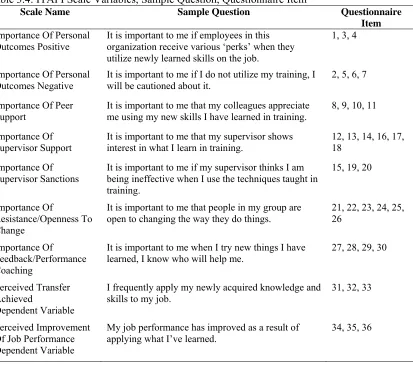
Specifically, the proposed relationships are: 1) the employees’ perception of the importance of the work environment variables in the context of transfer, 2) whether the employees’ perception of the importance of the work environment variables predicts the employees’ motivation to transfer, 3) whether employees perceive that transfer was achieved, and 4) whether employees perceive their job performance improving when they transferred their newly learned knowledge and skills.
1
2
3 4
Employees’ Perception of the Existence of Work Environment Variables
feedback, peer support, supervisor support, openness to change, personal outcomes positive, personal
outcomes negative, and supervisor sanctions
Employees’ Perception of Importance of the Work Environment
Variables
Self-Reported Performance Improvement Work Environment
Employees
Outcomes
Motivation to Transfer
The model guiding the research is developed based on Holton, et al.’s (2000) conceptual model (Figure 1.1) and transfer factors found in the literature review. The seven work environment variables, motivation to transfer, transfer effort, and
performance are included in Holton et al.’s (2000) model. As shown in the proposed model, the seven work environment variables (independent variables: feedback, peer support, supervisor support, openness to change, personal outcomes positive, personal outcomes negative, and supervisor sanctions) may influence the motivation to transfer (dependent variable). Furthermore, this relationship may be influenced by the
suggested importance of the work environment variables.
The predictive variables are the employee’s perception of the importance of the work environment variables. For example, if the work environment variable
variable) may influence the perceived transfer achieved (dependent variable) and perceived performance improvement (dependent variable).
While secondary influences (self-efficacy, learner readiness) and abilities
(training program design, content validity, personal capacity to transfer, and opportunity to use) are recognized as components of the transfer system, these variables will not be addressed in this research study primarily because current literature exists on the relationship of these factors to training effectiveness and it is beyond the scope of this study. A complete review of the related literature supporting the relationships proposed in the model (Figure 1.2) is presented in the next chapter. A brief description of the model is provided here to define the variables selected for the study.
Overview of Proposed Model
Motivation to transfer is the intention of the trained employee to apply the newly learned knowledge and skills mastered in the training program back to the work
environment (Seyler et al., 1998). As shown in Figure 1.2, seven work environment variables are suggested to influence the motivation to transfer. However, the perceived importance of the work environment variables is suggested to influence this relationship between the work environment variables and motivation to transfer. Based on previous research specific to the work environment variables, the selected seven work
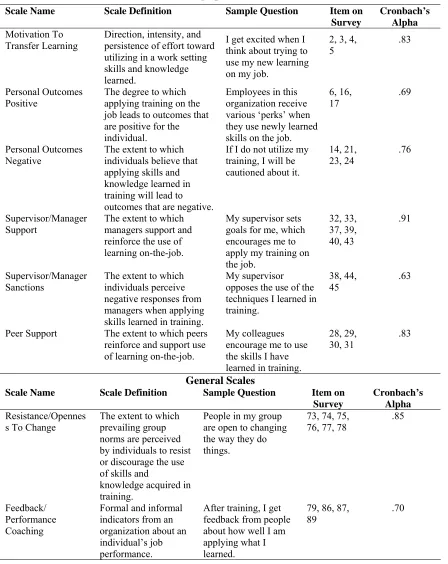
1. Feedback (performance coaching) is defined as the extent to which individuals receive constructive input, assistance, and feedback from people in their work environment (peers, employees, colleagues, managers, etc.) when applying new abilities or attempting to improve work performance. Feedback may be formal or informal cues from the workplace (Holton et al., 2003).
2. Peer Support is defined as the degree to which peers mutually identify and
implement opportunities to apply KSAs learned in training, encourage the use of or expect the application of new skills, display patience with difficulties associated with applying new skills, or demonstrate appreciation for the use of new skills (Holton et al., 2003).
3. Supervisor (Manager) Support is defined as the managers’ involvement in clarifying performance expectations after training, identifying opportunities to apply new KSAs, setting realistic goals based on training, working with individuals on problems encountered while applying new skills, and providing feedback when individuals successfully apply new KSAs (Holton et al., 2003).
4. Openness (Resistance) To Change is defined as the work groups’ resistance to change, willingness to invest energy to change, and degree of support provided to individuals who use techniques learned in training (Holton et al., 2003).
reward, the opportunity to further career development plans, or the opportunity to advance in the organization (Holton et al., 2003).
6. Personal Outcomes Negative is defined as the reprimands, penalties, peer resentment, too much new work, or the likelihood of not getting a raise if newly acquired skills are utilized (Holton et al., 2003).
7. Supervisor (Manager) Sanctions is when managers oppose the use of new KSAs, use techniques different from those taught in training, do not assist individuals in identifying opportunities to apply new KSAs, or provide inadequate or negative feedback when individuals successfully apply learning on-the-job (Holton et al., 2003).
Research has shown that the seven work environment variables can influence an individual’s motivation to transfer (Cheng & Ho, 2001; Holton et al., 1997). As shown in Figure 1.2, the proposed model, the employees’ perception of the importance of these seven work environment variables is suggested to influence their motivation to transfer. Therefore, if the work environment variable (supervisor support) exists at a high level in the organization and the employee perceives that work environment variable is
Research Questions
The following research questions are guiding the study:
1. What are the trainees’ perceptions of the existing work environment variables in supporting transfer immediately after training?
2. What are the trainees’ perceptions of the importance of the work environment variables in supporting transfer two months after training?
3. What is the relationship between trainees’ motivation to transfer (immediately after training) and perceived transfer achieved (two months after training)?
Definitions
Motivation to Transfer: the intended effort towards utilizing the skills and
knowledge learned in a training context to the trainee’s job (Seyler et al., 1998). Transfer Climate: Consists of those situational cues and consequences that
either inhibit or help to facilitate the transfer of what has been learned in training into the job situation (Rouiller & Goldstein, 1993).
Transfer System: All factors in the person, training, and organization that
influence transfer of learning/training to job performance (Holton et al., 2000). Transfer of Training: Positive transfer of training is the degree to which
trainees effectively apply the knowledge, skills, and attitudes gained in a training context to the job and maintained over time (Baldwin & Ford, 1988).
Work Environment: The work environment comprises all of the conditions in
Significance of the Study
A study of how trainees perceive the importance of the work environment variables and transfer of training is significant for several reasons. First, organizations have invested billions of dollars in formal training for their employees in hopes to have this training investment reciprocated through improved performance and competitive advantage (Awoniyi et al., 2002; Donovan et al., 2001; Yamnill & McLean, 2001). This significant resource allocation is pressuring training practitioners to demonstrate the effectiveness of training.
Second, this study will add to the body of knowledge and provide insight to conflicting results of work environment variables influencing transfer of training. Cheng and Ho (2001) suggest that interventions can be developed for effective transfer of training only by clearly understanding the work environment variables that support and undermine them. They also argue that more studies should be conducted to test posited variables in various training contexts in order to generalize their findings. By testing the variables in different settings, a more consistent view of their functions on training transfer could be obtained.
employees’ motivation to transfer, 3) whether employees perceive that transfer was achieved, and 4) whether employees perceive their job performance improving when they transferred their newly learned knowledge and skills.
Limitations
Although this study may shed some light on employees’ perceptions of the importance of the work environment variables, these results should be interpreted with some caution. This study contains all self-report and perception data from the trainees (full-time service engineers and technicians) from two high-tech companies.
Certainly a true observable measure of training transfer and improved job performance would be a better measure than the self-reported responses used in this study. However, it would be very difficult for the researcher to travel to the client sites with 100 or more service engineers and therefore, beyond the budget and time frame of this study to access direct measures of transfer and improvements to job performance.
CHAPTER II: REVIEW OF THE LITERATURE
Transfer of training has historically been a critical topic of investigation in human resource development (HRD) and adult education research (Holton et al., 2003; Pedersen & Liu, 2002). Broad and Newstrom (1992) state that transfer of training is based on three major challenges. First, U.S. organizations spend billions of dollars each year on training for their employees to provide them with the needed knowledge and skills to improve organizational performance.
Second, most formal investments in organizational training and development is dissipated because most of the knowledge and skills gained in training are not fully applied by trainees back on the job (Broad & Newstrom, 1992). There is a strong consensus that training is a wasted investment if the acquisition of knowledge and skills are not generalized to the job, and are not maintained over time (Baldwin & Ford, 1988; Broad & Newstrom, 1992; Burrow & Berardinelli, 2003; Haskell, 1998; Kozlowski & Salas, 1997; Yamnill & McLean, 2001).
Finally, faced with economic uncertainty, globalization, and competition, most organizations have invested in formal training for their employees in hopes of having this training investment reciprocated through improved performance and competitive advantage (Awoniyi et al., 2002; Belling, James, & Ladkin, 2004; Ellinger, Watkins, & Bostrom, 1999; Seyler et al., 1998; Yamnill & McLean, 2001).
Newstrom, 1992). For this reason, Elangovan & Karakowsky (1999) contend that effectiveness of transfer is very important in determining the usefulness of training and development programs in organizations. However, it is estimated that the extent to which learning typically is transferred into performance range from 5 to 20 percent (Broad, 2000). This estimate is a rather low payoff for the investment in training.
One of the reasons that transfer of training is so disappointingly low is that the transfer process may not be as simple as it first appears. Transfer of training does not occur in isolation, but rather in a dynamic work environment. The work environment can support, discourage, or prohibit trainees from applying their newly acquired knowledge and skills to their job (Tannenbaum & Yukl, 1992). According to Broad (2000), if a good performer is pitted against a bad system, the system will win every time. In other words, once trainees return back to their jobs, the pressures of day-to-day demands may push them back into old habits and behavior patterns. If employees do not transfer the knowledge and skills they have acquired from training back to the job, then neither the employee nor the organization will benefit (Elangovan & Karakowsky, 1999).
organizational performance, then research should support the training practitioners in their understanding of how to support transfer of training in their organizations (Yamnill & McLean, 2001).
This chapter will review the literature related to transfer of training by first discussing the early theoretical frameworks that under gird transfer studies. In addition, there will be a discussion of the early studies on transfer of training. Following this discussion, a review of the relevant transfer studies that examine the affects of the work environment factors (situational or task constraints and social support) on transfer of training and motivation to transfer. Finally, is a summary of the development of the transfer climate to the transfer system, Holton, et al.’s (2000) conceptual model, and the recent studies that focus on transfer as the outcome.
Motivation Theories Supporting Transfer of Training
Equity Theory
Adams (1963) is the major contributor to the equity model of motivation. Equity theory is simply based on the idea that people want to be treated fairly in relation to others (Yamnill & McLean, 2001). It is based on the premise that a person will compare his/her inputs (extra work effort, skills) to outputs (pay, advancement, and benefits). This critical ratio is then compared to another individual’s (other) inputs to outputs (Lawson & Shen, 1998). The person can take a variety of actions to restore equity or balance in the ratios. For example, altering inputs or outputs, cognitively distorting inputs or outcomes, leaving the position or organization, changing the inputs or outcomes of the other, or changing the other (Lawson & Shen, 1998). It is clear that organizational members observe actions and associated consequences of other members and compare themselves to others and that the “perception” of equity is much more important than actual equity conditions (Lawson & Shen, 1998).
According to Vroom (1964, cited in Yamnill and McLean, 2001), individuals seek equity in their jobs and job satisfaction reflects the extent to which rewards
training practitioners to understand what employees perceive they should receive from their work environment when they transfer the learned knowledge and skills.
Expectancy Theory
Vroom (1964) is a major contributor to the expectancy model of motivation theory. Vroom’s valance-instrumentality-expectancy model of motivation assumes that people make choices that maximize pleasure and minimizes pain (Lawson & Shen, 1998). His formula for the theory is P=f(F x A), which suggests that job performance (P) is the result of the interaction of two components, force (F) and ability (A), with ability representing the potential for performing some task (Yamnill & McLean, 2001). The force to perform is the sum of the products of the valences of all outcomes (E) and the valence or rewards of those outcomes (V). According to Lawson and Shen (1998), valance is a person’s expected level of satisfaction from a work-related outcome, rather than the real value the person actually derives from the outcome.
performance (Yamnill & McLean, 2001). However, Porter and Lawler argue that it is the reverse; if rewards are adequate, high levels of performance may lead to satisfaction (Yamnill & McLean, 2001). They state that effort is a function of the value of the potential reward for the employee (valence) and the perceived effort-reward probability (expectancy). Effort then combines with abilities, traits, and role perceptions to
determine performance (Yamnill & McLean, 2001).
In order for an organization to apply Vroom’s 1964 model of motivation, managers need to be certain that positively valent rewards are associated with good job performance and that their employees perceive the connection between the two
conditions; linking rewards with performance. In addition, individuals will be more motivated if they believe that their effort will lead to enhanced performance. Learners who are successful in applying the KSAs during training feel able to perform and, therefore, are more motivated to transfer (Holton, 1996).
Goal-Setting Theory
Goal-setting theory suggests two cognitive determinants of behavior: intentions and values (Yamnill & McLean, 2001). Intentions are the immediate precursors of human action. The second cognitive process manifests itself in the choice or acceptance of intentions and subsequent commitment to those goals. Goals are immediate
regulators of performance. A goal is the level of performance an individual is trying to accomplish; it is the object of behavior (Yamnill & McLean, 2001). Difficult and specific goals direct attention and action and once an individual accepts a goal, the person will try (performance) until the goal is achieved or the goal is lowered or abandoned (Lawson & Shen, 1998).
The performance can result in two kinds of rewards: 1) intrinsic, which is intangible (feeling of accomplishment), and 2) extrinsic, which is tangible outcomes (pay, promotion) (Yamnill & McLean, 2001). If individuals believe there is a link between training and rewards, then it is likely they will be enthusiastic about training and be willing to make an effort to acquire desired knowledge and skills (Tracey, Hinkin, Tannenbaum, & Mathieu, 2001).
workplace and how they perceive performance and rewards. These motivation theories help training practitioners predict behaviors that contribute to performance at work and these provide clarity to Holton, et al.’s (2000) conceptual model of the transfer system.
Early Studies on Transfer of Training
Transfer of training has been an interest of research for more than fifty years. According to Broad and Newstrom (1992), Edwin Fleishman, Edwin Harris, and Harold Burtt (1955) conducted one of the first formal transfer research studies. Their study measures the changes in behavior of International Harvester foremen who completed a leadership principles and techniques course. The foremen demonstrate the desired behavior change back on the job immediately following the training. However, overtime most of the foremen reverted back to their old habits and behavior. The desired change in behavior is achieved only with a few foremen and this group of foremen report to supervisors who consistently demonstrate the desired leadership principles and desired behaviors (Broad & Newstrom, 1992).
Nadler examines support systems, such as management actions to support transfer, and organizes these support systems into categories relating to level of management and timing of actions (Broad & Newstrom, 1992). Training House (1977) identifies 12 factors inhibiting transfer and Mary Broad (1982) identifies 74 actions managers can take before, during, and after training to aid in positive transfer (Broad & Newstrom, 1992).
The focus on these variables has its beginnings in the concept of trainability. Noe and Schmidt (1986) expand Wexley and Latham’s (1981) trainability concept to include the environmental component. They describe trainability as a function of ability, motivation, and environment favorability [Trainability = f (Ability, Motivation, Environmental Favorability)] (Noe & Schmitt, 1986). The ability of the trainee directly influences whether or not the trainee can understand and master the content of the training. Motivation is a force that is composed of energizing (enthusiasm about the training), directing (a stimulus that directs trainees to learn and attempt to master the content), and maintenance components (a force that influences the use of newly
acquired KSAs, even in the presence of criticism and lack of support) (Noe & Schmitt, 1986). The environmental component encompasses both trainees’ perceptions of social support for the use of new skills and possible task constraints.
Schmidt (1986) suggest that trainees’ motivation and work environment may explain another 15-20 percent of the variance (Cheng & Ho, 2001).
In 1988, Baldwin and Ford conducted a twenty-year review of the research from 1967 through 1987. In their review, they examine several studies and classify the factors affecting transfer of training into three categories: 1) training inputs, which consist of trainee characteristics, training design, and work environment, 2) training outcomes, which are learning and retention, and 3) conditions of transfer, which focus on the generalization and maintenance of training (Baldwin & Ford, 1988). Training inputs are seen as affecting learning and retention, which directly influence
generalization and maintenance. Under training inputs are the major training-design factors, such as the incorporation of learning principles, the sequencing of content, and the job relevance of the content. Trainee characteristics consist of ability or skill, motivation, and personality factors. Work-environment includes climatic factors such as supervisor or peer support and constraints and opportunities to perform learned behaviors on the job.
environment characteristics to transfer of training. These seven studies used large-scale questionnaires to examine the relationships of work climate, leadership climate, and supervisory support to transfer criteria. No studies were conducted that examined the effects or changes in the work environment due to an intervention.
Baldwin and Ford (1988) determine that these studies have two major problems. The first issue is that work environment characteristics were not operationalized in past research. For example, research proposes that supervisory support is an important component impacting transfer of training, however, there was little attempt to understand the specific supervisor behaviors that lead to perception of support by trainees. Second, the work environment studies used self-report of behavior change as the major measure of transfer. In fact, to measure transfer of training, some studies used a measure of “intent to transfer,” which is motivational rather than a measure of actual transfer.
Among early works on transfer, Noe (1986) and Baldwin and Ford (1988) determine that the extant literature on training transfer has very little value to
Work Environment Factors
Although trainees may be able to apply the learned knowledge and skills during a training program, elements of the trainees’ work environment may impact their ability to transfer these learned KSAs to the job. Noe (1986) argues that environmental
favorability is an important variable impacting the subsequent transfer of training. Noe proposes that environmental favorability was comprised of both situational or task constraints (lack of resources) and the perceived social support for training. Individuals may be motivated to transfer learned KSAs back to the job, but may be discouraged, inhibited, or prevented from doing so by circumstances in their work environment (Tannenbaum & Yukl, 1992).
Several studies demonstrate that transfer of training is complex and involves multiple factors and influences (Cheng & Ho, 2001; Holton & Baldwin, 2003; Rouiller & Goldstein, 1993). However, significantly less has been done to understand how transfer-related factors present themselves in organizations and how these factors can be effectively changed or managed (Holton et al., 2003). A review of the literature
delineate the specific factors in the work environment that impact transfer. This section provides an overview of the research on the work environment variables as it relates to social support and situational or task constraints.
Situational or Task Constraints
Situational constraints are defined as characteristics of the work environment that promote, reduce, or prevent an individual from performing on the job (Peters & O'Connor, 1980). Peters and O’Connor (1980) identified eight situational variables that adversely affect performance. These variables are: 1) job-related information –
information from supervisors, peers, customers needed to do the job assigned; 2) tools
and equipment – specific tools, equipment and machinery needed to do the job
assigned; 3) materials and supplies – materials and supplies need to do the job assigned; 4) budgetary support – financial support and budgetary resources, such as money for hiring personnel that are a part of the job assigned; 5) required services and help from
others – the services and help from others needed to do the job assigned; 6) task
preparation – previous personal preparation through previous education and experience needed to do the job assigned; 7) time availability – the available time taking into consideration both time limits imposed and interruptions, to the job assigned; and 8)
constraints become frustrated when they cannot translate work motivation into performance.
In three separate studies, Mathieu, et al. (1992), Noe and Schmidt (1986), Ford, et al. (1992) found empirical support for trainees’ perceived situational constraints having a significant negative impact on trainees’ motivation to learn and motivation to transfer training. However, Facteau et al. (1995) conclude that task constraints were not significantly related to perceived training transfer. These authors contribute their findings to the fact that managers did not believe that severe task constraints were present in their work environments, which is the case in most organizations (Clarke, 2002; Facteau et al., 1995).
can limit the extent to which trainees transfer learned KSAs to the job. The research on situational constraints can impact transfer at many critical points and may act as
moderators between learning and transfer back to the job. Although many factors influence transfer, the period after training seems to be most critical in facilitating transfer (Hawley & Barnard, 2005).
Social Support Factors
The supports-in-organization variables are derived from the concept of social support. According to Noe (1986), the extent to which the supportive social context (supervisors and peers) of the work environment provides reinforcement and feedback, the more likely the trainee will use the learned skills and knowledge on the job. The social support system plays a central role in facilitating the transfer of training (Tracey et al., 1995). This line of inquiry is necessary to understand how transfer-related factors present themselves in organizations and how these factors can be effectively changed or managed.
Facteau et al., (1995) identified four major sources of social support:
significant relationship (Facteau et al., 1995). Therefore, managers who believe that their subordinates and peers are supportive of their training efforts are more likely to perceive greater transfer of their training skills. In an effort to understand the negative relationship between supervisor support and perceived transfer, Facteau et al., (1995) strongly cautions that future research should better understand the manner in which social support variables operate in combination with other types of support to influence training motivation and transfer.
In addition, studies on social support factors found support for: 1) the critical role of peer support in facilitating training transfer (Bates et al., 1999; Hawley &
Barnard, 2005; Seyler et al., 1998); 2) openness to change (Bates & Holton, 2004; Bates et al., 1999; Holton et al., 2000; Lim & Morris, 2006); 3) norms and group pressure, which support performance improvements and encourage transfer (Elangovan & Karakowsky, 1999); 4) feedback (Holton et al., 2000; Lim & Morris, 2006; Rouiller & Goldstein, 1993); 5) upper management or organizational support (Hawley & Barnard, 2005); and 6) intervention strategies and transfer enhancement activities that improve the probability of transfer (Brinkerhoff & Montesino, 1995; Gaudine & Saks, 2004; Huint & Saks, 2003; Machin & Fogarty, 2003; Richman-Hirsch, 2001; Thayer & Teachout, 1995; Wexley & Baldwin, 1986).
Although there is a variety of social supports in an organization, supervisor’s support has received the most attention in the literature on transfer. Hawley and
job, including setting goals with trainees, modeling behaviors, and providing positive reinforcement for the transfer of new skills. Supervisor support comes in many forms, such as encouragement to use newly learned KSAs, assistance in identifying situations where learned knowledge and skills can be used, guidance and feedback on properly applying newly learned skills, sufficient practice, holding trainees accountable to apply new KSAs, and rewarding for performance.
If management does not support what was learned in training, one can’t expect the training to have much of an impact on job performance (Cascio, 1998). Managers play a critical role as transfer agents when they use their managerial skills and abilities to support and influence employee learning and transfer, help training generate the outcomes for which it was intended, and enhance the return their organization realizes from the training investment (Bates, 2003). In addition, the manager should provide a supportive environment for teamwork by involving other managers and other team members (Bates, 2003; Cannon-Bowers, Salas, & Milham, 2003).
significant positive relationship between supervisor’s support and transfer (Awoniyi et al., 2002; Facteau et al., 1995; Van der Klink et al., 2001).
Tracey et al. (1995) conclude that various training-related cues in the work environment can facilitate or hinder transfer of newly learned KSAs. Additionally, the social support components in both the climate and culture measure had the strongest relationships with the underlying constructs being measured. This indicates that the degree to which supervisors and peers encourage the use of learned KSAs to the job setting may be the crucial elements in the transfer environment (Machin & Fogarty, 2004). The relationship of the social support factors to transfer lends support to the research hypothesis that social support is positively related to motivation to transfer. The next section presents the relevant literature that examines the motivation to transfer.
Motivation to Transfer
motivation to transfer is influenced by the environmental favorability. Trainees’ perceptions regarding work group support for the use of new skills and environmental favorability influences motivation to transfer.
Baldwin and Magjuka (1991) tested a model where motivation to learn and transfer was influenced by trainees’ perceptions of organizational importance.
Management’s actions send signals to employees that affect perceptions and influence behavior. Their study hypothesizes that trainees will have greater intentions to transfer training (likelihood to transfer) to the job when they received information prior to the training program, recognized that they would be accountable for their learning by their supervisor, and perceived a program as mandatory (Baldwin & Magjuka, 1991).
intentions to transfer. Furthermore, their study found that over 80 percent of trainees reported that their previous experience with training programs in their organization had been either favorable or very favorable (Rouiller & Goldstein, 1993).
In another study, Naquin and Holton (2003) examined a higher order construct called motivation to improve work through learning (MTIWL). The primary outcome of organizational training is improvements in work outcomes or productivity. Thus, the MTIWL focuses on motivational influences that will lead to improved work outcomes from training. It is defined as the motivation to improve work outcomes by engaging in training or learning activities (motivation to train) and using what is learned to perform job functions differently (motivation to transfer) (Naquin & Holton, 2003). Using the Learning Transfer System Inventory (LTSI) (Holton et al., 2000) to measure motivation to transfer, their study found support for the higher order construct MTIWL. Naquin and Holton (2003) suggest that motivation should encompass both motivation to learn and motivation to perform using that learning.
system, which relates the work environment, the motivation to transfer, and the employees’ perception of the work environment.
Transfer Climate
of the work environment that facilitate or inhibit the use of learned KSAs to the job (Holton et al., 1997; Tracey et al., 1995). Even when learning occurs during a training program, the transfer climate may either support, inhibit, or prevent its application on the job (Baldwin & Ford, 1988; Mathieu et al., 1992; Tannenbaum & Yukl, 1992). Several studies concur that transfer climate can significantly influence an individual’s ability and motivation to transfer learned KSAs to the job (Ford et al., 1992; Mathieu et al., 1992; Rouiller & Goldstein, 1993; Thayer & Teachout, 1995; Tracey et al., 1995).
Rouiller and Goldstein (1993) conducted an empirical study to assess the relationship between climate and posttraining behaviors, which is a specific, training-related dependent variable. They examine the "transfer of training climate," which consists of "those situations and consequences which either inhibit or help to facilitate the transfer of what has been learned in training into the job situation" (p. 379). They define climate as “the practices and procedures used in an organization that connote or signal to people what is important” (p. 379). They propose a framework for
operationalizing the transfer climate construct, which consists of two general types of workplace cues comprising eight dimensions of transfer climate.
membership; 3) task cues, which are the design and nature of the job; and 4) self-control cues, which permit trainees to use what has been learned (Rouiller & Goldstein, 1993).
The second set, consequence cues, influence trainees’ further application of learned KSAs to the job. Consequence cues consist of: 1) positive feedback, where trainees are given positive information about their use of learned KSAs; 2) negative feedback, where trainees are told about the negative consequences of not using their learned KSAs; 3) punishment, where trainees are ridiculed for using learned KSAs; and 4) no feedback, where trainees are not given any information about their use or
importance of learned KSAs (Rouiller & Goldstein, 1993).
Rouiller and Goldstein (1993) suggest that the organizational transfer climate may be a tool that should be investigated as a potential facilitator for enhancing positive transfer of training into the work environment. Their findings led Tracey, Tannenbaum, and Kavanagh (1995) to question whether or not organizational climate factors were important variables in transfer of newly trained supervisory skills for supermarket managers. Tracey et al. (1995) conducted a study, that was based on the research of Rouiller and Goldstein (1993), which hypothesizes that there will be a direct
relationship between transfer of training climate and posttraining behaviors and that the transfer of training climate and continuous-learning culture will moderate the
relationship between knowledge gained in training and posttraining behaviors (Tracey et al., 1995).
The climate scales generated from Tracy et al.’s (1995) study are similar, but not identical to Rouiller and Goldstein (1993). Rouiller and Goldstein (1993) derived their scales through expert sorting judgments, whereas Tracy et al.’s (1995) use factor
analytic techniques. Their studies found similar results. The transfer of training climate is significantly related to posttraining behaviors. Both studies found that the work environment influences the application of newly acquired behavior and skills and that various training-related cues in the work environment can facilitate or hinder the application of learned behaviors (Rouiller & Goldstein, 1993; Tracey et al., 1995).
situation (Rouiller & Goldstein, 1993). Cheng and Ho (2001) found that a supportive environment alone does not influence trainees’ use of trained skills. In addition, some authors’ results indicate that a positive transfer climate encourages transfer of behavior on the job. Other studies show that support from supervisors and peers significantly influences perceived transfer of training (Cheng & Ho, 2001). Specifically, there is a relationship between organizational transfer climate and training transfer behavior. Positive organizational transfer climate is a very important aspect in determining whether training will transfer into the organization (Rouiller & Goldstein, 1993).
Transfer System
Several studies have established that transfer climate can significantly influence a trainee’s ability and motivation to transfer learning to job performance (Lim & Morris, 2006; Rouiller & Goldstein, 1993; Tracey et al., 1995). These studies led Holton, Bates, Seyler, and Carvalho (1997) to develop a conceptual framework that suggests that trainees perceive climate according to referents in the organization rather than according to psychological cues, as Rouiller and Goldstein (1993) suggest.
including employee motivation, relevance of training and, notably, the work environment (Donovan, Hannigan, and Crowe, 2001).
Holton et al. (2000) argue there is a lack of a well-validated comprehensive set of scales to measure factors in the transfer system and what is needed in research is a valid and generalizable set of transfer system scales with validated constructs and psychometric qualities (Holton, 2003). The field is in need of a diagnostic general transfer system instrument to measure factors affecting transfer. These authors had several concerns about past studies, such as the: 1) tendency toward customized scales for each study made the generalization of the results difficult and draw conclusions about the latent construct structure of transfer climate; 2) studies often did not include factor analyses to validate hypothesized scale constructs; and 3) scales used in these studies have questionable psychometric qualities (Holton et al., 2000). Without
minimally validated scales, the incorrect assessment of models, the misinterpretation of findings, and measurement error may increase and thus may explain the mixed results of past studies. By defining and accurately measuring factors affecting transfer, the field can move from whether training is effective to how transfer-related factors present themselves in organizations, and how these factors can be effectively changed or managed (Holton et al., 2000; Holton et al., 2003).
theoretical framework is derived from Holton’s (1996) HRD Research and Evaluation Model and Noe and Schmitt’s (1986) macrostructure that HRD outcomes are a function of ability, motivation, and environmental influences at three outcome levels: learning, individual, and organizational performance (Holton, 2003; Ruona et al., 2002). Clarke (2002) purports that many of the discrepancies in the transfer studies (situational or task constraints and social support) are likely due to the different ways in which the
construct of environmental climate has been both conceptualized and subsequently measured.
In a study conducted by Holton, Chen, and Naquin (2003) they document that transfer systems are significantly different across organizational types, organizations, and training types. They found the following results from private sectors: 1) employees perceive that changing their performance is more likely to lead to valued outcomes, 2) employees have more opportunity to use their learning, and 3) employees have more capacity for applying new learning. In contrast, employees in the public sector perceive that: 1) their supervisor is more likely to oppose their application of new KSAs, 2) they are more likely to encounter resistance to change, and 3) they will experience negative personal outcomes if they do not apply their training. Furthermore, employees in nonprofit organizations tend to have a strong transfer system with higher motivation to transfer and more supervisor support (Holton et al., 2003).
and the type of training. This study supports that participants’ perception of transfer systems differ due to situational variables. Therefore, practitioners need to diagnose their transfer system strategically and identify the key factor or factors that will have an influential effect on trainees’ transfer of learning (Holton et al., 2003).
In another study, Bates and Holton (2004) examine the relationship between different mastery levels of workplace literacy skills and their perceptions of learning transfer system factors. Their results indicate that individuals with lower literacy levels tend to perceive a less supportive environment for the transfer of training and greater levels of active resistance, such as lower levels of openness to change, peer support, and higher levels of supervisor sanctions (Bates & Holton, 2004). However, the lower literacy group has high expectations about the value of training because they recognize training can help them perform better on the job. Furthermore, they are less likely to transfer new skills and knowledge effectively perhaps because of difficulties and barriers that lower skilled workers may encounter (Bates & Holton, 2004). This study suggests that differences in skill levels are associated with potentially meaningful differences in perceptions across a variety of LTSI factors, including transfer support and motivation.
Holton (2003) states that studies have not determined if there is an optimal level for the sixteen learning transfer system factors, but theory suggests that the most
interchangeable or compensate for missing elements. For example, a strong reward system may compensate for a poor peer support or transfer design. In addition, cultural differences may explain why certain work environment factors (supervisor support) are more salient in a government agency while peer support is less salient (Holton et al., 2003). Cultural variations across organizations suggest that not all organizations will or should build the same types of transfer systems (Holton et al., 2003). A fit perspective might be more appropriate, whereby certain cultures require certain elements of a transfer system to be stronger than in other organizational cultures (Holton et al., 2003).
Summary
Based on the literature, the motivation theories, expectancy, equity and goal setting, help under gird transfer studies by providing a theoretical framework and showing that systems congruence is essential for transfer (Kozlowski & Salas, 1997). In addition, the literature has demonstrated that transfer of training is complex and has not provided practitioners with useful applications to deal with the complexities of transfer.
More recent studies have been focused on the work environment factors as supports-in-organizations and learning organizations (Cheng & Ho, 2001). In addition, recent work has focused on developing instruments to measure transfer and its
course (Kozlowski & Salas, 1997; Mathieu & Martineau, 1997; Rouiller & Goldstein, 1993; Tannenbaum & Yukl, 1992). If learning is an internal behavior and performance is an external behavior, then training outputs should emphasize performance, not just learning (Yamnill & McLean, 2001).
Organizations have shifted their views about training as a one time event to a fully integrated and strategic component of human resources development to support the organization. In addition, researchers are adopting a systems view of training and are more concerned with the organizational context (Christoph, Schoenfeld, & Tansky, 1998; Salas & Cannon-Bowers, 2001). For many years, training researchers have ignored the fact that training cannot be isolated from the system it supports and therefore, the organization context matters in a significant way (Rouiller & Goldstein, 1993; Salas & Cannon-Bowers, 2001).
Therefore, this study will examine: 1) the employees’ perception of the
CHAPTER III: METHODOLOGY
Overview
This research study involved testing the relationships proposed in the model of the importance of the work environment variables and transfer (Figure 1.2). A
correlation research design was selected to allow the researcher to study the degree of the relationships that naturally exist and measure the naturally occurring variables and to analyze the relationships among a large number of variables in this single study (Gall et al., 1996; Hatcher & Stepanski, 1994). The proposed relationships were: 1) the employees’ perception of the importance of the work environment variables in the context of transfer, 2) the relationship between trainees’ motivation to transfer and perceived performance improvement, 3) whether employees perceive that transfer was achieved, and 4) the predictive ability of the importance of each the seven work environment variables to predict the trainees’ motivation to transfer their training to practice.
This chapter presents the research design and methodology used in the study. Included in the chapter are descriptions of the population and sample, training program design, research design, instrumentation, data collection, and data analysis.
Population and Sample
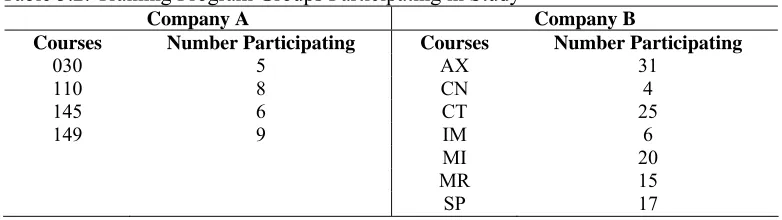
The target population for this study is service engineers (technicians) who are full-time employees, from two high-tech industries, that are responsible for
study, service engineers are responsible for the proper configuration, administration, and troubleshooting of the product’s software, hardware, network, and systems. Company A has 1,425 total employees in 30 countries, which includes approximately 500 service engineers. Company B has 9,000 total employees in 146 countries, which includes 4,500 service engineers.
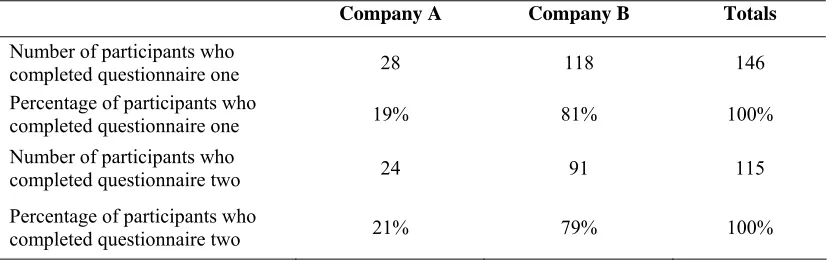
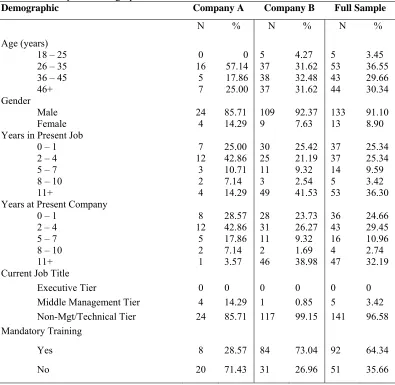
The single-stage, convenience sample was drawn from the population who consented to participate in this research. Participants were full-time employees of Company A and B, participated and completed an instructor-led, classroom-based technical training program (Babbie, 1990). Table 3.1 shows the first questionnaire was completed by 146 participants. Of the 146 participants, 28 (19%) participants were from Company A and 118 (81%) participants were from Company B. The recruitment letter and consent form are shown in Appendix A.
Table 3.1: Sample Sizes and Percentages
Company A Company B Totals
Number of participants who
completed questionnaire one 28 118 146
Percentage of participants who
completed questionnaire one 19% 81% 100%
Number of participants who
completed questionnaire two 24 91 115
Percentage of participants who