This is a peerreviewed, postprint (final draft postrefereeing) version of the following published document, © 2018 Elsevier Inc and is licensed under Creative Commons: AttributionNoncommercialNo Derivative Works 4.0 license: Hollamby, Joy, Taylor, Ian, Berragan, Elizabeth ORCID: 000000023345 6341, Taylor, Denise and Morgan, Justin (2018) Preparing students for safe practice using an interprofessional ward simulation. Journal of Interprofessional Education and Practice, 12. pp. 7882. ISSN 24054526 DOI: https://doi.org/10.1016/j.xjep.2018.06.002 EPrint URI: http://eprints.glos.ac.uk/id/eprint/5773 Disclaimer The University of Gloucestershire has obtained warranties from all depositors as to their title in the material deposited and as to their right to deposit such material. The University of Gloucestershire makes no representation or warranties of commercial utility, title, or fitness for a particular purpose or any other warranty, express or implied in respect of any material deposited. The University of Gloucestershire makes no representation that the use of the materials will not infringe any patent, copyright, trademark or other property or proprietary rights. The University of Gloucestershire accepts no liability for any infringement of intellectual property rights in any material deposited but will remove such material from public view pending investigation in the event of an allegation of any such infringement. PLEASE SCROLL DOWN FOR TEXT.
1
This article has been accepted for publication in the Journal of Interprofessional Education and Practice
Hollamby, Joy, Taylor, Ian, Berragan, Elizabeth, Taylor, Denise and Morgan, Justin (2018) Preparing students for safe practice using an interprofessional ward simulation. Journal of Interprofessional
Education and Practice, 12. pp. 78-82. ISSN 2405-4526
Preparing students for safe practice using an interprofessional ward simulation Abstract
We describe an interprofessional ward simulation for final year medical, nursing and pharmacy students, which has been rarely represented in current literature.
Objectives: Identify patient safety issues in a ward environment: Develop confidence in communicating with other healthcare professionals: Recognise the roles of other health care professionals: Prepare for future registered clinical practice.
The study comprised seven half day simulation sessions with a total of 92 participants. The simulation was evaluated using pre and post-session questionnaires combining Likert style and free text questions. 89 paired questionnaires were obtained and Likert responses were analysed using a two tailed t test, using a p value of 0.001. Free text answers were thematically analysed.
Both patient safety and interprofessional education are important components in health care education. We describe our simulation in detail and include an overview of the simulation and a case example.
Format
Interprofessional ward* simulation with classroom based student led debrief sessions. * ward refers to unit/unit of care
Target Audience
Educators of medical, nursing and pharmacy students.
Objectives
1. Identify patient safety issues in a ward environment
2. Develop confidence in communicating with other healthcare professionals 3. Recognise the roles of other health care professionals
2
Activity description
Each student attended for one half day session based at the University of the West of England. Each session accommodated a maximum of eighteen undergraduate students; six each from the disciplines of medicine, nursing and pharmacy. There were three faculty members present at each session, one from each discipline. Students received an introduction and orientation to the ward on arrival.
The medical students were in their fifth (final) year of study. The nursing students were in their third (final) year of study. The pharmacy students were either in their third or fourth (final) year. The length of the undergraduate course differs for medical, nursing and
pharmacy students therefore interprofessional education cannot be matched year to year. We aimed this session at students due to enter practice the following year. In order to recruit sufficient numbers of pharmacy students, some were recruited from the third year. The nursing and pharmacy students volunteered for the sessions following email invitation. The medical students attended as part of their timetable requirement.
Each half day session comprised three simulation sessions through which the students rotated. Initially six students, two each from medicine, nursing and pharmacy, were asked to take up their respective professional 'roles' within the ward. The paired medical and
pharmacy students received a verbal handover from a faculty member. They then entered the first simulation during which the medical/pharmacy students acted as one doctor/pharmacist, thereby moving to tasks together throughout. This was to enable the students to experience conflicting demands when prioritising tasks.
The nursing students were able to act independently during the simulation. This differed from the medical and pharmacy students. The simulation was designed to challenge participants and it was thought that as nursing students regularly act independently on the ward during training they would gain more benefit from the simulation this way.
The nursing students received a handover on the ward, from a faculty member acting as a ward sister. The handover style differed for the nursing students in order to reflect the handover they would typically receive at the start of an on-call shift. A joint handover with medical, nursing and pharmacy students could be given instead.
The remaining students were asked to step into 'patient' or 'relative' roles within the ward. Of the eight beds in the ward, two held high fidelity simulation manikins and one a low fidelity manikin. The remaining five beds contained simulated patients, played by students. All beds contained an instruction sheet describing the history required for that simulated
patient/relative(s), an example of which is provided. Patient notes and observation charts were available for each patient. The students reviewed their instructions whilst the others were receiving handover. During this preparatory period a facilitator was available to provide clarification.
The first simulation ran for twenty-five minutes during which the students in their professional roles completed the tasks handover to them. Events occurred during the
simulation which were planted through the pre-prepared patient histories. For example, in one patient history, the student was asked to 'fall' out of bed at some point during the simulation. Facilitators had an overview chart showing all patients, tasks and events, which would occur during each stage. An example of this is provided. Directly following the first simulation was a 20 minute debrief session.
3
A second set of six students then rotated into their respective professional roles on the ward and the previous six rotated into patient/relative roles. The simulation recommenced as though later in the same shift on the same ward. The handover provided between phases was adapted to reflect tasks completed during the preceding phase. The simulation ran for another 25 minutes and a second debrief followed. This was repeated a third time so that all students could take up their roles within the simulation.
Tasks planted in the simulations fell into three broad categories:
1. Communication tasks, for example a confused patient or an angry relative. 2. Practical tasks such as blood transfusion or medicine reconciliation. 3. Acute/emergency situations; e.g. anaphylaxis, upper gastrointestinal bleed.
Specific patient safety elements were embedded within the simulation, guided by the NHS England 'never events' list (NHSEngland 2015/6):
Incorrect blood for transfusion
Patient identification errors
Prescribing errors
Incorrectly placed naso-gastric tube
Confused/falling patients
Handover errors
The aim of the simulation was not to test performance of practical skills or specific knowledge but to incorporate tasks which required teamwork and communication. Any practical tasks were ‘performed’ with this in mind. Facilitators were available during the simulation to troubleshoot or direct students away from tasks which were not part of the learning objectives.
The debrief sessions were held in a different room in order to allow students to break out of their roles. The students were provided with a sheet to focus their ideas. This was based on the 'structural debriefing and reflection guide' (Gibbs, 1988). Questions posed by the facilitator(s) were intended to guide the students through the key learning outcomes. Examples include:
How did you find the simulation?
What did/didn't help?
Did you find anything difficult?
Assessment
Students completed paper pre and post-session questionnaires, which were paired for
analysis. Pre-session the students were asked to rate the following statements according to the Likert scale: 1=strongly disagree, 2=disagree, 3=neutral, 4=agree, 5=strongly agree.
1. I feel confident in prioritising ward tasks whilst on-call
2. I feel confident in communicating with healthcare professionals from a different background to my own
3. I understand the role of other healthcare professionals working in a ward environment 4. I have an understanding of patient safety issues and how these affect my clinical work
4
They were also asked to list three patient safety issues.
After the session the students were asked to rate the following statements according to the same Likert scale. "Learning with students from other health and social care professions in a simulated ward environment:
1. is likely to facilitate my subsequent working relationships
2. has improved my team-working skills more so than learning only with my peers 3. has improved my confidence in communicating with other healthcare professionals 4. has helped my understand better the roles of other healthcare professionals
5. has made me feel better prepared for starting work on a real ward 6. has been an effective way of learning about patient safety
7. has helped improve my awareness of patient safety issues in clinical practice" They were again asked to list three patient safety issues and answer the following question: As a result of today’s session are there any changes that you will make to your future practice?
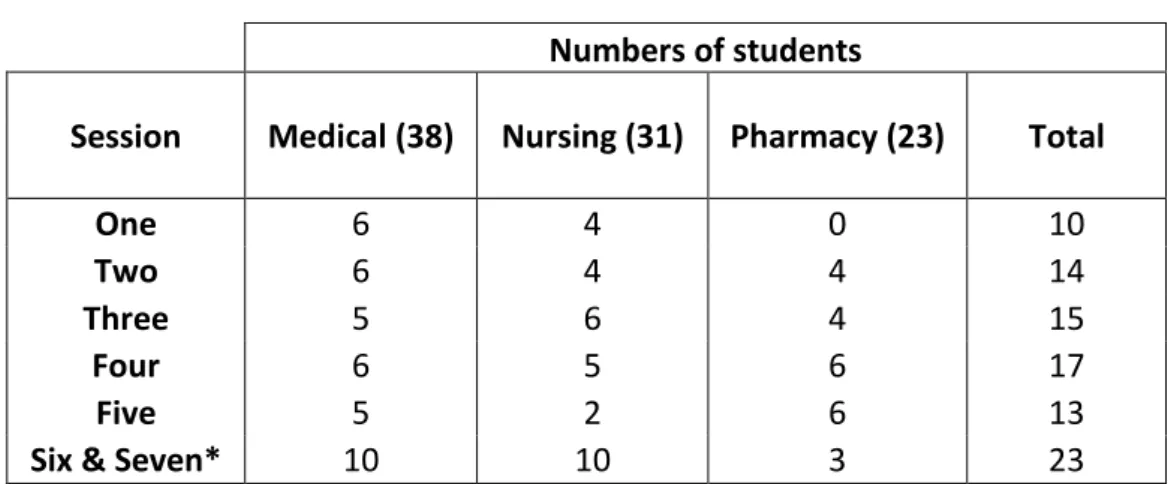
Table 1: The total number of participants for the seven sessions Numbers of students
Session Medical (38) Nursing (31) Pharmacy (23) Total
One 6 4 0 10
Two 6 4 4 14
Three 5 6 4 15
Four 6 5 6 17
Five 5 2 6 13
Six & Seven* 10 10 3 23
* the numbers for these session are combined as they occurred on the same date.
92 students participated in the sessions (Table 1). 89 students completed both a pre and post-session questionnaire. Three of the seven post-post-session questions were paired with pre-post-session questions. A two tailed t-test, using a p value of 0.001 (confidence level >99.0%), was used to determine whether there was a statistically significant change in response to the paired questions.
Assessment of learning objective one: Identify patient safety issues in a ward environment
This was assessed using questions 4 and 7 in the pre and post-session questionnaire
respectively. 88 answers were paired and the average response increased from 3.65 to 4.40. This was a statistically significant increase with a p value of <0.001 (confidence level > 99.9%).
5
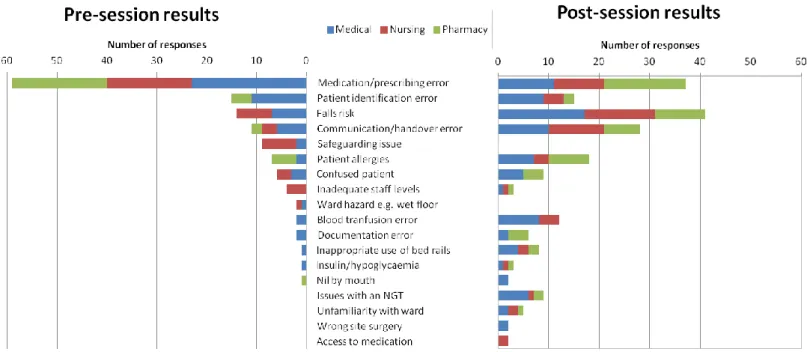
Figure 1. Patient safety issues cited in pre and post-session questionnaires
Figure 1 shows the patient safety issues cited by the students. Any issues which were not considered to be patient safety related were excluded from further analysis. The patient safety issues were then divided into categories. For example "patients with the same names" was coded under 'patient identification'. Of a possible 267 total responses (maximum 3 per student) 134 patient safety issues were listed pre-session whereas 200 were mentioned post session. This indicates an average increase of 1.5 to 2.2 per student.
Assessment of learning objective two: develop confidence in communicating with other healthcare professionals
This was assessed using questions 2 and 3 in the pre and post-session questionnaires
respectively. 87 answers were paired and the average response to this question increased from 3.56 to 4.47. This was a statistically significant increase with a p value of <0.001.
Assessment of learning objective three: recognise the roles of other healthcare professionals
This was assessed using questions 3 and 4 in the pre and post-session questionnaires
respectively. 88 answers were paired and the average response to this question increased from 3.72 to 4.53. This was a statistically significant increase with a p value of <0.001.
Assessment of learning objective four: prepare for registered clinical practice
Question 1 in the pre session questionnaire asked the students to rate how confident they felt prioritising ward tasks whilst on-call. 89 responses were obtained. The average response given was 2.87.
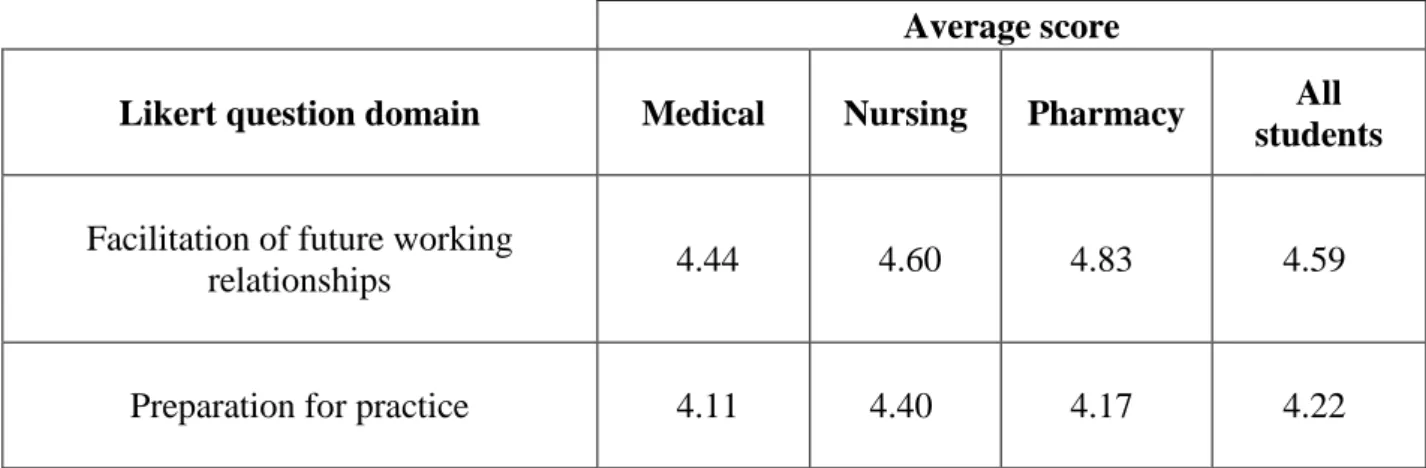
6 Table 2: Post-session Likert responses
Average score
Likert question domain Medical Nursing Pharmacy All
students
Facilitation of future working
relationships 4.44 4.60 4.83 4.59
Preparation for practice 4.11 4.40 4.17 4.22
The domains in table 2 cannot be directly compared with their responses to confidence in prioritising however the responses are more favourable following the session.
When asked "As a result of today’s session are there any changes that you will make to your future practice?" seventy seven of the ninety two participants left a comment. 30, 24, and 23 from medical, nursing and pharmacy students respectively. Comments were analysed in the same way as described previously. The learning themes identified are shown in Table 3. Table 3. Changes to future practice
Theme Example of student comment
Handover "Deliberate effort to handover with nurses at the beginning of the shift"
Board round "A mini brief with the doctors and nurses was very helpful before a ward round"
Knowledge of pharmacists role
"Yes, understanding pharmacists"
Empathy with patients
"Patient's point of view and making them feel at ease and remembered" and
"empathy with the patient experience" Involve patients
in decision making
"Take into account patient attitudes/family"
Improved communication (with nurses)
"No fear of communication to other health care professionals", "Improved liaison with nurses" and
"Communicate more with the nurses" Calling for help "Don't be afraid to ask for help" Delegation of
tasks
"Use delegation throughout practice as not to become overwhelmed"
Documentation "Be confident to write in notes and alert Drs of issues"
Abbreviations "Don't assume other professionals know the same abbreviations as us"
7
Evaluation
We have evaluated our simulation session using Kirpatrick's four level evaluation model (Kirpatrick, 2009).
Level 1.Reaction.
When asked whether they thought the session was an effective was to learn about patient safety. the students' average score, from 89 responses, was 4.35. Comments on the post-session questionnaire suggest that students enjoyed the post-session. For example "Thank you. Really useful and enjoyable session", "I'll be recommending it to everyone", "Ultimately fantastic. Thank you!!" and "I don't know why we don't do this from 1st/2nd year. I think it would prepare us so much better".
Level 2: Learning.
The three paired questions, which showed a statistically significant increase, suggests that the session did achieve objectives one, two and three. Written comments also support this
conclusion. For example
"Feel my confidence has grown"
"Have more confidence in my skills"
"I will now be a lot more confident in emergency situations and communicating with other professionals"
"Confidence in liaising with other professionals is much improved" Level 3: Behaviour.
We did not assess the behaviour of the students once students had returned to practice settings. This could be achieved through analysis of placement documentation and feedback from those mentoring each student group in practice.
Level 4: Organisational performance.
The organisations we refer to are universities. Each university sets course requirements based on guidance from governing bodies. The WHO and GMC have produced curriculum
specifying that students entering the workforce must be aware of patient safety issues (WHO, 2011, GMC, 2015). Students are also expected to work effectively within multi-professional teams and have an understanding of one another's roles in the workplace (GMC 2015, GPhC 2010, NMC 2015). Our session aims to help the students achieve these curriculum goals.
Impact
It has been reported that patient harm occurs in 10% of hospital admissions yet 50% of harmful incidents are thought to be preventable (WHO, 2017). There is literature reporting that interprofessional simulation could improve patient safety (Liaw, et al. 2014). Ward based interprofessional simulation with the objective of teaching patient safety does not appear to have been established in current literature. The students in our study demonstrated an
8
increase in awareness of patient safety issues. The session did appear to lead to increased learning around a specific topic only for those involved. For example no pharmacy students cited blood transfusion as a potential safety issue; they were not involved in this issue during the simulation. We suggest writers consider whether students will miss learning opportunities if they are not present for a task.
Student-led debriefs allowed the discussion to tend towards issues not envisaged by facilitators. Students clarified points to one another, such the prescribing limits for
pharmacists and differing views on the use of bedrails. Such discussions such are beneficial for the transfer of information and for encouraging interprofessional communication. Initial concerns that eighteen students would hinder student interaction in debriefs proved
unfounded provided they were adequately facilitated.
An unexpected benefit of the simulation was that students reported during debrief that they appreciated acting as patients and/or relatives. This was not formally assessed however some written comments provide further insight. Examples include "involve patients in decisions", "empathy with the patient experience" and "patient's point of view and making them feel at ease and remembered".
Although initial preparation includes writing the patient histories and actor instructions, folder contents and preparing medication, once prepared the session can be repeated any number of times. It can be scaled to accommodate varying numbers of students. Ward simulations in the literature have involved significantly fewer beds, for example only two (Muller-Juge et al. 2014) or three (Pucher, et al. 2013). Although this simulation could be run with fewer beds, we consider that a higher number increases fidelity. We had one faculty member present per six students however we believe this ratio could be decreased to one per nine students. Some ward simulations quote costs of £25 per hour per actor (Pucher et al. 2013). By using students instead the cost of running a ward simulation is reduced. Reviews of interprofessional education suggest that scheduling is the most frequently reported barrier to implementation (Abu-Rish, et al. 2012) and although we encountered some difficulties with timetabling these were overcome by early planning.
Required materials Simulated ward*
Three manikins: two high and one low fidelity*
One folder per patient containing patient history/extension sheets/observations/drug chart/investigations
Actor/student instruction sheets (example provided)
Overview of simulation (example provided)
Labelled medication
As required: gown/NG tube/inhaler/vomit bowl/fake blood etc
9
*A simulated ward could be created with appropriate space/furniture without requiring a dedicated resource. A control room would not be required should students/actors/low fidelity manikins replace the high fidelity manikins.
Conflicts of interest
The authors declare that there are no conflicts of interest.
Ethical approval was obtained through the University of the West of England Research Ethics committee. All students completed a consent form prior to their participation, which
explained the nature of the simulation, the voluntary basis to participation and the research aims. Students were able to withdraw at any time.
Funding
This research did not receive any specific grant from funding agencies in the public, commercial, or not-for-profit sectors.
Acknowledgements
Thank you to Dr Joanna Kennedy for allowing us to extend her pilot ward simulation run with medical and nursing students in 2015. Thank you to the additional simulation faculty staff of the University of the West of England for their assistance with the sessions. Thank you to all undergraduate participants for their enthusiasm and insightful contributions.
References
Abu-Rish E, Kim S, Choe L, Varpio L, Malik E, White AA, Craddick K, Blondon K, Robins L, Nagasawa P, et al. 2012. Current trends in interprofessional education of health sciences students: A literature review. Journal of Interprofessional Care. 26(6):444-451. Available from <Go to ISI>://WOS:000310077600003 doi 10.3109/13561820.2012.715604
Gibbs, G. 1988. Learning by doing.A guide to Teaching and Learning Methods. Available from http://gdn.glos.ac.uk/gibbs/index.htm
GMC. 2015. Outcomes for graduates (Tomorrow's Doctors). GPhC. 2010. Code of conduct for pharmacy students.
Kirpatrick, D. 1950. Available from https://www.kirkpatrickpartners.com/Our-Philosophy/The-Kirkpatrick-Model
Liaw SY, Zhou WT, Lau TC, Siau C, Chan SWC. 2014. An interprofessional communication training using simulation to enhance safe care for a deteriorating patient. Nurse Education Today. 34(2):259-264. Available from <Go to ISI>://WOS:000331347000018 doi
10.1016/j.nedt.2013.02.019
Muller-Juge V, Cullati S, Blondon KS, Hudelson P, Maitre F, Vu NV, Savoldelli GL, Nendaz MR. 2014. Interprofessional Collaboration between Residents and Nurses in General Internal Medicine: A Qualitative Study on Behaviours Enhancing Teamwork Quality. Plos One. 9(4). Available from <Go to ISI>://WOS:000336736600027 doi 10.1371/journal.pone.0096160
10 NHS England. 2015/6. Never Events List 2015/2016.
NMC. 2015. The Code: Professional standards of practice and behaviour for nurses and midwives.
Pucher PH, Darzi A, Aggarwal R. 2013. Simulation for ward processes of surgical care. American Journal of Surgery. 206(1):96-102. Available from <Go to
ISI>://WOS:000321510100015 doi 10.1016/j.amjsurg.2012.08.013
WHO. 2011. WHO patient safety curriculum guide: multi-professional edition.