ABSTRACT
LI, MINSHENG LIFE-CYCLE INVENTORY (LCI) DEVELOPMENT FOR A SOLID WASTE/COAL BLEND GASIFICATION SYSTEM FOR PRODUCTION OF POWER AND CHEMICALS (Under the Direction of Drs. Morton A. Barlaz and H. Chris Frey)
To make good estimates of pollution prevention, performance, and cost of potentially
promising new technologies, it is important to develop new assessment methodologies for
managing technological development and for evaluating technologies. The research
presented in this study is part of a larger effort to develop novel assessment methodologies
for evaluation of the risks and potential pay-offs of new technologies that minimize or
avoid pollutant production. The assessment methodology was demonstrated via a detailed
case study of one promising pollution prevention technology – gasification of municipal
solid waste (MSW), which was evaluated using a tiered approach including process
simulation and life-cycle analysis (LCA).
In this study, an overall life-cycle inventory (LCI) model was developed for calculation of
the LCI of the MSW/coal blend gasification system by combining the IGCC based
polygeneration model, the refuse derived fuel (RDF) process model, the landfill process
model, the conventional methanol process model, and the remanufacturing model.
Specially, the development of the RDF process model was part of this research. Also, an
existing LCI model was used for calculation of the LCI of the conventional mass burn
waste to energy (WTE) system based on the WTE process model.
The gasification system was evaluated in two cases: a landfill with energy recovery and a
landfill without energy recovery. Compared to a landfill without energy recovery, there is
an environmental performance improvement for landfill with energy recovery. However,
this improvement is negligible to the total LCI of the gasification system.
For both the gasification system and the WTE system, the emissions of most pollutants are
Compared to the WTE system, the gasification system has a better LCI for all the
pollutants including atmospheric emissions, waterborne emissions, and solid waste
emissions partly because more electricity was produced in the gasification system than the
WTE system. Another reason is due to the production of methanol in the gasification
system. The only exception is the BOD emissions, for which emissions associated with the
MSW residual disposal in the landfill has a large contribution to its total emissions.
As the methanol plant size increases, the total emissions of the gasification system keep
decreasing. Therefore, it is favorable for the gasification system to increase methanol
production.
In this study, the avoided emissions associated with the sulfur recovery in the gasification
were not included due to lack of data. Therefore, the total emissions of the gasification
system were overestimated. Also, the effect of ammonia production on the LCI of the
gasification system could not be evaluated in this study because the ammonia process
model was not combined with the MSW/coal gasification system.
PERSONAL BIOGRAPHY
Minsheng Li was born on January 13, 1977 in Jilin Province, P.R.China. Mr. Minsheng Li
graduated from Quanlin High School in Jilin Province, China in 1995. He attended
Tsinghua University, earning a Bachelor of Science degree in Environmental in July 2000.
In August 2000, he entered the Civil Engineering graduate program at North Carolina State
University. His graduate focus was in environmental engineering and his research areas
were in process modeling and Life-Cycle Inventory development. His graduate advisors
were Drs. Morton A. Barlaz and H. Christopher Frey. Mr. Li received a Master of Science
ACKNOWLEDGEMENTS
My sincere thanks to my advisors, Drs. H. Christopher Frey and Morton A. Barlaz, and
committee member, Dr. John W. Baugh Jr., for their instructions and help throughout my
graduate study at North Carolina State University. I would like to thank my project partner,
Chi Xie, who gave me help in studying ASPEN Plus and worked with me to calibrate the
IGCC model. I would also like to thank all of my friends at NC State University,
specifically Song, Jianjun, and Yunhua, who helped me get through the tough times.
Finally, I would like to express my deep gratitude to my parents, my sisters and my brother,
LIST OF CONTENTS
LIST OF TABLES ...vi
LIST OF FIGURES...x
1.0 INTRODUCTION ...1
2.0 OVERVIEW OF THE MSW GASIFICATION PROCESS AND THE LCI MODEL OF THE MSW/COAL BLENDS GASIFICATION SYSTEM ...3
2.1 Introduction to Life-Cycle Analysis ...5
2.2 Overview of Overall LCI Model of the MSW/Coal Blends System ...5
2.2.1 Overview of the IGCC Based Polygeneration System Model...7
2.2.2 Overview of Waste to Energy Model ...13
2.2.3 Overview of RDF Process Model ...14
2.2.4 Overview of the Landfill Model ...16
2.2.5 Overview of Transportation Model...18
2.2.6 Overview of Remanufacturing Model...18
3.0 CASE STUDIES ON THE APPLICATION OF GASIFICATION TECHNOLOGY TO MSW 19 3.1 Scenario Definition...19
3.2 Input Assumptions and Results of the Base Case...20
3.2.1 MSW Waste Composition ...20
3.2.2 Input Assumptions for the Base Case ...22
3.2.3 The LCI Model Results for the Base Case ...23
3.3 Sensitivity Analysis for the LCI Model ...33
3.3.1 Incoming MSW Compositions ...33
3.3.2 RDF Percentage in the MSW/Coal Blends...39
3.3.3 Purge Gas Recycle Ratio from the Methanol Plant...42
3.3.4 Saturation Level of the Fuel Gas to the Gas Turbines...44
4.0 COMPARISON OF MSW TREATMENT BY GASIFICATION AND CONVENTIONAL MASS BURN WASTER TO ENERGY ...46
4.1 Comparison Study on Scenario A ...46
4.1.1 LCI Results of the WTE system ...46
4.1.2 Comparison of Gasification and WTE Results...48
4.2 Comparison Study on Scenario B...51
4.2.1 LCI Results of the MSW/Coal Blends Gasification System ...51
4.3 Comparison Study on Scenario C...58
4.4 Summary of the Results for Scenario A, B, and C ...65
5.0 CONCLUSIONS AND RECOMMENDATIONS ...67
6.0 REFERENCES...69
APPENDIX A RDF PROCESS MODEL DOCUMENTATION...72
APPENDIX B LCI COEFFICIENTS FOR SUB MODELS OF GASIFICATION SYSTEM ....88
APPENDIX C CALIBRATION OF IGCC BASED POLYGENERATION MODEL...95
LIST OF TABLES
Table 2-1 Top 10 Commercial Gasification Projects (Simbeck, 2001)...8
Table 3-1 LFG Treatment in the First, Second, Third Treatment Periods in Case 1 & 2...20
Table 3-2 Waste Composition and Heating Value of Each MSW Component a...21
Table 3-3. Proximate and Ultimate Analysis of Pittsburgh No. 8 Coal, RDF, and RDF/coal blend ...22
Table 3-4. Input Assumptions for the IGCC System Firing the RDF/coal blenda...23
Table 3-5 Categorization of Waste Items with Respect to CO2 Emission Source ...24
Table 3-6 Selected Results of the IGCC System Model for the Base Case...25
Table 3-7 Material and Energy Flows Attributed to RDF of the MSW/Coal Blends Gasification System...26
Table 3-8 LCI Results of the MSW/Coal Blends Gasification System (Base Case / Landfill with no Energy Recovery)a,b (Lbs/day)...29
Table 3-9 LCI Results of the MSW/Coal Blends Gasification System (Base Case / Landfill with Energy Recovery)a,b (Lbs/day) ...31
Table 3-10 Comparison of Three Reported Waste Compositions (wet wt %)...34
Table 3-11 Comparison of Ultimate Analysis of Different MSWs...35
Table 3-12 Comparison of Ultimate Analysis of Different RDFs ...35
Table 3-13 Proximate Analysis and Ultimate Analysis of Each Component of Paper and Plastics* ...36
Table 3-14 Comparison of Three Waste Compositions Produced by Adjusting Paper to Plastic Ratio (wet wt %) ...37
Table 3-15 Proximate Analysis and Ultimate Analysis of the RDFs Produced from MSW with Varying Paper to Plastic Ratio...38
Table 3-16 Comparison Results of Gasification System Performance for Three MSWs...38
Table 3-17 LCI Results of Gasification System Firing Four Different RDF/Coal Blends (lb/ton MSW) ...39
Table 3-18 Proximate Analysis and Ultimate Analysis of Different RDF/Coal Blends for Different RDF Fractions ...40
Table 3-19 Comparison Results of Gasification System Performance for Three Fuels with Different RDF Percentage in the RDF/Coal Blends...41
Table 3-20 LCI Results of Gasification System Firing the RDF/Coal Blends with Different RDF Percentage (lb/ton MSW) ...42
Table 3-21 Comparison of Results of Gasification System Performance with Different Purge Gas Recycle Ratio from the Methanol Plant...43
Level of Fuel Gas to Gas Turbine ...44
Table 3-24 LCI Results of Gasification System with Different Saturation Level of the Fuel Gas to Gas Turbines (lb/ ton MSW)...45
Table 4-1 LCI Results of the WTE System in Scenario A (Lbs/day)a...47
Table 4-2 Comparison Results between Gasification System and WTE System for Scenario A (Lbs/day)...50
Table 4-3 Material and Energy Flows Attributed to RDF of the MSW/Coal Blends Gasification System for Scenario B ...51
Table 4-4 LCI Results of the MSW/Coal Blends Gasification System (Lbs/day) (Scenario B / Landfill with no Energy Recovery) ...52
Table 4-5 LCI Results of the MSW/Coal Blends Gasification System (Lbs/day) (Scenario B / Landfill with Energy Recovery)...54
Table 4-6 LCI Results of the WTE System in Scenario B (Lbs/day)...56
Table 4-7 LCI Comparison Results between Gasification System and WTE System (Scenario B)...57
Table 4-8 Material and Energy Flows of the MSW/Coal Blends Gasification System (Scenario C)...58
Table 4-9 LCI Results of the MSW/Coal Blends Gasification System (Lbs/day) (Scenario C / Landfill with no Energy Recovery) ...59
Table 4-10 LCI Results of the MSW/Coal Blends Gasification System (Lbs/day) (Scenario C / Landfill with Energy Recovery)...61
Table 4-11 LCI Results of the WTE System in Scenario C (Lbs/day)...63
Table 4-12 LCI Comparison Results between Gasification System and WTE System(Scenario C)...64
Table 4-13 Comparison of the LCI of the Gasification System (Landfill with Energy Recovery) of Scenario A, B, and C ...65
Table A.1 Table of Default Value Used in Energy Calculation ...85
Table A.2 Calculation for Air Classifier Electricity Consumption ...86
Table A.3 Pollutant Species of LCI ...87
Table B-1 Offset LCI Coefficients for Methanol Using Conventional Processa (lb pollutant / lb methanol produced) ...88
Table B-2 LCI Coefficients for the RDF Plants (lb pollutant / Ton MSW processed)...89
Table B-3 LCI Coefficients for the Traditional Landfills without Energy Recovery (lb pollutant / Ton MSW processed)...90
Table B-4 LCI Coefficients for the Traditional Landfills with Energy Recovery (lb pollutant / Ton MSW processed)...91
Table B-7 Recycled Ferrous and Aluminum Transportation Associated LCI Coefficients for the RDF Plant and the WTE Plant (lb pollutant/ton Fe/Al) ...93 Table B-8 Offset LCI Coefficients for Recycled Ferrous and Aluminum ... (lb
pollutant/ton MSW) 94
Table C.1 Proximate Analysis and Ultimate Analysis of Four Fuels...98 Table C.4 Comparison between IGCC without methanol and with 1 lb/hr methanol for Pittsburgh NO. 8 coal* ... 102 Table C.5 Input Assumptions for IGCC Model Firing Pittsburgh #8 Coal w/ Methanol... 103 Table C.6.1 Pickett's results and reproduced results for Pittsburgh # 8 coal with 10k LB/HR Methanol... 104 Table C.6.2 Pickett's results and reproduced results for Pittsburgh # 8 coal with 20k LB/HR
Methanol... 105 Table C.6.3 Pickett's results and reproduced results for Pittsburgh # 8 coal with 40k LB/HR
Methanol... 106 Table C.7 Proximate and Ultimate Analysis of the RDF/coal blend and German waste ... 107 Table C.8 Recalibrated Input Assumptions for IGCC Model Firing German Waste, the RDF/Coal Blend, and American Waste w/ Methanol... 108 Table C.9 Crude Syngas Composition Comparison: German Waste V.S. Lurgi Data ... 110 Table C.10 Crude Syngas Composition Comparison: German Waste V.S. RDF/Coal Blends
... 110 Table C.11 Comparison of IGCC Model Results Firing RDF/coal Blends and German Waste
with 10,000 lb/hr Methanol Production... 111 Table C.12 Model Results Firing German Waste with 10k, 20k, and 40k Methanol Production
and with Recalibrated Input Assumptions ... 114 Table C.13 Model Results Firing American Waste with 10k, 20k, and 40k Methanol
Production and with Recalibrated Input Assumptions ... 115 Table D.1.1 LCI Results of Gasification System Firing MSWa0.2~1.5 with a Landfill without
LIST OF FIGURES
Figure 2-1 Simplified Process Flow Diagram of the MSW Gasification Process ...4
Figure 2-2 Simplified Structure of the Overall LCI Model...6
Figure 2-3 Simplified Schematic of Gasification Island of IGCC System...10
Figure 2-4 Simplified Schematic of Power Island of IGCC System ...12
Figure 2-5 Process Flow Diagram for Refuse Derived Fuel Production ...15
Figure 2-6 RDF Process Model Calculation Sequence ...17
Figure A.1 Process Flow Diagram for Refuse Derived Fuel Production ...73
Figure A.2 RDF Process Model Calculation Sequence ...75
Figure C.1 Syngas Calibration Curves for Reaction: C + H2O = CO + H2 (Endothermic).. 110
Figure C.2 Syngas Calibration Curves for Reaction: C + 2 H2 = CH4 (Exothermic)... 110
Figure C.3 Syngas Calibration Curves for Reaction: C + CO2 = 2CO (Exothermic) ... 110
1.0 INTRODUCTION
Technology development is an iterative process involving decisions regarding
which research paths to pursue based upon current results and assessment of competing
technologies and market needs (Frey and Barlaz, 2001). Due to limited data during
research, development, and demonstration (RD&D), there is significant variability and
uncertainty that may result in misleading estimates of pollution prevention, performance,
and the cost of potentially promising new technologies. With a limited pool of funds
available to support RD&D, it is important to develop new methods for managing
technological development and for evaluating technologies. The research presented in this
study is part of a larger effort to develop novel assessment methodologies for evaluation of
the risks and potential pay-offs of new technologies that minimize or avoid pollutant
production. The assessment methodology was demonstrated via a detailed case study of
one promising pollution prevention technology – gasification of municipal solid waste
(MSW), which was evaluated using a tiered approach including process simulation and
life-cycle analysis (LCA).
Two alternatives for the thermal processing of MSW are incineration and
gasification. Due to recently demonstrated benefits of gasification over incineration,
gasification technology is receiving significant attention (Simbeck
et al.
, 1983; Stiegel,
2000). However, at present, MSW gasification is a relatively new concept. There are
several research projects investigating the process. The only commercially demonstrated
IGCC system firing solid waste is the Lurgi Schwarze/Pumpe plant in Germany (Pickett,
2000). To evaluate the risks and potential pay-offs of MSW gasification, a systematic
approach for assessment must be explored. Models must be developed to characterize its
performance and environmental emissions, so that it can be compared to other MSW
treatment alternatives including the most common thermal treatment alternative, mass burn
combustion with energy recovery or waste-to-energy (WTE).
The objective of this study is to develop a model to calculate the life-cycle
Specific objectives are:
1) To develop a process model for a refuse derived fuel (RDF) plant to calculate energy requirements and environmental emissions.
2) To combine the RDF process model with a previously developed model for an integrated gasification combined cycle (IGCC) system, a landfill process model, electrical energy production, and recyclables remanufacturing into an overall model for calculation of the LCI of the MSW gasification process.
3) To perform sensitivity analyses on the LCI model to identify the key parameters affecting the LCI of the MSW gasification process.
4) To compare the LCI of a process utilizing MSW gasification to that of a process in which MSW is burned in a WTE.
Chapter 2 provides an overview of each component of the overall LCI model. In
addition, the RDF process model that was developed as part of the research is documented
in detail. Chapter 3 describes the results of a case study of MSW gasification and the
results of sensitivity analyses on the overall LCI model. The LCI calculation for the
conventional MSW combustion process, and a comparison between the LCI of the MSW
gasification process and that of the conventional MSW combustion process are presented
in Chapter 4. Finally, conclusions and recommendations for future work are presented in
2.0 OVERVIEW OF THE MSW GASIFICATION PROCESS AND THE LCI
MODEL OF THE MSW/COAL BLENDS GASIFICATION SYSTEM
The objective of this chapter is to describe the various sub-models that were used to
conduct a complete LCI of MSW gasification, including models that were developed in
previous research as well as models developed in the research described in this thesis. To
evaluate the environmental performance of the MSW gasification process, the MSW/coal
blends gasification system is defined to incorporate all aspects of the treatment process,
including the production of RDF required for gasification, the IGCC process, the liquid
phase methanol (LPMEOH) process, landfill burial of residuals from both RDF production
and MSW/coal gasification, and the beneficial reuse of recyclables recovered during RDF
production, henceforth referred to as remanufacturing. A simplified schematic of the
overall system as modeled in this study is presented in Figure 2-1. Initially, MSW must be
processed to separate it into high and low heating value streams. This step occurs in what
is referred to as a RDF plant. The high heating value stream, referred to as RDF, is used to
feed the IGCC system as a fuel; the low heating value stream is assumed to be disposed of
in a landfill. Recyclable ferrous and aluminum are recovered at a RDF plant and recycled
in the remanufacturing plants. The RDF is mixed with coal and the blend is fed into the
IGCC system. In the IGCC based polygeneration system, the RDF/coal blend is converted
into synthesis gas (syngas) which is then used to produce energy, methanol, and ammonia.
For a detailed description of the IGCC system model, methanol production from syngas
and ammonia production the user is referred to Pickett (2000), Vaswani (2000), and Xie
(2001), respectively.
The following section presents an introduction to LCA methodology, followed by
Syngas
Methanol
MSW
Gasification
Island
MSW
Processing
Al
Fe
Ammonia
Synthesis
Methanol
Synthesis
Power
Island
Ammonia
Electricity
Emissions
(NOx, CO, SO2, PM, HC)
Steam
Coal
Air
Sulfur
Tail Gas
(CO2)Landfill
N
2Slag
RDF
Low BTU
Materials
Electricity
Material Stream; Electricity Stream; Steam Stream;
(CO, CO2, CH4, CH4O)
2.1 Introduction to Life-Cycle Analysis
LCA is an objective process to evaluate the environmental burdens associated with
a product, process, or activity by identifying and quantifying energy and materials use and
wastes released to the environment, and to evaluate and implement opportunities to effect
environmental improvements (SETAC Code of Practice, 1991). A LCI represents a
compilation of a specific set of inputs and outputs associated with a product or process. A
complete life-cycle study consists of three complementary components: (1) inventory
analysis, which is a compilation of all material and energy requirements associated with
each stage of product manufacture, use and disposal; (2) impact analysis, a process in
which the effects of the inventory on the environment are assessed; and (3) improvement
analysis, which is aimed at reducing the impact of a product or process on the environment
(Pistikopulos
et al.
, 1994).
2.2 Overview of Overall LCI Model of the MSW/Coal Blends System
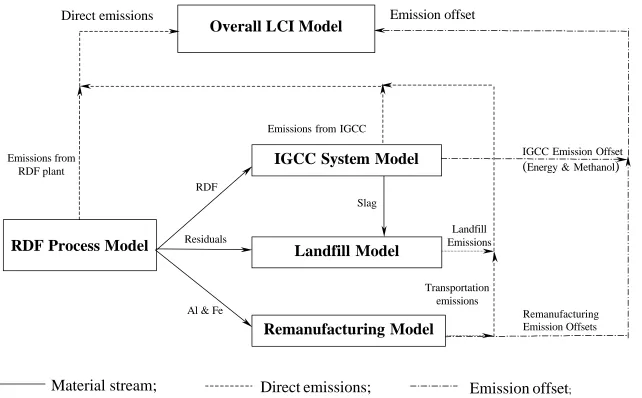
As illustrated in Figure 2-2, the overall LCI model is comprised of multiple
sub-models, including the RDF process model, the IGCC system model, the landfill model,
and the remanufacturing model. An ammonia process model was developed by Xie, 2000.
However, it has not been integrated with the entire system. Therefore, the effect of the
ammonia production on the LCI of the gasification system can not be estimated in this
study.
The essential feature of LCI methodology is an attempt to thoroughly consider all
aspects of a process. In the context of gasification of MSW, the LCI methodology requires
that in addition to an inventory of the direct emissions associated with the RDF plant, the
transportation from the RDF to the remanufacturing plant, the IGCC system, the traditional
landfill, and the ash landfill, an inventory of the avoided emissions is also included. This
accounts for the avoided emissions associated with the recovery of recyclable materials
(ferrous and aluminum), and the production of methanol, electricity, ammonia and sulfur
from syngas. An offset analysis was used to capture the benefit of recyclables recovery,
Overall LCI Model
RDF
Process
Model
IGCC
System
Model
Landfill
Model
Remanufacturing
Model
Residuals Emissions from
RDF plant
RDF
Al & Fe
EmissionsfromIGCC
Landfill Emissions
Direct emissions
Emission offset
IGCCEmissionOffset
(
Energy& Methanol)
Material stream;
Direct
emissions;
Emission
offset
;Transportation emissions Slag
aluminum is converted to a new product, there are emissions associated with the
manufacturing process. There are also emissions that are avoided because the aluminum
product is not produced from virgin materials. In an offset analysis, the emissions from the
virgin process are subtracted from the emissions from the recycle process and the net value
is added to the overall system LCI. This net value is a negative number if the recovery
process is beneficial. The overall LCI model integrates all the sub models and calculates
the LCI of the direct emissions and the avoided emissions for the entire MSW/coal blends
gasification process.
2.2.1 Overview of the IGCC Based Polygeneration System Model
Gasification is a technology that has been widely used in commercial applications
for over 40 years in the production of fuels and chemicals. Current trends in the chemical
manufacturing and petroleum refinery industries indicate that use of gasification facilities
to produce syngas will continue to increase (Orr, et. al, 2000). Attractive features of the
technology include: 1) the ability to produce a consistent, high quality syngas product
composed primarily of carbon monoxide and hydrogen, which can be used as a fuel to
generate electricity, steam and/or used as a basic chemical building block in the
petrochemical and refining industries; and 2) the ability to accommodate a wide variety of
gaseous, liquid, and solid feedstocks. Gasification regained attention in 1970’s due to the
energy crisis in the US at that time.
An IGCC system is one system that utilizes gasification technology to produce
power. It replaces the traditional coal combustor with a gasifier and gas turbine. Exhaust
heat from the gas turbine is used to produce steam for a conventional steam turbine, thus
the gas turbine and steam turbine operate in a combined cycle. The IGCC configuration
provides high system efficiencies and ultra-low pollution levels compared to conventional
power generation systems (Orr
et. al
, 2000). In addition to electricity, the syngas produced
in a gasification plant can also be used to produce industrial feedstocks including methanol,
IGCC equivalent. (Simbeck, 2001). In Table 2-1, the top 10 commercial gasification
projects are presented.
Table 2-1 Top 10 Commercial Gasification Projects (Simbeck, 2001)
Plants
Location Gasifiers MW syngas Year
Feedstock/Products
Sasol-
Π
S. Africa Lurgi
5,090
1977
Coal/F-T liquids
Sasol-Ø
S. Africa Lurgi
5,090
1982
Coal/F-T liquids
Confidential*
USA
Texaco
2,761
2006
Coal/Electric
Port Authur*
USA
E-Gas
2,029
2005
Coal/Electric
Dakota
USA
Lurgi
1,900
1984
Lignite/SNG
Repsol*
Spain
Texaco
1,654
2005
Residue/Electric
Lake Charles* USA
Texaco
1,407
2005
Coke/Electric
Deer Park*
USA
Texaco
1,400
2006
Coke/Electric
Eagle Energy* USA
Texaco
1,367
2005
Coke/Electric
SARLUX
Italy
Texaco
1,217
2001
Residue/Electric
* Planned
2.2.1.1 Introduction to ASPEN PLUS Software
In this study, the gasification process is simulated as an IGCC system model by
using a chemical software, ASPEN (Advanced Systems for Process Engineering) PLUS.
ASPEN PLUS is a chemical process simulation software that enables users to design and
simulate a process. ASPEN PLUS can estimate material and energy balances, phase and
equilibrium, physical properties of chemical compounds and even the capital cost of
equipment. With users’ inputs, reliable thermodynamic data, realistic operating conditions,
and rigorous equipment models, it can model, control, optimize and manage a steady-state
chemical process (ASPEN Tech 2000). ASPEN PLUS 10.1-0, which runs on Windows 98
platform and incorporates a Graphic User Interface (GUI), was employed to develop and
implement the IGCC model.
2.2.1.2 Overview of the IGCC System Model
The IGCC system model, which calculates mass and energy balances for the entire
IGCC system, was developed by Pickett (2000) and Vaswani (2000). In this study, this
model was calibrated to the MSW/coal blends as described in Appendix C. The model
auxiliary power requirements for each process area and for supporting facilities are also
modeled.
The gasification island consists of the gasification area, the gas cooling/cleaning
and liquor separation area, and the sulfur recovery area. In the gasification island, clean
syngas is produced and then used as the feedstock to produce energy in the power island or
to produce chemicals such as methanol and ammonia. A simplified schematic of the
gasification island is illustrated in Figure 2-3.
The gasification area is based on a British Gas/Lurgi (BGL) slagging gasifier. As
modeled, the fuel in the gasification area is first converted to a form that can be processed
by ASPEN PLUS. Then the hydrocarbons that enter the combustion zone are generated
from the carbon, hydrogen, and oxygen. In this process, some carbon and sulfur are taken
out of the fuel and are added to the slag. In the combustion zone, carbon and oxygen are
partially combusted and the resulting products enter the gasifier for gasification. The crude
syngas generated in the gasifier is then separated from ash and CaO and enter the gas
cooling area.
To simulate the gasification of solid materials such as MSW in ASPEN PLUS, an
ultimate analysis, a proximate analysis, and the sulfur content must be specified. For RDF,
these values were calculated in the RDF process model which is described in section 2.2.3.
For coal, these values were obtained from the literature (Pechtl
et al.
, 1992).
Crude syngas is then cooled before it enters the gas cleaning area. The gas cooling
section is highly integrated with the rest of the IGCC system. Water used to cool the syngas
is from the fuel gas saturation area and steam cycle.
The gas cleaning section utilizes the Rectisol® cleaning process to remove sulfur
and other contaminants from the syngas. The Rectisol® cleaning unit separates the cooled
syngas into a clean gas, an acid gas, a naphtha rich gas, a condensate and a CO
2rich gas.
The gas liquor separation area separates the combustible hydrocarbons from water
Figure 2-3 Simplified Schematic of Gasification Island of IGCC System
Gasifier
Gas
Cooling/Cleanin
g
Acid Gas
Separator
Air Separation
Plant
RDF
Coal
Electricity
Emissions
(
H2S
)
N
2O
2Claus Plant
Tail Gas
Treatment
Liquor
Separation
Slag
Steam
Combustible Hydrocarbons
Sulfur
Material Stream; Electricity Stream
in the process condensate are separated and recycled to the gasifier. While the other stream
containing the gases dissolved in the liquor proceeds to the Beavon-Stretford tail-gas
treatment process. The remaining liquid is split for use in the quench units in the
gasification area and gas cooling section.
The sulfur recovery section consists of a Claus plant and a Beavon-Stretford tail gas
treatment plant. In the Claus plant, sulfur is recovered from H
2S while a tail gas of SO
2is
also generated. The tail gas is further treated in the Beavon-Stretford tail gas treatment
plant to recover sulfur from SO
2.
After the removal of impurities and sulfur containing compounds, the syngas enters
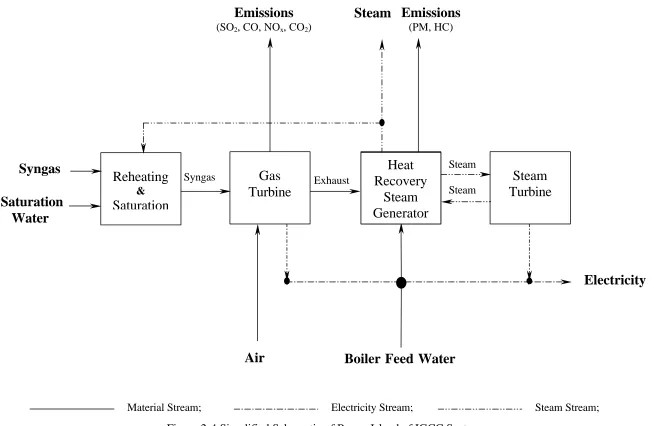
the saturation area. In the power island, the clean syngas is saturated with water to reduce
NO
xemissions and increase power output from the gas turbine. After saturation in the fuel
gas saturation area, the outlet stream is advanced to gas turbine. The heat of the exit gas
from the gas turbines is recovered as steam. A simplified schematic of power island is
illustrated in Figure 2-4.
The gas turbines modeled for the IGCC system represent a heavy-duty “F” class
system, similar to a General Electric MS7001F. The default assumed IGCC plant size
includes two gas turbines in parallel (Pickett, 2000). The gas turbine consists of three
sections; compression, combustion and expansion. The compression section pressurizes
and heats air. Cooling air is extracted from the compression section to cool the expander
blades and rotors with air, thereby prolonging the life of the expanders. The fuel, along
with compressed air, is introduced to the combustion section. After combustion, the hot,
compressed exhaust gas expands to generate electrical energy.
The steam cycle consists of two sections: the heat recovery steam generator
(HRSG) and the steam turbine. The HRSG cools the exit gas from the gas turbine and
recovers the sensible heat in steam production. Liquid water enters the steam cycle process
area to generate high-pressure, intermediate-pressure, and low-pressure steam. There are
four HEATER blocks in HRSG to cool the exhaust gas of the gas turbine and to provide
Figure 2-4 Simplified Schematic of Power Island of IGCC System
Material Stream; Electricity Stream; Steam Stream;
Boiler
Feed
Water
Electricity
Steam
Reheating
&Saturation
Syngas
Emissions
(PM, HC)Syngas Exhaust
Steam
Turbine
SteamSteam
Saturation
Water
Gas
Turbine
Air
Emissions
(SO2, CO, NOx, CO2)Heat
Recovery
There are three stages in the steam turbine. The super-heated, high-pressure steam
enters the first stage of the steam turbine. Its pressure is reduced in the first stage and then it
mixes with the intermediate-pressure steam. The mixture advances to the second stage of
the steam turbine. The outlet stream is mixed with low-pressure steam and the mixture
enters the final stage of the steam turbine.
2.2.1.3 Overview of Liquid Phase Methanol Process and Conventional Methanol
Production Model
A Liquid Phase Methanol Process (LPMEOH
TM) model was developed and
integrated with the IGCC model (Vaswami 2000, Pickett, 2000). The LPMEOH
TMmodel
simulates the production of methanol from syngas produced by the MSW/coal blends
gasification. In addition to syngas, the steam produced during gasification is used in
methanol production. The process model consists of twenty-six unit operation blocks, four
FORTRAN blocks and four design-specs (Vaswani 2000).
To calculate the offset LCI of the methanol produced by the gasification system, a
model for calculation of the LCI of the methanol produced using conventional technology
was required. This model was also developed by Vaswani (2000). It was modeled based on
conventional feedstock (natural gas). Coefficients were calculated from mass and energy
balance as well as consideration of overall energy requirements. The offset LCI
coefficients for the conventional methanol process are presented in Table B-1.
2.2.2 Overview of Waste to Energy Model
The objective of the waste-to-energy process model is to calculate the cost and LCI
for a MSW WTE facility. A detailed description of the WTE-LCI model has been
presented previously (Harrison et al. 2000). In this study, the LCI portion of the
waste-to-energy model was used to calculate the LCI associated with MSW combustion.
LCI parameters are calculated on the basis of both user input and default design
information. Model results are based on both the quantity and composition of the waste
combustion. For SO
x, NO
x, CO and particulate matter, emissions were calculated from
information on regulatory requirements for MSW combustion. In addition, the direct
emissions associated with the transportation from the WTE facility to the remanufacturing
plant were calculated. The WTE-LCI model also computes the avoided emissions due to
energy recovered by MSW combustion. Avoided emissions were calculated by assuming
that any energy recovered offsets the use of natural gas and coal (Harrison et al., 2000). In
this study, the fuel mix of the Southeastern Electric Reliability Council (SERC) was used.
2.2.3 Overview of RDF Process Model
The objective of the RDF process model is to calculate the energy consumption and
LCI parameters for converting MSW into a fuel that is used to produce syngas by
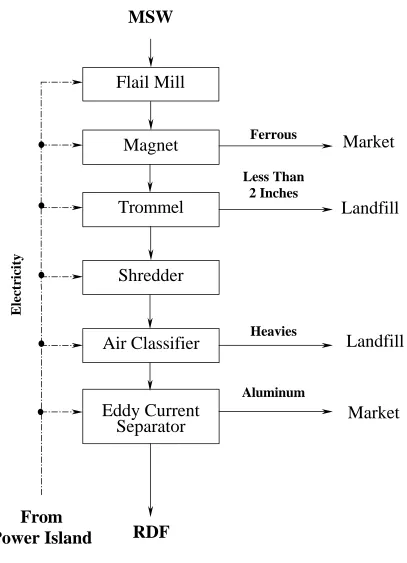
gasification. The conceptual design of the RDF model is illustrated in Figure 2-5. A
detailed description of the RDF process model with all equations is presented in Appendix
A and an overview of the model is presented below. All input default values are also
presented in Appendix A.
In the modeled RDF facility, refuse that is received either loose or in bags is loaded
onto a conveyor and fed to a flail mill. The flail mill opens any unopened bags and reduces
the size of some of the refuse. From the flail mill, the refused passes under a magnet that
recovers ferrous metal. The remaining refuse then continues to a trommel for removal of
material less than 2 inches in diameter. The trommel removes materials like broken glass,
dirt, and some food waste, all of which have a low energy value. From the trommel, refuse
is shredded and then routed to an air classifier that separates the “lights”, considered to
have the high BTU content, from the “heavies”, which have a relatively low BTU content.
The “lights” then flow to an eddy current separator for aluminum removal. The material
Electricity
MSW
Magnet
Trommel
Shredder
Air Classifier
Ferrous
Less Than
2 Inches
Heavies
Landfill
Flail Mill
From
Power Island
Landfill
Market
Eddy Current
Separator
Aluminum
Market
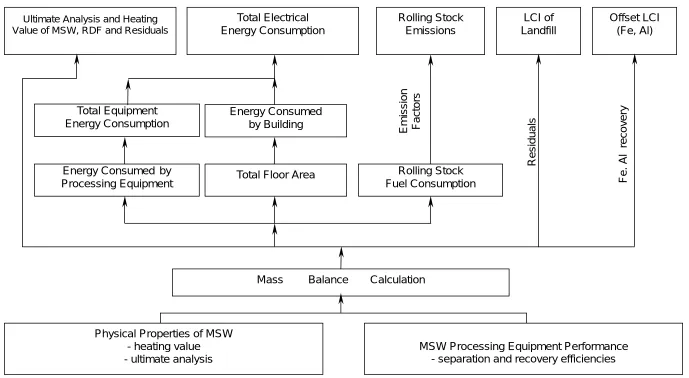
The calculation sequence for the RDF process model is illustrated in Figure 2-6.
The quantity and composition of materials flowing through the RDF plant, including the
RDF stream, the residual stream, and the recovered ferrous and aluminum, are calculated
through mass balance equations based on assumed separation efficiencies at each step.
Energy is consumed in the production of RDF both by processing equipment such as the
shredder and by rolling stock. Thus, both diesel fuel and electrical energy are consumed.
For each type of energy, both combustion energy and precombusiton energy is considered.
Combustion energy is the energy consumed directly (diesel or electricity), while
precombustion energy is the energy that is required to produce the combustion energy. The
ultimate analysis of RDF is a required input to the IGCC model and is calculated based on
the ultimate analysis of each MSW component and a mass balance through the RDF plant.
The LCI associated with the RDF process contains three parts: diesel combustion in rolling
stock; pre-combustion emissions associated with diesel production; and emissions
associated with electrical consumption. The benefits associated with the recovered
aluminum and ferrous are calculated in the remanufacturing process model.
The LCI coefficients for the RDF process model are presented in Table B-2.
2.2.4 Overview of the Landfill Model
The objective of the landfill process model is to calculate the cost and LCI for a
landfill. The landfill process model is a sub-model of the ISWM model. Only the LCI
results were used for this study.
In the RDF production process, the low heating value materials that are referred to
as residuals are managed in a traditional landfill. The landfill process model was used to
evaluate two scenarios, a landfill with or without energy recovery. For the landfill with
energy recovery, energy was recovered by the conversion of methane to electrical energy
in a turbine.
Avoided emissions associated with electrical energy production were handled
as for the WTE-LCI model. In this study, the fuel mix of the SERC was used, which is the
Mass Balance Calculation Energy Consumed by
Processing Equipment
Rolling Stock Fuel Consumption Total Floor Area
Total Equipment Energy Consumption
Energy Consumed by Building Total Electrical Energy Consumption
Offset LCI (Fe, Al)
Physical Properties of MSW - heating value - ultimate analysis
Ultimate Analysis and Heating Value of MSW, RDF and Residuals
Rolling Stock Emissions
LCI of Landfill
Emission Factors
Residuals
Fe. Al recovery
MSW Processing Equipment Performance - separation and recovery efficiencies
it is managed in an ash landfill. There are environmental emissions associated with the
landfill treatment of the residuals and slag.
The landfill process model simulates landfill operation based on default design
information and user inputs. In this study, the LCI coefficients of the traditional and ash
landfill are used to compute the environmental burdens for the disposal of the MSW
residuals and the slag from the IGCC system. A detailed description of the landfill process
model is presented in Sich (1999). The LCI coefficients for the traditional landfill
with/without energy and the coefficients for the ash landfill are presented in Table B-3, B-4
and B-5, respectively.
2.2.5 Overview of Transportation Model
The objective of the transportation model is to calculate the LCI coefficients for
transporting the recovered ferrous and aluminum from the recovery units such as the RDF
plant to the remanufacturing plants. The transportation model is a sub-model of the ISWM
model. In this study, it was used to calculate the recovered ferrous and aluminum
transportation associated emissions from both the RDF plant and the WTE plant to the
remanufacturing plant. The assumed distances to the remanufacturing plant and the
transportation associated LCI coefficients for the RDF plant and the WTE plant are
presented in Table B-6, and Table B-7, respectively.
2.2.6 Overview of Remanufacturing Model
The objective of the remanufacturing model is to calculate emission offsets
associated with the recovery of recycled aluminum and ferrous. The remanufacturing
model is a sub-model of the ISWM model. One ton ferrous or aluminum can be produced
either by virgin material or by recycled material. If virgin material is used to produce one
ton ferrous or aluminum, there are energy consumption and environmental emissions
associated with the processes of mining, combustion, and transportation, which will be
avoided if recycled materials are used. Therefore, there exist offset LCIs when ferrous and
aluminum are recovered for remanufacturing. The offset is calculated as the difference in
emissions between the manufacturing processes based on virgin and recycled materials.
3.0 CASE STUDIES ON THE APPLICATION OF GASIFICATION
TECHNOLOGY TO MSW
This chapter presents the results of case studies on the application of gasification
technology to MSW. Three scenarios were defined to analyze the gasification system. In
addition to the results for these scenarios, sensitivity analyses were conducted on the LCI
model based on the base case.
3.1 Scenario Definition
Three scenarios were designed to evaluate the LCI of MSW gasification. The IGCC
plant size was varied in each scenario by varying methanol production. The size of the
methanol production plant was set at 10,000, 20,000 and 40,000 lb/hr in scenarios A, B and
C, respectively. In each scenario, the size of the two gas turbines modeled in the IGCC
system model is constant.
For each scenario, a series of model runs was made to determine (1) material usage,
material production, energy production, and the emissions associated with the RDF/coal
blends, (2) the material usage, the material production, the energy production and the
emissions that could be attributed to RDF production and (3) the environmental burdens
associated with the application of gasification technology to MSW. For each of the three
scenarios, two cases are considered. In case 1, the MSW residual is disposed in a traditional
landfill with no energy recovery. In case 2, the MSW residual is disposed in a traditional
landfill with electrical energy recovery. The landfill gas (LFG) is treated differently in
these two cases, as listed in Table 3-1.
As developed, the IGCC model allows for calculation of the LCI for the MSW/coal
blend. However, it was necessary to separate out the fraction of the LCI that was
attributable to MSW. This is because in Chapter 4, the LCI of MSW gasification is
compared to that of WTE that processes MSW without coal. The allocation technique is
Table 3-1 LFG Treatment in the First, Second, Third Treatment Periods in Case 1 & 2
Landfill Gas Treatment Methods
Case 1 (%)
Case 2 (%)
Year 1 - 5
Vent 100 100Flare 100 0
Year 6 - 40
Turbine 0 100
Flare 100 0
Year 41 - 80
Turbine 0 100
3.2 Input Assumptions and Results of the Base Case
The calculation sequence for the LCI model is as follows.
1. Use the RDF process model to compute the proximate analysis, ultimate
analysis and the heating value of the RDF based on the user specified MSW
composition and physical properties.
2. Use the IGCC system model to compute the material usage, material
production, and energy production with a specified RDF/coal blend and
methanol plant size.
3. Use the RDF process model, the IGCC model, the landfill model, the electricity
model, the remanufacturing model and the conventional methanol production
model to compute the total LCI of the MSW/coal blends system.
In the base case, the RDF/coal blend is specified on the weight average with 25%
Pittsburgh #8 coal and 75% RDF. The methanol plant size is set to produce 10,000 lb
methanol /hr.
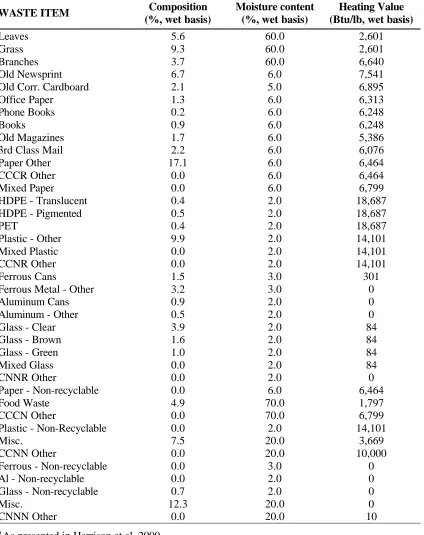
3.2.1 MSW Waste Composition
The MSW waste stream used in the base case is characterized by 39 waste
Table 3-2 Waste Composition and Heating Value of Each MSW Component
aWASTE ITEM Composition
(%, wet basis)
Moisture content (%, wet basis)
Heating Value (Btu/lb, wet basis)
Leaves 5.6 60.0 2,601
Grass 9.3 60.0 2,601
Branches 3.7 60.0 6,640
Old Newsprint 6.7 6.0 7,541
Old Corr. Cardboard 2.1 5.0 6,895
Office Paper 1.3 6.0 6,313
Phone Books 0.2 6.0 6,248
Books 0.9 6.0 6,248
Old Magazines 1.7 6.0 5,386
3rd Class Mail 2.2 6.0 6,076
Paper Other 17.1 6.0 6,464
CCCR Other 0.0 6.0 6,464
Mixed Paper 0.0 6.0 6,799
HDPE - Translucent 0.4 2.0 18,687
HDPE - Pigmented 0.5 2.0 18,687
PET 0.4 2.0 18,687
Plastic - Other 9.9 2.0 14,101
Mixed Plastic 0.0 2.0 14,101
CCNR Other 0.0 2.0 14,101
Ferrous Cans 1.5 3.0 301
Ferrous Metal - Other 3.2 3.0 0
Aluminum Cans 0.9 2.0 0
Aluminum - Other 0.5 2.0 0
Glass - Clear 3.9 2.0 84
Glass - Brown 1.6 2.0 84
Glass - Green 1.0 2.0 84
Mixed Glass 0.0 2.0 84
CNNR Other 0.0 2.0 0
Paper - Non-recyclable 0.0 6.0 6,464
Food Waste 4.9 70.0 1,797
CCCN Other 0.0 70.0 6,799
Plastic - Non-Recyclable 0.0 2.0 14,101
Misc. 7.5 20.0 3,669
CCNN Other 0.0 20.0 10,000
Ferrous - Non-recyclable 0.0 3.0 0
Al - Non-recyclable 0.0 2.0 0
Glass - Non-recyclable 0.7 2.0 0
Misc. 12.3 20.0 0
CNNN Other 0.0 20.0 10
a
3.2.2 Input Assumptions for the Base Case
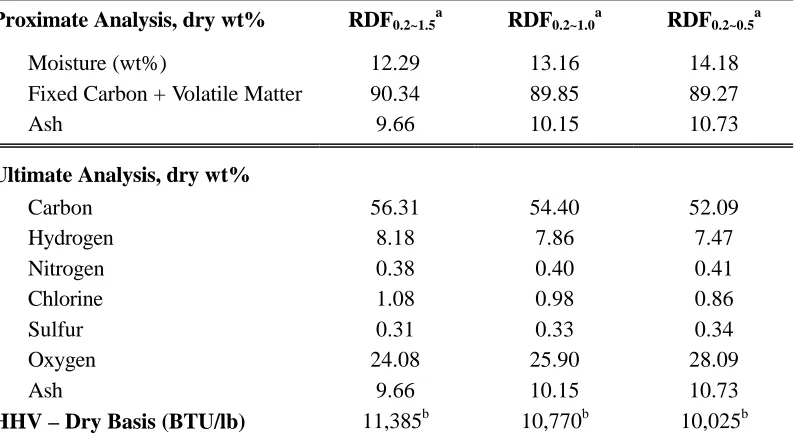
Table 3-3 provides the proximate analysis, ultimate analysis, and the higher heating
value of the RDF/coal blend that will be fed into the IGCC system. They are the weighted
average of 25% Pittsburgh #8 coal and 75% RDF. The data for RDF was computed in the
RDF process model based on the MSW specified in Table 3-2. The heating value for the
RDF/coal blends used in this study was calculated by Dulong correlation equation instead
of by the RDF process model to account for the uncertainty and variability in the RDF
process model inputs and parameters.
Table 3-3. Proximate and Ultimate Analysis of Pittsburgh No. 8 Coal, RDF, and RDF/coal
blend
Proximate Analysis, dry wt% Pittsburgh No. 8
aRDF RDF/coal blend
bMoisture (wt %) 6.00 14.42 13.32
FC & VMc 87.77 86.54 86.87
Ash 12.23 13.46 13.13 Ultimate Analysis, dry wt%
Carbon 73.21 46.96 53.99 Hydrogen 4.94 6.39 6.00 Nitrogen 1.38 0.58 0.79 Chlorine 0.00 1.19 0.87 Sulfur 3.39 0.41 1.21 Oxygen 4.85 31.01 24.00 Ash 12.23 13.46 13.13
HHV – Dry Basis (BTU/lb) 13,138 9,658
d9,738
da
Pechtl et al., 1992
b
The RDF/coal blend is comprised of 25% of Pittsburgh #8 coal and 75% of RDF
cFC – Fixed Carbon and VM – Volatile Matter
dHHV calculated from the ultimate analysis using the Dulong correlation
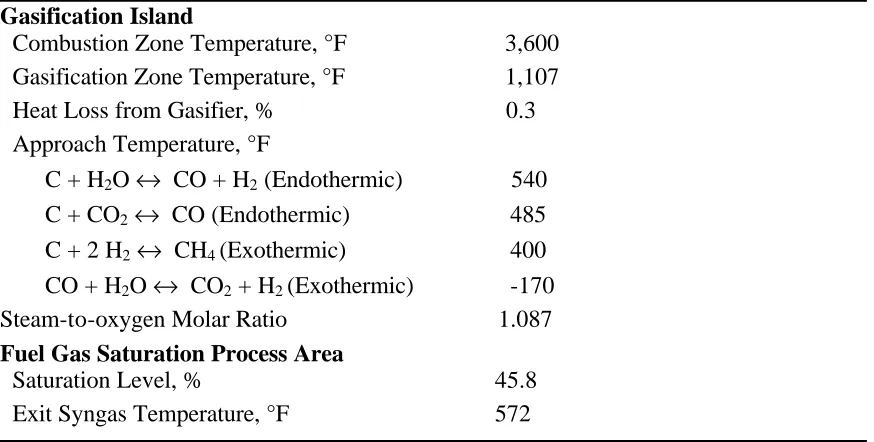
The input assumptions for the IGCC system firing the MSW/coal blends are
presented in Table 3-4. The input assumptions were developed based on a review of design
and performance parameters obtained from the literatures (Pickett, 2000). A detailed
Table 3-4. Input Assumptions for the IGCC System Firing the RDF/coal blend
aGasification Island
Combustion Zone Temperature, °F 3,600
Gasification Zone Temperature, °F 1,107
Heat Loss from Gasifier, % 0.3
Approach Temperature, °F
C + H
2O
↔
CO + H
2(Endothermic) 540
C + CO
2↔
CO (Endothermic) 485
C + 2 H
2↔
CH
4(Exothermic) 400
CO + H
2O
↔
CO
2+ H
2(Exothermic) -170
Steam-to-oxygen Molar Ratio 1.087
Fuel Gas Saturation Process Area
Saturation Level, % 45.8
Exit Syngas Temperature, °F 572
a – The input assumptions for the IGCC system firing RDF/coal blends were calibrated in Appendix C.
3.2.3 The LCI Model Results for the Base Case
3.2.3.1 The Results of the IGCC Based Polygeneration System Model
After specifying the input RDF/coal blend and the input assumptions for the IGCC
system, the IGCC model is used to compute data for the LCI calculation of the MSW/coal
gasification system, including total material usage, total material production, total power
production, and total emissions from IGCC system when firing RDF/coal blends and
producing 10,000 lb/hr methanol. The contribution of the RDF to the total material flows,
energy flows, and emissions is also computed. The contribution of the RDF was
calculated based on the contribution of the RDF to the total energy input, except two cases:
1) The contribution of the RDF to the fuel, which is calculated based on the weight
percentage of RDF and coal; 2) The contribution of the RDF to the ash and sulfur, which is
calculated based on the ratio of the ash and sulfur content in the RDF to the ash and sulfur
content in the RDF/coal blends. The calculation is given by Equation 3-1. The basis for this
calculation is that material production, energy production, and emissions are related to the
Where:
MRDF -- Contribution factor for RDF for material usage, material production, energy production, and emissions (Lb/hr or kWh/hr)
MTotal -- Total material usage, material production, energy production, and emissions (Lb/hr or kWh/hr)
E_inputRDF -- Contribution of RDF to the total energy input. E_inputRDF = 75% x Fuel_Input x HHVwet of RDF E_inputTotal -- Total energy input
E_inputTotal = Fuel_Input x (75% x HHV wet
of RDF + 25% x HHVwet of coal) HHVwet – Higher heating value on wet basis
For the LCI, CO
2is categorized into fossil CO
2and biomass CO
2. However, the
IGCC system model only calculates the sum of these two types of CO
2. Therefore, the CO
2emission must be categorized. This was done based on Table 3-5.
Table 3-5 Categorization of Waste Items with Respect to CO
2Emission Source
Waste Item Biomass CO2 Fossil CO2
Leaves X
Grass X
Branches X
Old Newsprint X
Old Corr. Cardboard X
Office Paper X
Phone Books X
Books X
Old Magazines X
3rd Class Mail X
Paper Other X
CCCR Other X
Mixed Paper X
HDPE - Translucent X
HDPE - Pigmented X
PET X
Plastic - Other X
Mixed Plastic X
CCNR Other X
Ferrous Cans X
Ferrous Metal - Other X
Aluminum Cans X
1)
-3
(Eqn
input
_
E
input
_
E
M
M
Total RDF Total(Continued)
Waste Item Biomass CO2 Fossil CO2
Aluminum - Other X
Glass - Clear X
Glass - Brown X
Glass - Green X
Mixed Glass X
CNNR Other X
Paper - Non-recyclable X
Food Waste X
CCCN Other X
Plastic - Non-Recyclable X
Misc. X
CCNN Other X
Ferrous - Non-recyclable X
Al - Non-recyclable X
Glass - Non-recyclable X
Misc. X
CNNN Other X
Selected results of the IGCC system model that will be used for calculation of the
LCI for the gasification system for the base case are summarized in Table 3-6, including
fuel, methanol, sulfur, slag, and power flow rate and emissions from the IGCC system.
Table 3-6 Selected Results of the IGCC System Model for the Base Case
RDF/coal blend Contribution of RDF Material
Methanol (lb/hr) 10,000 6,354
Fuel (lb/hr) 481,969 361,476
Sulfur (lb/hr) 5,164 2,292
Slag (lb/hr) 69,862 61,442
Power
Power to Grid (MW) 452.6 287.6
Emissions
SO2 (lb/hr) 9.40E-01 7.17E-03
CO2 (Biomass) (lb/hr) 4.21E+05 3.21E+03
CO2 (Fossil) (lb/hr) 3.17E+05 2.42E+03
NOx (lb/hr) 388.5 2.96E+00
3.2.3.2 Material and Energy Flows of the MSW/Coal Blends Gasification System
Based on the RDF demand calculated in section 3.2.3.1, the MSW demand to the
gasification system for the base case, and the MSW residual produced, the ferrous &
aluminum recovered and the power consumed associated with such amount of MSW are
calculated by using the RDF process model. Hence, the material and energy flows for
calculation of the LCI of the gasification system for the base case are calculated and
summarized in Table 3-7.
Table 3-7 Material and Energy Flows Attributed to RDF of the MSW/Coal Blends
Gasification System
MSW Input (Ton/day) 7,776
RDF Produced (Ton/day) 4,338
MSW Residual (Ton/day) 3,012
Fe Recovered (Ton/day) 329
Al Recovered (Ton/day) 98
Slag from IGCC (Ton/day) 737
Sulfur Produced (Ton/day) 28
Methanol Produced (Ton/day) 76
Power Consumed in RDF Plant (MWh/day) 391
Net Power from IGCC (MWh/day) 6902
These material and energy flows provide the basis for calculation of the LCI of the
MSW/coal gasification system. The MSW feed rate will determine emissions from the
RDF plant; the MSW residual is assumed to be buried in a traditional landfill and results in
emissions from disposal; the slag from IGCC assumed to be buried in an ash landfill and
results in emissions from disposal; the power consumption in RDF plants is subtracted
from the power produced in the IGCC system, which results in the net power production of
the overall system. There are avoided emissions associated with the methanol production,
sulfur production, ferrous and aluminum recovered, and net power production of the
gasification system. The avoided emissions associated with the sulfur production are not
overestimate of emissions since the emissions avoided from conventional sulfur
production are not subtracted.
3.2.3.3 The LCI Results of the MSW/Coal Blends Gasification System (Base Case)
The results of the overall LCI for an MSW gasification system for the base case are
presented in Tables 3-8 and 3-9 for a landfill with and without energy recovery,
respectively.
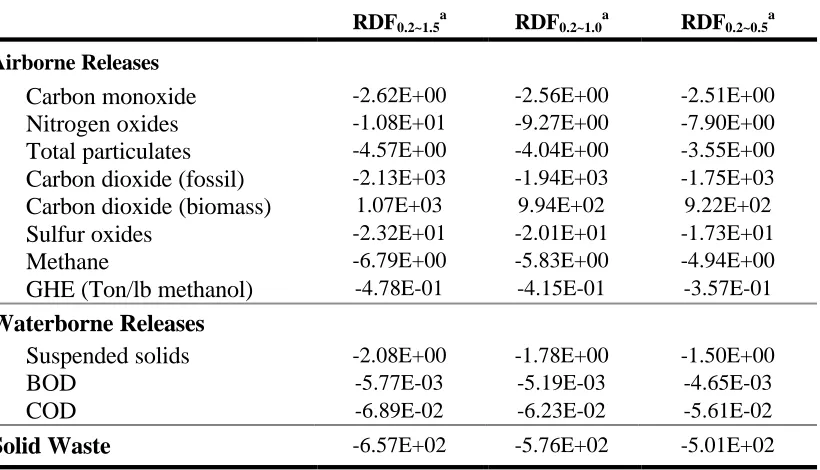
In both cases, for all the pollutants including atmospheric, waterborne and solid
waste emissions, the total emissions are negative, with the exception of biomass CO
2and
BOD. The reason is that the emission offsets of the electricity, the aluminum and the
ferrous make the largest contribution to the total emissions of the gasification system LCI.
While for Biomass CO
2, the largest contributor to its emission is the direction emissions
from the IGCC based polygeneration system. For BOD, the largest contributor to its
emission is the direction emissions associated with the MSW disposal in the landfill. The
reason is due to the lechate release from the landfill. A lechate collection system efficiency
of 99% was assumed for the landfill process model so that 1% of lechate generated is also
released to the environment directly. Both treated and untreated lechate releases are
included in the landfill emissions presented in Tables 3-8 and 3-9.
The emissions in Case 2 are less than those in Case 1 because in case 2 the LFG
from traditional landfill is converted to energy and there are avoided emissions associated
with the recovered energy. However, the difference between landfill with and without
energy recovery is negligible to the total emissions. This is partly due to largest contributor
to the total emissions of most pollutants is the offset emissions associated with the
electricity, aluminum and ferrous, instead of the direction emissions from the landfill.
Another reason is due to the fact that paper is the largest biodegradable component of
MSW and paper is in the RDF used for gasification, and not in the residual stream.
Because the emission offsets of sulfur are not considered, the total emissions of the
One assumption was made for the offset emissions associated with the methanol
production that the biomass CO
2emission is zero because in conventional methanol plants,
Table 3-8 LCI Results of the MSW/Coal Blends Gasification System (Base Case / Landfill with no Energy Recovery)
a,b(Lbs/day)
Coal Precomb.
IGCC Plant
RDF Plant
Traditional Landfill
Ash Landfill
Electricity Offset
Methanol
OffsetC Transportd
(Al + Fe)
Offset Total
Airborne Releases
Carbon monoxide 1.30E+02 3.23E+03 2.83E+02 1.23E+02 1.84E+01 -3.87E+03 -1.15E+03 1.77E+02 -1.80E+04 -1.91E+04 Nitrogen oxides 1.66E+02 5.92E+03 4.40E+02 1.95E+01 5.43E+01 -5.12E+04 -5.43E+02 1.79E+02 -6.30E+03 -5.13E+04 Total particulates 1.85E+03 3.60E+02 4.87E+01 1.37E+01 4.99E+00 -1.75E+04 -8.42E+01 2.58E+01 -8.63E+03 -2.39E+04 Carbon dioxide (fossil fuel) 2.94E+04 4.81E+06 7.09E+03 1.06E+03 3.88E+03 -1.36E+07 -2.39E+05 2.09E+04 -2.75E+06 -1.17E+07 Carbon dioxide (biomass fuel) 2.17E+02 6.46E+06 7.15E+04 1.21E+05 9.15E-01 -1.92E+03 0.00E+00 5.00E+00 0.00E+00 6.65E+06
Sulfur oxides 1.66E+02 1.43E+01 1.03E+02 5.12E+00 9.24E+00 -9.05E+04 -5.60E+03 5.08E+01 -1.78E+04 -1.14E+05 Hydrocarbons 6.15E+01 3.12E+02 2.02E+02 3.06E+00 1.39E+01 -2.63E+03 N/A 7.21E+01 -3.21E+03 N/A
Methane 3.39E+03 N/A 1.09E+01 1.06E+03 6.88E-01 -3.00E+04 -1.35E+03 3.32E+00 -3.76E+03 -3.06E+04 Lead 1.95E-03 N/A 3.78E-04 1.50E-05 2.10E-05 -5.84E-01 N/A 1.15E-04 4.04E-01 N/A Ammonia 6.29E-02 N/A 1.08E-01 2.41E-03 6.00E-03 -1.14E+01 N/A 3.28E-02 -6.45E+00 N/A Hydrochloric acid 7.95E-01 N/A 6.75E-02 1.59E+00 4.64E-03 -1.10E+03 N/A 2.05E-02 -3.87E+02 N/A
GHEe (Tons/day) 1.37E+01 N/A 9.98E-01 3.18E+00 5.31E-01 -1.94E+03 -3.65E+01 2.86E+00 -3.86E+02 -2.34E+03
Waterborne Releases
Dissolved Solids 5.93E+01 N/A 9.39E+01 1.41E+00 5.22E+00 -1.15E+04 N/A 2.85E+01 -9.47E+03 N/A Suspended solids 1.02E+03 N/A 2.13E+00 1.98E-01 2.09E-01 -9.56E+03 -5.14E+01 6.48E-01 -1.03E+03 -9.62E+03 Bio-chemical Oxygen Demand 8.68E-02 N/A 3.51E-01 3.41E+01 3.98E-02 -1.14E+01 -7.47E+00 1.07E-01 -1.41E+01 1.69E+00
(Continued)
Coal Precomb.
IGCC Plants
RDF Plant
Traditional Landfill
Ash Landfill
Electricity Offset
Methanol
OffsetC Transportd
(Al + Fe)
Offset Total
Cadmium 2.60E-03 N/A 3.51E-03 5.86E-05 1.95E-04 -5.22E-01 N/A 1.07E-03 -4.02E-01 N/A Arsenic 0.00E+00 N/A 0.00E+00 2.10E-05 0.00E+00 0.00E+00 N/A 0.00E+00 0.00E+00 N/A Mercury 2.02E-07 N/A 2.64E-07 2.97E-07 1.47E-08 -4.10E-05 N/A 8.03E-08 -3.60E-04 N/A Phosphate 8.68E-02 N/A 9.44E-03 7.95E-03 5.25E-04 -6.76E+01 N/A 2.87E-03 -3.79E+00 N/A Selenium 0.00E+00 N/A 0.00E+00 6.79E-06 0.00E+00 0.00E+00 N/A 0.00E+00 0.00E+00 N/A Chromium 2.60E-03 N/A 3.51E-03 1.13E-04 1.95E-04 -5.22E-01 N/A 1.07E-03 -4.02E-01 N/A Lead 4.12E-06 N/A 4.05E-05 9.76E-06 2.25E-06 -3.86E-05 N/A 1.23E-05 -2.08E-03 N/A Zinc 9.40E-04 N/A 1.75E-03 2.58E-05 9.75E-05 -1.79E-01 N/A 5.33E-04 -1.45E-01 N/A
Solid Waste 2.49E+05 N/A 3.59E+02 1.83E+02 2.79E+01 -2.60E+06 -2.91E+04 1.09E+02 -9.53E+05 -3.33E+06 a
The term “N/A” means that data for that item are not available.
b
Based on material flows given in Table 3-7.
c
This is offset from net energy production from IGCC based polygeneration system after subtracting the RDF plant demand.
d
LCI associated with the transportation from RDF plants to remanufacturing plants
Table 3-9 LCI Results of the MSW/Coal Blends Gasification System (Base Case / Landfill with Energy Recovery)
a,b(Lbs/day)
Coal Precomb.
IGCC Plant
RDF Plant
Traditional Landfill
Ash Landfill
Electricity Offset
Methanol
OffsetC Transportd
(Al + Fe)
Offset Total
Airborne Releases
Carbon monoxide 1.30E+02 3.23E+03 2.83E+02 3.90E+01 1.84E+01 -3.87E+03 -1.15E+03 1.77E+02 -1.80E+04 -1.91E+04 Nitrogen oxides 1.66E+02 5.92E+03 4.40E+02 2.32E+00 5.43E+01 -5.12E+04 -5.43E+02 1.79E+02 -6.30E+03 -5.13E+04 Total particulates 1.85E+03 3.60E+02 4.87E+01 -1.11E+01 4.99E+00 -1.75E+04 -8.42E+01 2.58E+01 -8.63E+03 -2.39E+04 Carbon dioxide (fossil fuel) 2.94E+04 4.81E+06 7.09E+03 -5.42E+03 3.88E+03 -1.36E+07 -2.39E+05 2.09E+04 -2.75E+06 -1.18E+07 Carbon dioxide (biomass fuel) 2.17E+02 6.46E+06 7.15E+04 3.37E+05 9.15E-01 -1.92E+03 0.00E+00 5.00E+00 0.00E+00 6.87E+06 Sulfur oxides 1.66E+02 1.43E+01 1.03E+02 -3.79E+01 9.24E+00 -9.05E+04 -5.60E+03 5.08E+01 -1.78E+04 -1.14E+05 Hydrocarbons 6.15E+01 3.12E+02 2.02E+02 1.81E+00 1.39E+01 -2.63E+03 N/A 7.21E+01 -3.21E+03 N/A
Methane 3.39E+03 N/A 1.09E+01 1.05E+03 6.88E-01 -3.00E+04 -1.35E+03 3.32E+00 -3.76E+03 -3.06E+04 Lead 1.95E-03 N/A 3.78E-04 -2.63E-04 2.10E-05 -5.84E-01 N/A 1.15E-04 4.04E-01 N/A Ammonia 6.29E-02 N/A 1.08E-01 -3.03E-03 6.00E-03 -1.14E+01 N/A 3.28E-02 -6.45E+00 N/A Hydrochloric acid 7.95E-01 N/A 6.75E-02 1.10E+00 4.64E-03 -1.10E+03 N/A 2.05E-02 -3.87E+02 N/A
GHEe (Tons/day) 1.37E+01 N/A 9.98E-01 2.26E+00 5.31E-01 -1.94E+03 -3.65E+01 2.86E+00 -3.86E+02 -2.35E+03
Waterborne Releases
Dissolved Solids 5.93E+01 N/A 9.39E+01 -4.08E+00 5.22E+00 -1.15E+04 N/A 2.85E+01 -9.47E+03 N/A Suspended solids 1.02E+03 N/A 2.13E+00 -4.35E+00 2.09E-01 -9.56E+03 -5.14E+01 6.48E-01 -1.03E+03 -9.63E+03 Bio-chemical Oxygen Demand 8.68E-02 N/A 3.51E-01 3.41E+01 3.98E-02 -1.14E+01 -7.47E+00 1.07E-01 -1.41E+01 1.69E+00 Chemical Oxygen Demand 9.40E-01 N/A 2.35E+00 9.47E+01 2.75E+01 -1.62E+02 -5.31E+01 7.13E-01 -2.13E+02 -3.02E+02