Analysis Selection Formwork Systems of
Building Project Using AHP and Smart
Methods
Eben Ezer Sihombing1, Resmi Bestari Muin2, B.P. Kusumo Bintoro2
Master Program in Civil Engineering, University of Mercu Buana, Jakarta1
Department of Civil Engineering, University of Mercu Buana, Jakarta2
ABSTRACT: In the work of reinforced concrete structures, the material and equipment needed to facilitate the work process is needed especially in the formwork work. Therefore required a method to selection of materials and equipment effective and efficient. The decision-making process is basically choosing a best alternative. The methods that can be used in decision making are Simple Multi Attributes Rating Technique (SMART) and Analytic Hierarchy Process (AHP). Both are methods by taking many criteria as the basis of decision making.
The purpose of this study was to compare two types of formwork namely conventional formwork and table form system on the work of beams and floor plates using AHP method and SMART method, so that the best formwork alternative was obtained. This research uses quantitative method, which data obtained from questionnaires and project data. The following criteria are cost, job schedule, quality, and human resources. Result of calculation analysis using SMART method got final weight for conventional formwork alternative equal to 0,16 and for alternative formwork table form that is equal to 0,84. While the results of analysis using AHP weights obtained comparison of the use of conventional forming that is equal to 0.460 and for alternative formwork table form that is equal to 0,540. Both methods show alternatives that meet the criteria to be chosen ie formwork table table system.
KEYWORDS: Formwork, Decision making, SMART, AHP
I. INTRODUCTION
Formwork is an auxiliary tool for printing concrete with the size, shape or position and the desired alignment (Muis, 2013). The allocation of a good formwork will determine the effective use of the equipment. The problem is very interesting from the point of view of engineering and implementation management to discuss the allocation of type of formwork so that it can assist the executor in solving one of the real problems that occurred in the handling of the project. Generally reinforced concrete work using conventional formwork type. However, at this time has been developed a different formwork system that is the table form system. the needs of materials and equipment used to facilitate the process of work is needed by the executor of the construction, therefore required a method of pemiihan material and equipment effective and efficient.
II. THEORY
Decision-making
Decision (decision) literally means choice. The choice here is a choice of two or more possibilities, or it can be said to be a decision reached after consideration by choosing one possible choice (Gito Sudarmo, 2000).
SMART method
Simple Multi Attribute Rating Technique (SMART) is a multi-criteria decision-making method developed by Edward in 1977. This multi-criteria decision-making technique is based on the theory that each alternative consists of a number of criteria that have values and each criterion has a weight describes how important he is compared to other criteria. This weighting is used to assess each alternative in order to obtain the best alternative.
AHP Method
Analytic Hierarchy Process AHP is one of the models for decision making that can help the framework of human thinking. This AHP method was developed around 1970 by Thomas L. Sabaat (Faizal, 2012). The AHP method is a decision making technique that incorporates double criteria both real and unreal, quantitative or qualitative which takes into account the differences of opinion.
Formwork
According to Alfalah (2013) Formwork or formwork is a temporary construction on the execution of concrete work that serves to form the concrete in accordance with the size and place of its position or can also be called a construction that is a mold or mall.
1. Conventional System
Conventional system formwork is usually used one-time use. The materials used may be organic, artificial, and / or combined material. The depreciation of this type of formwork is very high, as the volume of material is wasted in the manufacturing process and requires considerable volume of labor and experience.
2. Table FormSystem
III. METHODOLOGY
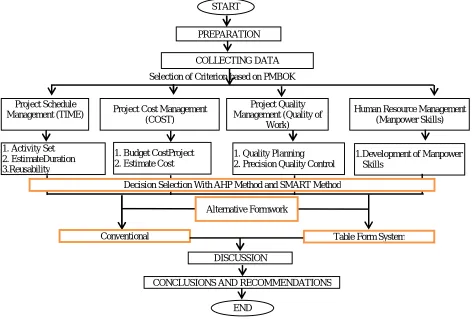
The research method that is done is a quantitative method. In general, the implementation of this research is illustrated in the following picture Flowchart.
Figure 1. Flowchart Research Methodology
Data collection technique
The data collection procedure that will be used in this research is by doing questionnaires to 30 staffs who work on the project flats Pemda DKI Jakarta.The questionnaire is aimed at determining the priority comparison of each criterion where the value is determined as follows.
Tabel 1: Scale assessment of the relative importance (Saaty, 1988)
Inportance Definition
PREPARATION
COLLECTING DATA START
Human Resource Management (Manpower Skills) Project Quality
Management (Quality of Work)
Project Schedule
Management (TIME) Project Cost Management (COST)
1. Activity Set 2. EstimateDuration 3.Reusability
1.Development of Manpower Skills
1. Budget CostProject 2. Estimate Cost
1. Quality Planning 2. Precision Quality Control
Alternative Formwork
Decision Selection With AHP Method and SMART Method Selection of Criterion based on PMBOK
DISCUSSION
CONCLUSIONS AND RECOMMENDATIONS
END
AHP and SMART Method
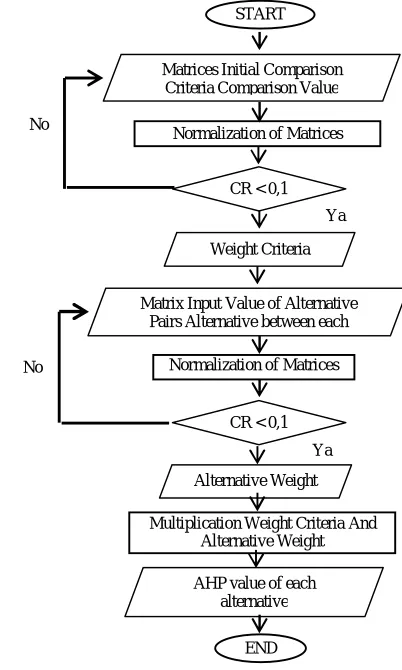
step analysis with Simple Multi Attribute Rating Technique (SMART) method and Analytical Hierarchy Process (AHP) method can be described in the flow diagram like Figure 2 and Figure 3.
Figure 2. SMART Method Flowchart Figure 3. AHP Method Flowchart
IV. DISCUSSION
Calculation Value Each Criteria based on project data can be seen in the following recap table:
Table 2. Comparative Matrix Criteria To the formwork system
Criteria with Alternative Conventional System Table Form
Time 14 Day / zone 11 Day / zone
Cost Rp 2.609.739.200 Rp2.160.233.210
Quality 5 5
Human Resources (labor skills) 2,434 m2/Day/person 4,463 m2/Day/person
Start
Alternative
Define Criteria Weight
Calculation of normalization (nwj)
Difine Alternative Weight
Calculation of utility value of each alternative (Uij)
Calculation of each criterion from each alternative utility of
each alternative (nwj * Uij)
Value results criteria (n)
END
START
Matrices Initial Comparison Criteria Comparison Value
Normalization of Matrices
CR < 0,1
END Weight Criteria
Matrix Input Value of Alternative Pairs Alternative between each
Normalization of Matrices
CR < 0,1
Alternative Weight
Multiplication Weight Criteria And Alternative Weight
AHP value of each alternative
Ya Ya
Analysis of SMART methods
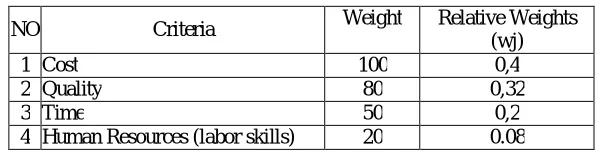
Determining the assessment criteria, weighting criteria and normalization of criteria weight.
Table 3. Criteria , Weight and normalization
NO Criteria Weight Relative Weights
(wj)
1 Cost 100 0,4
2 Quality 80 0,32
3 Time 50 0,2
4 Human Resources (labor skills) 20 0.08
Provide parameter value criteria on each criterion for each alternative
Table 4. Alternative weight
NO Criteria Value Weight
1 Cost Lower 3
Same 2
Higher 1
2 Quality Better 3
Same 2
Less 1
3. Time Faster 3
Same 2
Longer 1
4 Human Resources (labor skills)
Less than 3
Same 2
More than 1
Determining the value of utility by converting the criterion value on each criterion to the criterion value.
Table 5. Utility Values of each Alternative
Alternatif Citeria Value Bobot Utility weight
Conventional
Cost Higher 1 0
Quality Same 2 0,5
Time Longer 1 0
Human Resourrse More than 1 0
Final Value of each alternative
Table 6. Final Value
Decision Formwork Final Value
Conventional 0.16
Table Form System 0.84
Analysis of AHP methods
Determination of Comparative Matrix Between Criteria based on the results of questionnaires from 30 respondents who have been collected.
Table. 7. Comparative Matrix Criteria To the formwork system
Critria Time Cost Quality Human Resources
(labor skills)
Time 1 0,1111 0,1428 2
Cost 9 1 3 7
Quality 7 0,3333 1 5
Human Resources (labor skills)
0,5 0,1428 0,2 1
Total 17,5 1,5872 4,3428 15
Calculating eigen values Criteria and Testing Consistency by:
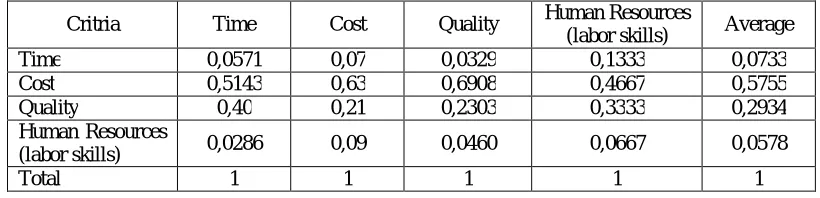
Normalization of Criteria Matrix and Calculating Eigen values Criteria
Table. 8. Normalization of Criteria Matrix
Critria Time Cost Quality Human Resources
(labor skills) Average
Time 0,0571 0,07 0,0329 0,1333 0,0733
Cost 0,5143 0,63 0,6908 0,4667 0,5755
Quality 0,40 0,21 0,2303 0,3333 0,2934
Human Resources
(labor skills) 0,0286 0,09 0,0460 0,0667 0,0578
Total 1 1 1 1 1
Based on the table, then calculate the value of CI and CR: n = 4, RI = 0,89
CI = 0,0715
CR = 0,0803 Based on CR value < 0.10, it can be concluded that the data entered is valid.
Determination of an Alternative Interview Matrix for Each Criteria
Based on the calculation of data in table 2. Obtain an alternative matrix anatar each criteria.
Calculating eigen values Criteria and Testing Consistency with Normalization of Criteria Matrices 1. Matrix of Schedule (Time) criteria against Alternative
Table 9. Schedule criteria against Alternative
C1 Schedule l (Day/Zone) Conventional Table Form System
Conventional 1 0,786
Table FormSystem 1,273 1
Total 2,273 1,786
Table 10. Normalization Matrix Schedule Criteria
Schedule (Hr/Zone) Conventional Table Form System Average
Conventional 0,440 0,440 0,440
Table Form System 0,560 0,560 0,560
2. Matrix of Cost criteria against Alternative
Table 11. Cost criteria against Alternative
C2 Cost Conventional System Table Form
Conventional 1 0,828
System Table Form 1,208 1
Total 2,208 1,828
Table 12. Normalization Matrix Cost Criteria
Cost Conventional System Table Form Average
Conventional 0,453 0,453 0,453
System Table Form 0,547 0,547 0,547
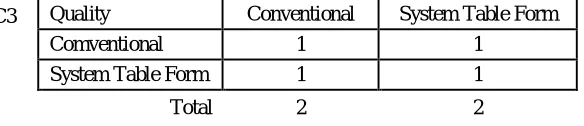
3. Matrix of Quality criteria against Alternative
Table 13. Quality criteria against Alternative
Table 14. Normalization Matrix Quality Criteria
Quality Conventional Table Form System Average
Conventional 0,5 0,5 0,5
Table Form System 0,5 0,5 0,5
4. Matrix of Human Resources criteria against Alternative
Table 15. Human Resources criteria against Alternative
C4
Human Resources
(labor skills) Conventional Table Form System
Conventional 1 0,545
Table FormSystem 1,834 1
Total 2,834 1,545
Table 16. Normalization Matrix Human Resources Criteria
Human Resources
(labor skills) Conventional Table Form System Average
Conventional 0,353 0,353 0,353
Table Form System 0,647 0,647 0,647
Calculating Eigenvalues Criteria
Table 17. Eigenvalues Criteria for Alternatives
Time Cost Quality Human Resources
Conventional 0,440 0,453 0,500 0,353
Table FormSystem 0,560 0,547 0,500 0,647
Final Weight
From the results of criteria analysis in the previous discussion, then get the final result of alternative formwork selection as below.
Table 18. Priority of Weight
Criteria Priority of Weight
Time 0,073
Cost 0,575
Quality 0,293
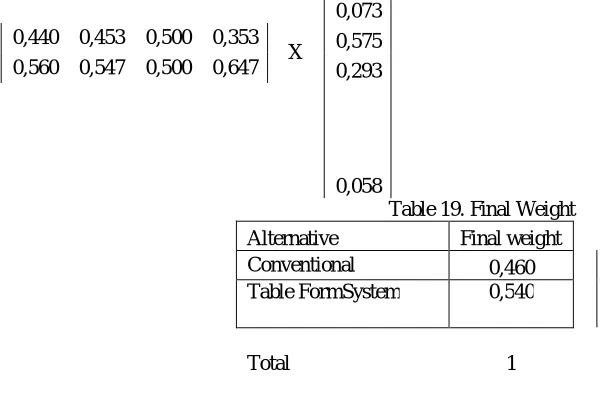
Multiplication of eigen matrix with priority weight matrix, so we get the final weight value.
0,073 0,440 0,453 0,500 0,353
X 0,575 0,560 0,547 0,500 0,647 0,293
0,058
Table 19. Final Weight Alternative Final weight
Conventional 0,460
Table FormSystem 0,540
Total 1
V. CONCLUSION
The conclusions can be drawn from the results of the analysis as follows:
1. The results of analysis using Simple Multi Attributes Rating Technique (SMART) for conventional alternative weight of 0.16 and for alternative table form value 0.84. While the results of Analytical Hierarchy Process (AHP) obtained conventional alternative weight of 0.460 and for alternative table form of 0.540.
2. From the results of the analysis Both methods show an alternative that meets the criteria to be selected is the forming of table form system.
3. Based on the implementation of both methods, the SMART method is faster in the execution process than the AHP method.
SUGGESTION
Suggestions that can be submitted by the author to develop decision-making system Selection of the next formwork is: 1. In the next research is expected to be added other assessment criteria as a decision making materials selection
decision.
2. Another suggestion is the comparison can be added using other Decision-making methods.
REFERENCES
[1] S. Honggowibowo. 2015. Sistem Pendukung Keputusan Penerimaan Calon Mahasiswa Baru Jalur Prestasi Di Sekolah Tinggi Teknologi
[7] Saaty, T.L. (1980) The Analytic Hierarchy Process, New York: McGraw Hill. International, Translated to Russian, Portuguese, and Chinese, Revised editions, Paperback (1996, 2000), Pittsburgh: RWS Publications.
[8] Shapira, Aviad. 2005. AHP-Based Equipment Selection Model for Construction Project. Journal of Construction Engineering And Management
© Asce / December 2005, hal 1263-1273.
[9] Suryanto, M. Safrizal. 2015. Sistem Pendukung Keputusan Pemilihan Karyawan Teladan dengan Metode SMART (Simple Multi Attribute
Rating Technique). Jurnal CoreIT, Vol. 1, No.2 Desember, Hal. 25-29.
[10] Trijeti. 2011. Studi Perbandingan Bekisting Konvensional Dengan PCH (Perth Construction Hire). Jurnal Konstruksia Volume 3 Nomer 1, hal
45-55
[11] Utami , Anggraeni. 2015. Analisis Perbandingan Zoning dan Siklus Bekisting Table Form System Pada Proyek Pembangunan Prima Orchard
Apartement. Jurnal skripsi Universitas Mercu Buana, hal 1-7.