Gradient Plasticity Approach to Size Effects
T. Malmberg(1), I. Tsagrakis(2), I. Eleftheriadis(2), E.C. Aifantis(2, 3), K. Krompholz(4), G. Solomos(5)
(1) Forschungszentrum Karlsruhe GmbH, Institut für Reaktorsicherheit, Postfach 3640, D-76021 Karlsruhe, Germany (2) Aristotle University of Thessaloniki, Laboratory of Mechanics and Materials, GR-54006 Thessaloniki, Greece (3) Michigan Technological University, Center for Mechanics of Materials and Instabilities, Houghton, MI 49931, USA (4) Paul Scherrer Institut, Labor für Werkstoffverhalten, CH-5232 Villigen PSI, Switzerland
(5) European Commission, Joint Research Centre, Institute for Systems, Informatics and Safety, I-21020 Ispra/VA, Italy
ABSTRACT
The size effect in deformation and failure of materials and structures is currently a subject of increasing interest. Different explanations have been proposed in the past but only recently non-classical continuum mechanics theories have provided a means to interpret size effects; for example, by incorporating higher order spatial strain gradients into classical plasticity theories. These extensions implicate additional material parameters which relate to internal length scales of the material. In spite of the increased complexity of such extended material models, a relatively easy theoretical treatment may be possible in cases of simple loading configurations and with simplifying assumptions.
In this paper, deformation theories of plasticity, extended by spatial first and/or second order strain gradients, are employed and solutions are obtained for different types of idealized specimens to determine the extent at which strain gradient models describe size influences on the deformation behavior. The following cases are considered, namely (a) simple elastic – ideal plastic models enhanced with strain gradient terms are assumed for pure torsion and pure
bending which allow, within a strength-of-materials approximation, closed form solutions; the results are fitted to available experimental data revealing the decrease of yield stresses with increasing size;
(b) a deformation theory of plasticity with a power law for the strain hardening which is extended by a 2nd order strain gradient term is assumed for the tension problem of tapered rods. An approximate analytical solution is obtained and parameter variations are performed to determine the relative influence of the strain gradient term.
When macroscopic strain gradients are absent, then the above gradient models are not capable of describing size effects. Therefore, a different approach than strain gradient plasticity is adopted in order to interpret certain size effects within a continuum mechanics framework. In particular,
(c) an internal variable model is assumed where the evolution of a microscopic internal variable is described by an evolution of the reaction-diffusion type; thus, the internal length is introduced through the diffusion coefficient. The model is applied to interpret size effects as observed in smooth tension specimens.
For the above three problem areas the exact or approximate analytical solutions and their evaluation are presented and discussed.
1. INTRODUCTION
The influence of size on the deformation and failure behavior of structures and materials is presently a subject of increasing interest because it is important for the extrapolation of mechanical test results of scaled down structural models to the full scale structures using similitude laws. Furthermore, it concerns also the use of small scale laboratory type test results as a valid basis for the computational modeling of large scale components. The question acquired prominence for concrete structures but also within the EU-project REVISA for large nuclear vessel walls and, on the other end of the scale, for sub-size irradiation specimens and for materials characteristic for the micro-systems technique.
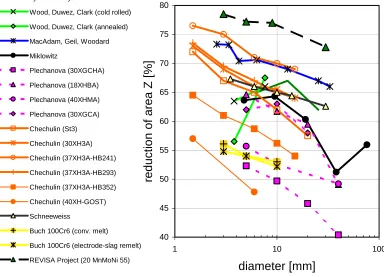
Of course, the size influence on the mechanical behavior has been investigated previously. Only two aspects will be mentioned here. The size influence in tensile testing of smooth ductile specimens (the most basic and simple testing configuration) has been of concern in the past dating back to the early times of material testing. Clearly, before more complex specimens with non-uniform strain and stress distributions are investigated, possible size dependencies under these simple conditions should be known. A review of the past activities in quasi-static tension testing of different steels at room temperature (R.T.) of geometrically similar uniform specimens has been prepared (Ref. [1]) and common trends have been identified:
(i) The yield or proof stress is frequently found to be not affected but there are definite exceptions which show a decrease with increasing size.
(ii) The ultimate stress is frequently found to be independent whereas the uniform elongation, rarely documented, shows no or a slight decrease with increasing size; this applies also to the fracture elongation.
with size (Ref. [2]). The latter observations suggest that the neck formation at fracture is more localized in small specimens. Most of these trends have been confirmed by recent experiments on a ferritic reactor pressure vessel steel (Ref. [3], as well as Malmberg et al., division F and Solomos et al., division F, this conference).
(iv) Lack of data exists with respect to the size influence on the plastic working up to the ultimate load and to fracture. This question is important for the energy absorption capacity under transient and impact loading. Also no or insufficient data is available for the softening regime beyond the ultimate load up to fracture. Furthermore, the initiation of cracks, an important question but difficult to investigate, is very rarely documented: one investigation (Ref. [4]) demonstrated that internal cracks appear in small specimens at a later deformation stage than in geometrically similar large tensile specimens; this may imply that the precursor state is size dependent. Furthermore, the reduction of impurities increases the fracture stress and the area reduction and decreases the size influence (Ref. [5]).
40 45 50 55 60 65 70 75 80
1 10 100
diameter [mm]
reducti
on of ar
ea Z [%]
Lyse and Keyser
Wood, Duwez, Clark (cold rolled)
Wood, Duwez, Clark (annealed)
MacAdam, Geil, Woodard
Miklowitz
Plechanova (30XGCHA)
Plechanova (18XHBA)
Plechanova (40XHMA)
Plechanova (30XGCA)
Chechulin (St3)
Chechulin (30XH3A)
Chechulin (37XH3A-HB241)
Chechulin (37XH3A-HB293)
Chechulin (37XH3A-HB352)
Chechulin (40XH-GOST)
Schneeweiss
Buch 100Cr6 (conv. melt)
Buch 100Cr6 (electrode-slag remelt)
REVISA Project (20 MnMoNi 55)
Fig. 1: Size dependence of the reduction of area at fracture for smooth circular tension specimens
Under non-uniform stress distributions the phenomenon of increased yield stress (sometimes called "delayed yielding") compared to the yield in quasi-homogeneous stress distributions (tensile tests) has attracted considerable attention in the past; a review is contained in Ref. [1]. It is observed especially for steels with a pronounced upper and lower yield stress, and it has been related to the formation of flow layers of finite thickness or to a supporting effect of the material neighborhood of stress peaks, their thickness characterized by an intrinsic material length. These interpretations imply a size influence on the initiation of yielding of geometrically similar specimens under macroscopically non-uniform stress distributions such that small specimens should have a greater resistance against yield initiation than larger ones. This effect has been observed in experiments for thick cylinders under internal pressure, beams with circular or rectangular cross-sections under pure bending, torsion of circular rods, flat strips with a central circular bore-hole under tension, and indentation tests; for a review see Ref. [1]. Typical dimensions (diameter or depth) ranged from a few mm (<5 mm) to dimensions not larger than 10-times. Qualitatively, all tests showed a decrease of the yield stress when the size is increased. Size effects were also studied recently in the domain of micro-plasticity. The micro-hardness indentation size effect (increase of hardness with decreasing indenter size) has lately attracted ample attention (e.g. Ref. [6]). Also the increase of the flow stress in plastic deformation with the decrease in diameter was demonstrated for torsion of very thin copper wires (Ref. [7]) and for the micro-bending of thin foil specimens (Ref. [8]).
material behavior may be responsible for some of the observed size effects. Visco-plasticity which, for example, becomes apparent when the flow stress rises with increasing strain rate, may be the cause for a size influence if the characteristic velocities are not scaled such that the strain rate is the same in the small and in the large specimens. Heat conduction may induce another size-effect since it is more effective in small scale models and thus thermal softening is less pronounced in these models. Random inhomogeneities and related statistical theories may play a prominent role in the interpretation of size effects, especially in brittle fracture and fatigue. More recently non-classical continuum mechanics theories became a means to interpret size effects. To mention are, for example,
(α) non-local (integral) concepts which involve a finite neighborhood volume integral of a state variable;
(β) gradient concepts which account for the influence of higher order spatial gradients in the constitutive equations; (γ) polar media concepts which account for additional kinematic deformation measures, their conjugated generalized
stresses and additional balance equations.
These theories implicate additional parameters which can be associated with internal length scales characteristic for the material. They account for long range interactions in the material in different ways. In fact, all solid materials contain substructures (e.g. crystal lattice, grains, inclusions etc.) having some characteristic lengths. The aforementioned theoretical concepts attempt to account for this micro – or mesoscopic heterogeneity on a phenomenological level, still treating the material as a continuum.
The modern treatment of gradient dependent constitutive equations (item (ß) above) in relation to loss of local stability, material softening and deformation patterning is due to Aifantis (e.g. Ref. [9]). He extended the usual yield condition of classical plasticity by including the Laplacian of the equivalent plastic strain to dispense with the usual difficulties exhibited by the standard plasticity models when the material enters the softening regime. These difficulties, including the indetermination of the shear band thickness and the mesh-size dependence in finite element calculations, are removed by the inclusion of the stabilizing gradient terms. The corresponding gradient coefficients, i.e. the phenomenological coefficients measuring the effect of the gradient terms, turned out to relate directly to the internal length characterizing the underlying dominant microstructure, e.g. the grain size in a metal polycrystal (Refs. [10, 11]). On the other hand, it was shown by Aifantis (Refs. [12, 13]) that the original “symmetric stress” strain gradient theory can also be used to interpret size effects exhibited by elastic bore holes and twisted wires. It was also shown (Ref. [14]) that the original “symmetric stress”, second order gradient theory can model quite well size effects exhibited by metal matrix composites.
Strain gradient models in elasticity and plasticity are not just straight forward modifications of the standard models. The gradient extension increases the order of the governing differential equations, and this implies also the need of additional boundary conditions. However, depending on the complexity of the gradient model, in cases of simple loading configurations and under simplifying assumptions, relatively easy theoretical treatments may be possible (Ref. [15]). For example, when the equilibrium equations can be trivially satisfied and the strain distribution is assumed as in classical treatments (e.g. torsion and pure bending) the gradient theory may not even require the solution of any boundary value problem. In other cases the equilibrium equations can be solved independently of the constitutive relations. This “uncoupling” may allow for a direct integration of the constitutive equations which now take the form of differential equations for the strain. Thus, a grossly simplified boundary value problem is obtained. On this basis and using deformation theories of plasticity, extended by first and/or second order strain gradients, solutions are presented for different types of idealized specimens. The following cases are considered:
• Simple elastic-ideal plastic 1st and 2nd order strain gradient models are used to interpret the increase in yield stress with decreasing size in pure torsion and pure bending. The models are fitted to experimental data.
• A deformation theory of plasticity with non-linear strain hardening is extended by a 2nd order spatial strain gradient term involving an internal length scale and parametric analyses are performed for geometrically scaled specimens (tension of tapered rods).
When a macroscopic strain gradient is absent, the above gradient plasticity models are not capable of describing size effects. Therefore, a different approach is employed in order to interpret size effects, i.e.
• an internal variable model is assumed, where the evolution of the "microscopic" internal variable is described by a reaction-diffusion equation which introduces the internal length through the diffusions coefficient. This model is applied to interpret size effects in uniform tension specimens.
Thus, using solutions for relatively simple problems, it is the limited scope of this paper to demonstrate up to what extend several gradient models can describe size effects in deformation behavior.
2. SIZE EFFECTS IN YIELD INITIATION
of tensile or compressive stresses. On the other hand, Morrisons torsion tests indicated an increase in the apparent yield stress of 15.5 % when the diameter decreased from 22.42 mm to 2.586 mm (scale factor 8.67).
For the theoretical modeling of this behavior the standard elastic relation τ = Gγ is assumed in the elastic regime,
where τ is the shear stress, γ = ϕr (ϕ: angle of twist per unit length, r: radial coordinate) denotes the shear strain and G
the elastic shear modulus. The initiation of yielding in shear is supposed to be gradient sensitive such that the gradient enhanced yield condition is assumed to take the form (Ref. [15]).
γ γ
τ
τ 2
2
1∇ − ∇
−
= o c c
,
(2.1)where τ0 is the size invariant upper yield stress under homogeneous shear deformation and
c
1 andc
2 are additionalstrain gradient related material parameters. Yielding just occurs when the shear stress at the outer surface of the circular specimen (r = α) becomes equal to the yield stress in shear Y. Thus,
Y =Gϕα=
τ
o−
c1ϕ−
c2ϕ α,
(2.2)since ∇γ = ϕ. and ∇2γ = ϕ/r. On eliminating ϕ from Eq. (2.2), one obtains the following relation for the dependence of
the yield stress Y on the specimen radius α
Y(α) σo =α2Λ
[
α2+(
c1/G) (
α+ c2/G)
]
−1 (2.3)where Λ = τ0/σ0 is the ratio of the shear yields stress τ0 to the tensile yield stress σ0. According to the experimental
results of Morrison, Y(α) must be a decreasing function of α. This implies that the admissible values of
c
1andc
2are those which satisfy the inequalityc
1α + 2c
2 < 0. This relation holds true for all positive values of α, provided that bothvalues
c
1 andc
2 are negative. However, by restricting the validity of this inequality to the range of radii where experimental results are available, positive values are also allowed for only one of them. Then two internal length scalesmay be defined as
l
1=
c
1G
andl
2=
c
2G
, respectively.Using the least squares method, the relation Eq. (2.3) with the three parameters
c
1,c
2and Λ was fitted to Morrison´s experimental torsion results which are given in the form Y/σ0 versus α. The parameterc
1 is found to benegative while
c
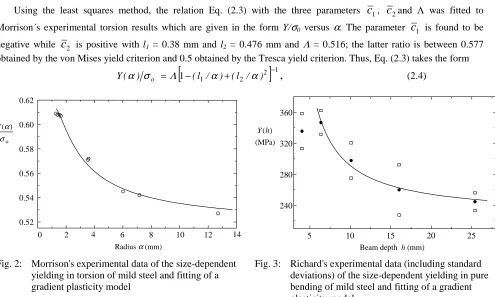
2 is positive with l1 = 0.38 mm and l2 = 0.476 mm and Λ = 0.516; the latter ratio is between 0.577obtained by the von Mises yield criterion and 0.5 obtained by the Tresca yield criterion. Thus, Eq. (2.3) takes the form
[
2]
12 1
1− + −
= (l / ) (l / ) )
(
Y α σo Λ α α
,
(2.4)0 2 4 6 8 10 12 14 0.52
0.54 0.56 0.58 0.60 0.62
Y( )
o
α σ
Radius α (mm)
5 10 15 20 25
240 280 320 360
Y h( ) (MPa)
Beam depth h (mm)
Fig. 2: Morrison's experimental data of the size-dependent yielding in torsion of mild steel and fitting of a gradient plasticity model
Fig. 3: Richard's experimental data (including standard deviations) of the size-dependent yielding in pure bending of mild steel and fitting of a gradient plasticity model
crystal grains” determines an internal length scale responsible for the size dependence of the yield initiation. This is in line with suggestions made by Morrison himself.
The second example refers to experiments by Richards (Ref. [17]) on the size effect of the yield initiation in pure bending of mild steel beams with rectangular cross-sections ( beam depth 4.026 to 25.4 mm). The details and the adapted gradient plasticity model are similar to the previous one, are described in Ref. [3, 15]. It is important to note that for this loading condition and with the assumption of Bernoulli´s hypothesis in beam theory, the 2nd order spatial strain gradient term vanishes identically. The size dependent yield stress at the tension surface is then given by
( )
[
(
)
]
12
1− −
= l/h h
Y σo , (2.5)
where h is the depth of the beam and l the internal length related to the 1st order strain gradient. Least squares fitting to the experimental data (Fig. 3) yields l = 1.125 mm and σo = 225.6 MPa. The internal length parameter l is found to be well below the half depth (h/2 = 3.19 mm) of the smallest beam specimen accounted for in the fitting process; this is, of course, a necessary requirement for a reasonable quasi-hyperbolic fit of the size effect model. A comparison of the internal length scale with the grain size is not possible since the data were not reported.
3. SIZE EFFECTS IN TAPERED TENSILE RODS
For the two previous gradient plasticity problems rather simple strength-of-materials solutions were sufficient which did not require the solution of boundary value problems. In the following a one-dimensional boundary value problem of gradient plasticity in considered: the tension of an exponentially tapered rod with a circular cross-section. A uniaxial state of stress is assumed and the non-uniformity of the cross-section distribution induces a non-homogeneous stress and strain field. For this case the size dependence of the mechanical response is systematically studied. Ignoring elastic effects, a deformation type plasticity law with a power law strain hardening is assumed which is extended by the Laplacian of the strain. Then the non-liner stress-strain relation takes the following form
σ =Kε n−K 2
2 2
dX
d
l
iε
, 0 < n≤ 1 . (3.1)
For the case of large strains, σ is the applied Cauchy stress, ε the logarithmic strain and X the material (Lagrangian) coordinate, i.e. σ = P/A(X), ε = ln (1+εR) and εR = du/dX where P is the tensile force, A(x) the current cross-section of
the rod, εR the engineering strain and u the displacement. K and n are material constants corresponding to the
homogeneous state and li, the intrinsic length scale, determines the gradient influence. The form of Eq. (3.1) is related to
early proposals by Aifantis (Ref. [9]). The change of the cross-section with the deformation is assumed to the controlled by the volume conserving plastic deformation which yields A(X) = AR(X)e-ε, where AR(X) is the initial undeformed
cross-section distribution. For an exponentially tapered rod one has
AR(X) =Aoρ
2 , ρ2= [α
+(1−α)
e
−X/L*]−1 , α =A
A
o
∞
<1 (3.2)
with A0 being the minimum cross-section, A∞ the large cross-section at infinity, and L* a characteristic length (transition
length) of the exponential cross section. With the dimensionless quantities ξ = X/L* and β = li/L*, the equilibrium
condition σ = P/A(X) combined with the constitutive relation Eq. (3.1) yields the following 2nd order differential equation
β2
2 2
ξ
ε
d
d
−ε n= − (σ
R/K) expε (3.3)
where σR = P/AR = ρ -2
P/Ao is the engineering stress. Two boundary conditions (B.C.I and II) are required. It suggests
itself that one has
B.C.I
ξ
→∞,
∞ →ξlim
ε
=
ε
∞ (3.4)with ε∞ being the solution of Eq. (3.3) at infinity where the gradient influence has vanished:
exp
.
K
A
P
n ∝
∝
∝
=
εε
1
(3.5)At the minimum cross-section (ξ = 0) the classical strain distribution εc(X) has its absolute maximum but its first
B.C. II
(
d
ε
d
ξ
)
ξ=0 = 0 . (3.6)A first qualitative glance at the behavior of the non-classical solution is possible by linearizing the governing differential equation Eq. (3.3), i.e. setting n = 1 and assuming small strains that is ignoring the cross-section reduction due to deformation (eε≈ 1). Then an exact solution is easily derived for β < 1
ε(ξ) =εco
{
[
ξβ α
α −
− − + 2e
1
1
]
−
β ξ ββ
α −
− −
e
2
1
1
}
(3.7)
where εc0 = P/(AoK) is the maximum strain of the classical solution at the minimum cross-section for the linear case. The
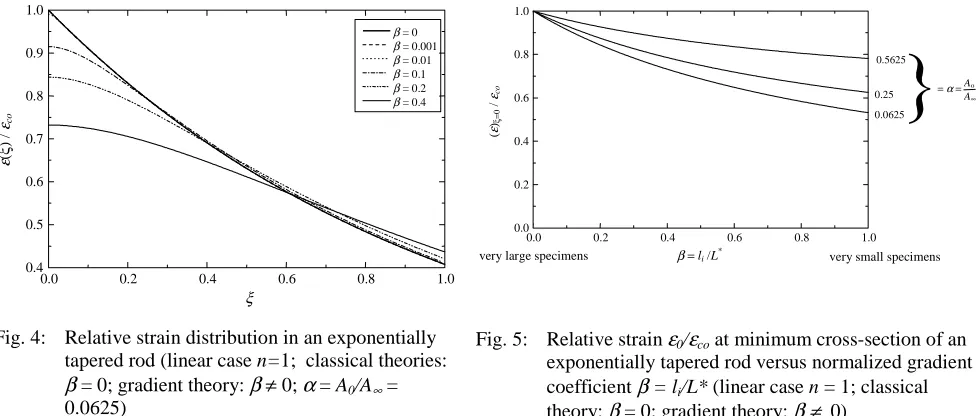
non-classical solution Eq. (3.7) is found to consist of two contributions: the first term represents essentially (for β << 1) the classical strain distribution and the second term is for small values of β and increasing distance from the strain maximum a fast decaying contribution; it represents for β << 1 a boundary layer effect at ξ = 0 which is entirely due to the gradient term (Fig. 4). Thus, the 2nd order strain gradient influence is largest where the classical solution shows a large variation.
β = 0
β = 0.001
β = 0.01
β = 0.1
β = 0.2
β = 0.4
ε
(
ξ
) /
εco
ξ
0.0 0.2 0.4 0.6 0.8 1.0
0.4 0.5 0.6 0.7 0.8 0.9 1.0
(
ε
)ξ=
0
/
εco
β=li /L*
0.0 0.2 0.4 0.6 0.8 1.0
0.0 0.2 0.4 0.6 0.8 1.0
0.5625
0.25 0.0625
=α=Ao
A∞
very small specimens very large specimens
Fig. 4: Relative strain distribution in an exponentially tapered rod (linear case n=1; classical theories:
β = 0; gradient theory: β≠ 0; α = A0/A∞ =
0.0625)
Fig. 5: Relative strain ε0/εco at minimum cross-section of an
exponentially tapered rod versus normalized gradient coefficient β = li/L* (linear case n = 1; classical
theory: β = 0; gradient theory: β≠ 0)
A comparison of the classical strain distribution εc(ξ) = P/(AR(ξ) K) and the gradient affected non-classical solution
at the same stress level shows that the inclusion of a 2nd order-strain gradient in the constitutive model, in conjunction with the non-classical boundary condition Eq. (3.6) yields (i) a reduction of the maximum strain and (ii) a smoothing out of strain peaks (Fig. 4). This is in accordance with previous findings (e.g. Ref. [18]), where a gradient enhanced elasticity law dispenses with the crack-tip strain-singularity.
If ε0 denotes the maximum strain (at ξ = 0) of the non-classical solution, then one gets for the relative strain ε0/εc0 at
the minimum cross-section
εo εco =
[
1+αβ] [
⋅1+β]
−1 (3.8)and this is illustrated in Fig. 5. It is seen that the influence of the gradient effect in the linear case is moderate; e.g. for a very small cross-section ratio α = 0.0625 (D0/D∞ = 0.25; D0: minimum initial neck diameter, D∞: largest initial diameter
at infinity) the relative strain reduction (εc0 - ε0)/εc0 is less than 20 % if β is less than 0.2.
The purely linear problem provides valuable qualitative information but the consideration of the non-linearities is important for obtaining a more realistic model. An exact solution of Eq. (3.3) appears not to be possible. However, for small β-values and a bounded 2nd order strain derivative, the gradient term in Eq. (3.3) represents a perturbation. For β = 0 the differential equation Eq. (3.3) reduces to an algebraic problem, its solution being the classical solution εc(ξ) which
satisfies the boundary condition at ξ→∞ but not at ξ = 0. This signals a singular perturbation problem. An approximate asymptotically valid analytical solution can be obtained using a generalized version of the method of multiple scales by Nayfeh (Ref. [19]). A “slow” and a “fast” variable
ξ= * L
X
and η=
β ξ µ( )
, (3.9)
are introduced and a uniformly valid expansion
~
ε
(ξ,η;β) =0
ε
(ξ,η) +βε
1
(ξ,η) +β2
ε
2
(ξ,η) +β3
ε
3
is assumed to be applicable, where the two-scale functions εk(ξ, η), k = 0,1,2,3, as well as µ(ξ) remain to be determined. By developing and arranging according to powers of the small parameter β, the differential equation Eq. (3.3) and its boundary conditions transform to a system of ordinary differential equations of 2nd order in the η-variable for the εk(ξ, η)
and associated boundary conditions where ξ is a "silent" variable. The system must be solved in successive steps since the right-hand side of the kth equation depends on the solution of the previous differential equations. This system is
characterized by the fact that the non-linearity is restricted to the 0th order equation for
0
ε(ξ, η); but fortunately, it allows a simple solution, namely
) ( ) ,
(ξη εc ξ
ε0 = , (3.11)
the classical solution being independent of the “fast” variable η. The successive equations for k = 1,2,3 are linear differential equations in η. Their solutions involve “integration constants” which, of course, are functions of the “slow” variable ξ. They are determined partly by the boundary conditions. Further conditions in the form of differential equations are obtained for the ”integration constants” and for the yet unknown function µ by suppressing “secular terms” which make the ratio εk+1/εk unbounded in the (ξ, η)-domain. This is an essential part at the heart of the singular perturbation method (Ref. [15]). This yields, among others, the function µ(ξ), which determines the “fast” variable η as a functional of the classical strain distribution:
µ(ξ) =
ò
÷÷ ÷ ø ö çç ç è æ − − ξ τ τ ε τ ε ϕ 0 2 1 1 0 0 1 d )] ( [ )] ( n [ / n;
(3.12)the constant ϕ may be chosen at convenience. It is noted that the derived asymptotic solution for the logarithmic strain distribution, Eq. (3.10), does not explicitly depend on the spatial variation of the cross-section area (Ref. [15]). This
geometric quantity is solely contained in the function
0
ε
= εc; thus, the obtained solution is applicable to any smoothcross-section variation in the region 0 ≤ξ <∞ approaching a uniform cross-section at ξ→∞.
Although the full perturbation solution of the fully non-linear problem requires numerical integrations, important results can be derived without recourse to numerical methods. These refer to the maximum strain ε0 at the minimum
cross-section and its dependence on the size and shape of the tensile rod, the constitutive parameters and the stress level. Thus, closed form approximate analytical solutions are obtained which allow direct insight into essential response characteristics. The maximum non-classical strain in normalized form (relative strain ratio at ξ = 0) reads up to terms quadratic in the small parameter β:
0 0 2 1 1 0 0 0 0 1 ÷÷ø ö ççè æ ïþ ï ý ü ïî ï í ì ú ú û ù ê ê ë é === − + = − + ξ ε ε ε β ε
ε n /
co
o
(
)
(
)
n +
+ β 2
1 1 0 0 0 0 − + ÷÷ ÷ ø ö çç ç è æ ú ú û ù ê ê ë é === − n
)
(
)
(
n ε ε
ïî ï í ì + ÷÷ø ö ççè æ 0 0 0 0
)
(
εεξξ (3.13)
ï þ ï ý ü ú ú ú û ù ê ê ê ë é ===== + ===== + − ÷ ÷ ø ö ç ç è æ === − ÷÷ ø ö çç è æ + − 2 0 0 0 0 1 0 0 2 0 0 6 1 4 1 12
5
(
)
(
)
)
(
n ) n ( nn ε ε ε
εξ
;
here
0 0
ε
= εc0,0 0 ÷÷ø ö ççè æ ξ
ε and
0 0
÷
ø
ö
ç
è
æ
ξξε
are the classical solution and its 1st and 2nd order derivative at the minimumcross-section (ξ = 0), with εc0 being the maximum strain of the gradient-free solution, implicitly given by
.
A
P
,
exp
K
Ro Ro n co co 0=
=
σ
σ
ε
ε (3.14)== − − ú ú ú ú ú û ù ê ê ê ê ê ë é == − − = − 0 0 2 1 0 0 1 0 0
0 1 1
)
(
)
(
)
(
n n / n co ε α ε ε β ε ε ++β 2
== − ú ú ú ú ú û ù ê ê ê ê ê ë é == − − == − − 0 0 2 0 0 0 0 1 0 0 1 1
)
(
)
(
)
(
)
(
n n n n ε ε α ε ε ïî ï í ì + ÷ ÷ ø ö ç ç è æ == −− n
(
)
n2
0 0
1 α ε
α ï þ ï ý ü ===== + ===== + − + 2 0 0 0 0 6 1 4 1 12
5 n
(
)
(
)
) n (
n ε ε
;
(3.15)Eqs. (3.14) and (3.15) are an implicit representation of the strain-stress relation ε0 =
ε
ˆ
0(σRo/K, n, β, α). These resultsyield the following observations and qualitative conclusions:
(i) The singular perturbation solution for the fully non-linear tension rod problem is valid for moderately large
strains. However, the solution becomes increasingly inaccurate when the tension instability is approached; then
0 0
ε
→nand the derivatives
0 0
÷
ø
ö
ç
è
æ
ξε
and0 0
÷
ø
ö
ç
è
æ
ξξε
grow unbounded.(ii) The underlined terms in Eqs. (3.13) and (3.15) are due to the allowance for the cross-section reduction induced
by the assumed volume conservation. If this is ignored, then these equations simplify considerably and εco =
0 0
÷
ø
ö
ç
è
æ
ε
=(σRo/K)1/n.
(iii) For a tension rod with a sharp neck one finds for very small but positive ξ-values
0 0
÷
ø
ö
ç
è
æ
ξε
< 0 and0 0
÷
ø
ö
ç
è
æ
ξξε
> 0since the classical strain distribution is essentially a function of the inverse of the cross-section distribution. Thus, the dominant term, linear in the parameter β, is negative. This implies for sufficiently small β-values a reduction of the maximum non-classical strain ε0, as compared to the classical value εco. Furthermore, for a scaled tensile load and
geometrically similar specimens of the same material, the size influence is entirely contained in the parameter β = li/L*,
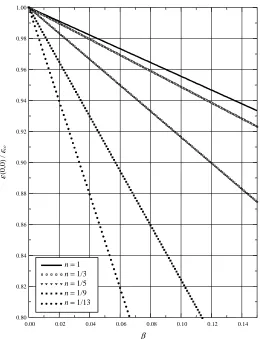
e.g. a decrease of characteristic length L* implies an increase of β and thus a decrease of the relative strain (Fig. 6); this is the primary aspect of the size effect for the tensile rod.
(iv) For a smooth meridional profile at the tip of the neck, i.e.
0 0
÷
ø
ö
ç
è
æ
ξε
= 0 and0 0
÷
ø
ö
ç
è
æ
ξξε
< 0, only a quadraticdependence on β is obtained. This shows that the relative strain reduction may be rather sensible to the local geometric properties at the neck. The relative strain reduction at the minimum cross-section of a smooth neck can be given a lucid interpretation if small strains are presumed. With D0being the initial neck diameter and R0 the radius of curvature of the
meridional profile at the minimum section, one has
co co
ε ε
ε − 0 =
( )
÷÷ø ö ççè æ ÷÷ø ö ççè æ − o i o i n co R l D l n2 1 4 ε = ÷÷ ø ö çç è æ ÷÷ ø ö çç è æ ÷ ø ö ç è æ − o i o i n n Ro R l D l n K 2 1 4 σ . (3.16)
Thus, this result for a smooth neck demonstrates that the internal length li in relation to the minimum geometrical
length scales D0 and R0 determines the relative strain reduction, i.e. the gradient effect. This result emphasizes the
importance of measuring the meridional radius of curvature at the neck. For a sharp neck, however, the relative strain reduction depends also linearly on the normalized gradient coefficient β although only a 2nd order strain gradient is contained in the constitutive model. This is due to the non-smoothness of the tension stress.
(v) With Eq. (3.13) or more explicitly Eq. (3.15), the relative strain reduction reads (εco - εo)/εco = β S - … ; the
dominant term, linear in β = li/L*, is controlled by the "sensitivity S" which contains all other parameters, i.e. n, α and εco
or σRo/K. The sensitivity S is the magnitude of the slope of the graphs in Fig. 6. When the geometry, the parameters β and
αand the normalized tensile stress σRo/K < 1 are held constant but the hardening exponent n (n≤ 1) is decreased (n→ 0),
maximal effect is found for a definite exponent n (Fig. 7). Its value, of course, depends on the choice of the other parameters; especially, if the loading is increased this effect becomes more pronounced and the maximum is shifted to small n-values. It may be shown that this is caused by two opposing effects (Ref. [15]).
0.00 0.02 0.04 0.06 0.08 0.10 0.12 0.14
0.80 0.82 0.84 0.86 0.88 0.90 0.92 0.94 0.96 0.98 1.00
n= 1
n= 1/3
n= 1/5
n= 1/9
n= 1/13
ε
(0
,0
) /
εco
β
Fig. 6: Relative strain ε0/εco≡ε(0, 0)/εcoversus normalized gradient coefficient β = li/L*; exponentially tapered
rod; linear and non-linear strain hardening (n ≤ 1) including cross-section reduction; 1st order perturbation solution (α = 0,5625, εco = 0.01)
0 0.1 0.2 0.3 0.4 0.5 0.6 0.7 0.8 0.9 1 0
1 2 3 4 5 6
σRo/K= 0.7 σRo/K= 0.5 σRo/K= 0.3 α= 0.0625
S
n
Fig. 7: Sensitivity S of the relative strain reduction versus hardening exponent n for different normalized stresses σRo/K; exponentially tapered
rod (α = A0/A∞ = 0.0625)
(vi) The qualitative importance of accounting for the geometrical non-linearity (i.e. cross-section reduction) can be
assessed as follows. For a prescribed engineering stress level σRo the corresponding classical strain εco =
0 0
÷
ø
ö
ç
è
æ
ε
is largerwhen the cross-section reduction is accounted for, as compared to the case without this geometric non-linearity. The
same trend is valid for the derivatives
0 0
÷
ø
ö
ç
è
æ
ξ
ε
= 0 and0 0
÷
ø
ö
ç
è
æ
ξξ
ε
. Therefore, it follows from Eq. (3.13) that the relativestrain reduction is increased when the geometric non-linearity is accounted for.
(vii) The result Eqs. (3.14) and (3.15) can also be used to prepare an engineering stress-strain diagram which simulates the size influences in a tensile test with the tapered specimen. The spatially local strain at the minimum cross-section is used as a strain measure instead of a strain average over an extended domain. For sufficiently small strains and small β-values (small internal length li or large specimen) valid approximations are obtained which shows the increase in
the flow stress with decreasing size (increase of β; Fig. (8). A theoretical example may illustrate this. For a rather wasp-waisted exponentially tapered tension specimen (D0/D∞ = 0.25), a low hardening exponent (n = 1/9, ferritic vessel steel)
and a small strain εo = 1,5 % the normalized engineering stress σRo/K is increased by 6.5 % if the normalized gradient
coefficient β = li/L* is increased from 0 (very large specimen) to 0.1. With D0/li interpreted as the number of grains along
the minimum diameter in the small specimen, say D0/li = 50, then L*/D0 = 0.2 which corresponds to a very steep
transition from the minimum diameter D0 to 95 % of the largest diameter D∞ approximately within a diameter D0's
distance. This examples makes clear that a significant non-uniformity in the geometry, stress or strain field is necessary to produce an effect in the range of a few percent.
4. THE SIZE EFFECT IN UNIFORM TENSION SPECIMENS: AN INTERNAL VARIABLE MODEL
The above problems show how strain gradient plasticity theory can be applied to describe size effects in the presence of macroscopic strain gradients. However, recent literature surveys and experiments have demonstrated the existence of size effects in tensile (Ref. [1]) and creep tests (see Malmberg et al., this conference, division F) of smooth un-notched specimens with circular cross-sections. Therefore, a different approach than gradient plasticity must be used for introducing an internal length into the constitutive equations to interpret such experimental results. Employing a gradient internal variable theory, an effort is made in this direction. In particular, the standard uniaxial true stress – true strain relation σ = Y + k0εn is modified to include an extra term which depends on the volumetric mean αof a microscopic
internal variable α, i.e.
α ε
σ o
n
o k
k
Y+ + ′
= . (4.1)
One may envision that α is a measure of the micro-structural inhomogeneity. Material heterogeneities cause non-uniform evolution of the material defects, which are the main carriers of plastic deformation. The complex and non-linear interactions between these defects leads to the development of heterogeneous patterns, e.g. dislocation cells, slip band, shear band etc. Within a continuum framework, internal stresses arising from these structures are modeled using internal variables. Among the first authors to study deformation patterning phenomena were Walgraef and Aifantis (Ref. [20]) who developed a reaction-diffusion model for dislocation patterning, motivated by earlier work as quoted in Refs. [20, 21]. Referring to this work, the evolution of the internal variable α reads in Eulerian coordinates
) , ( f D
t α α ε
α = ∇ + ∂
∂ 2
, (4.2)
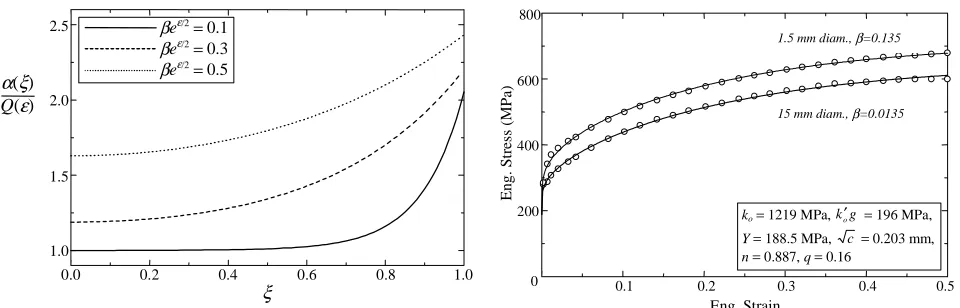
where the first term on the right hand side represents the diffusion and the second represents production and/or annihilation of α. For simplicity a linear relation f (ε, α) = Φ⋅ (Q(ε) - α) with Φ = const and Q(ε) = gεq is assumed. As in Aifantis (Ref. [21]), it is argued that the microstructure represented by the internal variable evolves much faster than the macroscopic variables, and thus it relaxes rapidly to the steady state (α≅ 0). This "adiabatic approximation" reduces Eq. (4.2) to a modified Bessel differential equation of zero order if axi-symmetry and axial homogeneity are assumed. From this a general analytical solution for α as a function of the radial coordinate is obtained consisting of modified Bessel functions of zero order and of 1st and 2nd kind. It requires a (non-standard) boundary condition at the outer boundary of the circular rod (current radius R).An ad hoc assumption concerning the flux of the microscopic variable is made
) ( Q D r
D
R r
ε Φ ∂
∂α =− −
=
; (4.3)
for simplicity extra parameters are not introduced but Eq. (4.3) implies an internal variable flow into the specimen. The assumption of isochoric deformations provides the relation R = R0 e
-ε/2
between the current and the initial radius R0 of the
rod. Then the dimensionless parameterβ = c/Ro, with c ≡ D/Φ = const., is the only parameter depending on size.
ξ
0.0 0.2 0.4 0.6 0.8 1.0
1.0 1.5 2.0 2.5
α(ξ) Q(ε)
βeε/2= 0.1
βeε/2= 0.3
βeε/2=
0.5
E
n
g.
S
tr
ess
(M
Pa
)
Eng. Strain
0.1 0.2 0.3 0.4 0.5
0 200 400 600 800
ko= 1219 MPa, ko′g = 196 MPa,
Y = 188.5 MPa, c = 0.203 mm, n = 0.887, q = 0.16
15 mm diam., β=0.0135 1.5 mm diam., β=0.135
Fig. 9: Influence of the normalized diffusion coefficient
0 R
DΦ
β = on the distribution of the internal variable α at a given strain ε.
Fig. 10: Experimental stress-strain data (o) of a stress annealed austenitic steel (geometrically similar specimens, 1.5 and 15 mm diameter) and adaption of an internal variable model () with diffusion.
For a given logarithmic strain ε the microscopic internal variable α decreases with the specimen radius. Moreover, with increasing distance from the center of the rod, the internal variable becomes larger and obtains its largest value at the boundary, whereas at the center, α is approximately uniform, primarily for large specimens. This indicates that surface processes are responsible for the non-uniformity and the choice of the boundary condition is here important. For very large specimens (β→ 0) a constant value for αis obtained in the whole specimen, except for the surface where a value twice as large is obtained. This solution differs from the classical steady state solution without diffusion and this signals the singular character of the diffusion enhanced evolution equation for small values of the parameters β. After determination of the volumetric mean of α, an engineering stress-strain relation is obtained as follows
[
]
[
]
ε
ε ε
β ε
σ
+
+ +
+ ′
+ + +
=
1
1 1 1 2
1 o q
n
o ln( ) k g( )ln( )
k Y
. (4.4)
It consists of three terms: the conventional part not related to the internal variable processes, a term related to the point kinetics (without diffusion) of the internal variable, and a third term which is diffusion controlled. The latter term depends linearly on β and therefore it determines the size dependence.
Eq. (4.4) has been fitted to the experimental results (quoted in Ref. [3]) of scaled tensile tests of stress annealed smooth specimens (1.5 mm and 15 mm diameter) made of the austenitic steel X5CrNi189 (Fig. 10). The strain up to the uniform elongation (~50 %) was covered. The fit catches the size effect quite well but the relatively large number of free parameters allows also some flexibility. Clearly, the validity of the internal variable model is not proved by this adaption. Also it is not yet resolved whether the physical origin of the observed size effect is related to bulk properties or to a surface effect (Ref. [3]). However, environmental influences during the test can be excluded.
5. CONCLUSIONS
The two fitting processes of a simple gradient plasticity model, including 1st and 2nd order strain gradient terms in the yield conditions, gave comforting agreement of the fitted models with the mean experimental values of the size dependent initial yield stresses in pure torsion and pure bending. Evidently, the phenomenological models are a useful means to interpret the observed size effects although a thorough physical interpretation of the gradient terms was not discussed. The results also indicate the importance of including a 1st order strain gradient term. The 1st order internal length scale was found to be about 10-times larger than the average grain size.
For the tension problem of an exponentially tapered rod, the multi-scale method of singular perturbation theory provided expressions in dimensionless form which allow direct understanding and quantitative estimates of the relative influence of various parameters, particularly the size of geometrically similar specimens or the internal length li; both are
controlled by a single dimensionless parameter β = li/L* < 1 where L* is a measure of the size of the specimen (e.g.
at the tip of the neck, only a quadratic dependence on β is obtained. This proves that the relative strain reduction is rather sensible to the local geometric properties at the neck. For a smooth neck the determining length ratios are li/Doand li/Ro.
The size influence is also reflected in the diagram relating the stress and the strain at the minimum cross-section. The example makes clear that small specimens show an increased flow stress but a significant non-uniformity in the geometry, stress or strain field is necessary to produce an effect of a few percentage.
An internal variable model was considered with an evolution equation for a microscopic internal variable which includes spatial diffusion. Thus, the diffusion coefficient introduces an internal length which is responsible for a size influence. The model is applied to the tension problem of a uniform specimen without a macroscopic strain gradient. For the required boundary condition at the surface of the specimen an ad hoc choice is made implying a non-vanishing internal variable flux. On this basis the non-uniform evolution of the internal variable is shown and an increase of the flow stress with decreasing size is demonstrated.
Acknowledgement
It is gratefully recognized that this work was financially supported by the EU under the project "Reactor Vessel Integrity in Severe Accidents (REVISA)", contract FIS-CT96-0024.
REFERENCES
[1] Malmberg, T., Tsagrakis, I., Eleftheriadis, I., Aifantis, E.C., "On the gradient plasticity approach to size effects, Part I: Reviews", Forschungszentrum Karlsruhe, Scientific Report FZKA 6321, 2001
[2] McAdam, D.J., Gail, G.W., Woodard, D.H., Jenkins, W.D., "Influence of size and the stress system on the flow stress and fracture stress of metals", Am. Inst. Mining & Metal. Eng., Techn. Publ. No. 2373, Class E, Metals Technology, pp. 1-19, June 1948
[3] Malmberg, T., Krompholz, K., Solomos, G., Aifantis, E.C., "Investigations on Size Effects in Ferritic and Austenitic Materials", Trans. 15th Int. Conf. Structural Mechanics (SMiRT-15), Seoul, Korea, Aug. 15-20, 1999, paper L06/5 [4] Chechulin, B.B., "On the size effect", Industrial Laboratory (engl. transl.of Zavodskaya Laboratoriya), vol. 26, no.
9, pp. 1192-1194, 1961
[5] Buch, A., "Effect of specimen diameter on the tensile characteristics of small steel specimens of different purity (German)", Materialprüfung, vol. 11, no. 2, pp. 54-58, 1969
[6] Poole, K.J., Ashley, M.F., Fleck, N.A., "Micro-hardness of annealed and work-hardened copper polycrystals",
Scripta Materialia, vol. 34, no. 4, pp. 559-564, 1996
[7] Fleck, N.A., Muller, G.M., Ashby, M.F., Hutchinson, J.W., "Strain gradient plasticity: Theory and experiment",
Acta Mater., vol. 42, no. 2, pp. 475-487, 1994
[8] Stölken, J.S., Evans, A.G., "A micro-bend test method for measuring the plasticity length scale", Acta Mater., vol. 46, no. 14, pp 5109-5115, 1998
[9] Aifantis, E.C., "The physics of plastic deformation", Int. J. Plasticity., vol. 3, pp. 211-247, 1987
[10] Mühlhaus, H.B., Aifantis, E.C., "A variational principle for gradient plasticity", Int. J. Solids Structures, vol. 28, no. 7, pp. 845-857, 1991
[11] Aifantis, E.C., "Pattern formation in plasticity", Int. J. Engng. Sci, vol. 33, pp. 2161-2178, 1995
[12] Aifantis, E.C., "Higher order gradients and size effects", in [Carpinteri, A., ed., "Size-scale effects in the failure mechanism of materials and structures", Proc. IUTAM Symp., Oct. 3-7, 1994, Turin, Italy, E & FN SPON, London 1996], pp. 231-242, 1996
[13] Aifantis, E.C., "Strain gradient interpretation of size effects", Int. J. Fracture, vol. 95, pp. 299-314, 1999
[14] Zhu, H.T., Zbib, H.M., Aifantis, E.C., "Strain gradients and continuum modeling of size effect in metal matrix composites", Acta Mechanica, vol. 121, pp. 165-176, 1997
[15] Malmberg, T., Tsagrakis, I., Eleftheriadis, I., Aifantis, E.C., "On the gradient plasticity approach to size effects, Part II: Applications", Forschungszentrum Karlsruhe, Scientific Report FZKA 6322, 2001
[16] Morrison, J.L.M., "The yield of mild steel with particular reference to the effect of size of the specimen", Proc. of the Inst. of Mech. Eng., vol. 142, pp. 193-223, Nov. 1939 – March 1940
[17] Richards, C.W., "Effect of size on the yielding of mild steel beams", Proc. Am. Soc. Testing Mat., vol. 58, pp. 955-970, 1950
[18] Altan, B.S., Aifantis E.C., "On the structure of the mode III crack-tip in gradient elasticity", Scripta Met. Materialia, vol 26, pp. 319-324, 1992
[19] Nayfeh, A., "Perturbation methods", John Wiley & Sons, New York, 1973
[20] Walgraef, D., Aifantis, E.C., "On the formation and stability of dislocation patterns – III: Three-dimensional considerations", Int. J. Engng. Sci., vol. 23, pp. 1365-1372, 1985