ABSTRACT
IVES, SARAH ELIZABETH. Learning to Teach Probability: Relationships among
Preservice Teachers‘ Beliefs and Orientations, Content Knowledge, and Pedagogical Content Knowledge of Probability. (Under the direction of Hollylynne Stohl Lee.)
The purposes of this study were to investigate preservice mathematics teachers‘ orientations, content knowledge, and pedagogical content knowledge of probability; the relationships among these three aspects; and the usefulness of tasks with respect to
Learning to Teach Probability: Relationships among Preservice Teachers‘ Beliefs and Orientations, Content Knowledge, and
Pedagogical Content Knowledge of Probability
by
Sarah Elizabeth Ives
A dissertation submitted to the Graduate Faculty of North Carolina State University
in partial fulfillment of the requirements for the Degree of
Doctor of Philosophy
Mathematics Education Raleigh, North Carolina
2009
APPROVED BY:
s Dr. Lee V. Stiff Dr. Ernest L. Stitzenger
s Dr. Karen F. Hollebrands Dr. Hollylynne Stohl Lee
BIOGRAPHY
Sarah Ives was born in Clinton, Iowa on March 10, 1977. She is the youngest of three children. She graduated from East Grand Rapids High School in 1995 and went on to pursue a Bachelor‘s degree in mathematics from the College of Wooster. She graduated in May, 1999 and from there went on to the University of North Carolina at Wilmington to complete a Master‘s in mathematics. During her studies at UNCW Sarah was a teaching assistant and gained valuable experience assisting several different professors. After graduating in 2001 Sarah continued her education at North Carolina State University to complete a Doctorate degree in mathematics.
While studying in the mathematics department Sarah had a teaching assistant position. Within this capacity Sarah taught Calculus I, Introduction to Mathematics, and Mathematics Finance. In fall 2003 Sarah decided to change her major from mathematics to mathematics education. Knowing since high school that she wanted to teach mathematics at the college level Sarah realized she would be a more effective teacher with a degree in mathematics education.
County Public School System in Evaluation and Research as well as a middle school teacher at Apex Middle School.
ACKNOWLEDGEMENTS
I would first like to thank Dr. Hollylynne Lee for all that she has done to help me reach this goal. This has not been an easy journey and taken a little longer than planned, but with her constant encouragement and support I have been able to complete this process. Hollylynne, you have been such an amazing advisor and you are truly a gift to the mathematics education field as a whole. I am proud to say that you were the chair of my committee. Thank you for pushing me, holding me to high standards, and telling me to get out of my own way. Really, words cannot do justice in expressing my gratitude to you.
Thank you also to my other committee members: Dr. Hollebrands, Dr. Lee, and Dr. Stitzenger for your support and input. I appreciate the time and effort you have put into helping me with my research.
There are several classmates, friends and family that I wish to acknowledge as well. Thank you to Kelli, Rachael, Sue, Bill, Miranda, Gemma, Holt, Valerie, Amanda, and Ryan. You have all been there with me through the classes and the research projects. Having such a great group of fellow graduate students with me through this endeavor has been a real
I would also like to thank my good friend Aimee; you were always there to listen to my complaints, worries, revelations, and findings. I‘m very glad I met you and I hope we stay friends throughout our lives. You are a great friend to have.
Thank you to my family for believing in me and offering all kinds of support. I know some of you thought this would never end, that I‘d remain the perpetual student. I believe your faith in me has helped me reach the finish line. I feel blessed to have such a supportive family. Thanks mom and dad and Ruth and Jon.
Finally I would like to thank Greg for being there with me from the beginning until the end. Times were tough here and there, but you have never doubted my abilities and your encouragement has been priceless. You always seemed to know just what to say right when it needed saying. For that, I thank you.
TABLE OF CONTENTS
LIST OF TABLES ...xv
LIST OF FIGURES ... xvii
CHAPTER 1: INTRODUCTION ...1
Significance of Study ...2
Teachers‘ Knowledge and Beliefs as Influences on Pedagogy ...4
Definitions of Terms ...7
CHAPTER 2: LITERATURE REVIEW ...9
Beliefs and Content Knowledge of Probability ...10
Students‘ Beliefs and Content Knowledge of Probability ... 11
Mathematical Knowledge Needed ... 12
Effects of Intuitions and Strategies on Probability Understanding ... 14
Interest and Beliefs ... 15
Teachers‘ Content Knowledge of Probability ... 17
Pedagogical Content Knowledge of Probability ...20
Connection Between Content Knowledge and Pedagogical Knowledge ... 20
The Role of Beliefs in Mathematics Education ... 24
Connection Between Content and Pedagogical Content Knowledge of Probability ... 26
Technology Use in Teaching Probability ... 35
Important Factors of Design ... 37
Representations ... 38
Teacher Education Practices to Develop Pedagogical Content Knowledge ... 40
Summary of Literature ...44
Framing the Research Study ...45
Importance in Examining Relationships Between Constructs ... 45
Components of the Three Aspects in the Framework ... 47
Orientations ... 49
Content Knowledge ... 50
Pedagogical Content Knowledge ... 51
Research Questions ...53
CHAPTER 3: METHODOLOGY ...54
Overview ...54
Case-Study Research ...54
Site and Participant Selection ...55
Instruments and Data Collection ...57
Pre-Post Test ... 58
Initial Interview ... 59
Reflection on Second Interview ... 65
Final Interview ... 65
Data analysis ...67
Coding the Data ... 67
Organizing the Tasks ... 68
With-in Case Analysis ... 80
Cross-case Analysis ... 82
Validity ...83
Data Collection ... 83
Data Analysis ... 84
Summary ...84
CHAPTER 4: within case FINDINGS ...86
Overview ...86
Within Case Analysis ...87
Case 1 - Pam ... 87
Introduction ... 87
Task by Task Analysis ... 88
Task 1: Interpretation of Randomness and Probability... 88
Task 2: Curricular Issues. ... 91
Task 4: Experimental Context and Critique/Plan. ... 96
Task 5: Schoolopoly Task and Reflection. ... 98
Task 6: Interpretation of Meaning of Probability. ... 119
Task 7: Curricular Issues Revisited. ... 123
Task 8: Multiple Choice and Free Responses from Pre/Post Tests. ... 125
Summary of Pam‘s Case ... 128
Orientations. ... 128
Content Knowledge. ... 130
Pedagogical Content Knowledge. ... 130
Relationships Among Three Aspects ... 133
Case 2 – Yasmin ... 134
Introduction ... 134
Task by Task Analysis ... 135
Task 1: Interpretation of Randomness and Probability... 135
Task 2: Curricular Issues. ... 136
Task 3: Real-world Context and Teaching Situation. ... 137
Task 4: Experimental Context and Critique/Plan. ... 139
Task 5: Schoolopoly Task and Reflection. ... 142
Task 6: Interpretation of Meaning of Probability. ... 159
Task 8: Multiple Choice and Free Response from Pre/Post Tests. ... 166
Summary of Yasmin‘s Case... 167
Orientations. ... 167
Content Knowledge. ... 169
Pedagogical Content Knowledge ... 170
Relationships among Three Aspects ... 170
Case 3 – Brad ... 172
Introduction ... 172
Task by Task Analysis ... 173
Task 1: Interpretation of Randomness and Probability... 173
Task 2: Curricular Issues. ... 175
Task 3: Real-world Context and Teaching Situation. ... 176
Task 4: Experimental Context and Critique/Plan. ... 179
Task 5: Schoolopoly Task and Reflection. ... 181
Task 6: Interpretation of Meaning of Probability. ... 196
Task 7: Curricular Issues Revisited. ... 201
Task 8: Multiple Choice and Free Responses from Pre/Post Tests. ... 204
Summary of Brad‘s Case ... 206
Orientations ... 206
Pedagogical Content Knowledge. ... 208
Relationships Among Three Aspects ... 210
Case 4 – Jeff ... 211
Introduction ... 211
Task by Task Analysis ... 212
Task 1: Interpretation of Randomness and Probability... 212
Task 2: Curricular Issues. ... 214
Task 3: Real-world Context and Teaching Situation. ... 217
Task 4: Experimental Context and Critique/Plan. ... 219
Task 5: Schoolopoly Task and Reflection. ... 221
Task 6: Interpretation of Meaning of Probability. ... 232
Task 7: Curricular Issues Revisited. ... 237
Task 8: Multiple Choice and Free Responses from Pre/Post Tests. ... 240
Summary of Jeff‘s Case ... 242
Orientations ... 242
Content Knowledge ... 243
Pedagogical Content Knowledge. ... 245
Relationships Among Three Aspects ... 247
Case 5 – Sam ... 249
Task by Task Analysis ... 250
Task 1: Interpretation of Randomness and Probability... 250
Task 2: Curricular Issues. ... 252
Task 3: Real-world Context and Teaching Situation. ... 253
Task 4: Experimental Context and Critique/Plan. ... 254
Task 5: Schoolopoly Task and Reflection ... 256
Task 6: Interpretation of Meaning of Probability. ... 268
Task 7: Curricular Issues Revisited. ... 273
Task 8: Multiple Choice and Free Responses from Pre/Post Tests. ... 275
Summary of Sam‘s Case ... 277
Orientations. ... 277
Content Knowledge ... 278
Pedagogical Content Knowledge. ... 279
Relationships Among Three Aspects ... 280
Chapter Summary ...281
CHAPTER 5: CROSS CASE ANALYSIS...284
Introduction ...284
Within Task Analysis ...284
Task 1: Interpretation of Randomness and Probability... 284
Task 3: Real World Context and Teaching Situation ... 290
Task 4: Experimental Context and Critique/Plan ... 293
Task 5: Schoolopoly Task ... 296
Task 5a: Analysis of Schoolopoly Task... 296
Task 5b: Analysis of Student Work on the Schoolopoly Task ... 299
Task 5c: Analysis of Schoolopoly Teaching Episode ... 304
Task 5d: Reflection ... 307
Task 6: Interpretations of Calculating and the Meaning of Probability... 310
Task 6a: Interpretations of Calculating Probability ... 311
Task 6b: Interpretations of the Meaning of Probability ... 312
Task 7: Curricular Issues Revisited ... 314
Task 8: Multiple Choice and Free Responses from Pre/Post Tests ... 317
Analysis of Relationships across Cases ...319
CHAPTER 6: CONCLUSIONS & IMPLICATIONS ...324
Introduction ...324
Conclusions ...325
Preservice Teachers‘ Knowledge of Teaching Probability ... 325
Limitations ...334
Implications...336
Implications for Methods of Researching Teachers‘ Knowledge ... 338
Implications for Future Research ... 339
REFERENCES ...341
APPENDICES ...360
APPENDIX A: INFORMED CONSENT FORM ...361
APPENDIX B: PRE-POST TEST QUESTIONS ...362
APPENDIX C: INITIAL INTERVIEW PROTOCOL ...366
APPENDIX D: SECOND INTERVIEW PROTOCOL ...371
APPENDIX E: SECOND INTERVIEW REFLECTION...378
APPENDIX F: FINAL INTERVIEW PROTOCOL ...379
LIST OF TABLES
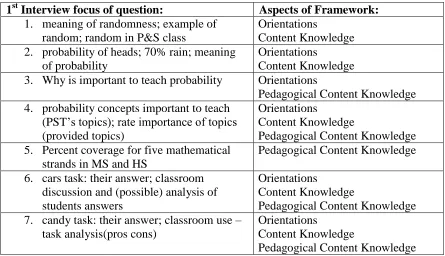
Table 1 Brief description of initial interview questions related to aspects of framework ... 59
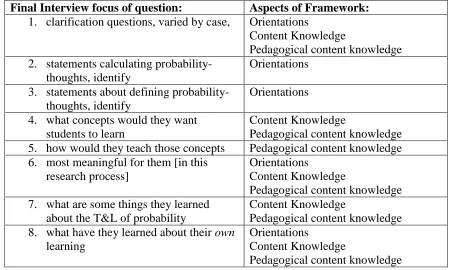
Table 2 Brief description of final interview questions related to aspects of framework ... 66
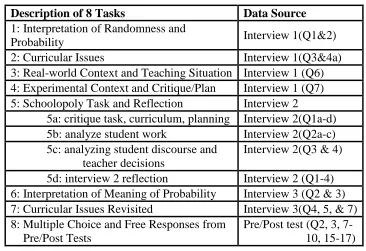
Table 3 Description of tasks and data sources ... 69
Table 4 Summary counts for Pam’s orientations by task ... 128
Table 5 Summary counts for Yasmin’s orientations by task ... 168
Table 6 Summary counts for Brad’s orientations by task ... 206
Table 7 Summary counts for Jeff’s orientations by task ... 242
Table 8 Summary counts for Sam’s orientations by task ... 277
Table 9 Brief description of preservice teachers’ responses to Task 1 ... 285
Table 10 Brief description of preservice teachers’ responses to Task 2 ... 289
Table 11 Brief description of preservice teachers’ responses to Task 3 ... 291
Table 12 Brief description of preservice teachers’ responses to Task 4 ... 294
Table 13 Brief description of preservice teachers’ responses to Task 5a ... 297
Table 14 Brief description of preservice teachers’ responses to Task 5b ... 300
Table 15 Brief description of preservice teachers’ responses to Task 5c... 304
Table 16 Brief description of preservice teachers’ responses to Task 5d ... 308
Table 17 Brief description of preservice teachers’ responses to Task 6a ... 311
Table 18 Brief description of preservice teachers’ responses to Task 6b ... 313
LIST OF FIGURES
Figure 1. Domain Map for Mathematical Knowledge for Teaching (Ball, et al., 2008, p. 403)
... 22
Figure 2. Framework for Knowledge for Teaching Probability ... 48
Figure 3. Task 1 – Interpretation of Randomness and Probability ... 69
Figure 4. Task 2 – Curricular Issues ... 70
Figure 5. Task 3 – Real world Context and Teaching Situation ... 71
Figure 6. Task 4 – Experimental Context and Critique/Plan ... 72
Figure 7. Schoolopoly Task (Maher, et al., 2006) ... 72
Figure 8. Task 5a – Schoolopoly Task Analysis ... 73
Figure 9. Task 5b – Analyze Schoolopoly Student Work ... 74
Figure 10. Task 5c – Analyze Schoolopoly Teaching Episode ... 74
Figure 11. Task 5d – Reflection on Second Interview ... 75
Figure 12. Task 6a – Interpretations of Calculating Probability ... 76
Figure 13. Task 6b – Interpretations of Meaning of Probability ... 76
Figure 14. Task 7 – Curricular Issues Revisited... 77
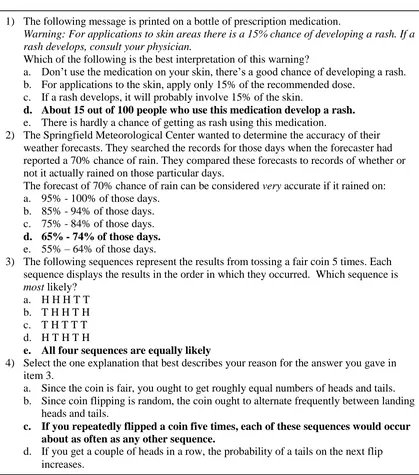
Figure 15. Task 8a – Multiple Choice Test Questions Assessing Interpretations of Probability and Understanding of Independence ... 78
Figure 17. Task 8c – Open-Ended Pedagogy Question Critiquing Student Strategies ... 80
Figure 18. Diagram of Pam‘s Within Case Analysis ... 81
Figure 19. Poster A – Screen Shot Included on Poster ... 102
Figure 20. Poster A – Student Writing ... 103
Figure 21. Poster B – Screen Shot Included on Poster ... 105
Figure 22. Poster C – Screen Shot Included on Poster ... 108
Figure 23. Poster D – Screen Shot Included on Poster ... 111
Figure 24. Poster A – Screen Shot Included on Poster ... 144
Figure 25. Poster B – Question 1 Student Answer ... 146
Figure 26. Poster B – Question 2 Student Answer ... 147
Figure 27. Poster C – Screen Shot Included on Poster ... 149
Figure 28. Poster D – Screen Shot Included on Poster ... 151
Figure 29. Poster A – Screen Shot Included on Poster ... 184
Figure 30. Poster A – Student Writing ... 185
Figure 31. Poster B – Question 1 Student Answer ... 186
Figure 32. Poster B ... 187
Figure 33. Poster C – Screen Shot Included on Poster ... 188
Figure 34. Poster D – Question 3 Student Answer ... 191
Figure 35. Poster A – Student Writing ... 222
Figure 37. Poster B – Screen Shot Included on Poster ... 224
Figure 38. Poster C – Screen Shot Included on Poster ... 226
Figure 39. Poster D – Question 3 Student Answer ... 227
Figure 40. Poster D – Sample Size ... 228
Figure 41. Poster A – Screen Shot Included on Poster ... 258
Figure 42. Poster B – Question 1 Student Answer ... 260
Figure 43. Poster C – Screen Shot Included on Poster ... 262
Figure 44. Poster D – Screen Shot Included on Poster ... 263
Figure 45. Poster D –Question 3 Student Answer ... 264
Figure 46. Sam‘s Illustration of the Law of Large Numbers ... 273
Figure 47. Continuum of Ratio of Statistical and Mathematical Orientations ... 321
Figure 48. Relationships among Orientations, Content knowledge, and Pedagogical Content Knowledge of Probability. ... 331
Figure 49. Poster A – Calibrated Cubes ... 373
Figure 50. Poster B – Calibrated Cubes ... 374
Figure 51. Poster C – Dice-R-Us ... 375
CHAPTER 1: INTRODUCTION
Probability can be considered one of the most important areas of mathematics for students to study due to the fact that it applies to many areas of daily life, including health decisions, sports, and weather. In the United States over the past 20 years, there has been increased importance of probability within the recommendations given by the National Council of Teachers of Mathematics (NCTM, 1989, 2000) for standards pertaining to K-12 mathematics. This is not a nationally adopted curriculum but a suggested set of standards that most states use to guide their state-level curriculum. Due to this increase, students are expected to learn, and teachers are expected to teach, probability concepts as early as primary school. Yet recent research has shown that many teachers, at primary, middle, secondary, as well as post-secondary levels, often struggle to teach probability concepts (e.g., Batanero, Godino, & Roa, 2004; Begg & Edwards, 1999; Haller, 1997; Liu, 2005; Mojica, 2006).
Significance of Study
A strong conceptual understanding of probability is important for a variety of reasons: it is required for critically reading newspaper reports, interpreting statistics, and to be an informed citizen; it helps one to understand and evaluate information in the world around us; and it is a prerequisite to entering many other fields of study (Ahlgren & Garfield, 1991). Reasons to include probability and statistics in the K-12 curriculum include ―the usefulness of statistics and probability for daily life, its instrumental role in other disciplines, the need for a basic stochastic knowledge in many professions and its role in developing critical reasoning‖ (Batanero, et al., 2004, p. 1).
The NCTM‘s (2000) Principles and Standards for School Mathematics (PSSM) is intended as a guide for improving the teaching and learning of mathematics in the US. Within the PSSM, NCTM stresses the importance of probability by including ‗Data analysis and Probability‘ as one of the five content standards recommended. In addition, Shaughnessy (1993) stated ―… perhaps no other branch of mathematical sciences is as important for all students, college-bound or not, as probability and statistics‖ (p. 244). Therefore, it is important to teach probability in schools which requires a demand for preparing future teachers in this area.
Rider, & Tarr, 2006; Maher, Speiser, Friel, & Konold, 1998; Pfannkuch & Brown, 1996; Pratt, 2000; Shaughnessy, 2003; Vahey, 2000; Watson & Moritz, 2003). In light of this evidence of problems with understanding probability, there has been a call for studies on the understanding of the teaching of probability (Jones, Langrall, & Mooney, 2007; Pfannkuch, 2005; Pratt, 2005; Shaughnessy, 1992, 2003). Little research on probability and statistics education has attended to teacher‘s understanding of probability and statistics or to their thinking on how to teach these subjects (Liu, 2005). However, a few studies have been done specifically on preservice mathematics teachers‘ understanding of teaching probability (Carnell, 1997; Carter, Zientek, & Capraro, 2005; Koirala, 2003; Lane, 2002; Peard, 2005). More research in this area is needed if we are to improve the teaching of probability.
was posed as a significant research question (Batanero, 2006, p. 6). However, at the completion of the conference, the facilitators of that working group concluded that this question had yet to be adequately addressed in the current research (Batanero, & Burrill, personal communication, July 3, 2008). Additionally, research is needed to address how teacher educators can influence change in practicing and preservice teachers‘ beliefs about learning and teaching probability. The increased importance of probability in the classroom, the evidence of students‘ difficulties learning probability, and the lack of research on preservice teachers‘ beliefs and pedagogical content knowledge of probability, all lead to a need for the research in this study.
Teachers‘ Knowledge and Beliefs as Influences on Pedagogy
Students at all grade levels have difficulty understanding probability concepts. One reason for this difficulty is because of commonly held intuitive biases that are contradictory to probabilistic reasoning (Aspinwall & Shaw, 2000; Fischbein & Gazit, 1984; Konold, 1995; Konold, Pollatsek, Well, Lohmeier, & Lipson, 1993; Pfannkuch & Brown, 1996; Sedlmeier & Gigerenzer, 1997). Another reason for students‘ difficulty learning probability is that teachers are often unprepared, ill-equipped, or unmotivated to teach probability (Batanero, et al., 2004; Garfield & Ahlgren, 1988; Greer &
(Papaieronymou, 2008, p. 2). Teachers that do not possess a strong understanding of the concepts within probability will likely not be able to teach probability effectively. While the extent of teachers‘ subject matter knowledge of mathematical concepts has an effect on their ability to teach mathematics, their content knowledge alone is not sufficient (Ball, 1990, 2000; Ball, Lubienski, & Mewborn, 2001; Thompson, 1984).
Teachers‘ content knowledge, or lack thereof, has an influence on their pedagogical decisions, such as the selection and creation of mathematical tasks,
instructional orientations, and types of assessments (Ball, 2000; Shulman, 1986). These decisions are based on a teacher‘s knowledge that is specific to the content – a knowledge referred to as pedagogical content knowledge (PCK). This interplay of content
knowledge and pedagogical content knowledge plays an important role in how well students understand mathematics in instructional settings (Hill, Rowan, & Ball, 2005; Thompson, 1984).
Definitions of Terms
Some of the terms used for this study are defined in this section. It is important to clarify what is meant by beliefs, orientations, content knowledge, and pedagogical content knowledge. Additionally the definition for preservice teachers is given as well.
For the purpose of this study, beliefs refer to how a person views the meaning of probability. Philipp (2007) offered this definition, ―beliefs might be thought of as lenses that affect one‘s view of some aspect of the world or as dispositions toward action‖ (p. 259). These beliefs can be about mathematics content and also pedagogy. How a person believes students learn and what the role of a teacher is are some examples of beliefs.
Orientations refer specifically to how a person views the meaning of probability and how to calculate probability. There are four orientations considered in this study: statistical, mathematical, subjective, and personal (Garuti, Orlandoni, & Ricci, 2008); also, a person can be categorized as having more than one orientation. For example, someone may interpret probability as the number of favorable outcomes out of the number of total outcomes, using a mathematical orientation, or a classical objective understanding of probability. However the same person may also take the view that probability is more subjective and is a degree of belief that is based on past experiences or personal beliefs.
concepts related to probability addressed in this study are: randomness, empirical
probability, theoretical probability, sample space, sample size, variability, and the law of large numbers.
Pedagogical Content Knowledge was first defined by Shulman (1986) as the knowledge teachers need to have of the content they teach. Ball (2000) expanded on this notion of bridging the two areas of knowledge, pedagogy and content: ―It is not just what mathematics teachers know, but how they know it and what they are able to mobilize mathematically in the course of teaching‖ (p. 243). Pedagogical content knowledge involves blending ideas into an understanding of how problems and tasks are organized, represented, and adapted to meet the diverse needs of learners with different abilities.
Preservice teacher is defined as a college student of mathematics education preparing to be a teacher but who has only had limited experiences in classrooms. In this study preservice teacher refers to the participants because they have not started their teaching careers yet and are currently studying mathematics education.
CHAPTER 2: LITERATURE REVIEW
Over the past two decades there has been increased attention on the teaching and learning of probability and statistics (Borovcnik & Peard, 1996; Garfield & Ahlgren, 1988; Jones, 2005; Kapadia & Borovcnik, 1991; NCTM, 1989, 2000; Shaughnessy, 1992). NCTM (2000) proposed that ideas about probability should start as early as pre-kindergarten where the treatment of probability ideas is informal. However, most teachers at all levels- elementary, middle, and secondary- are inadequately prepared to teach probability concepts (Haller, 1997; Lopes & de Moura, 2002; Stohl, 2005; Watson, 2001). Teachers‘ content knowledge is closely tied to their beliefs; thus in order to
improve future teachers‘ knowledge of probability, we must first understand their beliefs, current knowledge and how they use their beliefs and knowledge to teach probability (Philipp, 2007; Thompson, 1992).
There are several aspects from the literature that are pertinent in laying a
Beliefs and Content Knowledge of Probability
―Although many articles in the education literature recommend how to teach statistics better, there is little published research on how students actually learn statistics concepts‖ (Garfield & Ahlgren, 1988). In their 1988 review of the literature on students‘ understanding of probability and statistics concepts, Garfield and Ahlgren found that more cross-disciplinary research on how students think about probability and statistical concepts is needed.
Since that time, research has been conducted on students‘ learning of probability at many levels: elementary (Drier, 2000; Jones, Langrall, et al., 1999; Jones, Thornton, Langrall, & Tarr, 1999), middle (Aspinwall & Shaw, 2000; Stohl & Tarr, 2002; Vahey, 2000), secondary (Batanero & Serrano, 1999; Castro, 1998; Konold, et al., 1993; Maher, et al., 1998; Shaughnessy, 1999), and tertiary (Kahneman & Tversky, 1972; Konold, 1989, 1995; Shaughnessy, 1977). Among the tertiary studies, a few have been dedicated to preservice mathematics education teachers and their understanding of probability (Begg & Edwards, 1999; Canada, 2006; Capraro, Capraro, Parker, Kulm, & Raulerson, 2005; Carter & Capraro, 2005; Fabrizio, Lopez, & Plencovich, 2007; Fast, 1997; Lane, 2002).
this first section include: the mathematical knowledge needed, effects of intuitions and strategies on probabilistic reasoning, and interests and beliefs.
Students’ Beliefs and Content Knowledge of Probability
The most prevalent finding among the research in this area is that students of all ages have difficulties understanding probability. Garfield and Ahlgren (1988) offer three main reasons for these difficulties: ―1) students do not have a strong enough
understanding of basic rational numbers and proportional reasoning; 2) probability ideas often contradict how students view the world; and 3) students may already dislike probability because they have mainly been taught in an abstract formal way‖ (p. 47).
In a more recent review of the literature on the learning and teaching of
probability, Jones, Langrall, and Mooney (2007) focused on research related to students‘ understanding of three key themes: 1) randomness and chance, 2) sample space, and 3) probability measurement. These themes were chosen because they reflected the themes that were prevalent in their review of curricula from the United States, United Kingdom, and Australia.
understanding of probability are discussed in this section: 1) the mathematical knowledge needed to understand probability, 2) effects of intuitions on understanding probability, and 3) beliefs about and interest in probability.
Mathematical Knowledge Needed
In the book Navigating through Probability in Grades 6-8, published by NCTM, it is the expectation given by Bright, Frierson, Tarr, and Thomas (2003) that all students, age-appropriately, will learn to:
formulate questions that can be addressed with data and collect, organize, and display relevant data to answer them;
select and use appropriate statistical methods to analyze data;
develop and evaluate inferences and predictions that are based on data; and
understand and apply basic concepts of probability (p. 2).
These expectations reveal NCTM‘s position that probability should be taught using statistical data and students should be able to reason probabilistically about chance situations.
probability, theoretical probability, probability comparisons, conditional probability and independence. In order for students to be able to reason probabilistically, they also need to have an understanding of such mathematical topics as proportions, multiplicative relationships, and the connections between fractions, percents, and decimals.
Many students have difficulty with probability due to their lack of understanding of proportions, part-part, and part-whole relationships. For a review on the difficulties students have when reasoning about proportions see Tourniaire and Pulos (1985). Also for further detail on the role of proportional reasoning in the contexts of sampling and comparing data sets see Watson and Shaughnessy (2004).
Because probabilities can be expressed in a classical approach as a ratio of frequencies – desired outcomes divided by total outcomes – it can be inferred that students must have an understanding of fraction and proportional reasoning. In their study on the improvement of probabilistic reasoning with age, Fischbein and Gazit (1984) argued that probabilistic reasoning and proportional reasoning- while connected- are based on two distinct mental schema. They found that although a student might improve their understanding of proportions, this did not necessarily mean they improved their probabilistic reasoning. This finding supports the argument that probabilistic reasoning is complex and is based on many, sometimes conflicting, constructs.
aware of these conceptions and misconceptions related to probability. The underlying importance of randomness, proportional reasoning, and the equivalence between
fractions, decimals, and percents, should be addressed when preparing future teachers to teach probability.
Effects of Intuitions and Strategies on Probability Understanding
Students as well as teachers have intuitive biases that are often contradictory to appropriate probabilistic reasoning (Fischbein & Gazit, 1984; Konold, et al., 1993; Shaughnessy, 1977). The epistemological nature of probability requires one to make inferences, reason critically, and draw upon intuitive notions within the context of the specific problem. Freudenthal (as cited in Fischbein, 1975) stated, ―in no mathematical domain is blind faith in techniques more often denounced than in probability; in no domain is critical thought more often required‖ (p. 3). The area of probability is
particularly appropriate for the study of intuition because probabilities are closely tied to action (Fischbein, 1975). The construction of the concept of probability starts from specific experiences, which are stochastic in character. ―Intuition plays an essential part in the domain of probability, perhaps more conspicuously and strikingly than it does in other domains of mathematics‖ (p. 5). Fischbein (1999) discussed how intuitive
One study explored this issue by looking at middle school students‘ judgments on the fairness of games and the influence of intuition on these judgments (Aspinwall & Shaw, 2000). Their intuitions were evident in their responses when asked to explain or justify their reasoning, ―It‘s just luck. In any game, anybody could win‖ (p 219). Aspinwall and Shaw found that the students tended to believe their intuitions despite multiple samples and the graphic example of a tree diagram.
These intuitive misconceptions are one of the reasons that learning probability, as well as learning to teach probability, is difficult. In order to address the misconceptions, teachers need to first be aware of what these misconceptions are and second, have rich pedagogical content knowledge in order to change them effectively. Teachers must also be aware of their own intuitive biases (Ball, 2000; Garfield & Ahlgren, 1988). Another reason learning and teaching probability is so difficult is due to students‘ interest and beliefs.
Interest and Beliefs
Konold (1989) studied college students and found that many tend to focus on outcomes of single events. These students interpreted probability as related to predicting rain, into three discrete categories, rather than a continuous spectrum of belief. If the probability was greater than 50% the situation is certain to happen, if the probability is equal to 50% this doesn‘t tell you whether it will or will not happen, and if the
Another insight into students‘ beliefs about probability can be seen in the following quote from a student, ―I don‘t believe in probability. Just because the
probability of something is 40% doesn‘t mean that it can‘t happen. Even if the probability is only 2%, it can still happen. So I don‘t believe in probability‖ (Konold, as cited in Ahlgren & Garfield, 1991, p. 120). This quote shows that students‘ beliefs can have an impact on their understanding of how probability can be a measure for uncertainty. Since this student ―doesn‘t believe in probability‖ they may not have a grasp on the difference between a 40% chance and a 2% chance.
Another area of the literature that received much attention over the last 30 years is related to students‘ beliefs about probability using judgmental heuristics. Tversky and Kahneman (1974) defined a judgmental heuristic as a strategy that relies on a natural assessment to produce estimation or a prediction. These natural assessments are based on the student‘s perception of events. Shaughnessy (1992, 1993) expounded on this
definition that judgmental heuristics are used by people to make estimates of the likelihood of events. Such judgments can lead to biases that cause misconceptions with regard to probability. These judgmental heuristics provide a theoretical framework for the learning of probability and statistics. They can be characterized as general features
underlying intuitive reasoning.
(Tversky & Kahneman, 1974). The representativeness heuristic is used to estimate likelihoods for events based on how well an outcome represents some aspect of its parent population. There are situations in which individuals use an availability heuristic to assess the frequency of a class or the probability of an event based on how easily one can think of instances or occurrences of that event (Tversky & Kahneman, 1974). The
conjunction fallacy is employed when ―people rate certain types of conjunctive events as much more likely to occur as their parent stem events‖ (Shaughnessy, 1992, p. 472).
In this section on students‘ beliefs and content knowledge of probability, the research has shown that in addition to mathematical knowledge, beliefs and intuitions impact understanding. For teachers to effectively teach probability they will need to be aware of how these factors impact students‘ learning. In addition, teachers themselves need to have a strong content knowledge of probability concepts. The next section looks at the research that is related to teachers‘ understanding of probability.
Teachers’ Content Knowledge of Probability
There have been a few research studies aimed at gaining a better understanding of teachers‘ and preservice teachers‘ content knowledge of probability. These studies
on-line assessment instrument, preservice teachers‘ exhibited misconceptions regarding sample space, law of large numbers, representativeness, and the conjunction fallacy. They found that the majority of participants ―do not have a sufficient intuitive understanding of chance‖ (Carter & Capraro, 2005, p. 110). From their findings they suggest that preservice teachers‘ should have an introduction to probability that explicitly and directly addresses these misconceptions.
Liu (2005) focused on secondary teachers‘ content knowledge of probability and statistics. Within her dissertation she created a theoretical framework to explain teachers‘ understanding of hypothesis testing, margin of error, and probability. According to her framework, which developed through the analysis of the data, Liu proposed that there are two main perspectives teachers can have – a stochastic conception, and a non-stochastic conception. This relates to the deterministic and probabilistic viewpoints discussed by Schaeffer (2006). Through her study Liu found that teachers can have one perspective or the other, or both depending on the situation.
difficulty calculating the likelihood of uncertain events using a theoretical approach‖ (p. 2). And Lee and Mojica found that, ―Teachers overwhelmingly privileged the theoretical probability as the best or most reliable estimator of probability, often using empirical differences across groups to justify this preference‖ (p. 5). Also, Stohl (2005) in her discussion of the preparation of teachers, pointed out that this attitude, or belief, in one true answer stems from a deterministic (or non-stochastic) view of probability.
As has been shown by these few studies, the current state of our understanding of teachers‘ content knowledge is wanting. To meet the demands of the curriculum, which calls for an increased emphasis on probability and statistics (NCTM, 2000, 2004), teachers need to have a strong content knowledge base as well as instruction on how to use that knowledge pedagogically.
The next section of the literature review is focused on research regarding
Pedagogical Content Knowledge of Probability
In order to teach probability concepts with meaning, teachers must be able to draw upon a strong knowledge base. Not only do teachers need to know what to teach (the mathematical content), but they also need to know how to teach within the context of mathematics (the pedagogical content of the mathematics). Shulman (1986) introduced the construct of ‗pedagogical content knowledge‘ to refer to knowledge associated with the teaching of a specific topic. Since that time several researchers have worked to more closely define this type of knowledge and also find ways to measure it (see Ball, 2000; Ball, et al., 2001; Ball, Thames, & Phelps, 2008; Hill, Ball, & Schilling, 2008; Hill, et al., 2005; Silverman, 2005; Van Dooren, Verschaffel, & Onghena, 2002).
Connection Between Content Knowledge and Pedagogical Knowledge
Shulman saw a missing paradigm which he referred to as ―a ‗blind spot‘ with respect to content that now characterizes most research on teaching and, as a
consequence, most of our state-level programs of teacher evaluation and certification‖ (1986, pp. 7-8). Within the research literature on teaching what was missing were questions about understanding of the content needed for teaching. Thus the term
‗pedagogical content knowledge‘ was coined to refer to the pedagogical knowledge that is related to teaching a specific content.
accessible to the new learner. One way to address this challenge is to have opportunities in methods courses that would enable preservice teachers to use what they know in a variety of contexts.
Ball, Lubienski, and Mewborn (2001) further developed what they called
Mathematical Knowledge for Teaching (MKT). In their review of the research literature on teaching and learning they found that 15% of those articles focused on teachers‘ knowledge and beliefs but only 5% focused on how teachers‘ mathematical
understanding affected their practice and only 2% examined how it affected students‘ learning. Previous research has taken two approaches, one on researching characteristics of teachers, and the other on teachers‘ knowledge. What Ball, Lubienski, and Mewborn argued is that there needs to be an alternative approach that shifts the focus to teaching
and on teachers’ use of mathematical knowledge.
Figure 1. Domain Map for Mathematical Knowledge for Teaching (Ball, et al., 2008, p. 403)
Two constructs within this domain are in addition to what Shulman defined as PCK, namely common content knowledge (CCK) and specialized content knowledge
(SCK). CCK is defined as the knowledge of mathematics that is commonly used in other professions that use mathematics; whereas SCK is the knowledge of mathematics that is specifically used within teaching. Some examples of this include ways to accurately represent mathematical ideas, being able to provide explanations for rules and
procedures, and understanding unusual solution methods to problems. Both of these fall Subject Matter Knowledge Pedagogical Content Knowledge
Specialized content knowledge (SCK) Knowledge of content and Curriculum Common content knowledge (CCK) Horizon content knowledge Knowledge of content and teaching (KCT) Knowledge of content and students (KCS)
under subject matter knowledge because they do not require understanding of students or teaching. Under PCK, Hill, Ball, and Schilling (2008) went into further depth of the construct knowledge of content and students (KCS). They argued that KCS is distinct from subject matter knowledge and is focused on teachers‘ understanding of how students learn particular content. For example, a teacher might have a strong
mathematical understanding of the content but weak knowledge of how students learn that content.
As for knowledge of content and teaching (KCT), Ball, Thames, and Phelps (2008) further explained this construct. They focused their research not on what teachers need to know, but more on how teachers need to know the content in order to teach effectively. They sought to define what KCT is needed within the practice of teaching, what activities are required to develop a classroom ―in which mathematics is treated with integrity, students‘ ideas are taken seriously, and mathematical work is a collective as well as an individual endeavor‖ (2008, p. 385). Some of the activities that are involved in teaching include: planning, evaluating students‘ work, writing and grading assessments, explaining classwork to parents, managing homework, as well as dealing with issues of equity and working with colleagues and administration.
While Ball, Thames, and Phelps (2008) focused on the teaching of mathematics, Capraro, Capraro, Parker, Kulm, and Raulerson (2005) focused their research on
between teachers‘ content knowledge and teachers‘ pedagogical content knowledge using grades on math courses taken, state teacher certification test, observations, reflection journals, and a methods course. They found that a lack of mathematical content knowledge leads to ineffective mathematics instruction. The qualitative findings
indicated that those preservice teachers with stronger mathematical knowledge exhibited progressively more pedagogical content knowledge as they proceeded through their mathematics methods course. Similar to Ball (2000), the case studies provided some evidence that mathematics course-taking success does not guarantee that preservice teachers apply their knowledge correctly in the classroom. For this reason, Capraro et. al. (2005) argue that preservice teachers need experience in a school setting to build teaching confidence, allow preservice teachers to work on questioning strategies, and increase understanding of strategies used by students at various grade levels.
The Role of Beliefs in Mathematics Education
Beliefs and attitudes that teachers have about mathematics and teaching affect their practice and thus need to be considered when discussing teacher knowledge (Correa, Perry, Sims, Miller, & Fang, 2008; Philipp, 2007; Philipp, et al., 2007; Thompson, 1992). While the term ‗beliefs‘ is often popular in education research, it is also undefined by those who study it (Philipp, 2007; Thompson, 1992). Philipp (2007) offered this
belief some argue that knowledge has the added characteristic of truth (Clement, 1999; Pajares, 1992; Thompson, 1992). For example, Scheffler (1965) described knowledge as having three conditions: one believes Q, one has the right to believe Q, and Q is true.
Philipp (2007) in his literature review of research on teachers‘ beliefs about students‘ mathematical thinking found these beliefs to be correlated to teachers‘ instruction and students‘ learning. Research has demonstrated a relationship between teacher beliefs, instructional practices, and student learning (e.g., Richardson, Anders, Tidwell, & Lloyd, 1991; Staub & Stern, 2002, as cited in Correa, et al., 2008).
Furthermore, when preservice elementary school teachers were provided with
opportunities to learn about children‘s mathematical thinking, their beliefs changed. A reason for this change was attributed to the intensity of the experience associated with focusing upon students‘ thinking (Ambrose, 2004; Vacc & Bright, 1999). This provides an argument for why it may be a useful practice to engage preservice teachers with opportunities to learn about students‘ mathematical thinking.
within the past decade. The next part is focused on approaches to teaching probability, and the last part for this section on pedagogical content knowledge is focused on the use of technology in the teaching of probability.
Connection Between Content and Pedagogical Content Knowledge of Probability
Haller (1997), Mojica (2006), and Lee and Mojica (2008) conducted studies that examined the content knowledge and pedagogical content knowledge of middle grades teachers. Haller (1997) studied 35 middle grades teachers as they participated in a summer institute in an effort to document changes in teachers‘ knowledge of probability as well as describe the relationship between teachers‘ instructional practice and their knowledge of probability and teaching experience. Mojica (2006) examined 4 middle grades teachers‘ understanding and teaching of empirical and theoretical probability as the teachers participated in a professional development project. And Lee and Mojica (2008) studied 9 middle grades teachers that were enrolled in a graduate level course that was focused on probability and statistics for middle grades teachers. All three of these studies found that teachers‘ knowledge of the teaching and learning of probability is lacking.
that percentage rose to 67%. One area assessed was common misconceptions. With regards to the effect of sample size and the law of large numbers, only 11 teachers prior to instruction and 20 teachers post instruction understood this concept. The idea of sample size and its relation to variance is not intuitive (Kahneman & Tversky, 1972), requiring explicit instruction of this concept within teacher education.
Within Haller‘s study, those teachers with a stronger content knowledge of probability were better able to capitalize on students‘ questions and responses, had fewer errors or misconceptions within their lessons, and seemed more confident in their
teaching. Haller‘s study adds support to the claim that the extent of a teacher‘s content knowledge directly affects their pedagogical content knowledge.
Mojica (2006) studied teachers‘ understanding of probability by looking at their pedagogical decisions during teaching episodes, which include- use of models and representations, examples, and approaches. She found that although the teachers
attempted to connect empirical and theoretical probability, they did not have a thorough understanding of the relationship between the two concepts. In addition some participants were unable to easily move from empirical to a theoretical model and most participants‘ use of representations and examples were limited.
further students‘ statistical reasoning. Also the teachers‘ conception of empirical
probability did not foster an understanding of probability as a limit of stabilized relative frequency. As for sample size choices, the teachers almost exclusively chose to use small samples in their lessons and also rarely pooled class data. And while some teachers did compare theoretical and experimental probabilities they ―fail to address the heart of the issue: when should estimates of probability, using an experimental or theoretical
approach, be similar? What variability should be expected in results from repeated trials within a sample and across a collection of samples?‖ (p. 6). The teachers did not go in depth and explore these questions during instruction. Thus Lee and Mojica concluded that more work is needed with teachers to develop connections between statistics and probability.
Approaches to Probability Instruction
Several teacher educators and researchers have offered guidelines and
frameworks for the teaching of probability (Ahlgren & Garfield, 1991; Franklin, et al., 2005; Kvatinsky & Even, 2002; Shaughnessy, 2003; Stohl, 2005). Common themes across these guidelines and frameworks include: using data and experimentation, teaching probability within a context, making connections between statistics and probability, and the importance of connecting sample space and variability.
first determining what we want students to know, why they should know these things, how they will use them, and what is known about the difficulties of designing and
implementing new curriculum‖ (p. 107). These things need to be taken into consideration as we continue to add more probability into younger and younger grade levels.
Depending on the level, what is it we want students to know? In addition, we need to address why students should know this and how we can teach it effectively for conceptual understanding.
at level A the focus is on variability within a group, level B adds variability between groups and covariability, and level C adds variability in model fitting.
In particular to probability, the GAISE report argued that it should be seen as a tool for statistics. Within experimental design there is randomization – random sampling, as well as randomly assigning individuals to different treatments. This randomization leads to chance variability and probability is a tool we can use to describe the variation we expect to see in samples when sampling is repeated a large number of times.
Therefore, they suggest that probability in K-12 should be taught within an experimental context and students should explore data.
Shaughnessy (2003) in his article concerning research on students‘ understanding of probability suggested similar guidelines as those in the GAISE report. He agreed that probability should be taught using a problem-solving approach where students investigate probability problems and conduct their own experiments. Also, he suggested that
probability be introduced through data and argued for the importance of making connections between variability in statistics with the notion of sample space in probability.
teachers plan from tasks, the children‘s activity is likely to be unfocused and learning difficult to assess‖ (Ainley & Pratt, 2002, p. 18). To remedy this paradox, Ainley and Pratt propose using tasks with utility and purpose. Several other researchers have found this to be an effective method to engage students in meaningful learning of probability and statistics (Aspinwall & Shaw, 2000; Batanero, et al., 2004; Lee, et al., 2006; Pratt, 2005). Tasks that require students to predict outcomes and then defend their predictions can have a motivating effect and subsequently increase students‘ interest.
dealing with uncertainty, the importance of context, and understanding processes that produce data.
Mathematics as a discipline can be described as the study of patterns and deals with abstract patterns and notation systems (DelMas, 2004). Thus mathematical reasoning tends to be more abstract and devoid of context. Although some would
disagree with delMas, especially applied mathematicians, he claims that ―ultimately, the purpose of mathematical inquiry is to develop an understanding of mathematical objects that is independent of real-world contexts‖ (p. 84). Conversely, statistics is grounded in context and the context is essential to statistical reasoning. ―Unlike mathematical reasoning, statistical inquiry is dependent on data and typically is grounded within a context‖ (DelMas, 2004, p. 84). Implications for instruction are that students should have experiences that go beyond computations and procedures but are related to a physical or real-world context.
fields in mathematics, namely that probabilistic thinking is non-deterministic. For this reason, teachers should be aware of the different approaches to probability: objective- including classical and frequentist, and subjective. Teachers should also have an
appreciation for the strength of probability and how it is used in dealing with uncertainty and random situations in almost every facet of life. Over thirty years ago, Freudenthal remarked that, ―Probability applies in everyday situations, in games, in data processing, in insurance, in economics, in natural sciences. There is no part of mathematics that is as universally applied, except, of course, elementary arithmetic‖ (as cited in Kvatinsky & Even, 2002, p. 2).
Different representations and models, refers to the teachers‘ need to be able to use and interpret different representations such as tables, Venn diagrams, tree diagrams, pipe diagrams, area models, etc. In addition teachers need to be able to work between and among different representations in order to allow for deeper and more powerful
understanding of probability. Basic repertoire includes specific examples and tasks that illustrate important ideas, properties, and concepts. Some concepts that Kvatinsky and Even feel should be included in a teacher‘s basic repertoire include independence, sample space, and conditional probability. The basic repertoire for teachers should include examples from their specific probability curriculum.
the character of mathematical knowledge is predetermined and structured hierarchically. From this perspective they organize their teaching activities according to the structure of defining the basic concepts first and then developing the theory. This approach could also be referred to as procedural and stems from the axiomatic approach, which focuses on formulas and rules. This is problematic within probability because the definitions of the concepts depend on the theory, that is, what is defined must already be assumed for a universal definition. For example, ―the definition of equiprobability is based on equal likelihood of possibilities‖ (Steinbring, 1991b, p. 142). This structural approach is most often tied to the classical and frequentist definition of probability.
Researchers agree that these different approaches need to be integrated within the teaching of probability (Batanero, Henry, & Parzysz, 2005; Kvatinsky & Even, 2002; Shaughnessy, 1992; Steinbring, 1991b; Stohl, 2005). That is, there is not a preference of one approach over the other; in fact, both approaches need to be used in an integrated way in order to gain a thorough understanding of probability. Both the structural and intuitive approaches should be used with respect to the student‘s current knowledge.
In summary, the research regarding teachers‘ pedagogical content knowledge of probability suggests that approaches for instruction should include a classical or
axiomatic approach as well as a frequentist or experimental approach. Also that statistical thinking is different from mathematical thinking and is non-deterministic. Thus, the teaching of probability should include contexts with data and opportunities for students to make predictions, ask questions of data, and carry out experiments with data in order to learn key probabilistic concepts such as variability and sample space.
Technology Use in Teaching Probability
cultural and epistemological confusion surrounding probability do not support the construction of good probabilistic intuitions‖ (p. 100). The question becomes, ‗what constitutes a good learning environment?‘
Over 20 years ago Pea (1987) explained how technologies can be used within mathematics education as both a cognitive reorganizer as well as an amplifier.
Technology can be used as an amplifier in the sense that it allows us to perform tasks and calculations faster and easier. Pea asserted that technology also has the capacity to act as a cognitive reorganizer and defined a cognitive technology as ―any medium that helps transcend the limitations of the mind‖ (1987, p. 91). One way this can be done is through the use of ―manipulable, dynamically linked, and simultaneously displayed
representations‖ (p. 110). Ben-Zvi (2000) elaborated on this notion and applied it to statistical education; he explained how a powerful tool brings about the reorganization of physical or mental work in several ways, some of these are: by shifting the activity to a higher cognitive level; focusing the activity on transforming and analyzing
representations; and accessing statistical conceptions by the use of graphics.
common throughout the literature on the use of technology: design issues and representations.
Important Factors of Design
Children are curious and using an investigative approach to teaching probability concepts builds on this innate curiosity (Konold, 1995; Pratt, 2005). Not only the technology itself, but the tasks as well need to be open-ended and exploratory. For example, Pratt (2000, 2005) introduced a micro-world called Chance-Maker designed to develop students‘ understandings of chance and randomness. In the microworld, students are given gadgets that simulate random generators (coin, dice, and spinner) and a variety of tools that control the gadgets. The objective is for the students to determine which of the gadgets are fair (in their mind) and which are ‗broken.‘ Within this design there are two constructs that Pratt feels are essential to quality task design: purpose and utility. A purposeful task is one that ―has a meaningful outcome for the learner, in terms of an actual or virtual product, or the solution of an engaging problem‖ (Pratt, 2005, p. 182). A good task is one that affords the student to, ―appreciate the utility of mathematical
Stohl and Tarr (2002) addressed these same issues with the use of the software,
Probability Explorer. Probability Explorer was designed as an open ended learning environment that enables learners to design, simulate, and analyze results of probability experiments. This in turn allows for understanding to evolve as a continuous and dynamic process through observation, reflection and experimentation (Stohl & Tarr, 2002; Tarr, Lee, & Rider, 2006; Weber, Maher, Powell, & Lee, 2008). In their research, one task the students were given was to determine which die company would be the best for their hypothetical school to buy as part of a game. Through simulations the students were to decide which die appeared to be unfair. This activity addresses Pratt‘s (2005) constructs of purpose and utility; the purpose is to find the ‗broken‘ dice and the utility comes in through their interpretations of the data from simulations.
Along the lines of purpose is the idea of motivation. The medium of technology by itself can motivate students to be engaged more so than without technology. If the task is designed in such a way that it is game like, students can feel it is more play than work. Another additional element than can increase motivation is competition, ‗which group (gadget, dice) will win.‘ These design issues need to be a part of teachers‘ pedagogical content knowledge in order to make the most effective use of technology.
Representations
Tarr, 2002). For example, Probability Explorer includes a pie-graph, pictograph, bar graph, and data tables. These different representations can support the learning of relative frequency and theoretical probability. One advantage within this design is that the
representations update simultaneously as the experiment runs.
Abrahamson and Wilensky (2005) also address this issue of representation within their micro-world ProbLab. One of the components, Sample Stalagmite, looks at
combinatorial sample space in a game like setting. ―The histogramed combinatorial sample space is designed as a visualization bridge for students to ground a sense of the likelihood of an event in combinatorial analysis and proportional judgment‖ (p. 5). The model simulates the random generation of blocks of red and green squares. The squares accumulate into columns according to the number of red squares in each. This pictorial representation can help students to understand distribution and spread.
Teacher Education Practices to Develop Pedagogical Content Knowledge
Recent efforts in mathematics teacher education have capitalized on research on classroom practices and students‘ mathematical learning to create opportunities for preservice teachers to engage in the practices of teaching through a variety of contexts that provide opportunities for situational learning. Many teacher educators and
researchers have created and used artifacts from the practice of teaching mathematics (e. g., Ball & Even, 2009; Darling-Hammond & Snyder, 2000; Doerr & Thompson, 2004). Examples of artifacts of practice are sample student work, lesson plans, mathematical tasks, video cases, teacher reflections, and case studies of classroom episodes. Several uses of artifacts of practice were used in this study and will be briefly discussed: examining mathematical tasks, analyzing sample student work, and video cases.
this can be helpful for preservice teachers in determining the usefulness and effectiveness of tasks they may want to use in their teaching.
Stein et al. (2008) discussed a framework related to orchestrating productive mathematical discussions in the classroom. Cognitively challenging mathematical tasks used in conjunction with students‘ work on those tasks can provide a means for teaching preservice teachers how to conduct productive classroom discussions. Stein et al. (2008) felt that ―these practices help make it more likely that teachers will be able to use
students‘ responses to advance the mathematical understanding of the class as a whole‖ (p. 322).
Lee, Hollebrands, and Wilson (2007) developed curriculum materials to prepare teachers to teach mathematics with technology. One module within these materials is focused on engaging preservice teachers in data analysis and probability tasks using technology tools such as TinkerPlots (Key Curriculum Technologies, 2005), Fathom
same time. In addition to recognizing the pedagogical aspects of the tools, these
curriculum materials also engage preservice teachers in reflection on their own learning and to consider pedagogical issues such as anticipating student difficulties.
Another artifact of practice that can be used in teacher preparation is the use of student work. Student work can be used to help preservice teachers gain a better understanding of students‘ mathematical thinking and also conjecture possible
misunderstandings (Crespo, 2000; Hiebert, et al., 2007; Kazemi & Franke, 2004). Crespo (2000) conducted a study where preservice teachers exchanged letters with students in a local elementary school (grade 4) as a way to carry out mathematical discussions, while Kazemi and Franke (2004) used student work with practicing elementary teachers as a way to facilitate discussion about students‘ mathematical thinking.
understanding by watching a video case of students‘ work on comparing distributions using TinkerPlots. Hollebrands, Wilson, and Lee (2007) found that preservice teachers‘ analysis of student work using this video case could be categorized in four different ways: description, comparison, analysis, and restructuring. Preservice teachers often needed to first describe what the students were doing with the technology, often
compared the students‘ work to their own work on the task (often in a judgmental way). However some of the preservice teachers were able to use the evidence in the video case to hypothesize what students‘ may be thinking when engaged in the task, and some were able to engage in restructuring activities where their analysis of student‘s thinking informed their own thinking about the task, the mathematical content, and implications for instruction.
This section on pedagogical content knowledge for probability has focused on guidelines for teaching probability, approaches to instruction of probability, the use of technology in teaching probability, and teacher education practices that promote
Summary of Literature
The teaching and learning of probability is complex and many students as well as teachers have difficulties. Part of this is due to the nature of probability and the different approaches, objective and subjective, one can take to understanding the meaning of probability. Another factor that contributes to this difficulty is that a person‘s beliefs about randomness and probability can be incomplete or incorrect and resistant to change. Teaching probability should include a classical, experimental, and subjective approach involving opportunities for students to explore data. Connections between statistics and probability can be made through the use of simulations and experimentation.
In light of these issues and suggestions for the learning and teaching of
Framing the Research Study
From the review of the literature it is clear that there is a need for research on preservice teachers‘ beliefs and knowledge of the nature of probability concepts, their pedagogical content knowledge of probability, and the relationships that exist between these types of knowledge. To gain an understanding of this subgroup and their
knowledge, several perspectives are used as a way to frame this investigation. For this study, several constructs are developed and defined, one for each aspect (orientations, content knowledge, pedagogical content knowledge), to build an overall conceptual framework which focuses on the relationships among these aspects. I will first give support as to why a framework that inter-relates the three aspects of interest in my study is warranted and appropriate, and then further explain how I am drawing upon literature to develop the individual constructs used to describe each aspect of interest in the study.
Importance in Examining Relationships Between Constructs
to the subcategories of Subject Matter Knowledge (SK) and Pedagogical Content
Knowledge (PCK). One area that is missing from this framework is that of orientations. Thompson (1984) researched three junior high school teachers and found that, ―the teachers‘ beliefs, views, and preferences about mathematics and its teaching played a significant, albeit subtle, role in shaping their instructional behavior‖ (p. 105). Thompson (1992) also argued for the position that researchers shouldn‘t separate the study of
teachers‘ beliefs from teachers‘ knowledge, but rather study ―whether and how, if at all, teachers‘ beliefs – or what they may take to be knowledge – affect their experience‖ (p. 129). As described in his 2007 synthesis, Philipp further supports the importance of studying the relationships between teachers‘ beliefs and knowledge and that further research is evidently needed. However the current research on teaching probability has yet to carefully consider the interactions among a teacher's beliefs about probability, content understandings, and pedagogical content knowledge, especially among preservice teachers. Once these relationships are more defined and better understood, they can be taken into account in designing and improving mathematics teacher education
curriculum.