An Enhanced Cloud Based Attribute Cryptography Technique for
Hierarchy Shared Files
Md Ateeq Ur Rahman
1and Sayeed Bin abdullah
2,
1Professor and Head, Dept. of Computer Science & Engineering,SCET, Hyderabad [email protected]
2Research Scholar, Dept. of Computer Science & Engineering,
SCET, Hyderabad [email protected]
Abstract- Ciphertext-policy attribute-based Cryptography (CP-ABC) has been a preferred cryptography technology to unravel the tough drawback of secure information sharing in cloud computing. The shared info files generally have the characteristic of structure hierarchy, notably at intervals the house of care and so the military. However, the hierarchy structure of shared files has not been explored in CP-ABC. Throughout this paper, degree economical file hierarchy attribute-based Cryptography theme is projected in cloud computing. The stratified access structures unit integrated into one access structure, and then, the stratified files unit encrypted with the integrated access structure. The ciphertext components related to attributes might be shared by the files. Therefore, every ciphertext storage and time worth of cryptography unit saved. Moreover, the projected theme is proved to be secure beneath the standard assumption. Experimental simulation shows that the projected theme is incredibly economical in terms of cryptography and coding. With the number of the files increasing, the advantages of our theme become a lot of and a lot of conspicuous.
I.
INTRODUCTIONWith the quickly increasing network and mobile technologies, on-line data sharing has become a fresh “pet”, like Facebook, MySpace, and Badoo. Meanwhile, cloud computing [1]–[5] is one of the foremost promising application platforms to unravel the explosive increasing of information sharing. In cloud computing, to safeguard data from leaky, users need to be compelled to write in code their data before being shared. Access management [6]-[7] is dominant as a result of it's that the initial line of defense that forestalls unauthorized access to the shared data. Recently, attribute-based cryptography (ABC) [8] – [10] has been attracted way more attentions since it'll keep data privacy and perceive fine-grained, one-to-many, and non-interactive access management. Ciphertext-policy attribute based cryptography (CP-ABC) is one of potential schemes that has additional flexibility and is more applicable for general applications.
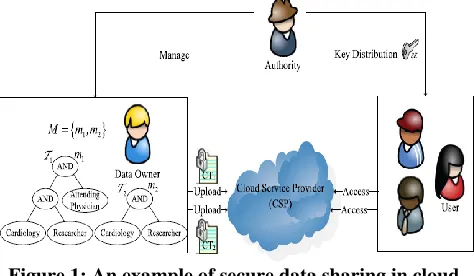
In cloud computing, as illustrated in Fig. 1, authority accepts the user enrollment and creates some parameters. Cloud service supplier (CSP) is that the manager of cloud servers and
provides multiple services for shopper. info owner encrypts and uploads the generated ciphertext to CSP.
Figure 1: An example of secure data sharing in cloud computing
User downloads and decrypts the interested ciphertext from CSP. The shared files generally have hierarchical data structure. That is, a bunch of files area unit divided into style of hierarchy subgroups placed at all totally different access levels. If the files at intervals constant system may be encrypted by associate integrated access structure, the storage value of ciphertext and time value of cryptography may be saved.
In this study, a cost-effective cryptography theme supported stratified model of the access structure is projected in cloud computing, that's referred to as file hierarchy CP- fundamentals theme (or CP- fundamentals, for short. FH-CP- fundamentals extends typical FH-CP- fundamentals with an information structure of access policy, thus on reach easy, versatile and fine-grained access management. The contributions of our theme area unit 3 aspects:
1) Firstly, we have a tendency to tend to propose the stratified model of access structure to unravel the matter of multiple gradable files sharing. The files area unit encrypted with one integrated access structure.
below the Decisional additive Diffie-Hellman (DBDH) assumption.
3) Thirdly, we have a tendency to tend to conduct and implement comprehensive experiment for FH-CP- fundamentals theme, and thus the simulation results show that FH-CP- fundamentals has low storage value and computation quality in terms of cryptography and cryptography.
It got to be detected that the projected theme differs from the following CP- fundamentals schemes, that utilize the user stratified model to distribute the work of key creation on multiple domain authorizations and lighten the burden of key authority
II.
RELATED WORKSExisting System
Sahai and Waters planned fuzzy Identity-Based Cryptography (IBE) in 2005 that was the model of fundamental principle. Latterly, a variant of fundamental principle named CP-ABC was planned. Since aristocracy and Silverberg planned the first notion of stratified cryptography theme, many stratified CP-ABC schemes area unit planned. as associate example, Wang et al. planned a stratified fundamental principle theme by combining the stratified IBE and CP-ABC. Wan et al. planned stratified fundamental principle theme. Later, Zou gave a stratified fundamental principle theme, whereas the length of secret secret's linear with the order of the attribute set. A ciphertext policy stratified fundamental principle theme with short ciphertext is to boot studied. In these schemes, the parent authorization domain governs its child authorization domains and a ranking authorization domain creates secret key of the next-level domain. The work of key creation is distributed on multiple authorization domains and conjointly the burden of key authority center is lightened.
At present, there area unit three types of access structures gate, access tree, and linear secret sharing theme (LSSS) utilized in existing CP-ABC schemes. Cheung and Newport initial used gate access structure to achieve CP-ABC theme. Later, some improved schemes area unit planned. Meanwhile, there area unit CP-ABC schemes supported access tree that support AND, OR, and threshold, and supported LSSS, where and area unit the quality schemes of access tree and LSSS.
Other CP-ABC schemes with specific choices area unit presented. as associate example, Hur planned associate data sharing theme to unravel the matter of key agreement by exploitation associate written agreement free key supply protocol between the key generation center and conjointly the information storing center. inexperienced et al. and Lai et al. planned CP-ABC schemes with outsourced decryption to chop back the work of the decryption user. And Fan et al. planned associate arbitrary-state fundamental principle theme to resolve the matter of the dynamic membership management. to boot, Guo et al. planned a singular constant-size decryption key CP-ABC theme for storage-constrained devices. Hohenberger associated Waters planned associate online/offline fundamental principle theme to reinforce the
speed of key generation and cryptography, where each computation processes is split into 2 halfs: offline part (a preparation section) and on-line phase.
Disadvantages of Existing System
In Existing System
Time and cost for encryption is high.
No any special multiple hierarchical files are used.
Decryption system time and computation cost are very high.
III.
PROPOSED SYSTEMIn this study, associate economical cryptography theme supported superimposed model of the access structure is planned in cloud computing, that's referred to as file hierarchy CP-ABC theme (or FH-CP-ABC, for short). FH-CP-ABC extends typical CP-ABC with a knowledge structure of access policy, so on succeed simple, versatile and fine-grained access management. The contributions of our theme unit of measurement three aspects. Firstly, we tend to tend to propose the superimposed model of access structure to unravel the matter of multiple graded files sharing. The files unit of measurement encrypted with one integrated access structure. Secondly, we tend to tend to in addition formally prove the protection of FH-CP-ABC theme which is able to successfully resist chosen plaintext attacks (CPA) below the Decisional linear Diffie-Hellman (DBDH) assumption. Thirdly, we tend to tend to conduct and implement comprehensive experiment for FH-CP-ABC theme, and conjointly the simulation results show that FH-CP-ABC has low storage worth and computation complexity in terms of cryptography and coding.
Advantages of Proposed System
CP-ABC attainable schemes that incorporates a heap offlexibility and is additional applicable for general applications Multiple hierarchic files sharing unit resolved pattern superimposed model of access structure. In planned system every ciphertext storage and continuance of coding unit saved. The planned theme incorporates a bonus that users can decipher all authorization files by computing secret key once. Thus, the continuance of decryption is to boot saved if the user needs to decipher multiple files. The computation worth of decryption may be reduced if users ought to be compelled to decipher multiple files at an identical time.
Figure 2: Proposed System Architecture
System Design
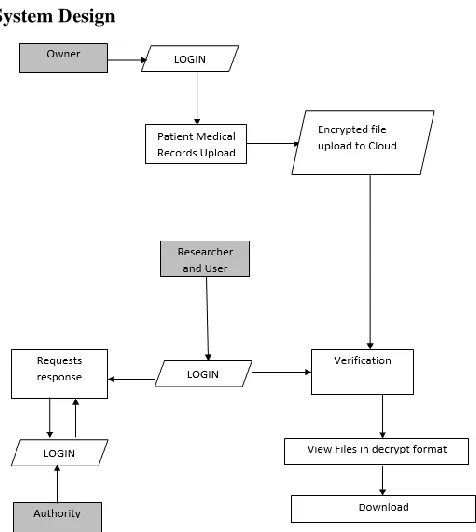
Figure 3: Process flow of the proposed System
Figure 4: UML diagram of the proposed system
IV.
MODULESRegistration
In this module ancient registration for the multiple users. There square measure multiple house owners, multiple AAs, and multiple users. The attribute hierarchy of files – leaf nodes
is atomic file categories whereas internal nodes square measure compound categories. Dark boxes ar the categories that a PSD’s data reader have access to Encrypted data. Ciphertext-policy attribute-based cryptography (CP-ABC) has been a most well liked cryptography technology to resolve the troublesome disadvantage of secure information sharing in cloud computing
Upload files
In this module, users transfer their files with secure key prospects. The house owners transfer ABE-encrypted PHR files to the server. each owner’s PHR file encrypted every beneath a particular fine grained model.
ABE for Fine-grained Data Access Control
In this module ABE to grasp fine-grained access management for outsourced info notably, there has been Associate in Nursing increasing interest in applying ABE to secure electronic health care records (EHRs). Associate in Nursing attribute-based infrastructure for EHR(Electronic Health Records) systems, where each patient’s EHR files ar encrypted using a broadcast variant of CP-ABE that allows direct revocation. However, the cipher text length grows linearly with the quantity of worldwide organization revoked user in an exceedingly very variant of ABE that allows delegation of access rights is projected for encrypted EHRs(Electronic Health Records) applied cipher text policy ABE (CP-ABE) to manage the sharing of PHRs, and introduced the conception of social/professional domains investigated exploitation ABE to induce self-protecting EMRs, which can either be hold on on cloud servers or cell phones therefore EMR could also be accessed once the health supplier is offline.
Setup and Key Distribution
In this module the system first defines a typical universe of data attributes shared by every PSD, like “basic profile”, “medical history”, “allergies”, and “prescriptions”. Associate in nursing emergency attribute is to boot printed for break-glass access.
Every PHR owner’s shopper application generates its corresponding public/master keys. the final public keys could also be discovered via user’s profile in an online health care social-network (HSN)
There square measure two ways in which during which for distributing secret keys.
1) First, once initial exploitation the PHR service, a PHR owner can specify the access privilege of Associate in Nursing info reader in her PSD, and let her application generate and distribute corresponding key to the latter, in an exceedingly very technique resembling invitations in GoogleDoc.
ABC to induce the user secret key that embeds her access structure.
Break-glass module
In this module once associate degree emergency happens, the regular access policies couldn't be applicable. To handle this instance, break-glass access is needed to access the victim’s PHR. In our framework, each owner’s PHR’s access right is to boot delegated to associate degree emergency department erectile dysfunction to stop from abuse of break-glass chance, the emergency workers must contact the erectile dysfunction to verify her identity and thus the emergency state of affairs, and acquire temporary browse keys. Once the emergency is over, the patient can revoke the emergent access via the erectile dysfunction.
VI.
CONCLUSIONIn this paper, we tend to planned a variant of CP-ABC to with efficiency share the hierarchical files in cloud computing. The hierarchical files are encrypted with AN(Authorized) integrated access structure and additionally the ciphertext components related to attributes could be shared by the files. Therefore, every ciphertext storage and note value of cryptography are saved. The planned theme encompasses a bonus that users can rewrite all authorization files by computing secret key once. Thus, the note value of secret writing is to boot saved if the user needs to rewrite multiple files. Moreover, the planned theme is verified to be secure below DBDH assumption.
REFERENCES
[1] C.-K. Chu, W.-T. Zhu, J. Han, J.-K. Liu, J. Xu, and J. Zhou, “Security concerns in popular cloud storage services,” IEEE Pervasive Comput., vol. 12, no. 4, pp. 50–57, Oct./Dec. 2013.
[2] T. Jiang, X. Chen, J. Li, D. S. Wong, J. Ma, and J. Liu, “TIMER: Secure and reliable cloud storage against data re-outsourcing,” in Proc. 10th Int. Conf. Inf. Secur. Pract. Exper., vol. 8434. May 2014, pp. 346–358.
[3] K. Liang, J. K. Liu, D. S. Wong, and W. Susilo, “An efficient cloudbased revocable identity-based proxy re-encryption scheme for public clouds data sharing,” in Proc. 19th Eur. Symp. Res. Comput. Secur., vol. 8712. Sep. 2014, pp. 257–272.
[4] T. H. Yuen, Y. Zhang, S. M. Yiu, and J. K. Liu, “Identity-based encryption with post-challenge auxiliary inputs for secure cloud applications and sensor networks,” in Proc. 19th Eur. Symp. Res. Comput. Secur., vol. 8712. Sep. 2014, pp. 130–147.
[5] K. Liang et al., “A DFA-based functional proxy re-encryption scheme for secure public cloud data sharing,” IEEE Trans. Inf. Forensics Security, vol. 9, no. 10, pp. 1667–1680, Oct. 2014.
[6] An Efficient File Hierarchy Attribute-BasedEncryption Scheme in Cloud Computing, IEEE TRANSACTIONS ON INFORMATION FORENSICS AND SECURITY, VOL. 11, NO. 6, JUNE 2016
[7] J. K. Liu, M. H. Au, X. Huang, R. Lu, and J. Li, “Fine-grained twofactor access control for Web-based cloud computing services,” IEEE Trans. Inf. Forensics Security, vol. 11, no. 3, pp. 484–497, Mar. 2016.
[8] A. Sahai and B. Waters, “Fuzzy identity-based encryption,” in Advances in Cryptology. Berlin, Germany: Springer, May 2005, pp. 457–473.
[9] V. Goyal, O. Pandey, A. Sahai, and B. Waters, “Attribute-based encryption for fine-grained access control of encrypted data,” in Proc. 13th ACM Conf. Comput. Commun. Secur., Oct. 2006, pp. 89–98.