ISSN (Print) : 2320 – 3765 ISSN (Online): 2278 – 8875
I
nternational
J
ournal of
A
dvanced
R
esearch in
E
lectrical,
E
lectronics and
I
nstrumentation
E
ngineering
(An ISO 3297: 2007 Certified Organization)
Vol. 5, Issue 4, April 2016
Optimization of Wireless Sensor Networks
Using Advanced Clustering Approach
A.Vigneswaran 1, Vaidyanathan2, Geethapriya3
Assistant Professor, Department of Electronics and Communication Engineering, SKP Engineering College
Tiruvannamalai, Tamilnadu, India1
Associate Professor, Department of Electronics and Communication Engineering, SKP Engineering College
Tiruvannamalai, Tamilnadu, India 2, 3
ABSTRACT: The past few years shows increased interest in Wireless Sensor Networks in a wide range of applications. Many clustering schemes have been proposed to reduce the traffic and increasing lifetime. Such algorithms do not provide how the Cluster Heads (CH) are elected with optimal Cluster Ratio (CR). Improper choice of CR leads to reduction in network lifetime. Also improper cluster division with isolated nodes increases energy. To overcome this, an advanced clustering approach is proposed. This approach analyzes CR in terms of CHs. By calculating the energy consumption, optimal number of CHs is elected without any isolated nodes. Multi-hop communication preserves the coverage and energy of the network. The multi-user clustering protocol behaves as one representative form of energy-aware clustering algorithm. Simulation results show that multi-hop with modified clustering protocol prolongs the network lifetime and enhances energy efficient in heterogeneous WSNs.
KEYWORDS: Cluster Ratio, Multi-hop, isolated node, Optimal Cluster Head, energy-efficient.
I.INTRODUCTION
A Wireless Sensor Network is popular network used to transfer data packets without any wired medium. It contains a sensing module inside a sensor node, which is used to sense the data and transfer it through wireless media. It also consists of microprocessor, to processes data and control functionality. In addition, it consists of a memory, to store data, a power source, which behaves as a battery to a sensor node.
In order to transfer a data packet from source to base station, each and every node must be aware and transfer the data at early stage. Hence it consumes energy for all nodes; even the node is not included in on-time transmission. Hence huge energy is required as well as network lifetime is reduced. Later, clustering schemes are introduced, which refers to collectively form a group of nodes. Clusters are formed based on many techniques, by analyzing node’s energy, by calculating node’s efficiency, etc., as in [1], and one advanced form is analyzing Cluster Ratio. It is defined as the ratio between numbers of Cluster Heads to the total number of nodes. Analyzing CR is the effective way for dividing sensor network into clusters.
In each cluster, CHs can be steady for all rounds or rotated for each round as per the residual energy. CH is responsible for gathering sensed data from its CMs. The working and election of CH are deeply explained in [2]. Similarly, all other cluster members behave under the authority of CH. Any node’s energy which is less than the threshold energy of the node is considered to be ignored. Rechargeable and replaceable battery in sensor networks is difficulty.
Sensor networks can be categorized into homogenous-same type of nodes and equal sized clusters or heterogenous- different types of nodes with unequal clusters. In addition, networks may be static or dynamic[3], single hop or multi-hop transmission.
In each clustered network, two phases are there: set-up phase and steady-state phase. In set-up phase, nodes deployment and cluster formation setups are used. In steady-state phase CHs and CMs are elected and transmission is continued. This paper concentrates mainly on second steady-state phase.
ISSN (Print) : 2320 – 3765 ISSN (Online): 2278 – 8875
I
nternational
J
ournal of
A
dvanced
R
esearch in
E
lectrical,
E
lectronics and
I
nstrumentation
E
ngineering
(An ISO 3297: 2007 Certified Organization)
Vol. 5, Issue 4, April 2016
II. RELATED WORK
Clustering schemes provide much better performance than individual node transmissions. Clusters are formed by using many clustering protocols. In that, LEACH-low energy adaptive clustering hierarchy[4], is the first-formed protocol, which uses the CHs as routers. But it doesn’t guarantee about the charge of the node as well as uniform distribution of the node.
Many advanced form of LEACH protocols[5] are proposed. i.e., LEACH-D,E and so on. Good things cannot be good alone. Likewise, even many advanced protocols have been proposed, it includes both advantages and disadvantages.
In [6], the authors proposed an algorithm to prolong the network lifetime of isolated nodes, which doesn’t belongs to any cluster. Due to improper division of clustered network, there may be a possibility of occurrence of isolated nodes. Isolated nodes are also created due to unaware of the user when analyzing the cluster in the sensor networks. It consumes more energy than any clustered node to make transmission. Hence the authors use REAC-IN protocol that elects CHs based on weight, residual energy of each node and regional average energy.
Data packet can be transferred using two ways: between the clusters and within the clusters. In [7], Koteeswararao, Shailaja and Madhu proposed multi-hop cluster based routing protocol. For large networks, single hop transmission is difficult to use. It consumes much energy and reduces the network lifetime. Using multi-hop protocol offers better performance and enhances the node’s lifetime. It transmits the data over the Base Station through several CHs. It ignores gateway nodes and makes transmissions with the rest of the nodes. Kumar, Ahuja and Bhushan et.al [8] proposed MEECDA algorithm in which they used multi-hop transmission. It combines both the idea of multi-hop and clustering to provide better performance. But it doesn’t analyze Cluster Ratio to divide the network. In [9], the authors proposed a multi-hop routing protocol on uneven, un sized clustering algorithm. It is on the basis of LEACH protocol. Hence energy is not guaranteed.
In [10], Kour and Sharma et.al. proposed the advance form of HEED which includes heterogeneous clustered networks. This algorithm is used in two-hop, three-hop and also in multi-hop transmission in terms of node’s energy. This method provides better performance compared to HEED.
For ad-hoc sensor networks, in [11], the authors proposed HEED protocol to enhance the long-lived networks. But this approach is applicable only for two-level hierarchy. It doesn’t obey multi-level hierarchy. In [12], Bandyopadhyay and Coyle proposed an algorithm for efficient hierarchical algorithm for sensor networks. Though this paper calculates optimal CR, it valid only for contention-free and error-free environment. And it is questioned for lossy environment. In [13],Kim et.al. proposed a clustering scheme for self organizing distributed networks. It analyzes the optimal clusters by novel probability function, but only for single-hop only. For multi-hop clusters, it is not applicable.
In [14], Jin, Kim and Cho et.al. proposed optimal CR in clustered sensor networks. It analyzes the CR by calculating the transmission count and link reliability. Though it behaves as a good approach, improper choice of CR leads to isolated nodes. This isolated node take too much of energy to transmit as well as reduces the network lifetime. In the overall existing schemes, they possess not only advantages, but also some disadvantages. Some authors proposed multi-hop communication, but CR is not analyzed. While some proposed CR calculation, but no way if isolated nodes were formed. Hence, this paper proposes an advanced clustering approach which analyzes optimal Cluster Ratio with tri advantages in sensor networks. This algorithm uses HEED protocol with multi-hop level communication. It also uses in isolated node network. Also it analyzes the nodes for each round to found out the active, sleepy and inactive nodes.
III. PROPOSED SYSTEM
This section presents the proposed method, which is more convenient for wireless sensor networks. A. CR BASED CLUSTER SCHEME
ISSN (Print) : 2320 – 3765 ISSN (Online): 2278 – 8875
I
nternational
J
ournal of
A
dvanced
R
esearch in
E
lectrical,
E
lectronics and
I
nstrumentation
E
ngineering
(An ISO 3297: 2007 Certified Organization)
Vol. 5, Issue 4, April 2016
and CM are elected with the help of HEED protocol. HEED protocol defines one hybrid protocol, since it uses the node’s residual energy as well as node’s neighbourhood degree. The steps including cluster formation and CH election are termed as set-up phase. In the steady-state phase, CR is analyzed.
Z = CH¡ / N
Where Z is the Cluster Ratio, CH¡ is the number of Cluster Heads and N is the total number of nodes in the network.
By analyzing CR, if isolated nodes are formed, then re-cluster the network and again analyzed the CR. This project suits for heterogeneous network with homogenous cluster. Every node assigns an ID number by CH, which is used to call randomly if that node contains any information.
B. Multi-hop based cluster scheme
Our existing method uses communication only for single user. One more cluster needs the same information means, again the Source Cluster sends the same to the needed user. This consumes much energy as well as time consumption. Network traffic is also heavy. Hence this paper proposes multi-hop communication which means same data can be send simultaneously to the needed users without any packet loss. Recipient clusters receive the needed information simultaneously without any loss and time difference.
The flowchart in Figure 1 shows how data communication is happened when analyzing CR. Initially, when a node receives initialization message, CR is analyzed based on optimal derivation. Check whether isolated nodes are created. If so, again analyze the CR in terms of CH. Otherwise, CH is elected based on HEED protocol.
ISSN (Print) : 2320 – 3765 ISSN (Online): 2278 – 8875
I
nternational
J
ournal of
A
dvanced
R
esearch in
E
lectrical,
E
lectronics and
I
nstrumentation
E
ngineering
(An ISO 3297: 2007 Certified Organization)
Vol. 5, Issue 4, April 2016
After electing the CH, Source Cluster wanders any more recipient cluster. If yes, then it sends the data in multi-hop to all the users, otherwise single hop is used. After data is communicated, this process is repeated for upcoming round. Before next transmission, nodes are inspected thoroughly for the status of active, sleep or idle.
IV. PERFORMANCE EVALUATION
Our simulations are done in Network Simulator-3(ns -3). It is an advanced form of ns-2.
Figure 2.Data in multi-hop communication
The above window shows cluster division based on Optimal CR and data can be sent over several users using multi-hop technique. Source Cluster takes much responsibility on selecting the required data receivers and sends it simultaneously.
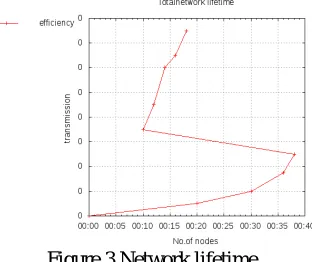
Figure 3. shows the graphical notification for network lifetime. Data transmits in multi-hop saves the energy consumption and hence increases the network lifetime gradually.
Figure 3.Network lifetime
ISSN (Print) : 2320 – 3765 ISSN (Online): 2278 – 8875
I
nternational
J
ournal of
A
dvanced
R
esearch in
E
lectrical,
E
lectronics and
I
nstrumentation
E
ngineering
(An ISO 3297: 2007 Certified Organization)
Vol. 5, Issue 4, April 2016
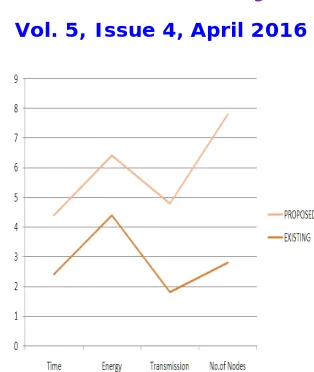
Figure 4.Comparison graph for energy consumption
V. CONCLUSION
This paper presents an advanced clustering approach that analyzes CR in multi-hop communication. This method is also applicable to isolated node environment, which converts that isolated node into a clustered node. Simulation results showed that, using multi-hop technique reduces the power consumption as well as enhances network lifetime. Our future work extends to analyze optimal CR in contention network in terms of rotatable CHs in dynamic network environment.
REFERENCES
[1]Hossein Jadidoleslamy, “An introduction to Basic Concepts of Clustering Techniques on Wireless sensor Networks,” International Journal of Mobile Network Communication and Telematics, Vol. 3, No. 1, February 2013
[2] Manjusha M.S and Kannammal K.E, “Efficient Cluster Head Selection method for Wireless Sensor Networks,” International Journal of Computational Engineering Research|| Vol, 4|| Issue, 2||
[3] Prashant Krishan, “A Study on Dynamic and Static Clustering Based Routing Schemes for Wireless Sensor Networks,” International Journing of Modern Engineering Research, Vol.3, Issue.2, March-April 2013.pp-1100-1104.
[4] Wendi B. Heinzelman, Member, IEEE, Anantha P. Chandrakasan Senior Member, IEEE, and Hari Balakrishnan, Member, IEEE, “An Application-Specific Protocol Architecture for Wireless Microsensor Networks,” IEEE Transactions on Wireless Communications, Vol. 1, No.4, October 2002
[5] Santosh.Irappa.Shirol, Ashok Kumar.N, Kalmesh.M.Waderhatti, “Advanced-LEACH Protocol of Wireless sensor Network,” International Journal of Engineering Trends and Technology-Volume4 Issue^-June 2013
[6] Jenq-Shiou Leu, Member, IEEE, Tung-Hung-Chiang, Min-Chieh Yu and Kaun-Wu Su, “Energy Efficient Clustering Scheme for Prolonging the Lifetime of Wireless Sensor Network with Isolated Nodes,” IEEE Communications Letters, Vol.. 19, No.2, February 2015
[7] Koteswararao.S, Sailaja.M and Madhu.T, “Imlementation of Multi-hop Cluster based Routing Protocol for Wireless Sensor Networks,” International Journal of Computer Applications(0975-8887)Vol 59-No.8, December 2012
[8] Surendar Kumar, Prateek. M, Ahuja N.J and Bharat Bhushan, “MEECDA : Multi-hop Energy Efficient Clustering and Data Aggregation Protocol for HWSN,” International Journal of Computer Applications(0975-8887)Vol 88-No.9, February 2014
[9] Qiulaun Li, Guohua Zhan, Zhihua Li, “Novel multi-hop Routing algorithm based on uneven clustering,” 2013 Fourth International Conference on Networking and Distributed Computing
[10] Harneet Kour and Ajay K.Sharma, “Hybrid Energy Efficient Distributed Protocol for Heeterogeneous Wireless Sensor Networks,” International Journal of Computer Applications(0975-8887)Vol 4-no.6, July 2010
[11] Ossama Younis and Sonua Fahmy, “HEED: A Hybrid, Energy-Efficient, Distributed Clustering Approach for Ad Hoc Sensor Networks,” IEEE Transactions on Mobile Computing, vol 3, no.4, October-December 2004
[12] Seema Bandyopadhyay and Edward J.Coyle, “An Energy Efficient Hierarchical Clustering Algorithm for Wireless Sensor Networks,” 0-7803-7753-2/30/$17.00(C) 2003 IEEE
[13] Kyung Tae Kim, Han Ku Yoo, Byung Ha Son, and Hee Yong Youn, “An Energy Efficient Clustering Scheme for Self-Organizing Distributed Wireless Sensor Networks,” 2010 10th International Conference on Computer and Information Technology(CIT 2010)