ISSN 2286-4822 www.euacademic.org
Impact Factor: 3.4546 (UIF) DRJI Value: 5.9 (B+)
Optimal utilization of satellite bandwidth by using
output back off
ATIF OSMAN BAKHEIT University of Medical Sciences & Technology Khartoum, Sudan HEISUM MUHAMAD EWAD University of Medical Sciences & Technology Khartoum, Sudan ABDALMAHMOUD ALI ABD ALLA University of Medical Sciences & Technology Khartoum, Sudan
Abstract:
A satellite transponder having finite resources in terms of bandwidth and power, leasing costs are determined by bandwidth and power used. For optimal utilization, a satellite circuit should be designed to use similar share of transponder bandwidth and transponder power.
The main objectives are summarized in determining the appropriate space in the satellite channels to avoid the both, high financial costs and weak performance, avoiding the effects of parameters in BW determination, and making the output back off (OBO) as a core measure of operation .
Two options (A) and (B) integration are presented toward providing developed in maintaining the optimization whatever parameters changes are occurred.
Option (B): is how to obtain an optimization by equality of the both transponder BW and Power Equivalent Bandwidth (PEB), in the light of this condition, the main contribution is obtained by revealed mathematical equation that leads to such optimization in regardless of changes in parameter(keeping the BW in fixed without effected by any changes in the link).
Finally, a test is taken under various conditions to validate our options.
Key words: transponder power, making the output back off (OBO) as a core measure of operation, Forward Error Correction (FEC), and modulation, leased BW for duplex link is greater of PEB or BW, for which is determine by the OBO, and keeping the BW in fixed without effected by any changes in the link.
1-INTRODUCTION
Once the satellite and earth station parameters are fixed, the traditional approach to balancing a satellite circuit involves trade-off between modulation and coding. A lower order modulation requires less transponder power while using more bandwidth. Conversely, higher order modulation reduces required bandwidth, but at a significant increase in power. (1)
Communication using satellite, much like all wireless communication, carry signals using electromagnetic waves the difference being that satellites relay signals around the Earth‟s curve. In order to prevent signal interference from occurring, there are regulations imposed by international organizations to limit the bands of frequency that companies or individuals are permitted to use.
communication in general. To optimize the discussed parameters, we will be using a set of codes and modulation types that fall under FEC and QPSK techniques. Our main objective is to enhance satellite performance by calculating the optimum bandwidth and power for new launched businesses and studying the already existing bandwidth of companies in order to determine if it is optimal or not.(2)
The Antenna Coverage Area, EIRP, Power per Backhaul Carrier, and Spurious Outputs achieve payload system performance or performance parameters. (14)
2- Modulation:
2.1 Binary Phase Shift Keying (BPSK):
In BPSK, the transmitter selects one of two phases for the carrier, e.g. −π/2 for “0” and π/2 for “1”. The transmitter does the same mixing with a sinusoid as explained earlier. The receiver computes the I and Q components from its received waveform, as before. (15)
2.2 Quadrature Amplitude Modulation (QAM):
QAM may be viewed as a generalization of QPSK (in fact, QPSK is sometimes called QAM4). One picks additional points in the constellation, varying both the amplitude and the phase. (16)
2- Carrier –in-Carrier:
Once the satellite and earth station parameters are fixed, the traditional approach to balancing a satellite circuit involves trade-off between modulation and coding. A lower order modulation requires less transponder power while using more bandwidth. Conversely, higher order modulation reduces required bandwidth, but at a significant increase in power. Comtech EF Data has added a new dimension to satellite communication optimization – Doubletalk Carrier-in-Carrier(CnC). This innovative technology provides a significant improvement in bandwidth and power utilization, beyond what is possible with forward error correction (FEC) and modulation alone, allowing users to achieve unprecedented savings. When combined with advanced Modulation and FEC, it allows for multi-dimensional optimization:
a) Reducing OPEX
b) Occupied Bandwidth & Transponder Power c) Reducing CAPEX
d) BUC/HPA Size and/or Antenna Size
e) Increasing throughput without using additional transponder resources
f) Increasing link availability (margin) without using additional transponder resources
g) Or, a combination to meet different objectives
3- Asymmetric Data Rate Link
As occupied (or allocated bandwidth) of a Carrier-in-Carrier circuit is dictated by the larger of the two carriers, it is strongly recommended that the smaller carrier be spread as much as possible using a lower order modulation and/or FEC, while meeting the PSD ratio spec. Spreading the smaller carrier using a lower order modulation has multiple benefits:
1. Lower order modulation is always more robust 2. Lower order modulation uses less transponder power 3. Reduces total transponder
5. Lower order modulation uses less transmit power on the ground
6. This can significantly reduce the BUC/SSPA size by not only reducing the transmit EIRP, but (1)
4- Bandwidth versus power
If the allocated bandwidth of a satellite service (the amount of bandwidth calculated, taking into account symbol rate and the satellite filter roll-off) requires more power to support aservice, then typically more bandwidth needs to be purchased to compensate for that extra power usage. The total Power Equivalent Bandwidth (PEB) would be the satellite occupied and width. This is referred to as being a „power limited‟ link budget. If the satellite service requires less power and the allocated bandwidth of the service is greater than the Power Equivalent Bandwidth (PEB), then this link budget is referred to as a „bandwidth limited‟ link budget.
Therefore, when a duplex SCPC service is designed and implemented, the total bandwidth (space occupied on a transponder) by both the carriers can be significant. By using more efficient coding and modulation on the satellite carriers, savings can be made on the amount of satellite bandwidth required, but in turn will require an increase in power. (2)
5-Antenna:
Antennas transmit and receive radio waves. They operate as matching devices from a transmission line to the free space and vice versa. An ideal antenna radiates all the power incident from the transmission line feeding the antenna. It radiates to (or receives from) desired directions; in other words, an antenna has a certain radiation pattern.
structures have been developed for different frequencies and applications. Antennas can be categorized, for example, into current element antennas, traveling-wave antennas, aperture antennas, and antenna arrays. (3)
6. Block Codes
When using block codes, the data to be transmitted is segmented into blocks of a fixed length k. To each block of the information message m, a certain amount of parity bits are added. The information bits and the parity bits together form the code words c of length n. (5)
Block codes work on static packets of bits of predetermined size. Practical block codes can be hard-decoded in polynomial time to their block length.
There are many types of block codes, the most important is Reed-Solomon coding because of its common used on the compact disc, the DVD, and in hard disk drives, Classical block codes are usually decoded using hard-decision algorithms, which means that for every input and output signal a hard decision is made whether it corresponds to a one or a zero bit. Nearly all classical block codes apply the algebraic properties of finite fields. Hence traditional block codes are referred to as algebraic codes. In compare to classical block codes that often require an error-detecting or error-correcting ability, many modern block codes such as LDPC codes lack such guarantees. Instead, modern codes are calculated in terms of their bit error rates.
6.1 Forward Error Correction:
FEC is accomplished by adding redundancy to the transmitted information using an algorithm. A redundant bit may be a complex function of many original information bits. The original information may or may not appear literally in the encoded output; codes that include the unmodified input in the output are systematic, while those that do not are non-systematic.
The forward error correction codes come in two main types, convolution and block. In a simple convolution encoder, a sequence of information bits passes through a shift register, and two output bits are generated per information bit. These two output bits are transmitted. Basically. Forward Error Correction (FEC) is a widely used method to improve the connection quality in digital communications and storage systems. The word “forward” in conjunction with error correction means the correction of transmission errors at the receiver side without needing any additional information from the transmitter. The main concept of FEC is to add a certain amount of redundancy to the information to be transmitted, which can be exploited by the receiver to correct transmission errors due to channel distortion and noise. Therefore, in the literature, the FEC coding is mostly described as channel coding. Shannon presented in his mathematical theory of communication that every transmission channel has a theoretical maximum capacity, which depends on the bandwidth and the signal-to-noise-ratio (SNR).
The capacity of implemented systems is mostly much smaller than the maximum possible value calculated by the theory. For this reason, the use of suitable codes has to allow further improvement in bandwidth efficiency.
6.2Convolution Codes
Therefore, as opposed to the block codes, which operate on finite-length blocks of message bits, a convolution encoder operates on continuous sequences of message symbols.(5)
A convolution coder is a finite memory system. The name „„convolution‟‟ refers to the fact that the added redundant bits are generated by mod-2 convolutions. (6)
6.3Turbo Codes
Turbo coding was introduced first in 1993 by Berrou [BerrGl93]. Extremely impressive results were reported for a code with a long frame length that is approaching the Shannon channel capacity limit. Since its recent invention, turbo coding has evolved at an unprecedented rate and has reached a state of maturity within just a few years because of the intensive research efforts of the turbo coding community. As a result, turbo coding has also found its way into standard systems, such as the standardized third-generation (3G) mobile radio systems [SteeHa99] and is being discussed for adoption for the video broadcast systems standards. The turbo encoders are based on a given type of the convolution encoders, called Recursive Systematic Convolution (RSC) encoders. (5)
Turbo codes are a new class of iterated decoding convolution codes with small memory order, which closely approach the theoretical limits imposed by Shannon's theorem. They have much less computational complexity than the Viterbi algorithm for decoding convolution codes with large constraint lengths, which would be required for the same error performance. This sort of codes, being introduced by Berrou, Glavieux and Thitimajshima, is also characterized by an increased bandwidth and power efficiency, when compared to the classical (non-iterative) FEC solutions.
6.3.1 Turbo Principle:
interleaves. The Turbo code Interleave permutes the information bit sequence and the output is passed to the second RSC encoder. The role of the interleave is to generate a long block code from convolution encoders with small memory orders. Also, it decor relates the Turbo decoder inputs (extrinsic information and channel values) by spreading out the burst errors. Finally, it breaks the low-weight input sequences and, hence, increases the free distance of the code.
The error performance is improved by increasing the interleave size. For RSC codes, an increase of the interleave and reduces the bit error probability. This is called interleaving performance gain. (7)
6.4 BCH and Reed-Solomon codes:
The BCH (Bose–Chaudhuri–Hocquenghem) codes are perhaps the most powerful and flexible group of cyclic error correction codes available design is straightforward: it uses shift register and logic circuits for coding and decoding. For instance, for a given block length n, codes can be designed with a number of gates and error correction capability. (6)
Reed-Solomon (RS) and Bose-Chaudhuri-Hocquenghem (BCH) schemes are a subset of the linear-cyclic block codes. Normally, they are used in a systematic manner, i. e., the redundant symbols - generated via an appropriate encoding algorithm to be explained in the sequel - are appended to the source data. The error coiTection capability is given by the generator polynomial. RS and BCH codes are strictly related; in fact, the former may be regarded as non-binary BCH codes.
Note also that RS codes are part of both the DVB-S and CCSDS standard, while BCH algorithms are recommended in the DVB-S2 standard.
as fast Fourier transform (FFT), both techniques are well established in digital signal processing. (8)
6.5 LDPC decoding
The sparseness of the parity check matrix of LDPC codes is crucial to the successful implementation of the decoder which makes use of iterative algorithms Indeed; the information about each edge in the graph must be calculated on each iteration of the decoding algorithm. The information for a particular edge depends on the degree of the nodes that are connected to it.
The state-of-the-art of channel coding has been reviewed, taking into account issues related to design, encoding and decoding. The most important techniques used for satellite applications have been presented, with particular emphasis on the developments over the last years, i.e., Turbo and LDPC codes. It has been shown how the iterative principle revolutionized the design of communications systems. In fact, apart from FEC decoders, receiver modules like equalizers are already exploiting this novel approach. In this respect, it is to be noticed that, in future receiver designs, estimation and synchronization tasks will be merged with powerful decoding algorithms. (7)
7- Bandwidth Reduction:
The bandwidth of the information-bearing signal on either the uplink or the downlink can be reduced during periods of intense attenuation, resulting in an increase in available carrier-to-noise ratio on the link. A reduction in bandwidth by one-half would result in a 3 dB carrier-to-noise improvement for that link.
Teledyne Paradise Datacom has introduced 5%, 10% and 15% spectral roll-off options (using root-raised-cosine filtering) on all Evolution, Quantum and Q-Series (Q-Flex and QLite) satellite modems with immediate effect. These new options significantly reduce the BW such as DVB-S2, DVB-S21, and DVB-S2X 786+the required allocated satellite bandwidth thereby directly reducing the operational costs associated with leasing transponder bandwidth.
a) 5% roll-off provides a 20% bandwidth saving compared to 35% roll-off.
b) 5% roll-off provides a 10% bandwidth saving compared to 20% roll-off.
c) When using the new roll-off factors no increase in Eb/No level is required to achieve the same BER performance. The new roll-off factors are available for all satellite services other than DVB-S2.
For DVB compliant systems the QAM/QPSK pass band spectrum is shaped by root raised cosine filtering with a roll-off factor.(19)
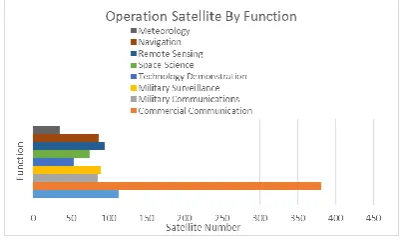
Of the 994 satellites on orbit, 38% are commercial communications satellites
• An additional 20% are civil government or military communications satellites
• The relative proportion comprised by communications satellites remained consistent from 2011 to 2012. (13)
Satellite industry:
The satellite industry is a subset of both the telecommunications and space industries and revenues represent 61% of space industry revenues and 4% of overall global telecommunications industry revenues.
The U.S. telecommunications spending experienced somewhat faster growth of 5.8% in 2011, following slower 2.4% growth in 2010 and a steep decline of 8.2% in 2009, while the overall global space spending rose by 4.8% in 2011, following 7.7% growth in 2010.(17)
Satellite operation into two objectives functional or orbital, as seen in following figures. (18)
8. Methodology:
8.1 Composite rate
Composite rate= data rate in case the data rate< 2 MB/S, else adding 0.96Kb/s as overhead, then:
…………(1)
Where DR ≡ Data rate and OH ≡overhead.
8.2 Transmission Rate (T.R):
( ) ……..(2)
Where T.R≡ Transmission rate, C.R ≡ Composite rate, M ≡ Modulation level
8.3 Symbol Rate S.R:
………(3)
Available EIRP (W) = 10(Transponder EIRP – OBO)/10……….(4)
( ) ( )
……(5)
PEB = 10(EIRP Carr.)/10/ Power Available …….(6)
( ) …………..(7)
………(8)(11)
………. (9)
( (
))
( ) (( (( ) ))
( )) … (11)
( ) ………. (12)
( ) …….. (13)
Results:
Appreciated selected values are: Available
Transp.(%) Oper. EIRP
OBO Data Rate
Satur. EIRP
Transp. BW
Space Carr. EIRP (dB)
FEC R.S LDPC Mod.
13.80384 1819.701 4.4 2.048 37 36 1.4 24 0.75 Non Non QPSK
The results can be divided into four optimization options:
Option (A): Determination of the required allocated transponder bandwidth, the option is ensure the truth required bandwidth is directly proportional to the codes.
So, no relation between PEB and allocated transponder BW, each has individually parameters, specially, the OBO as manually (assumption).
Optimization option (B): Creation of the optimization, this option is accomplished mathematically through equation, by which, OBO is explored as adjusting, to achieve the optimization link:
From which:
Relation between the power and BW is created, not impact by any effected parameters.
problem of this optimization is that, the parameters that affect the PEB, surely will affect the BW, for this reason, we achieved variable values of BW due these parameters.
Optimization option (C): This option is specialized in solving the previous problem, so the fixed value of BW is obtained in regardless of changes, this accomplished by controlling in the TCP.
Therefore, these previous aspects are reached by studying the affection of the following:
4.1 TCP (Without Optimization):
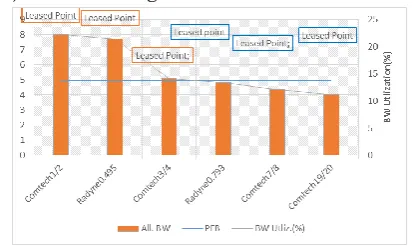
The graph below shows the PEB is linear, this means TCP has no effect in PEB and inversely with BW and the assumption of OBO (4.4 dB) is controlling in the leased.
Figure 1. Impact of TCP in all. BW (without Optim)
4.1.2 Option (B&C): With enhanced optimization:
The below figure show that, the equality of PEB with BW through automatic controlling in OBOkeeping the link in optimization state, in regardless of any changing in the effected parameters.
11.17816% of all. BW, PEB, available transponder power and BW correspondence respectively all through 3.4837 dB of OBO.
Figure 2.Equality of PEB with BW through automatic
4.1.3 Impact of FEC in all. BW and PEB: 1- Option- A (Without optimization):
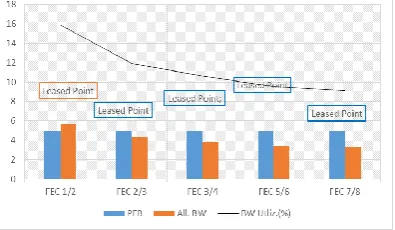
Inequality of BW and PEB leaded to create the link without optimization, so the leased point must be determined as shown in the figure blew.
Figure 3.Impact of FEC in all. BW and PEB
4.1.2 Option (B&C): With enhanced optimization:
The below figure show that, the equality of PEB with BW through automatic controlling in OBO keeping the link in optimization state, in regardless of any changing in the effected parameters.
(FEC 7/8) is used, 3.2768 MHz, 3.2768 dBW/W, 9.1% of all. BW, PEB, available transponder power and BW correspondence to 36 MHz respectively. All through 2.591474 dB of OBO.
Figure 4. Option (B&C): With enhanced optimization
4.4.1 Option - A (Without optimization):
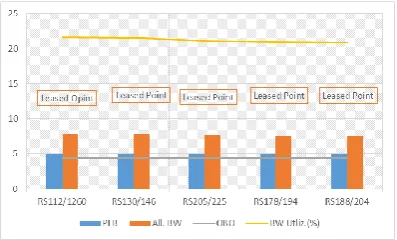
Inequality of BW and PEB leaded to create the link without optimization, so the leased point must be determined as shown in the figure blew. The leased point s are concentrated on allocated BW because the selection of OBO value is small (4.4 dB).
Figure 5a. Option - A Without optimization
Figure 5b. Option - A Without optimization
4.4.2 Option B&C with enhanced optimization:
The below figure show that, the equality of PEB with BW through automatic controlling in OBO keeping the link in optimization state, in regardless of any changing in the effected parameters.
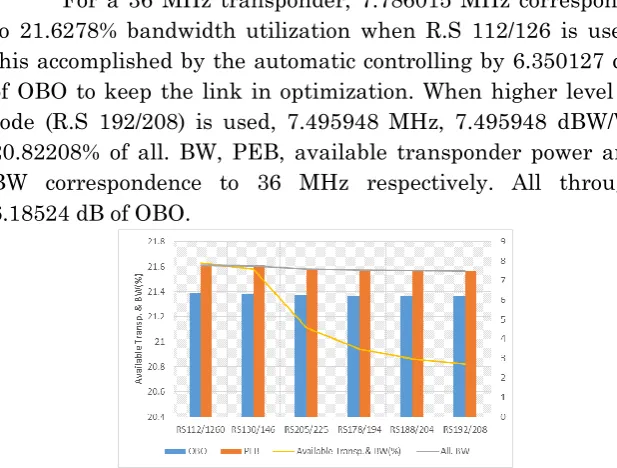
For a 36 MHz transponder, 7.786015 MHz corresponds to 21.6278% bandwidth utilization when R.S 112/126 is used, this accomplished by the automatic controlling by 6.350127 dB of OBO to keep the link in optimization. When higher level of code (R.S 192/208) is used, 7.495948 MHz, 7.495948 dBW/W, 20.82208% of all. BW, PEB, available transponder power and BW correspondence to 36 MHz respectively. All through 6.18524 dB of OBO.
4.4.1 Option - A (Without optimization):
Inequality of BW and PEB leaded to create the link without optimization, so the leased point are occupied by the allocated BW once have higher value rather than PEB. The leased point s are concentrated on allocated BW because the selection of OBO value is low (4.4 dB).
Figure 6a. Option - A Without optimization
When OBO is increased to be 8.312 dB, the optimum link is obtained, but greater than a value the leased point is turned toward PEB instead of allocated BW when LDPC 5/16 is used.When OBO is decreased to be 3.48 instead of 4.4 dB, the optimum link is obtained when LDPC 0.95 is used, as in the following figure:
Figure 6b. Option - A Without optimization
4.4.2 Option B&C with enhanced optimization:
optimization state, in regardless of any changing in the effected parameters.
For a 36 MHz transponder, 12.2333 MHz corresponds to 33.9816% bandwidth utilization when LDPC 5/16 is used, this accomplished by the automatic controlling by 8.31244 dB of OBO to keep the link in optimization. When higher level of code (LDPC 0.95) is used, 4.024142 MHz, 4.024142 dBW/W, 11.1782% of all. BW, PEB, available transponder power, and BW correspondence to 36 MHz respectively. All through 3.4837 dB of OBO.
Figure 7. equality of PEB with BW through automatic controlling in OBO
Figure 8. Increasing in the carrier EIRP
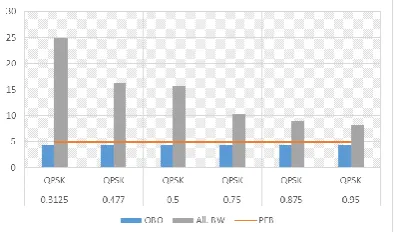
For ensuring the operation of the OBO equation for working with combination codes, the figure show the different types of codes with different values, the optimum link is obtained.
Figure 9. Different types of codes with different values
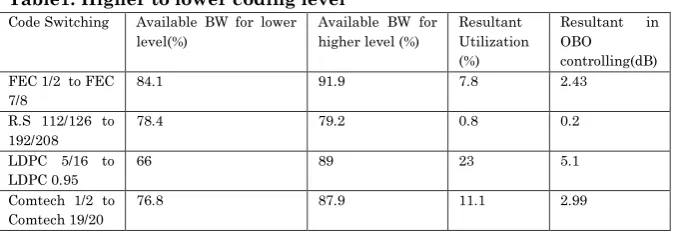
In general, we can say that, the switching from higher to lower coding level combining with FEC 3/4, the following results are obtained:
Table1. Higher to lower coding level
Code Switching Available BW for lower
level(%)
Available BW for higher level (%)
Resultant Utilization (%)
Resultant in
OBO controlling(dB) FEC 1/2 to FEC
7/8
84.1 91.9 7.8 2.43
R.S 112/126 to 192/208
78.4 79.2 0.8 0.2
LDPC 5/16 to LDPC 0.95
66 89 23 5.1
Comtech 1/2 to Comtech 19/20
CONCLUSION:
The paper is studied the roll of coding in the satellite link into two options, and used the OBO parameter as controller to maintaining the optimum link. In case of no optimum has different leased points.
The main contribution is how to achieve the optimal satellite link through controlling in the OBO parameter, so the paper is revealed the important mathematic equation created the equality of PEB and allocated BW through automatic controlling in OBO by keeping the link in optimization state, in regardless of any changes in the parameters.
Higher value than this optimal, the leased points is turned toward PEB instead of allocated BW.
Putting in consideration that, the OBO has limited value for controlling and maintaining the optimization link in optimal, since the negative value leaded to nonlinear operational and distortions. On the other hand, the higher OBO is risk and the lower is decreasing in BW.
Higher level of coding, gave min. BW and higher available percentage which are controlling through minimum value of OBO and vice versa, as when OBO is increased to be 8.312 dB, the optimum link is obtained, but greater than this value the leased point is turned toward PEB instead of allocated BW in case LDPC 5/16 is used.
When switching from lower to higher coding level, the combination of FEC and LDPC has significant effects in bandwidth utilization which is 23%, but has higher decreasing in OBO which is 5.1 dB( may be caused nonlinear operational, there is risk). On the other hand, the combination of R.S and FEC #3/4, leaded to minimum decreasing in OBO (0.2 dB) and minimum bandwidth utilization.
in OBO which is 5.1 dB( may be caused nonlinear operational, there is risk). On the other hand, the combination of R.S and FEC #3/4, leaded to minimum decreasing in OBO (0.2 dB) and minimum bandwidth utilization.
Satellite industry:
The satellite industry is a subset of both the telecommunications and space industries and revenues represent 61% of space industry revenues and 4% of overall global telecommunications industry revenues.
The global satellite industry posted growth of 5% in 2011, matching growth in 2010, overall global telecommunications spending rose by 4.9% in 2011, compared with 5.5% in 2010.
The U.S. telecommunications spending experienced somewhat faster growth of 5.8% in 2011, following slower 2.4% growth in 2010 and a steep decline of 8.2% in 2009, while the overall global space spending rose by 4.8% in 2011, following 7.7% growth in 2010.(17)
Satellite operation into two objectives functional or orbital, as seen in following figures.(18)
REFERENCES:
1- Optimizing Satellite Communications Using DoubleTalk® Carrier-in-Carrier® & CDM-625 Advanced Satellite Modem, December 2010, Comtech EF Data Corporation, Carrier-in-Carrier is a Registered Trademark of Comtech EF Data, Inc, USA).
2- Handbook on Earth station communications technology, Version Five, INTELSAT Signatory Training Program (ISTP), 1999, Washington.
3- Satellite Bandwidth Optimisation, New Sat , LTD,rob stojanovic, 19 october 2011)
4- Radio Engineering for WirelessCommunication and SensorApplications, Antti V. Ra¨isa¨nenArto Lehto, Artech HouseBoston, 2003, London)
5- W.E. Ryan, Coding and Signal Processing for Magnetic Recording Systems, chapter X, p. Sec. VI: Iterative Decoding, CRC Press, New Yorlc, USA, 2004.)
6- Broadband Powerline Communications Networks, Network Design, Halid Hrasnica, Abdelfatteh Haidine, Ralf Lehnert, Copyright, John Wiley & Sons Ltd, 2004. 7- Satellite Communication Engineerin, Michael O.
Kolawole, Jolade Pty. Ltd., Melbourne, Australia, 2002 by Marcel Dekker, Inc.
8- Satellite Communications Systems Engineering Atmospheric Effects, Satellite Link Design and System Performance Louis J. Ippolito, Jr. ITT Advanced Engineering & Sciences, USA)2008 1 st edition.
9- DIGITAL SATELLITE COMMUNICATION, SGiovanni E. Corazza, University of Bologna, Italy, Springer, 2007 10-S. Johnson, Low-density Parity-check Codes from
11-W.E. Ryan, Coding and Signal Processing for Magnetic Recording Systems, chapter X, p. Sec. VI: Iterative Decoding, CRC Press, New Yorlc, USA, 2004.)
12-Digital mod.Technology Trends in Wireless Communications, Ramjee Prasad, Marina Ruggieri, Artech House Boston • London, 2003.
13-Sources: Union of Concerned Scientists (UCS) Satellite Database; Futron analysis; All data current as of May 2012.
14-Global Mobile Satellite Communications Theory For Maritime, Land and Aeronautical Applications, Stojce Dimov Ilcev, 2017, Springer International Publishing. 15-Digital Communications, Mylène, Pischella, Didier Le
Ruyet, 3 October 2015, John Wiley & Sons, Inc.
16-Dick K.P. Yue, Professor, MIT School of Engineering open courseware, 2016.
17-SIA “State of the Satellite Industry Report 2012”; Telecommunications Industry Association “2012 Playbook”; Space Foundation “The Space Report 2012.” 18-20- Union of Concerned Scientists (UCS), Satellite
Database; Futron analysis; May 2012.