Available online:
http://edupediapublications.org/journals/index.php/IJR/
P a g e | 1 8 8Android Based Smart Home Automation System
Design Using Raspberry Pi3
T.Shreya,
[email protected]
Ms.B.Karunasree,
[email protected]
Associate Professor, ECE Department
CMR Technical Campus
Kandlakoya (V), Medchal (M), Hyderabad-501401.
A bs tract :
Automation plays an important role in today’s human life and people’s life is gradually changing with smart living due to modern technology development and Android Smartphone. This paper presents a low-cost Smart Living System, which uses Android based User Interface for control of home appliances. Connection to the smart living system can be made from the designed app via Bluetooth or internet connection. It also integrates home security and alert system. Also, the smart home concept in the system improves the standard living at home.
The main control system implements wireless Bluetooth technology to provide remote access from PC/laptop or smart phone. The design remains the existing electrical switches and provides more safety control on the switches with low voltage activating method. The switches status is synchronized in all the control system whereby every user interface indicates the real time existing switches status. The system intended to control electrical appliances and devices in house with relatively low cost design, user-friendly interface and ease of installation. Keywords
Smart Living; Automation; Android Smart Phone; Bluetooth.
1.
Introduction
An embedded system is a combination of software and hardware to perform a dedicated task. Some of the main devices used in embedded products are Microprocessors, Microcontrollers.
Microprocessors are commonly referred to as general purpose processors as they simply accept the inputs, process it and give the output.
In contrast, a microcontroller not only accepts the data as inputs but also manipulates it, interfaces the data with various devices, controls the data and thus finally gives the result. In this project we use RF
module as well as the DTMF decoder for communication. Now when we dial the numbers in the mobile phone from the controlling side then it automatically recognizes which number has been recorded and it follows with the corresponding next step to be taken i.e., movement of the robot in water.
An Embedded System is a combination of computer hardware and software, and perhaps additional mechanical or other parts, designed to perform a specific function. A good example is the microwave oven. Almost every household has one, and tens of millions of them are used every day, but very few people realize that a processor and software are involved in the preparation of their lunch or dinner.
The continuous growth of mobile devices in its recognition and functionality has led to an increase in the demand for advanced ubiquitous mobile applications in people’s daily lives. Smart phones are more than just phones in today’s life having a broad range of applications, such as education, healthcare, and entertainment. Smart homes aim to provide enhanced convenience and comfort, energy efficiency, security and surveillance. It is claimed by market researchers that majority of homes will be outfitted with home automation systems in the very near future. Various smart home systems have been proposed where the control is via Bluetooth, internet based while some researchers have proposed voice controlled smart home system based on Microsoft speech recognition and microcontroller based voice activation (voice recognition module is used).
2.
Proposed system Architecture
Available online:
http://edupediapublications.org/journals/index.php/IJR/
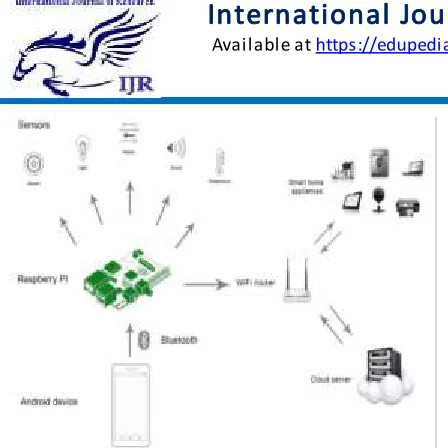
P a g e | 1 8 9Fig ure 1: Connectivity between Ras p b erry Pi 3 an d W i-Fi Ro u ter
If any of the temperature, fire and smoke sensors detect the change in the threshold the sensors have to be activated and the changes to the raspberry Pi 3 which would in turn when connected to a Wi-Fi router or Mobile Data(in mobile phone)can warn the end user by sending the email to the registered Mail ID.
a) Challenges
A recent study by different researchers determined that the top four barriers to wider adoption of smart homes are the issues associated with linking disparate systems, poor manageability, high cost of ownership, and difficulty of integrating security systems.
i) Linking disparate systems
The smart home market is fragmented, at present. Many competing manufacturers are developing disparate smart home systems and technologies. It’s easy to integrate devices made by the same vendor, but that requires, in many cases, consumers to buy replacement devices.
ii) Limited functionality
Integrating devices from disparate vendors often results in limited functionality and unreliable service. Further, many systems on the market have complex interfaces that limit the functionality of smart homes. Finally, app-based smart home systems, while cheaper than fully custom integrated systems, have more limited functionality than full systems.
iii) Costs
Fully integrated custom systems are expensive and often require a consultant to install them, and structural changes to the home, both costs of course tacked on to the price of the system itself.
b) Hardware Implementation
1) Raspberry pi unit: For programming, communication and controlling the HC-05 Bluetooth module and different sensors connected to it.
2) HC-05 Bluetooth module
3) Transformer to transfer electrical energy between two or more circuits.
4) Relay 5V
5) LCD Screen
6) Regulated +5v Power supply 7) MOC3021 for driving TRIACs.
8) BT136 for controlling AC loads. c) Applications
i) Home automation
Home automation is the residential extension of building automation and involves the control and automation of lighting, heating, ventilation, air conditioning (HVAC), appliances, and security. Modern systems generally consist of switches and sensors connected to a central hub sometimes called a "gateway" from which the system is controlled with a user interface that is interacted either with a wall-mounted terminal, mobile phone software, tablet computer or a web interface
ii) Machines controlling system in industry Smart homes also have the potential to be greener and cheaper. Water and energy-monitoring tools, and programs to optimize energy consumption, could impel us to lower our water and energy usage, which could, in turn, lower our bills and reduce our carbon footprint.
iii) Door access control system
The door locks are the primary type of access control devices used for security purposes. These door locks can be used in houses, offices and places where the security is the main purpose.
3.
Methodology and Implementation
The methodology of this project design can be divided into two sections; hardware and software implementations. The hardware implementation consists of the development of the main controller (Raspberry Pi3), sensor networks and the smart home while the software implementation focuses on the programming of the Raspberry Pi 3 using Python.
Available online:
http://edupediapublications.org/journals/index.php/IJR/
P a g e | 1 9 0Option 1: Both loads light and fan are ON Option 2: Light is ON and Fan is OFF Option 3: Both loads light and fan are OFF
Option 4: Light is OFF and Fan is ONs We have used Raspberry pi 3 module as a processor. The Raspberry Pi 3 uses a Broadcom BCM2837 SoC with a 1.2 GHz 64-bit quad-core ARM Cortex-A53 processor, with 512 KB shared L2 cache. In the designed prototype Programming is Code for Raspberry pi unit using Python Language.
For internet connectivity, the user has to enter the IP address and a password whereas for Bluetooth connection selecting the device and entering a password is required.
Every user United Nations agency is full-fledged within the existing system might imagine of a system which will add additional flexibility and run with some common applications like humanoid. The
projected system is meant in such how to avoid the restrictions of the prevailing system. The projected system supports additional flexibility, comfort ability and security. The projected home automation system is functioning with very humanoid phones having chiefly 3 components; the humanoid enabled user device, a LAN router having a decent ascendable vary, and a raspberry pi board .Here the users have provision to regulate the house appliances through humanoid enabled device. This can improve the system quality since there no would like for a wired association, net etc. The directions from the user are transmitted through the LAN network.
The raspberry pi board is organized in step with the house system and will change the relay circuit as per user request. The relay circuits will management the house appliances additionally. We will add appliances to the system can also add extra security measures. The main objectives of the projected system is to style associate degree to implement an inexpensive and open supply home automation system that are capable of dominant and automating most of the house appliances through an humanoid device.
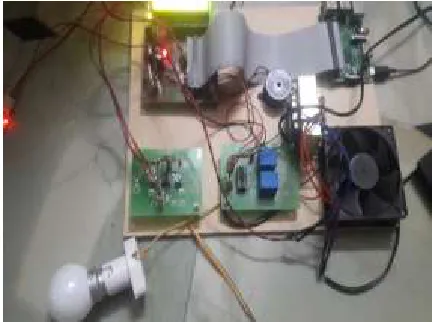
Fig ure 2: Hardware imp lemen tatio n o f p ro p o s ed s y s tem
For this home automation and security system we are targeting Android platform since it has huge market and open source. Android is a software stack for mobile devices that includes an operating system, middleware and key applications. The Android OS is based on Linux. Android Applications are made in a Java-like language running on a virtual machine called ‘Dalvik’ created by Google. A Smart phone is a mobile phone based on a mobile operating system, with more advanced computing capability and connectivity than a feature phone.
Available online:
http://edupediapublications.org/journals/index.php/IJR/
P a g e | 1 9 1is a customizable platform that can look and feel very different on every different handsets. Android gives us tools for creating apps that looks great and take more advantage of the hardware capabilities available on each device. Android is mainly based on Linux operating system which uses java- like languages for running applications. The main purpose of using android is to send the control signals from smart phone through Bluetooth.
4.
Results and Discussions
The S2 terminal for Bluetooth application would be displayed with the fire, temperature and smoke values.
Figure 3: Results obtained on Bluetooth app
Figure 4: Results obtained on LCD Display
Figure 5: Results obtained to our mail id 1
Figure 6: Results obtained to our mail id 2
Available online:
http://edupediapublications.org/journals/index.php/IJR/
P a g e | 1 9 25.
Conclusion
In this paper, a novel architecture for low cost and flexible home control and monitoring system using Android based Smart phone is proposed and implemented. Any Android based Smart phone with built in support for Wi-Fi can be used to access and control the devices at home. When a Wi-Fi connection is not available, mobile cellular networks such as 3G or 4G can be used to access the system. The proposed smart home system and the smart home app has been successfully developed and tested. Devices such as light switches, temperature sensors, gas sensors, motion sensors and alarms have been integrated in the system to demonstrate its feasibility and effectiveness. Features such as low cost, user authentication, voice activation, security and surveillance, and automatic control make the proposed system unique.
6.
Future scope
Future scope for the home automation systems involves making homes even smarter. Homes can be interfaced with sensors including motion sensors, light sensors and temperature sensors and provide automated toggling of devices based on conditions. More energy can be conserved by ensuring occupation of the house before turning on devices and checking brightness and turning off lights if not necessary. The system can be integrated closely with home security solutions to allow greater control and safety for home owners. The next step would be to extend this system to automate a large scale environment, such as offices and factories.
7.
References
[1] G. Kortuem, F. Kawsar, D. Fitton, and V. Sundramoorthy, "Smart objects as building blocks for the internet of things," Internet Computing, IEEE, vol. 14, pp. 44-51, 2010.
[2] R. J. C. Nunes and J. C. M. Delgado, "An Internet application for home automation," in 10th Mediterranean Electrotechnical Conference (MELECON 2000), Lemesos, 2000, pp. 298-301. [3] F. Kausar, E. A. Eisa, and I. Bakhsh, "Intelligent Home Monitoring Using RSSI in Wireless Sensor Networks," International Journal of Computer Networks & Communications, vol. 4, pp. 33-46, 2012.
[4] R. Piyare and M. Tazil, "Bluetooth Based Home Automation System Using Cell phone," in IEEE 15th International Symposium on Consumer Electronics, Singapore 2011, pp. 192 - 195.
[5] S. Anwaarullah and S. V. Altaf, "RTOS based Home Automation System using Android," International Journal of Advanced Trends in
Computer Science and Engineering, vol. 2, pp. 480- 484, January 2013 2013.
[6] C. Chiu-Chiao, H. C. Yuan, W. Shiau-Chin, and L. Cheng-Min, "Bluetooth-Based Android Interactive Applications for Smart Living," in 2nd International Conferenceon Innovations in Bioinspired Computing and Appplications (IBICA 2011), 2011, pp. 309-312.
[7] D. Javale, M. Mohsin, S. Nandanwar, and M. Shingate, "Home Automation and Security System Using Android ADK," International Journal of Electronics Communication and Computer Technology (IJECCT), vol. 3, pp. 382-385, March 2013 2013.
[8] J. Potts and S. Sukittanon, "Exploiting Bluetooth on Android mobile devices for home s ecurity applications," in Southeastcon, 2012 Proceedings of IEEE Orlando, FL 2012.
[9] R. A. Ramlee, M. H. Leong, R. S. S. Singh, M. M. Ismail, M. A. Othman, H. A. Sulaiman, et al., "Bluetooth Remote Home Automation System Using Android Application," The International Journal of Engineering And Science, vol. 2, pp. 149-153, 11, January 2013.
[10] M. Yan and H. Shi, "Smart Living Using Bluetooth Based Android Smartphone," International Journal of Wireless & Mobile Networks, vol. 5, pp. 65-72, February 2013.
[11] C. C. Ko, B. M. Chen, S. Hu, V. Ramakrishnan, C. D. Cheng, Y. Zhuang, et al., "A web-based virtual laboratory on a frequency modulation experiment " IEEE Transactions on Systems, Man, and Cybernetics, Part C: Applications and Reviews, vol. 31, pp. 295-303, 2001.
[12] N. Swamy, O. Kuljaca, and F. L. Lewis, "Internet-based educational control systems lab using NetMeeting” IEEE Transactions on Education, vol. 45, pp. 145-151, 07 August 2002.