Biodiesel Production and Investigation the Performance of
Variable Compression Ratio Diesel Engine Fueled With
Mineral oil and its Blends With Diesel
Vipul Kumar Sharma
1& Shashank Bhardwaj
21M.Tech. Scholar, Dept. of Mech. Engg. Uttarakhand Technical University, Dehradun-248007,India
2Astt.Professor, Dept. of Mech. Engg. Sachdeva Institute Of Technology, Mathura-281122, India
1.ABSTRACT
Diesel Engine is the most important part of our life. With the increase the use of diesel engines in our life many problems are raising. Pollution is major problem so it is necessary to engine manufacturer to invent new technology that how to increase efficiency, decrease fuel consumption rate, Increase work done and decrease exhaust emission.
A 3.5 kW, constant speed diesel engine was tested on diesel, MOME-diesel blends in 15:85, 30:70, 45:55 and 60:40 ratio. The
performance of the engine was found to be satisfactory on the blends.
The kinematic viscosity of raw mineral oil used to make mineral oil methyl ester (MOME) was about 4.665 times higher than the diesel and MOME was about 3.477 times higher than the diesel.
found to be highest and BSFC was found to be lowest on this blend.
Key Words-
Mineral Oil Methyl Ester (MOME); B15; B30; B45; B60; Brake power.
2.INTRODUCTION
During the previous phase decades, power demands have been rising at a nearer rate. To arrange this rising command, consideration has shifted near another source of fuel. An excellent substitute for petroleum diesel, biodiesel has been measured.Petroleum based fuels are inadequate reserves determined in certain regions of the world.
Biodiesel is an another fuel for diesel engines. Vegetable oil or fats are reacted with small chain alcohol, usually methanol and ethanol, to produce a mixture of corresponding mono-alkyl esters defined as biodiesel. This process is identified as transesterification.
The process of trans-esterification brings concerning acute change in viscosity of vegetable oil. The biodiesel thus formed by this method is totally miscible with mineral diesel in some ratio. Biodiesel viscosity comes very near to that of mineral diesel hence no troubles in the accessible fuel handling system. Flash point of the biodiesel gets small after esterification and the cetane number gets better. Even lesser concentrations of biodiesel act as cetane amount improver for biodiesel blend. Calorific significance of biodiesel is also initiate to be very much closer to mineral diesel.
A mineral oil is any of different monotonous, neutral, light mixtures of higher alkanes from a mineral source, particularly a concentrate of petroleum. The name mineral oil by itself is inaccurate, having been used for many explicit oils over the past few centuries. This type of mineral oil is a transparent, colorless oil collected mainly of alkanes and cyclo alkanes associated to petroleum jelly. It has a density of around 0.8 gram/cm3.
It may be possible in the prospect to increase the necessary properties of biodiesel through genetic engineering of the feed stock oils, which could finally produce a fuel enriched with certain fatty acid(s), possibly oleic acid, which shows superior fuel properties. (Kamalesh A. Sorate et al 2014).
The energy thus saved increases thermal efficiency, cooling wounded and exhaust wounded from the engine. The thermal efficiency starts dropping after a assured attention of biodiesel.
3. LITERATURE REVIEW
This chapter reviews the possibility of this fuel cause and some of the results obtained from investigation on the use of vegetable oils and their esters as fuel in CI engine.
Bueno et al 2011 studied the combustion characteristics of a turbocharged diesel engine operated with soybean oil ethyl ester and it is 10%, 20% and 30% by volume blends at full load conditions. The test results showed that the crank angle interval required to a combustion reaction progresses of 90% presented an average reduction of 1.81 for B15, 1.87 for B30 and 1.97 for B45 was obtained with relation to diesel. He was attributed that to the shorter mixing time of neat biodiesel (B100).He also indicated that the initial heat release rates of diesel and B30 were very well matched, which indicated that the biodiesel bulk modulus of compressibility, or speed of sound, does not affect the beginning of injection with the engine. Moreover, a reduction in lower in- cylinder mean temperatures was observed for B30 blend. This can be attributed to the reduction in fuel heat value and injected mass caused by biodiesel addition to diesel fuel.
Sharon et al 2012 studied the combustion characteristics of a palm oil biodiesel and its 25% ,50% and 75% by volume blends at different load conditions and constant speed in DI diesel engine. The results showed that peak pressure of B25, B75, and B100 are 1.08bar ,8.124bar and 7.347bar higher than diesel. He has also been observed that biodiesel and their blends showed shorter ignition delay of 2.11, 1.91, 1.71 and 11 for B100, B75, B50 and B25 respectively compared to diesel fuel. This is because of
higher cetane number and the presence of some fatty acid sin biodiesel which stimulates easy vaporization hence it would reduce the ignition delay. Maximum heat release rate for B25, B50, B75 and B100 were 1.343 kJ/m3deg, 2.192 kJ/m3deg, 13.884 kJ/m3deg and 21.149 kJ/m3deg, respectively, lower than diesel fuel. This is attributed to the lower ignition delay of biodiesel blended fuel.
M.R. Jakeria et al 2013 find out the gradual depletion of fossil fuel has greatly enhanced the necessity to look for alternative fuel for automotive engine. In response to this, biodiesel is being considered as a promising solution with a number of technical advantages over conventional petroleum diesel. On the other hand, commercial use of biodiesel has been limited because of some drawbacks including corrosivity, instability of fuel properties, higher viscosity, etc. Stability of fuel properties is especially important to ensure expected engine performance as well as engine life. He found the different factors that cause instability in biodiesel and their possible implications of different fuel properties.
Flash position, density, pour position, cetane amount, calorific number of biodiesel comes in very similar range to that of mineral diesel.
4.MATERIALS AND METHODS
procedure adopted to evaluate performance of a VCR diesel engine on the blends.
4.1 Selection of Fuel Constituents
The experiments were carried out using diesel as reference fuel and Mineral oil methyl ester (MOME) and their blends with diesel in various proportions as engine fuel.
4.2 Preperation of Fuel Blends
High viscosity of mineral oil makes it unsuitable as whole substitution of diesel for the CI engine. The mineral oil methyl ester (MOME)-diesel blends were arranged by blending mineral oil methyl ester (MOME) with diesel.
4.3 Test Engine
The setup consists of single cylinder, four stroke, VCR (Variable Compression Ratio)Diesel engine connected to eddy current type dynamometer for loading. The setup enables study of VCR engine performance for brake power, indicated power, frictional power, BMEP, IMEP, brake thermal efficiency, indicated thermal efficiency, Mechanical efficiency, volumetric efficiency, specific fuel consumption, A/F ratio and heat balance. EnginesoftLV” is provided for on line performance evaluation.
Figure:1
Table:1 Engine Specification
Rated Brake Power (kW) 3.5
Rated Speed (rpm) 1500
Number of Cylinder 1
Bore (mm) 87.5
Stroke(mm) 110
Displacement volume (cc) 661 cc Compression Ratio 17.5:1
Table:2 Mineral Oil Methyl Ester – Diesel
S.No. Fuel Types
Nomenclature
1. Diesel -
2. Raw
mineral oil
-
3. 15%
Mineral Oil Methyl Ester + 85% Diesel
B15
4. 30%
Mineral Oil Methyl Ester + 70% Diesel
B30
5. 45%
Mineral Oil Methyl Ester + 55% Diesel
B45
6. 60%
Mineral Oil Methyl Ester + 40% Diesel
B60
4.4 Fuel consumption test
The fuel consumption test was carried out on fuels . The performance of the engine on selected fuels was evaluated at the following load condition.
No load
3 kg load
6 kg load
9 kg load
12 kg load
The following parameters were measured during the test:
Indicated power,KW
Brake power, KW
Friction power, KW
Indicted mean effective pressure, bar
Brake mean effective pressure, bar
Frictional mean effective pressure,bar
Specific fuel consumption
Fuel consumption, l/h
Air flow
Fuel flow
Indicated thermal efficiency
Brake thermal efficiency
Torque
Mechanical efficiency
Volumetric efficiency
Brake power
The brake power developed by the engine under different test condition was measured. In order to make the measurement the engine was initially run on no load condition and its speed was adjusted constant.
The corresponding torque to be applied to the engine when delivering rated power (3.5 kW) at rated speed of 1500 rpm was calculated using the equation given below:
BP =
60000 2NT
Where,
T= Torque, N-m
N= Engine speed, rpm
Fuel consumption
The fuel consumption was measured with the help of fuel consumption unit as shown in the engine set up. The hourly fuel consumption was calculated using equation as given below:
= × 3.6
Where,
fc = Fuel consumption, l/hr Vcc = Volume of fuel consumed,
T = Time, hr
3.6 = Unit constant
The brake specific fuel consumption was calculated using the following relationship: BFSC =
= × × 3.6 ×
Where,
BFSC = Brake specific fuel consumption, kg/kW-h
Vcc = Volume of fuel consumed, 25 cc
ρ = Density of fuel, g/cc BP = Brake power, kW T = Time taken to consume 25 cc fuel, s
Brake thermal efficiency
The brake thermal efficiency of the engine at the different loads was determined using the equation as given below:
Ƞth= HV BSFC
Ks
=
Where,
Ƞth = Brake thermal efficiency, percent
HV = Gross heat combustion, kJ/kg
BFSC = Brake specific fuel consumption
5.RESULT AND DISCUSSION
In present study, therefore, Mineral Oil Methyl Ester (MOME) is made by methyl esterification process. Various fuel properties of diesel, raw mineral oil, methyl ester of mineral oil and their blends with diesel were calculated. The fuel consumption test and rating test of 3.5 kW, constant speed CI engine was also conducted to evaluate the performance of the engine on diesel as well as different blends of MOME with diesel.
The fuel properties such as kinematic viscosity, relative density of raw mineral oil, MOME as well as their blends with diesel were compared.
A 3.5 kW, stationary, constant speed, single cylinder diesel engine was tested on diesel and selected MOME-diesel blends. The fuel consumption test of the engine were conducted as per IS: 10000 [P: 8]:1980 and break power, specific fuel consumption, brake thermal efficiency were calculated.
5.1 Engine Performance On Selected
Fuels
The performance of 3.5 kW, constant speed diesel engine was evaluated on selected fuels and compared with diesel. The fuel consumption test of the engine was conducted as per IS: 1000 [P: 8]: 1980. The performance of the engine was evaluated on diesel, B15, B30, B45, B60 under the fuel consumption test at different load condition in terms of brake power, fuel consumption, specific fuel consumption, brake thermal efficiency.
5.2 Indicated Power, Brake Power and Friction Power
Figure:2 Indicated Power Produced by Diesel and its Blend with MOME
Figure:3 Brake Power Produced by Diesel and its Blend with MOME
Figure:4 Friction Power Produced by Diesel and its Blend with MOME
The figures indicate an increase in Indicated and brake power with increase in brake load of the engine under all fuel types. The figures also reveal that with increase in brake load there was an increase in brake
0 0.51 1.52 2.53 3.54 4.55
IN
D
IC
A
TE
D
P
O
W
ER
(
KW
)
IP
DIESEL
B15
B30
B45
B60
0 0.5 1 1.5 2 2.5 3 3.5
B
R
A
KE
P
O
W
ER
(
KW
)
BP
DIESEL
B15
B30
B 45
B60
0 0.5 1 1.5 2 2.5
FR
IC
TI
O
N
P
O
W
ER
(
KW
)
FP
DIESEL
B15
B30
B45
power and decrease in engine speed on all the MOME-diesel blends.
It was observed that the engine was able to develop similar power on all fuel types at every selected brake load condition. This could be due to the reason that the volumetric fuel flow rate on biodiesel was higher thus contributing energy supply near to diesel.
5.3 Fuel Consumption
The observed fuel consumption (l/h) of the engine on diesel and MOME-diesel blends is shown in Fig:5 shows the relationship between brake load and the fuel consumption of the engine on different fuel types.
Figure:5 Fuel Consumption Produced by Diesel and its Blend with MOME
It is observed from the figure that the fuel consumption of the engine gradually
increased with increase in brake load and was found to maximum on all selected fuel types. The fuel consumption of the engine on B60 was found higher than that of diesel.
5.4 Specific fuel consumption
The relationship between the specific fuel consumption of the engine and brake load on different fuel types is presented in Fig:6.
Figure:6 SFC Produced by Diesel and its Blend with MOME
5.5 Indicated and Brake Thermal Efficiency
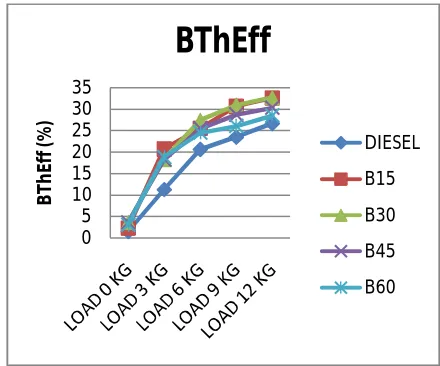
The Indicated and brake thermal efficiency corresponding brake load is shown in Fig:7 and Fig:8.
0 0.2 0.4 0.6 0.8 1
FU
EL
C
O
N
SU
M
P
TI
O
N
(
Kg
/h
)
FUEL CONSUMPTION
DIESEL
B15
B30
B45
B60
0 1 2 3 4 5 6
SF
C
(
Kg
/k
W
h
)
SFC
DIESEL
B15
B30
B45
Figure:7 IThEff Produced by Diesel and its Blend with MOME
Figure:8 BThEff Produced by Diesel and its Blend with MOME
Indicated Thermal Efficiency is decreasing with the increase in load. It is clear from the figure that the MOME-diesel blends mostly are having higher brake thermal efficiency than diesel.
5.6 Torque and Mechanical Efficiency
The Torque and mechanical efficiency corresponding brake load is shown in Fig:9 and Fig:10.
0 10 20 30 40 50 60 70
IT
h
Ef
f
(%
)
IThEff
DIESEL
B15
B30
B45
B60
0 5 10 15 20 25 30 35
B
Th
Ef
f (
%
)
BThEff
DIESEL
B15
B30
B45