ISSN 2286-4822 www.euacademic.org
Impact Factor: 3.4546 (UIF) DRJI Value: 5.9 (B+)
Developing Documentation of an Endangered
Language: A Case Study of Iguta Wordlist
MOHAMMED AHMAD ADO1
Department of English, Faculty of Arts and Education Bauchi State University, Gadau, Nigeria School of Languages, Civilisation and Philosophy UUM College of Arts and Sciences, Universiti Utara Malaysia
SITI JAMILAH BIDIN
School of Languages, Civilisation and Philosophy UUM College of Arts and Sciences, Universiti Utara Malaysia
Abstract:
The paper explores and identifies the various classes of words as vocabularies that can represent the most stable layer of the lexicon existing in Iguta language. Qualitative method was used to collect data from five selected villages in Jos North local government of the Plateau state, Nigeria, where the standard dialect (i.e., Andirgiza) is spoken. Swadesh (1955) 400 wordlist was used and modified as an instrument during the interview session with twenty native speakers of Iguta. The research data was also analysed using a hand analysis strategy and mind mapping, which were used in developing insights on the language data. The results revealed 455 different wordlist which culturally can represent the most stable set of lexicon in Iguta language. In conclusion, the study has contributed to the body of knowledge in descriptive linguistics of the Iguta as an endangered language in terms of lexicostatistic and vocabulary development.
Key words: Endangered, Swadesh, documentation, Iguta, lexicostatistic
1.1Introduction
The speedy endangerment and death of many smaller languages of Nigeria is an issue of widespread concern, not only among linguists but also those concerned with the questions of cultural identity in an increasing globalised communities since the cultural tradition connected to the ethnic groups and the socio-cultural or even ethnic independence of the groups that speak these ethnic languages very often perish with it. Yet, it is a common phenomenon in Nigeria and more especially the northern part of the country that the ethnic languages of minority groups go into extinction dragging down with them their social identity. If the existing trend is allowed to continue, by the end of the 21st century, only a small proportion of the ca
500 languages or so languages will be safe from the threat of disappearance. We therefore need to begin to think of what to do to save the remaining minority languages before they become extinct (Haruna, 2014). Therefore the present study explores the various classes of words as vocabularies that can represent the most stable layer of the lexicon existing in Iguta.
Iguta is one of the minority endangered languages of Plateau state in the central part of Nigeria and the Iguta language has neither been documented nor has it been studied, especially in linguistics related disciplines. The origin of Anaguta (speakers of Iguta), like any other ethnic groups in Nigeria, has been a source of debate among historians and anthropologists (Greenberg, 1970; Williamson, 1989; Williamson & Blench, 2000).
now occupy Naraguta, Kunga, Babale, Rafin Jaki, Zakaliyo, Rukuba Ring-Road, Maza, Tagir or Arai, Fadama, Hwoll and other nearby settlements (Isichei, 1991).
According to Diamond (1960), Anagutas are wonderful people of the middle belt of Nigeria with vast lands suitable for agricultural purposes. Their population is estimated to be about 2500 and they live in a dispersed settlement within the horticultural rugged hills of Gwong District, in Jos Division of Plateau Province in Nigeria. Sil (1977) reported that Anaguta had an estimated total number of 3,000 speakers. However, based on the 1990 Nigerian population census, their population had risen to the estimated number of 6,123 speakers.
In an attempt to accomplish a credible justification of endangered languages of West African Sub-Region, Blench (2007) assigned a status to each and every language of West Africa in the database. Blench (2007) argues that the status assigned was due to the ethnologies‘ limitation in terms of information dissemination on the West African endangered languages. The new allotted status according to Blench (2007) is that:
a) Any language with more than 50,000 speakers is
considered ‗not threatened‘,
b) Any language with below 400 speakers is considered
‗definitely threatened‘,
c) And language with less than 3000 speakers or with no
data status should be regarded as a language with no information and should significantly be considered paramount for future research.
Iguta is a language that falls under the third category with less than 3000 speakers and with no data status, hence the need to develop the language through documentation.
1.2 Problem Statement
has been passed down from generation to generation by oral tradition. Although there are some works written on the historical background of the people, not much has been done on the linguistic aspects of the language (Ames, 1934; Jungraithmayr 1963; Diamond, 1967; Gunn, 1953; Nyam, 1988; Gwon, 1983; Blench, 2007).
Furthermore, the consideration of Iguta language as one of the endangered languages, especially in the Plateau state of central Nigeria as observed in a conference of ‗Endangered Languages of Plateau State‘ (Nigerian Bible Translation Trust: 2006) raised concerns. The National Bible Translation Trust (NBTT) reveals that within a period of ten years, the language will be extinct. Sands (2009), argued that most African languages will continue to be undocumented and remain endangered until serious attempts are made to document them. Therefore, working towards the documentation of the language to serve as a source material for future research is of great importance. The study will also contribute to the development of the language and prevent it from the threat of extinction.
1.3 Research Aim and Objectives
The study aimed at developing a systematic linguistic document of Iguta language in order to avoid the language from becoming extinct. The objectives of the study are:
1. To provide a standard set of Iguta Wordlist that can be used for further linguistic related studies of the language; and
2. To identify and explore the various classes of words as vocabularies that can represent the most stable layer of the lexicon existing in Iguta language.
1.4 Research Questions
1. What are the standard sets of Iguta Wordlist that can be used for further linguistic related studies of the language?
2. What are the various classes of words as vocabularies that can represent the most stable layer of the lexicon existing in Iguta language?
1.5 Significance of the Study
The findings of this research will play a crucial role in the academic terrain, especially to future researchers, students and the Nigerian Association of Linguistics (NALS). It is hoped that this present study will inspire them to work on the language having dealt with the minimal but important aspect of the language. The work will serve as a pedagogical tool for the Iguta native speakers who wish to study the language, especially young people of Anaguta land to have the benefit of learning their language through the use of language learning and teaching strategy.
The study will also serve as a guide to policy makers in language policy making on education in Nigeria via documentation in the National Language Centre in Nigeria. It is hoped/predicted that this work will trigger enough interest among the literate Anagutas to embark on writing and producing resourceful materials on their history, culture and sound systems for the documentation of the various aspects of the language. Through this work, it is hoped to revive and improve the status of the language as well as its native speakers, since there is not much written material on the language.
1.6 Scope of the Study
(Targwong) dialect which is spoken in Naraguta village, part of Kunga, Zakaliyo, Rafin-Jaki Babale and Maza villages of Jos local Government Area of Plateau State of the central Nigeria. The rationale for choosing Andirgiza dialect is because it is the standard (central) dialect among the five dialects of the Iguta language. Therefore, this study explored and compiled 465 words in a wordlist that exists in the Andirgiza dialect of the language.
2.1 Language Death and Endangerment
Language death means when there are no speakers of the language left or when it is no longer use as a medium of communication. In fact it is a situation when a language is not viable. However, language endangerment refers to the process of losing speakers of a particular language (Hale, 1992; Fishman, 1991; Ladefoged, 1992; Errington; 2003; Crystal, 2000; Mufwene 2004). In another view by Cahill et al. (1999), a language is endangered when it is in imminent danger of dying out. In his opinion, there are two ways to recognize when a language is on the verge of death. The first is when the children in the community are not speaking the language of their parents, and the second is when there are only a small number of people left in the ethnolinguistic community.
2.2 Level and Factors of Language Endangerment
Endangerment is an underlying situation of losing speakers of a particular language. Wurm (1998 & 2003) and Crystal (2000) identified five stages of language endangerment. These are: potentially endangered, endangered, seriously endangered, moribund and extinct.
Potentially endangered languages are those that are under
speakers of the language/languages in question are economically dominated by other language speakers who live side by side with, and this resulted in the likelihood of being endangered. On the other hand, endangered languages refer to the languages that have no child speakers. The only fluent speakers of the language of this stage are the young adult ranging from 20 years to 40 years of age (Wurm, 1998; Crystal, 2000; Dansal, 2005). With regards to seriously endangered languages, Wurm (1998 & 2003) and Crystal (2000) claimed that these are languages where the fluent speakers are fifty years of age and above. In fact the youngest speakers are fifty years old. Moribund refers to a stage where a language has a handful of speakers and most of these speakers are very old. Crystal (2000) and Wurm (2003) also pointed out that moribund stands for any species that cannot reproduce anymore. Therefore, in this context any language that cannot be transmitted to another generation of users because of few numbers of speakers then it is considered moribund (Wurm, 1998 & 2003; Crystal, 2000). A language is said to be extinct
when there is no speaker left and also when it is not use as a medium of communication. The language becomes extinct when the last speaker dies (Wurm, 1998 & 2003; Crystal, 2000).
The Iguta language is considered as an endangered language (i.e., 2nd stage) because it lacks child speakers and the
In terms of Iguta language, the attitude of its speakers has led to it being rated as an endangered language. This is because they have abandoned the use of their language and uphold both Hausa and the English language in their daily communication, even in social and religious gatherings leaving the fate of Iguta in the hand of few adult illiterates using it. The bilingual situation of Anaguta community also contributes to the suffering of the Iguta language in terms of domination. The simple fact that there are many tribes in Jos North with their different ethnic backgrounds attribute much in the abandoning the use of Iguta language by its native. The culture and traditions of the Anaguta people are now influenced and dominated by those of Hausas and the English speaking people of Nigeria.
2.3 The Swadesh Wordlist
An American linguist named Morris Swadesh in the mid-20th
century compiled 200 words as a wordlist in English which can represent the core basic vocabulary of the human language per excellence. The 200 wordlist was then reduced by Swadesh to 100 stablest items because of convenience. The basic wordlist serves as an instrument for establishing genetic relations between languages. Swadesh aims at generating a general method for the automatic reconstruction of language. Furthermore, the wordlist was compiled to be used for a general method to find relationship between languages, for comparative method, glottochronology and semantic reconstruction as well as for additive typology to lexicostatistics (Swadesh, 1955).
lexicons to suit their research objectives (Rea, 1958; Hymes, 1960; Kassian et al., 2010).
The Swadesh wordlist is proven worthy as a useful linguistic tool, and is presently widely applied in various lexicostatistical and glottochronolgical studies. Why it is popular among linguists is because of its relative simplicity and transparency (Rea, 1958; Kassian et al.; 2010).
2.4. The Lexicostatistics
Crowley (1998) defined lexicostatistic as ―a technique that allows us to determine the degree of relationship between two languages by comparing the vocabularies of the languages and determining the degree of similarity between them‖. One can use lexicostatistics to determine: time depth i.e. glottochronology, subgrouping, and the genetic relationship (Attila, 1972).
Campbell (2000) claimed that when comparing two languages, it is assumed that the words on the Swadesh list have not changed significantly from their original form. This is because the 100 English words are the lexical items that resist cultural influences and therefore are not easily affected by neighbouring languages.
Some linguists such as Campbell (2000) challenged this aspect of lexicostatistic methodology for lack of culture-free basic vocabulary in a language. However, Nelson (2001) ascertained that there are lexical items in a vocabulary that are less likely to have been borrowed from other languages. It was further established that using lexicostatistic approach, one can subgroup large language families that could have close geographical proximity with relatively limited lexical data available for analysis (Nelson, 2001).
used lexicostatistics to discover the historical relations among Tagalog, Ilokano, and Bikolano, three languages of the Philippines, with regard to the Wave Theory. The study further explored that both the three languages have no significant difference in terms of lexical structure. In the study Nelson (2001) utilized the Swadesh wordlist for the analysis. He calculated the rate of retention, the rate of cross-linguistic loss, and the dates of divergence among the three languages. In addition, Nelson examined the effectiveness of glottochronology as it pertains to effectively finding relationships within the Austronesian Family, specifically the major dialects in use on the Philippine island of Luzon. Similarly, the present study explored the lexicons of Iguta language by utilising the Swadesh wordlist.
3.0 Research Methodology
3.1 Research Design
A qualitative research design was used in this study as guidance in exploring and compiling the 465 wordlist of Iguta. The Iguta words are collected and compiled in the wordlist through the analysis of spoken data collected and recorded from the participants who are native speakers of the language.
means the case study provides clear understanding of a given phenomenon under study.
3.2 Sampling
In order to achieve the objective of this study, a typical sampling strategy was used under the purposive sampling method in selecting the sites and persons that are typical for this kind of study. During the interview session the snowball sampling method was used under the guardianship of the traditional rulers of the research villages (Haruna, 2010).
3.2.1 Criteria for the Sampling of Participants
The following criteria were used in the sampling of the Iguta Andirgiza speakers as participants:
a) Anaguta native speakers.
b) Age is within forty (40) to sixty-five (65). This age range
was chosen because it was assumed that these participants would be a matured user of the language.
c) Twenty (20) participants were selected and interviewed
for the study.
The selection of the speakers was made possible with the approval of the traditional leaders of the people and their Iguta development association, whose consent was sought to ensure a reliable data collection. From each of Naraguta, Babale, Rafin-Jaki and Maza villages, four (4) participants were selected including their rulers totalling sixteen (16) participants. However, only two participants from each of Zakiliyo and Kunga villages were selected and interviewed due to the nature of the settlements which have less number of speakers scattered in the dispersed areas.
3.2.2 Profiles of the Participants
participants with different personality ensured the representation of data with full choice of dictions from different works of life which is considered rich and trustworthy for the research. In addition, other issues like age, gender, ethnic background, and the number of languages spoken by the participants were also considered. In the process of providing information about the twenty participants, for confidentiality, pseudonyms were used in representation of their names. However, other information is presented as accurate as provided by the participants.
3.3 Data Collection Procedures (Fieldwork)
Based on the research design, qualitative interviews with the 400 wordlist together with open ended questions were designed and administered to the participants during the qualitative interview (Swadesh, 1955; Bailey, 2007; Kassian, Starostin, Dybo, & Chernov, 2010). In this respect, several ethics of the interview were considered i.e. being very careful about choice of words, avoiding yes or no questions, being flexible and polite to interviewees by selecting and making choice of environment that is conducive.
The designed structured interview was divided into two parts. The first part is the introduction which was designed to gather demographic information including the participants‘ name, age, village/town, ethnic group, occupational and educational background and the number of languages spoken by each participant. The second part was based on the 400 wordlist (Swadesh, 1955), which was provided to the participants in order to elicit the equivalent of each of the words in Andirgiza dialect of Iguta language.
transcription of the data collected and its tone marking. This is in line with Puvenesvary (2011: 29-30) who stated that:
―The need for recording an interview session cannot be underestimated. This is because tape recording enables the interviewer to capture the actual words (preserves actual language) of the interviewee, thus increasing the accuracy of the data collection. Other than that, it also allows the interviewer to be more attentive to the interviewee because it frees the interviewer from writing down everything that is said‖.
Another method adopted in this study is unobtrusive observation. This kind of observation was useful in observing certain phenomenon such as tone marking in the words that were uttered by the participants because Iguta is a tonal language. During the interview session the participants were carefully observed by the researcher on how they pronounce each word from the data. Sometimes the researcher had to imitate the way the participants pronounce the Iguta words before recording them in writing. This process is in line with the assertion of Badsiz (2011) that a careful observation is fundamental for good reflection and expectation of the result from research data. Tone plays a significant role in tonal languages. The change of tone affects the meaning of words in tonal languages. Therefore, the adaptations of interviews with observation in this study have assisted the researcher in discovering how the words are properly pronounced.
3.3.1 Distribution of 400 Wordlist
difference between Andirgiza dialect of Iguta and English language from the 400 wordlist that was designed.
The actual interviews were conducted with twenty participants, four from each of the Naraguta, Babale, Maza and Rafin-Jaki villages, and two each from Kunga and Zakaliyo villages. Each of these twenty participants was provided with a 100 wordlist to which he/she gave their equivalents in Andirgiza dialect of Iguta language. The interview was administered in Hausa to the participants who do not understand English and it was administered in both Hausa and English to those who have little understanding of the English language. Similarly, the participants with English proficiency were interviewed in the English language.
3.4 Method of Data Analysis
A qualitative hand analysis strategy was used in this study in analysing the data. The researcher read and re-read the data as many times as possible, because this phase provides the bedrock for understanding the data analysed. The Iguta 465 wordlist were extracted from the participants verbally during the interview. Therefore, the data was first transcribed into written form before it was subjected to a hand analysis strategy.
The researcher organised the data into recurring concepts related to the Swadesh wordlist and generated the result. According to Taylor et al. (1998), emerging ideas or pattern structure can be obtained by analysing conversation topics, sentences, or word meanings.
4.0 Findings and Discussion
The study developed a systematic linguistic document of Iguta language in the attempt to prevent the language from becoming extinct. To obtain the result of the study, Swadesh (1955) wordlist model was exactly followed. The following discussion of the results is based on two research questions.
4.1 The standard set of Iguta wordlists
In an attempt to answer research question 1 of the study, i.e. ―what are the standard sets of Iguta Wordlist that can be used for further linguistic related studies of the language?‖ The Swadesh‘s model of 400 wordlist was used and 11 words are discovered to lack equivalents in Iguta language. In other words, 389 words have the equivalents in Iguta language, while the remaining 11 words do not. The non-existent words include; ‗animal, francholin, grey heron, hog, buffalo, dun palm tree, sweet pepper, chalk, receptacle, meningitis, born‘ (see Appendix A, page 21). The absent of these words could be due to the cultural differences existing between the English language which the Swadesh model is designed and the Iguta language (an African origin). Therefore, additional 66 words were added to the Swadesh (1955) wordlist to complement the non-existent words in the language. This addition is in line with the recommendation of Rea (1958), Hymes (1960) and Kassian et al. (2010). They ascertained that whenever a language under study lacks the equivalent of certain items (words) due to the absence of corresponding relia ―cultural differences‖, the researcher is at liberty to produce more lexicons that will suit their research objectives.
their plural forms or quantifiers in the case of the noun classes and adjectives or adverbs.
4.2 The various classes of words as vocabularies in Iguta language
The research question 2 was answered through the identification and exploration of the various classes of words as vocabularies that can best represent the most suitable layers of the lexicon existing in Iguta language through the thematic analysis of the Iguta 455 wordlist.
Based on the Swadesh (1955) wordlist, different word classes are discovered to exist in Iguta Swadesh wordlist. These include; Nouns, Pronouns, Verbs, Adjectives, Adverbs, Prepositions, Conjunctions, Interjections and an Article. Although the Iguta wordlist discovered are 455 in number, just like their English counterparts, most of these wordlist have multiple functions denotatively in the language. Examples: ‗and —kìní [kini ] ―conj. or preposition‖, ‗bark — ùkûbù [ʔuku:bu] ―Noun or verb‖, ‗bite — ùrmà [ ʔurmǝ] ―verb or noun‖, ‗blow — ùwúrbú [ʔuwu:rbu:r] / blow - yúrbù [ju:rbu] "Andigong Dialect" ―noun or verb‖, ‗bone — rùgù [rugu] ―noun, verb or adjective‖, ‗cut - túzú [th u:zu:] ―verb, adjective or noun‖, ‗far — pìyáu
[pijau] ―adjective or adverb‖ and others. Connotatively, it is also discovered that there are other word classes in the wordlist that can produce additional meanings (based on context) apart from their denotative meanings and these words includes: ‗dig — kàbàh [khabǝh] denotatively refers to verb but in another
Adjective word classes of Iguta language, we discovered 61 words with denotative functions and 5 words with connotative functions. Adverb class has 36 words with denotative meanings and 3 words with connotative meanings. There are 6 words with denotative meanings in the class of preposition, 4 words in conjunction class and 1 word in article class. The word class identified with least denotative and connotative functions in Iguta wordlist is interjection with 2 words as denotative and 1 word with connotative function. Due to the multiple functions of certain words in Iguta, the study has identified 563 words with denotative functions and 64 words with connotative functions from various classes of words discovered within the Iguta 455 wordlist (see appendix A & B, page 21-39).
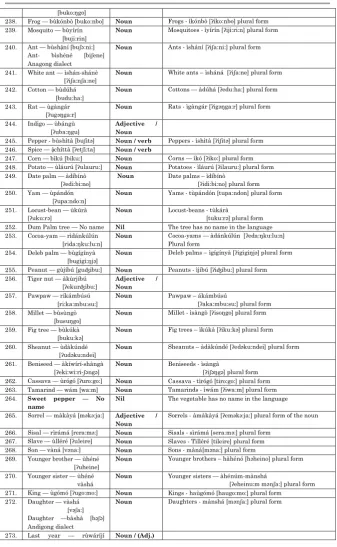
— sùpàh [supǝh] / Hairs — sùpàhsídíchár [supǝhsi:di:tʃa:r], hand — ùwòráh [ʔuwora:h] / hands — tèráh [tera:h] / hands — tùwàráh [tuwǝra:h] "Andigong Dialect" and others‘ (see appendix A & B, page 21-39). In the part of names of fruits, vegetables and crops we discovered 29 words in the Iguta wordlist. The examples of these are; ‗Cotton — bùdúhá [budu:ha:] / Cottons — àdúhá [ʔedu:ha:], Indigo — ùbángù [ʔuba:ŋgu], Spice — ậchíttà [ʔetʃi:ta], Pepper - bùshìtà [buʃitǝ] / Peppers - ìshìtà [ʔiʃitǝ], Corn — bìkú [biku:] / Corns — ìkó [ʔiko:], Potato — ùláurú [ʔulauru:] / Potatoes - ìláurú [ʔilauru:], Date palm — àdíbínò [ʔedi:bi:no] / Date palms - ìdíbíno [ʔidi:bi:no], Yam — ùpándón [ʔupa:ndo:n] / Yams - tùpándón [tupa:ndon], Tamarind — wám [wa:m] / Tamarind - ìwám [ʔiwa:m] and others‘ (see appendix A & B, page 21-39) for detail examples. 77 names of Objects and things also formed part of the noun class found in the Iguta wordlist. Examples: ‗ashes – mùmá / ashes — Tùnãnfúr [tunǝ: nfur] ―Anabor dialect‖, dust — ùkíhú [ukihu], fog — ùgòskól [ʔugo:skol] / Fogs — Tùgòskól [tugosko:I], Rope — rùwé [ruwe] / Rope— rèwè [rewe] Andigong Dialect. Ropes — sùwé [suwe] / Ropes — sèwè [sewe], Sand — ìshìnshí [ʔiʃinʃi:] and others‘ (see appendix A & B, page 21-39).
5. Recommendation for further studies
and pragmatics of Iguta language using the Ado‘s Iguta Swadesh Wordlist as an instrument or data.
6. Conclusion
Based on the findings, several conclusions can be made. Firstly, Iguta is not an extinct language. This is because Nouns, Pronouns, Verbs, Adjectives, Adverbs, Prepositions, Conjunctions, Interjections and an Article are fully reflected in the wordlist. Secondly, the dominant word class found in the Iguta Swadesh Wordlist are nouns followed by verbs. The least word class found to exist in the wordlist is an article. Other features of Iguta Swadesh wordlist includes the provision of the plural forms of some of the words that are nouns, dialectal variation of how certain words are called in some of the dialects of the same language in cases where the distinction exist, as well as the tonal indication of the words reflecting the exact way the Iguta words are pronounced along with their phonetic transcriptions. However, these plural forms and the dialectal variation mentioned and exemplified of the words in the wordlist are not included in the estimation made on the quantity of different word classes discussed. This is because they are considered as part of the same examples given.
REFERENCES
1. Attila, R. (1972). An introduction to historical and comparative linguistics. New York: Macmillan.
2. Ames, C.G. (1934). Gazetteer of the Plateau province. Nigeria, Jos.
3. Bailey, C. A. (2007). ‗A guide to qualitative field research‘. Thousand Oaks: Pine Forge Press.
5. Birnbaum, H. (1977). ‗A framework for the study of language spread‘. Springer Blackwell Publishers.
6. Blench, R. (2007). ‗Endangered languages in West Africa‘. Language diversity endangered,181, 140.
7. Brenzinger, M. (1998). ‗Endangered languages in Africa‘: R. Koppe.
8. Brenzinger, M. (2007a). ‗Further evidence for a Niger-Saharan macro phylum‘. Proceedings of the 8th
Nilo-Saharan Linguistics Colloquium, University of
Hamburg, August 22-25, 2001, Ed.
9. Cahill, L., Paiva, D., Doran, C., Evans, R., Mellish, C., Reape, M., & Scott, D. (1999). ‗Towards a reference architecture for natural language generation systems‘. 10.Campbell, L. (2000). Historical linguistics: An
introduction Cambridge. MIT Press.
11.Collin, B., & Sylvia, P. J. (1998). Encyclopaedia of bilingualism and bilingual education. University of Wales Bango.
12.Conrad, A. W., & Fishman, J. A. (1976). English as a world language: The evidence.
13.Creswell, J. W. (2005). Educational research: Planning, Conducting, and evaluating quantitative and qualitative research. New Jersey: Pearson Education.
14.Crowley, T. (1998). An introduction to historical linguistics. 2nd (ed.) Auckland, New Zealand: Oxford
University Press.
15.Crystal, D. (1997). Languages. Civilization, 40-45.
16.Crystal, D. (2000). Language death. Cambridge. Cambridge University Press.
17.Dansal, M. (2005). Endangered languages. London Heinemann.
18.Diamond, S. (1960). ‗Anaguta cosmography: The
linguistics and Behavioural implications‘.
19.Diamond, S. (1967). ‗Suburban Primitives‘ in Julien Steward (ed). Three African Tribes in Transition. Chicago.
20.Diamond, S. (1993). ‗Anaguta cosmography: The
linguistics and behavioural implications‘.
Anthropological linguistics, 426-434.
21.Dorian, N. (1998). ‗Western language ideologies and small-language prospects‘. In Grenoble and Whaley (eds.) 5-21.
22.Errington, J. (2003). ‗Getting language rights: The rhetoric‘s of language endangerment and loss‘. American Anthropologist, 105(4), 723-732.
23.Fishman, J. A. (1991). ‗Reversing language shift: Theoretical and empirical foundations of assistance to threatened languages‘ Clevedon, (Vol. 76). Multilingual Matters Limited.
24.Fossi, A., & Lambo, A. O. (2012). ‗Cultural and linguistic hybridizations in Cameroon: English loanwords in ng mbà‘. International Journal of Linguistics, 4(1), pp-267.
25.Greenberg, J. H. (1963). ‗The languages of Africa‘. The Hague: Mouton, Bloomington, Indian University Press. 26.Greenberg, J. H. (1970). ‗The languages of Africa‘. (3rd
Edition). Bloomington: Indiana University.
27.Gunn, H.D. (1953). ‗People of the Plateau area of Northern Nigeria‘ (London).
28.Gwom, S. L. (1983). ‗History of Jos and political development of Nigeria‘, Jos.
29.Hale, K. (1992). ‗Endangered languages: on endangered languages and the safeguarding of diversity‘. Language, 68(1), 1-42.
30.Haruna, S. H. (2010). Research methods: A simple guide To Educational Inquiry. Kano, Nigeria.
strategy, documentation and preservation‘: A paper read at the First International Conference on endangered languages in honour and memory of Professor M.K.M. Galadanci held at Bayero University Kano
32.Himmelman, N. P. (2008). ‗Reproduction and preservation of linguistic knowledge: Linguistics' response to language endangerment‘. Annual review of anthropology, 37, 337-350.
33.Isichei, E. (1991). ‗On being invisible: a historical perspective of the Anaguta and their neighbours‘. The International Journal of African Historical Studies, 24(3), 513-556.
34.Jungraithmayr, H. (1963).Die sprache der sura (Maghavul) in Nordnigerien. Auǖ. 45, 95-123.
35.Kassian, A., Starostin, G., Dybo, A., & Chernov, V. (2010). ‗The swadesh wordlist‘. an attempt at semantic specification. Journal of Language Relationship, 4, 46-89.
36.Ladefoged, P. (1992). ‗Another view of endangered languages‘. Language, 68(4), 809-811.
37.Merriam, S.B. (1998). ‗Qualitative research and case study applications in education‘. San Francissco: Jossey-Bass Publishers.
38.Mufwene, S. S. (2004). ‗Language birth and death‘. Annual Review of Anthropology, 201-222.
39.NBTT, (2006). ‗How to read and write Irigwe Language and Bible Translation Project & Nigeria Bible Translation Trust: Jos‘.
40.Nelson, H. (2001). ‗Lexicostatistics applied to the historical development of three languages of the Philippines‘. In Deseret Language and Linguistic Society Symposium (Vol. 27, No. 1, pp. 45-61).
42.Puvenesvary, M. et al. (2011). Qualitative research: data collection & data analysis techniques. University Utara Malaysia Press, Sintok.
43.Hymes, D. H. (1960a). ‗Lexicostatistics so far‘. Current Anthropology, 1(1), 3-44.
44.Hymes, D. H. (1960b). ‗More on lexicostatistics‘. Current anthropology, 1(4), 338-345.
45.Rea, J. A. (1958). ‗Concerning the validity of lexicostatistics‘. International journal of American linguistics, 145-150.
46.Sands, B. (2009). ‗Africa's linguistic diversity‘. Language and Linguistics Compass, 3(2), 559580.
47.Swadesh, M. (1955). ‗Towards greater accuracy in lexicostatistic dating‘. International journal of American linguistics, 121-137.
48.Taylor, S. J. & Bogdan, R. (1998). Introduction to qualitative research methods: A guidebook and resources. New York: John Wiley and sons.
49.UNESCO, (2013). Atlas of the World's languages in danger.
50.Wiese, A. M., & Garcia, E. E. (1998). ‗The bilingual education act: language minority students and equal educational opportunity‘. Bilingual Research Journal, 22(1), 1-18.
51.Williamson, K. Shimizu, K. (1968). ‗Benue-Congo Comparative Wordlist‘, vol. 1. Ibadan: West African Linguistic Society.
52.Williams, K. Blench, R. (2000). ‗Niger-Congo‘. Derek and Bernd Heine (eds.) African languages. Cambridge: Cambridge University Press 11-12.
APPENDIX
Ado’s Iguta 400 Wordlist (Mainly Andirgiza Dialect) S/N GLOSS word classes
with Denotative / connotative function (s)
Commentary (plural forms, and variation of usage in other Iguta dialects apart from Andirgiza dialect)
1. all — kùsúm [kusum] Adj. / adv. / pron.
2. and —kìní [kini ] Conj. / prep. and — kíní[kini] (Andigong dialect) 3. Animal – no name
4. ashes - mùmá Noun / verb ashes — Tùnãnfúr[tunǝ:nfur] (Anabor dialect)
5. At - nìrá [nira:] preposition 6. back - àmárú [ǝma:ru:] Noun /
Adverb 7. bad – ùshôrò [ʔu,ʃƆ:r] Adjective /
Noun
8. bark — ùkûbù [ʔuku:bu] Noun / Verb barks — Tùkùbú [tuku:bu] 9. because - ìmínká
[ʔimi:nka:]
Conjunction Bàkànándé [bekana:nde] "Andigong Dialect".
10. belly — àsóng [ asoŋ] Noun bellies — mùsóng [muso:ŋ] plural form bellies — àsóndí [ậso:ndi:] "Anabor Dialect" 11. big — ùgbáu [ʔugbau] Adjective big — Tùbúgbáu [tubu:gbau] great quantity
big — ùbándí [ʔubandi:] "Annabor Dialect"
12. bird — ùyèn [ʔujen] ùnyàn [ʔunjǝn] "Andigong Dialect"
Noun birds — ìyèn [ʔijen] plural form birds — ùnyàndí [ʔunjǝndi:] plural form in "Andigong Dialect"
13. bite — ùrmà [ ʔurmǝ] Verb / Noun bites - ùrúnzà [ʔuru:nzǝ] 14. black — ùgúubúh
[ʔugu:buh] tàntúbùgùh
[tentu:buguh]"Andigong Dialect"
gùbà [gubǝ]"Andisama Dialect"
Adjective blacks — àguúbúh [ǝgu:buh] great in quantity
tàntúbùgbùhdí[tentu:bugubuhdi] "Andigong Dialect" great in quantity
15. blood - mùnyí [munji:] Noun / Verb The blood is too much — mànyímùndíchár [menjimundi:tʃa:r]
16. blow — ùwúrbú [ʔuwu:rbu:r]
blow - yúrbù [ju:rbu] "Andigong Dialect"
Noun / Verb blows — ùwúrbùz-ù [ʔuwu:rbuzu]
ùrbùchár [ʔurbutʃa:r] "Andigong Dialect" great quantity in both dialects
17. bone — rùgù [rugu] N / V / Adj. bones — sùgù [sugu] plural form 18. breathe – ùvúnkoà
[ʔuvu:ŋkwǝ:]
Verb breathe – ùvùkhúzàh [ʔuvunkhu:zh]
great in extent
19. burn - jìshá [d3ʃa:] Verb / Noun burn – ùdòkhó [ʔudokwo:] "Andigong Dialect" 20. child — vàná (m) [vǝna]
vàshá (f) [vǝʃa]
Noun children – àndígyénzè [andi:gja:nze] plural form
21. cloud - ùwér [ʔuwer] Noun / Verb cloud without rain —tùwér [thuwer]
22. cold – toòtó [th oto] Adjective /
Noun 23. come — Ráu [rau] Verb
24. count – bàrà [bǝrǝ] Verb / Noun counts — bàràchár [bǝrǝtʃa:r] plural form
counts — bàrà én [bǝrǝ en] "Andigong Dialect" plural form 25. cut - túzú [th u:zu:] V / Adj. / N
days- tùwéntídí [tuwenti:di:]
great in quantity
27. die — ùwí [ʔuwi:] Verb / Noun dies — ùwízí [ʔuwi:zi:] great in quantity 28. dig — kàbàh [khabǝh] Verb / (Noun) digs — kàbàhchár [kh ǝbǝhtʃa:r]
Kàbàhténchár [kh ǝbǝhtentʃa:r]
great quantity or extent 29. dirty — màjúnú
[mǝd3u:nu]
Adj. / V/ Adv. (intensifier)
dirty — múnchár [muntʃar] Adv. intensifier
mùjínúmúdíchár[mud3i:nu:mu:di:tʃa:r] "Andigong Dialect"
30. dog — ùwõrèh [ʔuwori] Noun dogs — ìyèrèh [ʔijereh] plural form 31. drink — sùwà [suwǝ] Verb /
(Noun)
drinks — sùwàchár [suwǝtʃa:r]
32. dry — ùwá [ʔuwa:] Verb / Adj. / (N)
dries — tùmàwá [tumǝwa:] great in degree
33. dull — ùlàkàr [ʔulǝkǝr] Adjective / (N)
dulls — tílàkàr [ti:lǝkǝr] great in degree
34. dust — ùkíhú [ukihu] Noun / (V)
35. ear — ùtútòh [ʔutu:toh] Noun ears—tútútòh [tu:tu:toh] plural form
ears — tútòtídí [tu:toti:di:] "Andigong Dialect" plural form
36. earth — úpànàh [ʔu:pǝnǝh] Noun / (V) village — úpànà [ʔu:pǝnǝh]
villages — túpànàh [tu:pǝnǝh] "Andigong Dialect" plural form
37. eat — rìyà [rijǝ] or rínzậ
[ri:nza:]
Verb eats — riyachar [rijotfa:r] great in quantity eater – máríría [ma:ri:rija] noun form
38. egg — Rìngàh [riŋgǝh] Noun / (V) eggs — àngàh [ʔeŋgǝh] plural form
eggs — ànnándíchár [ʔena:hdi:tʃa:r] "Andigong Dialect" plural form
39. eye — rìgì [rigi] Noun / (V) eyes — àdìjì [ʔedid3i ] plural form
eyes — àdìjídcíhár [ʔedid3i:ditʃa:r] "Andigong Dialect" plural form
40. fall — ùrì [ʔuri] Verb / (N) falls — ùrízí [ʔurizi:] great in extent 41. far — pìyáu [pijau] Adj. / Adv.
42. fat — tùnó [tuno:] Adjective / Noun
43. father — dádá [da:da:] Noun fathers — hádádá [ha:da:da:] plural form 44. fear — ìyèwáh [ejewa:h] Noun / Verb fears — ìyèwáchár [ʔejewa:tʃa:r]
plural form / quality of degree fears – ìyèwá éndáh [ʔewa:endah] 45. feather — ùlém [ʔulem]
feather - sùpáh [supah] ―Andigong dialect‖
Noun / Verb feathers — sìlém [silem] plural form
feathers -sùpàhsídíchár [supahsi:di:tʃa:r] "Andigong Dialect" plural form
46. few — yàngòlóm [ʔjǝngolo:m]
Adjective / (Noun)
47. fight — ùkwárá [ʔukwa:ra:] Verb / (Noun) fights — ùkwáráchár [ukwa:ra:tʃa:r]
plural form / great in quantity or degree 48. fire — ùráh [ʔura:h] Noun / Verb fire — ùkwáráchár [ʔukwara:htʃa:r]
great in quantity or degree 49. fish — bùgíní [bugi:ni:] Noun Fishes — ìgíní[ʔegi:ni.] plural form
fishes — ìgínídíchár [ʔegi:ni:di:tʃa:r] ―Andigong dialect‖ plural form
50. five — shùbì [ʃubi] Adjective / Noun 51. float — mànnùkónnúz
[mǝnuko:nui:]
float – ùrèmàríríyá[ʔurimari:ri:ja] "Andigong Dialect"
[mǝnuja:ngu:rzihma:ri:] "in Andigong Dialect" 53. flower — tùryóngín
[turjoŋgi:n] flower – ùpúlàwá[upu:lǝwa:]"in Tarwgon dialect"
Noun flowers — tùryóngínchá [turjo:ŋgi:ntʃr] flowers — ùpúlàwàdíchár [?upu:lowadi:tfa:r] ―Tarwgon dialect‖ plural form
54. fly — ùtúnnó [ʔutu:no:] Verb / Noun flies — ùtúnnóchár [ʔutu:notʃa:r] plural form 55. fog — ùgòskól [ʔugo:skol] Noun / Verb Fogs — Tùgòskól [tugosko:I] plural form /
great in quantity or degree 56. foot — ùbùnnà [ʔubunǝ] Noun feet — Tùbùnà [tubunǝ] plural form 57. four — Nànzí [nanzi:] Noun / Adj.
58. fruit — Bànàchíchí [banatʃi:tʃi:]
Noun / (Verb) fruits — Tìchíchí [titʃi:tʃi:] plural form
59. give — yìmbà [ʔjimbǝ] Verb 60. good — ìgìlán [ʔegila:n] Noun / Adv.
61. grass — ùkúpé [ʔuku:pe] Noun grasses — ùkúpé [ʔuku:pe] plural form 62. green — màrínú[mari:nu:]
green – ùkwòré [ʔukwore] ―Anabor Dialect‖
Noun / (Verb) greens — ùmòrènú [ʔumorenu:] plural form greens – Tùkwòré [tukwore] ―Anabor dialect‖ plural form
63. guts — Bàkúndí-ìyàwòh [baku:ndi:ʔejawoh]
Noun / (Verb)
64. hair — sùpàh [supǝh] Noun Hairs — sùpàhsídíchár [supǝhsi:di:tʃa:r] plural
65. hand — ùwòráh [ʔuwora:h] Noun / (Verb) hands — tèráh [tera:h] plural form hands — tùwàráh [tuwǝra:h] "Andigong Dialect"
66. he — ậmáh [ʔǝma:h] Pronoun he — ậmúdà [ʔǝmu:d] "Annabor dialect" 67. Head - Rìhpèh [rihpeh]
head - Rìkpé [rikpe] in ―Andigong Dialect‖
Noun / (V) heads — àpèh [ʔepeh] Plural form heads — èkpé [ʔikpe] ―Andigong Dialect‖ plural form
68. hear — kúndà [ku:ndǝ] Verb hears — ùkúndíràh [ʔuku:ndi:rǝh] great in quality
69. heart — ùrái [ʔurai] heart —rèróhó [reroho:] in ―Andigong dialect‖ heart ùnùrái [ʔunurai] in ―Anabor dialect‖
Noun hearts — Tanizai [tunurai]
hearts — seroho [sereho] ―Andigong dialect‖ plural form
hearts — sùnùrái[sunurai] ―Anabor dialect‖ plural form
70. heavy — Dàlán-dàlán [dala:n-dala:n]
Adjective / Adverb 71. here — Bàndí [bandi:] N / Adv. / Adj. 72. hit — Lùbà [lubǝ] Verb /
(Noun) 73. hold — Yòtò [ʔjoto] Verb / Noun 74. how — màshè [mǝʃi] Adverb 75. Hunt — ùbìzù [ʔubizu] Verb 76. husband — ùràhzù
[ʔurǝhzu]
Noun
77. 1— àmdé [ʔemde] (or) àmàdí [ʔemǝdi:]
Adj. / Pron. / N
In Andigong dialect 1— ín [ʔi:n] 78. Ice — àtènè [ʔetene] Noun In Annabor dialect
Ice — àkènkèrá [ʔekenkera:]
79. If— èm [ʔim] Conjunction In Andigong Dialect if - ìn rám [ʔinra:m] 80. In — Yèmáh [ʔjima:h] Adv. / Prep. /
(Adj.) / (N)
In — néyímè [ni:ʔji:me] in Annabor dialect In — nèmmáh [ni:ma:h] in Andigong dialect 81. Kill — ùwúnà [ʔuwu:na] Verb (Noun)
82. Know — ìrúzúh [ʔiru:zu:h] Verb / (Noun)
83. Lake — réfèndé [ri:fende] Noun Lakes — sífèndé [si:fende] plural form 84. Laugh — Tùzúnzà
[tuzu:nzǝ]
Verb / (Noun)
[ʔusa.ru:gu:ʃi:] 87. Leg — ùbùná [ʔubuna:]
Leg — ùbúnná [ʔubuna:] In Andigong dialect
Noun Legs — Tùbùná [tubuna:] plural form
Legs — Sùbúnná [subuna:] plural form in Andigong dialect
88. Lie — màlém [mǝlem] Verb / (Noun) / (Adverb) 89. Live - tèshí [teʃi:] Verb / (Adj.) 90. Liver — ùbúnkúzú
[ʔubu:ŋku:zu:]
Noun / (Adj.) Livers — Tùbúnkúzú [tubu:ŋku:zu:] plural form
91. Long — ùgébù [ʔugeibu:] Long — gàbú [gabu:] In Andigong dialect
Adj. / Adv. / (V)
92. Louse — bùrón [buro:n] Noun Lice — ìrón [ʔiro:n] plural form
Lice — ìróndíchár [ʔiro:ndi.tʃa:r] Andigong dialect 93. Man — ùndúbúh
[ʔundu:bu:h] ùndúgármàh
[ʔundu:ga:rmǝ] In Andigong dialect àtàh [ʔetǝh] in Annabor dialect
Noun / (Interjection) / (Verb)
Men — àndúbúh [ʔendu:bu:h] plural form
àndúgármàh [ʔendu:ga:rmǝ] plural form in Andigong dialect
ànátàh [ʔna:tǝh] plural form in Annabor dialect
94. Many — Chár [tʃa:r] Adjective / Noun 95. Meat — bùnámá
‗in Annabor dialect‘ Meat — ìnàmá [inǝma:]
Noun Plenty of meat–ìnnámá
[ina:ma:] Ìnnámádíchár [ina:ma:di:tʃa:r] plenty of meat in Annabor dialect 96. Mother — àngó [ʔengo:] Noun Mothers — ànángó [ʔena:ŋgo:] plural form 97. Mountain — ùwòhóh
[ʔuwoho:]
Noun Mountains — Tùwòhóh [tuwoho:h] plural form
98. Mouth — ùnúh[ʔunu:h] Noun / (Verb) Mouths — tùnúh [tunu:h] plural form 99. Name — rìzíh [rizi:h]
Name — reze [reze] Andigong dialect
Noun / (Verb) Names — sìzíh [sizi:h] plural form
Names — sèzè [seze] plural form in Andigong dialect 100. Narrow — fínzíh [fi:nzi:h] Adjective/
(Verb)
Narrows tùmúfínzíh [tumufi:zi:] great in extent
101. Near — Vàtí [vati:] Adj. / Adv. / V / Prep.
102. Neck — rùmòrò [rumoro] Noun / (Verb) Necks — sùmòrò [sumoro] plural form 103. Now — nànádè [nana:de] Adverb /
Noun
now-now-nànà-nànádè [nǝnǝ-nǝna:de] great extent
104. Night— àrríh [ʔeri:h] Noun Nights — tìrríh [tiri:h] plural form 105. Nose — bìmù [bimu] Noun /
(Verb)
Noses — sìbímù [sibi:rnu] plural form
106. Not — ùwá [ʔwa:] Adverb not— ámànì [ʔa:mani] In Andigong dialect 107. Old — ùkàrsá [ʔukǝrsa:]
ùpúnkwár[?upu:kwa:r] In Andigong dialect
Adjective / Noun
Old — tùkàrsá [tukǝrsa:]
Old — tùpúkwár [tupu:kwa:r] In Andigong dialect
108. One — dìnká [dinka:] Noun / Adjective / Pronoun
One -Wùndáh [wunda:h] stand for pronoun
109. Other — zùndó [zundo:] Adj. / Pron. Others — ìndíndí [ʔindi:ndi:] great in quantity 110. Person — ùndúbúh
[ʔundu:bu:h]
Person — ùndí [ʔundi:] Andigon Dialect
Noun Persons — èndúbúh [ʔendu:bu:h] plural form Persons — àndí [ʔendi:] plural form in Andigon dialect
111. Play — ùkízàrá [ʔuki:zǝra:] Verb / Noun Plays — tùkízàrá [tuki:zǝra:] great in extent 112. Pull — wùndú [wundu:] Verb / (Noun)
113. Push — chànzíh
Verb / (Noun) Push several times
dialect
114. Rain — ùré [ʔure] Noun 115. Red — gùvón [guvo:n] Adjective /
Noun 116. Right — kànkàm [kǝ:ŋkam] N / adj. /Adv./
V/ Interj. 117. Rightside — ùsár kànkàm
[ʔusa:rkǝ:ŋkǝm]
Noun
118. River — ùsàká [ʔusǝka:] Noun 119. Road — àchúnná [ʔetʃu:na:] Noun 120. Root — stárúm [sta:ru:m] Noun / Verb 121. Rope — rùwé [ruwe]
Rope— rèwè [rewe] Andigong dialect
Noun / Verb Ropes — sùwé [suwe] plural form
Ropes — sèwè [sewe] plural form in Andigong dialect
122. Rotten — wùshú [wuʃu:] Adjective
123. Rub — ùsúngà [ʔusu:ŋgǝ] Verb / (Noun) Rubs — ùsúngúzà [ʔusu:ŋgu:zǝ] great in extent 124. Sand — ìshìnshí [ʔiʃinʃi:] Noun
125. Say — gàrá [gǝra:] Verb / (Noun) 126. Scratch — ùkártúzà
[ʔuka:rtu:zǝ]
Verb / Noun
127. Sea — ùsáká-báu [ʔusa:ka:bau]
Noun
128. See — ùríkírà [ʔuri:ki:rǝ] Verb 129. Seed — bùmùz [bumuz] Noun / (Verb)
130. Sew — dúnzà [du:nzǝ] Verb Sews — màdónzó [mǝdonzo:] great in quantity 131. Sharp — màryà [marjǝ] Adjective
(Adv.) 132. Sit — tìrshí [tirʃi] Verb 133. Short — ìgyàwwáh
[ʔiga:wah]
Adjective / Verb / Adverb / Noun
Shorts — gyàwíwàhgwá [ʔiga:wiwah] plural form / great in quantity
134. Sing — Rìmèzèh [rimeze] Verb Sings – sìmèzèh [simeze] great in quantity 135. Skin — rìkàzàh [rika:zǝ] Noun Skin — sìkàzàh [sikazǝ] plural form 136. Sky — àshìrí [ʔaʃiri] Noun / (Verb)
137. Sleep — mòrmó [mormo:] Noun / Verb Sleep much – mòrmòchár [mormotʃa:r]
138. Small — gìsán [gisa:n] Adj. / Adv. Smalls – yòngòlón [jongolo:n] great in degree / extent 139. Smell — ùnyá [unja:] Verb / Noun
140. Smoke — mùshín [muʃi:n] Noun / Verb 141. Smooth — wùlétí (or)
wìlwíl
Adj. Verb / Noun 142. Some — zòndó [zondo:] Adj. / Adv.
143. Snake — ùnwá [ʔunwa:] Noun Snakes — ìngá [ʔinga:] plural form
144. Spit — ùbɓó [ʔubɓo:] Verb / (Noun) I spit — màsàsà [mǝsǝ:sǝ]example of structural use 145. Split — ùsàtà [ʔusǝtǝ] Verb / N /
Adj.
We split — ùsàsà [ʔusǝ:sǝ] example of structural use
146. Squeeze — ùfírkúm [ʔufi:rku:m]
Verb / (Noun)
147. Stab — ùdùnnà [ʔudunǝ] Verb / Noun Stabs — ùdúnzà [ʔudu:nzǝ] plural form 148. Stand — tùrá [tura:] Verb / Noun
149. Star — tùwér [tuweir] Noun / Adjective 150. Salt — mùmú [mumu:] Noun 151. Stone — Rìshárí [riʃa:ri:]
Stone— àshàrí [ʔeʃǝri:] Andigong dialect
Noun / (Adjective)
Stones — Rìsháríchár plural form
Stones — àshàrídíchár [ʔeʃǝri:di:tʃa:r] plural form in Andigong dialect
152. Stick — ùbíndà [ʔubi:ndǝ] Noun 153. Straight — ùwìtú [ʔuwitu:] Adjective /
156. Swell — ùbújú [ʔubu:ʤu:] Verb 157. Swim — tìyí [tiji:] Verb / (Noun) 158. Tail — rìbítú [ribi:tu:] Noun / (Verb) 159. That — ìnjìmà [ʔinʤimǝ] Conjunction
/ pronoun
That – ùnjí [ʔunʤi:] in Andigong dialect
160. There — ìnjì [ʔinʤi] Adverb / Noun / interjection 161. They — ìnádàh [ʔina:da:h] Pronoun 162. Thick —kànfán [kǝnfa:n Adj. / (Adv.) 163. Thin — ùwérá [ʔuweira:] Adj. / Adv. 164. Think — tùnà [tunǝ] Verb / Noun
165. This — ìngǝ[ʔngei] Pronoun This — ìndì [ʔindi] in Andigong dialect 166. Three — tàrá [tǝra:] Noun /
Adjective 167. Throw — gùrá [gura:] Verb / (Noun) 168. Thou—àudí
[ʔaudi:]
Noun / Pronoun
Thou — ìmìdá [ʔimida:] in Andigong dialect
169. Tie — kìsá [kisa:] Verb / Noun
170. Tongue — rèlém [rilem] Noun Tongues — sèlém [silem] plural form 171. Tooth — rènyìní [renji: ni.] Noun Teeth — ènyíní [ʔenji:ni:] plural form 172. Tree — ùchíchí [ʔutʃi:tʃi:] Noun Trees — tìchìchì [titʃitʃi] plural form 173. Turn — wàngàrà [wǝŋgǝrǝ:] Verb / Noun
174. Vomit — wínjà [wi:nʤǝ] Verb 175. Two — rèpó [repo] Noun /
Adjective
176. Walk — tànú [tanu] Verb / Noun Walks — Tànúchár [tǝnu:tʃa:r] great in extent 177. Warm — pái [pai] Adj. / V / Adv.
178. Wash — ùkúnzú [ʔuku:nzu:]
Verb / Noun
179. Water — mìní[mini:] Noun 180. We — àrdé [ʔerde] Pronoun 181. Wet — ùrínú [ʔuri:nu:] Adjective /
Verb 182. What — ìmìyó [ʔimijo:] Pron. / Adv. /
Interj. 183. When — èrí [ʔǝri:] Adv. / Conj.
184. White — gùpín [gupi:n] Adj. / (V) / (N) White — gùvón [guvo:n] in Andigong dialect 185. Where — nàbè [nǝbe] Adv. / Conj.
186. Who — àví [ʔvi:] Pronoun 187. Wide — chár [tʃa:r] Adj. / Adv. 188. Wife — ùgwàgyà
[ʔugwǝgjǝ]
Noun Wives — Tùgàtútágyà [tugǝtu:ta:gjǝ] plural form
189. Wind — ùvìnú [ʔuvinu:] Noun Winds — tùvìnú [tuvinu:] plural form 190. Wing — ùgàngú [ʔugǝŋgu:] Noun Wings — tùgàngú [tugǝŋgu:] plural form 191. Wipe — ùbízà [ʔubi:zǝ] Verb / (Noun) Sweep — ùbísà [ʔubi:sǝ] great in quantity 192. With — kíní [ki:ni:] Preposition
193. Woman — ùgwá [ʔugwa:] Noun Women — tùgwà [tugwǝ] plural form 194. Wood — tìchí [titʃi:] Noun Woods — ùbúshú [ʔubu:ʃu:] plural form 195. Worm — bùzó [buzo:] Noun / (Verb) Worms — ìzóh [ʔizo:h] plural form 196. Ye — ùmà [ʔumǝ] Article /
Pronoun
197. Year — rùwóh [ruwo:h] Noun Years — sùwóh [suwo:h] plural form 198. Yellow — bùyèló [bujelo:] Adjective /
Noun 199. Duck — ègwágwá
[ʔǝgwa:gwa:]
Noun
200. Pigeon —ùkwúkwé [ʔukwu:kwe]
Noun
[ʔina:nu:m]
203. Owl — figoshi [?ug Ii:] Noun
204. Francholin — no name Nil The word don‘t exist in the language 205. Magpie — ùgàkí [ʔugaki:] Noun
206. Hen — ùtòkóró [ʔutoko:ro:] Noun Hens — ìtókóró [ʔito:ko:ro:] 207. Dove —
ùkwùkwé [ʔukwukwei]
Noun Doves — ìkwùkwé
[ʔikwukwei] plural form 208. Stock — rìbíngà [ribi:ŋgǝ] Noun Stocks — sìbíngà [sibiŋgǝ] plural form 209. Vulture — ùjíjí
[ʔuʤi:ʤi:]
Noun Vultures — ìjíjí [ʔiʤi:ʤi:] plural form
210. Guinea fowl — ùpùsílím [ʔupusi:li:m]
Noun Guinea fowl — ìpùsílím [ʔipusi:li:m] plural form 211. Grey heron — No name Nil The bird do not have name in the language 212. Swallow — ùtúnàh
[ʔutu:nǝh]
Verb / (Noun)
213. Leopard — ùpénk [ʔupeiŋk] Noun Leopards — ìpénk [ʔipeiŋk] plural form 214. Duiker — ùshúnkò
[ʔuʃu:ŋko ]
Noun Duikers — ìshúnkò [ʔiʃu:ŋko] plural form
215. Elephant —No name Nil The animal do not have name in the language 216. Hog — No name Nil The word do not exist in the language 217. Lion — ùpèng [ʔupeŋg]
Lion — ùzàkí [ʔuzǝki:] Annabor dialect
Noun
Lions ìpèng [ʔipeŋg] plural form
Lions — ùzàkíchár [ʔuzaki:tʃ a:r] plural form in Annabor dialect
218. Sheep — ùtàmú [ʔutamu:] Noun Sheep - ìtàmú [ʔitǝmu:] plural form 219. Cow — bùná [buna:]
Cow— bìná [bina:] Anagong dialect
Noun Cattle — ìná [ʔina:]
220. Horse — ùkwánsè [ʔukwa:nse] Horse - ùkángsí [ʔuka:ŋsi] Andigong dialect
Noun Horses — ìkánsè [ika:nse] plural form Horses - ìkángsí [ʔika:ŋsi] plural form in Andigong dialect
221. Monitor — ùngángár [ʔuŋga:ŋga:r]
Noun Monitors — ìngángár [ʔiŋga:ŋga:r] plural form
222. Cobra — ùpánkè [ʔupa:ŋkǝ]
Noun Monitors — ìngángár [ʔiŋga:ŋga:r] plural form 223. Shrew mouse — ùwí
[ʔuwi:]
Noun Shrew mice — ìwí [ʔuwi:] plural form
224. Lizard bàlkín [balki:n]
Noun Lizard — ìbàlkín [ʔibǝlki:n] plural form
225. Scorpion — ùgílà [ʔugilǝ] Noun Scorpion - ìgílà [ʔigi:lǝ] plural form 226. Mouse — ùwì [ʔuwi] Noun Mice — ìwì [ʔiwi] plural form 227. Iguana lizard — ùdínhár
[ʔudi:nha:r]
Noun Iguana lizard — ùdínhár [ʔudi:nha:r] plural form
228. Billy goat — ùgósó [ʔugo:so:] Bùsàrí [busǝri:] (Castrated one)
Noun Billy goats- ìgósò [ʔigo:so:]
ìsàrí [ʔisǝri:] (Castrated ones) plural form
229. Nanny goat — ùmándí [ʔuma:ndi:]
Noun Nanny goats — ìmándí [ʔima:ndi:] plural form
230. Deer — ùbáréwà [ʔuba:rewǝ]
Noun Deer - ìbáréwà [ʔiba:re:wǝ] plural form
231. Monkey — ùzárúm [ʔuza:rum]
Noun Monkeys - ìzárúm [ʔiza:ru:m] plural form 232. Buffalo — No name Nil The animal has no name in the language 233. Donkey — ùjákí
[ʔuʤa:ki:]
Noun Donkeys - ìjákí [ʔiʤa:ki:] plural form
234. Fly (n) — Bìshím [Biʃi:m] Noun Flies (n) - ìshím [ʔiʃi:m] plural form 235. Cockroach — Bùpậpál
[bupǝ:pa:1]
Noun Cockroaches - ìpậpál [ʔipǝ:pa:1] plural form
236. Flea — ìsúrá [ʔisu:ra:] Noun
[buko:ŋgo]
238. Frog — bùkónbò [buko:nbo] Noun Frogs - ìkónbò [ʔiko:nbo] plural form 239. Mosquito — bùyírín
[buji:rin]
Noun Mosquitoes - ìyírín [ʔiji:ri:n] plural form
240. Ant — bùshậní [buʃǝ:ni:] Ant- bìshéné [biʃene] Anagong dialect
Noun Ants - ìshání [ʔiʃa:ni:] plural form
241. White ant — ìshán-shánè [ʔiʃa:nʃa:ne]
Noun White ants – ìsháná [ʔiʃa:ne] plural form 242. Cotton — bùdúhá
[budu:ha:]
Noun Cottons — àdúhá [ʔedu:ha:] plural form
243. Rat — ùgàngár [ʔugǝŋga:r]
Noun Rats - ìgàngár [ʔigǝŋga:r] plural form
244. Indigo — ùbángù [ʔuba:ŋgu]
Adjective / Noun
245. Pepper - bùshìtà [buʃitǝ] Noun / verb Peppers - ìshìtà [ʔiʃitǝ] plural form 246. Spice — ậchíttà [ʔetʃi:ta] Noun / verb
247. Corn — bìkú [biku:] Noun Corns — ìkó [ʔiko:] plural form 248. Potato — ùláurú [ʔulauru:] Noun Potatoes - ìláurú [ʔilauru:] plural form 249. Date palm — àdíbínò
[ʔedi:bi:no]
Noun Date palms – ìdíbínò [ʔidi:bi:no] plural form 250. Yam — ùpándón
[ʔupa:ndo:n]
Noun Yams - tùpándón [tupa:ndon] plural form
251. Locust-bean — ùkúrà [ʔuku:rǝ]
Noun Locust-beans - tùkárà [tuku:rǝ] plural form 252. Dum Palm tree — No name Nil The tree has no name in the language 253. Cocoa-yam — rìdánkúlún
[rida:ŋku:lu:n]
Noun Cocoa-yams — àdánkúlún [ʔeda:ŋku:lu:n] Plural form
254. Deleb palm — bùgígínyà [bugigi:ŋjǝ]
Noun Deleb palms – ìgígínyà [ʔigigiŋjǝ] plural form
255. Peanut — gùjíbú [guʤibu:] Noun Peanuts - ìjíbú [ʔiʤibu:] plural form 256. Tiger nut — àkùrjíbú
[ʔekurʤibu:]
Adjective / Noun 257. Pawpaw — ríkámbúsú
[ri:ka:mbu:su:]
Noun Pawpaw – ákámbúsú
[ʔaka:mbu:su:] plural form 258. Millet — bùsùngò
[busuŋgo]
Noun Millet - ìsàngò [ʔisoŋgo] plural form
259. Fig tree — bùkúkà [buku:kǝ]
Noun Fig trees – ìkúkà [ʔiku:kǝ] plural form
260. Sheanut — ùdàkúndé [ʔudǝku:ndei]
Noun Sheanuts – àdàkúndé [ʔedǝku:ndei] plural form 261. Beniseed — àkíwírí-shàngà
[ʔeki:wi:ri-ʃǝngǝ]
Noun Beniseeds - ìsàngà
[ʔiʃǝŋgǝ] plural form 262. Cassava — ùrógó [ʔuro:go:] Noun Cassava - tìrógó [tiro:go:] plural form 263. Tamarind — wám [wa:m] Noun Tamarinds - ìwám [ʔiwa:m] plural form 264. Sweet pepper — No
name
Nil The vegetable has no name in the language
265. Sorrel — màkàyá [mǝkǝ:ja:] Adjective / Noun
Sorrels - àmàkàyá [ʔemǝkǝ:ja:] plural form of the noun
266. Sisal — rìrámá [rera:mǝ:] Noun Sisals - sìrámá [sera:mǝ:] plural form 267. Slave — ùlléré [ʔuleire] Noun Slaves - Tìlléré [tileire] plural form 268. Son — vàná [vǝna:] Noun Sons - màná[mǝna:] plural form 269. Younger brother — ùhéné
[ʔuheine]
Noun Younger brothers – hàhénó [hǝheino] plural form
270. Younger sister — ùhéné vàshá
Noun Younger sisters — àhénúm-mànshá
[ʔeheinu:m mǝnʃa:] plural form 271. King — ùgómó [ʔugo:mo:] Noun Kings - haùgómó [haugo:mo:] plural form 272. Daughter — vàshá
[vǝʃa:] Daughter —bàshà [bǝʃǝ] Andigong dialect
[ruwa:ri:] Or rùwái [ruwai] 274. Wet season — rùkózò
[ruko:zo]
Noun / Verb
275. Tomorrow — ìzú [ʔizu:] Noun / Adverb 276. Third day — wènjí
[wenʤi:]
Adjective / Noun 277. Harmattan — ùkíhú
[ʔuki:hu:]
Noun
278. Yesterday -- nàízú [nǝʔi:zu:] Noun / Adverb 279. Rainy season – mànámúré
[mǝna:mu:rei] Noun
280. Morning — pìmmá [pimma:]
Noun Very early morning — pímpím [Pi:mpi:m]
281. Wooden vessel — àrú [ʔeru:]
Adjective Wooden vessels - màrú [mǝru:] great in quantity 282. Thread — bùzárí [buza:ri:] Noun / Verb Threads – ìzárí [ʔza:ri:] plural form
283. Chalk — No name Nil The object has no name in the language 284. Matchet — ậddà [ʔeda:] Noun
285. Bow — ùtá [ʔuta:] Noun Bows - tìtá[tita:] plural form 286. Spring — rìshí[riʃi:] Noun / Verb
287. Loincloth — ùbákárá [ʔuba:ka:ra:]
Noun Loincloths – tùbákárá [tuba:ka:ra:] plural form
288. Receptacle — No name Nil The item has no name in the language 289. Iron rod — ùbítúyàbú
[ʔubi:tu:jǝbu:]
Noun Iron rods – yàbú [jǝbu:] plural form
290. Tray — ùpí [ʔupi:] Noun Trays - ìpí[ʔipi:] plural form 291. Hoe —bùsásó [busa:so:] Noun Hoes - ìsásó [ʔisa:so:] plural form 292. Blanket — ìmínkúpúrùfúm
[ʔimiŋku:pu:rufu:m]
Noun
293. Pad — ìréhréh [ʔireihreh] Noun Pads - réhréh [reihreh] plural form 294. Cap — bùfólí [buto:1i:] Noun Caps - ìpolí [ʔipo:li:] plural form 295. Season day — wènjí
[wenʤi:]
Noun
296. Calabash — àrú [ʔeru:] Noun Calabash — màrú [mǝru:] plural form 297. Arrow — ùrá[ʔura:] Noun Arrows - tírá [tira:] plural form 298. Ladle — ùládé [ʔula:dei] Noun (Verb) Ladles - tìládé [tila:dei] plural form 299. Sickle — ùláujè [ʔulauʤe] Noun Sickles - tìláujè [tilauʤe] plural form 300. Basket — àgéré[ʔegeire] Noun Baskets - tìigéré [tigeire] plural form 301. Reins —
ìmínyánzù-kwánse
[imi:njǝ:nzu.kwǝnsi]
Noun / Verb
302. Swizzle stick — ùbúngál [ʔubu:ŋga:1]
Noun Swizzles – tùbúngál [tubu:ŋga:1] plural form 303. Plough — àbárá [ʔeba:rǝ:] Verb / Noun
304. Spear — ùrá-ùwírí [ʔura:?uwi:ri:]
Noun / Verb Spears - tìrá-tùtáráh [tira:tuta:rǝ:] plural form
305. Hat — bùkátá [buka:ta:] Noun Hats - ìkátá [ʔika:ta:] plural form 306. Skirt — ùbúkàrá
[ʔubu:kǝra:]
Noun Skirts - tùbúkàrá [tubu:kǝra:] plural form
307. Bier — rìsáná [risa:na:] Noun Biers - rìsánágún [risa:na:gu:n] plural form 308. Grinning stone —
rìsháré-rùwúhá [riʃa:ri:-ruwu:ha:]
Noun Grinning stones — àsháré-rùwúhá [ʔeʃa:re-ruwu:ha:] plural form 309. Slough -ìmínháráchá
[ʔimi:nha:ra:tʃ a:]
Noun / Verb
310. Pot — ìkósó [ʔiko:so:] Pot — Mùkósò [muko:so ] Andigong dialect
Noun / (Verb)
Pots — tìkósò [tiko:so] plural form