International Journal of Research (IJR)
e-ISSN: 2348-6848, p- ISSN: 2348-795X Volume 2, Issue 10, October 2015Available at http://internationaljournalofresearch.org
A survey enabling data integrity protection in regenerating
coding based cloud storage
S.Manikanth #1& N.Venkatadri #2
#1 PG Student, Dept. Of CSE, SKR College Of Engineering And Technology, Kondurusatram, Manubolu,Nellore,AP
#2 Assoc. Professor, Dept. Of CSE, SKR College Of Engineering And Technology, Kondurusatram, Manubolu,Nellore,AP
Abstract-
Cloud computing refers to the various remote systems inter connected through the internet. We can outsource data, software, and infrastructure from the cloud environments. Once we outsource storage there is a possibility for the data for the data to get corrupted or be hacked. The general solution is to stripe the data across multiple servers. In the setting the repair traffic will be high and the fault tolerance will be low. In order to improve the storage efficiency and the repair traffic regenerating codes have been use. In this paper we will discuss about the various regenerating codes that have evolved from time to time.
Index Terms- Erasure coding; regenerating codes; cloud storage; I/O overhead.
I.INTRODUCTION
Due to the decreased storage pricing and the decreasing bandwidth, leading it firms implement software as a service(saas), infrastructure as a service(iaas) inside their data centers. This new paradigm of providing services and infrastructure is called cloud- computing. The volume of data generated and stored by the cloud users is rapidly increasing exponentially every day. In order to maintain the massive volume of data being stored, cloud storage systems must be scalable. In this case, it becomes a major challenge for cloud storage systems to maintain data integrity due to large volume of data and the large number of disks used. Even though the number of disk failures is small within a data center, it may increase due to the addition of the large volumes of disks.
Moreover other systems in the data center may cause outages of data, making data unavailable or even get lost.
International Journal of Research (IJR)
e-ISSN: 2348-6848, p- ISSN: 2348-795X Volume 2, Issue 10, October 2015Available at http://internationaljournalofresearch.org
coding very expensive in terms of both bandwidth
and disk I/O overhead. Unfortunately,
applications hosted in the cloud are sensitive to the disk I/O performance, and bandwidth is always a limited resource inside the data center
since most data centers introduce link
oversubscription[2].
In this paper, we examine recent advances of
these coding techniques. Specifically, we
introduce coding techniques that optimize the overhead of data repair in the objective of minimizing the bandwidth consumption and increasing the storage efficiency. Due to the high frequency of data repairs and the high repair
overhead of convention alerasurecoding,
optimizations in both of these two axes fall into the considerations of data repair.
For bandwidth consumption, Dimakisetal[3] proposed a family of regenerating codes. Based on a model inspired by network coding, the repairs of coded data can be modeled into an information flow graph, with a constraint that maintains the ability to tolerate disk failures. Based on this model, an optimal tradeoff between storage and bandwidth can be derived, such that given the amount of data stored on the disk; we can obtain an optimal lower bound of the amount of data that should be transferred during the repair. In the tradeoff curve, two extreme points attract much more attention than interior points, corresponding to the minimum storage cost and the minimum bandwidth cost, respectively. To achieve these two extreme points, many papers proposed instances of regenerating codes that either constructs randomized codes that maintain the tolerance against disk failures with a high probability, or construct deterministic codes using interference alignment. With the help of deterministic coding, lost data can be repaired exactly, suggesting that we can construct systematic codes to achieve an access latency as
low as replicas. Moreover, cooperative
regenerating codes make it possible to repair from multiple disk failures with an even lower bound of bandwidth consumption, with the help of cooperation among participating servers. In this paper, we examine the various
II. ERASURE CODING AND ITS
PERFORMANCE METRICS A. Erasure codes in Storage Systems
International Journal of Research (IJR)
e-ISSN: 2348-6848, p- ISSN: 2348-795X Volume 2, Issue 10, October 2015Available at http://internationaljournalofresearch.org
Suppose the size of the data object is M bits, the size of each coded block should be M\k bits, if we do not consider the metadata of the data object. In this sense, the storage efficiency of MDS codes is at best k\n. Compared to the 3-way replication as shown in Fig. 1b, (5; 3)MDS codes can still tolerate at most 2 disk failures, while improving the storage efficiency by 80%. To access the data object, the system needs to access k different coded blocks (from k different disks) and recover the original data object by the decoding algorithm of the corresponding MDS codes. Apparently, the decoding algorithm incurs additionalaccess latency. To improve the access latency, the storage system can use a cache to store one replica of the original data object as well
[5]
. Recovering the whole data object for data access may sound reasonable in most cases. However, from the point of view of the storage system, it is totally unnecessary to recover the whole data object if we only need to repair one lost coded block, as what we need is just a very small portion of the data object. Unfortunately, before the appearance of regenerating codes, all MDS codes, to our best knowledge, require to access at least k disks to repair even only one disk, while in the case of replication, to repair one replica we only need to transfer one replica. This requirement can dramatically increase bandwidth overhead in a data center, and significantly affect the performance of the storage system and other applications hosted in the cloud.
B. Performance Metrics
It has been made clear that it is not enough to
consider only the storage efficiency and the tolerance against disk failures in cloud storage systems. The performance metrics that should be considered when designing erasure coding for cloud storage should also include:
Repair Bandwidth: To repair failed disk,
data stored onthat disk should be repaired in a replacement disk. The server with the replacement disk, called a newcomer, needs to retrieve data from some existing disks. If the servers that host these existing disks, called providers, send out the raw data of their coded blocks, the bandwidth used to transmit the existing coded blocks equals the size of these coded blocks and then the newcomer encodes the received data by itself to generate the lost data. However, if encoding operations
can be performed both on the newcomer and providers rather than on the newcomer only, a much smaller amount of data can be transferred.
In the pioneering paper of Dimakis et al[3], a surprising and promising result was shown that the bandwidth used in the repair can be approximately as low as the size of the repaired block by encoding operations of providers and the family of erasure codes that achieves the optimal bandwidth consumption during the repair was called regenerating codes.
Repair I/O. Besides bandwidth, another
performancemetric in the repair for erasure coding is disk I/O at the participating
servers. Specifically, the writing
operations are performed only at the newcomer, and the amount of data written should equal the size of the coded block. As the writing operations are unavoidable, what we really care is actually the amount of data read from disks of providers. Similar to the bandwidth consumption, conventional erasure codes will ask for providers to read k blocks in total just to repair one block.
Access latency. Due to the decoding
International Journal of Research (IJR)
e-ISSN: 2348-6848, p- ISSN: 2348-795X Volume 2, Issue 10, October 2015Available at http://internationaljournalofresearch.org
encoded by erasure coding has to be much larger than replicas. However, systematic codes, in which the original data can be embedded into code blocks, are able to maintain a higher storage efficiency than replicas while achieving a low access latency, since we now only need to access the systematic part with no decoding operations. This attractive property of systematic codes comes with a high price that makes the repair much more complex than non-systematic codes, because the repaired data should be exactly the same as the lost data, at least for the embedded original data. Therefore, the deterministic construction of codes must be considered when designing systematic erasure codes for cloud storage.
Storage efficiency. The storage efficiency
denotes theratio of the amount of the original data to the actual amount of data stored on disks. In other words, given the same amount of data, with a higher storage efficiency we can use a smaller amount of storage space to tolerate the same number of disk failures. MDS codes achieve the optimal storage efficiency, i.e., given n and k, MDS codes can be constructed such that any k among all n coded blocks are sufficient to recover the original data.)
III.VARIETIES OF REGENERATING CODES
A. Information Flow Graph
To investigate the bandwidth consumption in repairs with erasure coding, Dimakis et al.[3] proposed to use the information flow graph, which is a tool used in the analysis of network coding, as a model to characterize the tradeoff between storage and bandwidth.
As shown in Fig. 2, in the information flow graph, all servers can be categorized as the source, storage nodes, and the data collector. The source denotes the server where the data object is originated. Suppose that the size of the data object is M bits.
After encoding, coded blocks of bits are disseminated into n storage nodes. Particularly, the source is represented by a vertex and a storage
node is represented by two vertices in the information flow graph. The weight of the edge corresponds to the amount of data stored in the storage node. Thus, after thedissemination, all n storage nodes store bits and any k of them suffice to recover the original data object, suggesting that k M A virtual vertex called data collector is able to connect to any k storage nodes to recover the original data object. When a storage node fails, a newcomer does not just connect to k
available storage nodes, but d storage nodes as providers (d k). Different from
Fig 2: An illustration of the information flow graph that corresponds to (4,2) MDS
codes. This figure was firstly shown in Ref. [9].
Conventional MDS codes, the newcomer can
receive bits from each provider,
represented by the weight of the edge between the provider and the newcomer. After receiving a total of bits from providers, the newcomer stores bits and becomes a new storage node. It is required that after any rounds of repairs, the MDS property that any k coded blocks suffice to recover the original data object always holds. In other words, the data collector can connect to not only the storage nodes that receive data directly from the source, but the storage nodes repaired from newcomers in repairs as well. Besides, the weights of edges attached to the source or the data collector are all set to be infinity.
International Journal of Research (IJR)
e-ISSN: 2348-6848, p- ISSN: 2348-795X Volume 2, Issue 10, October 2015Available at http://internationaljournalofresearch.org
multicasting data to all possible data collectors. It is well known in the multicast problem that the maximum multicast rate equals the minimum cut separating the source from any receivers, and this rate can be achieved through network coding[6]. Thus, it can be proved that the MDS property holds after any rounds of repairs, if the min-cut in the information flow graph is no less that the size of the original data object. By calculating the minimum min-cut in the information flow graph, given d and we can derive the minimum value of and then we obtain the tradeoff curve between and the total bandwidth consumption r.
B. Minimum-storage Regenerating
codes and minimum-bandwidth regenerating codes
The codes that achieve that the min-cut in the information flow graph equals the amount of the data object is called regenerating codes. Given the tradeoff between storage and bandwidth r , two special cases of regenerating codes interest us most, which correspond to the minimum storage space required at storage nodes and the minimum total bandwidth consumption in the repair, respectively.
The regenerating codes that achieve the minimum storage in storage nodes is called Minimum-Storage Regenerating (MSR) codes,
where( )=( ). Notice that now
equals to the size of coded blocks of conventional MDS codes, and thus MSR codes can be regarded as MDS codes. However, since
r= MSR codes consume
bandwidth in the repair approximately the same as the amount of one coded block, while conventional MDS codes consume bandwidth that equals the size of k coded blocks. In this sense, MSR codes save a significant amount of bandwidth in the repair.
The other extreme points in the tradeoff between storage and bandwidth is called Minimum-Bandwidth Regenerating (MBR)
codes, where ( ) =
( )MSR codes achieve the
minimum bandwidth consumption among
regenerating codes. Though MBR codes require more storage than MSR codes, the newcomer only
needs to receive exactly the amount of data it needs to repair, and the storage and bandwidth
both converge to when d is large enough.
To implement regenerating codes, the simplest way is to use random linear coding[7] which is inspired by network coding. Dividing the original data object into k blocks, a coded block produced by random linear coding is a random linear combination of the k blocks. The encoding operations areperformed on a Galois field GF( ). As a Galois field size of 28 corresponds to a byte in the computer, q is usually set to be an integral times of 8 to make encoding operations convenient. Given any k coded blocks and their coding coefficients, the decoding operations are just solving the corresponding linear system with k unknowns (i.e., original blocks) and k equations. When q is large enough, such as 16 or 32, any k coded blocks can be decoded with a very high probability.
On the other hand, the randomized
construction of regenerating codes can suffer from a significant computational complexity, especially when parameters are not properly selected [8]. In additional, by no means the randomized regenerating codes can guarantee to repair data exactly as the lost data. Even worse, even a very large Galois field cannot ensure that any k code blocks are decodable, but only with a very high probability, due to the randomized coefficients. The number of repairs, however, cannot be easily limited, suggesting that after a large number of repairs data integrity cannot be maintained, as the randomness accumulates gradually in coded blocks.
Therefore, it is necessary to find explicit construction of regenerating codes, especially for MSR and MBR codes. Further, it is desirable that the lost block can be repaired exactly given the explicit construction.
C.Exact Regenerating codes
The most important tool used to construct
exact regenerating codes is interference
International Journal of Research (IJR)
e-ISSN: 2348-6848, p- ISSN: 2348-795X Volume 2, Issue 10, October 2015Available at http://internationaljournalofresearch.org
codes.
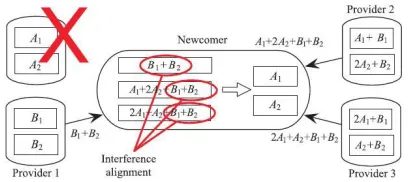
We suppose that in Fig. 3 data are encoded by (n=4, k=2, d =3) MSR codes, i.e., any two of the four nodes can recover the original file. In each storage node, each coded block contains two coded segments, such as (A1,A2) in the failed
storage node. To recover A1 and A2 , the
newcomer contacts 3 storage nodes as providers and downloads half of a coded block, i.e., a coded segment from each provider to achieve the bandwidthconsumption of MSR codes. Notice that each provider owns coded segments containing components of B1 and B2 , which are
undesirable to the newcomer. To eliminate B1 and
B2 , each provider can send a segment in which B1
and B2 are aligned onto the same linear subspace
of B1 + B2 . Clearly,B1 + B2 can be eliminated as
one unknown and A1 and A2 can be decoded by
solving three equations with three unknowns. As for exact MBR codes, Rashmi et al.[9] proposed a Product-Matrix construction which is able to explicitly construct (n,k,d) exact MBR codes on a finite field of size n or higher with anychoices of n, k, d if k d < n. The Product-Matrix construction produces vector MBR codes such that a coded block contains multiplecoded segments, just like the example shown in Fig. 3.
Fig 3: An example of (4,2,3) exact MSR codes. By interference alignment, the loss of (A1,A2) can be repaired exactly since B1 and B2 are eliminated by aligning them onto B1 + B2 in
three providers.
As for exact MSR codes, the choices of parametersbecome more complicated. Suh and Ramchandran[10] proposed an explicit construction of scalar exact MSR codes where
, over a finite field of size atleast 2(n-k).Rashmi et al[9] improved the choices of parameters such that d ≥ 2k-2, by constructing exact MSR codes using the Product-Matrix
construction, with a larger finite field of size at least n.(d-k+1). In Ref [11], Shah et al. had proved that no scalar exact MSR codesexist when d <2k-3.
Cadambe et al[12]. andSuh and
Ramchandran[13] showed that any choices of (n, k, d) could be achieved asymptotically when constructing vector exact MSR codes, as the field size goes to infinity. Constructing regenerating codes on a very large finite field is impractical due to its overwhelming encoding/decoding overhead. Papailiopoulos and Dimakis[14] showed that (n= k +2 , k, d = k+ 1) vector exact MSR codes can be constructed explicitly, combining interference alignment and Hadamard matrices.
Since the exact repair makes much more sense for the systemmatic part than the parity part of exact regenerating codes, we can construct hybrid regenerating codes that only support the exact repair of the systematic part while the parity part is still repaired by the functional repair. Wu[15] constructed the (n,k,d = k+1) hybrid vector MSR codes when 2k ≤ n, where the field sizeis greater
than 2 Tamo et al[16] and Cadambe et al[17]
both proposed (n,k,d = n-1) hybrid MSR codes for arbitrary n and k.
D.Cooperative regenerating codes
In some storage systems, such as Total Recall[18] ,in order to prevent unnecessary repairs incurred by temporary node departures, the system repairs failed nodes in batch when the number of failed nodes reaches a certain threshold. Hu et al.[19] first found that if newcomers can cooperate, there exist cooperative
regenerating codes that achieve a better
tradeoffcurve between storage and bandwidth. Still analyzing the min-cut in the information flow graph, Hu et al.[19] showed that
( ) randomized Minimum Storage
Cooperative Regenerating (MSCR) codes can achieve the bandwidth
consumption of with t providers (n-t ). Notice that the bandwidth consumption is independent of the number of providers.
A more general result of the bound of bandwidth consumption is
International Journal of Research (IJR)
e-ISSN: 2348-6848, p- ISSN: 2348-795X Volume 2, Issue 10, October 2015Available at http://internationaljournalofresearch.org
Zhang[23] showed that as for all possible values of (n,k,d,t), there exist explicit constructions of exact MBCR on a field of size at least n.
On the other hand, when
scalar MSCR codes can be constructed[20] . Le Scouarnec[24] discussed the construction of exact
MSCR codes with some other choices
ofparameters when .The existence of
exact MSCR codes with other values of parameters still remains an open problem.
E.Repair-by-transfer regenerating codes
The regenerating codes we have mentioned above require providers to encode their data to align vectors in a specific linear subspace and the newcomer to encode received data to eliminate undesired components. The arithmetic operations performed on a finite field can be expensive, if the field size is large. Thus, the cloud storage systems will favor the repair-by transfer property that in the repair no arithmetic operations are required at providers. With the repair-by-transfer property, the disk I/O overhead can be minimal since only data needed by the newcomer will be read from providers. Moreover, the storage node then can have no intelligence, such that its functionality can be implemented by hardware with a low cost. Some choices of parameters have been considered to construct the corresponding repair-by-transfer regenerating codes. Shum and Hu[25] and Hu
et al.[26\ constructed
and
functional repair-by transfer MSRcodes,
respectively. On the other
hand, exact MBR codes can
be constructed over a finite field of size 2[27] . The existence of exact regenerating codes remains an open problem as for most other choices of parameters. The onlyknown result is that if
linearexact MBCR codes cannot achieve the repair-by-transfer property[23].
Nevertheless, Rashmi et al.[28] proposed an intuitive graph-based construction of repair-by-transfer exact MBR codes, where any missing block can only be repaired from its direct neighbors in the graph. Fractional repetition codes are employed in the construction such that direct neighbors share the same segmentand the newcomer only needs to receive replicas of the segments from its neighbors to repair itself, where no arithmetic operations are required not only at providers, but at the newcomer as well. It
is shown that any MBR codes can
be constructed uniquely with this method, n > k. Though repair-by-transfer regenerating codes are able to achieve the minimum disk I/O overhead, only some specific choices of parameters have instances of corresponding regenerating codes so far. Nevertheless, cloud storage systems can have a wide spectrum of parameter choices due to their own requirements. Therefore, it is desirable that erasure coding can achieve low disk I/O overhead with a wide range of parameter choices, even if some properties, such as the MDS property or the storage efficiency, will be sacrificed.
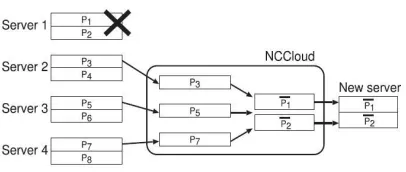
F. FMSR (Functionally minimum storage
which a file is striped over n servers using an (n,k)-FMSR code. Each server can be a storage site or even a cloud storage provider, and is assumed to be independent of other servers. An (n,k)-FMSRcode splits a file of size evenly into k(n-k) native chunks, and encodes
them into n(n-k) code chunks, Fig 4:Example of how a file is repaired in
(4,2)- FMSR codes.
IV. CONCLUSION
International Journal of Research (IJR)
e-ISSN: 2348-6848, p- ISSN: 2348-795X Volume 2, Issue 10, October 2015Available at http://internationaljournalofresearch.org
generally transfers from data integrity to resource overhead such as bandwidth consumption and storage efficiency. The exact regenerating codes help to maintain systematic erasure codes in the storage system such that no decoding operations are required to recover the original file. The repair-by-transfer regenerating codes help to achieve a repair process without arithmetic operations on both the newcomer and the providers. The FMSR codes are used to regenerate the data across a multi-server setting and performs a two-phase checking on the new code chunks generated in the repair operation. Flat XOR-codes—erasure codes in which parity disks are calculated as the XOR of some subset of data disks. These advances reduce the bandwidth consumption of the repair operations.
REFERENCES
[1] Wuala,http://www.wuala.com/en/learn/tec
hnology, 2012.
[2] M. Al-Fares, A. Loukissas, and A.
Vahdat, A scalable, commodity data center network architecture, in Proc. ACM SIGCOMM
Conference on Data Communication
(SIGCOMM), 2008.
[3] A. G. Dimakis, P. B. Godfrey, M. J. W. Y. Wu, and K. Ramchandran, Network coding for distributed storage system, IEEE Trans. Inform. Theory, vol. 56, no. 9, pp. 4539-4551, 2010.
[4] I. Reed and G. Solomon, Polynomial
codes over certain finite fields, Journal of the Society for Industrial and Applied Mathematics, vol. 8, no. 2, pp. 300-304, 1960.
[5] C. Huang, H. Simitci, Y. Xu, A. Ogus, B.
Calder, P. Gopalan, J. Li, and S. Yekhanin, Erasure coding in windows azure storage, in Proc. USENIX Annual Technical Conference (USENIX ATC), 2012.
[6] S.-Y. R. Li, R. W. Yeung, and N. Cai,
Linear network coding, IEEE Trans. on Inform. Theory, vol. 49, no. 2, pp. 371-381, 2003.
[7] T. Ho, R. Koetter, M. Medard, D. Karger,
and M. Effros, The benefits of coding over routing in a randomized setting, in Proc. IEEE International Symp. Inform. Theory, 2003, pp. 442-442.
[8] A. Duminuco and E. Biersack, A practical
study of regenerating codes for peer-to-peer backup systems, in Proc. IEEE International Conference on Distributed Computing Systems (ICDCS), 2009, pp. 376-384.
[9] K. Rashmi, N. Shah, and P. Kumar,
Optimal exactregenerating codes for distributed storage at the MSR and MBR points via a product-matrix construction, IEEE Trans. on Inform. Theory, vol. 57, no. 8, pp. 5227-5239, 2011.
[10] C. Suh and K. Ramchandran, Exact-repair
MDS code construction using interference alignment, IEEE Trans. on Inform. Theory, vol. 57, no. 3, pp. 1425-1442, 2011.
[11] N. B. Shah, K. V. Rashmi, P. V. Kumar, and K. Ramchandran, Interference alignment in regenerating codes for distributed storage: Necessity and code constructions, IEEE Trans. on Inform. Theory, vol. 58, no. 4, pp. 2134-2158, 2012.
[12] V. R. Cadambe, S. A. Jafar, and H. Maleki, Distributed data storage with minimum storage regenerating codes – Exact and functional repair are asymptotically equally efficient, http://arxiv.org/abs/1004.4299, 2010.
[13] C. Suh and K. Ramchandran, On the
existence of optimal exact-repair MDS codes for
distributed storage,
http://arxiv.org/abs/1004.4663, 2010.
International Journal of Research (IJR)
e-ISSN: 2348-6848, p- ISSN: 2348-795X Volume 2, Issue 10, October 2015Available at http://internationaljournalofresearch.org
Distributed storage codes throughhadamard designs, in Proc. IEEE International Symposium on Information Theory (ISIT), 2011, pp. 1230-1234.
[15] Y. Wu, A construction of systematic MDS
codes with minimum repair bandwidth, IEEE Trans. on Inform. Theory, vol. 57, no. 6, pp. 3738-3741, 2011.
[16] I. Tamo, Z. Wang, and J. Bruck, MDS array codes with optimal rebuilding, in Proc. IEEE International Symposium on Information Theory (ISIT), 2011, pp. 1240-1244
[17] V. R. Cadambe, C. Huang, S. A. Jafar, and J. Li, Optimal repair of MDS codes in distributed storage via subspace interference alignment, http://arxiv.org/abs/1106.1250,2011
[18] R. Bhagwan, K. Tati, Y.-C. Cheng, S. Savage, and G. M. Voelker, Total recall: System support for automated availability management, in Proc. USENIX Symposium on Networked Systems Design and Implementation (NSDI), 2004.
[19] Y. Hu, Y. Xu, X. Wang, C. Zhan, and P. Li, Cooperative recovery of distributed storage systems from multiple losses with network coding,
IEEE Journal on Selected Areas in
Communications, vol. 28, no. 2, pp. 268-276, 2010.
[20] K. Shum, Cooperative regenerating codes
for distributed storage systems, in IEEE
International Conference onCommunications
(ICC), 2011.
[21] A. Kermarrec and N. Le, Repairing
multiple failures with coordinated and adaptive regenerating codes, in IEEE International Symposium on Network Coding (NetCod), 2011.
[22] K. Shum and Y. Hu, Exact
minimum-repair-bandwidth cooperative regenerating codes for distributed storage systems, in Proc. IEEE International Symposium on Information Theory (ISIT), 2011.
[23] A. Wang and Z. Zhang, Exact
cooperative regenerating codes with
minimum-repair-bandwidth for distributed storage,
http://arxiv.org/abs/1207.0879, 2012.
[24] N. Le Scouarnec, Exact scalar minimum storage coordinated regenerating codes, in Proc. IEEE International Symposium on Information Theory (ISIT), 2012.
[25] K. Shum and Y. Hu, Functional-repair-by-transfer regenerating codes, in Proc. IEEE International Symposium on Information Theory (ISIT), 2012.
[26] Y. Hu, P. P. C. Lee, and K. W. Shum,
Analysis and construction of functional
regenerating codes with uncoded repair for
distributed storage systems,
http://arxiv.org/abs/1208.2787v1, 2012.
[27] N. B. Shah, K. V. Rashmi, P. V. Kumar, and K. Ramchandran, Distributed storage codes with repair-by-transfer and nonachievability of interior points on the storage-bandwidth tradeoff, IEEE Trans. on Inform. Theory, vol. 58, no. 3, pp. 1837-1852, 2012
[28] K. Rashmi, N. Shah, and P. Kumar,
International Journal of Research (IJR)
e-ISSN: 2348-6848, p- ISSN: 2348-795X Volume 2, Issue 10, October 2015Available at http://internationaljournalofresearch.org
regenerating codes for distributed storage, in Forty-Seventh Annual Allerton Conference on Communication, Control, and Computing, 2009.
[29] M.O. Rabin, ―Efficient Dispersal of
Information for Security, Load Balancing, and Fault Tolerance,‖J. ACM, vol. 36, no. 2, pp. 335-348, Apr. 1989.
Guide Profile:
Mr.N.Venkatadri Was Born In Andhra Pradesh, India. He is Working as Asso.Prof.,M.Tech Department of CSE, SKR College Of Engineering and Technology,KonduruSatram, manubolu,Nellore(DT).
Student Profile: