Available online:
http://edupediapublications.org/journals/index.php/IJR/
P a g e | 811A Survey of Carrier Sense Multiple Access and Multiple
Access with Collision Avoidance over DSR
Deepak Srivastava1, Harpal Singh Kushwaha2 Department of Computer Science and Engineering
College of Science and Engineering, Jhansi
[email protected], [email protected]2
ABSTRACT
The broadcast nature of wireless network critically depends upon the medium access control (MAC) protocols. A MAC protocol in a multi-access medium is essentially a distributed scheduling algorithm that allocates the channel to requesting nodes [3]. In MAC Layer, wireless broadcast medium is used and therefore multiple transmissions can result in garbled data, making communication impossible. A medium access control (MAC) protocol moderates access to the shared medium by implementing some rules that allow these devices to communicate in orderly and efficient manner with each other.
MAC protocols therefore plays very important role in enabling this paradigm by fair sharing of the wireless bandwidth. The medium require delay and jitter guarantees from network. MAC
protocols design and selection based
performance (throughput, delay, packet delivery ratio).
There are number of MAC protocols proposed for MANET to solve the above discussed problems such as CSMA, MACA, MACAW, MACA-BI, IEEE 802.11, FAMA and more. While studying the MAC protocols, the selection of the MAC protocol depends on efficient performance it provides. CSMA and MACA are found more reliable and basic protocols required for a wireless scenario among these protocols.
Mobile Ad hoc Network (MANET) is a self-configuring network of mobile devices and connected by non-wired links. In other words a MANET is a group of wireless mobile computers in which node moves in independent manner in any direction. The nature of MANETs brings a
great challenge to system security. In such a network, each mobile node operates not only as a host but also as a router, forwarding packets for other mobile nodes in the network that may be multiple hops away from each other.
Another effective method to increase the capacity of a wireless network is power control [9]. By controlling its transmission power, a node can achieve its transmission quality while at the same time reduce the interposition in the channel. Power control can also alleviate the effect of nodal movement to some extent.
Keywords-AWNs, MACA, CSMA, DSR,
Throughput.
1. INTRODUCTION
Available online:
http://edupediapublications.org/journals/index.php/IJR/
P a g e | 812transmitter. When exchanging packets, they
may use the routing services of host B to
forward packets since B is within the
transmission range of both of them.
Figure 1: Mobile Ad Hoc Network
MANETs are autonomous and decentralized wireless systems. Nodes are the systems or devices i.e. mobile phone, laptop, personal digital assistance, MP3 player and personal computer that are participating in the network and are mobile. They can form arbitrary topologies depending on their connectivity with each other in the network. These nodes have the ability to configure themselves and because of their self-configuration ability, they can be deployed urgently without the need of any infrastructure. Internet Engineering Task Force (IETF) has MANET working group (WG) that is devoted for developing IP routing protocols. Routing protocols is one of the challenging and interesting research areas for researchers. Many routing protocols have been developed for MANETs.
Security in MANET is the most important concern for the basic functionality of network. Availability of network services, confidentiality and integrity of the data can be achieved by assuring that security issues have been met. MANET often suffer from security attacks because of the its features like open medium, changing its topology dynamically, lack of central monitoring and management, cooperative algorithms and no clear defense mechanism
MANETs must have a secure way for transmission and communication and this is quite challenging and vital issue as there is increasing threats of attack on the Mobile Network.
Carrier Sense Multiple Access (CSMA)CSMA is standardized internationally in IEEE 802.11. It is contention based MAC layer protocol for wireless mobile ad-hoc network. This is packet based collision avoidance. It is probabilistic media access control protocol in which a node verifies the absence of other traffic before transmitting on a shared transmission medium.
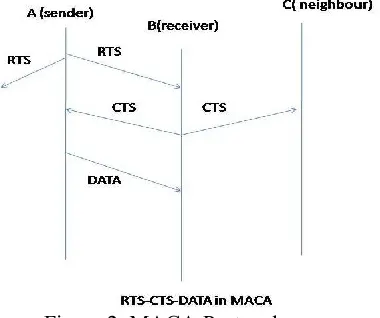
Figure 2: MACA Protocol
Multiple Access with Collision Avoidance (MACA) Multiple Accesses with Collision Avoidance (MACA) [2] is a slotted media access control protocol used in wireless LAN data transmission to avoid collisions caused by the hidden station problem and to simplify exposed station problem.
This MACA protocol is not fully solve the hidden node and exposed terminal problem and nothing is done regarding receiver blocked problem.
Contention Based Protocol
Nodes are not guaranteed periodic access to the channel
They cannot support real time traffic
Three way handshaking
Available online:
http://edupediapublications.org/journals/index.php/IJR/
P a g e | 813 Binary Exponential back off Algorithm Sender initiated Protocol
RTS—CTS carrier information about the duration of time for neighbor nodes.
Multiple access collision avoidance MAC layer protocol is three way handshaking techniques, known as RTS-CTS-DATA. There is no acknowledgment packet (ACK) in MACA scheme. The basic idea of MACA is a wireless network node makes an announcement before it sends the data frame to inform other nodes to keep silent. When a node wants to transmit, it sends a signal called Request-To-Send (RTS) with the length of the data frame to send. If the receiver allows the transmission, it replies the sender a signal called Clear-To- Send (CTS) with the length of the frame that is about to receive. Meanwhile, a node that hears RTS should remain silent to avoid conflict with CTS; a node that hears CTS should keep silent until the data transmission is complete.
When a node wants to transmit a data packet, it first transmits a RTS frame.
The receiver node, on receiving the RTS packet, if it is ready to receive the data packet, transmits a CTS packet.
Once the sender receives the CTS packet without any error, it starts transmitting the data packet.
If a packet transmitted by a node is lost, the node uses the binary exponential back-off (BEB) algorithm to back off a random interval of time before retrying.
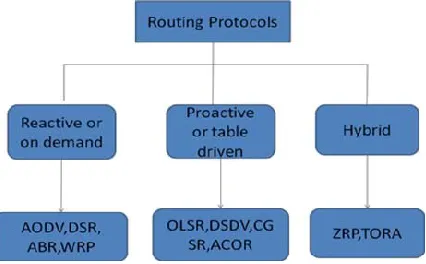
2. ROUTING PROTOCOLS FOR MANETS
Routing protocols May be generally categorized as
1. Table driven
2. Source initiated (demand driven)
Table Driven Protocols: Table driven protocols maintain consistent and up to date routing information about each node in the network. These protocols require each node to store their
routing information and when there is a change in network topology pupation has to be made throughout the network. Some of the existing table driven protocols are:
Figure 3: Routing Protocols
Destination sequenced Distance vector routing (DSDV)
Wireless routing protocol (WRP)
Fish eye State Routing protocol (FSR)
Optimized Link State Routing protocol (OLSR)
Cluster Gateway switch routing protocol (CGSR)
Topology Dissemination Based on Reverse path forwarding (TBRPF)
Source Initiated Demand driven: In on-demand routing protocols routes are created as and when required. When a source wants to send to a destination, it invokes the route discovery mechanisms to find the path to the destinations. The route remains valid till the destination is reachable or until the route is no longer needed The different types of On Demand driven protocols are:
Ad hoc On Demand Distance Vector (AODV)
Dynamic Source routing protocol (DSR)
Temporally ordered routing algorithm (TORA)
Associativity Based routing (ABR)
Available online:
http://edupediapublications.org/journals/index.php/IJR/
P a g e | 814groups, and deployed on several tested. Networks using the DSR protocol have been connected to the Internet. DSR can interoperate with Mobile IP, and nodes using Mobile IP and DSR have seamlessly migrated between WLANs, cellular data services, and DSR mobile ad hoc networks [6].
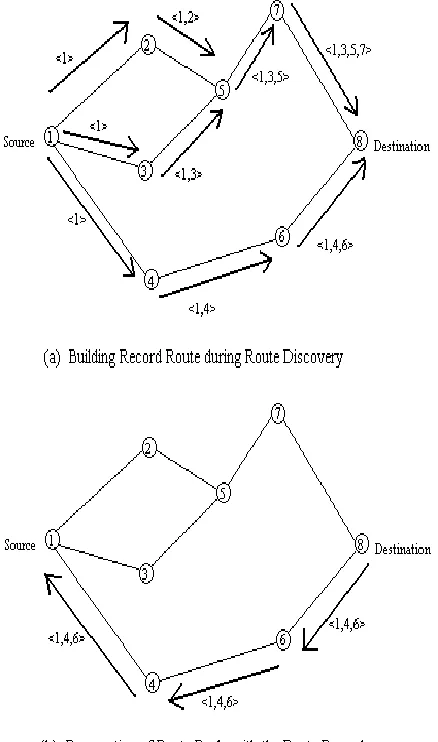
Figure 4: Creation of record route in DSRP
The Dynamic Source Routing protocol (DSR) is a simple and efficient routing protocol designed specifically for use in multi-hop wireless ad hoc networks of mobile nodes. DSR allows the network to be completely self-organizing and self-configuring, without the need for any
existing network infrastructure or administration.
It then appends its id to the
packet and forwards the packet to the next
node; this continuous until either a node
with a route to the destination is encountered
(i.e. has a route in its own cache) or the
destination receives the packet. In that case,
the node sends a route reply packet which
has a list of all of the nodes that forwarded
the packet to reach the destination. This
constitutes the routing information needed
by the source, which can then send its data
packets to the destination using this newly
discovered route. DSR can support relatively
rapid rates of mobility.
Working
Dynamic Source Routing (DSR) is a routing protocol for wireless mesh networks. The two major phases of the protocol are: route node wants to send a packet to a destination; it looks up its route cache to determine if it already contains a route to the destination. If it finds that an unexpired route to the destination exists, then it uses this route to send the packet. But if the node does not have such a route, then it initiates the route discovery process by broadcasting a route request packet. The route request packet contains the address of the source and the destination, and a unique identification number. Each intermediate node checks whether it knows of a route to the destination. If it does not, it appends its address to the route record of the packet and forwards the packet to its neighbors. To limit the number of route requests propagated, a node processes the route request packet only if it has not already seen the packet and its address is not present in the route record of the packet. A route reply is generated when either the destination or an intermediate node with current information about the destination receives the route request packet [7]. A route request packet reaching such a node already contains, in its route record, the sequence of hops taken from the source to this node.
Available online:
http://edupediapublications.org/journals/index.php/IJR/
P a g e | 815bandwidth consumed by control packets in ad hoc wireless networks by eliminating the periodic table-update messages required in the table-driven approach. The major difference between this and the other on-demand routing protocols is that it is beacon-less and hence does not require periodic hello packet (beacon) transmissions, which are used by a node to inform its neighbors of its presence. The basic approach of this protocol (and all other on-demand routing protocols) during the route construction phase is to establish a route by flooding Route Request packets in the network. The destination node, on receiving a Route Request packet, responds by sending a Route Reply packet back to the source, which carries the route traversed by the Route Request packet received. Consider a source node that does not have a route to the destination. When it has data packets to be sent to that destination, it initiates a Route Request packet. This Route Request is flooded throughout the network. Each node, upon receiving a Route Request packet, rebroadcasts the packet to its neighbors if it has not forwarded it already, provided that the node is not the destination node and that the packet’s time to live (TTL) counter has not been exceeded. Each Route Request carries a sequence number generated by the source node and the path it has traversed. A node, upon receiving a Route Request packet, checks the sequence number on the packet before forwarding it. The packet is forwarded only if it is not a duplicate Route Request. The sequence number on the packet is used to prevent loop formations and to avoid multiple transmissions of the same Route Request by an intermediate node that receives it through multiple paths. Thus, all nodes except the destination forward a Route Request packet during the route construction phase. A destination node, after receiving the first Route Request packet, replies to the source node through the reverse path the Route Request packet had traversed. Nodes can also learn about the neighboring routes traversed by data packets if operated in the promiscuous mode (the mode of operation in which a node can receive the packets that are neither broadcast
nor addressed to itself). This route cache is also used during the route construction phase. If an intermediate node receiving a Route Request has a route to the destination node in its route cache, then it replies to the source node by sending a Route Reply with the entire route information from the source node to the destination node.
In DSR every node is responsible for confirming that the next hop in the Source Route receives the packet. Also each packet is only forwarded once by a node (hop-by-hop routing). If a packet can’t be received by a node, it is retransmitted up to some maximum number of times until a confirmation is received from the next hop. Only if retransmission results then in a failure, a Route Error message is sent to the initiator that can remove that Source Route from its Route Cache. So the initiator can check his Route Cache for another route to the target. If there is no route in the cache, a Route Request packet is broadcasted.
3. PERFORMANCE METRICES
Following performance metrics are studied in this survey. The performance metrics such as Packet Delivery Ratio, Average End-to-End Delay and throughput are being used to evaluate the network efficiency.
Packet Delivery Ratio
The packet delivery ratio defined as the number of received data packets divided by the number of generated data packets.
Packet Delivery Ratio = ∑ (No. of Received Packets) / ∑ (No. of Delivered Packets)
Average End-to-End Delay
Available online:
http://edupediapublications.org/journals/index.php/IJR/
P a g e | 816delay. The end-to- end delay is measured in second. The delay assesses the ability of the routing protocols in terms of use- efficiency of the network resources.
Average End-to-End Delay = ∑ (Time when Packets enters in the Queue) - ∑ (Time when the Packets is received)
Throughput
The average rate at which the data packet is delivered successfully from one node to another over a communication network is known as throughput. In other words we say that, throughput is the number of packet that is passing through the channel in a particular unit of time. This performance metric shows the total number of packets that have been successfully delivered from source node to destination node and it can be improved with increasing node density. The throughput is usually measured in bits per second (bits/sec).
4. SUMMERY
The Study shows that the Efficient MAC protocols can provide significant benefits to mobile ad hoc networks, in terms of both performance and reliability. The issues associated with the design of a MAC protocol for wireless ad hoc networks are: node mobility; an error- prone, broadcast and shared channel; time-synchronization; bandwidth efficiency; QoS support. Many MAC protocols for such networks have been proposed so far but their performance in terms of Throughput, Total packet received, Average end to end delay and drop packet ratio is questionable and is not satisfactory.
The study shows that the behavior of routing protocols vary with the environments. In some condition CSMA and for some situation MACA are better. It depends where we have to use these.
In future we can implement these with various routing protocols using CSMA and MACA
environments and check how they behave. The previous work was done with AODV routing protocols.
5. REFERENCES
[1]A.Venkataramana, Dr.S.PallamShetty "Investigating the Impact of 802.11 and CSMA ON AODV and DSR Routing Protocols in MANETS Using GloMoSim" , IJCST VOL. 4, ISSUE 4, OCT -DEC 2013, ISSN : 0976-8491 (Online) | ISSN : 2229-4333 (Print)
[2] Imrich Chlamtac, Marco Conti, Jennifer J.N. Liu, “Mobile ad hoc networking: imperatives and challenges”, University of Texas at Dallas, Dallas, TX, USA, Ad Hoc (2003) 13–64.
[3] C.K. Toh, “Ad Hoc Mobile Wireless Networks: Protocols and Systems”, Springer Prentice Hall Publishers, 2001.
[4] Azzed ineBoukerche, “A lgorith ms and Protocols for Wireless and Mobile Ad Hoc Networks”, University of Ottawa, Ottawa, Canada, ISBN 978-0- 470-38358-2 (cloth) TK5105.77.A44 2008.
[5] Arun Ku mar B. R., “Performance Co mparison of Wireless Mobile Ad- Hoc Network Routing Protocols”, Bangalore & Research Scholar, Dept. of CS, School of Science & Technology, Dravid ian University, Kuppam- 517425, A. P., India, June 2008.
[6] S Krishnamurthy, “Ad-Hoc Networks Technologies and Protocols P Mohapatra”, Springer Publishers,2004(ISBN: 0-387-22689-).
[7] Changzhou Wang, Guijun Wang, Haiq in Wang, Alice Chen, “Quality o f Service (QoS) Contract Specification, Establishment, and Monitoring for Service Level Management”, Rodolfo Santiago Boeing Phantom Works Seattle, WA, USA 0-7695-2743-4/06, 2006.