ISSN 2286-4822 www.euacademic.org
Impact Factor: 3.4546 (UIF) DRJI Value: 5.9 (B+)
Process Models of Employee Turnover during
1975-1995: A Review
NIHARIKA SINGH PROF. L. S. SHARMA
Department of Management, Mizoram University India
Abstract:
Employee turnover has been one of the most widely investigated organizational phenomena and to understand turnover a number of models have been proposed from time to time. Turnover models can be basically classified as, content model (explains why employees leave) and process model (explains how employee leaves). The current study deals with the early process models of employee turnover to enlighten the past of the current complicated process models. To understand the history of process turnover models, the study reviews some of the articles on selected models given between 1975-1995. After first process model of Mobley’s (1977), bundle of process turnover models were given but unfortunately none has been universally accepted.
Key words: employee turnover, turnover model, process models
Introduction
employee turnover, which introduced the theory of „organizational equilibrium‟. According to this theory, members participate in the organization as long as inducements, such as pay, match or exceed the employees inputs and that the perceived desirability (equated with job satisfaction) and perceived ease of movement (equated with number of alternatives) are two primary factors that influence employee turnover(Lee and Mitchell 1994). Many models have been developed to explain turnover since the original model of March and Simon (1958). Some of the most notable early studies of turnover models are such as Farris (1969), who listed some of the core or key reasons towards turnover; Porter and Steers (1973) who proposed that met expectations were the central issue in employee turnover, which stands for a congruence between what newly hired employees expected and what they actually experienced in the organization. This leads toward satisfied employee, which would decrease the probability of quitting. Most of the early research attention was given to
content models (e.g., Porter and Steers 1973; Farris 1969,
and if possible can take actions to cease or delay the employee turnover.
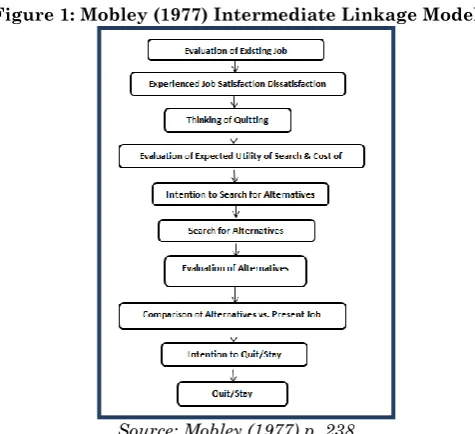
Mobley‟s (1977) “Intermediate linkage model” was one of the first process models introduced and served as a template for the development of future process model. This model explains the process by which a dissatisfied employee arrives at a decision to leave the organization (Hom et al.1984,141). At the same time, Price (1977) introduced another process turnover model i.e., causal model, which claims that intent to quit and perceived alternative opportunities determine turnover whereas job satisfaction influences turnover through its effect on intent to quit (Boswell et al. 2008, 196).
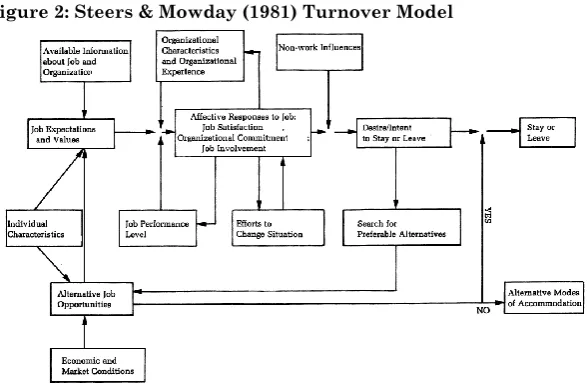
Mobley et al. (1979), gave a more comprehensive process model suggesting that there are four principal determinants of the decision to quit, namely job satisfaction, expected utility of alternatives roles within the organization, expected utility of alternative roles outside the organization and non-work values and roles, which in turn are influenced by a number of individuals, organization and environment factors (Boswell et al. 2008, 196). Further, Steer and Mowday (1981) proposed a dual sequence, in which intentions to quit may lead directly to quitting or may trigger a search for alternatives. Hom et al.
(1984) proposed a revised intermediate process model, suggesting two decision paths: once the employee decides to quit the job, s/he either directly resign or search the alternatives and compare with the present job. Some other remarkable contributions in the history of process models are such as, Sheridan and Abelson (1983)-cusp-catastrophe model; Jackofsky (1984)-integrated process model; Hom and Griffeth (1991); Price and Mueller (1981 & 1986); Lee and Mitchell (1994), some of them will be discussed in detail latter in the article.
turnover models and to show how the models have become more complex with time. Keeping in mind the introduction of the first process model i.e., Mobley‟s intermediate linkage model in 1977 and limitation of the study the models given within the period 1975-1995 were only considered. Finally, five models have been selected to be discussed in the study viz.,- (1) Mobley (1977)-Intermediate linkage model , (2) Steers and Mowday (1981)-Turnover Model, (3) Sheridan & Abelson (1983)-Cusp-Catastrophe model, (4) Jackofsky (1984)-Integrated process model, and (5) Lee & Mitchell (1994)-Unfolding Model of Turnover. Our rational for choosing to discuss these five models is that they represent a departure from March & Simon‟s work and other traditional models. In other words, they all gave something new to the history of turnover research, such as Steers and Mowday (1981) introduced role of available job and organization information, non-work values, job performance; Sheridan and Abelson (1983) recognized turnover as discontinuous function of two control variables and so on.
Need of the study:
Turnover models are classified into content and process models. Content model focus on why employees leave whereas process model focus on how employees leave. Turnover models are a means of integrating knowledge gained from studies of turnover behavior. Individual content and process models have been discussed and examined in a number of studies in past. But till now no such study has been found where history of early turnover models has been discussed systematically. Hence, this study has made an effort to understand turnover research during 1975-1995 and assemble them all on a single platform.
The objective of the study is (a) to discuss the process models of employee turnover during 1975-1995 and (b) to analyze the development on the studies of process models.
Research Methodology:
The study is a review article of early process turnover models, based on secondary data in the form of articles and books. The study was aimed to explore the history of process turnover models and its increasing complexity, with time. To conduct the study, five models introduced between 1975-1995 were considered; as the actual history of process turnover model starts in 1977 with the introduction of Mobley (1977)- Intermediate Linkage model. To identify the available articles for these models and other complementary studies, online databases and search engines were used. The content of the articles were thoroughly studied by the authors, so that it can be assembled in the best way possible without missing vital information for the models.
Discussion:
In order to understand the history of early process turnover models, five models were selected which seems to bring revolutionary change in the way employee decision to stay or leave the organization was studied. Vital details of selected five models are discussed below, in chronological order:
(1).Mobley (1977)-Intermediate Linkage model:
al. 1984,141). He proposed that a withdrawal decision process takes place between job dissatisfaction and quitting. (Gauger 2001) and highlighted the variables that link job attitude (job dissatisfaction) with actual turnover. He pioneered an extensive explanation for the psychological turnover process.
According to the model, (see Figure 1) the process starts with the (a)evaluation of existing job followed by emotional state of (b)satisfaction or dissatisfaction of employee with the job. Job dissatisfaction leads to (c)thinking about quitting, which in turn may lead to (d) evaluations for the expected utility
of searching for another job (for example, evaluating the
probability of finding a job within the same salary range) and
cost of quitting (for example, loss of excellent annual bonus,
health benefits). If perceived possibility of finding a comparable job is quite high and the costs of quitting is not much, employee will proceed for the next step i.e., (e)intention to search for
alternatives followed by (f) actual search for alternatives. If
alternatives are existent, (g) evaluation of these alternatives are made to find the best one among them. Afterwards, a (h)
comparison of the best alternative is made with the present job.
If the comparison favors the alternative, behavioral (i) intention
to quit will be stimulated, followed by the last step of (j) actual
quitting.
with the decision to leave and only indirectly related to actual turnover process. (Mowday et al. 1984)
Figure 1: Mobley (1977) Intermediate Linkage Model
Source: Mobley (1977) p. 238
A simplified version of Mobley‟s (1977) model was tested by Mobley, Horner & Hollingsworth (1978).
Mobley et al. (1979) gave an expanded model of turnover, which was expansion to the earlier intermediate linkage model. The model suggests that actual turnover is a result of job satisfaction, expected utility of alternative roles within the organization and outside the organization, and non-work values and roles. These determinants are in turn influenced by a very large number of labor, organization, job and person variables. Unlike Mobley (1977), this model was less concerned with intermediate linkage between the various constructs of decision process than with complex relationships between various job and non-job related factors that can influence the initiation of the decision process (Mowday et al., 1984).
Subsequent models enhanced Mobley‟s model and among them one such established theoretical alternative was
Hom et al. (1984).
(2)Steers & Mowday (1981)-Turnover Model:
spouse‟s job etc. (3) Desire/intention to leave can (a) end at actual staying or quitting, or (b) initiate search behavior leading to a more attractive job opportunities. Those individuals involve in searching behavior mostly leave an organization only after they find another job (Lee and Mowday 1987, 722).
They also hypothesized that job expectations and values are influenced by- (a) available information about job and organization, conceptualized as “degree of complete information”. (Steer and Mowday 1981, 243), (b) individual characteristics, and (c) alternative job opportunities. Further, alternative job opportunities were seen as influenced by (a) economic and market condition, and (b) individual characteristics (Lee and Mowday 1987).
Steers & Mowday (1981) shows one similarity with Price‟s (1977) -Causal model is that they both talks about interaction between intent to leave and opportunities for the final decision to stay/quit. Apart from that, Steers and Mowday made the model not only more complex than previous models but also more advanced. Unlike Mobley (1977), Steers and Mowday (1981) is very detailed about the determinants of job satisfaction and other affective responses. One noteworthy difference between these two models is that Mobley advocates intention to quit follows search for alternatives, whereas Steers and Mowday (1981) theorizes that search for alternate follows intent to quit (Lee and Mowday 1987, 724). The latter model is similar to expanded version of Mobley (1977).
attitudes (organizational commitment & job involvement) other than job satisfaction in turnover process; introduction of job performance levels as an influence on affective responses; introduction of new individual, job and organization related constructs and such.
Figure 2: Steers & Mowday (1981) Turnover Model
Source: Lee and Mowday (1987): 723
It is to be noted that, original model was given by Sheridan & Abelson (1983). Sheridan (1985) further extended the model with some new control variables and more detailed withdrawal behavior outcomes.
The model explains how a continuous change in control variables, such as job tension and exchange commitment (Sheridan & Abelson 1983) and job tension and group cohesion (Sheridan 1985) affects the discontinuous change in withdrawal behavior, such as from retention to termination state of behavior. The model suggests that withdrawal, to the point of termination, is not a continuous linear function of any control variables.
In cusp-catastrophe model, there are two surfaces (see Figure 3) viz., behavior surface and control surface. Behavior
surface describes set of three paths that shows the movements
of individuals with withdrawal process.
Path “a” –shows transition from retention to termination. Model says employee follow “delay rule” i.e. tend to stay in one particular state of retention for as long as possible. Increase in job tension leads to job stress and decline in commitment leads to job dissatisfaction. Thus, when job tension increases and commitment declines, it brings employee to a level known as hysteresis zone (represented as a fold in the behavior surface). This region represents a state of disequilibrium in which the employee is about to change from retention to termination.
Source: Sheridan & Abelson, 1983:421
Until and unless these measures of control variables have not reached to hysteresis zone, employees stay showing various other withdrawal behaviors.
Path “b” – shows low job tension but declining commitment, gives job dissatisfaction but since there is little job tension it does not reach to the hysteresis region.
Path “c” –shows high job tension but high commitment, which gives job stress to employee but since it did not reached hysteresis zone, it does not lead to termination.
When trace of the fold of hysteresis zone is projected on control surface, it is named as bifurcation plane. The model hypothesizes that when an individual approaches the fold region, control variables which have been changing slowly and smoothly till now, even small changes in these variables can result in discontinuous change from retention to termination i.e., termed as divergence property (Sheridan & Abelson, 1983). On either side of the bifurcation plane is retention & termination plane and altogether they constitute control surface.
Sheridan(1985) explains the three plains from the figure as follows:
Retention plane- high density region, where employee staying in the job is highly probable.
Termination plane- high density region, where employee leaving the job is highly probable.
Overall, the model suggests that withdrawal till the job termination is not a continuous linear function of either tension or commitment. Whereas, terminations occurs as a discontinuous change in withdrawal behavior only after the bifurcation level has been exceeded.
To support their study, Sheridan & Abelson (1983), conducted a study on nursing employees and almost all the hypothesis were accepted. Also, to show it‟s superiority over continuous linear model, they conducted a test and declared that catastrophe model has higher predictive ability (overall 84%) than continuous linear model (overall 70%) Sheridan (1985) also reported higher predictive accuracy i.e. 86% for new employee compared to 58% predictive accuracy for a linear interaction model.
No doubt, this model offers is more than the prior models and also, it gives a different direction from traditional model linear thinking to recognizing turnover as a discontinuous dynamic phenomenon.
(4) Jackofsky (1984)-Integrated Process Model
which includes movement between and within organizations, rather than predicting organizational withdrawal.
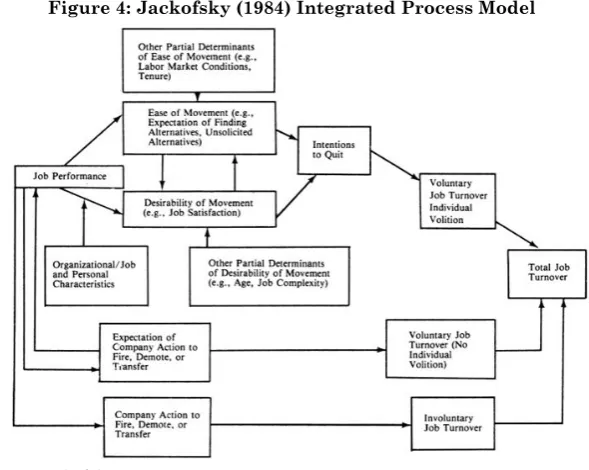
Other than that, Jackofsky model also have three obvious differences with March & Simon‟s model. First, in present work, perceived ease of movement is influenced by extra-organizational as well as intra-organizational alternatives (Jackofsky 1984, 75). Whereas, in March & Simon‟s work intra-organizational alternatives is given as precursor of „perceived ease of movement‟. Second, Jackofsky hypothesized that performance have an impact on perceived and desirability of movement. Some additional partial determinants are also given a place in the model, such as personal characteristics on the ease of movement side. Third difference is of the source of motivation to leave a job or an organization. March and Simon states that job dissatisfaction is a direct motivation to withdraw, whereas the current model argues that motivation to leave may come from either job dissatisfaction or from alternative (or ease) side of the model. An employee may feel motivated to leave if an unsolicited job offer is offered. Lastly, voluntary turnover (with or without individual volition) as well as involuntary turnover is also a part of the study.
(a) This model argues to have an indirect relationship between job performance and job satisfaction/dissatisfaction, where job satisfaction impact desirability of movement, which in turn effect intent to quit and voluntary turnover (with individual volition or free-will). It hypothesizes that with the involvement of certain moderators job performance is related to turnover. Moderators include job related stimuli, such as performance related reward, leader behavior, individual differences. For example, good job performance leads to equally good reward (moderator) followed by job satisfaction
Figure 4: Jackofsky (1984) Integrated Process Model
Source: Jackofsky, 1984: 78
Also, it hypothesizes that relation between job satisfaction and voluntary turnover is mediated by job performance. Since it‟s easy for a high performer to actually quit if dissatisfied, makes the relationship between satisfaction and turnover stronger than for low performer (Jackofsky, 1984:79).
and positive relationship. High performers or star employees are believed to always have offers from competitors, which makes easy for them to leave.
(b)The model hypothesizes performance to have impact on involuntary turnover, since low performers can be transferred or fired( forms of involuntary turnover) (Wanous, Stumpf & Bedrosian 1979). Apart from that, low performance can lead to voluntary turnover (but with not employee‟s free will), because of expected threat of company action. Though such turnover might be called as involuntary, since it‟s not an individual choice to leave, they leave to avoid negative remarks in his career (Jackofsky, 1984).
Undoubtedly, the most remarkable effort of this model is to focus on the role of job performance in actual turnover in detail. Also, rather than just using the ease of movement, as a variable interacting with other job attitudes to decide actual turnover, like all other prior models, it made a point that it can also be a source of motivation for employee to leave.
(5).Lee and Mitchell (1994)- Unfolding Model
Unfolding model of Lee and Mitchell (1994) is a representation of four possible decision paths, which may lead to employee voluntary turnover of employees. The research on prior models (e.g. Mobley, 1977; Steers & Mowday, 1981) had explained only a small portion of variance of actual employee turnover (Lee & Mitchell, 1994). These facts suggested that many employees leave the organization in ways not specified in prior models (Lee and Mitchell 1994, 56). Lee & Mitchell proposed unfolding model, which suggests paths that employees use to leave, that have not been discussed in the literature.
in behavior (i.e. leaving for another job), however, the status quo or present state (continues current job) continues. To accomplish this, two-step decision process is followed: (a) Screening, which ascertains whether new information or options easily integrate into a set of three specific images: value, trajectory and strategic image. Value image is value and principles that defines a person; trajectory image is set of goals individual is willing to achieve; strategic image is the set of strategies to be used to achieve these goals. Options which do not fit with these three images are screened out. This is termed as „compatibility test‟. (b) From surviving options, best alternative is chosen (if more than one alternatives). Those bests are/is compared with status quo, to choose better among them. It is termed as „profitability test‟ since choice is made for the option which maximizes the benefit.
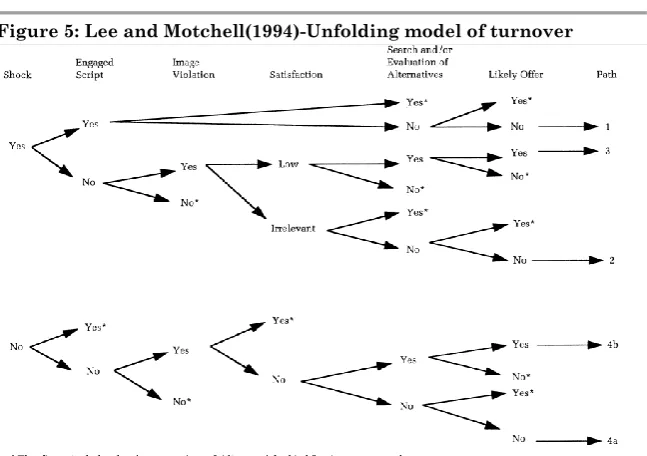
Lee & Mitchell (1994) proposed four paths, discussed below (see Figure 5):
Decision path 1: It starts with some sort of unusual job related, organization-related or personal events (such as, pregnancy, corporate takeover and such), which is called as
shock to the system. Shock causes the employee to search for
his/her memory for prior decision or rules, referred to as script
or decision frame (Donnelly and Quirin 2006, 60). In other
words, a script is a plan of action based on past experiences or social expectations. If the plan of action or script was appropriate in the past, then the script is enacted instantly. For example, an employee missed the promotion (shock) and he decided to leave the job if missed the promotion again (script). Hence, if missed the promotion again, the employee enact the script and quits automatically.
Decision Path 2: Shock to the system occurs, but no script or plan of action is available for the shock, which engages employee in further mental deliberation and he thinks about meaning of shock for the employee and his job. The individual evaluate how well the shock integrates or fits with his images i.e. value, trajectory & strategic images (Compatibility test in image theory) (Donnelly and Quirin 2006, 62). If the shock is not compatible with any of the images, image violation occurs and individual will either change the image or leave the organization. However, if it fits the employee will stay.
For example, a woman who become pregnant unexpectedly (shock), may check whether her images of being competent mother (value), having a career (trajectory) or continuing in her sales position (strategy) is not violated. In case none of it is violated, she will stay (Lee et al. 1994, 66).
Path 2 most likely occurs with a negative organizational shock, and it is considered to be so negative that instead of looking at job alternatives employee decide to quit. (Lee et al., 1996: 28) The entire experience in decision path 2 may develop into the script, which can be used for similar shock for decision path 1 (Lee et al. 1994)
Figure 5: Lee and Motchell(1994)-Unfolding model of turnover
Source: Lee et al., 1999: 451
Even if one of the images is not a fit, the alternative is dropped, whereas it survives for the next stage of judgment if it fits with all three images.
Next, either one or more than one alternative survived the last stage of judgment is compared to the experienced position (or status quo) and the one providing maximum benefits is chosen (Profitability test) (Lee et al. 1994, 67).
For example, a woman has been mentally harassed by the boss (shock), produces some disaffection with the job (misfit between images & shock). Hence, she starts looking for alternatives and when alternatives located, they are evaluated with respect to 3 images. One survive the minimum acceptable criteria (compatibility test) is compared to current employment situation. If current employment is better, she stays; otherwise
she leaves. Decision path 3 most likely occurs with job-related
shocks (Lee et al. 1996)
images of the employee changes, such that job is no longer fits with the value or trajectory images. For example, a woman (a mother) working in an organization is offered an excellent work-life balance policies but with time organization changed its work-life balance policies. This brings woman to a state where her value image (being a good mother) is violated which dissatisfies her followed by quitting the job.
Due to lack of fit, it causes job dissatisfaction, which may be diverged into: (a) Direct resign, without considering the alternatives (Decision path 4A) (b) Initiation of job search, evaluation of alternatives compatibility and so on, just like decision path 3 (Decision Path 4B) (Lee et al. 1994).
Mitchell, Wise and Fireman (1996) tested the unfolding model and demonstrated that 63 percent of the sample followed one of the paths of unfolding model, which increased to 92.6 percent after specific modifications proposed by Mitchell et al., (1996). Lee et al., (1999) gave similar kind of results. In a study, Donnelly and Quirin (2006) extended the work of unfolding model by involving quitters as well as stayers (who thought to quit but ultimately stayed). The study demonstrated 86 percent of the sample leaving through one of the paths.
Conclusion:
the studies i.e. job satisfaction. Most of the studies were conducted on nurses or hospital employees , such as Sheridan & Abelson, 1984; Sheridan , 1985; Lee et al, 1996; Mobley, 1997. All the studies considered same variables will influence employee to stay or leave, which may not be true, as supported by Mitchell et al. (2001).
REFERENCES
Bluedorn, Allen C. “The Theories of Turnover: Causes, Effects and Meaning.” In Research in the Sociology of
Organizations, edited by S. Bacharach, Greenwich,
Conn: JAI Press, 1982a.
Boswell, Wendy R., Lily R. Ren and Andrew T. Hinrichs. “Voluntary Employee Turnover: Determinants, Processes and Future Directions.” In The Sage
Handbook of Organizational Behavior, edited by J.
Barling and C. L. Cooper, vol . 1, 192-216. New Delhi, Sage Publication, 2008.
Donnelly, David P. and Jeffrey J. Quirin. “An Extension of Lee and Mitchell‟s Unfolding Model of Voluntary Turnover.”
Journal of Organizational Behavior 27 (2006): 59-77
Gauger, Jeffery W. “Integrating Content and Process Models to Study Turnover in the Canadian Forces.” Master‟s Thesis, University of New Brunswick, 2001.
Harman, Wendy S., Micheal Blum, Julia Stefani and Ada Taho. “Albanian Turnover: Is the Job Embeddednss Construct Predictive in an Alabanian Context?” Institute of
Behavioral and Applied Management (2003): 192-205.
Hom, Peter W. and Rodger W. Griffeth,. Employee Turnover. Cincinnati: South Western Publishing, 1995.
Turnover.” Organizational Behavior and Human
Performance 34 (1977): 141-174.
Jackofsky, Ellen F. “Turnover and Job Performance: An Integrated Process Model.” Academy of Management
Review 9, no.1 (1984): 74-83.
Lee, Thomas W. and Terence R. Mitchell. “An Alternative Approach: The Unfolding Model of Voluntary Employee Turnover.” Academy of Management Review 19, no.1 (1994): 51-89.
Lee, Thomas W., Terence R. Michell, Lowell Wise and Steven Fireman. “An Unfolding Model of Voluntary Employee Turnover.” Academy of Management Journal 39, no. 1(1996): 5-36.
Lee, Thomas W., Terence R. Mitchell, Brooks C. Holtom, Linda S. McDaniel and John W. Hill “The Unfolding Model of Voluntary Turnover: A Replication and Extension.”
Journal of Organizational Behavior 42, no.4 (1999):
450-462.
Lee, Thomas W. and Richard T. Mowday. “Voluntarily Leaving an Organization: An Empirical Investigation of Steer and Mowday‟s Models of Turnover.” The Academy of
Management Journal 30, no. 4 (1987): 721-743.
Maertz, Carl P. and Micheal A. Campion. “25 Years of Voluntary Turnover Research: A Review and Critique”
in International Review of Industrial and
OrganizationalPsychology edited by L. L. Cooper and I.
T. Robertson, 49-83.Chichester, UK: Wiley , 1998.
March, James G. and Herbert A. Simon. Organizations. New York: Wiley (1958)
Mobley, William H. “Intermediate Linkages in the Relationship Between Job Satisfaction and Employee Turnover Process.” Journal of Applied Psychology 62 (1977): 237-240.
Employee Turnover Process.” Psychological Bulletin 86 (1979): 493-522.
Morrell, Kevin, John Loan-Clarke. and Adrian Wilkinson. “Unweaving Leaving: The Use of Models in the Management of Employee Turnover.” Business School Research Series, 2001.
Mowday, Richard T., Christine S. Koberg and Angeline W. McArthur. “The Psychology of the Withdrawal Process: A Cross-validational Test of Mobley‟s Intermediate Linkages Model of Turnover in Two Samples.” Academy
of Management Journal 27, no. 1 (1984): 79-94.
Perez, Mylene. “Turnover Intent.” Diploma Thesis, University of Zurich, 2008.
Price, James L. The Study of Turnover. Ames, Iowa: Iowa State University Press, 1977.
Porter, Lyman W. and Richard M. Steers. “Organizational, Work and Personal Factors in Employee Turnover and Absenteeism.” Psychological Bulletin 80 (1973): 151-176. Ramesh, Anuradha “Replicating & Extending Job
Embeddedness across Cultures: Employee Turnover in India and the United States.” PhD Thesis, University of Maryland, 2007.
Sager, Jeffrey K., P. Rajan Varadarajan, and Charles Futrell, “Understanding Salesperson Turnover: A Partial Evaluation of Mobley‟s Turnover Process Model.” The
Journal of Personal Selling and Sales Management 8,
no. 1 (1988): 21-35
Sheridan, John E. “A Catastrophe Model of Employee Withdrawal Leading to Low Job Performance, High Absenteeism and Job Turnover During the First Year of Employment.” Academy of Management Journal 28, no. 1 (1985):88-109.
Sheridan, John E. and Michael A. Abelson. “Cusp Catastrophe Model of Employee Turnover.” Academy of Mnagement
Steers, Richard M. and Richard T. Mowday. “Employee Turnover and Post Decision Accommodation Processes”
in Research in Organizational Behavior, edited by L. L.
Cummings and B. M. Staw, vol. 3, 235-281. Greenwich, Connecticut: JAI Press, 1981
Stumpf, Stephen A. and Hartman, Karen. “Individual Exploration to Organizational Commitment or Withdrawal.” Academy of Management Journal 27 (1984): 308-329.