Comparative Analysis of Temperature
Controllers for High Pressure Rated Modified
CSTR system
Jimisha K1, Shinu M M2
PG Scholar, Dept. of EIE, Vimal Jyothi Engineering College, Kannur, Kerala,India1
Assistant Professor, Dept. of EIE, Vimal Jyothi Engineering College, Kanuur, Kerala, India2
ABSTRACT: A Continuous Stirred Tank Reactor (CSTR) is the heart of many processes, its stable and efficient operation is important to the success of an entire process. The CSTR is one of the optional machineries available to mimic and maintain the deep sea conditions such as pressure, temperature, pH etc in the laboratory to study environmental effects. This paper presents the design of suitable controller and tuning methods to optimize the system performance for a hyperbaric reactor system. In environmental CSTR the control of temperature is an absolute challenge due to strong on-line non linearity. A suitable control strategy was explored to develop the environmental CSTR system for deep sea applications using real time on-line open loop temperature curve. The First Order Plus Dead Time (FOPDT) process model was chosen to derive transfer function from real time on-line system curve at atmospheric pressure and 310C temperature condition. Simulation and result comparison is carried out using MATLAB &SIMULINK. Different controllers are examined to optimize the temperature control for environmental CSTR system. The simulation result on the environmental CSTR system is presented to show efficiency of various controllers.
KEYWORDS:Process modeling, PI &PID Controller. FUZZY PIDController
I.INTRODUCTION
from the real time open loop response [3]. The system is having significant delay due to various reasons in the environmental CSTR.
Generally the systems are initially checked with conventional controllers including PI,PID since it is easy to develop and implement. Various methods are available for tuning these controllers. If the response is not satisfactory advanced controllers are considered. When the system is non-linear and with significant delay conventional controllers cannot give satisfactory result. Fuzzy PID controller is a suitable alternative in such case. It can deal with non-linear systems efficiently.
II.SYSTEM MODEL
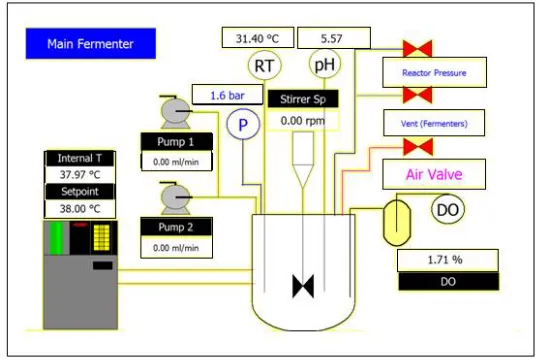
The environmental CSTR system is a new kind of instrument because it should match with the extreme environment like deep sea, according to specific requirements. Temperature control in the environmental CSTR system for deep-sea condition i.e. mimicking in the reactor is considered as a challenging issue due to its nonlinear dynamics because of its high pressure rating and thick wall material in the reactor system. The steady state simulation of an environmental continuous stirred tank reactor system precious temperature control has been implemented in the developed real time rector system. To avoid corrosion in the reactor system during sea water, PTFE liner has to be embedded inside the reactor system.. Therefore, an attempt was made to achieve the precious temperature control in the environmental CSTR mimicking one of the vital deep sea parameter i.e. temperature.
The system used to describe deep sea conditions in the environmental CSTR system includes a high pressure rated double jacketed reactor vessel, multiport serial server, digitally control heater/ chillers system, modem, temperature sensor and PC. The working pressure and temperature, at which any reactor or pressure vessel can be used, will entirely depend upon the design, size and nature of the material used for construction. Since all materials tend to vary their strength according to change in temperature, any pressure rating must be stated in terms of the temperature at which it is applicable. Here selected pressure rate is 5000 psi and temperature rate is -90 0 c to 235 0C and the volume of reactor vessel for real time experiment is 5L. The PTFE liner has been used to fit inside the reactor vessel. It must be noted, however, that adding a liner will slow the heat transfer rate into the vessel and it may be necessary to adjust the temperature control method to prevent overheating. Refrigeration bath circulators suitable for controlling the temperature are of externally connected appliances and thermoregulation is achieved through circulation of silicone oil in the thermostat bath. The equipment is able to meet the highest demands and this is ensured by the appropriate range of functional components, like controller, programmer, temperature sensor, interface as well as extensive safety and warning systems for better performance.
FOPDT process was examined in the presence and absence of PTFE liner in high pressure rated environmental CSTR system. Real time open loop temperature curve has been employed for mathematical model derivation.
Fig.2 Real time open loop response of environmental CSTR system with PTFE liner.
From this graph we can obtain the following terms,
T1 = 11.05105 min
T2 = 44.20423 min
Time constant (Ʈp) = 1.5(T2 – T1 ) = 49.72977 (3)
Time delay = T2 - Ʈp =5.52554 (4)
Fig.3. Real time open loop response of environmental CSTR system without PTFE liner. From this graph we can obtain the following terms,
T1 = 4.018 min
T2 = 16.744 min
Time constant (Ʈp) = 1.5(T2 – T1 ) = 19.089 (7)
Time delay = T2 - Ʈp =2.345 (8)
III. PI CONTROLLER
PI controller is used in many process industries due to its fast response and quick tuning. It calculates the error value as the difference between a measured process variable and a desired set-point. The PI controller tries to minimize the error by adjusting the process control input. PI is simple, robust and widely used in many control applications.
Mathematically
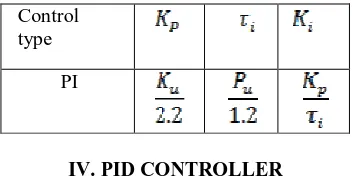
Ziegler- Nichols closed loop method is used here for the tuning of PI controller (with and without PTFE liner). The settings for PI controllers are determined directly from Ku and Pu according to the rules summarized in table 1.
Table 1 Z-N closed loop tuning rules for PI controller.
Control
type
PI
IV. PID CONTROLLER
A typical structure of a PID control system is shown in fig.4.9 The error signal e(t) is used to generate the proportional, integral, and derivative actions, with the resulting signals weighted and summed to form the control signal u(t) applied to the plant model. The proportional, integral, and derivative terms are summed to calculate the output of the PID controller.
Fig.4. PID control system. .
Mathematically,
The gain values of PID controllers for the environmental CSTR system using Ziegler Nichols closed loop tuning (with and without PTFE liner) are obtained and settings for PID controllers are given in the table below
Table 2 Z-N closed loop tuning rules for PID controller.
Control type
PID
fuzzy logic controller. In this work, two input and three output fuzzy PID controller is designed. The inputs are the error and the error rate (change in error) and outputs are the values of Kp, Ki and Kd. Variable PID controller adds the output value of the fuzzy controller and default PID values.
Fig.5.Structure of Fuzzy PID
The FLC is adding to the conventional PID controller to adjust the parameters of the PID controller on-line according to the change of the signals error and change of the error. Now the control action of the PID controller after self tuning can be describing as:
Where , and are the new gains of PID controller
Where Kp1, Ki1, and Kd1 are the gains outputs of fuzzy control, which are varying online with the output of the system
under control. Where KP, Ki , and Kd are the initial values of the conventional PID.
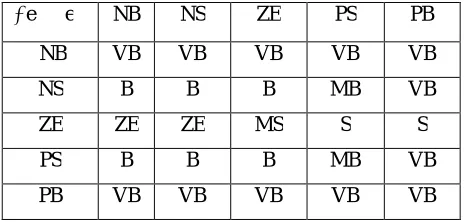
For the system under study the universe of discourse for both e(t) and De(t) may be normalized from [-1.5,1.5], and the linguistic labels are (Negative Big, Negative Medium, Negative Small, Zero, Positive Small, Positive Medium, Positive Big), and are referred to in the rules bases as (NB, NM, NS, ZE, PS, PM, PB) and the linguistic labels of the outputs are (Zero, Medium Small, Small, Medium, Big, Medium Big, Very Big) and referred to in the rules bases as (Z, MS, S, M, B, MB, VB).
Fig.7. Membership functions of outputs (Kp1, Ki1, Kd1)
Table.3. Rule base for determining Kp1
Table 4.Rule base for determining Ki1
Table 5. Rule base for determining Kd1
∆e e NB NS ZE PS PB
NB VB VB VB VB VB
NS B B B MB VB
ZE ZE ZE MS S S
PS B B B MB VB
PB VB VB VB VB VB
∆e e NB NS ZE PS PB
NB M M M M M
NS S S S S S
ZE MS MS ZE MS MS
PS S S S S S
PB M M M M M
∆e e NB NS ZE PS PB
NB ZE S M MB VB
NS S B MB VB VB
ZE M MB MB VB VB
VI. RESULT AND DISCUSSION
The simulations for different control mechanisms discussed above were carried out in SIMULINK & results have been obtained. Both the servo and regulatory responses of above controllers were observed and compared. The results are as shown below.
Fig.8. Servo response of controller with liner
Fig.9.Regulatory response of controllers with liner
Fig.10. Servo response of controllers without liner.
The performances of controllers are also examined using ISE and IAE and their values for FUZZY PID controller is less compared to both PI & PID controller in the entire operating region. The performance indices in terms of ISE and IAE for servo and regulatory response are also shown in table 6 and 7.
Table.6. Performance comparison (SERVO response)
Table.7. Performance comparison (REGULATORY response)
Controller IAE ITAE
With PTFE liner
PI 9630 1494.7 PID 7946 1135 FUZZY PID 1700 549
Without PTFE liner
PI 4290 1119.9 PID 3050 658.7 FUZZY PID 1242 593
VI.CONCLUSION
For non linear process a PI, PID & FUZZY PID controllers are designed. The performance is tested using MATLAB. The comparison of FUZZY PID controller with conventional controller is done and the experimental results prove that the response is smooth for both servo and regulatory changes for these controllers. It is concluded that FUZZY PID controller is suited to control the temperature of high pressure rated modified CSTR system when compared to conventional controller.
REFERENCES
[1] Stephanopoulos, G.: Chemical Process Control: A Introduction to Theory and Practice, 1st edn, . PHI Learning, Upper Saddle River (1984).
[2] Dr. M.J.Willis,”continuous stirred tank reactor models”,.Deptt. ofChemical and Process Engineering, University of Newcastle,March2010.
[3] Thiruppathi K, Kirubagaran R, Ponnusamy Lakshmi, Atmanand M.A.: “Design and optimization of temperature controller for high pressure rated modified CSTR system”, IEEE Proceedings , ISPCC (2013) 1-6
[4] Jithin K, Dr.P. Lakshmi, K. Thiruppathi, “Design of fuzzy logic based ph controller for high pressure rated modified CSTR system” ©
Springer India 2015
[5] S.Boobalan,K.Prabhu,V.MuraliBhaskaran: “Fuzzy Based Temperature Controller For Continuous Stirred Tank Reactor” International Journal of Advanced Research in Electrical, Electronics and Instrumentation Engineering vol.2,issue 12, December 2013
[6] Coughanowr, D.R.: Process Systems Analysis and Control. Chemical Engineering Series, 2nd edn, pp. McGraw-Hill International Editions (1991)
[7] M. Shyamalagowri, R. Rajeswari:“Modeling and simulation of non linear process control reactor - continuous stirred tank reactor”,
International Journal of Advances in Engineering & Technology, Sept. 2013. ©IJAET
[8] K. Prabhu, V. Murali Bhaskaran,“Optimization of a Temperature Control Loop using Self Tuning Regulator” International Journal of
Controller IAE ITAE
With PTFE liner
PI 9734 2060.5 PID 7974 1561.6 FUZZY PID 1700 868.9
Without PTFE liner