A Study of Routing Protocols Based on Different Models in
MANET
Satyam Kumar Sainy
1& Ravi Rai Chaudhary
2Department of Computer Science and Engineering College of Science and Engineering, Jhansi
[email protected]
1; [email protected]
2ABSTRACT
The main characteristics of Mobile Adhoc NETwork (MANET) are no infrastructure, no centralized administration and self-configuring networks. The primary motivation of MANET deployment is to increase portability, flexibility and mobility but, mobility causes an unpredictable change in topology and makes routing more difficult. Efficient dynamic routing is a research challenge in such networks. In this study we have chosen three routing protocols namely AODV (Adhoc On demand Distance Vector routing), DSR (Dynamic Source Routing) and LAR1 routing protocol on the basis of packet delivery ratio, routing overhead, average end-to-end delay and Number of Hope Count using Glomosim simulator. Three different models are created by changing few parameters of traffic generator file and scenario file like pause time, speed of mobile nodes and network size. The selection of an efficient routing protocol thus depends on different parameters of the MANET.
Keywords-MANET; DSR; LAR1; Pause Time; PDR
1. INTRODUCTION
Mobile Adhoc Networks is an autonomous system of mobile nodes connected by multi-hop wireless links without centralized infrastructure support. A central challenge in such networks is the development of dynamic routing protocol that can efficiently find routes between two communicating nodes and is able to keep up with the high degree of node mobility that often changes the network topology drastically and unpredictably. The routing protocols can be broadly classified into on-demand routing protocols (reactive) and table-driven routing protocols (proactive). The most popular on demand routing algorithms are Adhoc On-Demand Distance Vector routing [1] and Dynamic Source Routing [3]. LAR1 [2] routing is a table-driven routing algorithm. To determine the advantage of these protocols many researchers have made investigations comparing the performance of these protocols under various conditions and constraints [4][5][7][10].
2. RELATED WORK
A number of protocols are implemented and tested for MANETS in order to fulfill the major requirements of routing including, enhancement of the bandwidth utilization, loop-free routing, minimum route acquisition delay, higher packet delivery ratio, lesser overheads per packet, minimum consumption of energy and others.
In the beginning, protocol comparison of DSDV, AODV and DSR was carried out by Per Johansson et.al. [7]. The simulations were made on random scenarios including varied mobility and varied load. Results were presented as a function of a novel mobility metric designed to reflect the relative speeds of the nodes in a scenario. In most simulations the reactive protocols (AODV and DSR) performed significantly better than DSDV. The performance comparison of two reactive routing protocols AODV and DSR was presented by S.R Das et.al. [5] using varying network load, mobility and network size. The simulation results show that DSR outperforms AODV when there are less number of nodes and low mobility but AODV outperforms DSR in more stressful situation.
simulation studies were carried out in the paper by B. Mohammed [9] to review the quantitative properties of routing protocols. In our study we have compared two quantitative properties(packet delivery ratio and normalized routing overhead) of AODV,DSR and DSDV routing protocols when run over different models constructed by taking four different scenarios including varied mobility in terms of pause time and speed of nodes ,varied traffic connection and varied network size.
3. ROUTING PROTOCOLS
A. Adhoc On-demand Distance Vector (AODV) routing protocol
AODV [1] works on an on-demand basis that is, route is found from source node to destination only when there is a demand to transmit a data packet .It uses table driven routing framework and destination sequence numbers. AODV supports only one route for each destination and it deals with route table management. The path discovery and route maintenance process can be explained as follows:
Path Discovery Process in AODV: A RREQ packet is broadcasted to initiate path discovery. The RREQ contains the following fields:
<source_addr,source_sequence_#,broadcast_id,dest_a ddr,destination_sequence_#,hop_cnt>.
Each neighbor re-broadcasts it to its own neighbor after increasing the hop_cnt. An intermediate node can receive multiple copies of same RREQ broadcast from various neighbors. The pair <source_addr,broadcast_id > uniquely identifies a RREQ. An RREQ with same source address and broadcast_id is discarded .The intermediate node records the address of the neighbor from which it receives the first copy of the RREQ to automatically build the reverse path. Source_seq_# is used to maintain “freshness” information about the reverse route to the source. The desination_seq_# is the latest sequence number received in the past by the source for any route towards the destination. RREP contains the following information: <source_addr, dest_addr, dest_sequence_#, hop_cnt, lifetime> If an intermediate node has route entry for desired destination in its routing table, it compares its destination sequence number to the destination
sequence number in the RREQ. If RREQ’s sequence number is greater than intermediate node must not use its recorded route and re-broadcast the RREQ. If it has a route
with sequence number greater or equal to that contained in RREQ it uncast a RREP back to its neighbor from which it received the RREQ. In the event that there is no corresponding
entry for that destination, an entry is created. Lifetime is the time in milliseconds for which nodes receiving the RREP consider the route to be valid.
Route Maintenance in AODV: If a source node moves during an active session, it can reinitiate route discovery procedure to the destination. If an intermediate node moves, its upstream neighbor notices the move and sends RERR (route error) packet giving link failure notification message. Optionally a mobile node may perform local connectivity maintenance by periodically broadcasting HELLO messages.
B. DYNAMIC SOURCE ROUTING (DSR)
Dynamic Source Routing protocol is a reactive protocol i.e. it determines the proper route only when a packet needs to be forwarded. The node floods the network with a route-request and builds the required route from the responses it receives. DSR allows the network to be completely self-configuring without the need for any existing network infrastructure or administration. The DSR protocol is composed of two main mechanisms that work together to allow the discovery and maintenance of source routes in the ad hoc network. All aspects of protocol operate entirely on-demand allowing routing packet overhead of DSR to scale up automatically.
Route Discovery: When a source node S wishes to send a packet to the destination node D, it obtains a route to D. This is called Route Discovery. Route Discovery is used only when S attempts to send a packet to D and has no information on a route to D.
C. Location-Aided Routing (LAR 1)
Ad hoc on-demand distance vector routing (AODV) and distance vector routing (DSR) that have been previously described are both based on different variations of flooding. The goal of Location-Aided Routing (LAR) described in [6] is to reduce the routing overhead by the use of location information. Position information will be used by LAR for restricting the flooding to a certain area [7].
In the LAR routing technique, route request and route reply packets similar to DSR and AODV
are being proposed. The implementation in the simulator follows the LAR1 algorithm similar to DSR.
Location Information When using LAR, any node needs to know its physical location. This can be achieved by using the Global Positioning System (GPS). Since the position information always includes a small error, GPS is currently not capable of determining a node’s exact position. However, differential GPS5 offers accuracies within only a few meters.
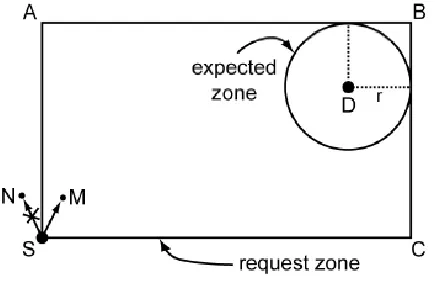
Expected Zone When a source node S wants to send a packet to some destination node D and needs to find a new route, it first tries to make a reasonable guess where D could be located. Suppose node S knows that at time t0 D’s position was P and that the current time is t1. Using this information S is able to determine the
expected zone of D from the viewpoint of node S by time t1. For instance if D traveled with an average speed v, the source node S expects D to be in a circle around the old position P with a radius v(t1−t0). The expected zone is only an estimate by S to determine possible locations of D. If D traveled with a higher speed than S expected, the destination node may be outside the expected zone at time t1.
Figure 1: LAR Expected Zone
If the source node does not know the position of D at time t0, it will not be possible to estimate an expected zone. D could be anywhere. In this case, the entire ad-hoc network is selected as the expected zone and the routing algorithm reduces to a simple flooding.
Request Zone Be S still our source node that wants to send a packet to destination node D. The request zone
is somewhat different from the expected zone, for it defines the zone where a route
request should be forwarded from. An intermediate node will forward a route request packet only, if it belongs to the request zone. This is different from the flooding protocols described before. Obviously the request zone should contain the expected zone to reach destination node D. The request zone may also include further regions:
• To create a path from S to D, both nodes must be contained in the request zone (Figure 6(a)). So if source S is not contained in the expected zone of D, additional regions need to be included. Otherwise the packet will not be forwarded from S to D.
• Under certain circumstances there may be no route from S to D, even if both nodes are contained in the requested zone (see Figure 6(b)). For instance, nodes that are near, but outside the request zone are needed to propagate the packet. Thus, after some timeout period, if no route is found from S to D, the request zone will be expanded and S will initiate a new route discovery process (Figure 6(c)). In this case, the route determination process will take longer because multiple route discoveries are needed.
C.1 LAR Request Zone Types
An intermediate node needs to use an algorithm to determine if it should forward a packet or not and if it is member of the request zone or not. LAR defines two different types of request zones in order to do this. LAR Scheme 1 (LAR1) was used in our simulations; it is discussed more detailed below. Further we mention LAR2 just for completeness.
request zone now is defined as the smallest possible rectangle that includes source node S and the circular expected zone. Further should the sides of the rectangle be parallel to the x and y axes.
The source node is capable of determining the four corners of the rectangular request zone. This four coordinates are now included in the route request packet when initiating the route discovery process. Every node which is outside the rectangle specified by the four corners in the packet just drops the packet. As soon as the destination D receives the route request packet, it sends back a route reply packet as described in the flooding algorithms. Its reply differs by containing its current position, the actual time, and as an option its average speed. Source node S is going to use this information for a route discovery in the future.
Figure 2: LAR Scheme 1 - Request Zone
LAR Scheme 2 (LAR2) The second LAR scheme is defined by specifying (estimated) destination coordinates (xd, yd) plus the distance to the destination [7]. The estimated destination and the current distance to it are included in the route request. Now, a node may only forward the route request packet if it is closer or at maximum farther away than the previous node. Is a system parameter which is dependent on implementation? Every forwarding node overwrites the distance field in the packet with its own current distance to the destination. This process ensures that the packet moves towards the destination.
4. DIFFERENT MODELS
The various different models are:
A. Pause Time Model
In this model the pause time governing mobility of nodes in the network is varied from 50s to 250s in slots of 50s. Pause time means high node’s random movement. If pause time is increased then movement of nodes is decreased.
B. Nodes Model
In this model, the number of nodes in the network varies from 10 nodes to 50 nodes and traffic flow is between all the nodes in the network.
C. Speed Model
In this model the speed of node movement is varied between 10 m/s to 50 m/s in a network.
5. PERFORMANCE METRICES
Following performance metrics are studied in this survey.
A. Throughput (bits/s)
Throughput is the measure of the number of packets successfully transmitted to their final destination per unit time. It is the ratio between the numbers of sent packets vs. received packets [4], [10].
B. Total Packets received
Packet delivery ratio is calculated by dividing the number of packets received by the destination through the number of packets originated by the application layer of the source (i.e. CBR source). It specifies the packet loss rate, which limits the maximum throughput of the network. The better the delivery ratio, the more complete and correct is the routing protocol [4], [10].
C. Drop Packet Ratio
Packet drop ratio is calculated by subtract to the number of data packets sent to source and number of data packets received destination through the number of packets originated by the application layer of the source (i.e. CBR source) [4].
D. Average End to End Delay
6. CONCLUSION AND FUTURE OUTLOOK
In this dissertation, the performance of three MANET Routing protocols such as LAR1, AODV and DSR was analyzed using Glomosim Simulator. The comprehensive simulation results of packet delivery ratio, average end-to-end delay, hope count and normalized routing overhead are evaluated by varying pause time, network size, speed of mobile nodes and number of connections.
REFERENCES
[1] C. Perkins, E. Belding-Royer and S. Das. “Ad hoc on-demand distance vector (AODV) routing protocol”, July 2003. IETF Internet RFC 3561.
[2] Charles E. Perkins and Pravin Bhagwat, “Highly dynamic Destination-Sequenced Distance-Vector routing (DSDV) for mobile computers”, Proc. of the SIGCOMM ’94 Conference on Communications Architectures, Protocols and Applications, pages 234– 244, August 1994.
[3] David B. Johnson, David A. Maltz, Josh Broch. “Dynamic Source Routing for Multihop wireless ad hoc networks”, In Ad Hoc Networking, edited by Charles E. Perkins, chapter 5, pp 139-172. Addison-Wesley, 2001.
[4] S.R. Das, R. Castaneda, J. Yan, and R. Sen gupta. “Comparative performance evaluation of routing protocols for mobile, ad hoc networks”, In 7th Int. Conf. on Computer Communications and Networks (IC3N), pp. 153–161, October 1998.
[5] S. R. Das, C. E. Perkins, and E. M. Royer. Performance Comparison of Two On-demand Routing Protocols for Ad Hoc Networks. Proceedings of the IEEE Conference on Computer Communications (INFOCOM), pp. 3-12, Tel Aviv, Israel, March 2000.
[6] Tracy Camp, Jeff Boleng and Vanessa Davies, “ A Survey of Mobility Models for Ad Hoc Networks Research”, Wireless Communication & Mobile Computing (WCMC): Special issue on Mobile Ad Hoc Networking: Research, Trends and Applications, vol. 2, no. 5, pp. 483-502,2002.
[7] P. Johansson, T. Larsson, N. Hedman, B. Mielczarek, and M. Degermark, “Scenario-based Performance Analysis of Routing Protocols for Mobile Ad-hoc Networks”. Proceedings of the ACM/IEEE International Conference on Mobile Computing and Networking (MobiCom), pp. 195-206, Seattle, WA, August 1999.
[8] Saiful Azadm, Arafatur Rahman and Farhat Anwar, “A Performance comparison of Proactive and Reactive Routing protocols of Mobile Ad hoc Networks(MANET)”, in Journal of Engineering and Applied Sciences.
[9] Mohammed Bouhorma, H.Bentaouit and A.Boudhir, “Performance comparison of Ad hoc Routing protocols AODV and DSR”, Proceedings of the IEEE Conference on Multimedia Computing and Systems, pp. 511-514 IEEE, April 2009.