On The Determination of a Low Cost
K-Connected Network
S.Latha, Dr. S. Senthil kumar
Associate Professor &Head, Dept. of Electronics & Instrumentation Engineering, Bharath University, Chennai, Tamil Nadu, India
Associate Professor, Dept. of Electronics & Instrumentation Engineering, Bharath University, Chennai, Tamil Nadu, India
ABSTRACT: The goal of the topological design of a computer network is to achieve a specified performance at a minimal cost. Unfortunately, the problem is completely intractable. A reasonable approach is to generate a potential network topology. One heuristic for generating a potential network topology is due to Steiglitz, Weiner and Kleitman and is called the link deficit algorithm. This paper presents a modified version of the above heuristic which results in a lower cost starting network. In addition, a novel and simple algorithm has been presented for designing a 3-connected starting network when the number of nodes in the network exceeds four.
KEYWORDS: Topological Design, Computer Networks, Link Deficit Algorithm, Minimal Weight Spanning Tree, K-Connected Network, Starting Network.
1. INTRODUCTION
The terms 'K-connected network’, ‘starting network’, ‘link deficit algorithm’,’ topological design’,’ minimal spanning tree' have the usual meanings{1,2,3].
The goal of the topological design of a computer communication network is to achieve a specified performance at a minimal cost. Unfortunately, the problem can be solved only by using exponential algorithms and as such the problem is completely intractable [2].The fastest available super computers cannot optimize a 25 node network, let alone a 100 node network. Thus, a reasonable approach is to generate a potential network topology (called a starting network) and see if it satisfies connectivity and delay constraints. If not, the starting network is subjected to small modification (called perturbation) to yield a slightly different network, which is now checked to see if it is better. If a better network is found, it is used as the base for more perturbations. If the network resulting from perturbation is not better, the original network is perturbed in some other way. This process is repeated till the computer budget is used up [4, 5]. One of the many heuristics for a generating a starting network is the link deficit algorithm [6]. We now present a modified version of the link deficit algorithm which results in a lower cost starting network.
II. MODIFIED LINK DEFICIT ALGORITHM
III. ILLUSTRATIVE EXAMPLE
The geographical positions of five nodes labeled 1 through 5 are shown in fig 1.
Fig 1
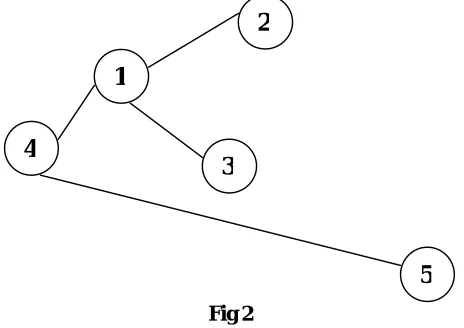
The cost of establishing a link between any nodes i to any node j is given by the following cost matrix C The minimal spanning tree can be determined as usual [2] and is shown in fig 2.Let us suppose that we want to set up a 3-connected network. In fig 2, the deficits of the nodes1 through 5 are 0,2,2,1 and 2 respectively. Application of the link deficit algorithm to what is shown in fig 2 results in the starting network shown in fig 3.
(1)
This modified link deficit algorithm can be used to set up any k-connected network wherein K is greater than 1.We now present a simple algorithm. Wherein the minimal spanning tree algorithm is applied twice.[11]
1
2
1
2
4
5
3
1 2 3 4 5
1 – 2 2 1 8
2 2 – 4 10 5
C
= 3 2 4 - 4 6
Fig 3
IV. ALGORITHM FOR A 3-CONNECTED NETWORK
Given the geographical positions of the nodes of a network and a cost matrix giving the cost of establishing a link between any node i and any node j, we proceed as follows. The minimal spanning tree T1 is determined. The costs of the link presented in T1 are made infinite in the cost matrix and the minimal spanning treeT2 is again determined. A low cost 3-connected starting network results when the edges of T1 and T2 are superimposed. We now illustrate this novel approach by working out the previous example.
V. ILLUSTRATIVE EXAMPLE
The geographical positions of the nodes of a network are shown in fig 1. The cost matrix is given by equation 1. The minimal spanning tree is determined as usual and is shown in fig 2.In the cost matrix given in equation 1.the costs of the edges present in fig 1 are made infinite and the modified cost matrix C’ is shown below.
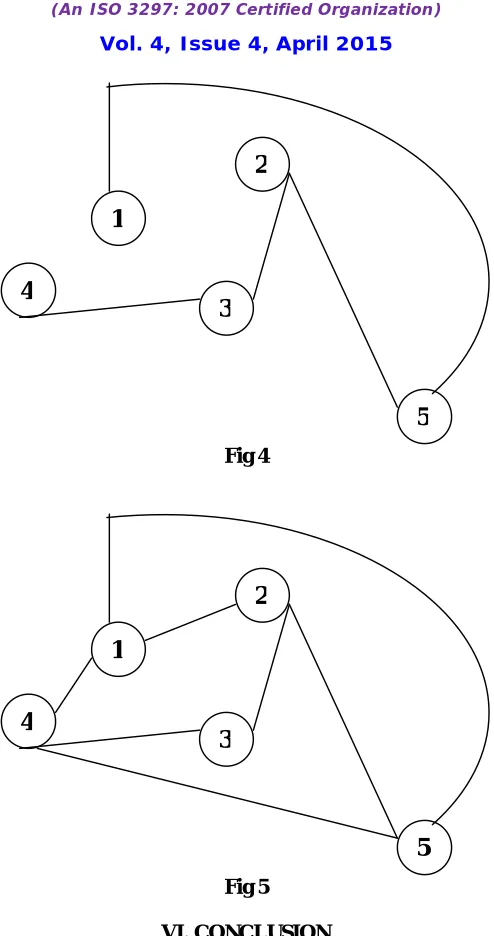
For the cost matrix C’ given in equation 2, we find the minimal spanning tree as shown in fig 4.When the edges shown in fig 2 and fig 4 are superimposed, we get a low cost 3 connected starting network as shown in fig 5.[9][10]
1
2
4
5
3
1 2 3 4 5
1 __
8
2
__ 4 10 5
C’= 3
4 __ 4 6
(2)
Fig 4
Fig 5
VI. CONCLUSION
This paper presents a modified version of the link deficit algorithm which results in a lower cost starting network, when we desire to set up a k-connected network. In particular when k=3, a novel algorithm which utilizes the
1
2
4
5
3
1
2
4
7. Gerla, H.Frank and J.Eckl, A cut saturation algorithm for topological design of packet switched communication networks, Proc NTC, 1974, pp 1074-1085.
8. Jebaraj S., Iniyan S., "Renewable energy programmes in India", International Journal of Global Energy Issues, ISSN : 0954-7118, 26(4Mar) (2006) PP.232-257.
9. A. Lavia and E.G. Manning, ‘Perturbation Techniques for topological optimization of computer networks, Proc Fourth Data Comm. Symp, 1975, pp 4.16-4.23
10. Gopalakrishnan K., Prem Jeya Kumar M., Sundeep Aanand J., Udayakumar R., "Thermal properties of doped azopolyester and its application", Indian Journal of Science and Technology, ISSN : 0974-6846, 6(S6) (2013) PP. 4722-4725.
11. K. Steiglitz, P.Weiner and D.J.Kleitman, The design of minimum cost survivable networks, IEEE Trans. Circuit theory (1969), pp455-460. 12. D.Kalaivani, Mrs.M.Indirani & Dr.A.Mukunthan, A Theoretical Study of Primary Nucleation Kinetics of L-Histidine Bromide: Semi Organic Optical Single Crystal, International Journal of Innovative Research in Science, Engineering and Technology, ISSN: 2319-8753,pp 4192-4197, Vol. 2, Issue 9, September 2013
13. D.Prakash and Dr. A.Mukunthan, A Theoretical Study of Internal Pressure And Free Volume for Single Molecule of a Sample Liquid, International Journal of Innovative Research in Science, Engineering and Technology, ISSN: 2319-8753,pp 7252-7257, Vol. 2, Issue 12, December 2013
14. Dr. A. Mukunthan & Ms.S.Sudha, FTIR Spectroscopic Features of Blood Serum of Diseased and Healthy Subjects (Animals), International Journal of Innovative Research in Science, Engineering and Technology, ISSN: 2319-8753, pp 2035-2040 Vol. 2, Issue 6, June 2013
15. Dr. A.Mukunthan, A Survey of Applications of Laser in Dermatology – Medical Physics, International Journal of Innovative Research in Science, Engineering and Technology, ISSN: 2319-8753 ,pp 33-36, Vol. 1, Issue 1, Nov 2012
16. Dr. M. Ganesan, Mergers and Acquisitions, International Journal of Innovative Research in Science, Engineering and Technology, ISSN: 2319-8753,pp 9081-9085, Vol. 3, Issue 2, February 2014
17. Dr.G.Brindha, A Study on Latest Management Governance Techniques in Indian Companies, International Journal of Innovative Research in Science, Engineering and Technology, ISSN: 2319-8753,pp 284-292, Vol. 2, Issue 1, January 2013