Scholarship@Western
Scholarship@Western
Electronic Thesis and Dissertation Repository
12-10-2013
Hydrodynamics in Recirculating Fluidized Bed Mimicking the
Hydrodynamics in Recirculating Fluidized Bed Mimicking the
Stripper Section of the Fluid Coker
Stripper Section of the Fluid Coker
Francisco J. Sanchez Careaga The University of Western Ontario
Supervisor Dr. Cedric Briens
The University of Western Ontario Joint Supervisor Dr. Franco Berruti
The University of Western Ontario
Graduate Program in Chemical and Biochemical Engineering
A thesis submitted in partial fulfillment of the requirements for the degree in Doctor of Philosophy
© Francisco J. Sanchez Careaga 2013
Follow this and additional works at: https://ir.lib.uwo.ca/etd
Part of the Complex Fluids Commons, Other Chemical Engineering Commons, Petroleum Engineering Commons, and the Process Control and Systems Commons
Recommended Citation Recommended Citation
Sanchez Careaga, Francisco J., "Hydrodynamics in Recirculating Fluidized Bed Mimicking the Stripper Section of the Fluid Coker" (2013). Electronic Thesis and Dissertation Repository. 1819.
https://ir.lib.uwo.ca/etd/1819
This Dissertation/Thesis is brought to you for free and open access by Scholarship@Western. It has been accepted for inclusion in Electronic Thesis and Dissertation Repository by an authorized administrator of
(Thesis format: Integrated Article)
by
Francisco Javier Sanchez Careaga
Graduate Program in Engineering Science Department of Chemical and Biochemical Engineering
A thesis submitted in partial fulfillment of the requirements for the degree of
Doctor of Philosophy
The School of Graduate and Postdoctoral Studies The University of Western Ontario
London, Ontario, Canada
ii
Abstract
The stripper section of a Fluid CokerTM consists of a system of baffles (sheds) that enhances the removal of interstitial and adsorbed hydrocarbon vapors from the fluidized coke-particles. Most of the hydrocarbon-vapors released below a stripper shed flow up to the stripper shed, where they may crack and form coke deposits that foul the shed. Extensive fouling changes the shapes of the sheds, makes them thicker and reduces the free-space between the adjacent sheds until downward solids flow is so impaired that the Coker has to be shut down.
The Radioactive Particle Tracking (RPT) technique allows the determination of a radioactive tracer-particle location within a certain space inside a fluidized bed and has been the main tool used to study the motion of agglomerates and their interactions with internals.
The research presents an innovative use of the RPT system, as a tool to measure the growth of internals fouling in time without the need of stopping the process. Moreover, the technique was able to characterize the type of interactions the agglomerate has with the sheds. In conjunction with a mathematical drying model, it was possible to predict the flow of organic vapors reaching each shed, thus estimating the risk of shed fouling, as well as the amount of liquid lost with the agglomerate as it leaves the stripper section.
The investigation found that small agglomerates lose very quickly their liquid and therefore its ability to cause fouling. Moreover, experimental work showed that the solid recirculation rate is a very important parameter, e.g., decreasing it by half, quadruples the residence-time in all zones.
The comparison of different types of sheds and configurations concluded that the Mesh-Shed type of internals performs the best. With regular sheds, the best configuration reduces the total open area by only 30%, instead of 50% as with the current sheds.
A study of a ring-baffle that is inserted above the stripper section showed that its main advantage is that it increases the residence time of the agglomerates above the baffle, providing them with more time to dry. Adding flux-tubes to the baffle is detrimental to their performance.
Keywords
• Recirculating fluidized beds • Fluid Cokers
• Sheds • Baffles
• Radioactive Particle Tracking • Fouling
iii
Dedication
To:
My dear wife:
Rosa Adriana García Herrera
My parents:
Francisco Javier Sánchez Blackaller
&
María Elisa Careaga Blackaller
My beloved sons:
Francisco Javier Sánchez García
&
iv
Co-Authorship Statement
The journal articles written from the thesis work are listed below. The individual contributions of all members are also indicated.
Chapter 2 Article Title:
Application of Radioactive Particle Tracking to Indicate Shed Fouling in the Stripper Section of a Fluid Coker
Authors:
Francisco J. Sanchez and Mikhail Granovskiy
Status:
Published in The Canadian Journal of Chemical Engineering (2013)
Individual Contributions:
The manuscript was written by Francisco J. Sanchez who also conducted the experimental work and analyzed the data. Various drafts of the article were reviewed by Mikhail Granovskiy.
Chapter 4 Article Title:
Agglomerate Behaviour in a Recirculating Fluidized Bed with Sheds: Effect of Agglomerate Properties
Authors:
Francisco J. Sanchez, Cedric Briens, Franco Berruti, Murray Gray and Jennifer McMillan
Status:
Fluidization XIV Conference Proceedings (2013) and expanded in preparation for Powder Technology
Individual Contributions:
The manuscript was written by Francisco J. Sanchez who also conducted the experimental work and analyzed the data. Various drafts of the article were reviewed by Cedric Briens, Franco Berruti, Murray Gray and Jennifer McMillan. The work was jointly supervised by Cedric Briens and Franco Berruti.
Chapter 5 Article Title:
Agglomerate Behaviour in a Recirculating Fluidized Bed with Sheds: Effect of Bed Properties
Authors:
Francisco J. Sanchez, Cedric Briens, Franco Berruti, Murray Gray and Jennifer McMillan
Status:
In preparation for Powder Technology
Individual Contributions:
v
Chapter 6 Article Title:
Agglomerate Behaviour in a Recirculating Fluidized Bed with Sheds: Effect of the Sheds
Authors:
Francisco J. Sanchez, Cedric Briens, Franco Berruti, Murray Gray and Jennifer McMillan
Status:
In preparation for Powder Technology
Individual Contributions:
The manuscript was written by Francisco J. Sanchez who also conducted the experimental work and analyzed the data. Various drafts of the article were reviewed by Cedric Briens, Franco Berruti, Murray Gray and Jennifer McMillan. The work was jointly supervised by Cedric Briens and Franco Berruti.
Chapter 7 Article Title:
Agglomerate Behaviour in a Recirculating Fluidized Bed with Sheds: Effect of Voltesso and Amount of Fluidized Material
Authors:
Francisco J. Sanchez, Cedric Briens, Franco Berruti, Murray Gray and Jennifer McMillan
Status:
In preparation for Powder Technology
Individual Contributions:
The manuscript was written by Francisco J. Sanchez who also conducted the experimental work and analyzed the data. Various drafts of the article were reviewed by Cedric Briens, Franco Berruti, Murray Gray and Jennifer McMillan. The work was jointly supervised by Cedric Briens and Franco Berruti.
Chapter 8 Article Title:
Agglomerate Behaviour in a Recirculating Fluidized Bed: Effect of Baffles
Authors:
Francisco J. Sanchez, Cedric Briens, Franco Berruti, Murray Gray and Jennifer McMillan
Status:
In preparation for Powder Technology
Individual Contributions:
vi
Acknowledgments
A lot of people supported me during my Ph. D. program with criticism, helpful assistance and expertise. This thesis would have never been possible without them.
I am very grateful to both my supervisors Dr. Cedric Briens and Dr. Franco Berruti, for their support, guidance and suggestions during the course of this research.
I would like to acknowledge Dr. Murray Gray from the University of Alberta and Dr. Jennifer McMillan from Syncrude Canada Limited for their guidance and help in the transition and completion of this research.
I would like to thanks for the financial support to Syncrude Canada Limited; and the Natural Science and Engineering Research Council (NSERC) of Canada.
I would like to thank the Engineering workshops at the University of Saskatchewan and the University of Western Ontario; the people that helped me in the construction of my setup: Regan Gerspacher, Dr. Mikhail Granovskiy and Rob Taylor; and the people that helped me with radiating the tracers at the Saskatchewan Research Council (SRC) and at the Material Test Reactor in McMaster University. In addition I would like to express my appreciation to my friends, colleagues, secretaries and personnel in the Institute for Chemicals & Fuels from Alternative Resources (ICFAR), the Department of Chemical and Biochemical Engineering, the University of Western Ontario and the University of Saskatchewan; Without whom, this work would not have been possible.
vii
Table of Contents
Abstract ... ii
Dedication ... iii
Co-Authorship Statement... iv
Acknowledgments... vi
Table of Contents ... vii
List of Tables ... xii
List of Figures ... xiii
List of Appendices ... xxiii
Nomenclature ... xxiv
Preface... xxvi
Chapter 1 ... 1
1 INTRODUCTION ... 1
1.1 Fouling ... 1
1.2 Bitumen ... 2
1.3 Coking ... 3
1.3.1 Fluid Coking ... 4
1.3.2 Sheds ... 6
1.4 Agglomerates ... 7
1.4.1 Agglomerate Formation ... 7
1.4.2 Effect of Liquid Properties ... 8
1.4.3 Granulation ... 9
1.5 Radioactive Particle Tracking ... 14
1.5.1 CARPT Rendition Technique ... 16
viii
1.6 Thesis Objectives and Outline ... 18
1.7 References ... 20
Chapter 2 ... 25
2 APPLICATION OF RADIOACTIVE PARTICLE TRACKING TO INDICATE SHED FOULING IN THE STRIPPER SECTION OF A FLUID COKER ... 25
2.1 Abstract ... 25
2.2 Introduction ... 25
2.3 Experimental Technique and its Accuracy ... 28
2.3.1 Experimental Setup ... 28
2.3.2 Accuracy in Experimental Detection ... 30
2.4 Results and Discussion ... 35
2.5 Conclusion ... 40
2.6 References ... 41
Chapter 3 ... 43
3 EQUIPMENT AND SOFTWARE DESIGN ... 43
3.1 New Recirculating Fluidized Bed ... 43
3.2 Software ... 48
3.3 RPT in Recirculating Fluidized Beds ... 52
3.4 Tracer Agglomerate Preparation ... 54
3.5 Thermal Model... 57
3.6 References ... 62
Chapter 4 ... 64
4 AGGLOMERATE BEHAVIOR IN A RECIRCULATING FLUIDIZED BED WITH SHEDS: EFFECT OF AGGLOMERATE PROPERTIES ... 64
4.1 Abstract ... 64
4.2 Introduction ... 64
ix
4.4 Selection Criteria from Initial Tracer Trajectories ... 68
4.5 Results and Discussion ... 71
4.5.1 Results ... 71
4.5.2 Discussion ... 78
4.6 Conclusion ... 79
4.7 References ... 81
Chapter 5 ... 83
5 AGGLOMERATE BEHAVIOR IN A RECIRCULATING FLUIDIZED BED WITH SHEDS: EFFECT OF BED PROPERTIES ... 83
5.1 Abstract ... 83
5.2 Introduction ... 83
5.3 Materials and Methods ... 85
5.4 Selection Criteria from Initial Tracer Trajectories ... 88
5.5 Results and Discussion ... 89
5.5.1 Fluidization Gas Velocity ... 89
5.5.2 Solid Recirculation Rate ... 92
5.5.3 Amount of Agglomerates ... 95
5.6 Conclusion ... 98
5.7 References ... 100
Chapter 6 ... 102
6 AGGLOMERATE BEHAVIOR IN A RECIRCULATING FLUIDIZED BED WITH SHEDS: EFFECT OF THE SHEDS ... 102
6.1 Abstract ... 102
6.2 Introduction ... 102
6.3 Materials and Methods ... 104
6.4 Selection Criteria from Initial Tracer Trajectories ... 108
x
6.5.1 Effect of the Internals... 109
6.5.2 Types of Shed ... 114
6.5.3 Cross Section Area Effect ... 119
6.6 Conclusion ... 122
6.7 References ... 124
Chapter 7 ... 126
7 AGGLOMERATE BEHAVIOR IN A RECIRCULATING FLUIDIZED BED WITH SHEDS: EFFECT OF VOLTESSO AND AMOUNT OF FLUIDIZED MATERIAL ... 126
7.1 Abstract ... 126
7.2 Introduction ... 126
7.3 Materials and Methods ... 128
7.4 Selection Criteria from Initial Tracer Trajectories ... 131
7.5 Results and Discussion ... 132
7.5.1 Effect of Liquid Inside the Bed ... 132
7.5.2 Effect of the amount of solids ... 138
7.6 Conclusion ... 141
7.7 References ... 142
Chapter 8 ... 144
8 AGGLOMERATE BEHAVIOR IN A RECIRCULATING FLUIDIZED BED: EFFECT OF BAFFLES ... 144
8.1 Abstract ... 144
8.2 Introduction ... 144
8.3 Materials and Methods ... 146
8.4 Criteria Selection from Initial Tracer Trajectories ... 150
8.5 Results and Discussion ... 152
xi
8.5.2 Small Dense Agglomerates ... 156
8.5.3 Scale-up... 158
8.6 Conclusion ... 159
8.7 References ... 160
Chapter 9 ... 162
9 CONCLUSIONS AND RECOMMENDATIONS ... 162
9.1 Conclusions ... 162
9.2 Recommendations ... 164
Appendices ... 166
xii
List of Tables
Table 2.1. Description of the eight experiments used for evaluating the RPT technique in
detecting the amount of fouling that a shed has. ... 30
Table 2.2. Characteristics of the nine tests that were used to evaluate the accuracy of the RPT technique. ... 33
Table 3.1. Influence of the amount the gold powder in tracer-agglomerate density. ... 55
Table 3.2. Simulated agglomerate properties and construction materials. ... 57
Table 4.1. Simulated agglomerate properties and construction materials. ... 67
Table 5.1. Simulated agglomerate properties and construction materials. ... 86
Table 5.2. Experiments conducted to evaluate agglomerate behavior... 87
Table 6.1. Simulated agglomerate properties and construction materials. ... 105
Table 7.1. Simulated agglomerate properties and construction materials. ... 129
Table 7.2. Comparison between real residence time and predicted residence time, above, in, and below the shed zone. ... 137
xiii
List of Figures
Figure 1-1. Schematic diagram of a fluid coke system (Speight, 2007). ... 4
Figure 1-2. Schematics of unwanted coke deposition (fouling) in the sheds and walls of the stripper section of a Fluid Coker (Adapted from Bi et al., 2005). ... 7
Figure 1-3. Mechanism of agglomerate formation (Bruhns and Werther, 2005). ... 8
Figure 1-4. Effect of liquid properties on the formation of agglomerates (McDougall et al., 2005). ... 9
Figure 1-5. Au198 decay graph (Moreira et al., 2010). ... 15
Figure 2-1. a) Fluidized bed apparatus components and instrumentation: Blower (1), air by-pass (2), orifice plate for flow measurement (3), wind box (4), air distributor (5), radioactive tracer-agglomerate (6), NaI scintillation sensors (7), USB hub (8), computer (9), 1.3 m of disengagement section (10), cyclone (11), fine powder collector recipient (12), shed (13). b) Schematic of the conical section of the fluidized bed with the single shed plus six layers of simulated foulant on top of it. ... 28
Figure 2-2. Schematic of the single shed structure with variable thicknesses of simulated foulant in the observation space. The height has a value of 8.5 cm divided in sections of 0.5 cm, which are 19 divisions... 29
Figure 2-3. An example of a calibration curve for detector 1. The X- axis presents the radiation in normalized data and the Y- axis presents the distance between the center of the detector and the tracer-agglomerate. As the particle is closer, the radiation is higher for that detector. ... 31
Figure 2-4. Schematics of a tracer-agglomerate motion to test accuracy of the RPT method (software and hardware) to determine its location (for clarity, only three detectors are
xiv
Figure 2-5. Typical RPT response for: a) X- at a constant 5 cm, b) Y- radius of 3cm, and c) Z- radius of 3cm plus 14 cm of height of the base; these graphs are plotted for the three coordinates in time in a non-stationary tracer environment... 34
Figure 2-6. Average standard deviation as a function of the tracer-agglomerate radiation. ... 34
Figure 2-7. Typical velocity arrow plot in the polar coordinates for the hydrodynamics behavior of the tracer particle when: (A) no shed is present, (B) shed is present, (C) shed plus maximum (3 cm) of foulant is present and (D) shed plus maximum (6 cm) of foulant is present. ... 35
Figure 2-8. Typical velocity arrow plot in the X coordinate for the hydrodynamic behavior of the tracer particle when: (a)No shed is present, (b) Shed is present, (c) Shed plus maximum (3cm) of foulant is present. (d) Shed plus maximum (6cm) of foulant is present. ... 36
Figure 2-9. Selected: a) Axial Segregation of the tracer particle along the fluidized bed; b) Accumulation of occurrences of the tracer particle along the fluidized bed. ... 37
Figure 2-10. a) Local occurrences of the tracer-agglomerate near the shed. b) Accumulation of occurrences of the tracer particle along the fluidized bed. ... 38
Figure 2-11. Calibration curve and trend line of the height of the foulant as a function of the standard deviation. ... 39
Figure 3-1. a) Blueprint of the new fluidized bed. b) New fluidized bed photo. ... 43
Figure 3-2. Sparger loop air feedstock. ... 45
Figure 3-3. Fluidized bed apparatus components and instrumentations: (1) Compressed air inlet; (2) orifice plates for flow measurement; (3) ball valves; (4) pinch valve; (5) elbow pressure taps for solids flow measurement; (6) 6.35 cm I.D. riser; (7) loop sparger; (8) three top-row sheds and two complete bottom-row shed plus two half; (9) 29.21 cm I.D.
disengagement zone; (10) cyclone; (11) γ-rays emitter; (12) twelve NaI Scintillation detectors
xv
Figure 3-4. a) Pressure taps along the fluidized bed. b) NI-DAQ and pressure transducers. . 47
Figure 3-5. a) Pressure tap to measure the flow of solids in the riser. b) Non-mechanical valve to divide the bed in two. ... 48
Figure 3-6. Screen shots of: a) the in-house software’s main windows, b) position rendition window and c) result analysis window. ... 49
Figure 3-7. Screenshot from: a) Complete Master/Slave System. b) The Slave computer screen. c) The Master computer screen... 51
Figure 3-8. Cold Flow Recirculating Fluidized Bed Measuring Zone. ... 52
Figure 3-9. Pyrolysis of Athabasca vacuum reside mix with gold. ... 56
Figure 3-10. Energy spectrum for: a) Epoxy/Gold agglomerate, b) Coke/Gold tracer-agglomerate. ... 56
Figure 3-11. Wet agglomerate behavior according to the model. ... 58
Figure 4-1. Simulated Agglomerate with: a) 1.94 mm diameter and a density of 1060 kg/m3. b) 12.65 mm diameter and a density of 1390 kg/m3. ... 67
Figure 4-2. Type of Interactions of the agglomerates with the sheds: a) Small cycle of the tracer-agglomerate in the measurement zone; b) Interaction from above the shed; c)
Interaction from below the shed; d) Crossing the shed zone interaction starting from below the shed; and e) crossing the shed zone interaction staring from above the shed. ... 69
Figure 4-3. Zones definitions to characterize the interactions of agglomerate with the shed: a) Measurement zones; b) Vicinity of the shed volume. ... 70
Figure 4-4. Average residence time per loop of the agglomerate inside the complete shed zone area (error bars represent the standard deviation). ... 71
xvi
Figure 4-6. Average residence time of the agglomerate below the shed zone (error bars
represent the standard deviation). ... 72
Figure 4-7. a) Typical mean Lagrangian velocity plot arrow for the X- and Z- coordinates. The X- coordinate is the coordinate that looks at the shed. b) Magnitude of the vertical component of the Lagrangian Velocity... 73
Figure 4-8. Typical frequency map of occurrences. ... 74
Figure 4-9. Change in velocity in the shed zone as a function of size and density. ... 74
Figure 4-10. Breakthrough velocities (error bars represent the standard deviation). ... 75
Figure 4-11. I) Velocity plot arrow for agglomerates: a) Tracer 1 ρ=1400 kg/m3 Ø≈2.00 mm. b) Tracer 3 ρ=1060 kg/m3 Ø≈2.00 mm. and c) Tracer 5 ρ=960 kg/m3 Ø≈2.00 mm. II) Velocity plot arrow for agglomerates: a) Tracer 2 ρ=1400 kg/m3 Ø≈13.00 mm. b) Tracer 4 ρ=1060 kg/m3 Ø≈13.00 mm. and c) Tracer 6 ρ=890 kg/m3 Ø≈13.00 mm. ... 76
Figure 4-12. Fraction of liquid entering the stripper lost to the burner for wet agglomerates (C0 = 30 wt%, for tracers 1 and 2) and semi-dry (C0 = 5 wt%, for tracers 3 and 4). ... 77
Figure 4-13. Fraction of liquid entering the stripper that reach the sheds level as vapor for wet agglomerates (C0 = 30 wt%, for tracers 1 and 2) and semi-dry (C0 = 5 wt%, for tracers 3 and 4). ... 77
Figure 5-1. Simulated Agglomerate with: a) 2.01 mm diameter and a density of 960 kg/m3. b) 12.65 mm diameter and density of 1400 kg/m3. ... 86
Figure 5-2. Zones definitions to characterize the interactions of agglomerate with the shed: a) Measurement zones. b) Vicinity of the shed area. ... 89
Figure 5-3. a) Residence time of the agglomerate in the shed zone as a function of the
xvii
shed as a function of the fluidization gas velocity. (With a 95% Confidence Interval, the error bars are very small to appear) ... 90
Figure 5-4. Residence time percentage of the agglomerate in the four distinctive of the fluidized bed plus the differential pressure of the shed zone as a function of the fluidization gas velocity. ... 91
Figure 5-5. Velocity plot arrow in the shed zone as a function of the fluidization gas velocity. ... 91
Figure 5-6. a) Residence time of the agglomerate in the shed zone as a function of the solid recirculation rate. b) Residence time of the agglomerate in the vicinity of the shed as a function of the solid recirculation rate. c) Residence time of the agglomerate below shed as a function of the solid recirculation rate. And, d) Residence time of the agglomerate above the shed zone as a function of the fluidization gas velocity. (With a 95% Confidence Interval, the error bars are very small to appear) ... 92
Figure 5-7. Percentage of time of the agglomerate in the four distinctive of the fluidized bed plus the differential pressure of the shed zone as a function of the solid recirculation rate. .. 93
Figure 5-8. Velocity plot arrow in the shed zone as a function of the solid recirculation rate. ... 94
Figure 5-9. Velocity plot arrow for polar coordinates in the entire measurement zone. ... 94
Figure 5-10. a) Residence time of the agglomerate in the shed zone as a function of the percentage of beads. b) Residence time of the agglomerate in the vicinity of the shed as a function of the percentage of beads. c) Residence time of the agglomerate below shed as a function of the percentage of beads rate. And, d) Residence time of the agglomerate above shed as a function of the fluidization gas velocity. (With a 95% Confidence Interval, the error bars are very small to appear) ... 95
xviii
Figure 5-12. a) Velocity plot arrow in the shed zone for dense agglomerate as a function of the beads in the bed. b) Velocity plot arrow in the shed zone for light agglomerate as a function of the beads in the bed. ... 97
Figure 5-13. Fraction of liquid entering the stripper that reaches the sheds level as vapor for: a) wet agglomerates; and, b) dry agglomerates. (With a 95% Confidence Interval, the error bars are very small to appear) ... 98
Figure 6-1. Simulated Agglomerate with: a) 1.94 mm diameter and a density of 1060 kg/m3. b) 12.65 mm diameter and a density of 1390 kg/m3. ... 105
Figure 6-2. Types of sheds tested: a) No shed; b) Normal sheds; c) Mesh-Shed and d) Mega-Sheds. ... 107
Figure 6-3. Normal-shed configuration with a: a) Small, b) Normal and c) Big, Cross Section Area Reduction. ... 107
Figure 6-4. Zones definitions to characterize the interaction of agglomerate with the sheds. ... 109
Figure 6-5. a) Average residence time of the agglomerate above the shed level as a function of agglomerate density; b) Average residence time of the agglomerate in the shed zone as a function of agglomerate density; and c) Average residence time of the agglomerate below the shed level as a function of agglomerate density. (With a 95% confidence interval, the error bars are very small to appear). ... 110
Figure 6-6. Fraction of liquid entering the stripper that reaches the sheds level as vapor for wet (C0 = 30 wt%, for tracers 1 and 2) and semi dry (C0 = 5 wt%, for tracers 3 and 4) agglomerates. This for: a) when sheds are located inside the bed; and b) when no internals are present. (The error bars represent the data with a 95% confidence interval) ... 111
xix
Figure 6-8. a) Upward velocities as a function of agglomerate densities, and b) Downward velocities for as a function of agglomerate densities. (With a 95% confidence interval, the
error bars are very small to appear). ... 112
Figure 6-9. Velocity plot arrow in the shed zone as a function of agglomerate density for: a) small agglomerate (Ø ≈ 2) and b) big agglomerate (Ø ≈ 13). ... 113
Figure 6-10. Differential pressure of the shed zone as a function of the shed type. (The error bars represent the data with a 95% confidence interval). ... 114
Figure 6-11. Average residence time of the agglomerate above the shed, in the shed, below the shed zones as a function of the shed type. (The error bars represent the data with a 95% confidence interval). ... 115
Figure 6-12. a) Fraction of liquid entering the stripper that reaches the sheds level as vapor as a function of shed type for wet agglomerate (C0 = 30 wt%, for tracer 2). b) Fraction of liquid entering the stripper lost to the burner as a function of shed type (C0 = 30 wt%, for tracer 2). (The error bars represent the data with a 95% confidence interval) ... 115
Figure 6-13. Percentage of liquid entering the stripper that reaches the shed as vapor as a function of the percentage of liquid entering the stripper lost to the burner, for each of the different internals. ... 116
Figure 6-14. Upward and downward velocities as a function of the shed type. ... 117
Figure 6-15. Velocity plot arrow in the shed zone as a function of the type of shed. ... 118
Figure 6-16. Frequency map of occurrences as a function of the type of shed. ... 119
Figure 6-17. Differential pressure of the shed zone as a function of the bed open area. (With a 95% confidence interval, the error bars are very small to appear). ... 120
xx
Figure 6-19. a) Fraction of liquid entering the stripper that reaches the sheds level as vapor as a function of the bed open area (C0 = 30 wt%, for tracers 7). b) Fraction of liquid entering the stripper lost to the burner as a function of the bed open area (C0 = 30 wt%, for tracers 7).
(The error bars represent the data with a 95% confidence interval) ... 121
Figure 6-20. Upward and Downward breakthrough velocities as a function of the bed open area. ... 121
Figure 6-21. Velocity plot arrow in the shed zone as a function of the bed open area. ... 122
Figure 7-1. Simulated Agglomerate with 12.65 mm diameter. ... 129
Figure 7-2. Voltesso injection system. ... 131
Figure 7-3. Zones definitions to characterize the interaction of agglomerate with the sheds. ... 132
Figure 7-4. Differential pressure of the shed zone as a function of the amount of liquid inside the bed using: a) tracer 2; and b) tracer 1 (With a 95% confidence interval, the error bars are too small to appear) ... 133
Figure 7-5. Residence time in the above the shed, in the shed and below the shed zone as a function of the amount of liquid inside the bed using tracer 1 (With a 95% confidence interval, the error bars are too small to appear). ... 133
Figure 7-6. Residence times above the shed, in the shed zone and below the shed as a function of the amount of liquid inside the bed using tracer 2 (With a 95% confidence interval, the error bars are too small to appear). ... 134
Figure 7-7. Fraction of liquid entering the stripper that reaches the sheds level as vapor for semi-dry and wet agglomerates as a function of the amount of liquid inside the bed (With a 95% confidence interval, the error bars are very small to appear). ... 135
xxi
Figure 7-9. Avalanche time as a function of the percentage of liquid in the bed. ... 137
Figure 7-10. Residence time in the above the shed, in the shed and below the shed zone as well as differential pressure as a function of the amount of coke inside the bed using tracer 1 (With a 95% confidence interval, the error bars are very small to appear). ... 138
Figure 7-11. Fraction of liquid entering the stripper and reaches the sheds level as vapor for wet agglomerates as a function of the amount of coke inside the bed (With a 95% confidence interval, the error bars are very small to appear). ... 139
Figure 7-12. Fraction of liquid entering the stripper lost to the burner for wet agglomerates as a function of the amount of coke inside the bed (With a 95% confidence interval, the error bars are very small to appear). ... 140
Figure 7-13. Lagrangian velocity vector plot. ... 141
Figure 8-1. Schematics of ring baffle (Wyatt et al., 2011). ... 146
Figure 8-2. Simulated Agglomerate with 12.65 mm diameter. ... 148
Figure 8-3. Baffle dimensions and characteristics. ... 149
Figure 8-4. Frequency map of occurrences. ... 150
Figure 8-5. Flux tubes. ... 150
Figure 8-6. Zones definitions to characterize the interaction of agglomerate with the baffles. ... 151
Figure 8-7. Residence time above the baffle zone, in the baffle zone and below the baffle zone of the big agglomerate as a function of the baffle angle (Vg = 0.24 m/s) ... 152
Figure 8-8. Fraction of the ratio of residence time with baffle divided by the residence time without internals as a function of the baffle angle (Vg = 0.24 m/s) ... 153
xxii
Figure 8-10. Fraction of liquid entering the stripper lost to the burner as a function of the baffle angle (Vg = 0.24 m/s) ... 154
Figure 8-11. Average time it takes a wet agglomerate to enter the baffle zone once it enters the measuring zone as a function of the baffle angle (Vg = 0.24 m/s) ... 155
Figure 8-12. Average Lagrangian velocity plot arrows in polar coordinates for baffles, shed and no internals (Vg = 0.24 m/s) ... 155
Figure 8-13. Time to first pass for all the baffles with (only flat to the bottom) and without flux tubes, as well as with and without sheds as a function of the fluidization gas velocity (for baffles with flux tubes, the flux tube length was 2.90 cm for the 45° angle baffle and 5.11 cm for a 30° angle baffle). ... 157
Figure 8-14. Ratio of time to first pass for a baffle with flux tubes to the time to first pass for a baffle without flux tubes, as a function of the fluidization gas velocity (Flux tube length of 2.70 cm for the 45° angle baffle and 4.91 cm for a 30° angle baffle) ... 157
xxiii
List of Appendices
Appendix A: RPT Single Computer Software Code ... 166
Appendix B: RPT Master Computer Software Code ... 216
Appendix C: RPT Slave Computer Software Code ... 223
Appendix D: Matlab Presentation Software Code ... 231
Appendix E: Drying Model Equation ... 236
Appendix F: John Wiley and Sons License Terms and Conditions ... 239
xxiv
Nomenclature
A Strength of the radiation source SD Square root of the mean sum of square differences
a Coefficient of the polynomial Regression
ST Sampling time (t)
b Coefficient of the polynomial
Regression StD Critical defluidization Stoke number
C Counts Stv Stoke number
C0 Initial liquid concentration Stv* Minimum Stoke number
Cp Heat capacity (J/K) T Temperature (°C)
CSum Summation of the counts from all
twelve detectors t Time (s)
c Coefficient of the polynomial Regression
tc Time for full conversion (s)
ci Counts for ith detector uo Granule collisional velocity (m/s)
e Particle coefficient or restitution U Superficial gas velocity (m/s)
Fs Flow of solids (kg/s) Um Minimum modify fluidization velocity (m/s)
Fv Mass flowrate of vapor (kg/s) Ur Gas velocity in the riser. (m/s)
F Oscillation frequency Us Amplitude of oscillation (m/s)
h Binder thickness (µm) v γ-rays per disintegration
hFouling Height of foulant in the shed (cm) XShed Occurrences at a certain height
ho Length of asperities (µm) XFouling Occurrences at a certain height register for the shed plus fouling k Thermal conductivity of coke layers
W/(m·K)
x Coordinate x from the tracer particle (m)
m Mass (kg) xi Coordinate x from the detector i
(m) mL Mass of liquid in the agglomerate at
time t (m/s)
y Coordinate y from the tracer particle (m)
mL0 Initial mass of liquid in the
agglomerate at t = 0 (m/s) yc Coke yield
R Particle Radius (m) yi Coordinate y from the detector i (m)
r Distance between detectors and
tracer particle (m) z Coordinate z from the tracer particle (m)
xxv
Greek Letters
α Unknown constant ∆HLiq Enthalpy change when the liquid
reacts (J/kg)
γ Constant φ Photopeak ratio
ε Total efficiency η Normalize radial position
µ viscosity (kg/m·s) Ø Diameter (mm)
ρ Density (kg/m3) ΦD Rate of deposition (kg/s)
∆P Pressure drop in the elbow (Pa) ΦR Rate of removal (kg/s)
∆H Enthalpy change (J/kg) Ψi Relative counts for a particular
xxvi
Preface
The thesis was written in an integrated article format, with six articles in total, and three extra sections were added:
1. Introduction (Chapter 1): Literature review of bitumen; the Fluid CokerTM, specifically the stripper section; the Radioactive Particle Tracking technique; and finally the objectives of the research.
2. Equipment and Software Design (Chapter 3): The design and construction of the experimental unit; development of the software and mathematical tools that were used to analyze the data; and finally the construction of the simulated agglomerates. 3. Conclusion and Recommendations (Chapter 9): General conclusions of the research
and recommendations for future work in the unit or the potential use of the Radioactive Particle Tracking technique.
The order of the Chapters 2 to 8 reflects when the experiment or the construction was made; i.e. the experimental work described in Chapter 2 (Application of Radioactive Particle Tracking to Indicate Shed Fouling in the Stripper Section of a Fluid Coker) was performed before the Cold Flow Recirculating Fluidized Bed was completed (Chapter 3). The six integrated articles are:
1. Application of Radioactive Particle Tracking to Indicate Shed Fouling in the Stripper Section of a Fluid Coker (Chapter 2). The license for publication in this thesis is presented in Appendix F.
2. Agglomerate Behavior in Recirculating Fluidized Bed with Sheds: Effect of Agglomerate Properties (Chapter 4)
3. Agglomerate Behavior in Recirculating Fluidized Bed with Sheds: Effect of Bed Properties (Chapter 5)
4. Agglomerate Behavior in Recirculating Fluidized Bed with Sheds: Effect of the Sheds (Chapter 6)
5. Agglomerate Behavior in Recirculating Fluidized Bed with Sheds: Effect of Voltesso and Amount of Fluidized Material (Chapter 7)
xxvii
If you take a look at science in its everyday function, of course you find that scientists run the
gamut of human emotions and personalities and character and so on. But there’s one thing
that is really striking to the outsider, and that is the gauntlet of criticism that is considered
acceptable or even desirable. The poor graduate student at his or her Ph.D. oral exam is
subjected to a withering crossfire of questions that sometimes seem hostile or contemptuous;
this from the professors who have the candidate’s future in their grasp. The students
naturally are nervous; who wouldn’t be? True, they’ve prepared for it for years. But they
understand that at that critical moment they really have to be able to answer questions. So in
preparing to defend their theses, they must anticipate questions; they have to think, “Where
in my thesis is there a weakness that someone else might find—because I sure better find it
before they do, because if they find it and I’m not prepared, I’m in deep trouble”.
Chapter 1
1
INTRODUCTION
The research presented in this dissertation addresses the behavior of simulated agglomerates and their interactions with the internals of the stripping section of Fluid CokersTM that are called sheds. A key motivation for this research is to understand the hydrodynamics of the agglomerates and why they foul internals. Extensive fouling impairs stripping and may cause the premature shutdown of the reactor. This chapter presents a brief introduction of bitumen, Fluid Coking, agglomerates and the Radioactive Particle Tracking (RPT) technique. Finally, it introduces the objectives of this research.
1.1 Fouling
One of the most persistent problems encountered in Fluid CokingTM is the fouling of the stripper section of the reactor by solid coke deposits. The accumulation of unwanted material on the surfaces of process equipment is usually referred to as fouling. The rate of fouling [Equation (1.1), where m is mass and t is time] can be defined by the difference between the rate of deposition (ΦD) and the rate of removal (ΦR). When
fouling occurs in a process, two possible scenarios can occur:
1. The rate of deposition is always greater than the rate of removal, and in time, a complete obstruction to the flow is formed.
2. At certain point in time, the rate of removal is equal to the rate of deposition and equilibrium is reached (Bott, 1995).
D R
t m
φ
φ −
= ∂ ∂
(1.1)
1.2
Bitumen
With the quality of crude oil diminishing all around the world, the lowest quality crude oils rich in sulfur, metals and fractions that boil above 560°C are becoming more important to the petrochemical industry (Hammond et al., 1997).
Bitumen is a naturally occurring product that is found in deposits where there is little permeability. Oil sand bitumen is a high-boiling material with little material that boils below 350 °C. Oil sands have been described in the United States (FE-76-4) as:
“…the several rock types that contain an extremely viscous hydrocarbon which is not
recoverable in its natural state by conventional oil well production methods including
currently used enhanced recovery techniques. The hydrocarbon-bearing rocks are
variously known as bitumen-rocks oil, impregnated rocks, oil sands and rock asphalt”
(Speight, 2007).
Oil sands are a mixture of sand, bitumen, mineral-rich clays and water. The bitumen content of the mined oil sands is about 10 – 12 wt% depending upon the location. When compared to conventional crude oils, bitumen is a thick material that has higher concentrations of high molecular weight species and heteroatomic species such as nitrogen, sulfur and metals (Soundararajan, 2001).
The oils sands in the Athabasca region of Alberta, Canada, are first mined. The bitumen is then extracted in two steps. First, the oil sands are washed with hot water to remove most of the sand and clay. This results in a sticky froth containing large volumes of water and solids. In the second step, the froth is diluted with a light hydrocarbon to cause the water and solids to settle out quickly, yielding diluted bitumen with only traces of water and solids. The light hydrocarbons are boiled off and bitumen is obtained. In an alternate, in-situ, process, called Steam Assisted Gravity Drainage (SAGD), steam is injected underground to heat the bitumen, thus reducing its viscosity and allowing it to drain into a lower well, from which it can be pumped out.
fraction is then routed to a vacuum distillation unit where reduced pressure is used to achieve further separation without thermal cracking. The temperature limit for conventional distillation is an atmospheric boiling point of 524-540 °C, which corresponds to a temperature of 250 °C in a typical vacuum system. In the vacuum distillation unit, the atmospheric tower residue is separated into vacuum gas oil, lubricating oil and vacuum residue fractions. The residue from the atmospheric tower is vacuum distilled for two reasons. First, vacuum distillation helps remove volatile materials and recover a higher fraction of product hydrocarbons. Secondly, removing the volatiles prevents them from being lost to gas through over-cracking in downstream refining operations (Soundararajan, 2001).
The enormous resources of oil sands bitumen in Western Canada require extensive processing in order to produce transportation fuels (gasoline, diesel, etc.), particularly the vacuum residue fraction which makes up to 50-60 wt % of the hydrocarbons in the oil sands. Coking is one of the most important technologies for processing the vacuum residue, which is converted to permanent gases, valuable distillable products and solid coke residues (Gray et al., 2003).
1.3
Coking
Coking is a thermal process for the continuous conversion of heavy hydrocarbons into synthetic crude oil plus coke and permanent gases as by-products. Several processes have been used to thermally crack bituminous materials (Speight, 2007):
• Visbreaking: Short for Viscosity Breaking. This process was developed to reduce the viscosity of highly viscous hydrocarbons by introducing the product into a furnace in order to achieve “mild” thermal cracking and thus meet fuel oil specifications.
• Delayed Coking: Semi-continuous process in which vacuum residues are
heated and then introduced into a coking drum, which provides very long residence times that enable more severe thermal cracking.
products. This process decreases the yield o greater quantities of more valuable liquid products.
• FlexicokingTM
gasification unit where excess coke is gasified.
1.3.1
Fluid Coking
Fluid Coking is a process for
thermal cracking into lighter hydrocarbon products. The heavy feed is preheated to 350 °C and injected through steam
500 °C to 550 °C. The bed temperature must be at a moderate level to avoid over
2004).
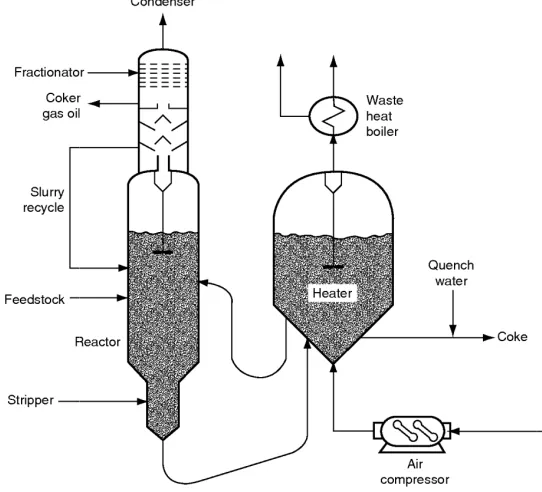
Figure 1-1. Schematic diagram of a fluid coke system (Speight, 2007).
The feedstock is injected in a downward it heats up and cracks into smaller
the particles flow down to a stripper where valuable oil vapors trapped between the c particles are recovered through steam stripping. The stripper section of the Coker consists of a system of baffles (sheds) that enhance the removal of hydrocarbon vapors
products. This process decreases the yield of undesirable coke and produces greater quantities of more valuable liquid products.
TM: A process that is very similar to Fluid Coking, but includes a gasification unit where excess coke is gasified.
Fluid Coking
is a process for refining heavy hydrocarbon bitumen through thermal cracking into lighter hydrocarbon products. The heavy feed is preheated to C and injected through steam atomization spray nozzles into a fluidized bed at °C to 550 °C. The bed temperature must be high enough to achieve cracking but kept at a moderate level to avoid over-cracking to low value permanent gases (House et al.,
Schematic diagram of a fluid coke system (Speight, 2007).
The feedstock is injected in a downward-flowing bed of hot coke particles, where up and cracks into smaller vapor molecules. Vapors rise through the bed while the particles flow down to a stripper where valuable oil vapors trapped between the c particles are recovered through steam stripping. The stripper section of the Coker consists of a system of baffles (sheds) that enhance the removal of hydrocarbon vapors
f undesirable coke and produces
: A process that is very similar to Fluid Coking, but includes a
refining heavy hydrocarbon bitumen through thermal cracking into lighter hydrocarbon products. The heavy feed is preheated to atomization spray nozzles into a fluidized bed at high enough to achieve cracking but kept cracking to low value permanent gases (House et al.,
from the fluidized coke particles. The down-flowing coke particles are then conveyed to a burner where they are reheated through partial combustion and hot coke particles are recirculated back to the reactor where they provide the heat required for the endothermic thermal cracking process, as described in Figure 1-1. Excess coke particles are removed, quenched and stockpiled.
When sprayed into the fluidized bed, the hydrocarbon feed is dispersed into very fine droplets in a wide spray, which significantly increases the phase contact area, in the reactor in order to provide a proper cracking environment for the bitumen feed, without major heat and mass transfer limitations. The evenly distributed droplets enhance the heat transfer, which is desirable, for a rapid and effective process (Base et al., 1999). The liquid-solid contact for this process is measured by the amount and quality of the product yields, the reactor operability and finally the process efficiency (House et al., 2004).
Gray et al. (2003) reported that the time required for Athabasca bitumen to react and lose its adhesion or ability to form stable liquid bridges between particles, thus form agglomerates is around 24 s at 503 °C. In addition, the adhesive forces due to the reacting material are significant only when the film was still liquid and able to form liquid bridges between particles. Coke particle growth can occur by two mechanisms:
1. Normal growth by virtue of product coke laid down on the individual particles.
2. By agglomeration of coke-particles.
1.3.2
Sheds
In some fluidized beds, especially with Group B powders (Geldart, 1973), internals are used in order to improve the fluidization by breaking and re-distributing the bubbles (Issangya et al., 2008). Bubble size is very important for gas/solid mass transfer in bubbling fluidized beds. The gas from inside the bubbles comes in contact with the coke particles in the clouds around the bubbles. This mass transfer between gas and solid is improved by reducing the bubble size and renewing the bubble surroundings by interchanging the gas component from the bubbles with that from the emulsion phase (Yang, 2003).
Horizontal baffles have been used to eliminate gas bypassing in deep fluidized beds of Geldart A powders, i.e. Fluid Catalytic Cracking (FCC) (Issangya et al., 2008; Issangya et al., 2013). Moreover the ability of baffles to reduce the gas bypassing is dependent on the vertical baffle spacing, effective open area and the spacing of the internals in the fluidized bed (Issangya et al., 2007). Rings, inverse cones and bluff bodies internals have been studied in the riser of Circulating Fluidized Beds (CFB) and are said to improve the radial solid distribution and improve gas-solids mixing (Jiang et al., 1991; Zhu et al., 1997). Hartholt et al. (1997) have shown that perforated plates located in the middle of a fluidized bed promote particle segregation by size while reducing the bubble size (Yang, 2003).
Luckenbach (1969) was the first one to patent and use shed decks in a fluid catalytic cracking reactor. Later, Blaser et al. (1986) patented the use of shed decks in the stripping section of a Fluid Coker.
Figure 1-2. Schematics of unwanted coke deposition (fouling) in the sheds and walls of
the stripper section of a Fluid Coker
1.4
Agglomerates
The agglomeration of solids occurs in many fluidization processes. In the pharmaceutical and fertilizer industries, agglomeration is something that is desirable and is used to reduce process problems like dustiness (Weber et al., 2009). In thermal cracking processes such as
production yield (agglomerates leave the Coker valuable un-cracked hydrocarbons, only to be burn
the reactors internals and surfaces. Fouling of the sheds in the stripper section leads to the premature shutdown of the unit.
1.4.1
Agglomerate Formation
Bruhns and Werther
formation based on experimental research; as the injected liquid is introduced into the fluidized bed not all the liquid is instantaneously vaporized (although the bed is oper above the boiling point of the liquid). Particles are suck
Schematics of unwanted coke deposition (fouling) in the sheds and walls of of a Fluid Coker (Adapted from Bi et al., 2005).
Agglomerates
The agglomeration of solids occurs in many fluidization processes. In the pharmaceutical and fertilizer industries, agglomeration is something that is desirable and is used to reduce process problems like dustiness (Weber et al., 2009). In thermal such as coking, agglomeration is not desirable because it affects production yield (agglomerates leave the CokerTM with a considerable amount of highly cracked hydrocarbons, only to be burned in the burner) and creates fouling of reactors internals and surfaces. Fouling of the sheds in the stripper section leads to the premature shutdown of the unit.
Agglomerate Formation
Bruhns and Werther (2005) proposed a model (Figure 1-3) of agglomerate on experimental research; as the injected liquid is introduced into the fluidized bed not all the liquid is instantaneously vaporized (although the bed is oper above the boiling point of the liquid). Particles are sucked into the liquid jet and
Schematics of unwanted coke deposition (fouling) in the sheds and walls of
The agglomeration of solids occurs in many fluidization processes. In the pharmaceutical and fertilizer industries, agglomeration is something that is desirable and is used to reduce process problems like dustiness (Weber et al., 2009). In thermal coking, agglomeration is not desirable because it affects amount of highly in the burner) and creates fouling of reactors internals and surfaces. Fouling of the sheds in the stripper section leads to the
immediately form agglomerates. These agglomerates then are transported into the rest of the fluidized bed.
Figure 1-3. Mechanism of agglomerate formation (Bruhns and Werther, 2005).
Ariyapadi et al. (2003) studied the agglomerate formation mechanism by using X ray imaging while injecting a radio opaque liquid tracer mixed with ethanol in order to visualize the jet cavity. Agglomerates appeared to form via coalescence of droplets and particles at the end of the jet cavity.
1.4.2
Effect of Liquid Properties
Schafer and Mathiesen
the formation of agglomerates. The research identified two mechanisms through which the initial wetting of the liqu
1. For small droplets: Wetting occurs through the distribution of droplets on individual solid particles. The
occurs.
2. For large droplets: The immersed inside the liquid.
immediately form agglomerates. These agglomerates then are transported into the rest of
Mechanism of agglomerate formation (Bruhns and Werther, 2005).
Ariyapadi et al. (2003) studied the agglomerate formation mechanism by using X ray imaging while injecting a radio opaque liquid tracer mixed with ethanol in order to
ity. Agglomerates appeared to form via coalescence of droplets and particles at the end of the jet cavity.
Effect of Liquid Properties
Schafer and Mathiesen (1996) used a shear mixer to study the effect
the formation of agglomerates. The research identified two mechanisms through which the initial wetting of the liquid droplets and particles occur:
For small droplets: Wetting occurs through the distribution of droplets on individual solid particles. Thereafter, coalescence between wet particles
For large droplets: The wetting involves a large number of particles be immersed inside the liquid.
immediately form agglomerates. These agglomerates then are transported into the rest of
Mechanism of agglomerate formation (Bruhns and Werther, 2005).
Ariyapadi et al. (2003) studied the agglomerate formation mechanism by using X-ray imaging while injecting a radio opaque liquid tracer mixed with ethanol in order to
ity. Agglomerates appeared to form via coalescence of droplets and
1996) used a shear mixer to study the effect of viscosity on the formation of agglomerates. The research identified two mechanisms through which
For small droplets: Wetting occurs through the distribution of droplets on after, coalescence between wet particles
Because of the results of open air experiments in which the Sauter mean diameter of the liquid droplets is equivalent to the Sauter mean diameter of the coke particles, the first mechanism is believe to be happening inside Fluid CokersTM (House, 2007).
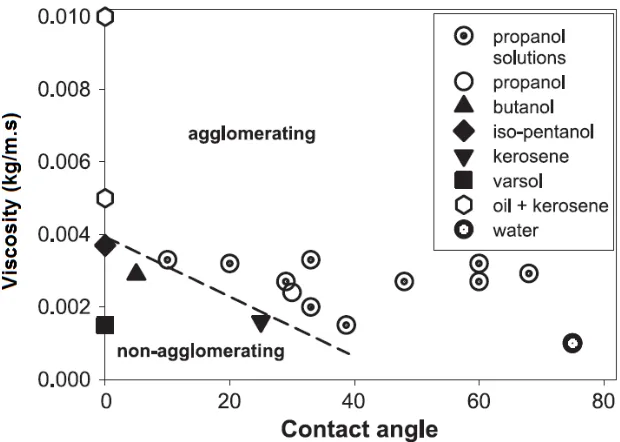
McDougall et al. (2005) studied the liquid properties that affect the formation of agglomerates inside fluidized beds when liquid is sprayed in. The research reported that the viscosity of the liquid and contact angle are the most important variables in the formation of agglomerates independently of the fluidization gas velocity. The formation of agglomerates with liquid that wets well the 135 µm particles (low contact angle
between the liquid and the solid surface) occurs only when the liquid has a high viscosity. For liquids that do not wet well particles (high contact angle), there is always the formation of agglomerates as presented in Figure 1-4.
Figure 1-4. Effect of liquid properties on the formation of agglomerates (McDougall et al., 2005).
1.4.3
Granulation
In their work on agglomerates fragmentation, Salman et al. (2004) presented different failure modes of agglomerates breakage as a function of the impact velocity. Larger and porous agglomerates promote the chipping (localised damage) of the agglomerate. Moreover Salman et al. (2003) concluded that the probability of agglomerate fragmentation is dependent upon size, material and impact velocity. Finally Subero and Ghadiri (2001) determined that there are two main types of breakage, localized damage and distributed damage. These findings are in accordance with results from Weber et al. (2006): at low fluidization gas velocities, erosion predominates and fragmentation prevails at high fluidization gas velocities.
Weber et al. (2009) showed that when erosion is the dominant mechanism of destruction, bigger and denser agglomerates are more stable than smaller and lighter ones. In addition, and up to 3 cP viscosity, an increase in liquid viscosity makes the agglomerates more stable (they can survive the harsh environment inside fluidized beds, something that is not desirable for Fluid CokersTM). Weber et al. (2006) concluded that the most stable agglomerates are formed with small spherical particles that are completely wetted by liquid. This is in accordance with findings from Dunlop et al. (1958), who found that particles larger than 70 µm adhere to each other because of liquid coating will be pulled apart because of fluidized bed forces, at the same time particles below 70 µm stay together to form an agglomerate.
Because the fouling in the stripper section is closely related to particle agglomeration, further study of the mechanism that leads to the coalescence between coke particles by liquid bitumen is needed. Granulation theory has been used in the past to study the mechanism that leads to fouling.
Ennis et al. (1991) proposed a minimum Stokes number [Stv*, Equation (1.2)] above which colliding granules rebound, which avoids agglomerate formation.
(1 )ln( )
0 *
h h e
Where:
• e is the particle coefficient of restitution.
• ho is the length of asperities on particle surface.
• h is the binder layer thickness.
By comparing Stokes number, Equation (1.3), with the minimum Stokes number [obtained from Equation (1.2)], Ennis et al. (1991) came up with a classification of the coalescence phenomena. When particles with initial Stokes number less than the critical value collide (Stv < Stv*), they coalesce. Collisions of particles with higher Stokes number (Stv > Stv*), result in a rebound of the colliding particles.
µ ρ
9 8 u0R
Stv = (1.3)
Where:
• ρ is the particle density.
• uo initial relative granule collisional velocity.
• R particle radius
• µ is the binder viscosity.
Equations (1.2) and (1.3) can be used to analyze defluidization in fluidized bed granulation. The addition of a binder to the fluidized bed increases the minimum fluidization velocity due to changes in the porosity of the fluidized medium. The liquid bridges generated by the binder have a tendency to increase the porosity of the bed, thus this increases the velocity of the gas, and results in a pressure drop equal to the weight of the bed, for example, the minimum fluidization condition. Therefore, the critical defluidization Stokes number [Equation (1.4)] is:
(1 1)ln( )
9 ) ( 8 0 0 * h h e R U U St m
D = +
− = µ ρα (1.4) Where:
• Um is the modified minimum fluidization velocity due to viscous layers.
• Uo is the minimum initial fluidization velocity.
Gray (2002) analyzed the work done by Ennis et al. (1991) in relation to the context of Fluid Coking. Solving for the minimum fluidization velocity [Equation (1.5)] suggests that this velocity increases in proportion to the logarithm of the liquid film thickness:
ln( )
8 ) 1 1 ( 9
0 0
h h R
e U
Um
ρα
µ +
+
= (1.5)
The film thickness is directly controlled by the rate of liquid feeding into a fluidized bed with a given amount of particles. The reaction and mass transfer processes favor minimal values of h, and this relationship suggests simultaneous benefits for thin films in avoiding defluidization. Optimizing process variables such as feed atomization, the number, position and orientation of jets or nozzles for the liquid feed, gas flow rate, and the reactor length to diameter ratio may help to achieve thinner films. In addition, Equation (1.5) suggests that the larger the particle, the smaller the increase in minimum fluidization velocity due to the presence of liquid binder. The overall conclusion can be summarized as: thinner films, larger particles and rougher particles help reduce the rate of particle adhesion. Moreover, the increase in the local characteristic velocity, Uo, increases the Stokes number near the reactor internal surfaces and helps avoid falling below the critical Stokes number and thus mitigates fouling.
fluidizing medium is effective to promote dispersion. The larger particles are fluidized easily and generate impaction and attrition forces that act as a dispersion forces on the adhesive particles (Masuda et al., 2006)
Parveen et al. (2013) presented a novel way to detect fragmentation of agglomerates inside a fluidized bed by using Radio Frequency Identification (RFID). The research concluded that the stability of an agglomerate is a function of its liquid content, its bulk density and the size of its constituent particles. An increase of the liquid content or bulk density increase the agglomerate stability, while larger constituent particles will make the agglomerate less stable. Also concluded that the average survival time for an agglomerate inside the bed is directly proportional to the critical shear force that is needed to break the agglomerate. The superficial gas velocity plays an integral role in determining which mechanism, erosion or fragmentation, cause agglomerate destruction: erosion predominates at low velocities and fragmentation at high velocities. When the superficial gas velocity is sufficiently high, fragmentation predominates, all agglomerates are fractured and no type of agglomerate is able to survive in a fluidized bed (Weber et al., 2006).
Wang and Rhodes (2005) presented a way to increase the velocity of the fluidized bed without affecting the overall operation of the bed. A major constraint associated with an increase in gas velocity is that the rate of particle elutriation may significantly increase. This is particularly true when the bed consists of particles with a wide size distribution. To take advantage of the effect of higher fluidization velocity without incurring excessive particle elutriation, a higher fluidization velocity is intermittently applied without increasing the time-averaged superficial gas velocity; such as applying gas-phase pulsation in the form of Equation (1.6).
U(t)=U0+Ussin(2πft) (1.6)
Where:
• U is superficial gas velocity.
• Uo time-averaged superficial gas velocity.
• Us amplitude of oscillation.
In practice, Us is set to be considerably smaller than Uo so that the oscillation component makes up only a small fraction of the total gas flow; with this approach, elutriation should not be impacted. Also, it has been reported that the effect of pulsation is most pronounced when the frequency of imposed pulsation matches the natural frequency of the bed.
1.5
Radioactive Particle Tracking
The Radioactive Particle Tracking (RPT) technique applied to fluidized beds consists of detecting the amount of radiation in the form of γ-rays, emitted by a single
radioactive tracer-particle (Because the focus of this research is related to agglomerates, the radioactive tracer-particle term, which is used in most RPT publications, will be changed to radioactive tracer-agglomerate in this work). The detected radiation is a function of distance from an array of gamma ray detectors located externally to the bed. The main advantage of this method is its non-intrusive nature; data can thus be obtained without disrupting the gas-solid flow inside the vessel.
A complete RPT system includes:
• A single radioactive tracer-agglomerate emitting γ-rays.
• Several scintillation detectors to sense the radiation emitted by the tracer-agglomerate.
• One computer or computers to record, process, and analyze the data from each detector.
polyurethane to match the diameter and density to that of the bed particles. Chaouki et al. (1997) described other attempts to introduce material that can be irradiated to produce a radioactive tracer. Regardless of the method or tracer preparation and the materials used, all suffer from similar limitations, i.e. the material is not exactly the same as the fluidized medium.
Radioactive gold (Au198), is preferred for RPT experiments because it decays very fast (as presented in Figure 1-5) and it decays into a stable isotope of Mercury (Hg198), which is very desirable for health concerns (Moreira et al., 2010).
Figure 1-5. Au198 decay graph (Moreira et al., 2010).
There are several position rendition techniques that can be used to determine the x-, y-, and z- coordinates of the tracer-agglomerate inside the reactor as a function of time using the radiation signal obtained from the scintillation detectors. The Computer Automated Radioactive Particle Tracking (CARPT) and the Monte Carlo simulation methods are the two most common ones.
1.5.1
CARPT Rendition Technique
The CARPT method was originally developed by Lin et al. (1985). The main outcome of this method is that the number of γ-rays counted by a detector depends
unequivocally on the distance between the tracer-agglomerate position and a virtual center in the detector surface. Once this virtual center is determined, a calibration curve relating γ-rays counts to distance is established for each detector for a condition identical
to those of the particle tracking. The calibration data obtained is expressed in a functional form using a curve fit of the raw data. Polynomial fits with various orders are used in order to describe the different domains of distance versus γ-rays counts relationships
(Chaouki et al., 1997).
By defining an arbitrary reference frame and denoting by (x,y,z) the unknown coordinates of the tracer as well as the coordinates of the virtual center of ith detector (xi, yi, zi), then for each detector the formula can be written as shown in Equation (1.7):
2 2 2 2
) ( ) ( )
( i i i
i x x y y z z
r = − + − + − (1.7)
Where r is the distance obtained from the polynomial fitting. The availability of distance measurements from many scintillation detectors results in data redundancy for location determination. To take advantage of this planned redundancy, a weighted least-square method based on an exact linearization scheme is used to obtain the tracer position (Lin et al., 1985).
between the tracer and a horizontal plane through the virtual center of the scintillation detector.
1.5.2
Monte Carlo Rendition Technique
In order to avoid extensive in-situ calibration, Professor Chaouki and his group at École Polytechnique de Montréal developed a phenomenological approach to account for geometry and radiation effects in RPT. With their rendition technique, the determination of the tracer position from the detectors counts requires the construction of a map of counts as a function of the possible coordinates of the particle by using Equation (1.8). Since a certain fraction of the γ-rays are absorbed by the fluidized material and by the
vessel walls, a new map is needed whenever the density of the medium to be studied changes (Chaouki et al., 1997).
ϕε τ
ϕε
A vA ST C
+ =
1 ) (
(1.8)
Where:
• C is the theoretical counts.
• ST the sampling time.
• v the number of γ-rays emitted per disintegration.
• φ the photopeak ratio.
• ε the total efficiency.
• τ is the dead-time per recorded pulse.
• A is the strength of the radiation source.
The advantages of Monte Carlo method are that it requires less calibration, and that the mathematics takes into account the angle at which the γ-rays enter the sensor.
1.6
Thesis Objectives and Outline
As mentioned before, agglomeration of small fluid coke particles is believed to be the main cause of fouling of the Fluid Coker internal surfaces. Nonetheless, and to the best of the author’s knowledge, there is no research dealing with the hydrodynamic mechanisms that contribute to or control fouling of internal surfaces in Fluid Cokers.
It has been suggested by the industry, that in order for significant shed fouling to occur in the Fluid Coker, three factors should be present in the shed zone of the reactor:
1. Wet agglomerates in the vicinity of the sheds.
2. Heavy organics vapors that cement the wet agglomerates on the shed surfaces. 3. Furthermore, low local characteristic velocities that allow enough time for the
agglomerates to foul the surfaces.
In order to study the hydrodynamic mechanism of the stripping section of a Fluid Coker the research proposed herein will focus on the following seven objectives:
1. Design and construction of a lab-scale cold flow recirculating fluidized bed surrounded by scintillation detectors to track the trajectory of a single radioactive tracer-agglomerate placed into a recirculating flow of real coke particles. The experimental reactor contains replaceable internals (sheds) that improve the contact between the solids and the gas. The bed does not contain irregular surfaces where the tracer-agglomerate can latch on to.
2. Fabrication of a tracer-agglomerate consisting of coke laced with gold or epoxy laced with glass bubbles and gold in order to mimic typical wet agglomerates encountered in Fluid Cokers. The tracer will be radiated in the Slowpoke II nuclear reactor at the Saskatchewan Research Council (SRC) or later, in the Material Test Reactor at McMaster University.