by
Nishant Jacob
A thesis submitted to the Graduate Faculty of North Carolina State University
in partial fulfillment of the requirements for the degree of
Master of Science
Department of Electrical and Computer Engineering
Raleigh, NC May 14, 2001
Approved By:
Dr. Brian Hughes Dr. J. Keith Townsend
Chair of Advisory Committee
JACOB, NISHANT. Capacity Aspects of Bit Interleaved Coded Modulation.
(Under the direction of Dr Brian .L. Hughes.)
Space-time block codes are a recently discovered, attractive modulation scheme for
multiple antenna wireless channels. They are capable of providing full diversity over
fading channels, at the same time requiring only low computational costs. Over the
last few years, several distinct approaches to designing space-time codes have been
proposed in the literature, including the layered architecture of [9, 22], trellis codes
in [3, 17, 23], turbo codes [13, 16] and the orthogonal designs in [1, 19]. Most work
on space-time coding has focused on the problem of designing codes to perform well
under quasi-static fading conditions. Some examples of codes designed for fast-fading
are [17, 6]. In practice, it is not unusual for a cellular handset to experience conditions
which range from fast fading to nearly static within seconds (e.g., a vehicle suddenly
braking). It is therefore of interest to design codes that are robust in the sense that
they perform well under a wide variety of channel fading conditions. A robust coding
architecture called Bit-Interleaved Space-Time Coded Modulation is proposed in [10] for channels with multiple transmit and receive antennas. It is designed to perform
well under a wide variety of channel fading conditions and which (when differentially
encoded) does not require accurate channel estimates at the receiver. The architecture
combines serial concatenation of short, full-diversity space-time block codes (inner
code) with bit-interleaved coded modulation.
This thesis examines the capacity aspects of this architecture namely, the ergodic
capacity, the outage capacity and the ergodic and outage cut-off rates in Rayleigh
flat-fading channels. It is shown that, if the inner block codes are chosen properly,
not only is the capacity close to the information-theoretic limits, but also a better
Biography
Nishant Jacob was born in Gujarat, India on Oct. 11th, 1977. He received his B.S
degree in Electrical Engineering from Bharathiyar University in Tamil Nadu, India.
He is currently working towards the completion of his Master of Science Degree in
Acknowledgements
I would like to extend my thanks, first and foremost to my committee chairman,
Dr. Brian Hughes for his patient guidance and support all through my research.My
thanks also go out to Dr. Keith Townsend and Dr. Gianluca Lazzi for being on my
thesis committee. I owe the deepest gratitude to Zhihong Hong, who was instrumental
in this research and its successful completion. Lastly I would like to thank Carmela
Contents
List of Figures v
1 Introduction 1
2 Background 5
2.1 Channel Model . . . 5
2.2 Review of Space-Time codes . . . 6
2.3 Bit-interleaved Space-time coded modulation . . . 10
3 Capacity Aspects 14 3.1 Capacity Calculation of BI-STC . . . 14
3.1.1 Ergodic Capacity . . . 14
3.1.2 Outage Capacity . . . 15
3.1.3 Channel Cutoff Rate . . . 15
4 Numerical Results and Performance Analysis 17 4.1 BI-STC Vs. BI-FC . . . 17
4.2 BI-STC Vs. CM-FC . . . 22
4.3 BI-STC Vs. CM-STC . . . 23
5 Conclusions 29
List of Figures
2.1 Channel model . . . 5
4.1 Ergodic capacities of BI-FC and BI-STC with various space-time block codes for t= 2, r= 1 . . . 18 4.2 Ergodic capacities of BI-FC and BI-STC with various space-time block
codes for t= 2, r= 2 . . . 19 4.3 Ergodic cut-off rates of BI-FC and BI-STC with various space-time
block codes fort = 2, r= 1 . . . 20 4.4 Ergodic cut-off rates of BI-FC and BI-STC with various space-time
block codes fort = 2, r= 2 . . . 21 4.5 90% Outage capacities of BI-FC and BI-STC with various space-time
block codes fort = 2, r= 1 . . . 22 4.6 90% Outage capacities of BI-FC and BI-STC with various space-time
block codes fort = 2, r= 2 . . . 23 4.7 90% Outage cut-off rates of BI-FC and BI-STC with various space-time
block codes fort = 2, r= 2 . . . 24 4.8 90% Outage cut-off rates of BI-FC and BI-STC with various space-time
block codes fort = 2, r= 2 . . . 25 4.9 Ergodic capacities of CM-FC and BI-ALAM for t= 2, r= 1 . . . 26 4.10 Ergodic capacities of CM-FC and BI-ALAM for t= 2, r= 2 . . . 27 4.11 Ergodic and 90% Outage cut-off rates of CM-ALAM and BI-ALAM
Chapter 1
Introduction
Fading makes reliable high speed communication over multipath environments
quite a challenge. Information-theoretic studies of the fading channel have been
re-ported several times in literature, as is well summarized in [5]. Antenna diversity
is an effective and practical means of mitigating the effect of the multipath fading.
It is well known, that the trade off between spectral efficiency and power can be
significantly improved through antenna diversity. Further to get the most of fading
multipath channels, it becomes necessary to fully utilize all the implicit and explicit
diversity available. In order to increase the capacity of Rayleigh fading wireless
chan-nels space diversity can be used. When multiple transmit and receive antennas are
used in conjunction with efficient signal processing, significant improvements in
ca-pacity are possible. Space time codes are designed for optimum transmission using
multiple transmit antennas and provide diversity as well as coding gain. They provide
diversity by introducing space and time correlation between the transmitted signals
over different antennas. This leads to a dramatic increase in throughput as well as
reliability of such systems. Several approaches to space-time coding have been
pro-posed, like the layered architecture of [9, 22], the block codes of orthogonal designs
in [1, 19], the trellis codes of [3, 17, 23], the turbo codes of [13, 16]. A detailed
study and generalization of the orthogonal code concept was given in [19]. It
minimum encoding and decoding complexities. A dramatic reduction of encoding
and decoding complexities is shown to be possible by partitioning the transmit array
into small groups and using individual space-time codes to transmit information from
each group of antennas. At the receiver, simple linear processing is used to suppress
signals transmitted from other groups of antennas by treating them as interference.
Performance is shown to be determined by matrices constructed from pairs of distinct
code sequences. The minimum rank among these matrices gives theDiversity Gain,
and this is quantified by the generalized hamming distance of certain sequences. The
minimum determinant gives theCoding Gainand this is quantified by the generalized
product distance of these sequences. The design criteria for these space-time codes are
based on the probability of confusing two distinct codewords. They are two criteria to
achieve maximum diversity namely, Rank Criteriaand Determinant Criteria. For
the ideal fast-fading channel, the criteria become a vector extension of the product
distance of scalar fading channels. Space-time codes are designed so as to achieve
the maximum possible diversity nR× nT under the constraint of simple decoding. They are not designed to achieve an additional coding gain. Hence they must be
concatenated with outer codes that provide the necessary coding gain.
In a fading channel, channel capacity is measured in different ways, depending on
how fast the channel is changing. Under quasi-static conditions, where we assume that the fading path gains remain constant for the entire duration of a frame, the
capacity is measured by the outage capacity. However under ideal fast-fading fading conditions, the fading path gains are modeled as i.i.d. random variables, because of
ideal interleaving and motion-induced Doppler spread in the multipath. In this case
the sensible measure of capacity is the ergodic capacity. Like channel capacity, the
channel cutoff rate is another useful measure, which gives the tradeoff between
per-formance and complexity when considering channel coding with different modulation
schemes. In [21], ergodic and outage cutoff rates are analyzed for various transmit
diversity schemes like maximum ratio combining (MRC) transmit diversity,
switched-time diversity (STD) and orthogonal transmit diversity (OTD). Most of the work so
Some examples of space-time codes designed for fast-fading can be found in [17, 8].
Robust space-time codes that can perform well in both quasi-static and fast-fading
conditions have been reported in [15, 6]. Performance of any coded system in a fading
channel depends on its diversity order. It is well known [24] and later [7] that, for
single antenna systems, Bit Interleaved Coded M odulation (BICM) provides good
performance over both the Rayleigh fading and the additive white Gaussian noise
channel. BICM improves reliability over the Rayleigh fading channel as compared to
symbol (block) interleaving. In symbol interleaving the order of diversity and hence
the fade margin is dependent on the minimum number of distinct symbols between
two code words. This can only be improved by increasing the constraint length of
the code and by preventing parallel transitions. BICM maximizes the code diversity
order to the minimum hamming distance of a code, and increases the fade margin,
while preserving the free Euclidian distance of the underlying constellation to a large
extent. Most of the coding gain is achieved by the increased diversity through bit
interleaving. This gain is larger than the loss associated with the random
modula-tion and suboptimal decoding. Random modulamodula-tion is caused due to the destrucmodula-tion
of the direct mapping between code symbols and constellation points. Suboptimal
decoding is a practical necessity due to the complexity of joint demodulation and
convolutional decoding, as is required by optimal ML decoding. BICM is achieved by
bit interleaving each bit output of a convolutional encoder. Binary convolution codes
have a larger free distance than non-binary codes, and BICM offers a much better
trade-off between code diversity and trellis complexity than plain trellis-coded
mod-ulation. With Gray labeling, BICM provides a free Euclidian distance d2E = dHd20, where dH is the free Hamming distance of the code and d0 is the smallest Euclidian distance of the constellation. Based on the robustness and relevance of the BICM
ap-proach on fading single antenna channels, BICM for multiple-antenna systems seems
an attractive concept. Further, since BICM isolates the design of the encoder from
that of the modulator, the design of such space-time codes is simpler than those for
regular coded modulation(CM) systems.
constella-tion(FC), made up of all the code matrices over some scalar constellation (denoted
here, as BI-FC for convenience). The output of an encoder is cycled between each
of the t transmitters. Each transmitter has an ideal bit interleaver, modulator and
transmit antenna. Each receiver computes the necessary bit metrics, deinterleaves
them to the original order and then uses them for the decoding stage.
Information-theoretic analysis of BI-FC for different number of transmit and receive antennas in
terms of ergodic capacity and outage capacity is also done in [6]. BI-FC is compared
to space-time coding using standard coded modulation(CM) and it is shown that
with two transmit antennas, BI-FC incurs a capacity loss to the CM-FC in both the
ergodic and outage sense. More recently, a robust coding architecture called Bit-interleaved Space-Time Coded Modulation (BI-STC) is proposed in [10] for channels with multiple transmit and receive antennas. This is based on the serial concatenation
of short, full-diversity, space-time block codes that serve as inner codes, with BICM.
Performance analysis and computer simulations in [10] show these space-time codes
can perform very well in fast-fading conditions. In quasi-static fading conditions, it
performs comparably to the best known space-time codes designed for quasi-static
fading conditions.
The important capacity aspects of this new architecture, namely, the ergodic
capacity, the outage capacity, and the ergodic and outage cutoff rates in the Rayleigh
Chapter 2
Background
2.1
Channel Model
Transmit
Array ReceiveArray
r
. . .
t
. . .
c1k
ctk c2k
. . .
y1k
yrk y2k h11
hij
hrt
. . .
Figure 2.1: Channel model
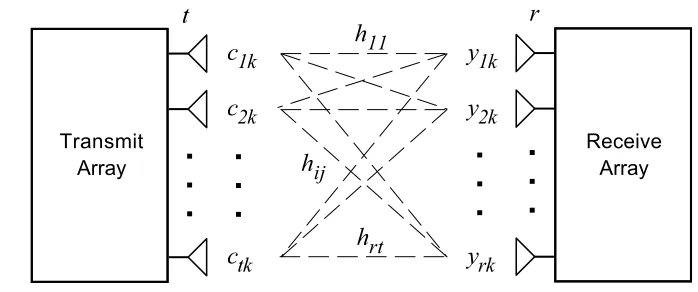
We consider the channel with t transmit antennas and r receive antennas
illus-trated in Fig. 2.1. Under Rayleigh flat-fading conditions, this channel can be described
by
Yk=√ρHkXk+Nk, k = 1, . . . , K (2.1)
matrix of noise. We assume that the elements of Nk and Hk are independent and identically distributed (i.i.d.) complex Gaussian random variables with probability
density function (pdf)
p(h) = 1/πexp(−|h|2) . (2.2)
We further assume that the transmitted signals are normalized to unit power, Tr[XkXk†]≤
nt, so that ρ represents the signal-to-noise ratio (SNR) per transmission path. We
consider two idealized models of the behavior ofHk: underquasi-staticconditions,Hk
is fixed for the duration of a frame, soHk =H,k = 1, . . . , K; underfast-fading condi-tions, we assume that ideal interleaving and time-selective fading rendersH1, . . . , HK
an i.i.d. sequence of random matrices.
2.2
Review of Space-Time codes
To get the most of fading multipath channels, it becomes necessary to fully utilize
all the implicit and explicit diversity available. When multiple transmit and receive
antennas are used in conjunction with efficient signal processing, significant
improve-ments in capacity are possible. Space time codes are designed for optimum
trans-mission using multiple transmit antennas. Many methods of transmit and receiver
processing can be used to achieve good diversity at reasonable complexity. Space
time codes introduce space and time correlation between the transmitted signals over
different antennas, and thereby provide diversity at the receiver.
Orthogonal space-time block codes
Orthogonal space-time codes were introduced in [1]. A detailed study and
gen-eralization of the concept was given in [19], and concentrated on the extracting full
diversity gain from the channel with minimum encoding and decoding complexities.
by
X =
x1 −x2∗ x2 x1∗
wherex1, x2∈ C are the transmitted symbols. This can be extended tor =mreceive
antennas trivially to provide an overall diversity of 2m. Following [10], for any binary
sequence say,{bi}, letbps denote the subsequence (bs+1, . . . , bs+p), where the subscript is generally omitted for s= 0. For|C| = 2p, let x(bp) denote a one-to-one mapping of binary labels to points in C. Then the code matrix becomes,
X(b2p) =
x(bp) −x(bpp)∗
x(bpp) x(bp)∗
. (2.3)
Further when x(bp) is a Gray labeling for C, X(b2p) becomes Gray labeling for X.
In [18] space-time trellis codes are designed for standard modulation schemes like
4-PSK,8-PSK and 16-QAM that perform extremely well from a capacity perspective
and achieve within 2-3 dB of the outage limits. These trellis codes combine spatial
and temporal diversity and are hence called r−space−time trellis codes, where r
represents the guaranteed diversity advantage provided by the code. The objective
of the code design is to achieve maximum possible rate at a diversity advantage of
rmform transmit antennas. Fundamental tradeoffs exist between transmission rate,
diversity advantage, constellation size and trellis decoding complexity. The design
criteria for these codes are based on the probability of confusing two distinct
code-words. There are two criteria to achieve maximum diversity namely, Rank Criteria
and Determinant Criteria. Several 4-PSK codes of rate 2 bps/Hz and 8-PSK codes
at 3 bps/Hz for transmission over two antennas are provided. These trellis codes have
4, 8, 16 or 32 states. When a single receive antenna is used, these codes provide a
diversity advantage of 2. Performance is determined by matrices constructed from
pairs of distinct code sequences. The minimum rank among these matrices gives the
Diversity Gain, that is quantified by the generalized Hamming distance of certain
sequences. The minimum determinant gives the Coding Gain and this is quantified
Space-time group codes
A general approach to differential modulation is established in [11]. This is based
on space-time block codes that have a group structure, and extends to any number of
antennas and any signal constellation. Since the class of group codes is inherently very
rich, it is possible to construct codes for any number of antennas and constellations.
Further group codes may also be differentially encoded, in a manner similar to PSK.
These codes may be used as space-time block codes when CSI is available at the
receiver and as differentially encoded codes when CSI is unavailable. The performance
degrades by only around 3 dB in the latter case over the former. The group structure
also leads to a more simpler modulation and demodulation processes. For a system
with t transmit antennas with a constellationC, agroup codeof any length nis given
by
DG≡ {DG:G∈ G}
wheren ≥t,G is any group ofn×n unitary matrices , D is at×n matrix such that
DG∈ Ct× n for all G∈ G and the code rate is given byR = (1/n)log2 | G |bps/Hz.
For t=n = 1 M-ary PSK is a group code with group G={1, ωM, ω2M, ..., ωMM−1}, with ωM ≡ exp(2πj/M) and D= 1.
For t=n= 2, a group code is the pair,
G = ±
1 0
0 1 ±
j 0
0 −j ±
0 1
−1 0 ±
0 j
j 0
and D=
1 −1
1 1
over the QPSK constellation C ={1, j,−1,−j}.
For M = 2p > 1, all optimal unitary group codes with | G |= M and diversity advantage vp =n=t= 2 are either cyclic or dicyclic. The (M, k) cyclic group code
is given by,
G = *
ωM 0
0 ωMk +
, D =
1 −1
1 1
where k is odd and 0 < k < M. It takes values in the M-PSK constellation with | G |=M code matrices, and a diversity advantage vp = 2.
For M ≥8, thedicyclic group code is given by
G = *
ωM/2 0 0 ω∗M/2
,
0 −1
1 0
+
, D =
1 −1
1 1
This has M code matrices and takes on values in the M/2 -PSK constellation. It
has a diversity advantage of vp = 2.WhenR = 0.5 bps/Hz, the only optimal unitary group code is the (2,1) cyclic group code. For R= 1, the (4,1) and (4,3) cyclic codes
are both optimal. The (4,3) is basically the Alamouti code.
For R= 1.5, the optimal dicyclic code is given by,
G = ±
1 0
0 1 ±
j 0
0 −j ±
0 1
−1 0 ±
0 j
j 0
, D =
1 −1
1 1
over the QPSK constellation C ={1, j,−1,−j}. This is called the quaternion code
,since the group G is the quaternion group. It has the desirable property of
main-taining the minimum product distance of the optimal R= 1 code. In addition, with
perfect CSI it can achieve 75% the rate of the Alamouti QPSK, with a 3 dB higher
coding gain.In the case, where CSI is unavailable at the receiver, the quaternion
code may be differentially encoded and detected without any constellation
expan-sion. When R = 2, both the best cyclic and dicyclic group codes have the same
minimum distance, but dicyclic codes have a larger second-nearest-neighbor spacing.
For R = 2.5 the (32, k) cyclic group codes are optimal for k = 7,9,23,25. Though
these codes have 2.3 dB loss in coding advantage over the codes in [8, 19], they are
simpler and can be differentially encoded, while preserving the constant modulus
property of the constellation.
As in [10], for both the cyclic and dicyclic group codes, a binary labeling x(bp) of Cp induces a natural labeling on X. For the cyclic code, this is
X(bp) =
x(bp) 0 0 x(bp)k
while for the dicyclic code is given by
X(bp+1) =
x(bp) 0 0 x∗(bp)
0 −1
1 0
bp+1
. (2.5)
Further, when x(bp is a Gray Labeling forC,X(b2p) is a Gray labeling for the Group code (except dicyclic R = 1.5).
2.3
Bit-interleaved Space-time coded modulation
In a single antenna system, BICM is achieved by bit interleaving each bit output
of a convolutional encoder. To provide maximum flexibility and symmetry, all the
encoder outputs are fed to a single-bit interleaver as in [7]. The interleaved sequence is
then split into several subsequences of m bits each. These subsequences are mapped
by an N - dimensional memoryless modulator over a signal set X ∈ CN of size | X |=M = 2m, through the binary labeling map µ: {0,1}m → χ. Using common signal sets with Gray labeling provides capacities very close to those of the signal sets
themselves. The asymptotic optimality of Gray labeling with BICM is shown in [7].
Gray labeling is best for suboptimal decoding and thus plays a key role in BICM. A
Gray coding scheme is defined by the mapping µ : {0,1}m → χ, such that for each
i = 1, ..., m and b ∈ {0,1} each x ∈ χib has at most one z ∈ χi
b at the minimum
Euclidian distance dmin. When one assumes ideal interleaving (infinite depth and totally random) and the channel state is iid, the BICM communication channel can
be modeled as a set of m parallel binary-input channels connected to the encoder.
Each channel represents a bit position in the label of the signal set χ. The encoder
randomly and independently uses one of them binary channels for each of its binary
outputs. The receiver which knows the sequence of channels used for transmission,
deinterleaves the sequence and computes the relevant branch metrics. Results show
that BICM with gray labeling for many common signal sets achieve capacities very
close to those of TCM. Since the robustness and relevance of the BICM approach
needs to be explored.
Full Constellation BICM (FC-BICM)
The application of BICM (Gray Labeling) concept to multi-antenna systems on
fading channels, was first described in [6], from an information theoretic view point.
In this scheme, the output of an encoder is cycled between each of the t
transmit-ters. Every transmitter has an ideal bit interleaver, modulator ,transmit antenna and
transmits a power of P/t. An antenna actually transmits a code that is the
punc-tured version of the encoder output. Since the transmitted symbol is chosen from
the entire constellation without restriction, this scheme is called Full Constellation
BICM (FC-BICM). The receivers are assumed to have perfect channel state
infor-mation (CSI). Each receiver computes the relevant bit metrics, deinterleaves them to
restore the original order and then uses them for the decoding stage. Biglieri’s results
indicate that bit interleaved space-time codes achieve ergodic and outage capacities
remarkably close to, those of general coded modulation(CM) over multiple transmit
and receive antennas.
Serially Concatenated BICM (SC-BICM)
It has been well established that concatenated codes also called multilevel codes,
have large coding gains and high efficiency. They obtain low bit error
probabili-ties at rates well beyond the channel cut off rate. Further they may be decoded
through the use of a remarkably simple iterative decoding scheme. Serial
concate-nated codes (SCC) have been to shown to achieve near error-free performance at
rates close to the capacity. A serial concatenated code (SCC) and interleaver
con-sists of an outer encoder , a bit interleaver and an inner encoder connected in
series. The input to the inner encoder is the permuted version of the outer code.
The extension of the serial concatenation concept to space-time block codes, called
Serially Concatenated BICM(SC-BICM) is proposed in [10]. This scheme involves
a bit interleaver. A block of m input bits are first encoded using a rate m/q outer
convolutional encoder. The encoder output, a block of q bits is then bit interleaved
and then encoded through the inner the space-time encoder. The space-time encoder
maps the block on to space-time block code of length n, say X of size 2q. This gives an overall spectral efficiency of m/n bps/Hz. Assuming perfect CSI at the receiver,
and using Gray labeling each binaryq-tuple output, of the interleaves at time k,bqk is mapped on to a space-time block code X =µ(bqk), Xk ∈ χ, which are then transmit-ted. Thus a sequence of information bits{im1 , im2 ...imK}are mapped on to the sequence of block codes X = {X1, X2, ..., XK}. The space-time demodulator at the receiver calculates the maximum likelihood (ML) metric for each bit. The bit metric is given
by
λ(bk+i=b) =log X
Z∈χi b
P(Yk|Z, Hk)≈minχi
bT r{(Yk
√
pHkZ)(Yk−√pHkZ)†}
where i = 1,2, ..., q, b = 0,1 and Xbi = {µ(bqk) |bk+1 =b} is the signal subset. After
metric de−interleaving, the bit metrics are given to a ML decoder, using the decision
rule,
∧
X=arg minX∈χi b K X k=1 q X i=1
λ(bk+1)
[10] also gives the design criteria for SC-BICM code design and the performance
re-sults. The code performance is significantly dependent on dfree and this needs to be maximized. The SC-BICM approach is suboptimal since it optimizes the diversity
gain rather than the product distance. SC-BICM is guaranteed to achieve full
diver-sity v =tr in Quasi-static and v = trdfree under fast fading conditions, where dfree
is the free Hamming distance of the outer code.Space-Time Trellis coding (STTC)
requires codes with larger constraint length and thus complexity to achieve the same
diversity order. Further the use of the high diversity inner codes makes the inner
cod-ing stage significantly more reliable and improves the overall code performance for
the same trellis complexity. On the other hand TCM concatenated with the
Alam-outi code (SC-TCM) as in [2] optimizes the product distance. Under Quasi-static
fading conditions SC-TCM would thus perform better, while SC-BICM will perform
that concatenatenation with space-time block codes of full diversity, has several
ad-vantages: First, under quasi-static fading conditions, the inner code guarantees full
diversity. Second, under fast-fading conditions, the same inner code can achieve a
much higher code diversity for given hamming distance of the underlying
convolu-tional code. Third, as shown in [10], that Gray labeling often exists for most of
the space-time block codes with full diversity. The result indicate that SC-BICM
outperforms the codes suggested in [17, 8] under both fading conditions. SC-BICM
performs comparably to Smart Robust (SR) codes (the best known code for fast
fad-ing) in quasi-static and remarkably better in the fast fading case. Further SC-BICM
approaches the performance of turbo code, introduced in [13, 16], even without
iter-ative decoding. Hence the robustness and relevance of the SC-BICM approach under
Chapter 3
Capacity Aspects
3.1
Capacity Calculation of BI-STC
3.1.1
Ergodic Capacity
Telatar[20] has shown that the ergodic capacity of channel (2.1) is given by,
C= 1
nI(X, Y|H) =E h
log2¯¯¯I+ρHH†¯¯¯i (3.1)
where I(X, Y|H) is the conditional mutual information and | · | is the determinant.
Moreover capacity is achieved when the elements of Xk are i.i.d. complex Gaussian random variables. Under the fast-fading conditions, Hong and Hughes show in [10],
that BI-STC often achieves a better tradeoff between code diversity and trellis
com-plexity than conventional symbol-interleaved space-time codes. In [10], the sequence
of code matrices X1, . . . , XK is constrained to take values in a full-diversity space-time block codeX and decoding is performed with suboptimal metrics, both of which
entail a loss of capacity relative to [20], in which X consists of all matrices over a
scalar constellationC.
We now determine the ergodic capacity of BI-STC. To this end, let Bi denote the
have b ∈ {0,1} in the i-th position of their binary label. Following [7], we can write
the ergodic capacity of BI-STC as
C = 1
n
q
X
i=1
I(Bi, Y|H) = 1
n
q−Xq
i=1
EY,H,Bi
log2
P
Z∈Xp(Y|Z, H) P
Z∈Xi
Bi p(Y|Z, H)
(3.2)
where
p(Y|X, H) = 1
πnr exp n
−kY −√ρHXk2o
and kAk2 = Tr[AA†] is the Frobenius norm. Here Bi, . . . , Bq are i.i.d., uniformly-distributed, binary random variables. If space-time block codes are concatenated
with standard coded modulation instead of BICM, the ergodic capacity of CM-STC
becomes
C= 1
nI(X, Y|H) =
1
n Ã
q− EY,H,X "
log2 P
Z∈Xp(Y|Z, H) p(Y|X, H)
#!
(3.3)
3.1.2
Outage Capacity
Under the quasi-static fading condition, the channel capacity is a random variable
depending on the instantaneous realization of the fading processh. In such a situation,
the outage capacity is used to assess the system performance. For a given rateR, the
outage probability is defined as
Pout(R) =P ·1
nI(X, Y|h)< R ¸
(3.4)
Here n1I(X, Y|h) is determined by (3.2) or (3.3) for BI-STC or CM-STC respectively.
3.1.3
Channel Cutoff Rate
Like the ergodic and outage capacities which give ultimate performance limits
under fast-fading and quasi-static fading conditions, the channel cutoff rate is a well
accepted means of assessing the trade-offs between performance and complexity for
various transmit diversity schemes, e.g. MRC transmit diversity, STD and OTD are
evaluated in [21]. Now we evaluate the channel cutoff rate for concatenated
space-time block codes. From the system model, with perfect CSI, the average bit-error
probability for fast fading could be obtained by Bhattacharyya bound [7],
Pb ≤ 1 q
q
X
i=1
EY,H,Bi
v u u u t P
Z∈XBi¯ p(Y|Z, H)
P
Z∈XBi p(Y|Z, H)
=Q (3.5)
where, by definition Q is the Bhattacharyya factor and XB¯i denotes the comple-mentary subset of XBi. Then under fast-fading conditions, the ergodic cutoff rate of BI-STC is
R0 = q
n[1−log2(Q+ 1)] (3.6)
While for CM-STC, the ergodic cutoff rate with CSI could be written as
R0 = 1
n
q−log2 X
Z∈X EY,H,Z v u u
tp(Y|Z, H) p(Y|X, H)
. (3.7)
Under quasi-static fading conditions, depending on the instantaneous realization of
the fading process h, the channel cutoff rate is also a random variable, denoted as R0. Following (3.4) the outage cutoff rate is
Pout(R) =P[R0 < R] (3.8)
Again, R0 is evaluated by (3.6) or (3.7) for BI-STC or CM-STC, respectively. The
difference between BI-STC and BI-FC lies in the inner code constellation, so
Chapter 4
Numerical Results and
Performance Analysis
In this section, we use Monte Carlo simulation to calculate the channel capacity
of BI-STC and standard CM-STC which is proposed in [4, 12, 15] and compare the
results with BI-FC and CM-FC of [6].
4.1
BI-STC Vs. BI-FC
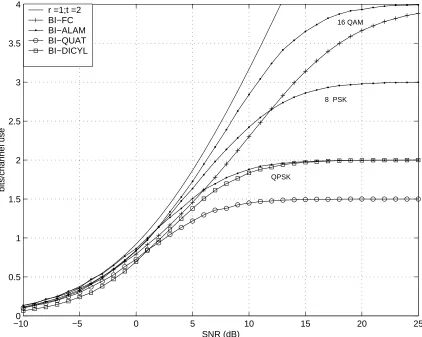
Fig. 4.1, plots the ergodic capacity of BI-STC with t = 2 transmit antennas and
r = 1 receive antenna for five space-time block codes under fast-fading conditions,
namely the QPSK, 8PSK, and 16QAM Alamouti codes[1] (denoted by BI-ALAM),
the rate R = 1.5 quaternion code (BI-QUAT) and R = 2 dicyclic code (BI-DICYL)
given in [11]. Also shown for reference, is the Gaussian-input capacity (solid) from
[20], and the ergodic capacity of BI-FC as proposed in [6], which X consists of all
t×n matrices over the scalar QPSK constellation {±1,±j}. The 16QAM BI-ALAM
outperforms the QPSK BI-FC approach over the entire range considered. For R≤1
bps/ch use, all of the BI-STC schemes yield comparable capacities, within 1-2 dB
−100 −5 0 5 10 15 20 25 0.5
1 1.5 2 2.5 3 3.5 4
SNR (dB)
bits/channel use
r =1;t =2 BI−FC BI−ALAM BI−QUAT BI−DICYL
16 QAM
8 PSK
QPSK
Figure 4.1: Ergodic capacities of BI-FC and BI-STC with various space-time block codes for t = 2, r= 1
performance of 2−3 dB relative to the 16QAM BI-ALAM code, which remains within
1 dB of the Gaussian-input capacity.
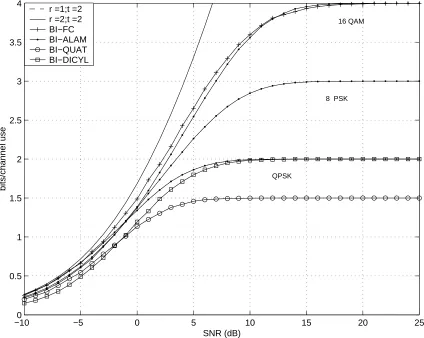
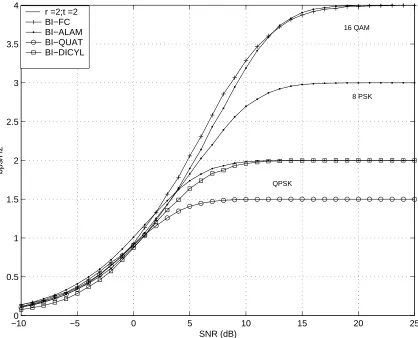
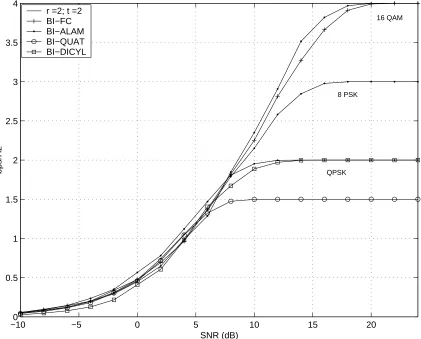
Fig. 4.2, plots the ergodic capacities of the same BI-STC codes fort = 2 transmit
and r = 2 receive antennas. The loss in capacity of all BI-STC schemes relative to
the Gaussian-input capacity for r = 2 receive antennas[20] is greater than ther = 1
case, and is most marked at larger rates. However both schemes are within 2 dB of
the Gaussian-input capacity for all rates up to 3 bps/ch use. In contrast to ther = 1
−100 −5 0 5 10 15 20 25 0.5
1 1.5 2 2.5 3 3.5 4
SNR (dB)
bits/channel use
r =1;t =2 r =2;t =2 BI−FC BI−ALAM BI−QUAT BI−DICYL
16 QAM
8 PSK
QPSK
Figure 4.2: Ergodic capacities of BI-FC and BI-STC with various space-time block codes for t = 2, r= 2
except very near saturation.
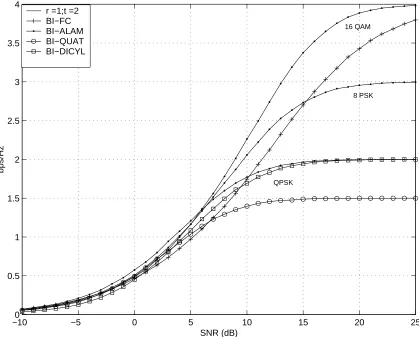
The ergodic cutoff rates of BI-FC with QPSK and 8PSK and BI-ALAM with
QPSK, 8PSK and 16QAM with t = 2, r = 1 is shown in Fig. 4.3. BI-ALAM has
larger cutoff rate than BI-FC over the entire capacity range. This performance gap
is even larger than that of ergodic capacity. Specifically, the BI-ALAM 16QAM
outperforms BI-FC QPSK 3 dB in terms of the ergodic capacity at 3 bps/Hz. This
advantage becomes 4 dB in terms of the ergodic cutoff rate at the same spectral
−100 −5 0 5 10 15 20 25 0.5
1 1.5 2 2.5 3 3.5 4
SNR (dB)
bps/Hz
r =1;t =2 BI−FC BI−ALAM BI−QUAT BI−DICYL
16 QAM
8 PSK
QPSK
Figure 4.3: Ergodic cut-off rates of BI-FC and BI-STC with various space-time block codes for t = 2, r= 1
However for two receive antennas, unlike the one receive antenna case, they
per-form comparably as illustrated in Fig. 4.4 .
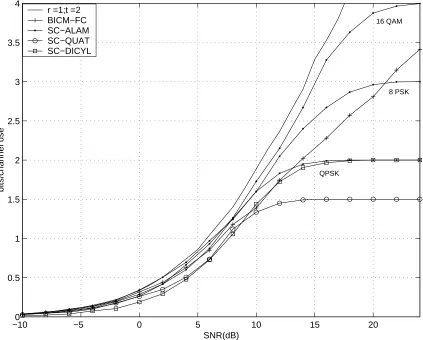
Under quasi-static fading conditions, the 90% outage capacity of BI-STC with
various inner codes X and QPSK BI-FC are plotted in Fig. 4.5 for t = 2, r = 1.
Also shown for reference, is the Gaussian-input capacity. For r = 1, we can see that
16QAM BI-ALAM outperform QPSK BI-FC for the entire range of rate considered,
especially at high rates. For example, the gap is about 5 dB at R= 3 bps/Hz.
−100 −5 0 5 10 15 20 25 0.5
1 1.5 2 2.5 3 3.5 4
SNR (dB)
bps/Hz
r =2;t =2 BI−FC BI−ALAM BI−QUAT BI−DICYL
16 QAM
8 PSK
QPSK
Figure 4.4: Ergodic cut-off rates of BI-FC and BI-STC with various space-time block codes for t = 2, r= 2
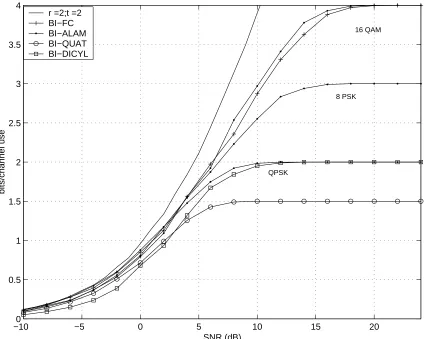
case, QAM BI-ALAM performs comparable with QPSK BI-FC below R= 2 bps/Hz,
but outperforms QPSK BI-FC by about 0.5 dB above R= 2 bps/Hz.
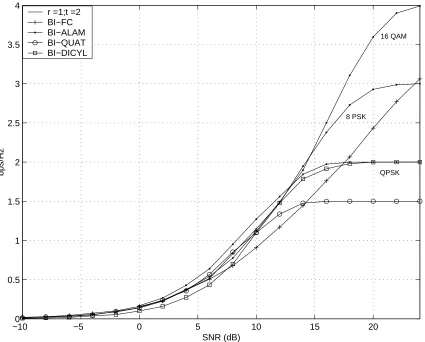
90% outage cutoff rates of QPSK BI-FC and BI-STC with various X are plotted
in Fig. 4.7 and Fig. 4.8 for t= 2, r = 1 andr = 2 respectively. A trend similar to the
−100 −5 0 5 10 15 20 0.5
1 1.5 2 2.5 3 3.5 4
SNR(dB)
bits/channel use
r =1;t =2 BICM−FC SC−ALAM SC−QUAT SC−DICYL
16 QAM
8 PSK
QPSK
Figure 4.5: 90% Outage capacities of BI-FC and BI-STC with various space-time block codes for t= 2, r = 1
4.2
BI-STC Vs. CM-FC
While BI-FC suffers capacity loss to CM-FC, as shown in [6], BI-STC achieves
almost the same capacity as CM-FC, for two transmit and one receive antennas. The
ergodic capacities of CM-FC with QPSK and BI-ALAM with various X are plotted
in Fig. 4.9. With two receive antennas, BI-ALAM suffers about 1dB loss at high
rate, which is shown in Fig. 4.10. This is because, Orthogonal Space-Time Block
−100 −5 0 5 10 15 20 0.5
1 1.5 2 2.5 3 3.5 4
SNR (dB)
bits/channel use
r =2;t =2 BI−FC BI−ALAM BI−QUAT BI−DICYL
16 QAM
8 PSK
QPSK
Figure 4.6: 90% Outage capacities of BI-FC and BI-STC with various space-time block codes for t= 2, r = 2
one receive antenna [14]. They suffer an inherent capacity loss for more than one
receive antenna.
4.3
BI-STC Vs. CM-STC
For a fast-fading scalar channel, the information-theoretic analysis done in [7]
shows that, BICM only suffers a fractional capacity loss compared to CM. However
−100 −5 0 5 10 15 20 0.5
1 1.5 2 2.5 3 3.5 4
SNR (dB)
bps/Hz
r =1;t =2 BI−FC BI−ALAM BI−QUAT BI−DICYL
16 QAM
8 PSK
QPSK
Figure 4.7: 90% Outage cut-off rates of BI-FC and BI-STC with various space-time block codes for t= 2, r = 2
This is because, for comparable complexity, BICM achieves much larger diversity
(Hamming distance of the underlying convolutional codes) than CM. Therefore BICM
generally provides a much better tradeoff between code diversity and complexity.
In the quasi-staic additive white Gaussian noise (AWGN) channel, performance is
primarily determined by Euclidean distance. Here the situation is reversed, and CM
performs better than BICM in terms of cutoff rate. For two transmit antennas,
CM-STC with the Alamouti code (denoted as CM-ALAM) and BI-ALAM are compared
−100 −5 0 5 10 15 20 0.5
1 1.5 2 2.5 3 3.5 4
SNR (dB)
bps/Hz
r =2; t =2 BI−FC BI−ALAM BI−QUAT BI−DICYL
16 QAM
8 PSK
QPSK
Figure 4.8: 90% Outage cut-off rates of BI-FC and BI-STC with various space-time block codes for t= 2, r = 2
BI-STC provides a better ergodic cutoff rate under fast-fading conditions. Under
quasi-static fading conditions, BI-STC and CM-STC have the same outage cutoff
rate with QPSK constellation, but CM-STC outperforms BI-STC with the 8PSK
−100 −5 0 5 10 15 20 25 0.5
1 1.5 2 2.5 3 3.5 4
SNR (dB)
Capacity (bits/channel use)
Capacity (w/Gaussian input) BI−Alamouti CM−FC QPSk 8PSK 16QAM
−100 −5 0 5 10 15 0.5
1 1.5 2 2.5 3 3.5 4
SNR (dB)
Capacity (bits/channel use)
Capacity (w/Gaussian input) Capacity of OSTBC BI−Alamouti CM−FC QPSk 8PSK 16QAM
0 5 10 15 20 0
0.5 1 1.5 2 2.5 3 3.5 4
SNR (dB)
cutoff rate (bits/channel use)
16QAM
8PSK
QPSK
Ergodic cutoff rate 10% outage cutoff rate BI−Alamouti CM−Alamouti
Chapter 5
Conclusions
In conclusion, the limits imposed by information theory on the performance of
bit-interleaved space-time coded modulation, that combines short space-time block
codes with bit-interleaved coded modulation have been considered. The ergodic,
outage capacities and cut-off rates of BI-STC with several possible inner block code
are compared. These BI-STC schemes use the suboptimal decoding metric described
in [10]. Fort= 2 transmit antennas and all ratesR≤3 bps/Hz, results show that
BI-STC can approach the ergodic capacity of the Rayleigh flat-fading channel within 1
dB forr = 1, and within 2 dB forr= 2 receive antennas. Thus, when the inner block
codes are chosen properly, these results suggest that the ergodic capacity of BI-STC
is often close to the information-theoretic limits of the multiple-antenna channel. A
similar conclusion can also be drawn for the outage capacity.
In practice, a more fair comparison is the channel cutoff rate for a finite coding
complexity. With receive antennas r ≤ 2, BI-STC can achieve a larger ergodic and
outage cutoff rate than BI-FC. Thus BI-STC can offer a better tradeoff between
Bibliography
[1] S. M. Alamouti, “A simple transmit diversity technique for wireless
communi-cations,” IEEE J. Sel. Areas Commun., vol. 16, no. 8, pp. 1451-1458, October 1998.
[2] S. M. Alamouti, V. Tarokh, and P. Poon, “Trellis-Coded Modulation and
Trans-mit Diversity: Design Criteria and Performance Evaluation,” in Proc. ICUPC, 1998,, pp. 703-707.
[3] S. Baro, G. Bauch, and A. Hansmann, “Improved codes for space-time
trellis-coded modulation,” IEEE Commun. Letters, vol. 4, pp. 20-22, Jan. 2000.
[4] G. Bauch, “Concatenation of space-time block codes and “turbo”-TCM,” in
Proc. ICC ’99, vol. 2, pp. 1202-1206, 1999.
[5] E. Biglieri, J. Prokis and S. Shamai (Shitz), “Fading channels:
information-theoretic and communications aspects,” IEEE Trans, Inform. Theory, vol. 44, no. 6, pp. 2619-2692, Oct. 1998.
[6] E. Biglieri, G. Taricco and E. Viterbo, “Bit-interleaved time-space codes for
fad-ing channels,”Proc. of Conf. Inform. Sciences and Systems (CISS’00), pp. WA4-1-6, March 2000.
[8] W. Firmanto, B. Vucetic and J. Yuan, “Space-time TCM with improved
perfor-mance on fast-fading channels,” to appear inIEEE Commun. Letters, 2001.
[9] G. J. Foschini, “Layered space-time architecture for wireless communication in
a fading environment when using multi-element antennas,” Bell Labs Tech. J., vol. 1, no. 2, pp. 41-59, Aug. 1996.
[10] Z. Hong and B. L. Hughes, “Robust Space-Time Trellis Codes Based on
Bit-Interleaved Coded Modulation,” CISS’01, 2001.
[11] B. L. Hughes, “Differential space-time modulation,”IEEE Trans. Inform. The-ory, vol. 46, no. 7, pp. 2567-2578, Nov. 2000.
[12] T. H. Liew, J. Pliquett, B. L. Yeap, L-L. Yang and L. Hanzo, “Concatenated
space time block codes and TCM, turbo TCM, convolutional as well as turbo
codes,” in Proc. IEEE Globecomm’00,vol. 3, pp. 1828-1833, 2000.
[13] Y. Liu, M. P. Fitz and O. Y. Takeshita, “Full rate space-time turbo codes,”
submitted to JSAC Turbo Codes, 2000.
[14] S. Sandhu, and A. Paulraj, “Space-time block codes: A capacity perspective,”
submitted to ICC ’01.
[15] S. Siwamogsatham and M. P. Fitz, “Robust space-time coding for correlated
Rayleigh fading channels,” inProc. 38th Annual Allerton Conf. on Communica-tion, Control, and Computing, October 2000, Monticello, Illinois, USA.
[16] A. Stefanov and T. M. Duman, “Turbo coded modulation for wireless
com-munications with antenna diversity,” in Proc. of IEEE VTC-Fall, (Amsterdam, Netherlands), pp. 1565-1569, Sept. 1999.
[17] V. Tarokh, A. Naguib, N. Seshadri and A. R. Calderbank, “Space-time codes
for high data rate wireless communication: Performance criterion and code
[18] V. Tarokh, H. Jafarkhani, and A. R. Calderbank, “Space-time block coding for
wireless communications: performance results,”IEEE J. Select. Areas Commun.
Vol. 17, pp. 451-460, Mar. 1999.
[19] V. Tarokh, H. Jafarkhani, and A. R. Calderbank, “Space-time block codes from
orthogonal designs,”IEEE Trans. Inform. Theory,vol. 45, no. 5, pp. 1456-1467, July 1999.
[20] I. E. Telatar, “Capacity of multi-antenna Gaussian channels,” European Trans. Telecomm., vol. 10, no. 6, pp. 585-595, November-December, 1999.
[21] H. Viswanathan, H. Huang and L. Mailaender, “A unified derivation and cutoff
rate analysis of transmit diversity,” Proc. IEEE VTC’00, vol. 2, pp. 869-873, Spring Tokyo, 2000.
[22] P. W. Wolniansky, G. J. Foschini, G. D. Golden and R. A. Valenzuela,
”V-BLAST: An architecture for realizing very high data rates over the rich-scattering
wireless channel,” Proc. ISSSE-98, pp. 295-300, Sept. 29, 1998.
[23] Q. Yan and R. S. Blum, “Optimum space-time convolutional codes for quasistatic
slow fading channels,” submitted to IEEE J. Sel. Areas Commun.,2000.