~.
A MODEL FOR SYRINGE GRADING BASED ON EXTRACTED FEATURES FROM HIGH DIMENSIONAL FRICTION DATA
by
Michael O'Connell, Douglas Nychka, Gerry Gray, David Martin and Perry Haaland
Mimeo 2256
Series M. Oconnel, D.
Nychka, G. Gray, D.
Martin
&
P. HaalandA Model for Syringe Grading Baaed on Extracted Features from High Dimensional Friction Data
Name DATE
Department of Statistics
Library
;
-A Model for Syringe Grading Based on Extracted
Features From High Dimensional Friction Data
By Michael O'Connell, Doug Nychka,
Gerry Gray, David Martin and Perry Haaland*
Abstract
In the biomedical products industry, measures of the quality of individual clinical specimens or manufacturing production units are often available in the form of high dimensional data such as continuous recordings obtained from an analytical instrument. These recordings are then examined by experts in the field who extract certain features and use these to classify individuals. To formalize and quantify this procedure an approach for extracting features from recordings based on nonparametric regression is described. These features are then used to build a classification model which incorporates the knowledge of the expert automatically.
The procedure is presented via an example involving the grading of syringes from associated friction profile data. Features of the syringe friction profiles used in the classification are extracted via smoothing splines and grades of the syringes are assigned by an expert tribologist. A nonlinear classification model is constructed to predict syringe grades based on the extracted features. The classification model makes it possible to grade syringes automatically without
expert inspection. Using leave one out cross-validation, the prediction accuracy of the classification model is found to be the same or better than the accuracy obtained from the expert.
KEY WORDS: Cross-validation; Quantile splines; Model selection.
1
INTRODUCTION
The classification of an individual production unit or clinical specimen based
on a recording from an analytical instrument presents a common problem in many
biomedical applications. Often, the instrument evaluating a material, sample or
system, yields a continuous set of measurements which are used in the classification.
Such continuous recordings must be reduced to a useful summary in order for an
appropriate diagnosis to be made. Often this is done subjectively by experts in
the field of application. In what follows a statistical approach to this problem is
presented. The approach provides a means to automate the instrument diagnosis by
building a classification model which incorporates the knowledge of the application
expert.
The approach is presented by way of an application involving the quality
as-sessment of hypodermic diabetic syringes. The syringes considered are made up
of a rubber stopped piston sliding within a plastic cylinder, aided by a lubricating
fluid. Syringe quality is indicated by ease of use and includes requirements of low
force and smooth movement in actuating the syringe, control of subsequent syringe
movement, and no leakage. Also it is important that the syringe retain its smooth
operation after a pause in use.
One way of evaluating the performance quality of a syringe is to measure the
amount of force necessary to produce constant acceleration of the plunger. This is
achieved using an Instron™ machine and results in a force/velocity curve which
we refer to as a friction profile. The friction profile consists of several hundred
some examples of friction profiles for three syringes of different qualities.
In general, profiles from better syringes plateau at a lower force and exhibit
little oscillation after the first peak. Although the testing procedure is not a
real-istic simulation of syringe use, these features in the profiles are able to predict the
smoothness of actuating a syringe after a pause in use. Furthermore, an engineer
familiar with the testing procedure, and the hydrodynamic principles that control
the frictional forces in this system plunger, can reliably convert a friction profile
into a absolute grade for the syringe. In the current application syringes are graded
on a soft ten point scale, with 1 being a poor syringe and 10 being the best. A
tribologist can convert the friction profiles of syringes to grades with an accuracy
of about
±
1 grade. The drawback to this type of procedure is that the grades areassigned subjectively based on a visual assessment. Thus the test is not generally
practical for quality improvement in a manufacturing setting and also may not even
be consistent among different graders.
The statistical problem is then to build a model, based on a diverse set of friction
profiles, that can be used to estimate the grade of a syringe. Besides providing a
rapid and objective method for grading syringes, such a model may suggest salient
features in the friction profiles missed by a visual assessment. The prediction of
syringe grades involves a combination of nonparametric curve fitting techniques and
nonlinear regression. For each syringe the friction profile is first summarized by
curve estimates describing the upper and lower boundaries. From these smooth
estimates of the envelope of the friction profile, a smaller subset of features relating
to the curves and their derivatives, are extracted. A classification regression model
is then built to predict the visual score from the extracted features. Cross-validation
is used to assess the predictive power of the model. For a diverse training sample
of 51 syringes we found that the statistical classification approach is expected to be
accurate to within
±
1 grade with 95% confidence.scien-tific format of: material and methods, results and discussion. Section 2 describes
the syringe data. Section 3 describes the feature extraction process based on
non-parametric regression. Section 4 describes the classification using regression models
and the estimates of predictive power based on cross-validation. Some conclusions
and discussion of alternative methods are given in Section 5.
2
THE FRICTION PROFILE DATA
2.1 Frictional forces in syringes
Lubricated friction can be divided into two regimes: boundary lubrication and
hy-drodynamic lubrication (Adamson, 1976). Boundary lubrication occurs at lower
speeds when the lubricating film is penetrated by some points of the sliding
sur-faces, causing a relatively high frictional force. As the speed is increased the system
makes a transition between boundary and hydrodynamic lubrication and this may
lead to a phenomenon known as "stick-slip" or "chatter". During this period the
sy-ringe system oscillates between the high and low frictional forces associated with the
boundary and hydrodynamic regimes. Hydrodynamic lubrication occurs at higher
speeds when the lubricant film is not penetrated by the sliding surfaces, and the
only resistance is the relatively low frictional force due to fluid shear. Thus in
the hydrodynamic regime, frictional force can be adjusted by varying the lubricant
viscosity.
Factors considered in the visual scoring procedure are listed in Table 1. For
example, force/velocity profiles which are flat, smooth, and less than about 300 g
score high. This is due to the absence of excessive boundary lubrication friction and
stick-slip oscillations (w
=
0 'v'v). Profiles that exhibit high forces in overcoming initial boundary friction changing to low force at high velocities (F = j(v», andfrequently accompanied by stick-slip oscillations (w
:f;
0), are scored low. We refer to the force required to overcome initial boundary friction loosely as "break-out"Three friction profiles are given in Figure 1. The associated grades cover the
range from best (10) to worst (1). Profile 1 (grade=l) has a high break-out force
of over 800 g and as the velocity is increased and the initial force is overcome, an
oscillatory area of stick-slip behavior can be seen. This region covers a broad range
of velocities, and operating a syringe in this range would result in lack of control
when dispensing small amounts of medicament. At high velocity the force drops
dramatically to a lower and steady level. All of the negative factors in Table 1 may
be observed in profile 1.
Profile 6 (grade=6) exhibits the characteristics of profile 1 but to much less an
extent. The break-out force is much lower than that observed for profile 1, but still
higher than the subsequent sustaining force by at least a factor of 2. Some stick-slip
oscillations are evident, though these are of lower magnitude and over a narrower
range of velocities than seen in profile 1. This profile is typical of some commercially
available syringes.
Profile 10 (grade=10) is an exceptionally well performing syringe. Initiation
of movement requires little force, with no stick-slip throughout the range. Also
the amount of force necessary to achieve constant acceleration is low and increases
gradually across the range of velocities after break-out. This syringe would be easy to
start and easy to control. Experience has shown that the low amplitude oscillations
seen in this curve are not perceptible by a syringe user. This profile exhibits all the
positive properties listed in Table 1.
2.2
Friction profile data for modeling
Initially friction profiles for three 1cc diabetic syringes were obtained and used to
develop the feature extraction process. These are the profiles given in Figure 1.
Subsequently, for the purpose of building the classification model, friction profiles
were obtained for an additional 51 syringes. These syringes were chosen to reflect the
Table 1: Factors influencing visual scoring
positive
F
<
3009F::j:.
I(v)
w = O,Vv
F = frictional force v= velocity of sliding
w = frequency of oscillations
negative
F> 5009 F =
I(v)
F(low v)
>>
F(high v)w::j:. O,some v
w::j:. 0, wide range ofv
in quality improvement applications. This range of syringe quality was achieved by
varying the lubricant and cross-linking conditions in production of the individual
syringes.
An Instron™ instrument was used to obtain the friction profiles. This
instru-ment is set up to hold the barrel of the syringe in place, and records the velocity of
the plunger, and the force required to maintain constant acceleration of the plunger,
as it is moved down the barrel of the syringe. The friction profile is constructed as
a plot of force versus velocity.
3
ESTIMATION OF FEATURES
We now describe the statistical methods that reduce the friction profile data to
a lower dimensional set of distinctive features that may be effective for grading. The
nonparametric curve estimates were developed by experimenting with the friction
qualitative features used to grade syringes. The functionals that were considered are
all derived from three nonparametric curve estimates. These are a mean function
f,
and two other curves!L
andfu
that estimate a smooth envelope for the themeasured force. The intent was that the mean function and
fu
would be used toestimate the break out force and the average amount of force needed after the break
out. The difference between the upper and lower curves was thought to be useful in
quantifying the stick-slip effect. These curve estimates are described below.
3.1 Spline estimates for the mean force curve
The curve estimates considered in this work areall variations on a cubic smoothing
spline where the smoothing is chosen adaptively from the data. For estimating the
mean function consider the nominal model:
where Yk is the force exerted when the plunger is at velocity Vk, f(v) is a smooth
(differentiable) function andekis a random component with mean zero and variance
proportional to l/wk. Under this model a cubic smoothing spline estimate of
f
is the function that minimizes:N
(liN)
I:
Wk(Yk - h(Vk))2+
AJ
(h"(v))2dvk=l [lIt,lIN)
over all h such that J(h"(v)?dv is finite and A
>
O. The spline estimate at aparticular point can be interpreted simply as weighted local average of{Yk} where
the weights depend on the independent variable, {Vk} and the smoothing parameter
A. Computing a cubic smoothing spline estimate is an efficient operation (O(N)).
Also, in between observation points, the estimate has the form of a cubic polynomial
and thus it is simple to evaluate the estimate or its derivatives at arbitrary points.
The choice ofthe smoothing parameter is important. As Abecomes very large the
extreme as >. - 0, the estimate is a function that interpolates the data. Intermediate
choices for >. strike a balance between fitting the data well and constraining the
resulting estimate to be a smooth curve. Often the smoothing parameter is chosen
subjectively by examining the data. However, since the interest in this study is
in providing an objective procedure for grading, a data-based method is used to
estimate>.. For fixed >. and
{Vk},
the spline estimate is a linear function of{Yd.
Iff>.
denotes the spline estimate then there is a "hat" matrix A(>.) such that (f>.
(VI)'
... , f>.(VN)f
= A(>')Y. With this notation the generalized cross-validation (GCV) function isV(>') = (1jN)[RSS(>')]
[1 - m(>')jN]2
where RSS(>.) is the residual sum of squares as a function of the smoothing pa-rameter and m(
>')
= trA(>')
is one measure for the effective number of parameters needed to describe the curve estimate. A suitable value for the smoothing parameteris taken as the value that minimizes V(>') over all >. in the range
[0,00].
For some background on splines and other smoothing methods see Eubank (1988) and Hastieand Tibshirani (1990, Chapter 3).
3.2 Smooth estimates of the upper and lower boundaries
Two methods for estimating the functional form of the lower and upper boundaries,
!L
andfu,
are developed. The first method, which we refer to as extremal splines,is based on estimating the upper boundary by smoothing subsets of the data that
are local maxima. The lower curve is found in a similar manner by considering local
minimum. The second strategy estimates the 5% and 95% conditional quantiles of
the friction profile data and is referred to as quantile splines.
To estimate an envelope that contains the limits of the force applied to the
syringe one can take advantage of the physical properties of these data. Although
the response for a poor syringe might be represented as an additive model, possibly
as the result of under-sampling a rapidly oscillating function. In these tests the
measurement error is actually negligible and the variation in the amount of force
is due to interactions among the rubber in the plunger, the silicon lubricant and
the barrel of the syringe. For this reason friction profiles such as those in Figure 1
can be interpreted as points from a continuous function where the sampling rate is
on the order of the higher frequency oscillations. Were it possible to measure the
force in smaller increments of the velocity, the trajectory would tend to trace out a
smooth but rapidly varying curve. From this perspective the envelope of the friction
profile should be related to the amplitude of these oscillations. Thus one method
for calculating such an envelope would be to find points that are local maxima and
minima, and then fit smooth curves through these points. A simple definition of
a local maximum (minimum) is a point which is larger (smaller) than each of its
two nearest neighbors. That is, based on the original velocityjforce pairs, form the
subsets:
{Vj,U,
¥i,u} :
the set of{Vk, Yk}whereYk-l, Yk+I<
Yk{Vj,L,
¥i,d :
the set of{Vk,Yk}where Yk-b Yk+I>
YkUpper and lower envelope curves are now estimated by fitting smoothing splines
to these sets of local minima and maxima. One advantage of this approach is that
the usual cross-validation function can be used to select smoothing parameters.
Figure 2 gives the estimated extremal spline for the friction profile of the grade 1
syringe. It is our experience that the extremal spline estimates were found to work
well in capturing one's visual impression of the features that affect a syringe's grade.
One problem with these estimates, however, is the bias in describing the sharp rise
in the friction profiles before breakout. This problem is due to the fact that no local
minima or maxima occur in this range of the data and thus the estimated envelope
is based on extrapolation from larger velocities.
As an alternative, quantile splines (Bloomfield and Steiger, 1983), were also
thus capture some form of smooth boundary. Let
{
a
lui
ifu~
0 Pa(u) =(l-a)lul ifu>O
For any vector Z it well known that theathquantile is a minimizer of
Ek=l
Pa(Zk-q) overall values ofq. Based on this characterization a quantile spline is taken as theminimizer of
N
(l/N)LPa(Yk-h(vk))+'x
J
(h"(v))2dvk=l [VI1V N]
over all h such that the roughness penalty is finite. Although a quantile spline
is a nonlinear function of the data, an approximate minimizer can be calculated
by a iterative procedure based on weighted least squares smoothing splines. Since
the least squares spline can be calculated rapidly, the computational burden for
determining a quantile spline is not large. (See the Appendix for details.)
An appropriate choice of smoothing parameter may vary as a function ofa and
for this reason it is important to estimate,X adaptively from the data. One strategy
for choosing ,X is an approximate form of leave-one-out cross-validation. Let
j!k]
"Ia
denote the quantile spline having omitted the kth data point, (Vk' Yk). Now suppose that jlk~, has been computed for each k then one might consider the quantile cross-validation criterion:
N
QGV('x)
=
(liN) L Pa(Yk -jl:~(
Vk))k=l
as a measure of the fit of the quantile spline to the data. For a particular a, an
estimate of'x is obtained as the smoothing parameter that minimizes QCV. Because
the quantile spline is a nonlinear function of the data it is computationally intensive
to determine QCV exactly. However, one can approximate
jlk~
with the result ofI
just one iteration of the weighted least squares algorithm using the estimate for the
full data as the initial value (see Appendix). This strategy may not be accurate
the sample sizes encountered in this application we found that approximate
cross-validation was stable and gave reasonable results.
Figure 2 also shows the 5% and 95% quantile spline estimates for the friction
profile data where A has been found by the approximate cross-validation procedure
mentioned above. Note that in contrast to the envelope splines these quantile
es-timates give a sharper characterization of the boundary in the initial part of the
curve. One reason for this difference is that the quantile estimates use the full data
while the extremal splines are restricted to a subset (either local maxima or
min-ima). Because the first part of the friction profile is monotonic, no points in this
range are used in deriving the extremal splines.
It was also found that the quantile estimates based on cross-validation tend to
smooth the data more than the extremal splines. This property resulted in more
stable estimates of the derivatives of the force/velocity curves. Section 4.1 and
Figure 6 discuss this issue further.
3.3
Extracting distinctive features from the friction profiles
Based on the visual features used to grade a syringe, we considered the following
functionals based on the mean and boundary curves. They are numbered in
accor-dance with later figures regarding model selection.
1 Effective number of parameters for
J,
where the smoothing parameter is chosenby cross-validation.
2 Maximum difference between
Ju
andh
3 Mean difference between
Ju
andJL .
4 Velocity at minimum second derivative of
Ju
5 Minimum second derivative of
Ju .
7 Velocity at first maximum of
Ju (
breakout point), VBP8 Force at first maximum of
Ju
,FBP .9 25th percentile of {
J'(
Vk)} for Vk ~ VBPA 50th percentile of {
J'(
Vk)} for Vk ~ VBPB 75th percentile of {
J'(
Vk)} for Vk ~ VBPThe first functional is an overall measure of the complexity of the estimated
mean function. The next two functionals are measures of the difference between the
upper and lower curves and are intended to quantify the stick-slip effect. There are
two strategies to identify the breakout point. One is to find the point of maximum
curvature in the upper envelope (4-6) and the other is to identify the first local
maximum in the test (7 and 8). The last three measures attempt to summarize the
smoothness of the profile after the breakpoint and the trend of the profile. Recall
that a syringe with a high grade tends to have a smooth but slightly increasing force
trajectory after the breakout point. Smoothness in this region may be characterized
by the scatter in the first derivative of the mean curve while a gradual trend in the
profile is indicated by a positive median first derivative.
4
CLASSIFICATION OF SYRINGES FROM A
TRAINING SAMPLE
4.1 Selecting a subset of features
For each of the 51 syringes tested mean, upper and lower boundary curves were
estimated using extremal and quantile splines. Based on these curves the 11
sum-mary functionals were computed. The first step was to identify a subset of the
classification models of the form
(1)
where Zk is the grade of the kth syringe as assigned by the tribologist; X~,l is the kth row of XT which corresponds to the extracted features of the kth syringe;
f3
is the vector of coefficients corresponding to the features and ek is a random error
term. Since the main interest is in the predictive power of these summary measures,
Mallow's Cp statistic was used to identify a subset of the functionals. Figure 3
includes a plot of the Cp statistics for the different subsets of features based on
extremal splines. This model selection criterion indicates that a linear model based
on 8 features is the best choice for the extremal splines approach. Itis interesting to
note that the best three variable model includes the basic visual aspects of grading:
the stick-slip effect noticed for poor syringes (3), the break out force as indicated
by the force at the minimum second derivative of
Ju
(6), and the general trend inthe friction profile after breakout (A).
Besides using Mallow's criterion, generalized cross validation (GCV) was also
considered. For linear regression the GCV function for a subset of size pis V(p)
=
(1/n)RSS(p)/(1-p/n)2. Under the assumption that pinis small and
RSS(p)/(n-p) is approximately equal to &2 based on the full set of variables, V(p) is similar to
&2Cp. However when pin is large GCV is more conservative and penalizes larger
models more heavily. For this reason the GCV criterion was also considered for
subset selection. Figure 3 also includes a plot of the GCV statistics for the different
subsets of features based on extremal splines.
For features derived from the extremal splines the GCV and Cp criteria (Figure
3) indicate a local minima(GCV == .5) at 5 features. The additional two features are:
the effective number of parameters for
J
(1), and the minimum second derivative ofJu
itself (5). In the interest of parsimony this was the subset offeatures considered in subsequent analysis. Itshould be noted that the GCV criterion is a nearly unbiasedsubset to grade syringes has a prediction standard deviation of approximately 0.7.
Thus the linear model using these five features can identify the syringe grade to
within ±1.4 with about 95% confidence.
The best subset of features based on quantile splines has four members namely
3, 8, A and B as indicated in Figure 4. This model has a slightly higher prediction
error compared to the extremal spline model discussed above.
The two linear classification models showed a substantial difference in predicting
the grades of two grade 3 syringes (Figure 5). The grade for these two cases was
predicted well by the extremal features and not well by the quantile features. Figure
6 shows the friction profile for one of these syringes and the estimated envelopes
for the two methods. The results are counter to what one would expect in that
although the quantile spline doesn't estimate the grade as well, it does appear
to estimate the features more accurately than the extremal spline. The extremal
spline undersmooths the set of local maxima to give a poor estimate of the upper
boundary. The rough upper boundary estimate translates into an unstable estimate
of the breakout force based on the second derivative. This breakout force estimate
of PBP ==
j(
v= 0.05) == 1.25, is substantially lower than what one would estimate from just a visual inspection ofthe force/velocity curve(PBP == 1.6). In contrast thequantile spline yields a smooth estimate of the upper boundary and appears to give
an accurate estimate of the break out force for this syringe. Given the discrepancy
between these two estimates of the envelope it is not surprising that the predicted
grades differ. However, it is unusual that the poorer extremal curve estimate does
better. One simple explanation is that the syringe was incorrectly graded by the
expert and more will be said about this in the discussion.
4.2
Nonlinear modifications of the model
For all of the linear models based on subset selection, the residuals indicated some
quan-tile spline model (Figure 7) and the best five feature subset extremal spline model
(Figure 8) suggest that agreement with the actual grades can be improved if the
estimated grades are transformed. Because the grades are qualitative there is no
reason to assume the unit differences among grades correspond to equal spacing in
the curve features. We therefore consider the nonlinear model
(2)
where Zk is the grade and (Xkb ... , Xkp) are the functionals estimated from the kth
friction profile and H is a smooth transformation. A direct way for estimating H is
to fit a smooth curve to the pairs (Zk, Zk) where Zk are the predicted values based
on fitting a linear model. Figures 7 and 8 summarize the results of estimating H in
this way using a smoothing spline. Note one adjustment made by the transformation
for both the quantile and extremal spline models is to discount predicted grades in
the range of 4 to 6. The residuals for the transformed models (Figure 9) appear to
have less dependence on the predicted values than the untransformed linear model
residuals (Figures 7 and 8) but there is still some bias in estimating very high grades.
After estimating the transformation the parameter vector f3 was re-estimated using nonlinear least squares, with the transformation considered fixed. From a practical
point of view this refinement of the parameter estimates gave little improvement.
Several other models were also considered. Given the large range for some of
the features, such as the average difference in the upper and lower envelopes, it is
unlikely that a linear model for the features is optimal even when the results are
sharpened by a nonlinear transformation. In order to explore some alternatives we
tried an additive model based on the best subsets indicated by the GCV criterion.
Additive models of the form:
P
Zk = "L!i(Xk,j)
+
ekj=1
were found to have the same bias in the residuals observed in the linear models
dependent variable rather than the prediction equation:
This model can be estimated using the same alternating strategy for determining
an ACE model (Friedman and Breiman 1985). Surprisingly this model did not
adequately adjust for the nonlinear effect in predicting the intermediate grades and
gave a similar residual pattern to the simple linear model.
An extension of this ACE-type model is
p
h(Zk)=
L
!i(Xk,j)+
ek·j=l
This model combines both the nonparametric flexibility of how features enter the
model along with the chance to consider transformations of the grades. We did not
fit this model due to the small size of the training sample.
4.3 Estimating prediction error
The final aspect of our analysis of the training sample was to assess the prediction
error from the nonlinear model that incorporates a transformation (model (1)).
Since the number of data points is small (51) the prediction error was estimated
by cross-validation. Each syringe was sequentially omitted from the data set and
model (11) was fit to the remaining data. The estimated model was then applied
to the omitted point to predict the syringe grade. Let ilk] denote this prediction.
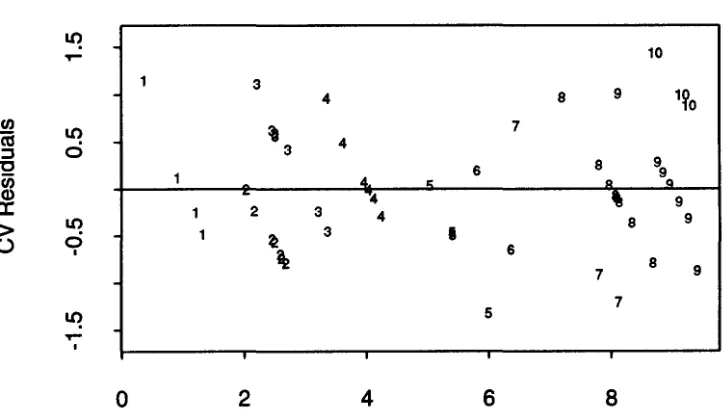
Note that Zk is independent of ilk] and the mean square of the cross-validation
residuals is an estimate of the mean square prediction error. Also the CV residuals
themselves are useful for model checking. For this training sample of 51 syringes, the
mean prediction error was estimated to be (0.638? based on extremal spline features
and (0.642)2 based on quantile splines on the transformed scale. Not surprisingly
these results are an improvement over assigning grades based on linear models.
the transformation of the linear grade reduces the bias for predicting intermediate
grades (compare with Figures 7 and 8). One systematic pattern in these plots is
that the model does not do an adequate job in distinguishing between syringes of
grades 9 and 10.
5
DISCUSSION
The results from modeling the training sample of friction profiles indicate that
syringes can be classified with a average accuracy of approximately ±1 grade with
95% confidence. Since visual evaluation by a trained engineer is only expected to
be this accurate we believe that this prediction makes a significant contribution to
the automatic grading of syringes.
Our strategy for predicting syringe grades combined four basic methods:
non-parametric regression techniques to extract distinctive features of the friction
pro-files, variable selection for identifying a parsimonious subset of features, nonlinear
regression to estimate a predictive classification model and finally leave-one-out
cross-validation of this model to estimate the average prediction error. Although
some of the details in this are necessarily specific to the friction profile
measure-ments we believe that this work may serve as a blueprint for other studies that
involve predicting semi-qualitative properties from continuous recordings produced
by an instrument. Perhaps the most difficult part in this process is identifying
po-tential features of the instrument recording that may be useful for prediction. In
the syringe application these features could be motivated in part by the physical
system.
Despite a low average prediction error there are several minor problems with the
final prediction models. Based on the features extracted from the friction profiles
it does not seem possible to distinguish among syringes with grades 9 or 10. We
choose not to refine the model because from a practical point of view the differences
residuals observed for the two syringes of grade 3 when the features are based on
quantile splines. Besides affecting the prediction error these two also influence the
smoothness of transformation estimate, H. Examining Figure 7 one may note the
II
dips slightly in the range [2,4] in an attempt to compensate for these two points.We decided to leave these data in the model so that estimates of the prediction error
would be conservative.
REFERENCES
Adamson, A. W. (1976), Physical Chemistry of Surfaces, New York: John Wiley. Bloomfield, P., and Steiger, W. (1983), Least absolute deviations: theory,
applica-tions and algorithms, Boston: Birkhauser.
Brieman, 1., and Friedman, J. H. (1985), "Estimating optimal transformations for
multiple regression and correlation" (with comments), Journal of the American Statistical Association 80, 580-619.
Eubank, R. (1988), Smoothing Splines and Nonparametric Regression. New York: Marcel Dekker.
Hastie, T. J., and Tibshirani, R.
J.
(1990), Generalized Additive Models. New York: Chapman and Hall.Reinsch, C. (1967), "Smoothing by spline functions". Numer. Math. 10, 177-83.
APPENDIX: QUANTILE SPLINES
This appendix describes the iterative technique for computing a quantile spline
and also defines the approximate cross-validation function associated with this
5.1
Background for the Computational Algorithm
It is first necessary to present an alternative characterization of a cubic smoothing
spline. Throughout this discussion we will assume that at least three of the
ob-servation points, Vk , are unique. From basic theory for splines one can show that
the function that minimizes the spline objective function must be a piecewise cubic
polynomial with join points (knots) at Vk , 1 :$ k :$ N and 'natural' boundary
con-ditions. Based on this form, it is enough to know the value of the spline at the knot
points. The rest of the values in between knots can be inferred from the piecewise
cubic form. Thus, an alternative version of the usual spline minimization problem
is
N
minhE~n(1/N)2:(Yk - hk)2Wk
+
>'htRh (A)k=l
wherehk
=
h(tk)and Ris anNx
N matrix that can be derived from the roughnesspenalty and the cubic spline basis. (For this discussion, it is not necessary to give
an explicit formula for R.)
The solution to (A) is equivalent to solving the linear system:
2(Yj - hj)wj
+
>'(Rh)j=
0 (B)for 1 :$ j :$ N. This solution can be found very efficiently by taking advantage of
the banded structure of the matrix R. The best known algorithm is that of Reinsch
(1967).
The strategy for computing a (approximate) quantile spline estimate is based on
an iterative procedure where each step involves the solution to a system of equations
like those in (B). Inorder to carry this out, however, it is necessary to make a slight modification toPOI so that it is differentiable at zero. The intuitive idea is round out
the corner ofPOI at zero by piecing in a quadratic function. Accordingly let
1
POI for
I
uI>
€POI(U)
=
au2/€
forO:$u:$€When a = .5, POi,f is the Huber weight function used in robust regression. The
important difference is that in our calculations € is chosen to be effectively zero
relative to the magnitude of the data values. In robust regression, €is usually of the
same order as the residuals.
Ifthis approximation is applied to the minimization functional below, one can
characterize the solution in a similar manner to the weighted least squares spline in
(A).
ConsiderN
(lIN)I:POi,f(Yk - h(Vk))
+
AJ
(h"(V))2dvk=l [Vt,VNl
(3)
Representing the solution in terms of the value of the function at the observation
points, a necessary condition for achieving the minimum value of(3) is
'l/JOi,lYj - hj)
+
A(Rh)j = 0 1~ j ~ n (C)where 'l/JOi,f = P~,f • Moreover, with at least three unique knots it is known that
a unique minimum of(3) will always exist. This result implies that (C) provides
a sufficient set of conditions for the solution. Note that (C) is a nonlinear set of
equations but has a similar form to those associated with the weighted least squares
spline.
Let hO denote an initial starting value for the solution to (C). Rewrite the system as
2(Yi -
h ) ['l/JOi'f(Yk - hk)]+
A(Rh) =0
(D)
k k 2(Yk _ hk) k
and now substitute the intial estimate for the occurrences ofhk in the bracketed
term. With this substitution one obtains a linear system of equations in h.
Identify-ingWk with ['l/JOi,f(Yk - h~)/2(Yk - h~)] one can solve this approximate system using
the standard algorithm for weighted least squares smoothing splines. In general if
system where the weights are based on hJ. Note by construction of the weighting function, at convergence hOO will solve (C).
In our computations the quantile splines were estimated for a grid of smoothing
parameters and the estimates were computed in descending order with respect to )..
An ordinary least squares spline was used as the starting value for computing the
estimate with the largest value of the smoothing parameter. Computations at other
values of ). use the previous quantile estimate as a starting value. Since the
quan-tile spline is a continuous function of the smoothing parameter, using the previous
estimate can significantly reduce the number of iterations needed for convergence.
5.2
Approximate Cross-validation
The approximate cross-validation for quantile splines is based on the approximation
of the estimate
it
by a particular weighted least squares smoothing spline. Forweighted least squares splines there is a simple formula for leave-one-out
cross-validation of the estimate. Let
il
kl denote the least squares spline estimate in (A)but having omitted the kth data point, Yk. It can be shown (Craven and Wahba 1979) that
YI _fA[kl(v)= Yk-i>.·(Vk)
k >. k 1 - Akk().*)
where Ais the "hat" matrix discussed in Section 3.1 and i>.. is the spline estimate
based on the full data with smoothing parameter ).*= n~1 ). .
Unfortunately since the quantile spline estimate is a nonlinear function of Y,
it does not reduce to such a simple form. However, recall that at convergence of
the iterative algorithm the quantile spline is the solution to an associated weighted
least squares spline problem. IfAw ()') is the associated 'hat' matrix for the quantile
estimate at convergence, then one could consider the approximate leave-one-out
This form has an attractive interpretation in terms of the computational
algo-rithm. Using the quantile spline for the full data as the starting vector, the
approxi-mation is the result of doing just one iteration of the algorithm on the reduced data
set. This is a reasonable approximation if the quantile estimate for the full data set
is not particularly sensitive to the omitted data point. With good starting values
it is our experience that the convergence of the iteratively reweighted least squares
procedure is rapid. Thus a single iteration should be adequate in terms of
approxi-mating the leave-one-out estimate for the purpose of constructing the comparative
statistic
N
QGV(A) = (liN)EPa(Yk -
jl:~(vk)).
FIGURE LEGENDS
Figure 1. Examples of friction profiles. Friction profiles for grade 1, grade 6 and
grade 10 syringes. Force is force required to maintain constant acceleration and is
plotted against measured velocity.
Figure 2. Extremal and quantile spline fits to a grade 1 friction profile, (a) extremal
splines, (b) 5% and 95% quantile splines. Upper and lower envelopes are estimated
using extremal and quantile splines.
Figure 3. Linear classification model selection: features from extremal splines, (a)
model selection based on GCV and (b) on Cp statistics. For each number of features
in the model the combination with the lowest value of the model selection statistics
is labeled with the appropriate feature labels (see text). Labels are centered at the
number of features. Other combinations are denoted with a
+
symbol.Figure 4. Linear classification model selection: features from quantile splines, (a)
model selection based on GCV and (b) on Cp statistics. For each number offeatures
in the model the combination with the lowest value of the model selection statistics
is labeled with the feature numbers (see text). Labels are centered at the number
of features. Other combinations are denoted with a
+
symbol.Figure 5. Residual plots for linear models, (a) residuals from both models, (b)
resid-ual difference. Residresid-uals from linear models based on extremal spline features are
plotted against those from linear models based on quantile spline features. Note the
two grade 3 syringes that were predicted differently by the two models.
Figure 6. Comparison of extremal and quantile spline estimates of a grade 3 syringe,
second derivatives for the upper boundary estimates. Break-out forces based on the
two estimated second derivatives are marked. Note the smooth estimated second
derivative based on the quantile spline and the resulting accurate estimate of the
break-out force.
Figure 7. Non-linear classification model construction: features from extremal
splines, (a) residual plot for the linear model, (b) spline estimate of the
trans-formation. The spline estimate of the transformation is obtained from a spline fit
to the pairs (Zk, Zk), where Zk are the predicted grades based on the 5 term linear model of features obtained from extremal spline fits to the friction profiles.
Figure 8. Non-linear classification model construction: features from quantile
splines, (a) residual plot for the linear model, (b) spline estimate of the
trans-formation. The spline estimate of the transformation is obtained from a spline fit
to the pairs (Zk, Zk), where Zk are the predicted grades based on the 4 term linear model of features obtained from quantile spline fits to the friction profiles.
Figure 9. Residual plots for non-linear models, (a) extremal spline model, (b)
quan-tile spline model. Note the better overall fit, and in particular the better fit between
grades 4 and 8, of these spline transformed models as compared to the residual plots
given in Figures 7 and 8.
Figure 10. Cross-validated residual plots for non-linear models, (a) extremal spline
Figure 1. Examples of friction profiles
•
·
..
• ••
...
....
..
..
•
• # ••..
•
..
.. ..
..
..
.
..
•
..
ex>o
<0o
• •
•
..
•
..
.. ..
..
•
..
•
...
•
•
..
...
.
•
•
•
..
•
•
..
.
•
•
•
• •
•
+ .+•
•
grade=1•
••• + + +++...
#• • • •..
~ + .+.+.
+ to. .~.+ .+ + +++ ~ +..+ ++ + ++.... •...
." ..." . ,... •t.,\~
".to¥....~ ~
•
•
•
..
•
•
•
..
•
•
•
+ : + + + + + • • • ++ + ...•
•
..
+..
+•
•
•
..
•
•
..
Q) ~o
u..
•
C\Io
o
o
Y~'t&\,
!
~rade=6
.
.
.,-:....
~~
...
_/-/I
grade=10~:.
. . . . ._-D D D D
:
.I DFigure 2. Extremal and quantile spline fits to a grade 1 friction profile
Extremal splines
ex>
o
o
o
o
100
200
Velocity
300
Q)
~
o
U-ex>
o
o
o
50;0
and
950;0
quantile splines
Figure 3. Linear classification model selection:
features from extremal splines
GCV
statistics
...
0 t: Q) c: 0 a>*
'';:: 0 6 Co)+
:a
~ +=
a. r--. 36
Q) c::i + C) +
f
~ + + Q) 36A +$
+*
:j:
!
+123456789AB> 346A
ctI + ~ + 123451S789A
"0 L() 1356A 1 6At34567A 12345678A
Q) c::i 1345678A
CiS E -.;::; '=t (/J c::i
w
1
3
5
7 9 11Number of variables
Cp
statistics
+ 0 6t
L() ~$
+Co) _/+ +
'';::
36A
=
(/J
~ 0 346A
-
(/J...
a. () L()
...
+ :j: + + + +; • + + :
~123456789AB
+ _± + + 123451S789A
1356A 134S6'i34567A 12345678A 1345678A
Figure 4. Linear classification model selection:
features from quantile splines
GCV
statistics
l -e l I -Q) c::: e +:: ent
(,) ci 8:c
+e
+ +C. +12345678SAB
Q)
18 ~ 1345et8SAB
~
I""- + 1345;aSABci +
38!B 38JAB
134~SAB
Q)
-
Ii
134!9AB
~ 38A 34 AB
"0 <0 Q) ci
c;
E '';:: IJ') CIJ ci w1
3
5 7 9 11Number of variables
Cp
statistics~ 0 c::i IJ') 8 $ +:I: + +
(,) :ta
*
+*./
$~123456789AB
+ + .1345 89AB
+:: + + 1345 SAB
CIJ + +
.~ 0 + 13488SAB
+
+ 134119AB
-
CIJ Lri ;+
34~AB
C. ; :j:
c.:> 38A :j: 38SAB 38AB IJ') ci
Figure 5. Residual plots for linear models
Residuals from both models
Q)
"0
o
E
Q)
05 Q.
(/)
~
; ;
c
aj
:J C"
E
e
-...
10
o
10
o
ILq
...
I
-1.0
-0.5
0.0
0.5
1.0
1.5
-
C"I
Q)
-
(/)(ij
:J
"0
Ow
~.5
Q)
o c
~
~
C
...
Residuals from extremal spline model
Figure 6. Comparison of extremal and quantile spline estimates of a grade 3 syringe
Envelope based on extremal splines
U!
..
"":
..
C\!
..
CD
e
If
..
C!co
0
U!
0
0.0 0.02 0.04 0.06
Veloclly
0.08 0.10 0.12
Envelope based on 5% and 95% quantile splines
U!
..
"":
..
C\!
..
CD e
If C!
..
co
0
U) 0
0.0 0.02 0.04 0.06
Velocity
0.08 0.10 0.12
Estimated second derviative for the upper boundary
Figure 7. Non-linear classification model construction:
features from extremal splines
Residual plot for linear model
LO 10
T"" 10
9
3
4 9
LO 3 4 9 10
en ci 2 9
cti
•
7'aft
~ 1. 3 9
"'C
"(ij
.
..
Q)
LO
\
3 8a:
ci 3 4 55 6 8 9
I 5
"
4
6 9
LO 5
T""
I
2 4
6
8 10Predicted Grades
Spline estimate of transformation
o
T""
C\I
Figure 8. Non-linear classification model construction:
features from quantile splines
•
Residual plot for linear model
LO 10
~
3 9 1?0
2
,
4 8 9en ~ 9
as
0 4 8 9:::J 11 2 3
.,
\. 9"'C
88
0iij
~ 9
Q)
LO 2
a:
ci 2 3 8 94
I 3 5
6
,
7~ 6 7
~ 5
~
I
2 4 6 8
Predicted Grades
Spline estimate of transformation
o ~
Figure 9. Residual plots for non-linear models
•
Extremal spline model
LO
...
3 4
LO 3 4
C/) ci 2
44
as
::3 3 5
" A
'0
"0 1 1 2 .. 4 5
CD LO 2'2:1 34
a:
ci 1 2 2 3I 5 6 7 LO
...
I 9 10 10 7 9 10 9 88 9 "..
8 9 8 8 8 99 782 4 6 8
Predicted values from non-linear model
Quantile spline model
LO
...
10
4 9
3 8 1'\9
LO ~ 4 7
C/) ci
ca
3 8 9::3 2 4 44 5 9
'0
..
"0 1 4
'"
5 6 81:1 "CD 3 8 99
LO 1 2
a:
ci 22 3 5 8 9I 2 I 6
7 8
7
LO
...
I
Figure 10: Cross-validated residual plots for non-linear models
•
Extremal spline model
T
LO
,...
1Rl9
3 3 7
f/) 4 10
as
It? 2 4 9:::J 0
4l 9
"C
•
9"Ci:i 3 ~ ~ A
Q) 1
"
5u,
a:
\
3 4LO 1 5
>
0 ~ 3 8 9U I 4 8
3
6 77 8 9
LO 5
,...
I
2
4
6 8Predicted values from non-linear model
Quantile spline model
It? 10
,...
3 9 1?0 4 8 f/)LO
,
7as
4:::J 0 3
"C 6 8 9
"Ci:i 4. "
..
9"Q) 4
,
9
a:
1 2 3 4 9>
LO3
•
80 1 ~
A
U I 6
\
8 9 7 7 It? 5,...
I