ABSTRACT
LIU, HUIQING. Analysis and modeling of wave-current interaction. (Under the direction of Dr. Lian Xie).
Analysis and modeling of wave-current interaction
By
Huiqing Liu
A dissertation submitted to the Graduate Faculty of North Carolina State University
In partial fulfillment of the Requirements for the degree of
Doctor of Philosophy
Marine, Earth and Atmospheric Sciences
Raleigh, NC 2006 Approved by:
Dr. Leonard J. Pietrafesa Dr. John M. Morrison
Dr. Gerald S. Janowitz Dr. Lian Xie
DEDICATION
To my wife, Yao Liu. Without her love, encouragement and support, I couldn’t have
BIOGRAPHY
Huiqing Liu was born on the 11th of May, 1976, in AnQiu a city of Shandong province. In 1995, he was enrolled to Ocean University of Qingdao (now called Ocean University of
China), where he spent seven years in the Department of Oceanography and graduated with a
BS degree in 1999 and a MS degree in 2002. He joined the Department of Marine, Earth and
Atmospheric Sciences of North Carolina State University in fall 2002 as a graduate student
ACKNOWLEDGMENTS
I got much help from many great people during this work. Here, I wish to acknowledge
these great people, without their help, this dissertation would not have been possible. First, I
wish to express my extreme gratefulness to my advisor Dr. Lian Xie, whose knowledge,
guidance and kindness gave me much help throughout my time at NCSU. His encouragement
and patience led me step-by-step to complete this work. I also acknowledge the other
committee members: Dr. Pietrafesa, Dr. Morrison and Dr. Janowitz for their assistance and
comments to this study.
I also would like to thank my friends in the Coastal Fluid Dynamics Laboratory: Dr.
Machuan Peng, Dr. Shaowu Bao, Dr. Shiqiu Peng, Dr. Tingzhuang Yan, Dr. Xiaoming Liu,
Dr. Binyu Wang, Dr. Kristen Foley, Xuejin zhang, Meng, Xia and Yanyun Liu for their help
and suggestions in this study. Many thanks are also given to Bob Bright, Joshua Palmer,
Mike Lin and Sondra Artis for their help in my English pronunciation and writing skills.
I would also like to say thank you to my parents, Xinai Zhang and Junming Liu, and my
brothers, Huidong Liu and Huisheng Liu, for your tremendous love and financial support
throughout my life.
This study is supported by the Carolina Coastal Ocean Observation and Prediction
System (Caro-Coops) project under NOAA Grant No. NA16RP2543 via the National Ocean
Service, through Charleston Coastal Services Center. Caro-COOPS is a partnership between
TABLE OF CONTENTS
List of Tables … … … ix
List of Figures … … … .x
1. INTRODUCTION 1.1 Scientific Background … …… … … ...1
1.2 Purposes of the Study … … … …..4
1.3 Organization of Dissertation … … … …… …… … …… … … ……… 6
2. INVESTIGATION OF DEPTH-INDUCED REFRACTION-DIFFRACTION, WAVE BREAKING AND NESTING IMPACTS ON WAVES USING SWAN 2.1 Introduction … … … ....7
2.2 Models description … … … …. … … … ..10
2.2.1 SWAN… … … …….10
2.2.2 WAVEWATCH… …… … …… … … …..11
2.2.3 Holland hurricane model… …… … …… … … ...12
2.3 Experiments and model setup … …… … …… … … ...12
2.4 Results … …… … …… … … …… …… … …… … … …… … ...13
2.4.1 The effect of depth-induced refraction-diffraction on waves … … … …… … ...13
2.4.2 The effect of depth-induced wave breaking on waves…… … … …… … ...15
2.4.3 The effect of spatial resolution on waves...… …… … …… … … …… … 18
3. A NUMERICAL STUDY ON THE EFFECT OF THE GULF STREAM ON WAVES
3.1 Introduction …… … …… … … …… …… … …… … … …… … 42
3.2 Setups of wave model and experiments … … …… …… … …… … … …… … 44
3.3 Results … …… … …… … … …… …… … …… … … …… … ...45
3.3.1 Case NEW… …… … … …… …… … …… … … …… … ...45
3.3.2 Case NES… …… … … …… …… … …… … … …… … ... 47
3.3.3 Case SEW… …… … … …… …… … …… … … …… … ...48
3.3.4 Case SES… …… … … …… …… … …… … … …… … .... 49
3.3.5 Case EW… …… … … …… …… … …… … … …… …... 50
3.3.6 Case ES… …… … … …… …… … …… … … …… … ... 50
3.4 Hurricane Bonnie Example … … … …… …… … …… … … …… … ....51
3.5 Results … … …… … … …… …… … …… … … …… …... 52
3.6 Summary … … …… … … …… …… … …… … … …… … ... 54
References … …… … …… … … …… …… … …… … … …… … ...69
4. SENSITIVITY OF NEAR-SHORE WIND WAVES TO HURRICANE WIND ASYMMETRY AND TRANSLATION SPEED 4.1 Introduction …… … …… … … …… …… … …… … … …… … 73
4.2 Model Description… …… … … …… …… … …… … … …… …75
4.2.1 The SWAN Wave Model…… … … … …… …… … …… … … …… … 75
4.2.2 Hurricane Models....… … … …… …… … …… … … …… ….. 76
4.4 Results and explanations… … … …… …… … …… … … ……… 79
4.4.1 The effect of hurricane translation speed on waves...… …… … … ……… 79
4.4.2 The effect of hurricane intensity of waves...… …… … …… … … ……… 82
4.4.3 The effect of the combining hurricane intensity and translation speed on waves…83 4.4.4 The effect of the hurricane wind field structure on the waves…… … … ……….. 84
4.4.5 The effect of background wind field on waves.… …… … …… … … 86
4.5 Discussion and conclusions.… … … …… …… … …… … … ….… ………87
References … …… … …… … … …… …… … …… … … …… …..104
5. THE EFFECT OF WAVE-CURRENT INTERACTIONS ON THE STORM SURGE AND INUNDATION IN CHARLESTON HARBOR DURING HURRICANE HUGO 1989 5.1 Introduction…… … …… … … …… …… … …… … … ……...108
5.2 Coupled wave-current system … … … …… …… … …… … … ………111
5.2.1 Model Description...… … … …… …… … …… … … …… …111
5.2.2 The coupling procedure… … … …… …… … …… … … …… …113
5.3 Model settings and experiments … … … … …… …… … …… … … …… …114
5.3.1 Model domain and nesting windows……… …… … …… … … …… … 114
5.3.2 Experiments...… …… … … …… …… … …… … … …… 115
5.4 Results of experiments …… … … …… …… … …… … … …… 116
5.4.1 The impact of wave-current interaction on storm surge……… … … ……116
5.4.2 The impact of wave-current interaction on inundation…... …… … … …. 117
References … …… … …… … … …… …… … …… … … …… …..138
6. FINAL REMARKS
6.1 Parameterization of drag coefficient and roughness … … … …...142
6.2 The effect of wave-current on waves (e.g. the effect of storm surge on waves)……….142
6.3 Turbulence closure … … … ………...143
6.4 Coupling with atmospheric model … … … ….…...143
LIST OF TABLES
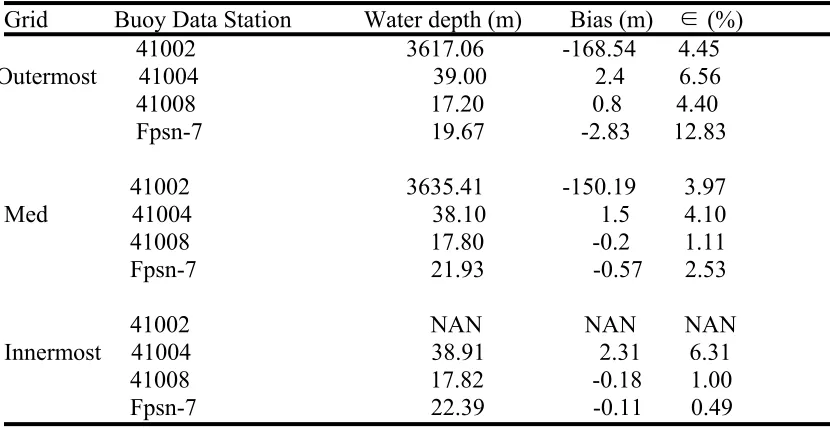
Table 2.1 The water depth of buoy data stations get from different resolution topography.
Where Bias equal water depth get from topography minus actual water depth; ∈=
Bias/actual water depth..………..… … … …… ………..22
Table 3.1 List of experiments carried out in the study………...56
Table 4.1 List of experiments.………...……….89
Table 5.1 List of experiments.………...123
Table 5.2 Difference of flooding areas (total) among experiments.………124
LIST OF FIGURES
Figure 2.1 Computational domain, distribution of Buoy data stations and the best tracks of
hurricane Bonnie, Dennis and Floyd… … … …… …… … …… …… 23
Figure 2.2.1 a) The mean wave direction along the center line from deep water to coastal
line. The asterisk is the analytical solution and lines are results of SWAN.
Dashed line is swell wave with peak wave direction 450 and solid line is swell wave with peak wave direction 150. b) Water depth (m) along the center line..24 Figure 2.2.2 a) The mean wave direction and b) significant wave height along the center line
from deep water to coastal line. Solid line is the result of swell wave propagates
on the beach without any channels; dashed line is the result of swell wave
propagates on the beach with a channel without considering diffraction effect
and dotted line is considering diffraction effect. c) water depth (m) along the
center line…… … …… … … …… …… … …… … … … …... 25
Figure 2.2.3 Same as Figure 2.2.2 but for case 3. … … … …… …… … …… ……..26
Figure 2.3.1 Significant Wave height (SWH) at buoy data stations for hurricane Bonnie Solid
line is buoy data, dashed line is WAVEWATICH-III results and dot-dashed line
is SWAN results. X-axis is time (hour) and Y-axis is SWH (meter) …… ….. 27
Figure 2.3.2 SWH at buoy data stations for hurricane Bonnie. Solid line is buoy data, dashed
line is SWAN results and dot-dashed line is SWAN (depth-induced wave
breaking not be included) results…… … …… … … …… ……. 28
Figure 2.4.1 Same as Figure 2.3.1 but for hurricane Dennis. … … … …… …… … 29
Figure 2.5.2 Same as Figure 2.3.2 but for hurricane Floyd... … … … …… …… … 32
Figure 2.6 The original and shifted track of hurricane Floyd. Dashed line is original track
and solid line is the shifted track, which shifted to right 1o… … … ….. 33 Figure 2.7 SWH at buoy data station for modified hurricane Floyd by shifting track to right
1o. Dashed line is WWATCH-III results and solid line is buoy data… … ….. 34 Figure 2.8 The setup of nesting domain. The outermost domain covers from 200 to 400 N and 850 to 600 W with resolution 12 minute. The mid domain is 280-350 N, 820 -700W with 4 minute as the spatial grid size. The inner most domain is 310-340N, 81.50-76.50W with resolution 2 minute... … … … …… …… ………... 35 Figure 2.9 SWH at buoy data stations for hurricane Floyd. Blue solid line is buoy data, red
solid line is Swan coarse run result, black solid line is WaveWatch III coarse
run and blue dash line is Swan nested in WaveWatch III run… … … … ….. 36
Figure 2.10 SWH at buoy data stations for hurricane Floyd. Dashed line is the results of
outer domain, dotted line is med domain, dot-dashed line is inner domain and
solid line is the buoy data … …… … … …… ………. 37
Figure 3.1 a) Computational domain and Gulf Stream current field simulated by HYCOM.
One line traversing the Gulf Stream is from 80.60W to 79.40W longitude and latitude is 30.20N; b) The profile of current speed (y direction) along this line.57 Figure 3.2 a) Significant wave height (NE wind condition) variation between including the
effect of the Gulf Stream (Solid line) and without the Gulf Stream (dashed line)
along the line; b) Same as a) but for mean wave direction; c) two-dimensional
condition. The location of this spectra is 800 west longitude and 30.20 north latitude (location B in Figure 1b); d) same as c) but including current………58
Figure 3.3 a) Same as figure 3.2b but for swell wave case; b) and c) same as figure 3.2c and
3.2d but for swell case………59
Figure 3.4 a) Same as figure 3.2a but under SE wind condition; b) two-dimensional spectra
of wind waves with and without current under SE wind condition at location A
(shown in Figure 3.1b); c) same as b but for location B; d) same as b but for
location C; e) same as figure 3.2b but under SE wind condition………60
Figure 3.5 a) Same as figure 3.3a but main swell direction is SE; b) and c) same as figure
3.2b and figure 3.2d but for swell case………..62
Figure 3.6 a) Same as figure 3.2a but for east wind condition; b) same as figure 3.2b but for
east wind condition……….…………63
Figure 3.7 a) Same as figure 3.5a but main swell direction is east; b) same as figure 3.5b
but for location B and main swell direction is east………65
Figure 3.8 The distributions of the best track of hurricane Bonnie (1998), the buoy data
station and the observation points of SRA………..66
Figure 3.9 a) Significant Wave Height induced by hurricane Bonnie at buoy data station 4-
1002, 41004 and Fpsn7. Solid line is the result of SWAN model including the
Gulf Stream effect, dashed line is the result of SWAN model without
considering the Gulf Stream effect and star point is buoy data………..67
Figure 3.10 The peak wave direction along the sample SRA points under hurricane Bonnie
results without considering the effect of the Gulf Stream and black square
represents model results considering the effect of the Gulf Stream…………...68
Figure 4.1 The distribution of significant wave height (SWH) driven by static symmetric
hurricanes (a) and symmetric hurricanes with different translation speeds b) 2
m/s; d) 4 m/s; f) 6 m/s; h) 8 m/s; j) 10 m/s; i) 12 m/s and different SWH
differences between them and these generated by the static hurricane c) 2 m/s;
e) 4 m/s; g) 6 m/s; i) 8 m/s; l) 10 m/s; m) 12 m/s………...90
Figure 4.2 The locations of two points. Point ‘A’ locates in the first quadrant one RMW
from the storm center, while point ‘B’ locates in the third quadrant, also one
RMW away from the storm center………..91
Figure 4.3 SWH values of waves generated by symmetric hurricanes moving with different
translation speeds of location ‘A’ a) and location ‘B’ b) (shown in Figure 4.2) at
MWRs……….92
Figure 4.4 One dimensional directional wave spectrum at Point A, which were generated b-
y symmetric hurricanes moving with different translation speeds: a) 0 m/s; b) 2
m/s; c) 4 m/s; d) 6 m/s; e) 8 m/s; f) 10 m/s; g) 12 m/s and h) 14 m/s………….93
Figure 4.5 Same as Figure 4.4 except for Point B……...……….94
Figure 4.6 Schematic picture of swell (of Point A and Point B) propagating in the direction
tangential to the circle defined by the RMW at an earlier position of storm…..95
Figure 4.7 SWH values of waves generated by static and symmetric hurricanes with differ-
ent intensity of location ‘A’ a) and location ‘B’ b) (shown in Figure 4.2) at
Figure 4.8 Normalized SWH difference (NSD) at location ‘A’ a) and location ‘B’ b)
(show-n i(show-n Figure 4.2)...97
Figure 4.9 The model topography and domain used in experiment D, extends latitudinally
from 25o to 35o north and longitudinally from 85o to 70o west. Dashed-X line and solid-point line are the best tracks of Bonnie and Floyd respectively. The
X-mark is the distribution of the buoy data stations………...98
Figure 4.10 a) The distribution of symmetric hurricane wind fields (Bonnie) at 18:00 of Aug.
25, 1998; b) Same as a) but for asymmetric hurricane wind and c) The
difference between these two wind fields………...99
Figure 4.11 a) The distribution of SWH generated by symmetric hurricane wind (Bonnie) at
18:00 of Aug 25, 1998; b) Same as a) but driven by asymmetric hurricane wind
and c) The difference between these two SWH fields………..100
Figure 4.12 SWH values during hurricane Bonnie at buoy data station a) 41002; b) 41004
and c) Fpsn7. Solid line is buoy data, dashed line is model results driven by
symmetric hurricane and dotted line is model results driven by asymmetric
hurricane wind………..101
Figure 4.13 Wind speed during hurricane Floyd at buoy station a) 41004; b) 41008 and c)
Fpsn7. Solid line is buoy data, dashed line is the result of asymmetric hurricane
model and dot-dashed line is the result of symmetric hurricane model……...102
Figure 4.14 Same as Figure 4.13 but for SWH field…...……….103
Figure 5.1 Flow diagram illustrating the coupling process between the wave and current
model……….125
Figure 5.3 a) Locations in the study area where data are used to plot the peak surges in
panel b). b) Peak storm surges at the locations shown in a) for Case NN (green)
and YYR (red)………127
Figure 5.4 Simulated maximum flooding areas induced by Hugo of case NN. The green co- lor represents the maximum flooding areas………...128
Figure 5.5 (a) Simulated maximum flooding areas induced by Hugo of case YN……….129
Figure 5.5 (b) the different maximum flooding areas between case YN and NN (case YN – case NN). The dark red color represents the shoreward increase flooding areas and the light green color represents the reduced flooding areas………...130
Figure 5.6 The definition of North, East and Southwest regions………131
Figure 5.7 (a) Same as Figure 5.5(a) but for case NY………132
Figure 5.7 (b) Same as Figure 5.5(b) but for case NY………133
Figure 5.8 (a) Same as Figure 5.5(a) but for case NNR……….134
Figure 5.8 (b) Same as Figure 5.5(b) but for case NNR……….135
Figure 5.9 (a) Same as Figure 5.5(a) but for case YYR……….136
CHAPTER 1. INTRODUCTION
1.1Scientific Background
Wind-generated waves are the prime energy supplier to the nearshore area, generating
currents and transporting sediments, so shaping our coasts. It is logical therefore that they are
a prime subject of research in physical oceanography and coastal engineering, which has led
to significant advances in understanding as well as modeling capability. Prediction of wind
waves in extensive areas such as oceans and shelf seas is only practically feasible in a
phase-averaged sense. This has led to numerical models based on the spectral wave energy balance,
with linear propagation and a set of source terms accounting for wind input, cross-spectral
transfer and dissipation. The archetype model in this category is WAM [WAMDI Group,
1988; see also Komen et al., 1994], primarily developed for deep water, with some
allowances for restricted depth. WAVEWATCH (WW) [Tolman, 1991] is a similar model,
while the model SWAN, based on the same principles, is designed especially for shallow
coastal regions [Booij et al., 1999]. The prediction skill of these models has been
demonstrated in many experimental exercises. Generally the skill of wave prediction is
mainly determined by wind field input as well as boundary condition, current condition and
topography (depth-induced breaking). For example, when waves encounter a strong current
(e.g. Gulf Stream), the changes of wave height and direction induced by current will be
significant, and wind is the principal source of energy creating and driving waves. Therefore
Wind waves, storm surges and ocean circulation are important, mutually interacting
physical processes in coastal waters. Over the past two decades, there have been a number of
studies focusing on wave-current interactions [Tolman, 1990, Zhang and Li 1996, Xie et al.
2001, 2003]. It is believed that wind waves can indirectly affect the coastal ocean circulation
by enhancing the wind stress [Mastenbroek et al., 1993] and by influencing the bed friction
coefficients [Signell et al., 1990, Davies and Lawrence, 1995]. Xie et al. [2001, 2003] studied
wave-current interactions through surface and bottom stresses and found that wind waves can
play a significant role in the overall circulation in coastal regions.
The key questions here must address how these processes affect one another and how
these processes can be properly coupled in numerical models. In general, these processes
influence one another in several ways: (1) wind stress, which is changed by incorporating the
wave effect [Donelan et al., 1993]; (2) radiation stress, which is considered to be an
additional mechanical force in storm surge models [Xie et al., 2001, Mellor, 2003, Xia et al.,
2004] and can be incorporated into wave models by invoking wave-action conservation
[Komen et al., 1994, Lin and Huang, 1996]; (3) bottom stress, which is a function of
wave-current interaction in the near bottom layer when the water depth is sufficiently shallow for
wave effects to penetrate to the bottom [Signell et al., 1990]; (4) the depth variation and
current conditions, which are inputted into wave models [Tolman, 1991]; (5) the Stokes’ drift
current induced by the non-linearity of surface waves [Huang, 1979]; and (6) wave run-up,
which has an impact on storm surge and inundation prediction [Holman et al., 1985 and
Because of the importance of these interactions, there have been several studies which
have attempted to incorporate these separate but important and linked effects into coupled
models. Tolman [1991] described the effects of astronomical tides and storm surges on wave
modeling via the consideration of unsteady currents and varying topography. Tolman’s
results suggest that the effects of tides and storm surges should be considered in modeling
physical waves in shelf seas. Tolman’s insightful study assumed one-way coupling and did
not consider the effect of wind waves on storm surge. Signell et al. [1990] studied the effect
of waves on bottom shear stress and Davies and Lawrence [1995] showed that wind waves
could play an important role in determining surface and near bottom currents as well as on
water level variations over and along a coastal region. In the Signell et al and Davies and
Lawrence studies, surface waves were considered to be a constant external input into the
current model, a one-way coupling.
Xie et al. [2001, 2003] investigated the dynamic coupling between waves and currents
and found that it was important to incorporate the surface wave effects into coastal
circulation and storm surge modeling. The results of their study showed an improved storm
surge prediction capability. However, they did not consider depth variations in their wave
model, which limited the more complete application of their results. Moon [2005] also
developed a wave-tide-circulation coupled system, in which the effects of wave-current
interactions on surface stress, a wave breaking parameterization, and depth variations in their
wave model were included. However, the effects of wave-current interaction on the bottom
shear stress were not included. Moreover, all of the above mentioned storm surge models did
et al., 2004] and did not include inundation as part of their storm surge model architecture.
Flooding caused by coastal storms is an occasional threat to people living in coastal regions.
So it is important to investigate the effect of wave-current interaction on coastal atmospheric
storm induced storm surge and inundation.
1.2Purposes of the Study
Ocean waves play an important role in the transfer of momentum and energy across the
air-sea interface and strongly impact current, storm surge and coastal inundation flooding.
Specifically, waves generated by hurricanes are relatively large and can easily reach 10-20
meters or even larger in sufficiently deep open ocean waters. Although the waves reduce
their SWH when they reach the shallow water areas, they can still significantly impact the
coastal zone. High waves can create hazardous conditions including debris overwash,
flooding, erosion, high wave energy and turbulence in the nearshore zone, and strong
currents. It is well known that hurricane waves are one of the most damaging phenomena
during the passages of hurricanes. Severe wave conditions are dangerous to vessels in ocean
and coastal waters, and waves can also run up over the storm surge in the coastal zone to
cause more severe damage along and on the coast, for example it can overwash coastal roads
and properties. So the ability to predict hurricane waves precisely is a very important
challenge and is of great value to many user communities.
To predict hurricane waves, you have to quantify the sensitivity of waves to several
hurricane wind fields. In order to address this issue, a suite of study topics are designed to
quantify the influence of: 1) depth-induced refraction-diffraction, wave breaking and spatial
resolution; 2) major western currents (e.g. Gulf Stream); 3) wind distribution, storm
translation speed and intensity on ocean surface wind waves using SWAN.
As shown in the first section of this chapter and previous studies, wind waves have an
important role in storm surges, inundation and ocean circulation in coastal waters. Generally,
surface waves and currents influence one another in several ways: 1) wind stress, which is a
function of the drag coefficient which is strongly tied to wave parameters [Donelan et al.,
1993]; 2) the radiation stress, which is considered to be an additional mechanical force in
storm surge models [Xie et al., 2001, Mellor, 2003, Xia et al., 2004] can be incorporated into
wave models by invoking wave-action conservation [Komen et al., 1994]; 3) the bottom
stress, which is a function of wave-current interaction in the near bottom layer when the
water depth is sufficiently shallow for wave effects to penetrate to the bottom [Signell et al.,
1990]; 4) water depth variation and current conditions, which are input parameters for the
wave models [Tolman, 1991]; 5) the Stokes’ drift current induced by the non-linearity of
surface waves [Huang, 1979]; and 6) wave run-up, which impacts storm surge and
inundation prediction [Holman et al., 1985 and 1986].
Therefore, we will develop a three-dimensional (3-D) wave-current dynamic coupled
modeling system, including the effect of wave-current interaction on storm surge and
surface wind stress, wave-current-dependent bottom shear stress, and time-dependent sea
surface elevation in the wave model, and three-dimensional radiation stress.
1.3Organization of dissertation
Investigation of depth-induced refraction-diffraction, wave breaking and nesting impacts
on waves using SWAN are given in chapter 2. Chapter 3 introduces a numerical study on the
effect of the GULF STREAM on waves. Sensitivity of near-shore wind waves to hurricane
wind asymmetry and translation speed are investigated in chapter 4. The effect of
wave-current interactions on the storm surge and inundation in CHARLESTON harbor during
CHAPTER 2. INVESTIGATION OF DEPTH-INDUCED
REFRACTION-DIFFRACTION, WAVE BREAKING AND
NESTING IMPACTS ON WAVES USING SWAN
2.1.Introduction
Simulation WAves Nearshore (SWAN) [Booij et al. 1999] and WAVEWATCH-III
[Tolman, 2002] are the third-generation wave models, which solve the spectral action
balance equation without prior assumption of spectral shape. The prediction skill of these
models has been demonstrated in many experimental cases [Ris et al., 1999, Rogers et al.,
2003, Hsu et al., 2005, Zijlema and Westhuysen, 2005, Tolman, 1991]. There are many
factors that affect their performance in prediction, e.g. spatial resolution, dissipation and
wind fields. Especially in coastal areas, depth-induced refraction-diffraction and wave
breaking is important for wave prediction due to shoaling effect. In simulating hurricane
induced waves, wave models frequently yield inordinately high values of wave heights in
shoal areas if wave breaking effect is not taken into account in models. This is also one of
driving forces to develop SWAN wave model. The main purpose of developing SWAN
model is to obtain realistic estimates of wave parameters in coastal areas, lakes and estuaries
from given wind, bottom and current conditions [SWAN Group, 2003]. Hence, the
depth-induced refraction-diffraction [Holthuijsen et al., 2003], wave breaking [Booij et al. 1999]
determine in which domain depth-induced refraction-diffraction should be considered, in
which domain depth-induced wave breaking should be activated and in which domain fine
grids should be selected; whereas some domain coarse grids could be ok.
Many studies have been focused on the wave breaking effect, e.g. Battjes and Janssen
[1978] presented a wave breaking dissipation approach, in which the local mean rate of
energy dissipation is modeled. The results of their models indicated a good agreement with
field experiments. The calibration and verification of their model was conducted by Battjes
and Stive [1985] using both laboratory and field data. Massel and Gourlay [2000] developed
a model which predicted wave transformation and wave-induced set up on coral reefs. Two
energy dissipation mechanisms had been incorporated into that model, i.e., wave breaking
and bottom friction. Considering waves on shallow foreshores are subject to depth-induced
breaking, Battjes and Groenendijk [2000] proposed a Composite Weibull distribution to
describe the wave height distributions on shallow foreshores. Zhao, et al. [2000] developed a
two-dimensional wave model which included wave breaking effects to simulate three cases.
The results showed that wave height in the nearshore areas was higher obtained from
Non-wave breaking than Non-wave breaking results. As the Non-wave breaking is one of important
dissipation aspects in shallow water areas, it suggests that switching off the depth-induced
breaking term is usually unwise, since that leads to unacceptably high wave heights (the
computed wave heights ‘explode’ due to shoaling effects) [SWAN user manual]. At the same
time, waves may be refracted and diffracted due to the presence of shoals and channels or
obstacles such as islands, headlands, or break waters when they approaching a coastline
numerical model in order to obtain realistic simulating results around coastal areas. The
widely used methods accounting for diffraction effect in models are mild-slope model
[Berkhoff, 1972, Ito and Tanimoto, 1972, Gao and Radder, 1998] and Bossinesq model
[Madsen and Sørensen, 1992, Li and Zhan, 2001]. In SWAN model, the effects of refraction
and diffraction are readily accounted by adding the diffraction-induced turning rate of the
waves (obtained from mild-slope equation) to model.
So far, there are few studies which focus on investigating the effect of wave breaking
dissipation on waves induced by a Hurricane, and few studies focus on examining the
conditions controlling this effect on waves, i.e., did wave breaking effect play the same role
on waves throughout the domain? In this chapter, we will discuss the wave breaking how to
affect the wave height during hurricane passing the domain, test the effect of depth-induced
refraction-diffraction incorporated into SWAN and examine the spatial resolution effect on
wave field using nesting method. SWAN and WAVEWATCH-III wave models were used to
simulate several real hurricane cases in our experiment in order to investigate the
depth-induced wave breaking and spatial resolution impacts on waves, in which the hurricane fields
were simulated by Holland hurricane model [Holland, 1980]. At the same time, several ideal
experiments were conducted to examine the impacts of depth-induced refraction-diffraction
presented in SWAN on waves. Wave models and hurricane model employed in this chapter
are described in section 2.2. Section 2.3 introduces ideal and real hurricane experiments,
model domains and buoy data stations used in this chapter. Section 2.4 provides experiment
cases (wave breaking and nesting effect). Discussions and summary are presented in section
2.5.
2.2.Models description
2.2.1 SWAN
The model is based on the wave action balance equation (or energy balance in the
absence of currents) with sources and sinks. In SWAN the evolution of the wave spectrum is
described by the spectral action balance equation which for Cartesian coordinates is (e.g.,
Hasselmann et al., 1973):
σ θ σ σ θ S N C N C N C y N C x N
t x y ∂ =
∂ + ∂ ∂ + ∂ ∂ + ∂ ∂ + ∂ ∂ (2.1)
Where N is the action density (N(σ, θ) = E(σ, θ) / σ), E is the energy density spectrum and σ
is the relative frequency. Cx, Cy and Cσ are propagation velocity in x-, y-, σ- and θ-space
respectively. S is the source term that represents the effects of generation, dissipation and
nonlinear wave-wave interactions. The governing equation is expressed in spherical
coordinates is: σ θ σ ϕ ϕ ϕ λ λ ϕ σ θ S N C N C N C N C N
t ∂ =
∂ + ∂ ∂ + ∂ ∂ + ∂ ∂ + ∂
∂ (cos )−1 cos
(2.2)
Where λ and ϕ represent longitude latitude respectively.
Depth-induced wave breaking has been considered in SWAN, which is expressed by the
2 ) 2 ( 4 1 m b BJ
tot Q H
D π σ α − =
in wich αBJ = 1 and Dtot is the mean rate of energy dissipation per unit horizontal area due to
wave breaking. It is based on the bore-based model of Battjes and Janssen [1978]. Qb is the
fraction of breaking waves determined by: 8 2
ln 1 m tot b b H E Q
Q =−
−
in wich H m is the maximum
wave height that can exit at the given depth.
2.2.2 WAVEWATCH-III
WAVEWATCH-III was developed at the Marine Modeling and Analysis Branch
(MMAB) of the Environmental Modeling Center (EMC) of the National Centers for
Environmental Prediction (NCEP) [Tolman, 2002] in the spirit of the WAM [WAMDI group,
1998]. It is the operational ocean wave predictions model of NOAA/NCEP, in which the data
assimilation is included. WAVEWATCH-III solves the spectral action density balance
equation for wave number-direction spectra. The implicit assumption of this equation is that
properties of medium (water depth and current) as well as the wave field itself vary on time
and space scales that are much larger than the variation scales of a single wave.
(http://polar.ncep.noaa.gov/waves/wavewatch/wavewatch.html) The governing equation is:
σ θ θ S N N k k N x t N
x ∂ =
∂ + ∂ ∂ + • ∇ + ∂
∂ & &
& (2.3)
U C
x& = g + (2.4)
s U k s d d k ∂ ∂ • − ∂ ∂ ∂ ∂ − = σ
∂ ∂ • − ∂ ∂ ∂ ∂ − = m U k m d d k σ
θ& 1 (2.6)
K and θ are wave number and propagation direction, respectively. s is a coordinate in the
direction θ and m is a coordinate perpendicular to s. The main difference between the two
wave models is that parameterizations of physical processes included in WAVEWATCH-III
model do not address conditions where the waves are strongly depth-limited.
2.2.3 Holland hurricane model
The wind speed is the function of radial distance from the center of the storm described
as:
[ ( )exp( / )/ a B]1/2 B
c
n P A r r
P AB
V = − − ρ (2.7)
where V is wind speed at radius r, Pc is the central pressure of hurricane, Pn is the ambient
pressure, ρa is the air density, A and B are constants. In which Pn = 105 Pa, ρa = 1.2 kg/m3, B
= 1.9 and A = (Rmax)B. The value of Rmax depends on the value of Pc.
2.3.Experiments and model setup
In order to examine the influence of depth-induced refraction-diffraction on waves, three
ideal experiments (named case 1, 2 and 3) are conducted in this chapter. Only swell waves
(avoid other effects except refraction-diffraction effect) propagate from deep water to coastal
width of the Gaussian frequency spectrum is 0.007 Hz; the significant wave height is 1.2 m;
peak frequency is 0.071 Hz; peak wave direction is 150 or 450 in case 1 and 00 in case 2 and
3; the directional width is 12.40. All the angles used in this chapter are under Cartesian
convention. The domain of these ideal experiments is 45 km in x direction and 15 km in y
direction with 1 km grid size resolution of both directions. The water depth decreases from
50 m to 5 m in x direction and the water depth in y direction is uniform for case 1. There is a
sub-water channel and ridge at the distance 21~26 km from coastline in case 2 and case 3
respectively. For case 2, the depth of channel is 50 meter. On the other hand, the water depth
of ridge in case 3 is 8 meters.
Three real hurricane cases (Bonnie 1998, Dennis 1999 and Floyd 1999) are selected in this
chapter to examine the effect of depth-induced wave breaking and the influence of spatial
resolution on waves. The best tracks of these hurricanes are shown in Fig. 2.1. These tracks
data is provided by Unisys Weather Hurricane/Tropical data center. Figure 2.1 alsodescribes
the computational domain of these hurricane cases, which covers latitude from 25o to 35o
north and longitude from 85o to 70o west. The bottom topography is derived from the ETOP5
bathymetry database. The resolution of both wave models is 1/5o in both directions. The last
information presented in Fig. 2.1 is the distribution of buoy stations, in which data was used
to compare with model results.
2.4.Results
2.4.1 The effect of depth-induced refraction-diffraction on waves
The effect of depth-induced refraction-diffraction plays an import role on waves
encounter sub-water channels or ridges. That is why these effects are incorporated into most
wave models. In this section, several ideal experiments were conducted to investigate these
processes represented in SWAN.
The results of the first ideal experiment (case 1) are illustrated in Fig. 2.2.1. In this case,
swell waves propagate through a plane beach with a slope 10-3 in the depth range from 5 to
50 m. Two swell waves are considered in this case, one propagates with peak wave direction
450 and the other is 150. Figure 2.2.1a shows the variation of mean wave direction due to
depth-induced refraction on the plane beach including model and analytical results. It
indicates that depth refraction makes waves bend toward to the normal direction of beach (00)
and shows a good agreement with the analytical results (symbols in Fig. 2.2.1a). The
analytical results are calculated by using Snel’s law:
, sin
const
c =
θ
c k
σ =
(2.8)
Where θis the wave direction, c is the wave phase speed, σis the wave frequency and k is
the wave number. The constant is determined from the (deep water) boundary conditions.
To illustrate the influences of depth-induced diffraction on waves, two cases (case 2 and
case 3) have been considered. In case 2 (second ideal experiment), swell waves with peak
wave direction 0 propagate from deep water to a plane beach (same as the first case) but with
a sub-water channel. The setups of case 3 are the same as the second case except that there is
a sub-water ridge not a channel in the beach. Figure 2.2.2 presents the results of the second
suggests that diffraction makes waves propagate closer to their original direction (reduced the
effect of channel) during through and after passing the channel. Furthermore it increases the
wave height of the back areas of channel (Fig. 2.2.2b). In Fig. 2.2.3 the results of case 3 are
presented. As the same anticipated, the modulation of wave propagation (Fig. 2.2.3a) and
wave height (Fig. 2.2.3b) due to the diffraction is obvious. Whereas Figure 2.2.2 and Figure
2.2.3 indicate that the effects of diffraction are to enhance the energy penetrates into the areas
behind the sub-water channel or ridge. In other words, the impacts of diffraction help reduce
the influence induced by sub-water channel or ridge on waves.
2.4.2 The effect of depth-induced wave breaking on waves
To explore the depth-induced wave breaking and spatial effects on wave field, three real
hurricane cases were selected as the forcing fields of SWAN and WAVEWATCH-III wave
models. The best tracks of these hurricanes are shown in Fig. 2.1 which includes Bonnie
(1998), Dennis (1999) and Floyd (1999). Hurricane wind fields of each case was simulated
by Holland hurricane model [Holland, 1980] and inputted into wave models. Wave fields
induced by the same hurricane were simulated three times by the two wave models. The first
two simulations were conducted by SWAN and the difference between them is that one
switched on wave breaking term and the other switched off wave breaking term. And the last
one was simulated by WAVEWATCH-III.
Figure 2.3-Figure 2.5 show the significant wave height (SWH) induced by hurricanes at
Bonnie are shown in Fig. 2.3 including outputs of SWAN (switch on and off wave breaking
term) and WAVEWATCH-III and observed buoy data. Figure 2.4 and Figure 2.5 display
results of Dennis and Floyd hurricane case respectively. In view of these comparison, two
wave model results display a good coincidence with buoy data no matter whether the wave
breaking term on or off in SWAN at most of buoy stations for these three hurricane cases.
However, it can be noted that the results of WAVEWATCH-III and SWAN (wave breaking
term is off) are extremely higher than those of SWAN (including breaking term) and
observed data in station Fran Pan Shoals, NC (FPSN7) for hurricane Bonnie and Floyd
cases (Fig. 2.3c and Fig. 2.5d). The character of station FPSN7 is that its position is 33.49N
and 77.59W, which is very close to shore line, and its water depth is 20~21m. Therefore, the
reason of why SWH simulated by SWAN (wave breaking term is off) and
WAVEWATCH-III is poor may be that water depth of buoy station FPSN7 is shallow enough to consider
wave breaking dissipation. In other words, depth-induced wave breaking is an important
dissipation mechanism in shallow water regions, which should be incorporated into wave
models. Otherwise, numerical models would produce unrealistic results in these regions.
Whereas, the more interesting phenomenon is that the performances of
WAVEWATCH-III and SWAN (no wave breaking term) at buoy station FPSN7 are good for hurricane
Dennis case compared to buoy data. The apparent difference among these three hurricane
cases is the relative location of buoy station FPSN7 to the best track of hurricane. It can be
obviously noticed that the best track of hurricane Dennis passed through right of buoy station
FPSN7 (Fig. 2.1), however, buoy station FPSN7 lies in the right area of the best tracks of
(depth-induced wave breaking no considered) at buoy station FPSN7 will be extremely high
when it lies in the right of the best track of hurricane, however, this phenomenon will be
disappeared when buoy station FPSN7 lies in the left of the best track of hurricane. Why? It
is known that hurricane is a tropical cyclone system and its wind direction is shoreward at
upper-right quadrant (along east coast of North Hemisphere). Therefore waves induced by
the hurricane at this quadrant would propagate from deep water to coastal water. To the
contrary, the hurricane wind direction is seaward and waves induced by the hurricane will
propagate from coastal water to deep water at lower-left quadrant. It means that larger waves
(SWH is high) will propagate from deep water to shallow water at the right areas of the best
track of hurricane, whereas, small waves will propagate from shallow water to deep water at
the left areas of the best track of hurricane. Therefore, it is obvious that the effect of
depth-induced wave breaking would play a significant role in simulating waves at the right areas of
the best track of hurricane and not have the same impact on waves at the left areas. To verify
this explanation, an experiment had been conducted, in which the best track of Floyd was
shifted to right by adding 1o in west longitude named hurricane Floyd-fix for every point in
order to make it pass on the right of FPSN7. Figure 2.6 shows the positions of original and
modified best track of Floyd (hereafter named fix). All parameters of hurricane
Floyd-fix are the same as the hurricane Floyd except the passage of the best track. The SWH
induced by hurricane Floyd-fix at station FPSN7 is presented in Fig. 2.7. The result indicates
that there is no significantly difference between SWH simulated by SWAN (no wave
breaking and including its effect) and WAVEWATCH-III. Hence, the above explanation is
On the other hand, WAVEWATCH-III shows a better performance in station 41002
(water depth is about 3785 m) than SWAN does compared with buoy data, i.e.
WAVEWATCH-III has a better performance in deep water areas than SWAN (Fig. 2.3a,
Fig. 2.4a and Fig. 2.5a).
2.4.3 The effect of spatial resolution on waves
In order to investigate the impact of spatial resolution on wave fields, two nesting runs
were conducted for the hurricane Floyd case. The first one was SWAN nested in SWAN
itself run and the other one was SWAN nested in WAVEWATCH-III run. Figure 2.8 shows
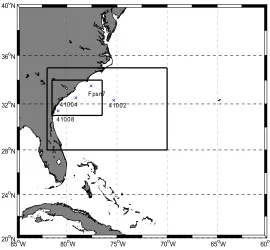
the computational domain and the nesting windows: The outermost domain covers from 200
to 400 North and 850 to 600 West with resolution 12 minute. The mid domain is 280-350N,
820-700W with 4 minute as the spatial grid size. The inner most domain is 310-340N, 81.50
-76.50W with resolution 2 minute. Time step for integration is 6 minutes. Number of
frequencies of waves is 31 (0.04177~1.0 Hz) and directional resolution is 100 (00~3600).
As was indicated in the previous section of this chapter, WAVEWATCH-III doesn’t
perform as well as SWAN wave model does in shallow water areas but does better in deep
water (more efficient than SWAN). Hence, SWAN nested in WAVEWATCH-III run (first
experiment) could be used to study the effect of boundary condition on waves, in which the
mid domain and outermost domain were used. Except this experiment, SWAN nested in
SWAN run was conducted in these three nesting domains to study the effect of spatial
Same as the previous experiments, Hurricane Floyd was also simulated by Holland
hurricane model [Holland, 1980] and Buoy data was employed to compare with model
results. The results of the first nesting run are presented in Fig. 2.9. It shows that the
significant wave height simulated in nesting run (SWAN nested in WAVEWATCH-III) is
closer to WAVEWATCH-III (independent run) result during hurricane not approaching
computational domain; however, it bends to SWAN (independent run) result during
hurricane dominating the domain. The reason is that the wind speed is very small before the
front edge of a hurricane reaches the model domain (due to no background wind field
incorporated in Holland hurricane model) and wave energy is mainly transported from
boundary condition (supplied by the coarse run of WAVEWATCH-III). On the other hand,
wind will play much more important role in wave generation when hurricane effect reaches
the domain due to the large wind speed. Thus, the significant wave height simulated in the
first nesting run is mainly impacted by boundary condition when hurricane effect does not
enter the domain, whereas it will be controlled by wind forces during hurricane approaching
the domain. In other words, boundary conditions have little impact on waves (could be
disregarded) when wind forces are strong in computational domain.
In the second nesting run experiment (SWAN nesting itself), the results are displayed in
Fig. 10. Before describing the results, it is worthwhile to show the difference of the water
depth at buoy stations among gaining from different resolution bathymetry (Table 2.1). It
can be seen that the water depth at buoy data stations is various from grid to grid. Water
m, for innermost it is 17.82 m and actual water depth is 18.0 m. The water depth bias
indicated by table 2.1 is significant among different grids and the bias of outermost is
largest. Hence, the SWH values (Fig. 2.10) computed by the models show that the results of
outermost grid are the worst compared to buoy data, mid grid and innermost grid are better.
Furthermore, the results are improved more obviously from outermost to mid grid than from
mid grid to innermost. It suggests that the effect of bathymetry resolution should be
considered in wave prediction but not necessary to consider too fine grid resolution.
2.5.Discussions and summary
The depth-induced refraction-diffraction process presented in SWAN was tested using
several ideal experiments in this chapter. The results of the beach refraction experiment
indicate that depth-induced refraction has a significant impact on wave propagation; it also
shows a good agreement with analytical result. At the mean time, the influence of
depth-induced diffraction plays an important role in wave propagation and wave height when
waves cross a sub-water channel or ridge in a beach. The results of experiments show that
there is a significant impact on waves if we activating the diffraction option in the SWAN. It
suggests that it is important to consider depth-induced diffraction effect to compute the wave
field in some specific case.
The effect of depth-induced wave breaking is often neglected or not given regard enough
by researchers in their wave simulation. Especially in hurricane cases, there are fewer studies
including breaking term) and WAVEWATCH-III forced by hurricane was conducted in this
chapter. Three hurricane cases and one modified hurricane case were selected as examples to
examine the effect of wave breaking in shallow water area. In most cases, the results in
station FPSN7 are poorer compared with observation data if the effect of wave breaking is
not considered in wave models than the results that include this effect. However, the wave
models exhibit no much different prediction skill at station FPSN7 when the track of
hurricanes passed through its right area. Therefore, depth-induced wave breaking is not
always important in shallow water areas in hurricane-induced wave simulation case. It has
more significant impact on wave field in areas which lies on the right of hurricane than those
lies on the left of hurricane.
The effect of topography resolution on waves is important when bathymetry feature is
complex, which need fine grid to represent it. Otherwise, it is not necessary to pick too fine
grid resolution to compute wave field using nesting run. The effect of boundary condition on
waves depends on the wind conditions, it is significant during weak wind conditions but it
can be disregarded during peak wind conditions. That is to say, waves are mainly determined
by boundary conditions during hurricanes increase phase and hurricanes play the main role in
Table 2.1 The water depth of buoy data stations get from different resolution topography. Where Bias equal water depth get from topography minus actual water depth; ∈=
Bias/actual water depth.
Grid Buoy Data Station Water depth (m) Bias (m) ∈ (%) 41002 3617.06 -168.54 4.45 Outermost 41004 39.00 2.4 6.56 41008 17.20 0.8 4.40 Fpsn-7 19.67 -2.83 12.83
41002 3635.41 -150.19 3.97 Med 41004 38.10 1.5 4.10 41008 17.80 -0.2 1.11 Fpsn-7 21.93 -0.57 2.53
Figure 2.1.Computational domain, distribution of Buoy data stations and the best tracks of hurricane Bonnie, Dennis and Floyd.
-85 -80 -75 -70
25 26 27 28 29 30 31 32 33 34 35
4 k0 3 k 2 k 1 k k 5 10 15 20 25 30 35 40 45 M ea n W a ve D ir e ct io n ( 0) 450 150
45km 35km 25km 15km 5km
60 40 20 0 Wa te r D e p th ( m )
Distance from coast (m)
Figure 2.2.1. a) The mean wave direction along the center line from deep water to coastal line. The asterisk is the analytical solution and lines are results of SWAN. Dashed line is swell wave with peak wave direction 450 and solid line is swell wave with peak wave direction 150. b) Water depth (m) along the center line.
a
45km 35km 25km 15km 5km -0.5 0 0.5 1 M ea n W a ve D ir e ct io n ( 0)
45km 35km 25km 15km 5km
0.9 1 1.1 1.2 S ign W a v e H eig ht ( m )
45km 35km 25km 15km 5km
60 40 20 0 Wa te r D e p th ( m )
Distance from coast (m)
channel-no Beach channel-Dif a b c
45km 35km 25km 15km 5km -4 -2 0 2 M ea n W a ve D ir e ct io n ( 0 )
45km 35km 25km 15km 5km
0.8 1 1.2 1.4 S ign W a v e H eig ht ( m )
45km 35km 25km 15km 5km
60 40 20 0 Wa te r D e p th ( m )
Distance from coastline channel-no Beach channel-Dif a b c
Figure 2.6. The original and shifted track of hurricane Floyd. Dashed line is original track and solid line is the shifted track, which shifted to right 1o.
-85 -80 -75 -70
26 28 30 32 34 36 38
Figure 2.7. SWH at buoy data stations for modified hurricane Floyd by shifting track to right 1o. Dashed line is WWATCH-III results and solid line is buoy data.
0 10 20 30 40 50 60 70 80 90 100 0
5 10
15 a) Floyd SWH Station 41002 (32.27N 75.42W)
W aveW atchIII Swan
0 10 20 30 40 50 60 70 80 90 100 0
5 10
15 b) Floyd SWH Station 41004 (32.50N 79.10W) W aveW atchIII Swan
0 10 20 30 40 50 60 70 80 90 100 0
2 4 6
8 c) Floyd SWH Station 41008 (31.40N 80.87W) W aveW atchIII Swan
0 10 20 30 40 50 60 70 80 90 100 0
2 4 6 8
10 d) Floyd SWH Station Fpsn7 (33.49N 77.59W)
Figure 2.8. The setup of nesting domain. The outermost domain covers from 200 to 400 N and 850 to 600 W with resolution 12 minute. The mid domain is 280-350 N, 820-700W with 4 minute as the spatial grid size. The inner most domain is 310-340N, 81.50-76.50W with resolution 2 minute.
85oW 80oW 75oW 70oW 65oW 60oW
20oN
24oN
28oN
32oN
36oN
40oN
41002 Fpsn7 41004
0 5 10 15 SWH ( m )
a)Floyd SW H 41004(32.50N 79.10W )
BUOY Data Swan(Med) Swan(Inner) Swan(Outer) 0 2 4
6 b)Floyd SW H 41008(31.40N 80.87W )
SW
H
(
m
)
0 10 20 30 40 50 60 70 80 90 100
0 5 10
c)Floyd SW H Fpsn7(33.49N 77.59W )
Time (Hr) SW H ( m )
References
Battjes, J.A. and H.W., Groenendijk, 2000. Wave height distributions on shallow foreshores.
Coastal Eng. 40, 161-182.
Battjes, J.A. and M.J.F. Stive, 1985. Calibration and verification of a dissipation model for
random breaking waves. J.Geophys. Res. 90 (c5), 9159-9167.
Battjes, J.A., J., Janssen, 1978. Energy loss and set-up due to breaking of random waves.
Proc. 16th Int. Conf. Coastal Engg. ASCE, New York, pp. 569-587.
Berkhoff, J.C.W., 1972, Computation of combined refraction-diffraction. Proc. 13th Int.
Conf. Coastal Eng., ASCE 1, 471-490.
Booij, N., Ris, R.C., Hothuijsen, L.H., 1999. A third-generation wave model for coastal
regions: 1. Model description and validation. J. Geophys. Res. 104 (c4), 7649-7666.
Gao, Q., Radder, A.C., 1998. A refraction-diffraction model for irregular waves. Proc. 26th
Int. Conf. Coastal Eng. 1, 366-379.
Hasselmann, K., T.P. Barnett, E. Bouws, H. Carlson, D.E. Cartwright, K. Enke, J.A. Ewing,
Richter, W. Sell and H. Walden, 1973. Measurements of wind-wave growth and swell decay
during the Joint North Sea Wave Project (JONSWAP), Dtsch, Hydrogr.Z. Suppl., 12, A8.
Holland, G.J., 1980. An analytic Model of the wind and pressure profiles in Hurricanes.
Mon. Wea. Rev., 108, 121-1218.
Holthuijsen, L.H., A. Herman and N. Booij, 2003, Phase-decoupled refraction-diffraction for
spectral wave models, Coastal Engineering, 49, 291-305.
Hsu, T.-W., S.-H. Ou and J.-M. Liau, 2005, Hindcasting nearshore wind waves using a FEM
code for SWAN, Coastal Engineering, 52, 177-195.
Ito, Y., tanimoto, K., 1972, A method of numerical analysis of wave propagation-application
to wave diffraction and refraction. Proc. 13th Int. Conf. Coastal Eng., ASCE 1, 503-522.
Li, Y.S. and Zhan, J.M., 2001, Boussinesq-type model with boundary-fitted coordinate
system. J. Waterw., Port, Coast. Ocean Eng., ASCE, New York, 127 (3), 152-160.
Madsen, P.A. and Sørensen, O.R., 1992, A new form of the Boussinesq equations with
improved linear dispersion characteristics: Part2. A slowly-varying bathymetry. Coast. Eng.
Massel, S.R. and M.R. Gourlay, 2000. On the modeling of wave breaking and set-up on coral
reefs. Coastal Eng. 39, 1-27.
Ris, R.C., N. Booij and L.H. Holthuijsen, 1999, A third-generation wave model for coastal
regions, Part II, Verification, J.Geoph.Research C4, 104, 7667-7681.
Rogers, W.E., P.A. Hwang and D.W. Wang, 2003, Investigation of wave growth and decay
in the SWAN model: three regional-scale applications, J. Phys. Oceanogr., 33, 366-389.
SWAN group, 2003. SWAN Cycle III version 40.20 USER MANUAL.
Tolman, H.L., 1991, A third-generation model for wind waves on slowly varying, unsteady
and inhomogeneous depths and currents. J. Phys. Oceanogr., 21, 782-797.
Tolman, H.L., 2002. User manual and system documentation of WAVEWATCH-III version
2.22.
WAMDI group, 1998. The WAM model---a third generation ocean wave prediction model. J.
Phys. Oceanogr., 1775-1810.
Zhao Liuzhi, Vijay Panchang, W. Chen, Z. Demirbilek, N. Chhabbra, 2001. Simulation of
wave breaking effects in two-dimensional elliptic harbor wave models. Coastal Eng. 42,
Zijlema, M. and A.J. van der Westhuysen, 2005, On convergence behaviour and numerical
accuracy in stationary SWAN simulations of nearshore wind wave spectra, Coastal
CHAPTER 3. A NUMERICAL STUDY ON THE EFFECT OF
THE GULF STREAM ON WAVES
3.1.Introduction
The important and interesting fluid mechanical and environmental problem of the effect
of currents on waves has been the subject of significant community interested as reflected in
the many observing programs [e.g., Meadows et al., 1983; Mapp et al., 1985; Liu et al.,
1989] and theoretical studies [e.g., Treloar, 1986; Longuet-Higgins and Stewart, 1961;
Kengyon, 1971; Mathiesen, 1987]. Longuet-Higgins and Stewart [1960, 1961] developed the
theory of conserved wave-current interactions. They introduced radiation stress into the
governing equation. Kengyon [1971] investigated wave refraction in ocean currents by using
the geometrical optics approximation, and discussed the kinematical effects of currents on
waves. Mapp et al. [1985] developed a numerical model for the refraction of ocean swell by
current that was tested with Seasat synthetic aperture radar (SAR) data, in which integration
of the ray equation was applied in a moving medium. In 1987, Mathiesen developed another
model to study wave refraction by a current whirl, which extended the study of Mapp et al.
[1985]. Simons and Maciver [1998] performed experiments with regular deep-water waves
propagating obliquely across a relative narrow jet-type current.
The results of previous studies of current induced changes in wave height and direction
Stream) could be significant. In particular, the trapping of waves in currents and the total
reflection of waves by currents is theoretically possible. Irvine and Tilley [1988] discussed
the trapping of waves by straight and meandering shear currents. Holthuijsen and Tolman
[1991] investigated the effects of the Gulf Stream on surface gravity waves by employing the
WAVEWATCH wave model. Ocean waves were propagated across a current ring and as
well as across an infinitely long and straight northward flowing Gulf Stream from the
northeast (NE) and southeast (SE) directions. The results showed that refraction may trap
locally generated waves in the straight Gulf Stream or it may reflect wave energy back to the
open ocean depend on wind and wave conditions. However, in their research paper, they
didn’t investigate the condition of waves crossing the Gulf Stream from the normal direction.
The Simulating WAves Nearshore, or SWAN [Booij et al., 1999] a wave model that
includes depth induced dissipation and other sophisticated physics has been extensively
studied [Padilla-Hernandez and Monbaliu, 2001; Rogers et al., 2003; Holthuijsen et al., 2003;
Hsu et al., 2005]. However few studies have been focused on investigating the effects of
major currents on waves by employing SWAN. In the study of this chapter we repeat the
Holthuijsen and Tolman [1991] experiment but we use SWAN and we also investigate the
case of normal encounter of the wave field with the Gulf Stream as well as consider the case
of the Hurricane Bonnie induced wave field with an idealized Gulf Stream.
A brief outline of model setups and ideal experiments conducted in this chapter are given
in section 3.2. Section 3.3 presents the results of the ideal experiments to analyze the
introduced in Section 3.4. The comparison between model results and observation data for
the case of Bonnie is given in section 3.5. The last section in this chapter presents the
summary and discussion.
3.2.Setups of wave model and experiments
The computational domain is from 850 to 700 (W) longitudes and from 250 to 350 (N)
latitude with grid resolution 0.20. The water depth is set to 5000 m in order to avoid wave
refraction due to topography. The integration time step is 6 minutes. Wave frequencies range
from 0.04177 to 1.0 Hz and the directional resolution is 10° (00~3600). The current fields
(Gulf Stream) used in ideal experiments of this paper were simulated by X. Liu (personal
communication) using the HYbrid Coordinate Ocean Model, or HYCOM ocean current
model results published in Xie et al. [2006]. In Liu’s study, the Gulf Stream current fields
were simulated in the presence of climatological wind fields (COADS). The Gulf Stream
current field varies slowly in time and the result of the 51st day of the run is selected and
treated constant in time. Figure 3.1a shows the Gulf Stream current field of Day 51 from
Liu’s study.
In order to examine the influence of the Gulf Stream on waves, six ideal experiments
(Table 3.1) are conducted in this chapter. Locally generated wind waves and waves
propagating in as swell propagating in a direction counter to the direction of current
constitute cases NEW and NES. The cases SEW and SES are wind waves and swell
encountering the Gulf Stream from the east are investigated in the cases EW and ES.
Homogeneous and constant wind fields (10 m/s) were set as the wind input term of SWAN in
all of wind waves cases (NEW, SEW and EW). Three directions of the wind fields were
selected: one the NE wind (2250) (case NEW); the SE wind (1350) (case SEW); and the E
wind (1800) (case EW). The set up of the wave swell cases for SWAN are as follows: the
boundary condition is characterized with a Gaussian-shaped frequency energy spectrum; the
width of the Gaussian frequency spectrum is 0.007 Hz; the significant wave height is taken as
1.99 m; peak frequency is 0.071 Hz; peak wave directions are 2250 (NES), 1350 (SES) and
1800 (ES); and the directional width is 12.40. All angles used in this paper assume a Cartesian
convention.
3.3.Results
A single line (Fig. 3.1a) traversing the Gulf Stream was set to sample the wave character
parameters to show the variation in wave fields. The line is from 80.60W to 79.40W
longitudes and the latitude is 30.20N. The profile of the current speed (y direction) along this
line is shown in Fig. 3.1b.
3.3.1.Case NEW
First we consider the results under the NE wind condition. Figure 3.2a shows the