An Efficient Virtual Tour – A Merging of Path Planning and Optimization
Muhammad Shafie Abd. Latiff, and Rohayanti Hassan
Faculty of Computer Science and Information Technology, Universiti Teknologi Malaysia, Johor, Malaysia.
Abstract. Users navigating in virtual environment normally suffers from getting lost and lost of interest. Furthermore in a large and complicated virtual environment, users are tending to plan their path and navigate in an automatic manner. This paper describes the result of a research project aimed to integrate a path-planning optimization-algorithm and produce an efficient tour in a virtual environment. The visitors can simply identify the locations they wish to visit and the system will automatically generate a tour plan and guide the user to walk through the desired locations. The results are presented using a 3D model of several different rooms and booths in a virtual exhibition area. This paper presents to the development of efficient virtual tour that later will contribute to an efficient design of the building or environment and also optimal solution of the path finding. We expect the result of this research project to be used as a new navigation assistance for visitors to plan their tours in a large exhibition area.
Keywords. Path planning, Optimization algorithm, Virtual environment.
1. Introduction
Navigating in virtual environment can either be boring or disorientating. Users are required to move around using keyboard or joystick. The whole design of the building is normally difficult to figure out and the movement control is always cumbersome. The virtual building can be so complicated that it needs not only navigating vertically but horizontally as well. In other words, an animated character is required to move up and down stairs of the building. The complexity now is not only on the environment itself but also on the movement of animated characters.
One of the most relevant usability issues in Virtual Environment (VE) navigation is the navigational support provided by its user interface. In the actual world, we are guided by the sign and arrows (of direction). However, in virtual environment it is limited by its views constraint. Perhaps the visitors have a specific purpose of visits. The system that is able to recommend a tour plan saves their time and distance to travel. Furthermore, they also might accomplish the goal of visits.
Path planning on the other hand provides a good solution for a visitor to plan their visit. Path planning using shortest path algorithm has been adopted in many path finding applications. The solution is that how to get from one location to another location in a shortest distance with obstacles avoidance. However, the visit is not only to go from one location to another one location, but it normally involves touring to more than one site. For this reason, optimization is required. Optimization is meant for minimizing travel time while maximizing the purpose of visit. With this requirement, users will satisfy and enjoy navigating in the virtual environment.
In the next section, we will discuss a related work about guided tours in virtual environment and path planning as well as the optimization algorithm. We explain the problem in Section 3 and our solutions in Section 4. System architecture and implementation will be described in Section 5. Finally in the last section, we conclude with improvements of future research plans.
2. Related Works
2.1. Guided tours and virtual environment (VE)
Surveys on the functions of current guided-touring systems in popular museums and parks show that most visitors use these systems to acquire site information such as how to visit all popular points without wasting time wandering around. Virtual Environment is a candidate technology that can add realistic visualization into such systems.
VE is a virtual world that potential to immerse the user. The more a VE looks like the real world, the more immersed the user feels. Fang et al. (1998) conceived that an immerse VE needed not only lifelike static objects buildings, furniture, mountains, but vivid lives should be also provided in a VE, such as plants, animals and even humans.
In the past few years, layered architecture has been presented for supporting the integration of deliberation and reaction of Artificial Intelligence (AI). Fang et al. (1998) also found out to solve planning between two and more layers. Nevertheless, new problems have appeared with the company of this architecture, such as the inconsistencies among the layers.
virtual theater as their case study and found out some design principles for navigation assistance in virtual environment and some design criteria for assistance by personal agents.
Inefficient or inappropriate cues may also result visitors of a virtual world in encountering situations where they will not be able to rely on navigation skills acquired in the real world. Nash et al. (2000) mentioned some navigation problems like disorientation, loss of overview, difficulty to return to a location previously visited or to revisit an object found before. As a consequence visitors become frustrated and unsatisfied.
There are many research which focused on various aspects of Virtual Environment. There are research that investigates the effect of navigation speed on the level of cyber sickness. The least occurrence of cyber sickness leads to the best tour navigation (So et al., 2001). The costs and benefits of using 3D virtual environments for on-line shops also have been discussed. E-commerce design guidelines are followed to build more usable and effective Virtual Stores, (Howes et al., 2001). On the other hand, Rocceti et al. (2001) proposed the general organization of a simulation-based Multimedia Learning Environment that enables collaborative educational activities.
2.2. Path planning
Path planning algorithm is also used as a geometric solution for a synthetic actor to find the shortest path from one location to another. There have been many researches that try to provide various forms of guidance to a user in a virtual environment. It is highly desirable for a VE system to generate guided tours automatically for its users. The generated tour plans should be able to take a user through all desired locations without colliding with obstacles in the environment.
In the Robotics literature, the problem of planning a collision free path for a moving object is called “Piano Mover’s Problem”. Although the problem is theoretically difficult, it is possible to develop algorithms that run efficiently most of time on most real-life examples (Latombe, 1990). Meanwhile, researches have shown that A* algorithm is guaranteed to find the minimal path from start location to the goal, if such a path exists.
Considerable work has been carried out on methods for finding a free path. For example, Lavalle (1995) uses a game-theoretic framework for path planning. Bandi and Thalman (1998) divide the space into a 3D grid of uniform cells. Then, with the A* algorithm, a roadmap approach, the shortest path from x to y is computed.
Another field of research was camera path planning which focus on how to obtain the finest camera views with certain manners. Drucker and Zeltzer (1994) model the methods used by a film director, logic-based constraints are defined which govern good views on the scene. With this information optimal camera positions are calculated, and with the A* algorithm a path is generated. Li et al. (1999) also investigate a motion planning algorithms to generate collision free paths for the virtual camera and the tour guide. Then a year later he developed a system that is capable of producing collision-free motions with flocking behavior in an avatar group (Li et al., 2000).
The difficulties in determining an optimal traversing sequence lies with the unknown distances between locations and the large number of possible traversing orders in general. Li et al. (2000) proposed greedy approach to overcome these difficulties, which traverses on a skeleton (discrete Voronoi Diagram). Pang et al. (2002) also studied on solving the path optimization problem. They focused on path planning optimization in Layered Manufacturing (LM) using Genetic Algorithm and implement new strategy using a combination of the Asymmetric Traveling Salesman Problem and Integer Problem.
3. Problem Description
It still remains a great challenge to simulate an animated character with planning capabilities. Generally, the animated character should be able to guide and propose the optimal tour based on visitor’s requirement. Meanwhile the main focus is to determine the path is genuinely optimal for a visitor and it has to keep a safe distance from the obstacles (avoid colliding). There are some requirements or parameters to be considered to generate the collision-free optimal-path such as time, distance and priority.
Chittaro et al. (2001) mentioned that VE based on architectural metaphors is very useful to visualize abstract information in 3D model of cities or buildings. Usually, inadequate information during user navigation causes them to leave the virtual world before they reach their targets of interest. As a consequence, users feel they have not adequately explored the world.
An inefficient and inappropriate architecture of the virtual world also leads the visitor to suffer from well-known navigation problem such as path finding. Improper navigation aids also cause visitors to become disoriented and tend to get lost. The lack of navigation cues or signs also cause visitors difficulty in finding their desired locations. As a result visitors may be unsatisfied with the tour visit, feeling that they had inadequately explored the virtual exhibition.
4. Approach and Methods
We propose the use of a simple animated character as the guided tour in 3D exhibition. We adopt VE technology so that the visitor could enjoy the tour like in the real world. This paper will describe some algorithms and discuss some features to be considered before designing the world in producing an efficient virtual tour in exhibition area. The system will be able to plan and generate the optimum sequence of visits based on visitor’s requirement. This research is still ongoing.
5. System Architecture and Implementation
Figure 1. System Architecture of virtual tour
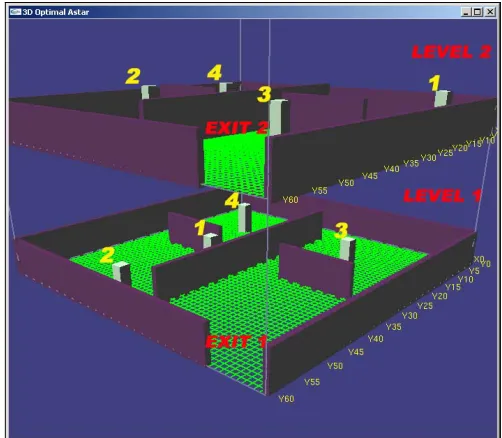
Figure 1 shows the generic architecture for a system designer to produce a virtual tour simulation. The main output from the system is a list of direction or a list of transformation for the movement of animated characters in virtual world by Path Planner based on the user’s input. Path Planner is the path generator as a result from the merging of path finding and optimization algorithm. A user is required to enter the coordinates of nodes to visit from the console. Nodes are referred as booths, rooms or point of interests in a virtual environment for the animated character to visit. The nodes entered become an input to a path planner. An algorithm used in path searching and optimization component can be altered to any other algorithm. Meanwhile, we used A* algorithm as a search technique and Prim algorithm as an optimization method. Figure 2 shows the input console by the user. Figure 3 shows the exact locations of nodes to visit in a virtual environment.
Figure 2. User’s input console
Figure 3. Nodes or locations to visit
Figure 4 shows the round tour of animated characters as the result of the user’s input. Based on the user’s input, node 1 at Level 1 was the first node to visit and path planner suggests that the tour starts at Level 1, from node 1 to node 2, node 2 to node 4, node 4 to node 3 and finally proceed to Exit 1. Animated character then will go up to Level 2 and move from Exit 2 and straight to the nearest node which is node 3, later on continue from node 3 to node 1, node 1 to node 4 and finally end up from node 4 to node 2.
Console Path Planner Optimization
Algorithm
Search Algorithm User
Figure 4. Optimal tour
Now u’re at Node 1 (35,35)
Next destination is Node 2 at (35,55). Distance: 35 Next destination is Node 3 at (15,20). Distance: 96 Next destination is Node 4 at (45,15). Distance: 73 So you should go to Node 2 at (35,55)
Now u’re atNode 2 (35,55)
Next destination is Node 3 at (15,20). Distance: 86 Next destination is Node 4 at (45,15). Distance: 80 So you should go to Node 4 at (45,15)
Now u’re at Node 4 (45,15)
Next destination is Node 3 at (15,20). Distance: 72 So you should go to Node 3 at (15,20)
Then u straight to EXIT 1.
Suggested tour at LEVEL 1: 1->2->4->3 Total distance: 265
From EXIT 2.
Now u’re at Node 3 (15,40)
Next destination is Node 1 at (5,10). Distance: 62 Next destination is Node 2 at (50,35). Distance: 90 Next destination is Node 4 at (45,20). Distance: 115 So you should go to Node 1 at (5,10)
Now u’re at Node 1 (5,10)
Next destination is Node 2 at (50,35). Distance: 127 Next destination is Node 4 at (45,20). Distance: 85 So you should go to Node 4 at (45,20)
Now u’re at Node 4 (45,20)
Next destination is Node 2 at (50,35). Distance: 43 So you should go to Node 2 at (50,35)
Final at Node 2 (50,35). You have completed tour. Suggested tour at LEVEL 2: 3->1->4->2
Total distance: 232
The result shows that the path generated is collision free with static obstacles i.e. walls. The algorithm running in the off-line process and is not able to avoid a real time obstacle such as another animated character or other moving object.
6. Conclusions and Future Work
7. References
Abd Latiff, M.S. (2001). Action recognition and motion planning for synthetic actors in virtual environment. PhD thesis, University of Bradford.
Bandi, S., & Thalmann, D. (1998). Space discretization for efficient human navigation. Proceeding of Eurographics, vol 17 (pp. 195-206).
Chittaro, L., & Scagnetto, I. (2001). Is semitransparency useful for navigating virtual environments. Proceedings of VRST ’01. Banf, Alberta, Canada.
Dijk, B.V., Akker, R., Nijholt, A., & Zwiers, J. (2003). Navigation assistance in virtual worlds. Special Series on Community Informatics, Informing Science Journal, 6. Drucker, S.M., & Zeltzer, D. (1994). Intelligent camera
control in a virtual environment. Proceeding of Graphics Interface (pp. 190-199). Canada: Canadian Information Processing Society.
Fang, W., & Mckenzie, E. (1998). Virtual life in virtual environments (Technical Report ECS-CSG-44-98). Edinburg: Department of Computer Science, University of Edinburg.
Howes, A., Miles, G.E., Payne, S.J., Mitchell, C.D., & Davies, A.J. (2001). Incidental memory and navigation in panoramic virtual reality for electronic commerce. Human Factors in ProQuest Science Journals, 43(2), 329.
Latombe, J.C. (1990). Robot motion planning. Kluwer Publishing.
Lavalle, S.M. (1995). A game-theoretic framework for robot motion planning. PhD thesis, University of Illinois at Urbana-Champaign, Illinois.
Li, T.Y., Lien, J.M., Chiu, S.Y., & Yu, T.H. (1999). Automatically generating virtual guided tours. Proceedings of the Computer Animation '99 (pp. 99-106). Geneva, Switzerland.
Li, T.Y., Lin, J.W., Liu, Y.L., & Hsu, C.M. (2000). Interactively directing virtual crowds in a virtual environment. Proceedings of the Tenth International Conference on Artificial Reality and Tele-existance. Nash, E.B., Edwards, G.W., Thompson, J.A., & Barfield, W.
(2000). A review of presence and performance in virtual environments. International Journal of Human-Computer Interaction, 12, 1-41.
Pang, K.W., Murty, K.G., Joneja, A., & Chiu, L.C. (2002). Tool path optimization in layered manufacturing. IEEE Transactions, ABI/INFORM Global, 34(4), 335.
Roccetti, M., Salomoni, P., & Bonfigli, M.E. (2001). A design for a simulation based multimedia learning environment. Simulations in ProQuest Science Journals, 76(4), 214. So, R.H.Y., Lo, W.T., & Ho, Andy T.K. (2001). Effects of
navigation speed on motion sickness caused by an immersive virtual environment. Human Factors in ProQuest Science Journals, 43(3), 452.